
Sample Size Calculations
Akmal Samsor
asamsor@jscs.af
Session Objectives
At the end of the session the participants will be
able to :
• Understand the formula used to calculate
sample size for a research study
• Understand the use of online sample size
calculators
• Understand the sample size calculation for a
finite population
• Understand the sample size calculation for
qualitative studies
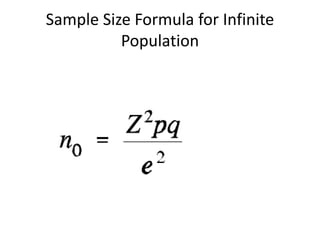
Sample Size Formula for Infinite
Population
• e= level of precision or sampling error
Z = confidence level
p or q (1-p)= degree of variability
Modify the sample size by adding
• Design effect which is usually 2 or 1.5.
Multiply the final sample size with 1.5 and
then add it to the sample size.
• Non response rate (usually 10%), calculate
10% of the sample size and then add it to the
sample size to get final sample size.
• Final Sample Size= Sample Size + Design Effect
+ Non Response Rate
Group Work
• Lets form 6 groups and then each group calculate
the sample size for the below mentioned
research studies ?
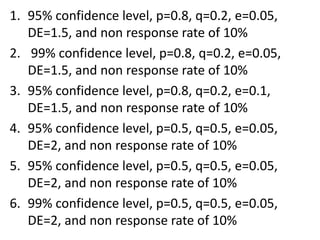
1. 95% confidence level, p=0.8, q=0.2, e=0.05,
DE=1.5, and non response rate of 10%
2. 99% confidence level, p=0.8, q=0.2, e=0.05,
DE=1.5, and non response rate of 10%
3. 95% confidence level, p=0.8, q=0.2, e=0.1,
DE=1.5, and non response rate of 10%
4. 95% confidence level, p=0.5, q=0.5, e=0.05,
DE=2, and non response rate of 10%
5. 95% confidence level, p=0.5, q=0.5, e=0.05,
DE=2, and non response rate of 10%
6. 99% confidence level, p=0.5, q=0.5, e=0.05,
DE=2, and non response rate of 10%
Online Sample Size Calculators
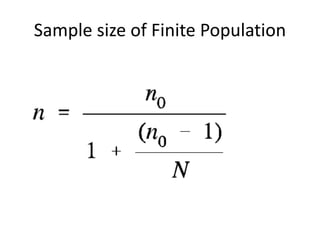
Sample size of Finite Population
Qualitative Sample Size Calculation
• Method for calculation of sample size not
clear
• Saturation level is the key
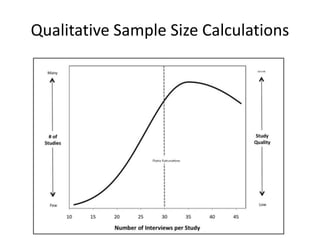
Qualitative Sample Size Calculations
Qualitative Sample Size Calculation
• But when do we reach a saturation level ?
• Some rules that are used in qualitative sample
size calculation :
– Key Informant Interviews (KII) per group=5
– In-Depth Interviews per group =30
– Focus Groups Discussion (FGDs) per group= 1
• Usually with the above mentioned sample size
saturation level is obtained.
Thank You
Questions/Comments ?

Sample Size Calculation for Quantitive and Qualitative Studies

  • 1.
    Sample Size Calculations AkmalSamsor asamsor@jscs.af
  • 2.
    Session Objectives At theend of the session the participants will be able to : • Understand the formula used to calculate sample size for a research study • Understand the use of online sample size calculators • Understand the sample size calculation for a finite population • Understand the sample size calculation for qualitative studies
  • 3.
    Sample Size Formulafor Infinite Population
  • 4.
    • e= levelof precision or sampling error Z = confidence level p or q (1-p)= degree of variability
  • 5.
    Modify the samplesize by adding • Design effect which is usually 2 or 1.5. Multiply the final sample size with 1.5 and then add it to the sample size. • Non response rate (usually 10%), calculate 10% of the sample size and then add it to the sample size to get final sample size. • Final Sample Size= Sample Size + Design Effect + Non Response Rate
  • 6.
    Group Work • Letsform 6 groups and then each group calculate the sample size for the below mentioned research studies ?
  • 7.
    1. 95% confidencelevel, p=0.8, q=0.2, e=0.05, DE=1.5, and non response rate of 10% 2. 99% confidence level, p=0.8, q=0.2, e=0.05, DE=1.5, and non response rate of 10% 3. 95% confidence level, p=0.8, q=0.2, e=0.1, DE=1.5, and non response rate of 10% 4. 95% confidence level, p=0.5, q=0.5, e=0.05, DE=2, and non response rate of 10% 5. 95% confidence level, p=0.5, q=0.5, e=0.05, DE=2, and non response rate of 10% 6. 99% confidence level, p=0.5, q=0.5, e=0.05, DE=2, and non response rate of 10%
  • 8.
    Online Sample SizeCalculators
  • 9.
    Sample size ofFinite Population
  • 10.
    Qualitative Sample SizeCalculation • Method for calculation of sample size not clear • Saturation level is the key
  • 11.
  • 12.
    Qualitative Sample SizeCalculation • But when do we reach a saturation level ? • Some rules that are used in qualitative sample size calculation : – Key Informant Interviews (KII) per group=5 – In-Depth Interviews per group =30 – Focus Groups Discussion (FGDs) per group= 1 • Usually with the above mentioned sample size saturation level is obtained.
  • 13.