(PAGE # 1) PREPARED BY: MUHAMMAD MEMON
SAMPLING DISTRIBUTION
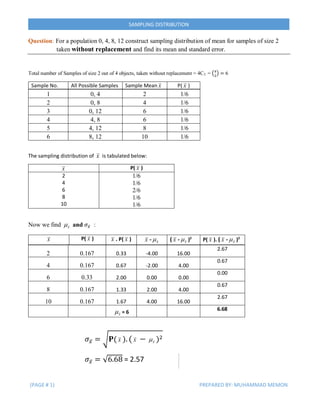
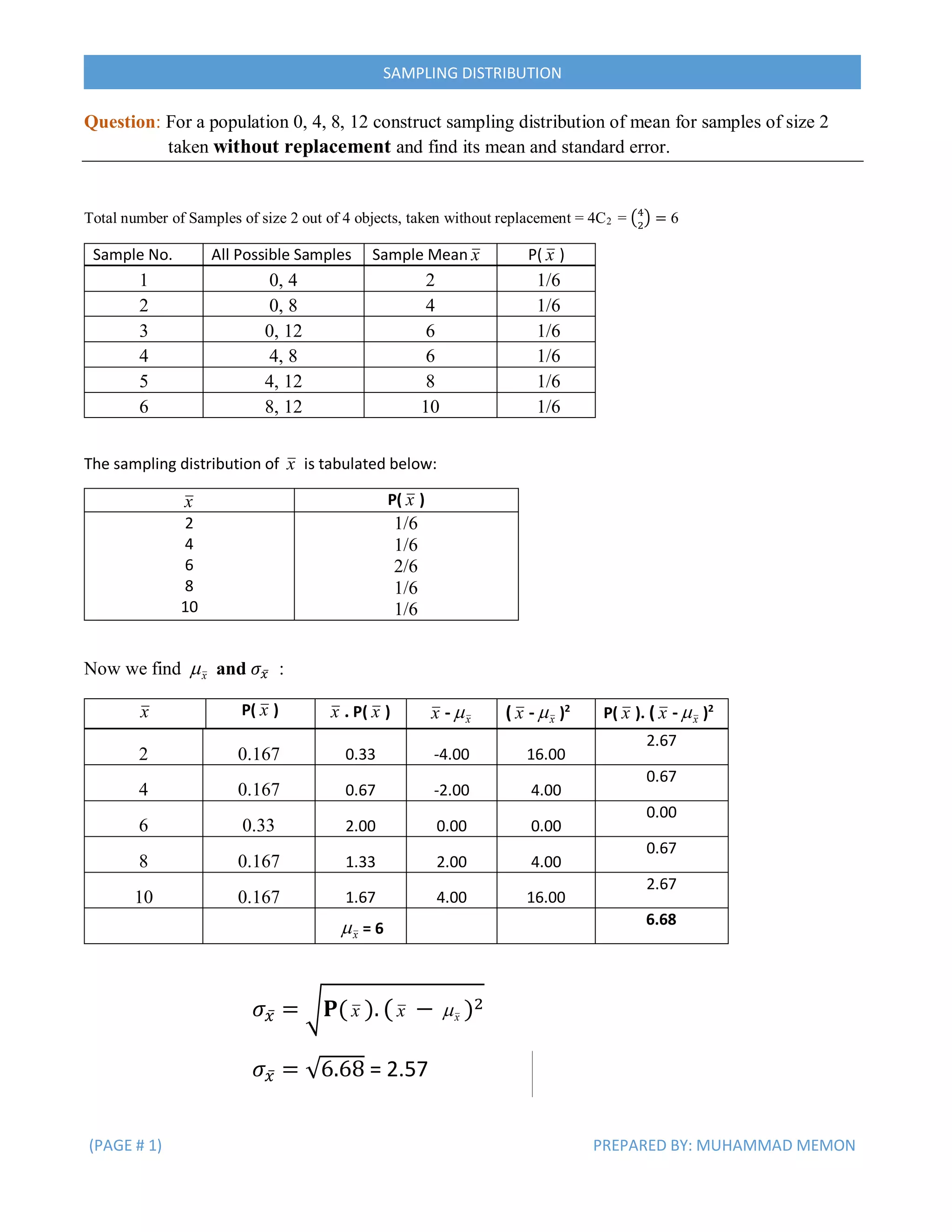
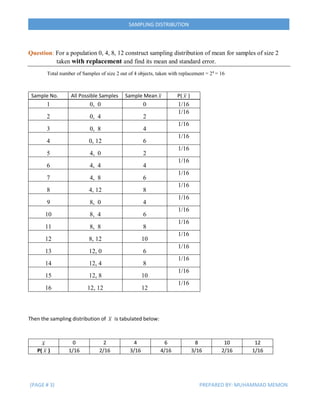
Question: For a population 0, 4, 8, 12 construct sampling distribution of mean for samples of size 2
taken without replacement and find its mean and standard error.
Total number of Samples of size 2 out of 4 objects, taken without replacement = 4C2 = (4
2
) = 6
Sample No. All Possible Samples Sample Mean x P( x )
The sampling distribution of x is tabulated below:
x P( x )
2
4
6
8
10
1/6
1/6
2/6
1/6
1/6
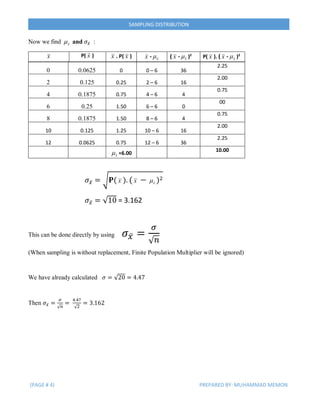
Now we find x and 𝜎𝑥̅ :
x P( x ) x . P( x ) x - x ( x - x )2
P( x ). ( x - x )2
2 0.167 0.33 -4.00 16.00
2.67
4 0.167 0.67 -2.00 4.00
0.67
6 0.33 2.00 0.00 0.00
0.00
8 0.167 1.33 2.00 4.00
0.67
10 0.167 1.67 4.00 16.00
2.67
x = 6
6.68
𝜎𝑥̅ = √ 𝐏( x ). ( x − x )2
𝜎𝑥̅ = √6.68 = 2.57
1 0, 4 2 1/6
2 0, 8 4 1/6
3 0, 12 6 1/6
4 4, 8 6 1/6
5 4, 12 8 1/6
6 8, 12 10 1/6
(PAGE # 2) PREPARED BY: MUHAMMAD MEMON
SAMPLING DISTRIBUTION
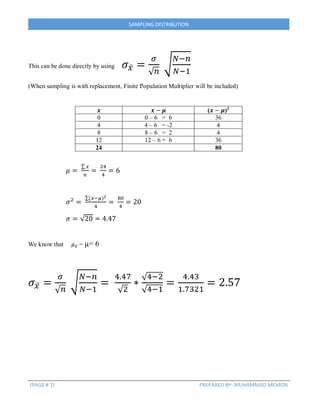
This can be done directly by using 𝜎 𝑥̅ =
𝜎
√ 𝑛
√
𝑁−𝑛
𝑁−1
(When sampling is with replacement, Finite Population Multiplier will be included)
𝒙 𝒙 − 𝝁 (𝒙 − 𝝁)2
0 0 – 6 = 6 36
4 4 – 6 = -2 4
8 8 – 6 = 2 4
12 12 – 6 = 6 36
24 80
𝜇 =
∑ 𝑥
𝑛
=
24
4
= 6
𝜎2
=
∑(𝑥−𝜇)2
4
=
80
4
= 20
𝜎 = √20 = 4.47
We know that 𝜇 𝑥̅ = µ= 6
𝜎 𝑥̅ =
𝜎
√ 𝑛
√
𝑁−𝑛
𝑁−1
=
4.47
√2
∗
√4−2
√4−1
=
4.43
1.7321
= 2.57
(PAGE # 3) PREPARED BY: MUHAMMAD MEMON
SAMPLING DISTRIBUTION
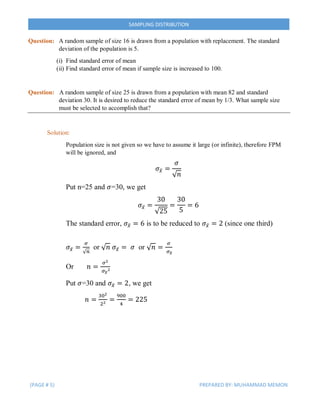
Question: For a population 0, 4, 8, 12 construct sampling distribution of mean for samples of size 2
taken with replacement and find its mean and standard error.
Total number of Samples of size 2 out of 4 objects, taken with replacement = 24
= 16
Sample No. All Possible Samples Sample Mean x P( x )
1 0, 0 0 1/16
2 0, 4 2
1/16
3 0, 8 4
1/16
4 0, 12 6
1/16
5 4, 0 2
1/16
6 4, 4 4
1/16
7 4, 8 6
1/16
8 4, 12 8
1/16
9 8, 0 4
1/16
10 8, 4 6
1/16
11 8, 8 8
1/16
12 8, 12 10
1/16
13 12, 0 6
1/16
14 12, 4 8
1/16
15 12, 8 10
1/16
16 12, 12 12
1/16
Then the sampling distribution of x is tabulated below:
x 0 2 4 6 8 10 12
P( x ) 1/16 2/16 3/16 4/16 3/16 2/16 1/16
(PAGE # 4) PREPARED BY: MUHAMMAD MEMON
SAMPLING DISTRIBUTION
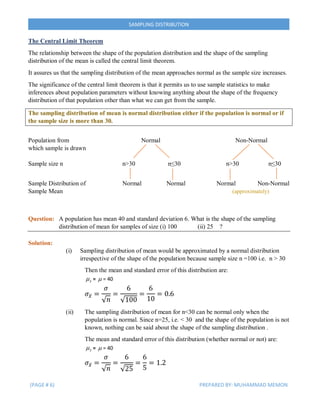
Now we find x and 𝜎𝑥̅ :
x P( x ) x . P( x ) x - x ( x - x )2
P( x ). ( x - x )2
0 0.0625 0 0 – 6 36
2.25
2 0.125 0.25 2 – 6 16
2.00
4 0.1875 0.75 4 – 6 4
0.75
6 0.25 1.50 6 – 6 0
00
8 0.1875 1.50 8 – 6 4
0.75
10 0.125 1.25 10 – 6 16
2.00
12 0.0625 0.75 12 – 6 36
2.25
x =6.00
10.00
𝜎𝑥̅ = √ 𝐏( x ). ( x − x )2
𝜎𝑥̅ = √10 = 3.162
This can be done directly by using 𝜎 𝑥̅ =
𝜎
√ 𝑛
(When sampling is without replacement, Finite Population Multiplier will be ignored)
We have already calculated 𝜎 = √20 = 4.47
Then 𝜎𝑥̅ =
𝜎
√ 𝑛
=
4.47
√2
= 3.162
(PAGE # 5) PREPARED BY: MUHAMMAD MEMON
SAMPLING DISTRIBUTION
Question: A random sample of size 16 is drawn from a population with replacement. The standard
deviation of the population is 5.
(i) Find standard error of mean
(ii) Find standard error of mean if sample size is increased to 100.
Question: A random sample of size 25 is drawn from a population with mean 82 and standard
deviation 30. It is desired to reduce the standard error of mean by 1/3. What sample size
must be selected to accomplish that?
Solution:
Population size is not given so we have to assume it large (or infinite), therefore FPM
will be ignored, and
𝜎𝑥̅ =
𝜎
√ 𝑛
Put n=25 and 𝜎=30, we get
𝜎𝑥̅ =
30
√25
=
30
5
= 6
The standard error, 𝜎𝑥̅ = 6 is to be reduced to 𝜎𝑥̅ = 2 (since one third)
𝜎𝑥̅ =
𝜎
√ 𝑛
or √ 𝑛 𝜎𝑥̅ = 𝜎 or √ 𝑛 =
𝜎
𝜎 𝑥̅
Or 𝑛 =
𝜎2
𝜎 𝑥̅
2
Put 𝜎=30 and 𝜎𝑥̅ = 2, we get
𝑛 =
302
22
=
900
4
= 225
(PAGE # 6) PREPARED BY: MUHAMMAD MEMON
SAMPLING DISTRIBUTION
The Central Limit Theorem
The relationship between the shape of the population distribution and the shape of the sampling
distribution of the mean is called the central limit theorem.
It assures us that the sampling distribution of the mean approaches normal as the sample size increases.
The significance of the central limit theorem is that it permits us to use sample statistics to make
inferences about population parameters without knowing anything about the shape of the frequency
distribution of that population other than what we can get from the sample.
The sampling distribution of mean is normal distribution either if the population is normal or if
the sample size is more than 30.
Population from Normal Non-Normal
which sample is drawn
Sample size n n>30 n≤30 n>30 n≤30
Sample Distribution of Normal Normal Normal Non-Normal
Sample Mean (approximately)
Question: A population has mean 40 and standard deviation 6. What is the shape of the sampling
distribution of mean for samples of size (i) 100 (ii) 25 ?
Solution:
(i) Sampling distribution of mean would be approximated by a normal distribution
irrespective of the shape of the population because sample size n =100 i.e. n > 30
Then the mean and standard error of this distribution are:
x =  = 40
𝜎𝑥̅ =
𝜎
√ 𝑛
=
6
√100
=
6
10
= 0.6
(ii) The sampling distribution of mean for n<30 can be normal only when the
population is normal. Since n=25, i.e. < 30 and the shape of the population is not
known, nothing can be said about the shape of the sampling distribution .
The mean and standard error of this distribution (whether normal or not) are:
x =  = 40
𝜎𝑥̅ =
𝜎
√ 𝑛
=
6
√25
=
6
5
= 1.2
(PAGE # 7) PREPARED BY: MUHAMMAD MEMON
SAMPLING DISTRIBUTION
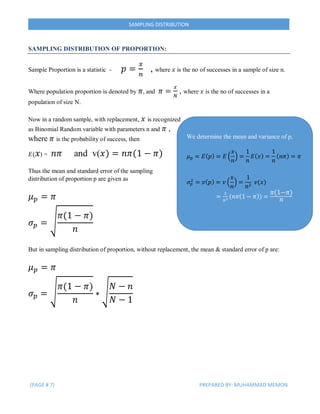
SAMPLING DISTRIBUTION OF PROPORTION:
Sample Proportion is a statistic - 𝑝 =
𝑥
𝑛
, where 𝑥 is the no of successes in a sample of size n.
Where population proportion is denoted by 𝜋, and 𝜋 =
𝑥
𝑁
, where 𝑥 is the no of successes in a
population of size N.
Now in a random sample, with replacement, 𝑥 is recognized
as Binomial Random variable with parameters n and 𝜋 ,
where 𝜋 is the probability of success, then
𝐸( 𝑥) = 𝑛𝜋 and v(𝑥) = 𝑛𝜋(1 − 𝜋)
Thus the mean and standard error of the sampling
distribution of proportion p are given as
𝜇 𝑝 = 𝜋
𝜎 𝑝 = √
𝜋(1 − 𝜋)
𝑛
But in sampling distribution of proportion, without replacement, the mean & standard error of p are:
𝜇 𝑝 = 𝜋
𝜎 𝑝 = √
𝜋(1 − 𝜋)
𝑛
∗ √
𝑁 − 𝑛
𝑁 − 1
We determine the mean and variance of p,
𝜇 𝑝 = 𝐸( 𝑝) = 𝐸 (
𝑥
𝑛
) =
1
𝑛
𝐸( 𝑥) =
1
𝑛
( 𝑛𝜋) = 𝜋
𝜎 𝑝
2
= 𝑣( 𝑝) = 𝑣 (
𝑥
𝑛
) =
1
𝑛2
𝑣(𝑥)
=
1
𝑛2 (𝑛𝜋(1 − 𝜋)) =
𝜋(1−𝜋)
𝑛
(PAGE # 8) PREPARED BY: MUHAMMAD MEMON
SAMPLING DISTRIBUTION
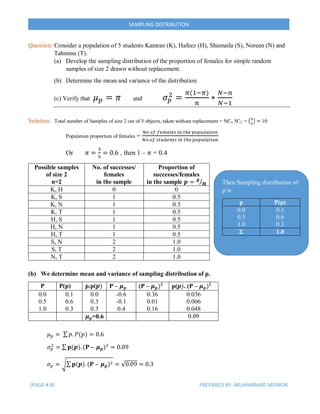
Question: Consider a population of 5 students Kamran (K), Hafeez (H), Shumaila (S), Noreen (N) and
Tahmina (T).
(a) Develop the sampling distribution of the proportion of females for simple random
samples of size 2 drawn without replacement.
(b) Determine the mean and variance of the distribution
(c) Verify that 𝜇 𝑝 = 𝜋 and 𝜎 𝑝
2
=
𝜋(1−𝜋)
𝑛
∗
𝑁−𝑛
𝑁−1
Solution: Total number of Samples of size 2 out of 5 objects, taken without replacement = NCn 5C2 = (5
2
) = 10
Population proportion of females =
𝑁𝑜 𝑜𝑓 𝑓𝑒𝑚𝑎𝑙𝑒𝑠 𝑖𝑛 𝑡ℎ𝑒 𝑝𝑜𝑝𝑢𝑙𝑎𝑡𝑖𝑜𝑛
𝑁𝑜.𝑜𝑓 𝑠𝑡𝑢𝑑𝑒𝑛𝑡𝑠 𝑖𝑛 𝑡ℎ𝑒 𝑝𝑜𝑝𝑢𝑙𝑎𝑡𝑖𝑜𝑛
Or 𝜋 =
3
5
= 0.6 , then 1 – 𝜋 = 0.4
(b) We determine mean and variance of sampling distribution of p.
P P(p) p.p(𝒑) P – 𝝁 𝒑 (P – 𝝁 𝒑)2
p(𝒑). (P – 𝝁 𝒑)2
0.0
0.5
1.0
0.1
0.6
0.3
0.0
0.3
0.3
-0.6
-0.1
0.4
0.36
0.01
0.16
0.036
0.006
0.048
𝝁 𝒑=0.6 0.09
𝜇 𝑝 = ∑ 𝑝. 𝑃(𝑝) = 0.6
𝜎 𝑝
2
= ∑ 𝐩(𝒑). (𝐏 – 𝝁 𝒑)2
= 0.09
𝜎 𝑝 = √∑ 𝐩(𝒑). (𝐏 – 𝝁 𝒑)2 = √0.09 = 0.3
Possible samples
of size 2
n=2
No. of successes/
females
in the sample
Proportion of
successes/females
in the sample 𝒑 = 𝒙
𝒏⁄
K, H 0 0
K, S 1 0.5
K, N 1 0.5
K, T 1 0.5
H, S 1 0.5
H, N 1 0.5
H, T 1 0.5
S, N 2 1.0
S, T 2 1.0
N, T 2 1.0
Then Sampling distribution of
p is
p P(p)
0.0
0.5
1.0
0.1
0.6
0.3
Σ 1.0
(PAGE # 9) PREPARED BY: MUHAMMAD MEMON
SAMPLING DISTRIBUTION
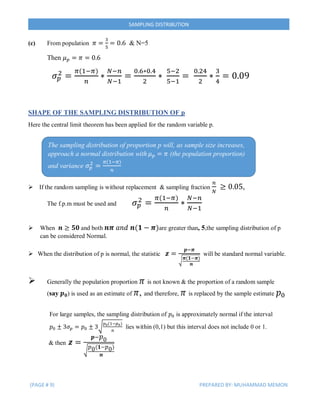
(c) From population 𝜋 =
3
5
= 0.6 & N=5
Then 𝜇 𝑝 = 𝜋 = 0.6
𝜎 𝑝
2 =
𝜋(1−𝜋)
𝑛
∗
𝑁−𝑛
𝑁−1
=
0.6∗0.4
2
∗
5−2
5−1
=
0.24
2
∗
3
4
= 0.09
SHAPE OF THE SAMPLING DISTRIBUTION OF p
Here the central limit theorem has been applied for the random variable p.
 If the random sampling is without replacement & sampling fraction
𝑛
𝑁
≥ 0.05,
The f.p.m must be used and 𝜎 𝑝
2
=
𝜋(1−𝜋)
𝑛
∗
𝑁−𝑛
𝑁−1
 When 𝒏 ≥ 𝟓𝟎 and both 𝒏𝝅 𝑎𝑛𝑑 𝒏(𝟏 − 𝝅)are greater than, 5,the sampling distribution of p
can be considered Normal.
 When the distribution of p is normal, the statistic 𝒛 =
𝒑−𝝅
√ 𝝅(𝟏−𝝅)
𝒏
will be standard normal variable.
 Generally the population proportion 𝜋 is not known & the proportion of a random sample
(say 𝒑 𝟎) is used as an estimate of 𝜋, and therefore, 𝜋 is replaced by the sample estimate 𝑝0
For large samples, the sampling distribution of 𝑝0 is approximately normal if the interval
𝑝0 ± 3𝜎 𝑝 = 𝑝0 ± 3√
𝑝0(1−𝑝0)
𝑛
lies within (0,1) but this interval does not include 0 or 1.
& then 𝒛 =
𝒑− 𝑝0
√
𝑝0(𝟏− 𝑝0)
𝒏
The sampling distribution of proportion p will, as sample size increases,
approach a normal distribution with 𝜇 𝑝 = 𝜋 (the population proportion)
and variance 𝜎 𝑝
2
=
𝜋(1−𝜋)
𝑛
(PAGE # 10) PREPARED BY: MUHAMMAD MEMON
SAMPLING DISTRIBUTION
Question: A company employs 2000 persons, 600 of whom are post-graduates.
(i) Specify completely the sampling distribution of proportion of post-
graduates for samples of size 50 drawn without replacement.
(ii) Find the probability of selection a sample whose proportion of post-
graduates is greater than 0.4.
Solution:
(i) The population proportion of post-graduates is 𝜋 =
600
2000
= 0.3
Since 𝒏 ≥ 𝟓𝟎 & 𝒏𝝅 = 50 ∗ 0.3 = 15 ; 𝒏( 𝟏 − 𝝅) = 𝟓𝟎 ∗ 𝟎. 𝟕 = 𝟑𝟓
are both greater than 5, the sampling distribution of sample proportion may be
considered normal with parameters
𝜇 𝑝 = 𝜋 = 0.3 [Since
𝑛
𝑁
=
50
2000
< 0.05 therefore f.p.m will be ignored.]
𝜎 𝑝
2
=
𝜋(1−𝜋)
𝑛
=
0.3∗0.7
50
= 0.0042
(ii) Since the sampling distribution of p has been determined as normal, therefore z-
transformation is used to find probabilities.
𝒛 =
𝒑 − 𝝅
√ 𝝅(𝟏 − 𝝅)
𝒏
=
𝟎. 𝟒 − 𝟎. 𝟑
√𝟎. 𝟎𝟎𝟒𝟐
= 𝟏. 𝟓𝟒
P(𝒑 > 𝟎. 𝟒) = 𝑷(𝒛 > 𝟏. 𝟓𝟒)
= 0.5 − 𝑃(0 ≤ 𝑧 ≤ 1.54)
= 0.5 − 0.4382 = 0.0618
(PAGE # 11) PREPARED BY: MUHAMMAD MEMON
SAMPLING DISTRIBUTION
Question: A cigarette manufacture has conducted a survey to estimate the proportion of
smokers who smoke his brand. 313 out of a random sample of 1000 smokers were
found to smoke the manufacturer’s brand. What is the probability that the proportion
of smokers using manufacturer’s brand is less than 0.35 ?
Solution: Estimated population proportion = 𝑝0 = 𝜋 =
313
1000
= 0.313
Required: P(𝑝 < 0.35)
We check to determine whether the sample size is large enough to use the normal
approximation for the sampling distribution of p. The criterion is tested by the interval
𝑝0 ± 3𝜎 𝑝 = 𝑝0 ± 3√
𝑝0(1 − 𝑝0)
𝑛
= 0.313 ± 3√
0.313 ∗ 0.678
1000
= 0.313 ± 0.043992
Or (0.269, 0.357), Since the interval lies within the interval (0, 1), the normal
approximation will be adequate.
For p=0.35, we calculate z value
z =
p − p0
√
p0(1 − p0)
n
=
0.35 − 0.313
√0.313 ∗ 0.687
1000
=
0.037
0.01466
= 2.52
Therefore,
P(𝑝 < 0.35) = 𝑃(−∞ ≤ 𝑝 ≤ 0.35) = 𝑃(−∞ ≤ 𝑧 ≤ 2.52)
=𝑃(−∞ ≤ 𝑧 ≤ 0) + 𝑃(0 ≤ 𝑧 ≤ 2.52)
=0.5 + 𝑃(0 ≤ 𝑧 ≤ 2.52)
= 0.5 + 0.4941
= 0.9941

Sampling Distribution -I

  • 1.
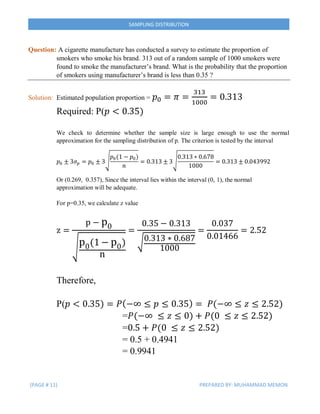
    (PAGE # 1)PREPARED BY: MUHAMMAD MEMON SAMPLING DISTRIBUTION Question: For a population 0, 4, 8, 12 construct sampling distribution of mean for samples of size 2 taken without replacement and find its mean and standard error. Total number of Samples of size 2 out of 4 objects, taken without replacement = 4C2 = (4 2 ) = 6 Sample No. All Possible Samples Sample Mean x P( x ) The sampling distribution of x is tabulated below: x P( x ) 2 4 6 8 10 1/6 1/6 2/6 1/6 1/6 Now we find x and 𝜎𝑥̅ : x P( x ) x . P( x ) x - x ( x - x )2 P( x ). ( x - x )2 2 0.167 0.33 -4.00 16.00 2.67 4 0.167 0.67 -2.00 4.00 0.67 6 0.33 2.00 0.00 0.00 0.00 8 0.167 1.33 2.00 4.00 0.67 10 0.167 1.67 4.00 16.00 2.67 x = 6 6.68 𝜎𝑥̅ = √ 𝐏( x ). ( x − x )2 𝜎𝑥̅ = √6.68 = 2.57 1 0, 4 2 1/6 2 0, 8 4 1/6 3 0, 12 6 1/6 4 4, 8 6 1/6 5 4, 12 8 1/6 6 8, 12 10 1/6
  • 2.
    (PAGE # 2)PREPARED BY: MUHAMMAD MEMON SAMPLING DISTRIBUTION This can be done directly by using 𝜎 𝑥̅ = 𝜎 √ 𝑛 √ 𝑁−𝑛 𝑁−1 (When sampling is with replacement, Finite Population Multiplier will be included) 𝒙 𝒙 − 𝝁 (𝒙 − 𝝁)2 0 0 – 6 = 6 36 4 4 – 6 = -2 4 8 8 – 6 = 2 4 12 12 – 6 = 6 36 24 80 𝜇 = ∑ 𝑥 𝑛 = 24 4 = 6 𝜎2 = ∑(𝑥−𝜇)2 4 = 80 4 = 20 𝜎 = √20 = 4.47 We know that 𝜇 𝑥̅ = µ= 6 𝜎 𝑥̅ = 𝜎 √ 𝑛 √ 𝑁−𝑛 𝑁−1 = 4.47 √2 ∗ √4−2 √4−1 = 4.43 1.7321 = 2.57
  • 3.
    (PAGE # 3)PREPARED BY: MUHAMMAD MEMON SAMPLING DISTRIBUTION Question: For a population 0, 4, 8, 12 construct sampling distribution of mean for samples of size 2 taken with replacement and find its mean and standard error. Total number of Samples of size 2 out of 4 objects, taken with replacement = 24 = 16 Sample No. All Possible Samples Sample Mean x P( x ) 1 0, 0 0 1/16 2 0, 4 2 1/16 3 0, 8 4 1/16 4 0, 12 6 1/16 5 4, 0 2 1/16 6 4, 4 4 1/16 7 4, 8 6 1/16 8 4, 12 8 1/16 9 8, 0 4 1/16 10 8, 4 6 1/16 11 8, 8 8 1/16 12 8, 12 10 1/16 13 12, 0 6 1/16 14 12, 4 8 1/16 15 12, 8 10 1/16 16 12, 12 12 1/16 Then the sampling distribution of x is tabulated below: x 0 2 4 6 8 10 12 P( x ) 1/16 2/16 3/16 4/16 3/16 2/16 1/16
  • 4.
    (PAGE # 4)PREPARED BY: MUHAMMAD MEMON SAMPLING DISTRIBUTION Now we find x and 𝜎𝑥̅ : x P( x ) x . P( x ) x - x ( x - x )2 P( x ). ( x - x )2 0 0.0625 0 0 – 6 36 2.25 2 0.125 0.25 2 – 6 16 2.00 4 0.1875 0.75 4 – 6 4 0.75 6 0.25 1.50 6 – 6 0 00 8 0.1875 1.50 8 – 6 4 0.75 10 0.125 1.25 10 – 6 16 2.00 12 0.0625 0.75 12 – 6 36 2.25 x =6.00 10.00 𝜎𝑥̅ = √ 𝐏( x ). ( x − x )2 𝜎𝑥̅ = √10 = 3.162 This can be done directly by using 𝜎 𝑥̅ = 𝜎 √ 𝑛 (When sampling is without replacement, Finite Population Multiplier will be ignored) We have already calculated 𝜎 = √20 = 4.47 Then 𝜎𝑥̅ = 𝜎 √ 𝑛 = 4.47 √2 = 3.162
  • 5.
    (PAGE # 5)PREPARED BY: MUHAMMAD MEMON SAMPLING DISTRIBUTION Question: A random sample of size 16 is drawn from a population with replacement. The standard deviation of the population is 5. (i) Find standard error of mean (ii) Find standard error of mean if sample size is increased to 100. Question: A random sample of size 25 is drawn from a population with mean 82 and standard deviation 30. It is desired to reduce the standard error of mean by 1/3. What sample size must be selected to accomplish that? Solution: Population size is not given so we have to assume it large (or infinite), therefore FPM will be ignored, and 𝜎𝑥̅ = 𝜎 √ 𝑛 Put n=25 and 𝜎=30, we get 𝜎𝑥̅ = 30 √25 = 30 5 = 6 The standard error, 𝜎𝑥̅ = 6 is to be reduced to 𝜎𝑥̅ = 2 (since one third) 𝜎𝑥̅ = 𝜎 √ 𝑛 or √ 𝑛 𝜎𝑥̅ = 𝜎 or √ 𝑛 = 𝜎 𝜎 𝑥̅ Or 𝑛 = 𝜎2 𝜎 𝑥̅ 2 Put 𝜎=30 and 𝜎𝑥̅ = 2, we get 𝑛 = 302 22 = 900 4 = 225
  • 6.
    (PAGE # 6)PREPARED BY: MUHAMMAD MEMON SAMPLING DISTRIBUTION The Central Limit Theorem The relationship between the shape of the population distribution and the shape of the sampling distribution of the mean is called the central limit theorem. It assures us that the sampling distribution of the mean approaches normal as the sample size increases. The significance of the central limit theorem is that it permits us to use sample statistics to make inferences about population parameters without knowing anything about the shape of the frequency distribution of that population other than what we can get from the sample. The sampling distribution of mean is normal distribution either if the population is normal or if the sample size is more than 30. Population from Normal Non-Normal which sample is drawn Sample size n n>30 n≤30 n>30 n≤30 Sample Distribution of Normal Normal Normal Non-Normal Sample Mean (approximately) Question: A population has mean 40 and standard deviation 6. What is the shape of the sampling distribution of mean for samples of size (i) 100 (ii) 25 ? Solution: (i) Sampling distribution of mean would be approximated by a normal distribution irrespective of the shape of the population because sample size n =100 i.e. n > 30 Then the mean and standard error of this distribution are: x =  = 40 𝜎𝑥̅ = 𝜎 √ 𝑛 = 6 √100 = 6 10 = 0.6 (ii) The sampling distribution of mean for n<30 can be normal only when the population is normal. Since n=25, i.e. < 30 and the shape of the population is not known, nothing can be said about the shape of the sampling distribution . The mean and standard error of this distribution (whether normal or not) are: x =  = 40 𝜎𝑥̅ = 𝜎 √ 𝑛 = 6 √25 = 6 5 = 1.2
  • 7.
    (PAGE # 7)PREPARED BY: MUHAMMAD MEMON SAMPLING DISTRIBUTION SAMPLING DISTRIBUTION OF PROPORTION: Sample Proportion is a statistic - 𝑝 = 𝑥 𝑛 , where 𝑥 is the no of successes in a sample of size n. Where population proportion is denoted by 𝜋, and 𝜋 = 𝑥 𝑁 , where 𝑥 is the no of successes in a population of size N. Now in a random sample, with replacement, 𝑥 is recognized as Binomial Random variable with parameters n and 𝜋 , where 𝜋 is the probability of success, then 𝐸( 𝑥) = 𝑛𝜋 and v(𝑥) = 𝑛𝜋(1 − 𝜋) Thus the mean and standard error of the sampling distribution of proportion p are given as 𝜇 𝑝 = 𝜋 𝜎 𝑝 = √ 𝜋(1 − 𝜋) 𝑛 But in sampling distribution of proportion, without replacement, the mean & standard error of p are: 𝜇 𝑝 = 𝜋 𝜎 𝑝 = √ 𝜋(1 − 𝜋) 𝑛 ∗ √ 𝑁 − 𝑛 𝑁 − 1 We determine the mean and variance of p, 𝜇 𝑝 = 𝐸( 𝑝) = 𝐸 ( 𝑥 𝑛 ) = 1 𝑛 𝐸( 𝑥) = 1 𝑛 ( 𝑛𝜋) = 𝜋 𝜎 𝑝 2 = 𝑣( 𝑝) = 𝑣 ( 𝑥 𝑛 ) = 1 𝑛2 𝑣(𝑥) = 1 𝑛2 (𝑛𝜋(1 − 𝜋)) = 𝜋(1−𝜋) 𝑛
  • 8.
    (PAGE # 8)PREPARED BY: MUHAMMAD MEMON SAMPLING DISTRIBUTION Question: Consider a population of 5 students Kamran (K), Hafeez (H), Shumaila (S), Noreen (N) and Tahmina (T). (a) Develop the sampling distribution of the proportion of females for simple random samples of size 2 drawn without replacement. (b) Determine the mean and variance of the distribution (c) Verify that 𝜇 𝑝 = 𝜋 and 𝜎 𝑝 2 = 𝜋(1−𝜋) 𝑛 ∗ 𝑁−𝑛 𝑁−1 Solution: Total number of Samples of size 2 out of 5 objects, taken without replacement = NCn 5C2 = (5 2 ) = 10 Population proportion of females = 𝑁𝑜 𝑜𝑓 𝑓𝑒𝑚𝑎𝑙𝑒𝑠 𝑖𝑛 𝑡ℎ𝑒 𝑝𝑜𝑝𝑢𝑙𝑎𝑡𝑖𝑜𝑛 𝑁𝑜.𝑜𝑓 𝑠𝑡𝑢𝑑𝑒𝑛𝑡𝑠 𝑖𝑛 𝑡ℎ𝑒 𝑝𝑜𝑝𝑢𝑙𝑎𝑡𝑖𝑜𝑛 Or 𝜋 = 3 5 = 0.6 , then 1 – 𝜋 = 0.4 (b) We determine mean and variance of sampling distribution of p. P P(p) p.p(𝒑) P – 𝝁 𝒑 (P – 𝝁 𝒑)2 p(𝒑). (P – 𝝁 𝒑)2 0.0 0.5 1.0 0.1 0.6 0.3 0.0 0.3 0.3 -0.6 -0.1 0.4 0.36 0.01 0.16 0.036 0.006 0.048 𝝁 𝒑=0.6 0.09 𝜇 𝑝 = ∑ 𝑝. 𝑃(𝑝) = 0.6 𝜎 𝑝 2 = ∑ 𝐩(𝒑). (𝐏 – 𝝁 𝒑)2 = 0.09 𝜎 𝑝 = √∑ 𝐩(𝒑). (𝐏 – 𝝁 𝒑)2 = √0.09 = 0.3 Possible samples of size 2 n=2 No. of successes/ females in the sample Proportion of successes/females in the sample 𝒑 = 𝒙 𝒏⁄ K, H 0 0 K, S 1 0.5 K, N 1 0.5 K, T 1 0.5 H, S 1 0.5 H, N 1 0.5 H, T 1 0.5 S, N 2 1.0 S, T 2 1.0 N, T 2 1.0 Then Sampling distribution of p is p P(p) 0.0 0.5 1.0 0.1 0.6 0.3 Σ 1.0
  • 9.
    (PAGE # 9)PREPARED BY: MUHAMMAD MEMON SAMPLING DISTRIBUTION (c) From population 𝜋 = 3 5 = 0.6 & N=5 Then 𝜇 𝑝 = 𝜋 = 0.6 𝜎 𝑝 2 = 𝜋(1−𝜋) 𝑛 ∗ 𝑁−𝑛 𝑁−1 = 0.6∗0.4 2 ∗ 5−2 5−1 = 0.24 2 ∗ 3 4 = 0.09 SHAPE OF THE SAMPLING DISTRIBUTION OF p Here the central limit theorem has been applied for the random variable p.  If the random sampling is without replacement & sampling fraction 𝑛 𝑁 ≥ 0.05, The f.p.m must be used and 𝜎 𝑝 2 = 𝜋(1−𝜋) 𝑛 ∗ 𝑁−𝑛 𝑁−1  When 𝒏 ≥ 𝟓𝟎 and both 𝒏𝝅 𝑎𝑛𝑑 𝒏(𝟏 − 𝝅)are greater than, 5,the sampling distribution of p can be considered Normal.  When the distribution of p is normal, the statistic 𝒛 = 𝒑−𝝅 √ 𝝅(𝟏−𝝅) 𝒏 will be standard normal variable.  Generally the population proportion 𝜋 is not known & the proportion of a random sample (say 𝒑 𝟎) is used as an estimate of 𝜋, and therefore, 𝜋 is replaced by the sample estimate 𝑝0 For large samples, the sampling distribution of 𝑝0 is approximately normal if the interval 𝑝0 ± 3𝜎 𝑝 = 𝑝0 ± 3√ 𝑝0(1−𝑝0) 𝑛 lies within (0,1) but this interval does not include 0 or 1. & then 𝒛 = 𝒑− 𝑝0 √ 𝑝0(𝟏− 𝑝0) 𝒏 The sampling distribution of proportion p will, as sample size increases, approach a normal distribution with 𝜇 𝑝 = 𝜋 (the population proportion) and variance 𝜎 𝑝 2 = 𝜋(1−𝜋) 𝑛
  • 10.
    (PAGE # 10)PREPARED BY: MUHAMMAD MEMON SAMPLING DISTRIBUTION Question: A company employs 2000 persons, 600 of whom are post-graduates. (i) Specify completely the sampling distribution of proportion of post- graduates for samples of size 50 drawn without replacement. (ii) Find the probability of selection a sample whose proportion of post- graduates is greater than 0.4. Solution: (i) The population proportion of post-graduates is 𝜋 = 600 2000 = 0.3 Since 𝒏 ≥ 𝟓𝟎 & 𝒏𝝅 = 50 ∗ 0.3 = 15 ; 𝒏( 𝟏 − 𝝅) = 𝟓𝟎 ∗ 𝟎. 𝟕 = 𝟑𝟓 are both greater than 5, the sampling distribution of sample proportion may be considered normal with parameters 𝜇 𝑝 = 𝜋 = 0.3 [Since 𝑛 𝑁 = 50 2000 < 0.05 therefore f.p.m will be ignored.] 𝜎 𝑝 2 = 𝜋(1−𝜋) 𝑛 = 0.3∗0.7 50 = 0.0042 (ii) Since the sampling distribution of p has been determined as normal, therefore z- transformation is used to find probabilities. 𝒛 = 𝒑 − 𝝅 √ 𝝅(𝟏 − 𝝅) 𝒏 = 𝟎. 𝟒 − 𝟎. 𝟑 √𝟎. 𝟎𝟎𝟒𝟐 = 𝟏. 𝟓𝟒 P(𝒑 > 𝟎. 𝟒) = 𝑷(𝒛 > 𝟏. 𝟓𝟒) = 0.5 − 𝑃(0 ≤ 𝑧 ≤ 1.54) = 0.5 − 0.4382 = 0.0618
  • 11.
    (PAGE # 11)PREPARED BY: MUHAMMAD MEMON SAMPLING DISTRIBUTION Question: A cigarette manufacture has conducted a survey to estimate the proportion of smokers who smoke his brand. 313 out of a random sample of 1000 smokers were found to smoke the manufacturer’s brand. What is the probability that the proportion of smokers using manufacturer’s brand is less than 0.35 ? Solution: Estimated population proportion = 𝑝0 = 𝜋 = 313 1000 = 0.313 Required: P(𝑝 < 0.35) We check to determine whether the sample size is large enough to use the normal approximation for the sampling distribution of p. The criterion is tested by the interval 𝑝0 ± 3𝜎 𝑝 = 𝑝0 ± 3√ 𝑝0(1 − 𝑝0) 𝑛 = 0.313 ± 3√ 0.313 ∗ 0.678 1000 = 0.313 ± 0.043992 Or (0.269, 0.357), Since the interval lies within the interval (0, 1), the normal approximation will be adequate. For p=0.35, we calculate z value z = p − p0 √ p0(1 − p0) n = 0.35 − 0.313 √0.313 ∗ 0.687 1000 = 0.037 0.01466 = 2.52 Therefore, P(𝑝 < 0.35) = 𝑃(−∞ ≤ 𝑝 ≤ 0.35) = 𝑃(−∞ ≤ 𝑧 ≤ 2.52) =𝑃(−∞ ≤ 𝑧 ≤ 0) + 𝑃(0 ≤ 𝑧 ≤ 2.52) =0.5 + 𝑃(0 ≤ 𝑧 ≤ 2.52) = 0.5 + 0.4941 = 0.9941