1
Naresh Chawla
Visiting Professor –TQM, Punjab Engineering College (Deemed to be University)
Principal Trainer, TQM & Operational Excellence
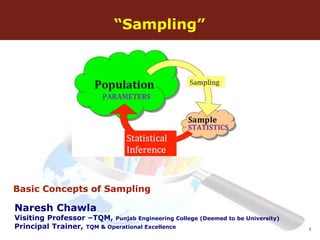
“Sampling”
Basic Concepts of Sampling
Sampling
2Naresh Chawla, Principal Trainer, TQM & Operational Excellence
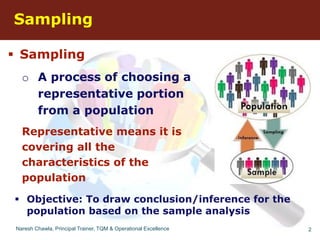
▪ Sampling
o A process of choosing a
representative portion
from a population
Representative means it is
covering all the
characteristics of the
population
▪ Objective: To draw conclusion/inference for the
population based on the sample analysis
Need for Sampling
Naresh Chawla, Principal Trainer, TQM & Operational Excellence 3
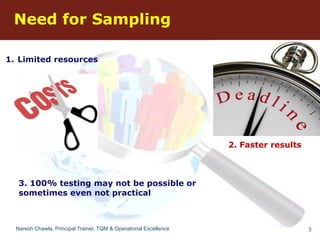
3. 100% testing may not be possible or
sometimes even not practical
2. Faster results
1. Limited resources
Application
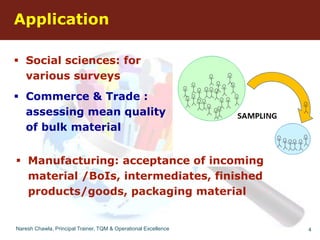
▪ Social sciences: for
various surveys
▪ Commerce & Trade :
assessing mean quality
of bulk material
Naresh Chawla, Principal Trainer, TQM & Operational Excellence 4
▪ Manufacturing: acceptance of incoming
material /BoIs, intermediates, finished
products/goods, packaging material
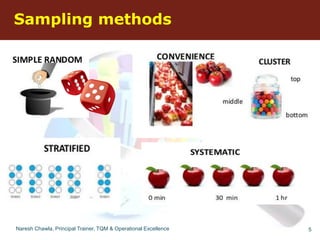
Sampling methods
Naresh Chawla, Principal Trainer, TQM & Operational Excellence 5
Errors in Sampling
Naresh Chawla, Principal Trainer, TQM & Operational Excellence 6
▪ Mistakes made during data acquisition
Systematic error (or bias)
Naresh Chawla, Principal Trainer, TQM & Operational Excellence 7
▪ Selection bias
▪ non response error
(information bias)
▪ Errors caused by chance
in selecting a random
sample
o Finding a difference (in
sample and population)
that doesn't exist really
o Not finding a difference
that actually exists
between sample and
population
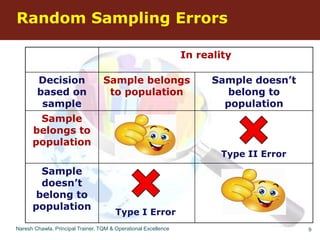
let us understand this by a
grid on next slide
Random Sampling Errors
Naresh Chawla, Principal Trainer, TQM & Operational Excellence 8
Random Sampling Errors
In reality
Decision
based on
sample
Sample belongs
to population
Sample doesn’t
belong to
population
Sample
belongs to
population
Sample
doesn’t
belong to
population
Type II Error
Type I Error
9Naresh Chawla, Principal Trainer, TQM & Operational Excellence
▪ Type I Error
o Also known as a error
o General level of acceptance is 5% (or 0.05)
▪ Type II Error
o Also known as b error
o (1-b) is also known as power of the plan
(ability to find a difference when actually it
is there)
Random Sampling Errors
Naresh Chawla, Principal Trainer, TQM & Operational Excellence 10
Minimizing Sampling Errors
▪ Sample should be representative i.e. it
should have all the characteristics of the
population
▪ Sample size should be adequately large.
▪ Sample size depends upon the inherent
variation in the population and the
accuracy required
Naresh Chawla, Principal Trainer, TQM & Operational Excellence 11
How much to sample?
Naresh Chawla, Principal Trainer, TQM & Operational Excellence 12
1.96 = Za/2 for 95 confidence level
s = Standard Deviation
E = Margin of Error
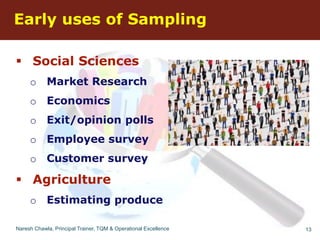
Early uses of Sampling
▪ Social Sciences
o Market Research
o Economics
o Exit/opinion polls
o Employee survey
o Customer survey
▪ Agriculture
o Estimating produce
Naresh Chawla, Principal Trainer, TQM & Operational Excellence 13
Application in Manufacturing
You just received a shipment of 2000 units
from a new supplier
How will you decide?
Is the shipment good enough?
Naresh Chawla, Principal Trainer, TQM & Operational Excellence 14
Three potential methods
15
Acceptance sampling
Naresh Chawla, Principal Trainer, TQM & Operational Excellence
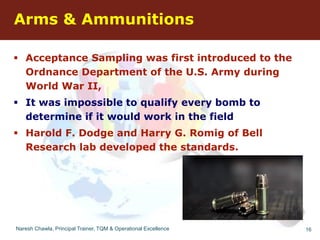
Arms & Ammunitions
▪ Acceptance Sampling was first introduced to the
Ordnance Department of the U.S. Army during
World War II,
▪ It was impossible to qualify every bomb to
determine if it would work in the field
▪ Harold F. Dodge and Harry G. Romig of Bell
Research lab developed the standards.
Naresh Chawla, Principal Trainer, TQM & Operational Excellence 16
Automotive Industry
IATF 16949: 2016
9.1.1.1 Monitoring & Measurement of
Manufacturing Processes
o Organization shall perform process studies to verify
process capability
o If it is not possible to demonstrate process
compliance through process capability use alternate
methods such as batch confirming to specifications
o Sampling plan, acceptance criteria and records of
actual measurement values and/or test results for
variables may be part of customer’s part approval
process
17Naresh Chawla, Principal Trainer, TQM & Operational Excellence
Acceptance Sampling
▪ Process of evaluating a portion
(sample) of the product from a lot
(population) for the purpose of
accepting or rejecting the entire lot.
Naresh Chawla, Principal Trainer, TQM & Operational Excellence 18
▪ Plans for attributes were first
developed for the US Army
during World War II.
▪ MIL-STD-105D was first
issued by the U.S.
government in 1963.
Various Standards for Acceptance
Sampling
Naresh Chawla, Principal Trainer, TQM & Operational Excellence
▪ MIL-STD-105D was revised to MIL-STD-105E in
1989. Its use has been discontinued since 1995
▪ MIT-STD-105D forms the basis of ANSI/ ASQC Z
1.4 -1981:Sampling Procedure and Tables for
Inspection by Attributes. Version 2008 is the
current version of this standard
19
▪ MIL-STD-105D also forms the basis of ISO
2859 (issued by ISO)
▪ Standards for variable inspections were also
introduced in the form of ANSI/ASQ/Z1.9
and ISO 3951-1:2013 is complementary to
ISO 2859-1:2008
▪ In India IS 2500 series is used for
acceptance sampling
Various Standards for Acceptance
Sampling
Naresh Chawla, Principal Trainer, TQM & Operational Excellence 20
▪ IS 2500 is in three parts:
o IS: 2500 (Part-1) : 2000 –for inspection
by attributes based on AQL for Lot by Lot
Inspection (aligned fully with 3rd revised
edition of ISO 2859 (Part-1) : 1999)
o IS: 2500 (Part-2): 1965 – For Inspection
by variables (based on MIL-STD-414)
o IS: 2500 (Part-3) : 1995 –Attribute
Sampling Plans based on LQ for isolated lot
inspection (protecting consumer risk)
Various Standards for Acceptance
Sampling
Naresh Chawla, Principal Trainer, TQM & Operational Excellence 21
▪ ISO 2859-1 or ANSI/ASQ Z1.4 for
series of lots; ISO 2859-2 or
ANSI/ASQ-Q3 for isolated lots)
▪ Material to be sampled:
1. Unitary material (finished product,
leaflets, test tubes, vials, stoppers,
medical devices etc
2. Particulate material (Powders of
API, granulate, blend etc
3. Bulky-continuous material (water,
liquid solution, viscous solutions,
gel, cream, compressed gas etc.
FDA Guidelines for Pharma
companies
Naresh Chawla, Principal Trainer, TQM & Operational Excellence 22
▪ In medical device manufacturing the key
point is to have the plan accept on zero
defectives, C = 0 plans by Nicholas L.
Squeglia
▪ This point is not FDA but legalese. It is
based on past lawsuits
Medical devices
Naresh Chawla, Principal Trainer, TQM & Operational Excellence 23
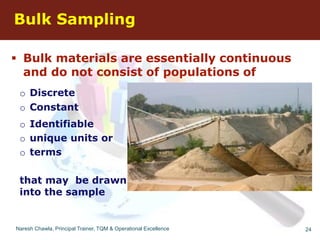
Bulk Sampling
▪ Bulk materials are essentially continuous
and do not consist of populations of
Naresh Chawla, Principal Trainer, TQM & Operational Excellence 24
o Discrete
o Constant
o Identifiable
o unique units or
o terms
that may be drawn
into the sample
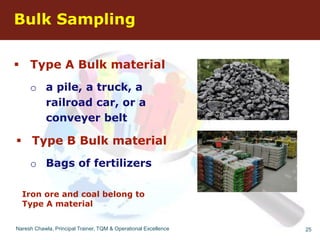
Bulk Sampling
▪ Type A Bulk material
o a pile, a truck, a
railroad car, or a
conveyer belt
▪ Type B Bulk material
o Bags of fertilizers
Naresh Chawla, Principal Trainer, TQM & Operational Excellence 25
Iron ore and coal belong to
Type A material
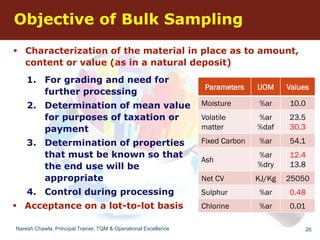
Objective of Bulk Sampling
▪ Characterization of the material in place as to amount,
content or value (as in a natural deposit)
Naresh Chawla, Principal Trainer, TQM & Operational Excellence 26
1. For grading and need for
further processing
2. Determination of mean value
for purposes of taxation or
payment
3. Determination of properties
that must be known so that
the end use will be
appropriate
4. Control during processing
▪ Acceptance on a lot-to-lot basis
Parameters UOM Values
Moisture %ar 10.0
Volatile
matter
%ar
%daf
23.5
30.3
Fixed Carbon %ar 54.1
Ash
%ar
%dry
12.4
13.8
Net CV KJ/Kg 25050
Sulphur %ar 0.48
Chlorine %ar 0.01
Foods, food production & food safety
▪ FV-Q Visible defects in fruits/vegetables - ISO 2859-1:1999: Sampling
procedures for inspection by attributes
▪ MI-Q Fat contents in milk - ISO 3951-1:2013: Sampling procedures for
inspection by variables
▪ FV-P Pesticides Residues in fruits/vegetables - CAC/GL 40-1993
C O D E X A L I M E N T A R I U S international food standards,
Naresh Chawla, Principal Trainer, TQM & Operational Excellence 27
Fruits/
Vegetabl
es
(FV)
Fats/
Oil
(FO)
Fish/
Fishery
product
(F)
Milk/Milk
product
(MI)
Meat/
Meat
product
(M)
Natural
Mineral
Waters
(MW)
Cereals
(C)
Qualitative/Quantitative
Characteristics / Sensory
inspection (Q)
FV-Q FO-Q F-Q MI-Q M-Q MW-Q C-Q
Food Hygiene (FH) FV-FH nr* F-FH MI-FH M-FH MW-FH nr*
Pesticide residues (P) FV-P FO-P nr* MI-P M-P nr* C-P
Contaminations (C) FV-C1/2 FO-C F-C MI-C M-C MW-C C-C
Residues of veterinary drugs
(R)
nr* FO-R F-R MI-R M-R nr* nr*
* nr – Not Required
Thank You!
nareshchawlaTQM@gmail.com
+91-9779070555
Naresh Chawla, Principal Trainer, TQM & Operational Excellence 28

Sampling: Basic Concepts

  • 1.
    1 Naresh Chawla Visiting Professor–TQM, Punjab Engineering College (Deemed to be University) Principal Trainer, TQM & Operational Excellence “Sampling” Basic Concepts of Sampling
  • 2.
    Sampling 2Naresh Chawla, PrincipalTrainer, TQM & Operational Excellence ▪ Sampling o A process of choosing a representative portion from a population Representative means it is covering all the characteristics of the population ▪ Objective: To draw conclusion/inference for the population based on the sample analysis
  • 3.
    Need for Sampling NareshChawla, Principal Trainer, TQM & Operational Excellence 3 3. 100% testing may not be possible or sometimes even not practical 2. Faster results 1. Limited resources
  • 4.
    Application ▪ Social sciences:for various surveys ▪ Commerce & Trade : assessing mean quality of bulk material Naresh Chawla, Principal Trainer, TQM & Operational Excellence 4 ▪ Manufacturing: acceptance of incoming material /BoIs, intermediates, finished products/goods, packaging material
  • 5.
    Sampling methods Naresh Chawla,Principal Trainer, TQM & Operational Excellence 5
  • 6.
    Errors in Sampling NareshChawla, Principal Trainer, TQM & Operational Excellence 6
  • 7.
    ▪ Mistakes madeduring data acquisition Systematic error (or bias) Naresh Chawla, Principal Trainer, TQM & Operational Excellence 7 ▪ Selection bias ▪ non response error (information bias)
  • 8.
    ▪ Errors causedby chance in selecting a random sample o Finding a difference (in sample and population) that doesn't exist really o Not finding a difference that actually exists between sample and population let us understand this by a grid on next slide Random Sampling Errors Naresh Chawla, Principal Trainer, TQM & Operational Excellence 8
  • 9.
    Random Sampling Errors Inreality Decision based on sample Sample belongs to population Sample doesn’t belong to population Sample belongs to population Sample doesn’t belong to population Type II Error Type I Error 9Naresh Chawla, Principal Trainer, TQM & Operational Excellence
  • 10.
    ▪ Type IError o Also known as a error o General level of acceptance is 5% (or 0.05) ▪ Type II Error o Also known as b error o (1-b) is also known as power of the plan (ability to find a difference when actually it is there) Random Sampling Errors Naresh Chawla, Principal Trainer, TQM & Operational Excellence 10
  • 11.
    Minimizing Sampling Errors ▪Sample should be representative i.e. it should have all the characteristics of the population ▪ Sample size should be adequately large. ▪ Sample size depends upon the inherent variation in the population and the accuracy required Naresh Chawla, Principal Trainer, TQM & Operational Excellence 11
  • 12.
    How much tosample? Naresh Chawla, Principal Trainer, TQM & Operational Excellence 12 1.96 = Za/2 for 95 confidence level s = Standard Deviation E = Margin of Error
  • 13.
    Early uses ofSampling ▪ Social Sciences o Market Research o Economics o Exit/opinion polls o Employee survey o Customer survey ▪ Agriculture o Estimating produce Naresh Chawla, Principal Trainer, TQM & Operational Excellence 13
  • 14.
    Application in Manufacturing Youjust received a shipment of 2000 units from a new supplier How will you decide? Is the shipment good enough? Naresh Chawla, Principal Trainer, TQM & Operational Excellence 14
  • 15.
    Three potential methods 15 Acceptancesampling Naresh Chawla, Principal Trainer, TQM & Operational Excellence
  • 16.
    Arms & Ammunitions ▪Acceptance Sampling was first introduced to the Ordnance Department of the U.S. Army during World War II, ▪ It was impossible to qualify every bomb to determine if it would work in the field ▪ Harold F. Dodge and Harry G. Romig of Bell Research lab developed the standards. Naresh Chawla, Principal Trainer, TQM & Operational Excellence 16
  • 17.
    Automotive Industry IATF 16949:2016 9.1.1.1 Monitoring & Measurement of Manufacturing Processes o Organization shall perform process studies to verify process capability o If it is not possible to demonstrate process compliance through process capability use alternate methods such as batch confirming to specifications o Sampling plan, acceptance criteria and records of actual measurement values and/or test results for variables may be part of customer’s part approval process 17Naresh Chawla, Principal Trainer, TQM & Operational Excellence
  • 18.
    Acceptance Sampling ▪ Processof evaluating a portion (sample) of the product from a lot (population) for the purpose of accepting or rejecting the entire lot. Naresh Chawla, Principal Trainer, TQM & Operational Excellence 18
  • 19.
    ▪ Plans forattributes were first developed for the US Army during World War II. ▪ MIL-STD-105D was first issued by the U.S. government in 1963. Various Standards for Acceptance Sampling Naresh Chawla, Principal Trainer, TQM & Operational Excellence ▪ MIL-STD-105D was revised to MIL-STD-105E in 1989. Its use has been discontinued since 1995 ▪ MIT-STD-105D forms the basis of ANSI/ ASQC Z 1.4 -1981:Sampling Procedure and Tables for Inspection by Attributes. Version 2008 is the current version of this standard 19
  • 20.
    ▪ MIL-STD-105D alsoforms the basis of ISO 2859 (issued by ISO) ▪ Standards for variable inspections were also introduced in the form of ANSI/ASQ/Z1.9 and ISO 3951-1:2013 is complementary to ISO 2859-1:2008 ▪ In India IS 2500 series is used for acceptance sampling Various Standards for Acceptance Sampling Naresh Chawla, Principal Trainer, TQM & Operational Excellence 20
  • 21.
    ▪ IS 2500is in three parts: o IS: 2500 (Part-1) : 2000 –for inspection by attributes based on AQL for Lot by Lot Inspection (aligned fully with 3rd revised edition of ISO 2859 (Part-1) : 1999) o IS: 2500 (Part-2): 1965 – For Inspection by variables (based on MIL-STD-414) o IS: 2500 (Part-3) : 1995 –Attribute Sampling Plans based on LQ for isolated lot inspection (protecting consumer risk) Various Standards for Acceptance Sampling Naresh Chawla, Principal Trainer, TQM & Operational Excellence 21
  • 22.
    ▪ ISO 2859-1or ANSI/ASQ Z1.4 for series of lots; ISO 2859-2 or ANSI/ASQ-Q3 for isolated lots) ▪ Material to be sampled: 1. Unitary material (finished product, leaflets, test tubes, vials, stoppers, medical devices etc 2. Particulate material (Powders of API, granulate, blend etc 3. Bulky-continuous material (water, liquid solution, viscous solutions, gel, cream, compressed gas etc. FDA Guidelines for Pharma companies Naresh Chawla, Principal Trainer, TQM & Operational Excellence 22
  • 23.
    ▪ In medicaldevice manufacturing the key point is to have the plan accept on zero defectives, C = 0 plans by Nicholas L. Squeglia ▪ This point is not FDA but legalese. It is based on past lawsuits Medical devices Naresh Chawla, Principal Trainer, TQM & Operational Excellence 23
  • 24.
    Bulk Sampling ▪ Bulkmaterials are essentially continuous and do not consist of populations of Naresh Chawla, Principal Trainer, TQM & Operational Excellence 24 o Discrete o Constant o Identifiable o unique units or o terms that may be drawn into the sample
  • 25.
    Bulk Sampling ▪ TypeA Bulk material o a pile, a truck, a railroad car, or a conveyer belt ▪ Type B Bulk material o Bags of fertilizers Naresh Chawla, Principal Trainer, TQM & Operational Excellence 25 Iron ore and coal belong to Type A material
  • 26.
    Objective of BulkSampling ▪ Characterization of the material in place as to amount, content or value (as in a natural deposit) Naresh Chawla, Principal Trainer, TQM & Operational Excellence 26 1. For grading and need for further processing 2. Determination of mean value for purposes of taxation or payment 3. Determination of properties that must be known so that the end use will be appropriate 4. Control during processing ▪ Acceptance on a lot-to-lot basis Parameters UOM Values Moisture %ar 10.0 Volatile matter %ar %daf 23.5 30.3 Fixed Carbon %ar 54.1 Ash %ar %dry 12.4 13.8 Net CV KJ/Kg 25050 Sulphur %ar 0.48 Chlorine %ar 0.01
  • 27.
    Foods, food production& food safety ▪ FV-Q Visible defects in fruits/vegetables - ISO 2859-1:1999: Sampling procedures for inspection by attributes ▪ MI-Q Fat contents in milk - ISO 3951-1:2013: Sampling procedures for inspection by variables ▪ FV-P Pesticides Residues in fruits/vegetables - CAC/GL 40-1993 C O D E X A L I M E N T A R I U S international food standards, Naresh Chawla, Principal Trainer, TQM & Operational Excellence 27 Fruits/ Vegetabl es (FV) Fats/ Oil (FO) Fish/ Fishery product (F) Milk/Milk product (MI) Meat/ Meat product (M) Natural Mineral Waters (MW) Cereals (C) Qualitative/Quantitative Characteristics / Sensory inspection (Q) FV-Q FO-Q F-Q MI-Q M-Q MW-Q C-Q Food Hygiene (FH) FV-FH nr* F-FH MI-FH M-FH MW-FH nr* Pesticide residues (P) FV-P FO-P nr* MI-P M-P nr* C-P Contaminations (C) FV-C1/2 FO-C F-C MI-C M-C MW-C C-C Residues of veterinary drugs (R) nr* FO-R F-R MI-R M-R nr* nr* * nr – Not Required
  • 28.
    Thank You! nareshchawlaTQM@gmail.com +91-9779070555 Naresh Chawla,Principal Trainer, TQM & Operational Excellence 28