
Six Sigma – a business strategy
for improving
“Capability, Reliability & Responsiveness”
Six Sigma – a business strategy
for improving
“Capability, Reliability & Responsiveness”
Naresh Chawla
GM- Consultancy & Training
PTU Nalanda School of TQM & Entrepreneurship, Mohali
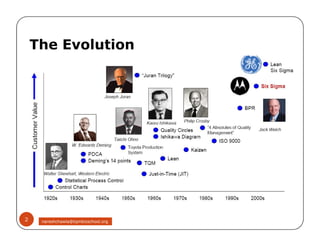
The Evolution
2 nareshchawla@tqmbizschool.org
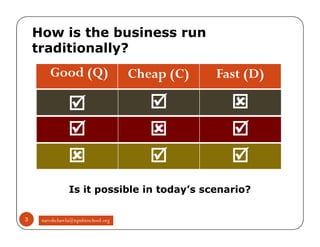
How is the business run
traditionally?
Good (Q) Cheap (C) Fast (D)
  
    
  
Is it possible in today’s scenario?
3 nareshchawla@tqmbizschool.org
Six Sigma is one strategic
initiative which helps you in
making your products or services
Faster, Better & Cheaper
Six Sigma is one strategic
initiative which helps you in
making your products or services
Faster, Better & Cheaper
4 nareshchawla@tqmbizschool.org
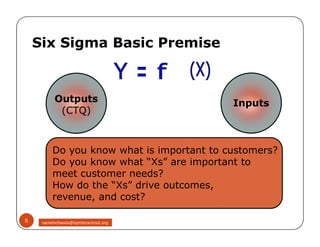
InputsInputs
Six Sigma Basic Premise
Outputs
(CTQ)
Outputs
(CTQ)
Do you know what is important to customers?
Do you know what “Xs” are important to
meet customer needs?
How do the “Xs” drive outcomes,
revenue, and cost?
5 nareshchawla@tqmbizschool.org
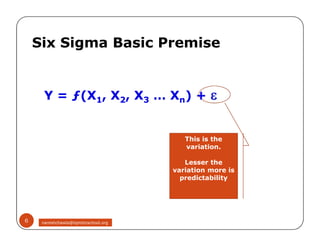
Y = ƒ(X1, X2, X3 … Xn) +
Six Sigma Basic Premise
6 nareshchawla@tqmbizschool.org
This is the
variation.
Lesser the
variation more is
predictability
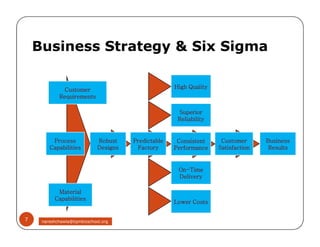
Business Strategy & Six Sigma
Superior
Reliability
High Quality
Customer
Requirements
7
…Customer Satisfaction is a Business Issue
Business
Results
Customer
Satisfaction
Consistent
Performance
On-Time
Delivery
Lower Costs
Predictable
Factory
Robust
Designs
Process
Capabilities
Material
Capabilities
nareshchawla@tqmbizschool.org
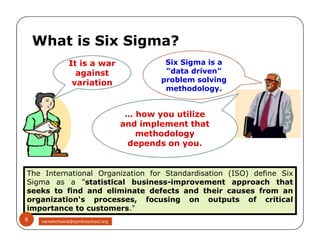
It is a war
against
variation
Six Sigma is a
“data driven”
problem solving
methodology.
… how you utilize
and implement that
methodology
depends on you.
What is Six Sigma?
… how you utilize
and implement that
methodology
depends on you.
The International Organization for Standardisation (ISO) define Six
Sigma as a "statistical business-improvement approach that
seeks to find and eliminate defects and their causes from an
organization's processes, focusing on outputs of critical
importance to customers."
8 nareshchawla@tqmbizschool.org
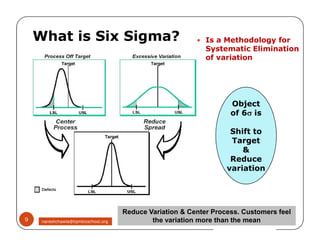
What is Six Sigma?  Is a Methodology for
Systematic Elimination
of variation
Object
of 6 is
Shift to
Target
&
Reduce
variation
Object
of 6 is
Shift to
Target
&
Reduce
variation
Reduce Variation & Center Process. Customers feel
the variation more than the mean
Object
of 6 is
Shift to
Target
&
Reduce
variation
Object
of 6 is
Shift to
Target
&
Reduce
variation
9 nareshchawla@tqmbizschool.org
 Six Sigma is a “Industry Independent”
methodology and has been successfully
applied across the various organization
 Manufacturing: Automotives, Aerospace,
Health Equipment, FMCG, Electronic Goods,
Continuous Process Industries, Textiles, etc.
 Service: Telecom, Banking and Financial
Services, Health Care, Hotels, IT, ITES, KPOs,
Airlines, Cargo movement, Support Services,
HR services, Marketing Services, etc.
Six Sigma Applicability
 Six Sigma is a “Industry Independent”
methodology and has been successfully
applied across the various organization
 Manufacturing: Automotives, Aerospace,
Health Equipment, FMCG, Electronic Goods,
Continuous Process Industries, Textiles, etc.
 Service: Telecom, Banking and Financial
Services, Health Care, Hotels, IT, ITES, KPOs,
Airlines, Cargo movement, Support Services,
HR services, Marketing Services, etc.
10 nareshchawla@tqmbizschool.org
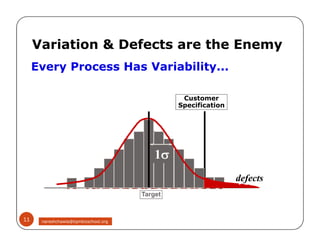
Customer
Specification
X
X
Every Process Has Variability...
Variation & Defects are the Enemy
Target
X XXX X XX XX
XX
X
X
X
XX
X
X
X
X
X
X
X
X
X
XX
X
X
X
XX X
XX
XXX
X X
X
X
X
1
defects
11 nareshchawla@tqmbizschool.org
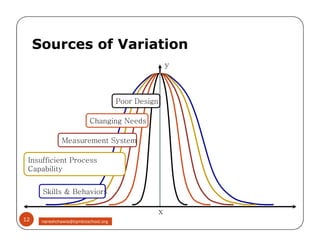
y
Poor Design
Changing Needs
Sources of Variation
x
Changing Needs
Measurement System
Insufficient Process
Capability
Skills & Behaviors
12 nareshchawla@tqmbizschool.org
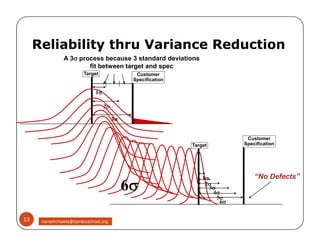
Target Customer
Specification
1
2
3
A 3 process because 3 standard deviations
fit between target and spec
Reliability thru Variance Reduction
Target
Customer
Specification
1
2
3
4
5
6
6
“No Defects”
13 nareshchawla@tqmbizschool.org
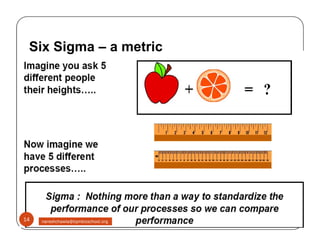
Six Sigma – a metric
14 nareshchawla@tqmbizschool.org
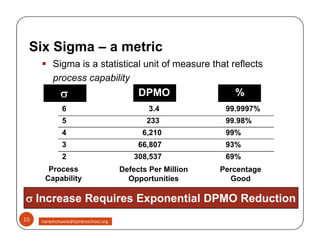
 Sigma is a statistical unit of measure that reflects
process capability
 DPMODPMO
6 3.4 99.9997%
5 233 99.98%
4 6,210 99%
3 66,807 93%
2 308,537 69%
%%
Six Sigma – a metric
6 3.4 99.9997%
5 233 99.98%
4 6,210 99%
3 66,807 93%
2 308,537 69%
Process
Capability
Defects Per Million
Opportunities
Percentage
Good
Increase Requires Exponential DPMO Reduction
15 nareshchawla@tqmbizschool.org
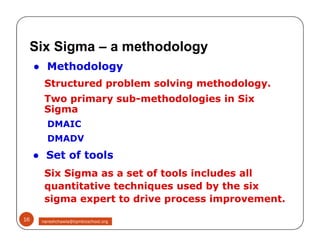
● Methodology
Structured problem solving methodology.
Two primary sub-methodologies in Six
Sigma
DMAIC
DMADV
● Set of tools
Six Sigma as a set of tools includes all
quantitative techniques used by the six
sigma expert to drive process improvement.
Six Sigma – a methodology
● Methodology
Structured problem solving methodology.
Two primary sub-methodologies in Six
Sigma
DMAIC
DMADV
● Set of tools
Six Sigma as a set of tools includes all
quantitative techniques used by the six
sigma expert to drive process improvement.
16 nareshchawla@tqmbizschool.org
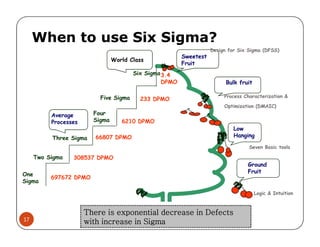
When to use Six Sigma?
3.4
DPMO
233 DPMO
6210 DPMO
Sweetest
Fruit
Average
Processes
Low
Hanging
Six Sigma
Five Sigma
Four
Sigma
World Class
Bulk fruit
Process Characterization &
Optimization (DMAIC)
Design for Six Sigma (DFSS)
There is exponential decrease in Defects
with increase in Sigma
6210 DPMO
66807 DPMO
308537 DPMO
697672 DPMO
Average
Processes
Low
HangingThree Sigma
Two Sigma
One
Sigma
Ground
Fruit
Logic & Intuition
Seven Basic tools
17
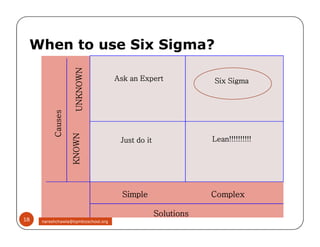
Ask an Expert Six SigmaUNKNOWN
When to use Six Sigma?
Just do it Lean!!!!!!!!!!
Simple Complex
KNOWN
Solutions
18 nareshchawla@tqmbizschool.org
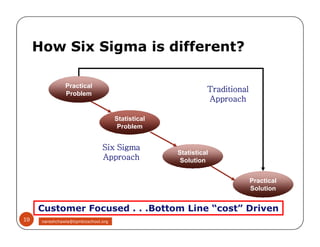
Statistical
Problem
Traditional
Approach
Practical
Problem
How Six Sigma is different?
Statistical
Problem
Statistical
Solution
Practical
Solution
Six Sigma
Approach
Customer Focused . . .Bottom Line “cost” Driven
19 nareshchawla@tqmbizschool.org
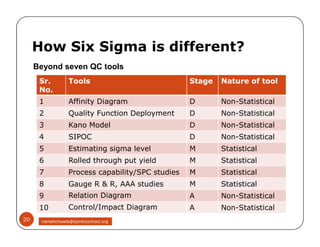
Beyond seven QC tools
Sr.
No.
Tools Stage Nature of tool
1 Affinity Diagram D Non-Statistical
2 Quality Function Deployment D Non-Statistical
3 Kano Model D Non-Statistical
How Six Sigma is different?
3 Kano Model D Non-Statistical
4 SIPOC D Non-Statistical
5 Estimating sigma level M Statistical
6 Rolled through put yield M Statistical
7 Process capability/SPC studies M Statistical
8 Gauge R & R, AAA studies M Statistical
9 Relation Diagram A Non-Statistical
10 Control/Impact Diagram A Non-Statistical
20 nareshchawla@tqmbizschool.org
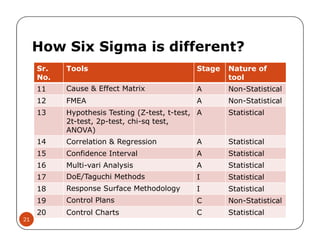
Sr.
No.
Tools Stage Nature of
tool
11 Cause & Effect Matrix A Non-Statistical
12 FMEA A Non-Statistical
13 Hypothesis Testing (Z-test, t-test,
2t-test, 2p-test, chi-sq test,
ANOVA)
A Statistical
How Six Sigma is different?
Hypothesis Testing (Z-test, t-test,
2t-test, 2p-test, chi-sq test,
ANOVA)
14 Correlation & Regression A Statistical
15 Confidence Interval A Statistical
16 Multi-vari Analysis A Statistical
17 DoE/Taguchi Methods I Statistical
18 Response Surface Methodology I Statistical
19 Control Plans C Non-Statistical
20 Control Charts C Statistical
21
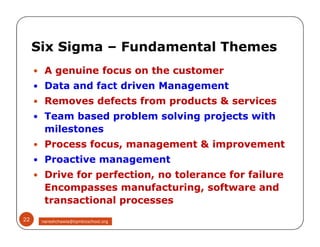
 A genuine focus on the customer
 Data and fact driven Management
 Removes defects from products & services
 Team based problem solving projects with
milestones
 Process focus, management & improvement
 Proactive management
 Drive for perfection, no tolerance for failure
Encompasses manufacturing, software and
transactional processes
Six Sigma – Fundamental Themes
 A genuine focus on the customer
 Data and fact driven Management
 Removes defects from products & services
 Team based problem solving projects with
milestones
 Process focus, management & improvement
 Proactive management
 Drive for perfection, no tolerance for failure
Encompasses manufacturing, software and
transactional processes
22 nareshchawla@tqmbizschool.org
● Identify &
Define
improvement
opportunity
● Determine
Customer
Requirement
(VoC)
● Develop
Project
Charter
● Map High
Level
Processes
(SIPOC)
● Define ‘As is’
Situation
(Detailed
Process Map)
● Plan for Data
collection
● Validate
Measurement
Systems
● Quantify
Current
Process
Performance
● Identify
patterns
through data
anlysis
● Identify
Potential
Causes (x’s)
● Prioritize
possible
root causes
● Validate
possible root
causes
● Generate
Potential
solutions
● Select Best
Solution
● Test Solution
(Piloting)
● Statistical
Evidence of
improvements
● Prepare
and
Implement
Control
Plan
● Implement
Full Scale
Solution
● Statistical
Evidence
that
improveme
nts are
sustainable
● Validate
Financial
Gains
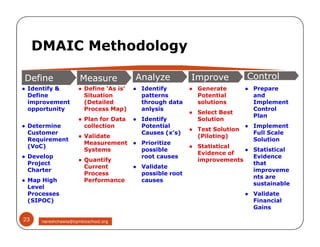
DMAIC Methodology
DefineDefineDefineDefine MeasureMeasureMeasureMeasure AnalyzeAnalyzeAnalyzeAnalyze ImproveImproveImproveImprove ControlControlControlControl
● Identify &
Define
improvement
opportunity
● Determine
Customer
Requirement
(VoC)
● Develop
Project
Charter
● Map High
Level
Processes
(SIPOC)
● Define ‘As is’
Situation
(Detailed
Process Map)
● Plan for Data
collection
● Validate
Measurement
Systems
● Quantify
Current
Process
Performance
● Identify
patterns
through data
anlysis
● Identify
Potential
Causes (x’s)
● Prioritize
possible
root causes
● Validate
possible root
causes
● Generate
Potential
solutions
● Select Best
Solution
● Test Solution
(Piloting)
● Statistical
Evidence of
improvements
● Prepare
and
Implement
Control
Plan
● Implement
Full Scale
Solution
● Statistical
Evidence
that
improveme
nts are
sustainable
● Validate
Financial
Gains
23 nareshchawla@tqmbizschool.org
Thank YouThank You
24 nareshchawla@tqmbizschool.org
Naresh Chawla
Master Black Belt

Why sixsigma

  • 1.
    Six Sigma –a business strategy for improving “Capability, Reliability & Responsiveness” Six Sigma – a business strategy for improving “Capability, Reliability & Responsiveness” Naresh Chawla GM- Consultancy & Training PTU Nalanda School of TQM & Entrepreneurship, Mohali
  • 2.
  • 3.
    How is thebusiness run traditionally? Good (Q) Cheap (C) Fast (D)            Is it possible in today’s scenario? 3 nareshchawla@tqmbizschool.org
  • 4.
    Six Sigma isone strategic initiative which helps you in making your products or services Faster, Better & Cheaper Six Sigma is one strategic initiative which helps you in making your products or services Faster, Better & Cheaper 4 nareshchawla@tqmbizschool.org
  • 5.
    InputsInputs Six Sigma BasicPremise Outputs (CTQ) Outputs (CTQ) Do you know what is important to customers? Do you know what “Xs” are important to meet customer needs? How do the “Xs” drive outcomes, revenue, and cost? 5 nareshchawla@tqmbizschool.org
  • 6.
    Y = ƒ(X1,X2, X3 … Xn) + Six Sigma Basic Premise 6 nareshchawla@tqmbizschool.org This is the variation. Lesser the variation more is predictability
  • 7.
    Business Strategy &Six Sigma Superior Reliability High Quality Customer Requirements 7 …Customer Satisfaction is a Business Issue Business Results Customer Satisfaction Consistent Performance On-Time Delivery Lower Costs Predictable Factory Robust Designs Process Capabilities Material Capabilities nareshchawla@tqmbizschool.org
  • 8.
    It is awar against variation Six Sigma is a “data driven” problem solving methodology. … how you utilize and implement that methodology depends on you. What is Six Sigma? … how you utilize and implement that methodology depends on you. The International Organization for Standardisation (ISO) define Six Sigma as a "statistical business-improvement approach that seeks to find and eliminate defects and their causes from an organization's processes, focusing on outputs of critical importance to customers." 8 nareshchawla@tqmbizschool.org
  • 9.
    What is SixSigma?  Is a Methodology for Systematic Elimination of variation Object of 6 is Shift to Target & Reduce variation Object of 6 is Shift to Target & Reduce variation Reduce Variation & Center Process. Customers feel the variation more than the mean Object of 6 is Shift to Target & Reduce variation Object of 6 is Shift to Target & Reduce variation 9 nareshchawla@tqmbizschool.org
  • 10.
     Six Sigmais a “Industry Independent” methodology and has been successfully applied across the various organization  Manufacturing: Automotives, Aerospace, Health Equipment, FMCG, Electronic Goods, Continuous Process Industries, Textiles, etc.  Service: Telecom, Banking and Financial Services, Health Care, Hotels, IT, ITES, KPOs, Airlines, Cargo movement, Support Services, HR services, Marketing Services, etc. Six Sigma Applicability  Six Sigma is a “Industry Independent” methodology and has been successfully applied across the various organization  Manufacturing: Automotives, Aerospace, Health Equipment, FMCG, Electronic Goods, Continuous Process Industries, Textiles, etc.  Service: Telecom, Banking and Financial Services, Health Care, Hotels, IT, ITES, KPOs, Airlines, Cargo movement, Support Services, HR services, Marketing Services, etc. 10 nareshchawla@tqmbizschool.org
  • 11.
    Customer Specification X X Every Process HasVariability... Variation & Defects are the Enemy Target X XXX X XX XX XX X X X XX X X X X X X X X X XX X X X XX X XX XXX X X X X X 1 defects 11 nareshchawla@tqmbizschool.org
  • 12.
    y Poor Design Changing Needs Sourcesof Variation x Changing Needs Measurement System Insufficient Process Capability Skills & Behaviors 12 nareshchawla@tqmbizschool.org
  • 13.
    Target Customer Specification 1 2 3 A 3process because 3 standard deviations fit between target and spec Reliability thru Variance Reduction Target Customer Specification 1 2 3 4 5 6 6 “No Defects” 13 nareshchawla@tqmbizschool.org
  • 14.
    Six Sigma –a metric 14 nareshchawla@tqmbizschool.org
  • 15.
     Sigma isa statistical unit of measure that reflects process capability  DPMODPMO 6 3.4 99.9997% 5 233 99.98% 4 6,210 99% 3 66,807 93% 2 308,537 69% %% Six Sigma – a metric 6 3.4 99.9997% 5 233 99.98% 4 6,210 99% 3 66,807 93% 2 308,537 69% Process Capability Defects Per Million Opportunities Percentage Good Increase Requires Exponential DPMO Reduction 15 nareshchawla@tqmbizschool.org
  • 16.
    ● Methodology Structured problemsolving methodology. Two primary sub-methodologies in Six Sigma DMAIC DMADV ● Set of tools Six Sigma as a set of tools includes all quantitative techniques used by the six sigma expert to drive process improvement. Six Sigma – a methodology ● Methodology Structured problem solving methodology. Two primary sub-methodologies in Six Sigma DMAIC DMADV ● Set of tools Six Sigma as a set of tools includes all quantitative techniques used by the six sigma expert to drive process improvement. 16 nareshchawla@tqmbizschool.org
  • 17.
    When to useSix Sigma? 3.4 DPMO 233 DPMO 6210 DPMO Sweetest Fruit Average Processes Low Hanging Six Sigma Five Sigma Four Sigma World Class Bulk fruit Process Characterization & Optimization (DMAIC) Design for Six Sigma (DFSS) There is exponential decrease in Defects with increase in Sigma 6210 DPMO 66807 DPMO 308537 DPMO 697672 DPMO Average Processes Low HangingThree Sigma Two Sigma One Sigma Ground Fruit Logic & Intuition Seven Basic tools 17
  • 18.
    Ask an ExpertSix SigmaUNKNOWN When to use Six Sigma? Just do it Lean!!!!!!!!!! Simple Complex KNOWN Solutions 18 nareshchawla@tqmbizschool.org
  • 19.
    Statistical Problem Traditional Approach Practical Problem How Six Sigmais different? Statistical Problem Statistical Solution Practical Solution Six Sigma Approach Customer Focused . . .Bottom Line “cost” Driven 19 nareshchawla@tqmbizschool.org
  • 20.
    Beyond seven QCtools Sr. No. Tools Stage Nature of tool 1 Affinity Diagram D Non-Statistical 2 Quality Function Deployment D Non-Statistical 3 Kano Model D Non-Statistical How Six Sigma is different? 3 Kano Model D Non-Statistical 4 SIPOC D Non-Statistical 5 Estimating sigma level M Statistical 6 Rolled through put yield M Statistical 7 Process capability/SPC studies M Statistical 8 Gauge R & R, AAA studies M Statistical 9 Relation Diagram A Non-Statistical 10 Control/Impact Diagram A Non-Statistical 20 nareshchawla@tqmbizschool.org
  • 21.
    Sr. No. Tools Stage Natureof tool 11 Cause & Effect Matrix A Non-Statistical 12 FMEA A Non-Statistical 13 Hypothesis Testing (Z-test, t-test, 2t-test, 2p-test, chi-sq test, ANOVA) A Statistical How Six Sigma is different? Hypothesis Testing (Z-test, t-test, 2t-test, 2p-test, chi-sq test, ANOVA) 14 Correlation & Regression A Statistical 15 Confidence Interval A Statistical 16 Multi-vari Analysis A Statistical 17 DoE/Taguchi Methods I Statistical 18 Response Surface Methodology I Statistical 19 Control Plans C Non-Statistical 20 Control Charts C Statistical 21
  • 22.
     A genuinefocus on the customer  Data and fact driven Management  Removes defects from products & services  Team based problem solving projects with milestones  Process focus, management & improvement  Proactive management  Drive for perfection, no tolerance for failure Encompasses manufacturing, software and transactional processes Six Sigma – Fundamental Themes  A genuine focus on the customer  Data and fact driven Management  Removes defects from products & services  Team based problem solving projects with milestones  Process focus, management & improvement  Proactive management  Drive for perfection, no tolerance for failure Encompasses manufacturing, software and transactional processes 22 nareshchawla@tqmbizschool.org
  • 23.
    ● Identify & Define improvement opportunity ●Determine Customer Requirement (VoC) ● Develop Project Charter ● Map High Level Processes (SIPOC) ● Define ‘As is’ Situation (Detailed Process Map) ● Plan for Data collection ● Validate Measurement Systems ● Quantify Current Process Performance ● Identify patterns through data anlysis ● Identify Potential Causes (x’s) ● Prioritize possible root causes ● Validate possible root causes ● Generate Potential solutions ● Select Best Solution ● Test Solution (Piloting) ● Statistical Evidence of improvements ● Prepare and Implement Control Plan ● Implement Full Scale Solution ● Statistical Evidence that improveme nts are sustainable ● Validate Financial Gains DMAIC Methodology DefineDefineDefineDefine MeasureMeasureMeasureMeasure AnalyzeAnalyzeAnalyzeAnalyze ImproveImproveImproveImprove ControlControlControlControl ● Identify & Define improvement opportunity ● Determine Customer Requirement (VoC) ● Develop Project Charter ● Map High Level Processes (SIPOC) ● Define ‘As is’ Situation (Detailed Process Map) ● Plan for Data collection ● Validate Measurement Systems ● Quantify Current Process Performance ● Identify patterns through data anlysis ● Identify Potential Causes (x’s) ● Prioritize possible root causes ● Validate possible root causes ● Generate Potential solutions ● Select Best Solution ● Test Solution (Piloting) ● Statistical Evidence of improvements ● Prepare and Implement Control Plan ● Implement Full Scale Solution ● Statistical Evidence that improveme nts are sustainable ● Validate Financial Gains 23 nareshchawla@tqmbizschool.org
  • 24.
    Thank YouThank You 24nareshchawla@tqmbizschool.org Naresh Chawla Master Black Belt