Sampling and Aliasing
Kurt Akeley
CS248 Lecture 3
2 October 2007
http://graphics.stanford.edu/courses/cs248-07/
CS248 Lecture 3 Kurt Akeley, Fall 2007
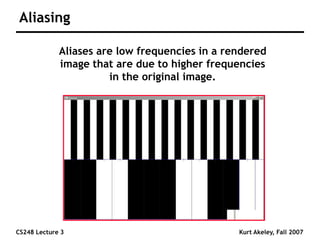
Aliasing
Aliases are low frequencies in a rendered
image that are due to higher frequencies
in the original image.
CS248 Lecture 3 Kurt Akeley, Fall 2007
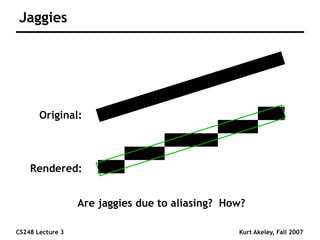
Jaggies
Are jaggies due to aliasing? How?
Original:
Rendered:
CS248 Lecture 3 Kurt Akeley, Fall 2007
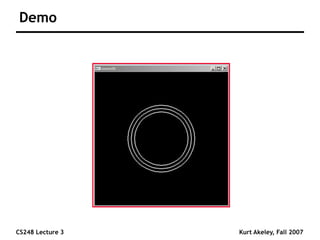
Demo
CS248 Lecture 3 Kurt Akeley, Fall 2007
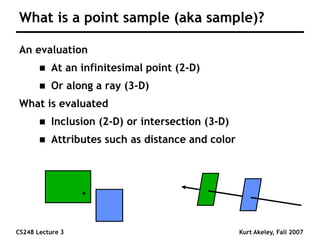
What is a point sample (aka sample)?
An evaluation
 At an infinitesimal point (2-D)
 Or along a ray (3-D)
What is evaluated
 Inclusion (2-D) or intersection (3-D)
 Attributes such as distance and color
CS248 Lecture 3 Kurt Akeley, Fall 2007
Why point samples?
Clear and unambiguous semantics
Matches theory well (as we’ll see)
Supports image assembly in the framebuffer
 will need to resolve visibility based on distance,
and this works well with point samples
Anything else just puts the problem off
 Exchange one large, complex scene for many
small, complex scenes
CS248 Lecture 3 Kurt Akeley, Fall 2007
Fourier theory
“Fourier’s theorem is not only one of the most
beautiful results of modern analysis, but it
may be said to furnish an indispensable
instrument in the treatment of nearly every
recondite question in modern physics.”
-- Lord Kelvin
CS248 Lecture 3 Kurt Akeley, Fall 2007
Reference sources
Marc Levoy’s notes
Ronald N. Bracewell, The Fourier Transform and its
Applications, Second Edition, McGraw-Hill, Inc.,
1978.
Private conversations with Pat Hanrahan
MATLAB
CS248 Lecture 3 Kurt Akeley, Fall 2007
Ground rules
You don’t have to be an engineer to get this
 We’re looking to develop instinct / understanding
 Not to be able to do the mathematics
We’ll make minimal use of equations
 No integral equations
 No complex numbers
Plots will be consistent
 Tick marks at unit distances
 Signal on left, Fourier transform on the right
CS248 Lecture 3 Kurt Akeley, Fall 2007
Dimensions
1-D
 Audio signal (time)
 Generic examples (x)
2-D
 Image (x and y)
3-D
 Animation (x, y, and time)
All examples in this presentation are 1-D
CS248 Lecture 3 Kurt Akeley, Fall 2007
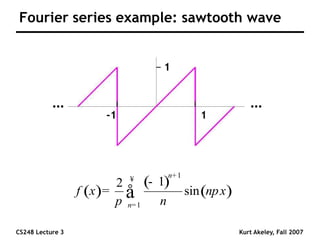
Fourier series
Any periodic function can be exactly
represented by a (typically infinite) sum
of harmonic sine and cosine functions.
Harmonics are integer multiples of the
fundamental frequency
CS248 Lecture 3 Kurt Akeley, Fall 2007
Fourier series example: sawtooth wave
…
…
( )
( )
( )
1
1
1
2
sin
n
n
f x n x
n
p
p
+
¥
=
-
= å
1
1
-1
CS248 Lecture 3 Kurt Akeley, Fall 2007
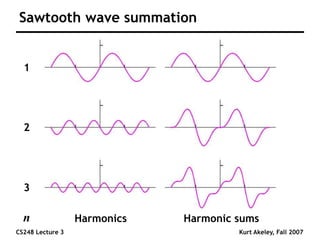
Sawtooth wave summation
Harmonics Harmonic sums
1
2
3
n
CS248 Lecture 3 Kurt Akeley, Fall 2007
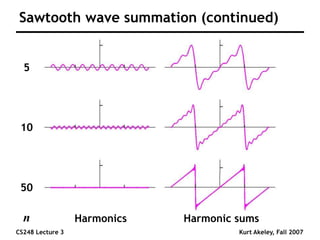
Sawtooth wave summation (continued)
Harmonics Harmonic sums
5
10
50
n
CS248 Lecture 3 Kurt Akeley, Fall 2007
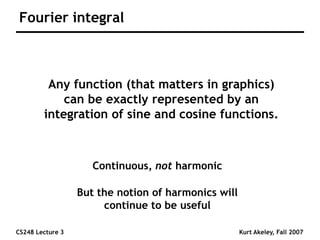
Fourier integral
Any function (that matters in graphics)
can be exactly represented by an
integration of sine and cosine functions.
Continuous, not harmonic
But the notion of harmonics will
continue to be useful
CS248 Lecture 3 Kurt Akeley, Fall 2007
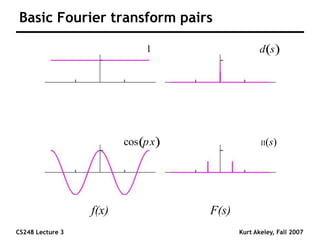
Basic Fourier transform pairs
1 ( )
s
d
f(x) F(s)
( )
cos x
p II(s)
CS248 Lecture 3 Kurt Akeley, Fall 2007
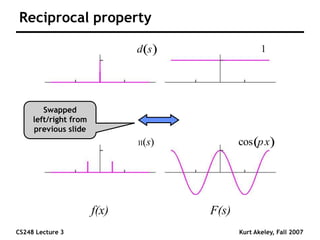
Reciprocal property
Swapped
left/right from
previous slide
f(x) F(s)
1
( )
cos x
p
( )
s
d
II(s)
CS248 Lecture 3 Kurt Akeley, Fall 2007
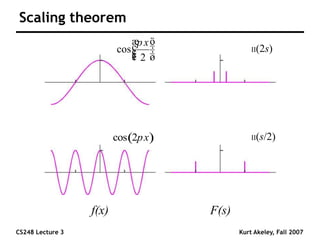
Scaling theorem
( )
cos 2 x
p
cos
2
x
p
æ ö
÷
ç ÷
ç ÷
ç
è ø
II(2s)
II(s/2)
f(x) F(s)
CS248 Lecture 3 Kurt Akeley, Fall 2007
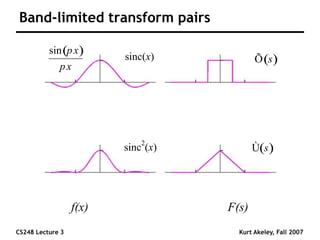
Band-limited transform pairs
( )
s
Ù
F(s)
f(x)
sinc(x)
( )
sin x
x
p
p
( )
s
Õ
sinc
2
(x)
CS248 Lecture 3 Kurt Akeley, Fall 2007
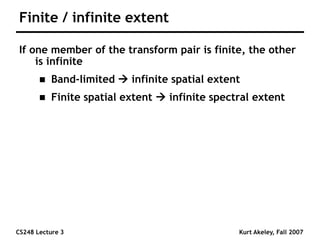
Finite / infinite extent
If one member of the transform pair is finite, the other
is infinite
 Band-limited  infinite spatial extent
 Finite spatial extent  infinite spectral extent
CS248 Lecture 3 Kurt Akeley, Fall 2007
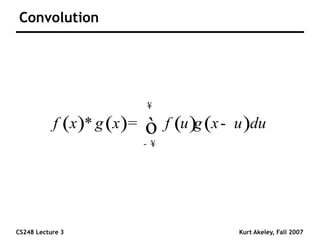
Convolution
( ) ( ) ( ) ( )
f x g x f u g x u du
¥
- ¥
* = -
ò
CS248 Lecture 3 Kurt Akeley, Fall 2007
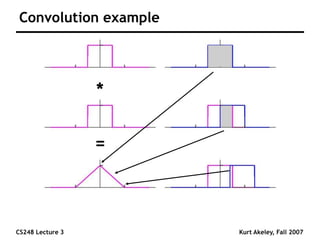
Convolution example
*
=
CS248 Lecture 3 Kurt Akeley, Fall 2007
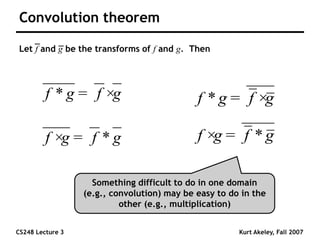
Convolution theorem
Let f and g be the transforms of f and g. Then
f g f g
* = ×
f g f g
× = *
f g f g
* = ×
f g f g
× = *
Something difficult to do in one domain
(e.g., convolution) may be easy to do in the
other (e.g., multiplication)
CS248 Lecture 3 Kurt Akeley, Fall 2007
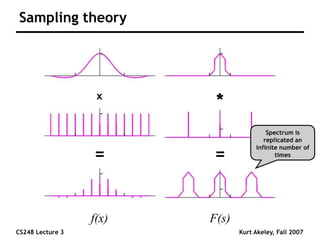
Sampling theory
x
=
*
=
F(s)
f(x)
Spectrum is
replicated an
infinite number of
times
CS248 Lecture 3 Kurt Akeley, Fall 2007
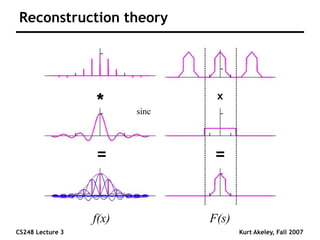
Reconstruction theory
x
=
*
=
F(s)
f(x)
sinc
CS248 Lecture 3 Kurt Akeley, Fall 2007
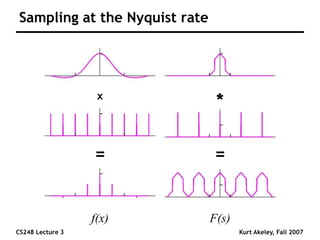
Sampling at the Nyquist rate
x
=
*
=
F(s)
f(x)
CS248 Lecture 3 Kurt Akeley, Fall 2007
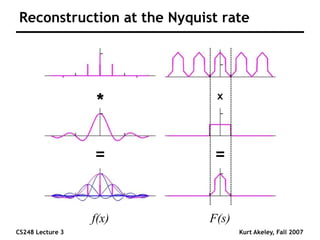
Reconstruction at the Nyquist rate
x
=
*
=
F(s)
f(x)
CS248 Lecture 3 Kurt Akeley, Fall 2007
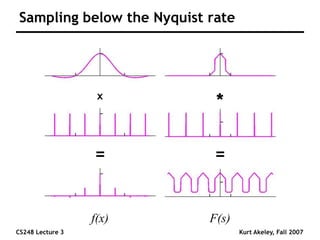
Sampling below the Nyquist rate
x
=
*
=
F(s)
f(x)
CS248 Lecture 3 Kurt Akeley, Fall 2007
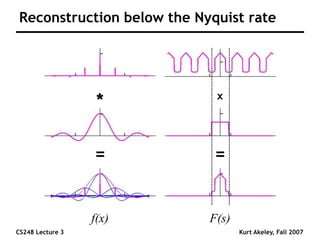
Reconstruction below the Nyquist rate
x
=
*
=
F(s)
f(x)
CS248 Lecture 3 Kurt Akeley, Fall 2007
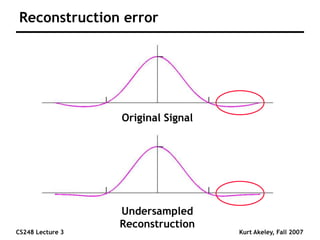
Reconstruction error
Original Signal
Undersampled
Reconstruction
CS248 Lecture 3 Kurt Akeley, Fall 2007
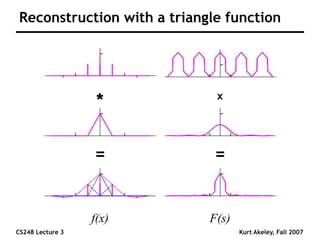
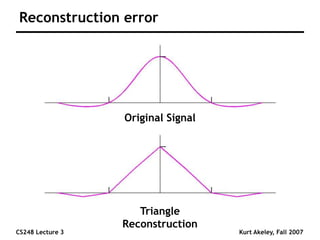
Reconstruction with a triangle function
x
=
*
=
F(s)
f(x)
CS248 Lecture 3 Kurt Akeley, Fall 2007
Reconstruction error
Original Signal
Triangle
Reconstruction
CS248 Lecture 3 Kurt Akeley, Fall 2007
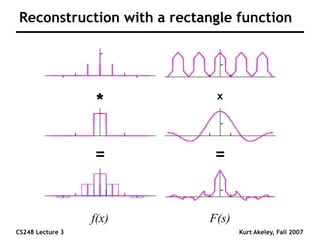
Reconstruction with a rectangle function
x
=
*
=
F(s)
f(x)
CS248 Lecture 3 Kurt Akeley, Fall 2007
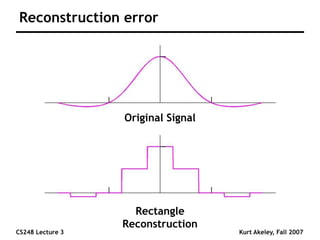
Reconstruction error
Original Signal
Rectangle
Reconstruction
CS248 Lecture 3 Kurt Akeley, Fall 2007
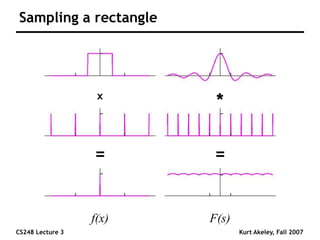
Sampling a rectangle
x
=
*
=
F(s)
f(x)
CS248 Lecture 3 Kurt Akeley, Fall 2007
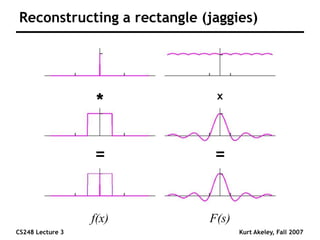
Reconstructing a rectangle (jaggies)
x
=
*
=
F(s)
f(x)
CS248 Lecture 3 Kurt Akeley, Fall 2007
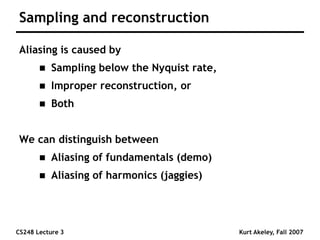
Sampling and reconstruction
Aliasing is caused by
 Sampling below the Nyquist rate,
 Improper reconstruction, or
 Both
We can distinguish between
 Aliasing of fundamentals (demo)
 Aliasing of harmonics (jaggies)
CS248 Lecture 3 Kurt Akeley, Fall 2007
Summary
Jaggies matter
 Create false cues
 Violate rule 1
Sampling is done at points (2-D) or along rays (3-D)
 Sufficient for depth sorting
 Matches theory
Fourier theory explains jaggies as aliasing. For correct
reconstruction:
 Signal must be band-limited
 Sampling must be at or above Nyquist rate
 Reconstruction must be done with a sinc function
CS248 Lecture 3 Kurt Akeley, Fall 2007
Assignments
Before Thursday’s class, read
 FvD 3.17 Antialiasing
Project 1:
 Breakout: a simple interactive game
 Demos Wednesday 10 October
CS248 Lecture 3 Kurt Akeley, Fall 2007
End

Sampling and Aliasing.ppt

  • 1.
    Sampling and Aliasing KurtAkeley CS248 Lecture 3 2 October 2007 http://graphics.stanford.edu/courses/cs248-07/
  • 2.
    CS248 Lecture 3Kurt Akeley, Fall 2007 Aliasing Aliases are low frequencies in a rendered image that are due to higher frequencies in the original image.
  • 3.
    CS248 Lecture 3Kurt Akeley, Fall 2007 Jaggies Are jaggies due to aliasing? How? Original: Rendered:
  • 4.
    CS248 Lecture 3Kurt Akeley, Fall 2007 Demo
  • 5.
    CS248 Lecture 3Kurt Akeley, Fall 2007 What is a point sample (aka sample)? An evaluation  At an infinitesimal point (2-D)  Or along a ray (3-D) What is evaluated  Inclusion (2-D) or intersection (3-D)  Attributes such as distance and color
  • 6.
    CS248 Lecture 3Kurt Akeley, Fall 2007 Why point samples? Clear and unambiguous semantics Matches theory well (as we’ll see) Supports image assembly in the framebuffer  will need to resolve visibility based on distance, and this works well with point samples Anything else just puts the problem off  Exchange one large, complex scene for many small, complex scenes
  • 7.
    CS248 Lecture 3Kurt Akeley, Fall 2007 Fourier theory “Fourier’s theorem is not only one of the most beautiful results of modern analysis, but it may be said to furnish an indispensable instrument in the treatment of nearly every recondite question in modern physics.” -- Lord Kelvin
  • 8.
    CS248 Lecture 3Kurt Akeley, Fall 2007 Reference sources Marc Levoy’s notes Ronald N. Bracewell, The Fourier Transform and its Applications, Second Edition, McGraw-Hill, Inc., 1978. Private conversations with Pat Hanrahan MATLAB
  • 9.
    CS248 Lecture 3Kurt Akeley, Fall 2007 Ground rules You don’t have to be an engineer to get this  We’re looking to develop instinct / understanding  Not to be able to do the mathematics We’ll make minimal use of equations  No integral equations  No complex numbers Plots will be consistent  Tick marks at unit distances  Signal on left, Fourier transform on the right
  • 10.
    CS248 Lecture 3Kurt Akeley, Fall 2007 Dimensions 1-D  Audio signal (time)  Generic examples (x) 2-D  Image (x and y) 3-D  Animation (x, y, and time) All examples in this presentation are 1-D
  • 11.
    CS248 Lecture 3Kurt Akeley, Fall 2007 Fourier series Any periodic function can be exactly represented by a (typically infinite) sum of harmonic sine and cosine functions. Harmonics are integer multiples of the fundamental frequency
  • 12.
    CS248 Lecture 3Kurt Akeley, Fall 2007 Fourier series example: sawtooth wave … … ( ) ( ) ( ) 1 1 1 2 sin n n f x n x n p p + ¥ = - = å 1 1 -1
  • 13.
    CS248 Lecture 3Kurt Akeley, Fall 2007 Sawtooth wave summation Harmonics Harmonic sums 1 2 3 n
  • 14.
    CS248 Lecture 3Kurt Akeley, Fall 2007 Sawtooth wave summation (continued) Harmonics Harmonic sums 5 10 50 n
  • 15.
    CS248 Lecture 3Kurt Akeley, Fall 2007 Fourier integral Any function (that matters in graphics) can be exactly represented by an integration of sine and cosine functions. Continuous, not harmonic But the notion of harmonics will continue to be useful
  • 16.
    CS248 Lecture 3Kurt Akeley, Fall 2007 Basic Fourier transform pairs 1 ( ) s d f(x) F(s) ( ) cos x p II(s)
  • 17.
    CS248 Lecture 3Kurt Akeley, Fall 2007 Reciprocal property Swapped left/right from previous slide f(x) F(s) 1 ( ) cos x p ( ) s d II(s)
  • 18.
    CS248 Lecture 3Kurt Akeley, Fall 2007 Scaling theorem ( ) cos 2 x p cos 2 x p æ ö ÷ ç ÷ ç ÷ ç è ø II(2s) II(s/2) f(x) F(s)
  • 19.
    CS248 Lecture 3Kurt Akeley, Fall 2007 Band-limited transform pairs ( ) s Ù F(s) f(x) sinc(x) ( ) sin x x p p ( ) s Õ sinc 2 (x)
  • 20.
    CS248 Lecture 3Kurt Akeley, Fall 2007 Finite / infinite extent If one member of the transform pair is finite, the other is infinite  Band-limited  infinite spatial extent  Finite spatial extent  infinite spectral extent
  • 21.
    CS248 Lecture 3Kurt Akeley, Fall 2007 Convolution ( ) ( ) ( ) ( ) f x g x f u g x u du ¥ - ¥ * = - ò
  • 22.
    CS248 Lecture 3Kurt Akeley, Fall 2007 Convolution example * =
  • 23.
    CS248 Lecture 3Kurt Akeley, Fall 2007 Convolution theorem Let f and g be the transforms of f and g. Then f g f g * = × f g f g × = * f g f g * = × f g f g × = * Something difficult to do in one domain (e.g., convolution) may be easy to do in the other (e.g., multiplication)
  • 24.
    CS248 Lecture 3Kurt Akeley, Fall 2007 Sampling theory x = * = F(s) f(x) Spectrum is replicated an infinite number of times
  • 25.
    CS248 Lecture 3Kurt Akeley, Fall 2007 Reconstruction theory x = * = F(s) f(x) sinc
  • 26.
    CS248 Lecture 3Kurt Akeley, Fall 2007 Sampling at the Nyquist rate x = * = F(s) f(x)
  • 27.
    CS248 Lecture 3Kurt Akeley, Fall 2007 Reconstruction at the Nyquist rate x = * = F(s) f(x)
  • 28.
    CS248 Lecture 3Kurt Akeley, Fall 2007 Sampling below the Nyquist rate x = * = F(s) f(x)
  • 29.
    CS248 Lecture 3Kurt Akeley, Fall 2007 Reconstruction below the Nyquist rate x = * = F(s) f(x)
  • 30.
    CS248 Lecture 3Kurt Akeley, Fall 2007 Reconstruction error Original Signal Undersampled Reconstruction
  • 31.
    CS248 Lecture 3Kurt Akeley, Fall 2007 Reconstruction with a triangle function x = * = F(s) f(x)
  • 32.
    CS248 Lecture 3Kurt Akeley, Fall 2007 Reconstruction error Original Signal Triangle Reconstruction
  • 33.
    CS248 Lecture 3Kurt Akeley, Fall 2007 Reconstruction with a rectangle function x = * = F(s) f(x)
  • 34.
    CS248 Lecture 3Kurt Akeley, Fall 2007 Reconstruction error Original Signal Rectangle Reconstruction
  • 35.
    CS248 Lecture 3Kurt Akeley, Fall 2007 Sampling a rectangle x = * = F(s) f(x)
  • 36.
    CS248 Lecture 3Kurt Akeley, Fall 2007 Reconstructing a rectangle (jaggies) x = * = F(s) f(x)
  • 37.
    CS248 Lecture 3Kurt Akeley, Fall 2007 Sampling and reconstruction Aliasing is caused by  Sampling below the Nyquist rate,  Improper reconstruction, or  Both We can distinguish between  Aliasing of fundamentals (demo)  Aliasing of harmonics (jaggies)
  • 38.
    CS248 Lecture 3Kurt Akeley, Fall 2007 Summary Jaggies matter  Create false cues  Violate rule 1 Sampling is done at points (2-D) or along rays (3-D)  Sufficient for depth sorting  Matches theory Fourier theory explains jaggies as aliasing. For correct reconstruction:  Signal must be band-limited  Sampling must be at or above Nyquist rate  Reconstruction must be done with a sinc function
  • 39.
    CS248 Lecture 3Kurt Akeley, Fall 2007 Assignments Before Thursday’s class, read  FvD 3.17 Antialiasing Project 1:  Breakout: a simple interactive game  Demos Wednesday 10 October
  • 40.
    CS248 Lecture 3Kurt Akeley, Fall 2007 End