

Sampling
• Sampling
• Population
• Elements
• Subject
• Sampling unit
• Sampling process
• Sampling units
Sampling
• The process of selecting right individual objects,
or events as representative for the entire
population is known as sampling.
For example
• Sensex-30 companies
• Nifty- 50 companies
Population
• The population refers to the entire group of
people, events or things of interest that
researcher wishes to investigate and wants to
make inferences.
For example
• If researcher wants to know the investment
pattern of Mumbai city then all residents of
Mumbai will be the population.
Element
• An element is a single member of the
population.
e.g.
• Total students of GICED is 1800, then each
student will be the element.
Sample
• It is a subject of the population
• It comprises some members selected from it
• In other words, some, but not all elements of the
population form sample.
• By studying the sample, the researcher should be
able to draw conclusion that are generalized to the
population of interest
E.g.
• Sensex-BSE
• Nifty-NSE
Sampling unit
• It is the element or set of element that is
available for set selection in some stage of the
sampling process
Subject
• It is a single member of the sample just as an
element of the population.
Reasons for sampling
• Practically impossible to collect data from, or
examine every element
• Even it is possible, it is prohibitive in terms of
time, cost and human resources
• Study of sample rather than population is also
sometimes likely to produce more reliable data
especially when a large number of elements is
involved
• E.g. election survey by media
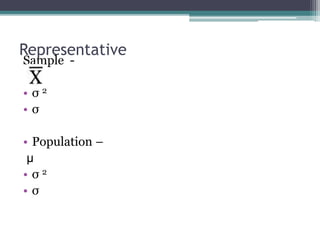
Representative
Sample -
• σ 2
• σ
• Population –
µ
• σ 2
• σ
Sampling process
• Define population
• Determine sample frame
• Determine sample design
• Determine appropriate sample size
• Execute sampling process
Define population
• It must be defined in terms of elements,
geographical boundaries and time
Determine sample frame
• It is a representation of all the elements in the
population from which the sample is drawn
E.g.
• The payroll of an organization would serve as the
sampling frame if its members are to be studied
Sampling design
Two major types of sampling design
• Probability
• Non probability
Probability
• The elements in the population have some
known, non-zero chance or probability of being
selected as a sample object
• This design is used when the representative of
the sample is of importance in the interest of
wider generalizability
• Non probability
• Elements in the population do not have a known
or predetermined chance of being selected as a
subject
• When time and other factors, rather than
generalizability, become critical, non probability
sampling is generally used
Determine sample size
• Is a large sample better than a small sample?
• Decision about how large the sample size should
be a very difficult one.
• We can summarize the factors affecting factors
affecting decision on sample size as
• Research objective
• Cost and time constraint
• Amount of the variability in the population itself
Probability sampling
1. Unrestricted or simple random sampling
2. Restricted or complex probability sampling
• Systematic sampling
• Stratified random sampling
• Cluster sampling
• Double sampling or Area sampling
Unrestricted or simple random sampling
• In this sampling every element in the population
has known and equal chance of being selected as
a subject
• This sampling design, has the least bias and
offers the most generalizability
• However this sampling process could become
cumbersome and expenive
Restricted or complex probability sampling
• These probability sampling procedures offer a
viable and sometimes more efficient design
• More information can be obtained
Systematic sampling
It involves drawing every nth element in the
population starting with randomly chosen
element between 1 & nth element
Stratified random sampling
• It involves a process of segregation followed by
random selection of subject from each stratum
Cluster sampling
• In this target population is first divided into
clusters
• A specific cluster sampling is area sampling
• Double sampling
• When further information is needed from subset
of the first group from which some information
has already been collected for the same study.
Non probability sampling
• There are two types
1. Convenience
2. Purposive
Convenience
• Collection of information from members of the
population who are conveniently available to
provide it.
Purposive
1. Judgment
2. Quota
1. Judgment
• Most advantageously placed
• In the best position to provide information
required
Quota
• Certain group
Sampling

Sampling

  • 1.
  • 2.
    • Sampling • Population •Elements • Subject • Sampling unit • Sampling process • Sampling units
  • 3.
    Sampling • The processof selecting right individual objects, or events as representative for the entire population is known as sampling. For example • Sensex-30 companies • Nifty- 50 companies
  • 4.
    Population • The populationrefers to the entire group of people, events or things of interest that researcher wishes to investigate and wants to make inferences. For example • If researcher wants to know the investment pattern of Mumbai city then all residents of Mumbai will be the population.
  • 5.
    Element • An elementis a single member of the population. e.g. • Total students of GICED is 1800, then each student will be the element.
  • 6.
    Sample • It isa subject of the population • It comprises some members selected from it • In other words, some, but not all elements of the population form sample. • By studying the sample, the researcher should be able to draw conclusion that are generalized to the population of interest E.g. • Sensex-BSE • Nifty-NSE
  • 7.
    Sampling unit • Itis the element or set of element that is available for set selection in some stage of the sampling process
  • 8.
    Subject • It isa single member of the sample just as an element of the population.
  • 9.
    Reasons for sampling •Practically impossible to collect data from, or examine every element • Even it is possible, it is prohibitive in terms of time, cost and human resources • Study of sample rather than population is also sometimes likely to produce more reliable data especially when a large number of elements is involved • E.g. election survey by media
  • 10.
    Representative Sample - • σ2 • σ • Population – µ • σ 2 • σ
  • 11.
    Sampling process • Definepopulation • Determine sample frame • Determine sample design • Determine appropriate sample size • Execute sampling process
  • 12.
    Define population • Itmust be defined in terms of elements, geographical boundaries and time
  • 13.
    Determine sample frame •It is a representation of all the elements in the population from which the sample is drawn E.g. • The payroll of an organization would serve as the sampling frame if its members are to be studied
  • 14.
    Sampling design Two majortypes of sampling design • Probability • Non probability
  • 15.
    Probability • The elementsin the population have some known, non-zero chance or probability of being selected as a sample object • This design is used when the representative of the sample is of importance in the interest of wider generalizability
  • 16.
    • Non probability •Elements in the population do not have a known or predetermined chance of being selected as a subject • When time and other factors, rather than generalizability, become critical, non probability sampling is generally used
  • 17.
    Determine sample size •Is a large sample better than a small sample? • Decision about how large the sample size should be a very difficult one. • We can summarize the factors affecting factors affecting decision on sample size as • Research objective • Cost and time constraint • Amount of the variability in the population itself
  • 18.
    Probability sampling 1. Unrestrictedor simple random sampling 2. Restricted or complex probability sampling • Systematic sampling • Stratified random sampling • Cluster sampling • Double sampling or Area sampling
  • 19.
    Unrestricted or simplerandom sampling • In this sampling every element in the population has known and equal chance of being selected as a subject • This sampling design, has the least bias and offers the most generalizability • However this sampling process could become cumbersome and expenive
  • 20.
    Restricted or complexprobability sampling • These probability sampling procedures offer a viable and sometimes more efficient design • More information can be obtained
  • 21.
    Systematic sampling It involvesdrawing every nth element in the population starting with randomly chosen element between 1 & nth element
  • 22.
    Stratified random sampling •It involves a process of segregation followed by random selection of subject from each stratum
  • 23.
    Cluster sampling • Inthis target population is first divided into clusters • A specific cluster sampling is area sampling
  • 24.
    • Double sampling •When further information is needed from subset of the first group from which some information has already been collected for the same study.
  • 25.
    Non probability sampling •There are two types 1. Convenience 2. Purposive
  • 26.
    Convenience • Collection ofinformation from members of the population who are conveniently available to provide it.
  • 27.
  • 28.
    1. Judgment • Mostadvantageously placed • In the best position to provide information required
  • 29.