SALES TRAINING
Playbook & Toolkit
Follow this simple step-by-step playbook to train Sales on a consultative approach
to selling that increases your win-rate, dealsize and % reps attaining quota.
Table of Contents SALES TRAINING
Introduction 05
Conclusion 27
Framework 03
Maturity Model 04
About This Playbook 28
Assess Current Situation 08
11Market Positioning
14The Sales Process
17Consultative Selling
22Key Account Planning
25Sales Metrics & Reports
stage
stage
stage
stage
stage
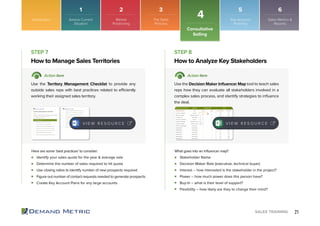
stage
1
2
3
4
5
6
Buying Process Stage
Template
Customer Profile Tool
Competitive Analysis
Tool
Competitive Products
Sales Reference Sales Forecasting Tool
Feature Advantage
Benefit Tool
Sales Productivity
Metrics (Monthly)
Sales Productivity
Metrics (Quarterly)
Key Account
Reporting Tool
Key Account
Analysis Tool
Sales Script Template
Sales Proposal
Template
Unique Selling
Proposition Template
Bid or No-Bid
Assessment
Sales Training
Assessment
Sales Skills
Assessment
Sales Enablement
Strategy Scorecard
SALES TRAINING
Framework
Leverage the framework below to quickly empower
your organization’s sales training strategy.
Click the buttons below to access all related
training, tools, templates, and other resources.
Qualified Lead
Definition Tool
Sales Playbook
Template
Account Scoring
Template
SPIN Selling
Questions Tool
Sales Productivity
Metrics (Daily)
Sales Presentation
Template
Decision Maker
Influencer Map
Objection
Responses Tool
Territory Management
Checklist
SELL4 PLAN5POSITION2 PROCESS3 MEASURE61 ASSESS
4SALES TRAINING
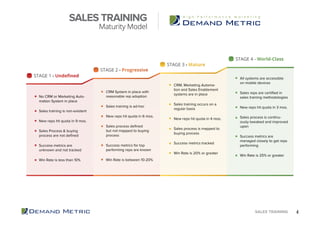
STAGE 1 - Undefined
STAGE 2 - Progressive
STAGE 3 - Mature
STAGE 4 - World-Class
No CRM or Marketing Auto-
mation System in place
Sales training is non-existent
New reps hit quota in 9 mos.
Sales Process & buying
process are not defined
Success metrics are
unknown and not tracked
Win Rate is less than 10%
CRM System in place with
reasonable rep adoption
Sales training is ad-hoc
New reps hit quota in 6 mos.
Sales process defined
but not mapped to buying
process
Success metrics for top
performing reps are known
Win Rate is between 10-20%
CRM, Marketing Automa-
tion and Sales Enablement
systems are in place
Sales training occurs on a
regular basis
New reps hit quota in 4 mos.
Sales process is mapped to
buying process
Success metrics tracked
Win Rate is 20% or greater
All systems are accessible
on mobile devices
Sales reps are certified in
sales training methodologies
New reps hit quota in 3 mos.
Sales process is continu-
ously tweaked and improved
upon
Success metrics are
managed closely to get reps
performing
Win Rate is 25% or greater
SALES TRAINING
Maturity Model
5SALES TRAINING
Assess Current
Situation
Market
Positioning
The Sales
Process
Consultative
Selling
Key Account
Planning
Sales Metrics &
Reports
1 2 3 4 5 6
Introduction
How to Use This Playbook
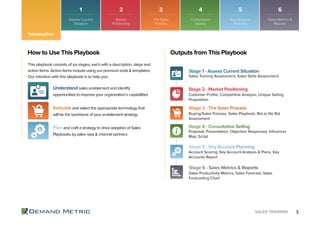
This playbook consists of six stages, each with a description, steps and
action items. Action items include using our premium tools & templates.
Our intention with this playbook is to help you:
Plan and craft a strategy to drive adoption of Sales
Playbooks by sales reps & channel partners
Understand sales enablement and identify
opportunities to improve your organization’s capabilities
Evaluate and select the appropriate technology that
will be the backbone of your enablement strategy
Outputs from This Playbook
Stage 1 - Assess Current Situation
Stage 4 - Consultative Selling
Sales Training Assessment, Sales Skills Assessment
Proposal, Presentation, Objection Responses, Influencer
Map, Script
Stage 2 - Market Positioning
Stage 5 - Key Account Planning
Customer Profile, Competitive Analysis, Unique Selling
Proposition
Account Scoring, Key Account Analysis & Plans, Key
Accounts Report
Stage 3 - The Sales Process
Stage 6 - Sales Metrics & Reports
Buying/Sales Process, Sales Playbook, Bid or No Bid
Assessment
Sales Productivity Metrics, Sales Forecast, Sales
Forecasting Chart
6SALES TRAINING
Sales Enablement Defined
“Consultative selling is based on the salesperson’s ability
to: act as a valued consultant to the prospect; identify
their most pressing needs, challenges and points of pain;
understand the impact of those needs in terms of risks
& opportunities; and only then communicate solutions to
those needs with related products and services.”
Jesse Hopps
CEO at Demand Metric
Demand Metric’s PATCHES Framework
Use this acronym to remember a solid framework for Sales
Enablement in your organization:
Playbooks: build a Sales Playbook to equip reps with the
knowledge, tools, and activities they need to succeed.
Assets: maintain content and digital assets in a system that
allows sales reps to rate quality and usefulness.
Training: consider methodologies such as SPIN Selling or
Miller Heiman to standardize your sales process.
Commitment: get a formal commitment from sales reps to
use and rate all materials provided by Marketing.
Hiring: sales reps with the same skills and attitudes as your
current star performers.
Enabling Technology: CRM, Marketing Automation and
Sales Enablement systems should work on mobile devices.
Sales Process: map your sales process to the buying
process and build content based on key buyer personas.
P
A
T
C
H
E
S
Assess Current
Situation
Market
Positioning
The Sales
Process
Consultative
Selling
Key Account
Planning
Sales Metrics &
Reports
1 2 3 4 5 6
Introduction
7SALES TRAINING
What Goes Inside a Sales Playbook?
A Sales Playbook is a collection of information, knowledge, sales
tools, and activities that have been proven to assist with closing busi-
ness in a variety of common sales situations.
You can structure your playbook like this:
1.	 Company Overview
2.	 Marketing Insights
3.	 Sales Opportunities
4.	 Stage 1 – Need / Prospecting
5.	 Stage 2 – Discovery / Qualification
6.	 Stage 3 – Consideration / Demo
7.	 Stage 4 – Decision / Proposal
8.	 Stage 5 – Review / Contract
Assess Current
Situation
Market
Positioning
The Sales
Process
Consultative
Selling
Key Account
Planning
Sales Metrics &
Reports
1 2 3 4 5 6
Introduction
SALES PLAYBOOK
Template
V I E W R E S O U R C E
Assess Current Situation
STAGE 1
SALES TRAINING
In this Stage, you will focus your efforts around analyzing your current sales training process, identifying the
skills gaps of your existing sales reps, and developing a plan for improving sales training going forward.
Key steps in this stage include:
STEP 1:	Conduct a Sales Training Assessment
STEP 2:	Assess Skills of Sales Team
STEP 3:	Create a Sales Strategy Scorecard
9SALES TRAINING
Introduction
Assess Current
Situation
1
Sales Process
Self-Management & Planning
Business Development
Sales Presentations
Relationship Management
Closing Sales
Relevant Knowledge
Sales Skills
Professionalism
Account Management
Customer Service
Conduct a Sales Training Assessment Assess Skills of Sales Team
STEP 1 STEP 2
Action Item Action Item
Use the Sales Training Assessment to determine your
organization’s strengths and weaknesses when it comes to
preparing your sales representatives to close deals.
Use the Sales Skills Assessment to evaluate the skills of your
existing sales reps, compare all with your top rep and deter-
mine the team averages and areas of needed improvement.
Areas of the assessment include: Sections of the Skills Assessment include:
V I E W R E S O U R C E V I E W R E S O U R C E
Market
Positioning
The Sales
Process
Consultative
Selling
Key Account
Planning
Sales Metrics &
Reports
2 3 4 5 6
10SALES TRAINING
Improve Average Deal Size
Reduce Length of Sales Cycle
Gain Adoption of Sales Playbook
Audit Assets to Identify Gaps
Create a Strategy Scorecard
STEP 3
Action Item
Use the Sales Enablement Strategy Scorecard to document
your high level sales enablement objectives, initiatives, KPIs
and target timeframes.
Examples of common objectives include:
V I E W R E S O U R C E
Introduction
Assess Current
Situation
1 Market
Positioning
The Sales
Process
Consultative
Selling
Key Account
Planning
Sales Metrics &
Reports
2 3 4 5 6
Market Positioning
STAGE 2
In this Stage you will start the training process by helping your sales team understand the market you
operate in, needs of the buyers, key competitors, and how to differentiate your products and services.
You will perform the following actions to train Sales on your market position:
STEP 1:	Communicate “Ideal” Customer Profile
STEP 2:	Present In-Depth Competitive Analysis
STEP 3:	Train Reps on Unique Selling Proposition
STEP 4:	Provide Competitive Products Reference
SALES TRAINING
12SALES TRAINING
Introduction
2
Market
Positioning
Target Industries
Company Size
Location
Environment
Offered
Available via Partner
Differentiator (category leader)
Not Available
Technical Buyers
Economic Buyers
End Users
Communicate “Ideal” Customer Profile Present In-Depth Competitive Analysis
STEP 1 STEP 2
Action Item Action Item
Use the Customer Profile Tool to share with sales reps infor-
mation about the target customer company and the buyer
personas in the decision making process they will encounter.
Use our Competitive Analysis Tool to highlight key
competitors in your industry, their relative strengths and
weakness, and how they are positioned on the competi-
tive positioning map.
The Customer Profile should include information on: How can you categorize competitive product features:
V I E W R E S O U R C E V I E W R E S O U R C E
Assess Current
Situation
The Sales
Process
Consultative
Selling
Key Account
Planning
Sales Metrics &
Reports
1 3 4 5 6
13SALES TRAINING
Product Name
Description
Competitors
Value Drivers
Rankings
Differentiation Chart
Positioning Map
Top 5 Competitor Profiles
Customers
Product Features
USP Statements
Train Reps on Unique Selling Proposition Provide Competitive Products Reference
STEP 3 STEP 4
Action Item Action Item
Use our Unique Selling Proposition Template to identify any
unique selling features of your products to help sales reps
differentiate your products when speaking with prospects.
Use our Competitive Products Sales Reference to give
sales reps a take-away from training that contains all
competitive products and compares them feature-by-fea-
ture with your products.
Key information to include in your worksheet: This analysis will provide you with:
V I E W R E S O U R C EV I E W R E S O U R C E
Introduction
2
Market
Positioning
Assess Current
Situation
The Sales
Process
Consultative
Selling
Key Account
Planning
Sales Metrics &
Reports
1 3 4 5 6
The Sales Process
STAGE 3
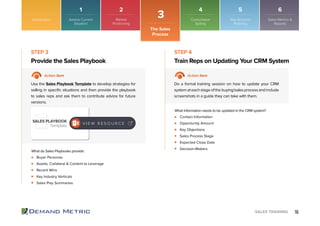
In this Stage you will train sales reps on your standardized sales process.
Key activities include:
STEP 1:	Map Buying & Selling Processes with Reps
STEP 2:	Teach How to Qualify Sales Opportunities
STEP 3:	Provide the Sales Playbook
STEP 4:	Train Reps on Updating Your CRM System
SALES TRAINING
Note: This methodology assumes you already have a SFA/CRM system in place.
15SALES TRAINING
Need / Prospecting
Discovery / Qualification
Consideration / Demo
Decision / Proposal
Purchase / Contract
Company (size, industry, location)
Contact (seniority level, decision-maker)
Buying Stage & Needs
Spending Authority
Recentness of Activity (web visits, downloads, call, etc.)
Map Buying & Selling Processes with Reps Teach How to Qualify Sales Opportunities
STEP 1 STEP 2
Action Item Action Item
Use the Buying Process Stage Template to teach reps how
your sales process aligns with the buying process and what
actions need to happen at each stage of the process.
Use the Qualified Lead Definition Tool to outline to sales
reps the key criteria required for a sales lead to be consid-
ered qualified. Also, use our Bid or No-Bid Assessment tool
if appropriate.
Key stages in the buying/selling process: Key qualification criteria:
Introduction
The Sales
Process
3
V I E W R E S O U R C E V I E W R E S O U R C E
Assess Current
Situation
Market
Positioning
Consultative
Selling
Key Account
Planning
Sales Metrics &
Reports
1 2 4 5 6
16SALES TRAINING
Buyer Personas
Assets, Collateral & Content to Leverage
Recent Wins
Key Industry Verticals
Sales Play Summaries
Contact Information
Opportunity Amount
Key Objections
Sales Process Stage
Expected Close Date
Decision-Makers
Provide the Sales Playbook Train Reps on Updating Your CRM System
STEP 3 STEP 4
Action Item Action Item
Use the Sales Playbook Template to develop strategies for
selling in specific situations and then provide the playbook
to sales reps and ask them to contribute advice for future
versions.
Do a formal training session on how to update your CRM
systemateachstageofthebuying/salesprocessandinclude
screenshots in a guide they can take with them.
What do Sales Playbooks provide:
What information needs to be updated in the CRM system?
Introduction
The Sales
Process
3Assess Current
Situation
Market
Positioning
Consultative
Selling
Key Account
Planning
Sales Metrics &
Reports
1 2 4 5 6
SALES PLAYBOOK
Template
V I E W R E S O U R C E
Consultative Selling
STAGE 4
To this point, you have trained your sales reps on the market, your positioning and the sales process.
Now, it’s time to teach them the consultative selling techniques they will need to be successful.
In this Stage, you will train your reps on the following:
STEP 1:	Asking Questions to Create Need
STEP 2:	Relating Needs to Relevant Features
STEP 3:	How to Communicate Value
STEP 4:	How to Deal with Objections
STEP 5:	How to Present Your Solution
STEP 6:	How to Customize a Proposal
STEP 7:	How to Manage Sales Territories
STEP 8:	How to Analyze Stakeholders
SALES TRAINING
18SALES TRAINING
Introduction
Consultative
Selling
4
Situation (how long have you worked in I/T?)
Problem (what is keeping you up at night?)
Implication (what is the impact of an unsuccessful implementation?)
Need-Payoff (how would success on this project affect your career?)
Advantages – generic benefits of a given product feature
(i.e. ‘you will save time if you buy our product.’)
Benefits – real benefits only apply to prospects who have
a need and will value the feature you are talking about. (i.e.
‘based on our conversation, you should save 6 hours on
your existing process by implementing our solution.’)
Asking Questions to Create Need Related Needs to Relevant Features
STEP 1 STEP 2
Action Item Action Item
Use the SPIN Selling Questions Tool to teach sales reps
how to consult their prospects and customers, earn their
trust and respect, and understand their most pressing busi-
ness challenges.
Use the Feature Advantage Benefit Tool to teach sales
reps how to relate the needs of their prospects to the right
features of your product or solution.
Types of questions to ask: What is the difference between an advantage and a benefit?
V I E W R E S O U R C EV I E W R E S O U R C E
Note – This method is derived from Neil Rackham’s SPIN
Selling methodology.
Assess Current
Situation
Market
Positioning
The Sales
Process
Key Account
Planning
Sales Metrics &
Reports
1 2 3 5 6
19SALES TRAINING
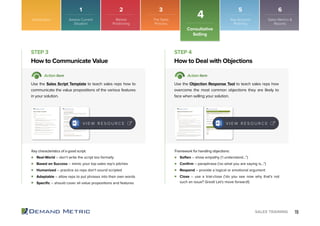
Real-World – don’t write the script too formally
Based on Success – mimic your top sales rep’s pitches
Humanized – practice so reps don’t sound scripted
Adaptable – allow reps to put phrases into their own words
Specific – should cover all value propositions and features
Soften – show empathy (‘I understand…”)
Confirm – paraphrase (‘so what you are saying is…”)
Respond – provide a logical or emotional argument
Close – use a trial-close (‘do you see now why that’s not
such an issue? Great! Let’s move forward!)
How to Communicate Value How to Deal with Objections
STEP 3 STEP 4
Action Item Action Item
Use the Sales Script Template to teach sales reps how to
communicate the value propositions of the various features
in your solution.
Use the Objection Response Tool to teach sales reps how
overcome the most common objections they are likely to
face when selling your solution.
Key characteristics of a good script: Framework for handling objections:
V I E W R E S O U R C EV I E W R E S O U R C E
Introduction
Consultative
Selling
4Assess Current
Situation
Market
Positioning
The Sales
Process
Key Account
Planning
Sales Metrics &
Reports
1 2 3 5 6
20SALES TRAINING
Introductions – show who is on the call today
Our Understanding – the prospect’s issues & needs
Our Approach – how your solution meets those needs
Pricing – solution costs and timeframe for delivery
Questions & Answers – leave time for more dialogue
Contact Information – how to reach each participant
Quick Follow-Up – deliver proposal within 24 hours
Proof Read – ensure no spelling mistakes
Be Thorough – avoid ‘unsupervised’ thinking
Pricing – be clear and include all relevant costs
Guarantees – include warranties and SLA
How to Present Your Solution How to Customize a Proposal
STEP 5 STEP 6
Action Item Action Item
Use the Sales Presentation Template to create a stan-
dardized sales presentation slide deck, and then train your
sales reps on how to customize it depending on the selling
situation.
Use the Sales Proposal Template to create a standardized
sales proposal, and then train your sales reps on how to
customize it depending on the selling situation.
Here is a proven format for presenting your solution: A few tips for winning more proposals:
SALES
PRESENTATION
Template
V I E W R E S O U R C E V I E W R E S O U R C E
Introduction
Consultative
Selling
4Assess Current
Situation
Market
Positioning
The Sales
Process
Key Account
Planning
Sales Metrics &
Reports
1 2 3 5 6
21SALES TRAINING
Identify your sales quota for the year & average sale
Determine the number of sales required to hit quota
Use closing ratios to identify number of new prospects required
Figure out number of contact requests needed to generate prospects
Create Key Account Plans for any large accounts
Stakeholder Name
Decision Maker Role (executive, technical buyer)
Interest – how interested is the stakeholder in the project?
Power – how much power does this person have?
Buy-In – what is their level of support?
Flexibility – how likely are they to change their mind?
How to Manage Sales Territories How to Analyze Key Stakeholders
STEP 7 STEP 8
Action Item Action Item
Use the Territory Management Checklist to provide any
outside sales reps with best practices related to efficiently
working their assigned sales territory.
Use the Decision Maker Influencer Map tool to teach sales
reps how they can evaluate all stakeholders involved in a
complex sales process, and identify strategies to influence
the deal.
Here are some ‘best practices’ to consider: What goes into an influencer map?
V I E W R E S O U R C EV I E W R E S O U R C E
Introduction
Consultative
Selling
4Assess Current
Situation
Market
Positioning
The Sales
Process
Key Account
Planning
Sales Metrics &
Reports
1 2 3 5 6
Key Account Planning
STAGE 5
In this Stage you will be training your reps on how to score their accounts, analyze key accounts,
develop an action plan for each, and then report on the status of each key account.
The training you will be rolling out to sales reps in this stage include:
STEP 1:	How to Score Accounts
STEP 2:	HowtoAnalyze&PlanforKeyAccounts
STEP 3:	How to Report on Key Accounts
SALES TRAINING
23SALES TRAINING
Introduction
Key Account
Planning
5
Industry
Company Size
Decision Maker
Current Need
Opportunity Size
Purchase History
Account Intelligence & Unknowns
Current & Forecasted Sales
Value Chain
Key Success Factors
Competition
Action Plan
How to Score Accounts How to Analyze & Plan for Key Accounts
STEP 1 STEP 2
Action Item Action Item
Use the Account Scoring Template to train sales reps on
how they can score each of their accounts to identify the key
accounts in their customer-base or sales territory.
Use the Key Account Analysis Tool to train sales reps on
how to identify sales opportunities and develop key account
action plans within their selected group of key accounts.
What criteria can you use to score accounts? What goes into a key account analysis & action plan?
V I E W R E S O U R C EV I E W R E S O U R C E
Assess Current
Situation
Market
Positioning
The Sales
Process
Consultative
Selling
Sales Metrics &
Reports
1 2 3 4 6
24SALES TRAINING
STEP 3
Account Name
Account Grade or Score (A,B,C,D)
Region or Territory
Account Plan Status (complete or not complete)
Account Status & Action Items
How to Report on Key Accounts
Action Item
Use the Key Account Reporting Tool to train sales reps on
how to report back to sales management on each of their
key accounts.
What information needs to be reported?
V I E W R E S O U R C E
Introduction
Key Account
Planning
5Assess Current
Situation
Market
Positioning
The Sales
Process
Consultative
Selling
Sales Metrics &
Reports
1 2 3 4 6
Sales Metrics & Reports
STAGE 6
Now that you have trained your sales reps on the consultative selling techniques required to
be successful in the field, you need to complete the training by providing insight into how their
productivity metrics will be tracked, and how they need to report on their sales funnel.
Steps in this Stage include:
STEP 1:	Training on Productivity Metrics
STEP 2:	How to Forecast Sales
SALES TRAINING
26SALES TRAINING
Introduction
Sales Metrics
& Reports
6
Number of Sales
Revenue
Closing Ratios
Sales Stage
Probability
Expected Revenue
Dials/Day
Number of New Prospects (set
appointments)
Number of Demos
Prospect/Customer
Product or Service
Close Date
Training on Sales Productivity Metrics How to Forecast Sales
STEP 1 STEP 2
Action Item Action Item
Use our Sales Productivity Metrics (Daily, Monthly, Quar-
terly) to train sales reps on which metrics will be tracked and
what they need to do on a daily basis to be successful.
Use our Sales Forecasting Tool and Sales Forecasting
Chart to train sales reps on how to report on their funnel if
you do not already have a SFA/CRM system in place.
Following are some key metrics you want to analyze: What information needs to go into the Sales Forecast?
V I E W R E S O U R C E V I E W R E S O U R C E
Assess Current
Situation
Market
Positioning
The Sales
Process
Consultative
Selling
Key Account
Planning
1 2 3 4 5
Conclusion
At the end of any project, it’s always a good idea to review it and identify
areas for improvement.
Demand Metric has the tools and expertise to help you build an effective
Sales Training program:
Creating or auditing your existing Sales Playbook
Assisting with using any of the tools referenced in this playbook
Providing hands-on marketing assistance to accelerate achieving
your marketing department’s goals.
To learn more, simply contact Demand Metric: info@demandmetric.com
SALES TRAINING
About This Playbook
SALES TRAINING
Demand Metric is a marketing research and advisory
firm serving a membership community of over 106,000
marketing professionals and consultants in 75 countries.
Offering consulting playbooks, advisory services, and
500+ premium marketing tools and templates, Demand
Metric resources and expertise help the marketing
community plan more efficiently and effectively, answer
the difficult questions about their work with authority and
conviction, and complete marketing projects more quickly
and with greater confidence — thus boosting the respect
of the marketing team and making it easier to justify
resources the team needs to succeed.
To learn more about Demand Metric, please visit
www.demandmetric.com
© Demand Metric Research Corporation.
All Rights Reserved.
www.demandmetric.com
Follow us on Twitter
Like us on Facebook
Join Linkedin Group

Sales Training Playbook

  • 1.
    SALES TRAINING Playbook &Toolkit Follow this simple step-by-step playbook to train Sales on a consultative approach to selling that increases your win-rate, dealsize and % reps attaining quota.
  • 2.
    Table of ContentsSALES TRAINING Introduction 05 Conclusion 27 Framework 03 Maturity Model 04 About This Playbook 28 Assess Current Situation 08 11Market Positioning 14The Sales Process 17Consultative Selling 22Key Account Planning 25Sales Metrics & Reports stage stage stage stage stage stage 1 2 3 4 5 6
  • 3.
    Buying Process Stage Template CustomerProfile Tool Competitive Analysis Tool Competitive Products Sales Reference Sales Forecasting Tool Feature Advantage Benefit Tool Sales Productivity Metrics (Monthly) Sales Productivity Metrics (Quarterly) Key Account Reporting Tool Key Account Analysis Tool Sales Script Template Sales Proposal Template Unique Selling Proposition Template Bid or No-Bid Assessment Sales Training Assessment Sales Skills Assessment Sales Enablement Strategy Scorecard SALES TRAINING Framework Leverage the framework below to quickly empower your organization’s sales training strategy. Click the buttons below to access all related training, tools, templates, and other resources. Qualified Lead Definition Tool Sales Playbook Template Account Scoring Template SPIN Selling Questions Tool Sales Productivity Metrics (Daily) Sales Presentation Template Decision Maker Influencer Map Objection Responses Tool Territory Management Checklist SELL4 PLAN5POSITION2 PROCESS3 MEASURE61 ASSESS
  • 4.
    4SALES TRAINING STAGE 1- Undefined STAGE 2 - Progressive STAGE 3 - Mature STAGE 4 - World-Class No CRM or Marketing Auto- mation System in place Sales training is non-existent New reps hit quota in 9 mos. Sales Process & buying process are not defined Success metrics are unknown and not tracked Win Rate is less than 10% CRM System in place with reasonable rep adoption Sales training is ad-hoc New reps hit quota in 6 mos. Sales process defined but not mapped to buying process Success metrics for top performing reps are known Win Rate is between 10-20% CRM, Marketing Automa- tion and Sales Enablement systems are in place Sales training occurs on a regular basis New reps hit quota in 4 mos. Sales process is mapped to buying process Success metrics tracked Win Rate is 20% or greater All systems are accessible on mobile devices Sales reps are certified in sales training methodologies New reps hit quota in 3 mos. Sales process is continu- ously tweaked and improved upon Success metrics are managed closely to get reps performing Win Rate is 25% or greater SALES TRAINING Maturity Model
  • 5.
    5SALES TRAINING Assess Current Situation Market Positioning TheSales Process Consultative Selling Key Account Planning Sales Metrics & Reports 1 2 3 4 5 6 Introduction How to Use This Playbook This playbook consists of six stages, each with a description, steps and action items. Action items include using our premium tools & templates. Our intention with this playbook is to help you: Plan and craft a strategy to drive adoption of Sales Playbooks by sales reps & channel partners Understand sales enablement and identify opportunities to improve your organization’s capabilities Evaluate and select the appropriate technology that will be the backbone of your enablement strategy Outputs from This Playbook Stage 1 - Assess Current Situation Stage 4 - Consultative Selling Sales Training Assessment, Sales Skills Assessment Proposal, Presentation, Objection Responses, Influencer Map, Script Stage 2 - Market Positioning Stage 5 - Key Account Planning Customer Profile, Competitive Analysis, Unique Selling Proposition Account Scoring, Key Account Analysis & Plans, Key Accounts Report Stage 3 - The Sales Process Stage 6 - Sales Metrics & Reports Buying/Sales Process, Sales Playbook, Bid or No Bid Assessment Sales Productivity Metrics, Sales Forecast, Sales Forecasting Chart
  • 6.
    6SALES TRAINING Sales EnablementDefined “Consultative selling is based on the salesperson’s ability to: act as a valued consultant to the prospect; identify their most pressing needs, challenges and points of pain; understand the impact of those needs in terms of risks & opportunities; and only then communicate solutions to those needs with related products and services.” Jesse Hopps CEO at Demand Metric Demand Metric’s PATCHES Framework Use this acronym to remember a solid framework for Sales Enablement in your organization: Playbooks: build a Sales Playbook to equip reps with the knowledge, tools, and activities they need to succeed. Assets: maintain content and digital assets in a system that allows sales reps to rate quality and usefulness. Training: consider methodologies such as SPIN Selling or Miller Heiman to standardize your sales process. Commitment: get a formal commitment from sales reps to use and rate all materials provided by Marketing. Hiring: sales reps with the same skills and attitudes as your current star performers. Enabling Technology: CRM, Marketing Automation and Sales Enablement systems should work on mobile devices. Sales Process: map your sales process to the buying process and build content based on key buyer personas. P A T C H E S Assess Current Situation Market Positioning The Sales Process Consultative Selling Key Account Planning Sales Metrics & Reports 1 2 3 4 5 6 Introduction
  • 7.
    7SALES TRAINING What GoesInside a Sales Playbook? A Sales Playbook is a collection of information, knowledge, sales tools, and activities that have been proven to assist with closing busi- ness in a variety of common sales situations. You can structure your playbook like this: 1. Company Overview 2. Marketing Insights 3. Sales Opportunities 4. Stage 1 – Need / Prospecting 5. Stage 2 – Discovery / Qualification 6. Stage 3 – Consideration / Demo 7. Stage 4 – Decision / Proposal 8. Stage 5 – Review / Contract Assess Current Situation Market Positioning The Sales Process Consultative Selling Key Account Planning Sales Metrics & Reports 1 2 3 4 5 6 Introduction SALES PLAYBOOK Template V I E W R E S O U R C E
  • 8.
    Assess Current Situation STAGE1 SALES TRAINING In this Stage, you will focus your efforts around analyzing your current sales training process, identifying the skills gaps of your existing sales reps, and developing a plan for improving sales training going forward. Key steps in this stage include: STEP 1: Conduct a Sales Training Assessment STEP 2: Assess Skills of Sales Team STEP 3: Create a Sales Strategy Scorecard
  • 9.
    9SALES TRAINING Introduction Assess Current Situation 1 SalesProcess Self-Management & Planning Business Development Sales Presentations Relationship Management Closing Sales Relevant Knowledge Sales Skills Professionalism Account Management Customer Service Conduct a Sales Training Assessment Assess Skills of Sales Team STEP 1 STEP 2 Action Item Action Item Use the Sales Training Assessment to determine your organization’s strengths and weaknesses when it comes to preparing your sales representatives to close deals. Use the Sales Skills Assessment to evaluate the skills of your existing sales reps, compare all with your top rep and deter- mine the team averages and areas of needed improvement. Areas of the assessment include: Sections of the Skills Assessment include: V I E W R E S O U R C E V I E W R E S O U R C E Market Positioning The Sales Process Consultative Selling Key Account Planning Sales Metrics & Reports 2 3 4 5 6
  • 10.
    10SALES TRAINING Improve AverageDeal Size Reduce Length of Sales Cycle Gain Adoption of Sales Playbook Audit Assets to Identify Gaps Create a Strategy Scorecard STEP 3 Action Item Use the Sales Enablement Strategy Scorecard to document your high level sales enablement objectives, initiatives, KPIs and target timeframes. Examples of common objectives include: V I E W R E S O U R C E Introduction Assess Current Situation 1 Market Positioning The Sales Process Consultative Selling Key Account Planning Sales Metrics & Reports 2 3 4 5 6
  • 11.
    Market Positioning STAGE 2 Inthis Stage you will start the training process by helping your sales team understand the market you operate in, needs of the buyers, key competitors, and how to differentiate your products and services. You will perform the following actions to train Sales on your market position: STEP 1: Communicate “Ideal” Customer Profile STEP 2: Present In-Depth Competitive Analysis STEP 3: Train Reps on Unique Selling Proposition STEP 4: Provide Competitive Products Reference SALES TRAINING
  • 12.
    12SALES TRAINING Introduction 2 Market Positioning Target Industries CompanySize Location Environment Offered Available via Partner Differentiator (category leader) Not Available Technical Buyers Economic Buyers End Users Communicate “Ideal” Customer Profile Present In-Depth Competitive Analysis STEP 1 STEP 2 Action Item Action Item Use the Customer Profile Tool to share with sales reps infor- mation about the target customer company and the buyer personas in the decision making process they will encounter. Use our Competitive Analysis Tool to highlight key competitors in your industry, their relative strengths and weakness, and how they are positioned on the competi- tive positioning map. The Customer Profile should include information on: How can you categorize competitive product features: V I E W R E S O U R C E V I E W R E S O U R C E Assess Current Situation The Sales Process Consultative Selling Key Account Planning Sales Metrics & Reports 1 3 4 5 6
  • 13.
    13SALES TRAINING Product Name Description Competitors ValueDrivers Rankings Differentiation Chart Positioning Map Top 5 Competitor Profiles Customers Product Features USP Statements Train Reps on Unique Selling Proposition Provide Competitive Products Reference STEP 3 STEP 4 Action Item Action Item Use our Unique Selling Proposition Template to identify any unique selling features of your products to help sales reps differentiate your products when speaking with prospects. Use our Competitive Products Sales Reference to give sales reps a take-away from training that contains all competitive products and compares them feature-by-fea- ture with your products. Key information to include in your worksheet: This analysis will provide you with: V I E W R E S O U R C EV I E W R E S O U R C E Introduction 2 Market Positioning Assess Current Situation The Sales Process Consultative Selling Key Account Planning Sales Metrics & Reports 1 3 4 5 6
  • 14.
    The Sales Process STAGE3 In this Stage you will train sales reps on your standardized sales process. Key activities include: STEP 1: Map Buying & Selling Processes with Reps STEP 2: Teach How to Qualify Sales Opportunities STEP 3: Provide the Sales Playbook STEP 4: Train Reps on Updating Your CRM System SALES TRAINING Note: This methodology assumes you already have a SFA/CRM system in place.
  • 15.
    15SALES TRAINING Need /Prospecting Discovery / Qualification Consideration / Demo Decision / Proposal Purchase / Contract Company (size, industry, location) Contact (seniority level, decision-maker) Buying Stage & Needs Spending Authority Recentness of Activity (web visits, downloads, call, etc.) Map Buying & Selling Processes with Reps Teach How to Qualify Sales Opportunities STEP 1 STEP 2 Action Item Action Item Use the Buying Process Stage Template to teach reps how your sales process aligns with the buying process and what actions need to happen at each stage of the process. Use the Qualified Lead Definition Tool to outline to sales reps the key criteria required for a sales lead to be consid- ered qualified. Also, use our Bid or No-Bid Assessment tool if appropriate. Key stages in the buying/selling process: Key qualification criteria: Introduction The Sales Process 3 V I E W R E S O U R C E V I E W R E S O U R C E Assess Current Situation Market Positioning Consultative Selling Key Account Planning Sales Metrics & Reports 1 2 4 5 6
  • 16.
    16SALES TRAINING Buyer Personas Assets,Collateral & Content to Leverage Recent Wins Key Industry Verticals Sales Play Summaries Contact Information Opportunity Amount Key Objections Sales Process Stage Expected Close Date Decision-Makers Provide the Sales Playbook Train Reps on Updating Your CRM System STEP 3 STEP 4 Action Item Action Item Use the Sales Playbook Template to develop strategies for selling in specific situations and then provide the playbook to sales reps and ask them to contribute advice for future versions. Do a formal training session on how to update your CRM systemateachstageofthebuying/salesprocessandinclude screenshots in a guide they can take with them. What do Sales Playbooks provide: What information needs to be updated in the CRM system? Introduction The Sales Process 3Assess Current Situation Market Positioning Consultative Selling Key Account Planning Sales Metrics & Reports 1 2 4 5 6 SALES PLAYBOOK Template V I E W R E S O U R C E
  • 17.
    Consultative Selling STAGE 4 Tothis point, you have trained your sales reps on the market, your positioning and the sales process. Now, it’s time to teach them the consultative selling techniques they will need to be successful. In this Stage, you will train your reps on the following: STEP 1: Asking Questions to Create Need STEP 2: Relating Needs to Relevant Features STEP 3: How to Communicate Value STEP 4: How to Deal with Objections STEP 5: How to Present Your Solution STEP 6: How to Customize a Proposal STEP 7: How to Manage Sales Territories STEP 8: How to Analyze Stakeholders SALES TRAINING
  • 18.
    18SALES TRAINING Introduction Consultative Selling 4 Situation (howlong have you worked in I/T?) Problem (what is keeping you up at night?) Implication (what is the impact of an unsuccessful implementation?) Need-Payoff (how would success on this project affect your career?) Advantages – generic benefits of a given product feature (i.e. ‘you will save time if you buy our product.’) Benefits – real benefits only apply to prospects who have a need and will value the feature you are talking about. (i.e. ‘based on our conversation, you should save 6 hours on your existing process by implementing our solution.’) Asking Questions to Create Need Related Needs to Relevant Features STEP 1 STEP 2 Action Item Action Item Use the SPIN Selling Questions Tool to teach sales reps how to consult their prospects and customers, earn their trust and respect, and understand their most pressing busi- ness challenges. Use the Feature Advantage Benefit Tool to teach sales reps how to relate the needs of their prospects to the right features of your product or solution. Types of questions to ask: What is the difference between an advantage and a benefit? V I E W R E S O U R C EV I E W R E S O U R C E Note – This method is derived from Neil Rackham’s SPIN Selling methodology. Assess Current Situation Market Positioning The Sales Process Key Account Planning Sales Metrics & Reports 1 2 3 5 6
  • 19.
    19SALES TRAINING Real-World –don’t write the script too formally Based on Success – mimic your top sales rep’s pitches Humanized – practice so reps don’t sound scripted Adaptable – allow reps to put phrases into their own words Specific – should cover all value propositions and features Soften – show empathy (‘I understand…”) Confirm – paraphrase (‘so what you are saying is…”) Respond – provide a logical or emotional argument Close – use a trial-close (‘do you see now why that’s not such an issue? Great! Let’s move forward!) How to Communicate Value How to Deal with Objections STEP 3 STEP 4 Action Item Action Item Use the Sales Script Template to teach sales reps how to communicate the value propositions of the various features in your solution. Use the Objection Response Tool to teach sales reps how overcome the most common objections they are likely to face when selling your solution. Key characteristics of a good script: Framework for handling objections: V I E W R E S O U R C EV I E W R E S O U R C E Introduction Consultative Selling 4Assess Current Situation Market Positioning The Sales Process Key Account Planning Sales Metrics & Reports 1 2 3 5 6
  • 20.
    20SALES TRAINING Introductions –show who is on the call today Our Understanding – the prospect’s issues & needs Our Approach – how your solution meets those needs Pricing – solution costs and timeframe for delivery Questions & Answers – leave time for more dialogue Contact Information – how to reach each participant Quick Follow-Up – deliver proposal within 24 hours Proof Read – ensure no spelling mistakes Be Thorough – avoid ‘unsupervised’ thinking Pricing – be clear and include all relevant costs Guarantees – include warranties and SLA How to Present Your Solution How to Customize a Proposal STEP 5 STEP 6 Action Item Action Item Use the Sales Presentation Template to create a stan- dardized sales presentation slide deck, and then train your sales reps on how to customize it depending on the selling situation. Use the Sales Proposal Template to create a standardized sales proposal, and then train your sales reps on how to customize it depending on the selling situation. Here is a proven format for presenting your solution: A few tips for winning more proposals: SALES PRESENTATION Template V I E W R E S O U R C E V I E W R E S O U R C E Introduction Consultative Selling 4Assess Current Situation Market Positioning The Sales Process Key Account Planning Sales Metrics & Reports 1 2 3 5 6
  • 21.
    21SALES TRAINING Identify yoursales quota for the year & average sale Determine the number of sales required to hit quota Use closing ratios to identify number of new prospects required Figure out number of contact requests needed to generate prospects Create Key Account Plans for any large accounts Stakeholder Name Decision Maker Role (executive, technical buyer) Interest – how interested is the stakeholder in the project? Power – how much power does this person have? Buy-In – what is their level of support? Flexibility – how likely are they to change their mind? How to Manage Sales Territories How to Analyze Key Stakeholders STEP 7 STEP 8 Action Item Action Item Use the Territory Management Checklist to provide any outside sales reps with best practices related to efficiently working their assigned sales territory. Use the Decision Maker Influencer Map tool to teach sales reps how they can evaluate all stakeholders involved in a complex sales process, and identify strategies to influence the deal. Here are some ‘best practices’ to consider: What goes into an influencer map? V I E W R E S O U R C EV I E W R E S O U R C E Introduction Consultative Selling 4Assess Current Situation Market Positioning The Sales Process Key Account Planning Sales Metrics & Reports 1 2 3 5 6
  • 22.
    Key Account Planning STAGE5 In this Stage you will be training your reps on how to score their accounts, analyze key accounts, develop an action plan for each, and then report on the status of each key account. The training you will be rolling out to sales reps in this stage include: STEP 1: How to Score Accounts STEP 2: HowtoAnalyze&PlanforKeyAccounts STEP 3: How to Report on Key Accounts SALES TRAINING
  • 23.
    23SALES TRAINING Introduction Key Account Planning 5 Industry CompanySize Decision Maker Current Need Opportunity Size Purchase History Account Intelligence & Unknowns Current & Forecasted Sales Value Chain Key Success Factors Competition Action Plan How to Score Accounts How to Analyze & Plan for Key Accounts STEP 1 STEP 2 Action Item Action Item Use the Account Scoring Template to train sales reps on how they can score each of their accounts to identify the key accounts in their customer-base or sales territory. Use the Key Account Analysis Tool to train sales reps on how to identify sales opportunities and develop key account action plans within their selected group of key accounts. What criteria can you use to score accounts? What goes into a key account analysis & action plan? V I E W R E S O U R C EV I E W R E S O U R C E Assess Current Situation Market Positioning The Sales Process Consultative Selling Sales Metrics & Reports 1 2 3 4 6
  • 24.
    24SALES TRAINING STEP 3 AccountName Account Grade or Score (A,B,C,D) Region or Territory Account Plan Status (complete or not complete) Account Status & Action Items How to Report on Key Accounts Action Item Use the Key Account Reporting Tool to train sales reps on how to report back to sales management on each of their key accounts. What information needs to be reported? V I E W R E S O U R C E Introduction Key Account Planning 5Assess Current Situation Market Positioning The Sales Process Consultative Selling Sales Metrics & Reports 1 2 3 4 6
  • 25.
    Sales Metrics &Reports STAGE 6 Now that you have trained your sales reps on the consultative selling techniques required to be successful in the field, you need to complete the training by providing insight into how their productivity metrics will be tracked, and how they need to report on their sales funnel. Steps in this Stage include: STEP 1: Training on Productivity Metrics STEP 2: How to Forecast Sales SALES TRAINING
  • 26.
    26SALES TRAINING Introduction Sales Metrics &Reports 6 Number of Sales Revenue Closing Ratios Sales Stage Probability Expected Revenue Dials/Day Number of New Prospects (set appointments) Number of Demos Prospect/Customer Product or Service Close Date Training on Sales Productivity Metrics How to Forecast Sales STEP 1 STEP 2 Action Item Action Item Use our Sales Productivity Metrics (Daily, Monthly, Quar- terly) to train sales reps on which metrics will be tracked and what they need to do on a daily basis to be successful. Use our Sales Forecasting Tool and Sales Forecasting Chart to train sales reps on how to report on their funnel if you do not already have a SFA/CRM system in place. Following are some key metrics you want to analyze: What information needs to go into the Sales Forecast? V I E W R E S O U R C E V I E W R E S O U R C E Assess Current Situation Market Positioning The Sales Process Consultative Selling Key Account Planning 1 2 3 4 5
  • 27.
    Conclusion At the endof any project, it’s always a good idea to review it and identify areas for improvement. Demand Metric has the tools and expertise to help you build an effective Sales Training program: Creating or auditing your existing Sales Playbook Assisting with using any of the tools referenced in this playbook Providing hands-on marketing assistance to accelerate achieving your marketing department’s goals. To learn more, simply contact Demand Metric: info@demandmetric.com SALES TRAINING
  • 28.
    About This Playbook SALESTRAINING Demand Metric is a marketing research and advisory firm serving a membership community of over 106,000 marketing professionals and consultants in 75 countries. Offering consulting playbooks, advisory services, and 500+ premium marketing tools and templates, Demand Metric resources and expertise help the marketing community plan more efficiently and effectively, answer the difficult questions about their work with authority and conviction, and complete marketing projects more quickly and with greater confidence — thus boosting the respect of the marketing team and making it easier to justify resources the team needs to succeed. To learn more about Demand Metric, please visit www.demandmetric.com
  • 29.
    © Demand MetricResearch Corporation. All Rights Reserved. www.demandmetric.com Follow us on Twitter Like us on Facebook Join Linkedin Group