Estratégia
Teoria
Definição militar de estratégia
A plan of action designed to achieve a
  particular goal.

How a battle is fought is a matter of tactics: the terms and
  conditions that it is fought on and whether it should be
  fought at all is a matter of strategy.


                                  Fonte: http://en.wikipedia.org/wiki/Strategy
                                  Fonte:
Definição de estratégia para empresas
Approach to future that involves:

(1) examination of the current and anticipated factors associated with
    customers and competitors (external environment) and the firm itself
    (internal environment),

(2) envisioning a new or effective role for the firm in a creative manner,
    and

(3) aligning policies, practices, and resources to realize that vision.


                     Fonte: http://www.businessdictionary.com/definition/corporate-strategy.html
“It is the customer who really matters”
“… you must recognize that it is the customer who really matters, and
    that the customers are always different. It is a fatal mistake to
    commoditize them.”

“It is critical that you try to understand your customersʼ needs, to segment
       them so that you can recognize their differences, and to assess your
       competencies as a firm so that you can offer not just products, but
       also creative and unique solutions to each customerʼs pressing
       needs.”

“…the essence of strategy becomes not to achieve sustainable
    competitive advantage with competitors as the benchmark – but to
    achieve customer bonding, with the customer as the driving force.”


                                                 Fonte: Prof. Arnoldo Hax - The Delta Model
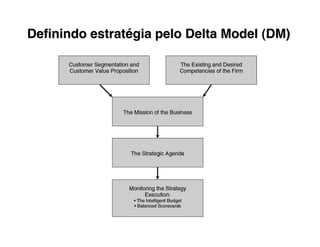
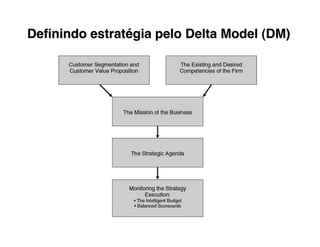
Definindo estratégia pelo Delta Model (DM)
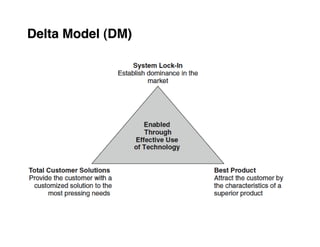
Delta Model (DM)
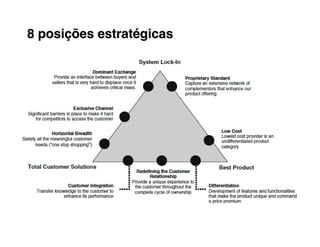
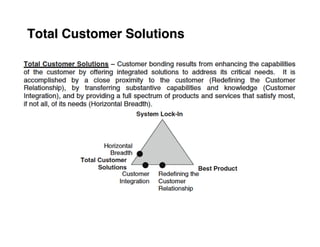
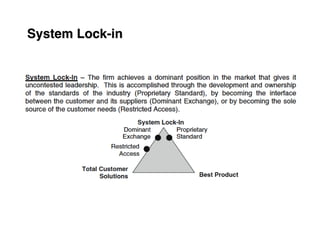
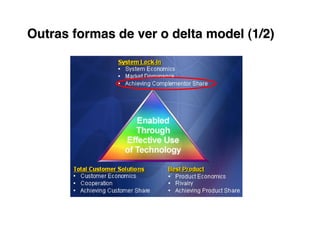
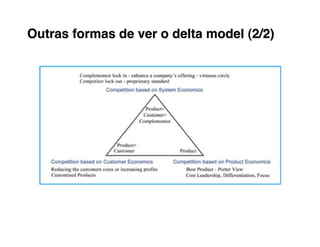
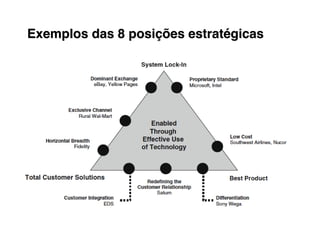
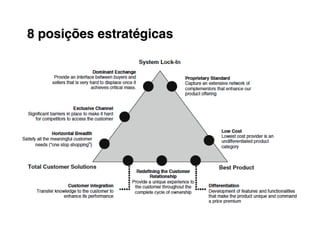
8 posições estratégicas
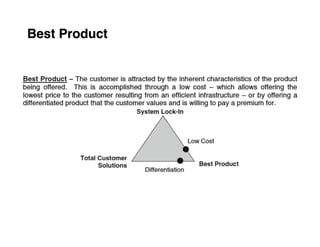
Best Product
Total Customer Solutions
System Lock-in
Outras formas de ver o delta model (1/2)
Outras formas de ver o delta model (2/2)
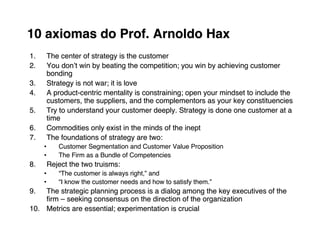
10 axiomas do Prof. Arnoldo Hax
1.   The center of strategy is the customer
2.   You donʼt win by beating the competition; you win by achieving customer
     bonding
3.   Strategy is not war; it is love
4.   A product-centric mentality is constraining; open your mindset to include the
     customers, the suppliers, and the complementors as your key constituencies
5.   Try to understand your customer deeply. Strategy is done one customer at a
     time
6.   Commodities only exist in the minds of the inept
7.   The foundations of strategy are two:
     •   Customer Segmentation and Customer Value Proposition
     •   The Firm as a Bundle of Competencies
8.   Reject the two truisms:
     •   “The customer is always right,” and
                                 right,”
     •   “I know the customer needs and how to satisfy them.”
                                                       them.”
9.  The strategic planning process is a dialog among the key executives of the
    firm – seeking consensus on the direction of the organization
10. Metrics are essential; experimentation is crucial
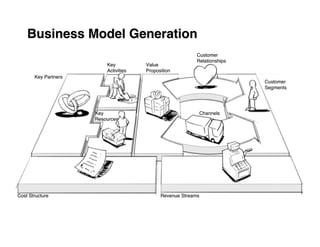
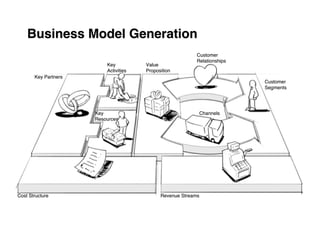
Business Model Generation
                                                          Customer
                                                          Relationships
                          Key          Value
                          Activities   Proposition
       Key Partners
                                                                          Customer
                                                                          Segments


                      Key                                  Channels
                      Resources


Cost Structure                               Revenue Streams
Exemplos
Exemplos das 8 posições estratégicas
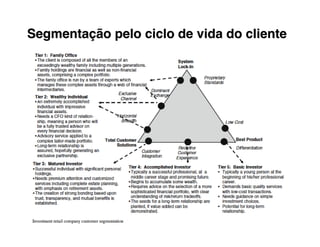
Segmentação pelo ciclo de vida do cliente
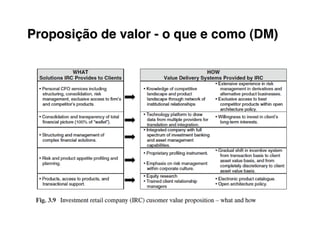
Proposição de valor - o que e como (DM)
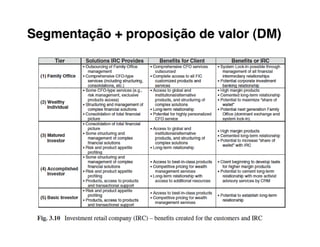
Segmentação + proposição de valor (DM)
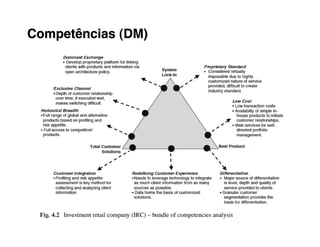
Competências (DM)
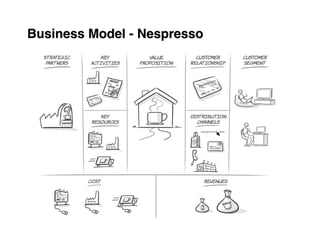
Business Model - Nespresso
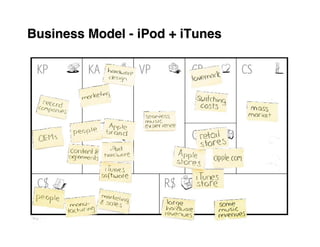
Business Model - iPod + iTunes
Ferramentas
para entender o cliente
Formas de segmentação de clientes (DM)
•   desejo do cliente fazer negócio conosco: compreende três tipos de
                                    conosco:               três
    relecionamento (transação - compra e vai embora, suporte - compra mas pede ajuda
                                             embora,
    e relacionamento - não só compra como interage constantemente). É a segmentação
                                                   constantemente).
    mais simples.

•   graus de valor que conseguimos adicionar ao cliente: nas palavras do Prof.
                                                      cliente:
    Arnoldo Hax "this is perhaps the most effective way of segmenting the customer when
    business conditions allow its use".

•   ciclo de vida do cliente: serve para quando as necessidades do cliente evoluem
                     cliente:
    com o tempo. Por exemplo, um profissional recém formado tem necessidades
                      exemplo,                recém
    diferentes se comparado com um profissional com 20 anos de carreira.
                                                                carreira.

•   diferentes padrões de compra: é baseado em quanto o cliente está disposto a
                             compra:
    pagar. Faz sentido para produtos físicos (VW, desde Gol até Touareg). Tb pode fazer
    pagar.                                                        Touareg).
    sentido para serviços (Itaú x Itaú Personnalite ou restaurantes).
                                                       restaurantes).

•   canais: de acordo com o Prof. Arnoldo Hax "if we are dependent upon a third party to
    canais:
    reach our customer, it is a top priority to seek and obtain a full strategic alignment with
    the channel".
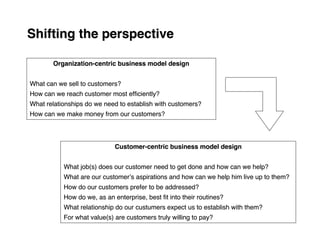
Shifting the perspective

       Organization-centric business model design


What can we sell to customers?
How can we reach customer most efficiently?
What relationships do we need to establish with customers?
How can we make money from our customers?


                             Customer-centric business model design


           What job(s) does our customer need to get done and how can we help?
           What are our customerʼs aspirations and how can we help him live up to them?
                        customerʼ
           How do our customers prefer to be addressed?
           How do we, as an enterprise, best fit into their routines?
           What relationship do our custumers expect us to establish with them?
           For what value(s) are customers truly willing to pay?
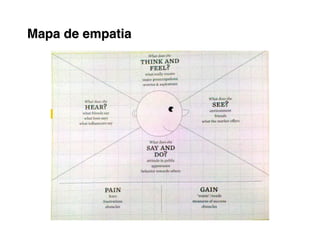
Mapa de empatia
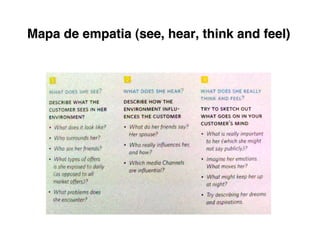
Mapa de empatia (see, hear, think and feel)
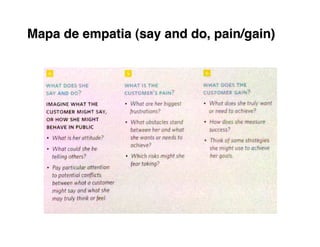
Mapa de empatia (say and do, pain/gain)
Ferramentas
    para definir
proposição de valor
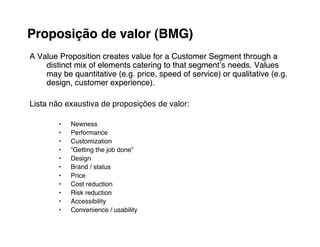
Proposição de valor (BMG)
A Value Proposition creates value for a Customer Segment through a
    distinct mix of elements catering to that segmentʼs needs. Values
    may be quantitative (e.g. price, speed of service) or qualitative (e.g.
    design, customer experience).

Lista não exaustiva de proposições de valor:

        •   Newness
        •   Performance
        •   Customization
        •   “Getting the job done”
        •   Design
        •   Brand / status
        •   Price
        •   Cost reduction
        •   Risk reduction
        •   Accessibility
        •   Convenience / usability
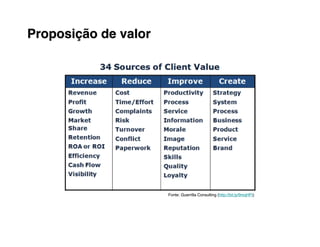
Proposição de valor


                      Fonte: Guerrilla Consulting (http://bit.ly/9mqHFt)
                      Fonte:                      (http://bit.ly/9mqHFt)
Ferramentas
     para entender
competências existentes e
  desejadas, ameaças e
        fraquezas
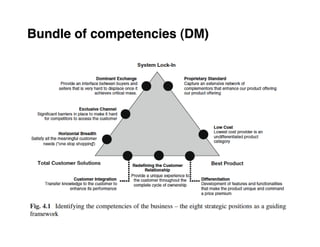
Bundle of competencies (DM)
Lições do Delta Model (1/2)
Think of your firm as a bundle of competencies, not merely as an engine for
     developing, making and distributing products.

        This is a major switch in mindset. So many firms are frustrated, particularly with
        the low returns that they get from their technology investments, because they
        tend to apply that technology strictly to the development of new products or to
        making them more efficient. Because of the pervasive nature of technology, it can
        seldom be the source of singular competitive advantage. However, if we use our
        knowledge base to provide solutions for our customers, it is most likely that we
        will produce singular answers.


Understand deeply your customer needs. Segment the customer base to
    differentiate meaningful value propositions to each customer tier.

        This is another task that sometimes is neglected in the business world.
        Companies tend to give much more attention to their competitors than to their
        customers. It is much easier to search for sources of growth and profitability once
        you understand in a granular way your customer base.
Lições do Delta Model (2/2)
The key to exploit opportunities for growth and profitability is to match your
     competencies with your customer needs. Try to be creative, bold, and fast.

         Customer segmentation and value proposition, plus existing and desired
         competencies analysis are the genuine foundations of a proper strategy.
         Understanding your competencies and your customers and matching your
         capabilities with your customers’ needs is of the essence.


The great companies play simultaneously in the three vertices of the Triangle:

    •    Best Products: All of them enjoy outstanding operational effectiveness which
         produces a low-cost infrastructure and a differentiated stream of products of great
         quality.
    •    Total Customer Solutions: All of them have a deep understanding of their
         customers, who receive creative and unique value propositions.
    •    System Lock-In: All of them have at least one legitimate leadership claim to
         achieve some form of System Lock-in. This is normally achieved through
         admirable innovation and effective use of information technology.
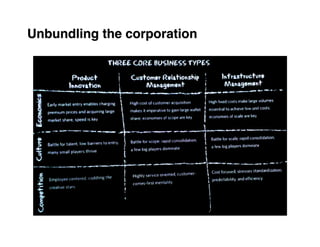
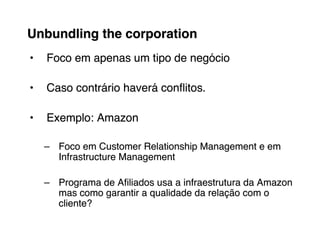
Unbundling the corporation
•   Foco em apenas um tipo de negócio

•   Caso contrário haverá conflitos.

•   Exemplo: Amazon

    – Foco em Customer Relationship Management e em
      Infrastructure Management

    – Programa de Afiliados usa a infraestrutura da Amazon
      mas como garantir a qualidade da relação com o
      cliente?
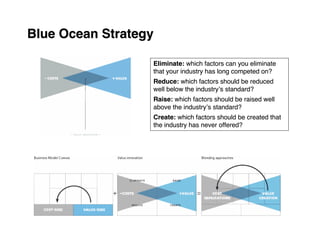
Blue Ocean Strategy

                  Eliminate: which factors can you eliminate
                  that your industry has long competed on?
                  Reduce: which factors should be reduced
                  well below the industryʼs standard?
                                 industryʼ
                  Raise: which factors should be raised well
                  above the industryʼs standard?
                            industryʼ
                  Create: which factors should be created that
                  the industry has never offered?
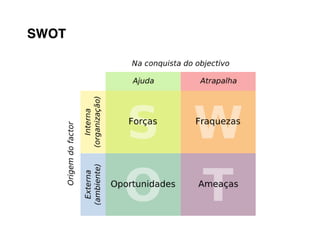
SWOT
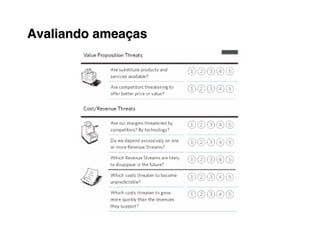
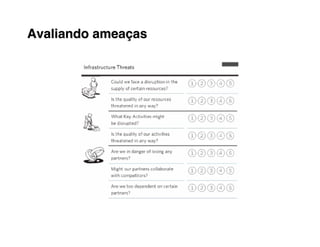
Avaliando ameaças
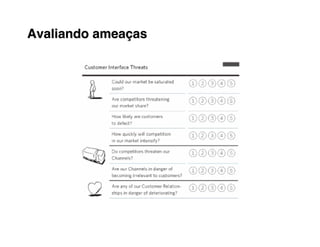
Avaliando ameaças
Avaliando ameaças
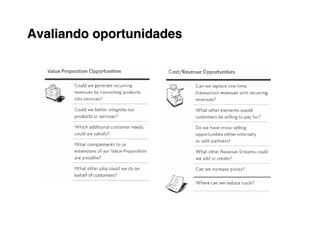
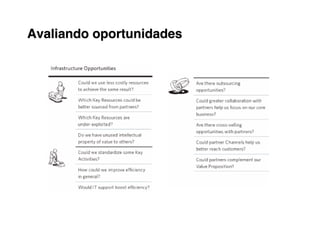
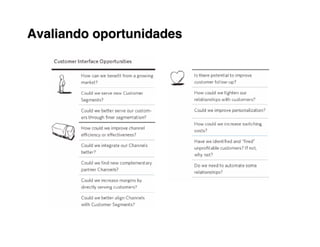
Avaliando oportunidades
Ferramentas
      para definir
objetivos e indicadores
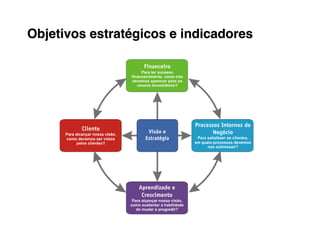
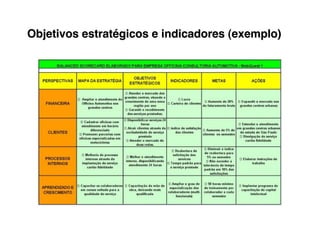
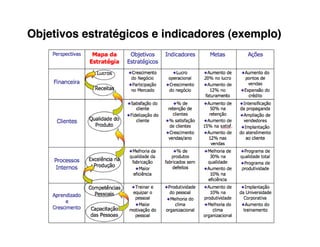
Objetivos estratégicos e indicadores
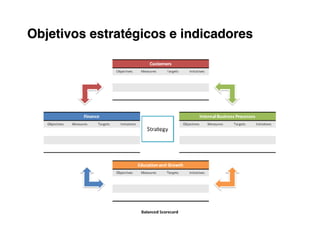
Objetivos estratégicos e indicadores (exemplo)
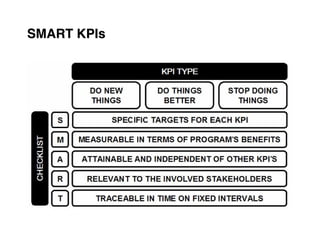
SMART KPIs
Recapitulando
Definindo estratégia pelo Delta Model (DM)
8 posições estratégicas
Business Model Generation
                                                          Customer
                                                          Relationships
                          Key          Value
                          Activities   Proposition
       Key Partners
                                                                          Customer
                                                                          Segments


                      Key                                  Channels
                      Resources


Cost Structure                               Revenue Streams
Mãos à obra
Mãos à obra
•   Definir segmentação de clientes e respectivas propostas de valor.

•   Colocar essas informações no triângulo do Delta Model.

•   Entender quais são as competências existentes e necessárias e
    qual o gap entre elas.

•   Entender o ambiente da empresa.

•   Definir quais segmentos atender e quais não atender (missão,
    purpose).

•   Baseado nos itens acima, planejar os passos para chegar nesses
    objetivos.

•   Monitorar a execução desses passos por meio de processo
    orçamentário e indicadores (KPIs).

Estratégia

  • 1.
  • 2.
  • 3.
    Definição militar deestratégia A plan of action designed to achieve a particular goal. How a battle is fought is a matter of tactics: the terms and conditions that it is fought on and whether it should be fought at all is a matter of strategy. Fonte: http://en.wikipedia.org/wiki/Strategy Fonte:
  • 4.
    Definição de estratégiapara empresas Approach to future that involves: (1) examination of the current and anticipated factors associated with customers and competitors (external environment) and the firm itself (internal environment), (2) envisioning a new or effective role for the firm in a creative manner, and (3) aligning policies, practices, and resources to realize that vision. Fonte: http://www.businessdictionary.com/definition/corporate-strategy.html
  • 5.
    “It is thecustomer who really matters” “… you must recognize that it is the customer who really matters, and that the customers are always different. It is a fatal mistake to commoditize them.” “It is critical that you try to understand your customersʼ needs, to segment them so that you can recognize their differences, and to assess your competencies as a firm so that you can offer not just products, but also creative and unique solutions to each customerʼs pressing needs.” “…the essence of strategy becomes not to achieve sustainable competitive advantage with competitors as the benchmark – but to achieve customer bonding, with the customer as the driving force.” Fonte: Prof. Arnoldo Hax - The Delta Model
  • 6.
  • 7.
  • 8.
  • 9.
  • 10.
  • 11.
  • 12.
    Outras formas dever o delta model (1/2)
  • 13.
    Outras formas dever o delta model (2/2)
  • 14.
    10 axiomas doProf. Arnoldo Hax 1. The center of strategy is the customer 2. You donʼt win by beating the competition; you win by achieving customer bonding 3. Strategy is not war; it is love 4. A product-centric mentality is constraining; open your mindset to include the customers, the suppliers, and the complementors as your key constituencies 5. Try to understand your customer deeply. Strategy is done one customer at a time 6. Commodities only exist in the minds of the inept 7. The foundations of strategy are two: • Customer Segmentation and Customer Value Proposition • The Firm as a Bundle of Competencies 8. Reject the two truisms: • “The customer is always right,” and right,” • “I know the customer needs and how to satisfy them.” them.” 9. The strategic planning process is a dialog among the key executives of the firm – seeking consensus on the direction of the organization 10. Metrics are essential; experimentation is crucial
  • 15.
    Business Model Generation Customer Relationships Key Value Activities Proposition Key Partners Customer Segments Key Channels Resources Cost Structure Revenue Streams
  • 16.
  • 17.
    Exemplos das 8posições estratégicas
  • 18.
    Segmentação pelo ciclode vida do cliente
  • 19.
    Proposição de valor- o que e como (DM)
  • 20.
  • 21.
  • 22.
  • 23.
    Business Model -iPod + iTunes
  • 24.
  • 25.
    Formas de segmentaçãode clientes (DM) • desejo do cliente fazer negócio conosco: compreende três tipos de conosco: três relecionamento (transação - compra e vai embora, suporte - compra mas pede ajuda embora, e relacionamento - não só compra como interage constantemente). É a segmentação constantemente). mais simples. • graus de valor que conseguimos adicionar ao cliente: nas palavras do Prof. cliente: Arnoldo Hax "this is perhaps the most effective way of segmenting the customer when business conditions allow its use". • ciclo de vida do cliente: serve para quando as necessidades do cliente evoluem cliente: com o tempo. Por exemplo, um profissional recém formado tem necessidades exemplo, recém diferentes se comparado com um profissional com 20 anos de carreira. carreira. • diferentes padrões de compra: é baseado em quanto o cliente está disposto a compra: pagar. Faz sentido para produtos físicos (VW, desde Gol até Touareg). Tb pode fazer pagar. Touareg). sentido para serviços (Itaú x Itaú Personnalite ou restaurantes). restaurantes). • canais: de acordo com o Prof. Arnoldo Hax "if we are dependent upon a third party to canais: reach our customer, it is a top priority to seek and obtain a full strategic alignment with the channel".
  • 26.
    Shifting the perspective Organization-centric business model design What can we sell to customers? How can we reach customer most efficiently? What relationships do we need to establish with customers? How can we make money from our customers? Customer-centric business model design What job(s) does our customer need to get done and how can we help? What are our customerʼs aspirations and how can we help him live up to them? customerʼ How do our customers prefer to be addressed? How do we, as an enterprise, best fit into their routines? What relationship do our custumers expect us to establish with them? For what value(s) are customers truly willing to pay?
  • 27.
  • 28.
    Mapa de empatia(see, hear, think and feel)
  • 29.
    Mapa de empatia(say and do, pain/gain)
  • 30.
    Ferramentas para definir proposição de valor
  • 31.
    Proposição de valor(BMG) A Value Proposition creates value for a Customer Segment through a distinct mix of elements catering to that segmentʼs needs. Values may be quantitative (e.g. price, speed of service) or qualitative (e.g. design, customer experience). Lista não exaustiva de proposições de valor: • Newness • Performance • Customization • “Getting the job done” • Design • Brand / status • Price • Cost reduction • Risk reduction • Accessibility • Convenience / usability
  • 32.
    Proposição de valor Fonte: Guerrilla Consulting (http://bit.ly/9mqHFt) Fonte: (http://bit.ly/9mqHFt)
  • 33.
    Ferramentas para entender competências existentes e desejadas, ameaças e fraquezas
  • 34.
  • 35.
    Lições do DeltaModel (1/2) Think of your firm as a bundle of competencies, not merely as an engine for developing, making and distributing products. This is a major switch in mindset. So many firms are frustrated, particularly with the low returns that they get from their technology investments, because they tend to apply that technology strictly to the development of new products or to making them more efficient. Because of the pervasive nature of technology, it can seldom be the source of singular competitive advantage. However, if we use our knowledge base to provide solutions for our customers, it is most likely that we will produce singular answers. Understand deeply your customer needs. Segment the customer base to differentiate meaningful value propositions to each customer tier. This is another task that sometimes is neglected in the business world. Companies tend to give much more attention to their competitors than to their customers. It is much easier to search for sources of growth and profitability once you understand in a granular way your customer base.
  • 36.
    Lições do DeltaModel (2/2) The key to exploit opportunities for growth and profitability is to match your competencies with your customer needs. Try to be creative, bold, and fast. Customer segmentation and value proposition, plus existing and desired competencies analysis are the genuine foundations of a proper strategy. Understanding your competencies and your customers and matching your capabilities with your customers’ needs is of the essence. The great companies play simultaneously in the three vertices of the Triangle: • Best Products: All of them enjoy outstanding operational effectiveness which produces a low-cost infrastructure and a differentiated stream of products of great quality. • Total Customer Solutions: All of them have a deep understanding of their customers, who receive creative and unique value propositions. • System Lock-In: All of them have at least one legitimate leadership claim to achieve some form of System Lock-in. This is normally achieved through admirable innovation and effective use of information technology.
  • 37.
  • 38.
    Unbundling the corporation • Foco em apenas um tipo de negócio • Caso contrário haverá conflitos. • Exemplo: Amazon – Foco em Customer Relationship Management e em Infrastructure Management – Programa de Afiliados usa a infraestrutura da Amazon mas como garantir a qualidade da relação com o cliente?
  • 39.
    Blue Ocean Strategy Eliminate: which factors can you eliminate that your industry has long competed on? Reduce: which factors should be reduced well below the industryʼs standard? industryʼ Raise: which factors should be raised well above the industryʼs standard? industryʼ Create: which factors should be created that the industry has never offered?
  • 40.
  • 41.
  • 42.
  • 43.
  • 44.
  • 45.
  • 46.
  • 47.
    Ferramentas para definir objetivos e indicadores
  • 48.
  • 49.
  • 50.
    Objetivos estratégicos eindicadores (exemplo)
  • 51.
    Objetivos estratégicos eindicadores (exemplo)
  • 52.
  • 53.
  • 54.
  • 55.
  • 56.
    Business Model Generation Customer Relationships Key Value Activities Proposition Key Partners Customer Segments Key Channels Resources Cost Structure Revenue Streams
  • 57.
  • 58.
    Mãos à obra • Definir segmentação de clientes e respectivas propostas de valor. • Colocar essas informações no triângulo do Delta Model. • Entender quais são as competências existentes e necessárias e qual o gap entre elas. • Entender o ambiente da empresa. • Definir quais segmentos atender e quais não atender (missão, purpose). • Baseado nos itens acima, planejar os passos para chegar nesses objetivos. • Monitorar a execução desses passos por meio de processo orçamentário e indicadores (KPIs).