SDM-Ch.5 1
Chapter 5
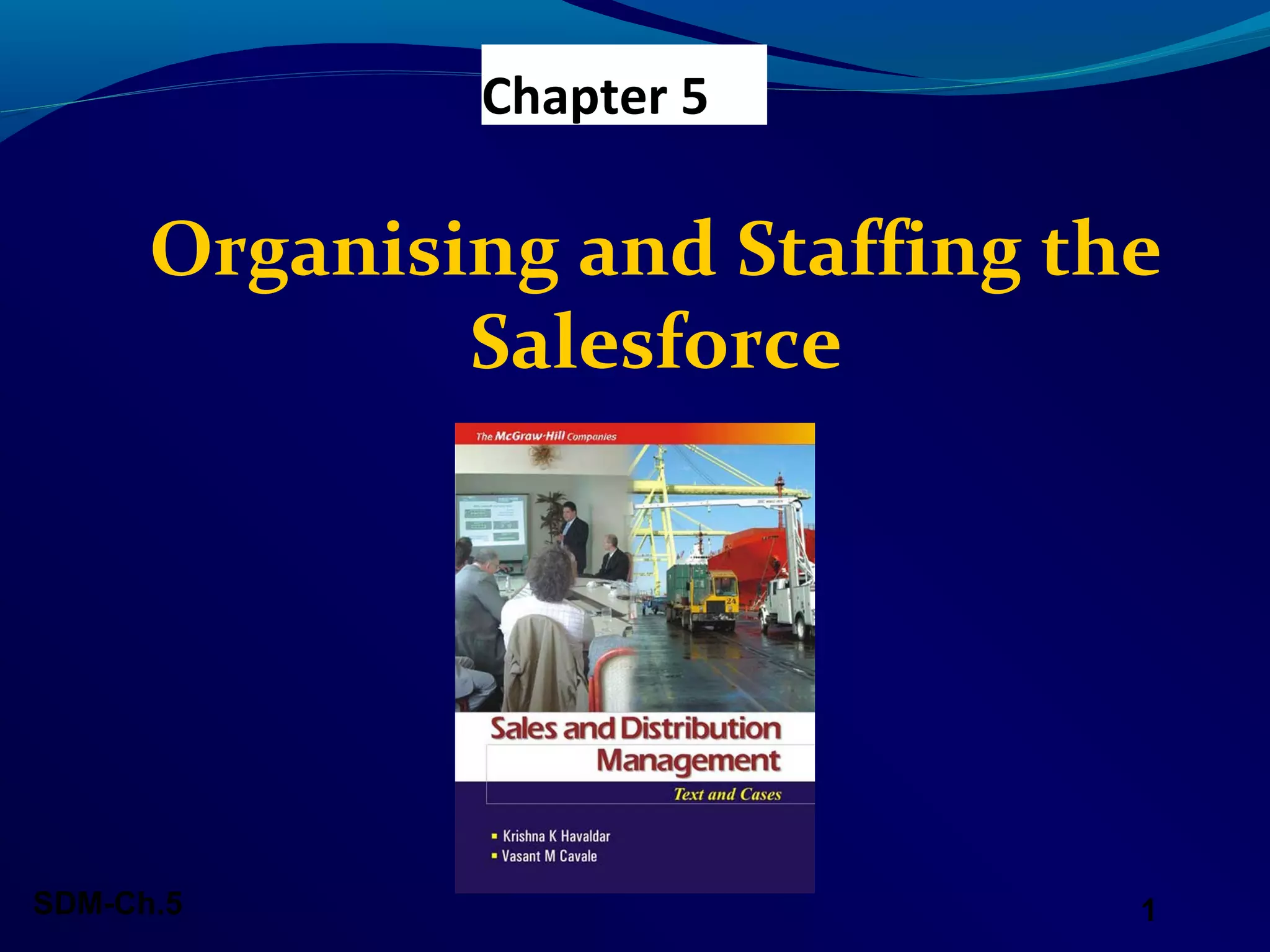
Organising and Staffing the
Salesforce
SDM-Ch.5 2
In an organisation
Difference between marketing and sales departments
Should sales manager be reporting to marketing
manager?
Should sales be an independent function?
Relations with Advertising, HR, Finance, Production,
Accounts, Legal deptts.
Should sales be an independent function?
SDM-Ch.5 3
Sales organisation depends on:
Own sales effort or thru agents?
Direct selling or through intermediaries: wholesale,
C&F agent, distributor, retailer?
Telesales or salesmen
Payment terms, Inventories
Targets
Integration with management goals
SDM-Ch.5 4
Organising salesforce
Order takers, order creators, or order getters,
missionary?
Geographic or product/brand?
Salesmen compensation, motivation
Authority, co-ordination, conflict avoidance
How much centralisation?
Line organisation, line-and-staff, and functional
organisation
Brand organisation
SDM-Ch.5 5
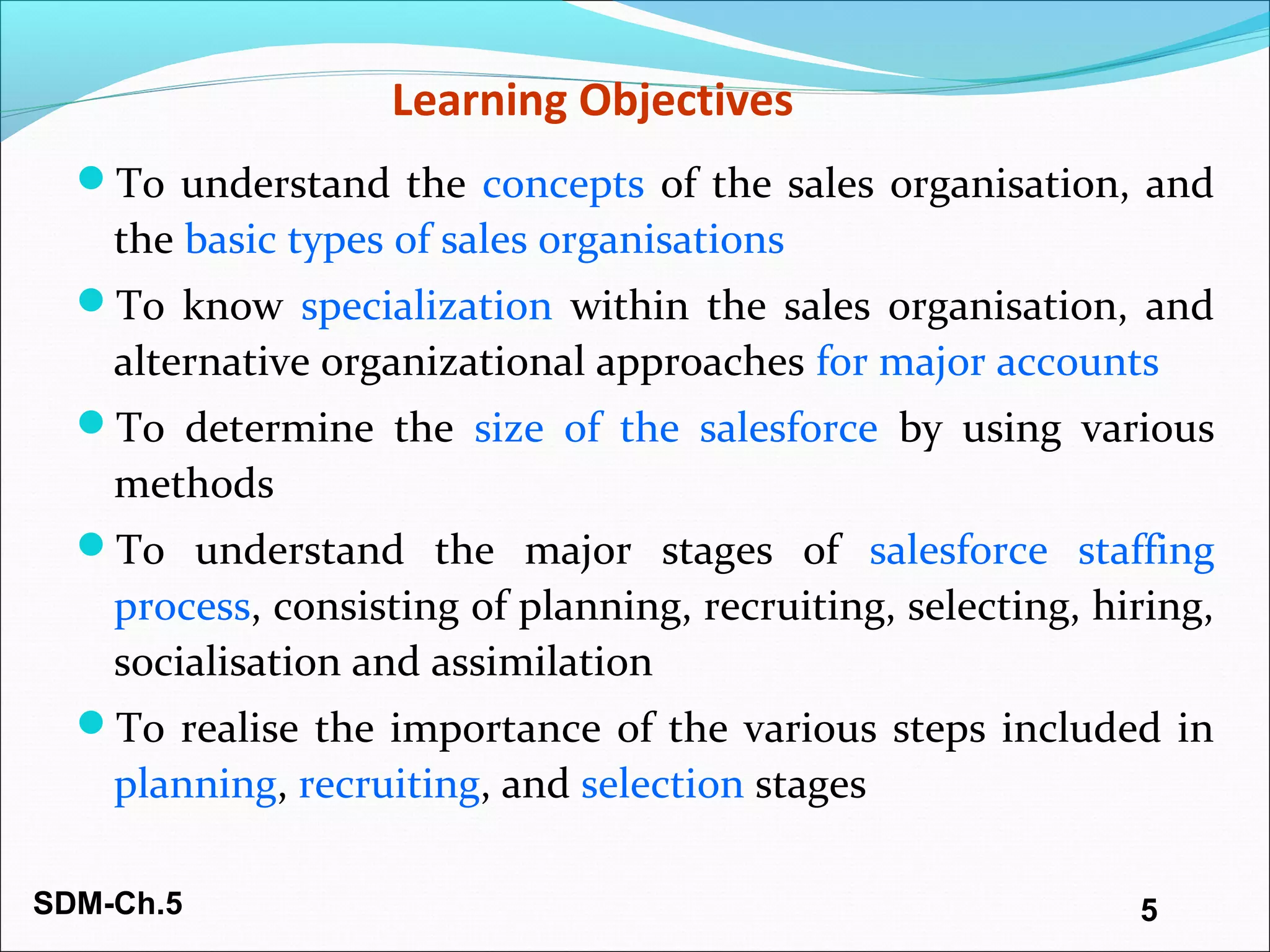
Learning Objectives
To understand the concepts of the sales organisation, and
the basic types of sales organisations
To know specialization within the sales organisation, and
alternative organizational approaches for major accounts
To determine the size of the salesforce by using various
methods
To understand the major stages of salesforce staffing
process, consisting of planning, recruiting, selecting, hiring,
socialisation and assimilation
To realise the importance of the various steps included in
planning, recruiting, and selection stages
SDM-Ch.5 6
Concepts of Sales Organisation
A sales organisation assists the sales manager to
carry out needed tasks efficiently and effectively
to achieve results
The basic concepts of the sales organisation are:
• Degree of centralisation
• Degree of specialisation
• Line or staff positions
• Market orientation
• Effective co-ordination
SDM-Ch.5 7
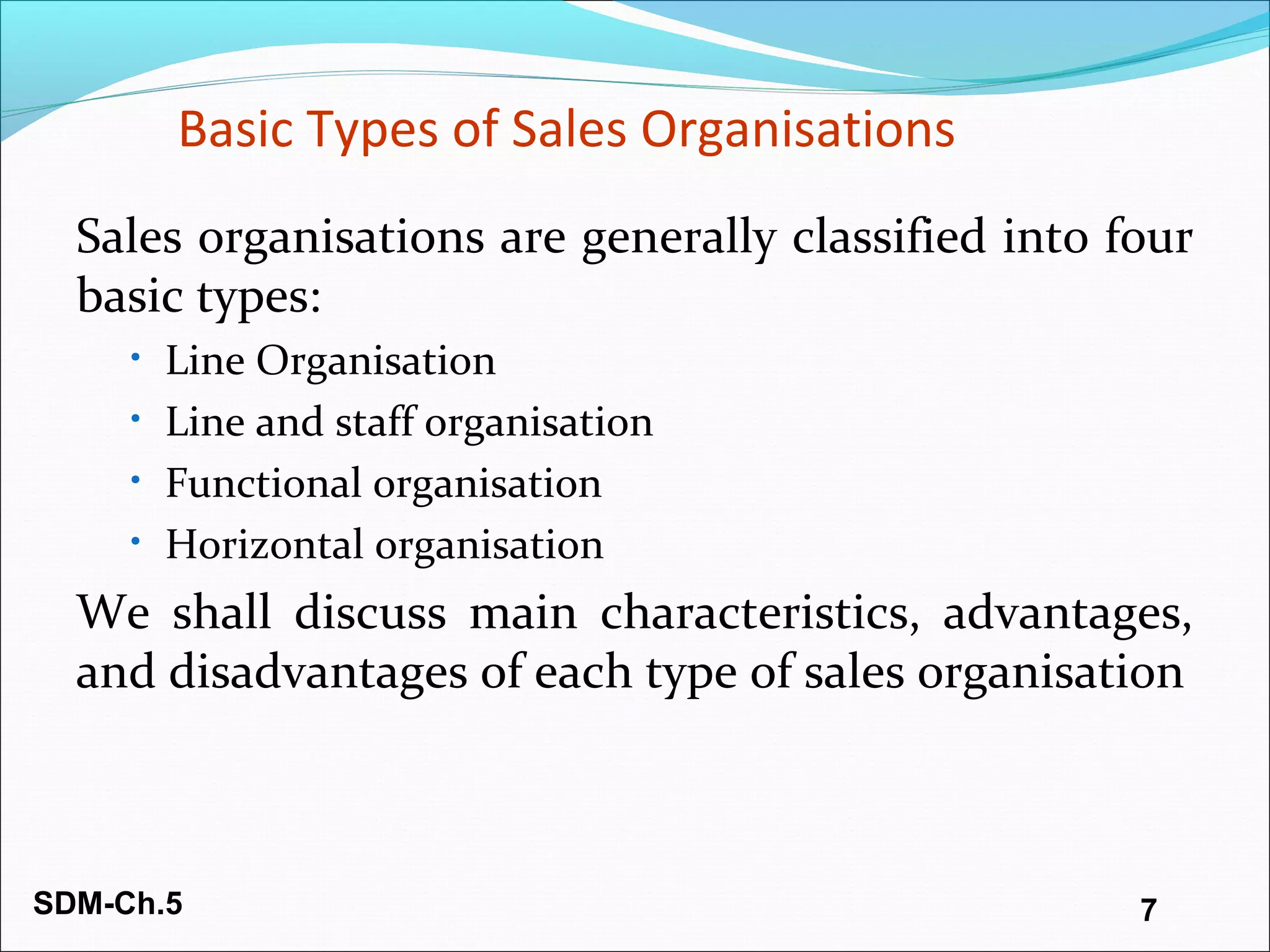
Basic Types of Sales Organisations
Sales organisations are generally classified into four
basic types:
• Line Organisation
• Line and staff organisation
• Functional organisation
• Horizontal organisation
We shall discuss main characteristics, advantages,
and disadvantages of each type of sales organisation
SDM-Ch.5 8
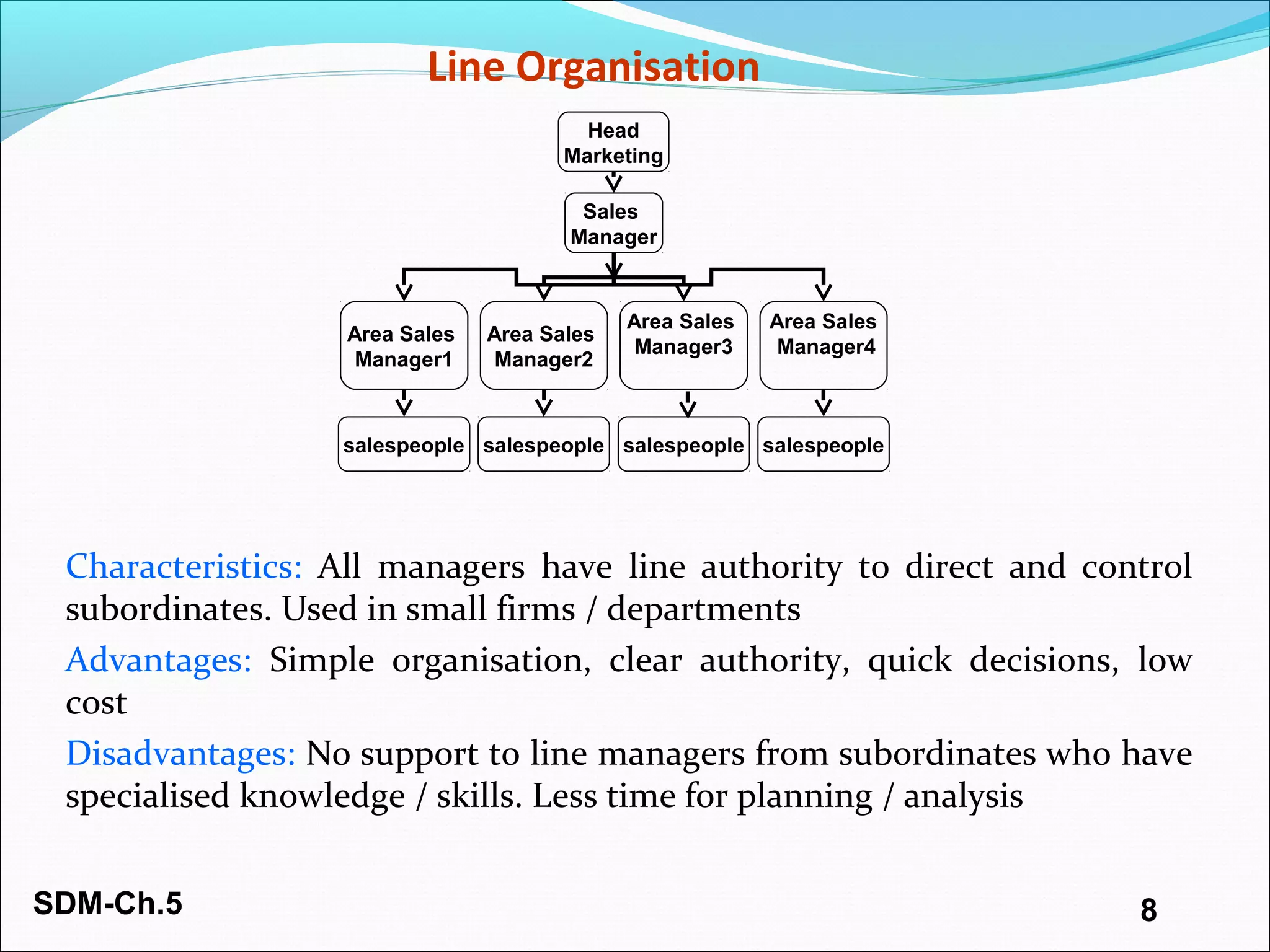
Line Organisation
Characteristics: All managers have line authority to direct and control
subordinates. Used in small firms / departments
Advantages: Simple organisation, clear authority, quick decisions, low
cost
Disadvantages: No support to line managers from subordinates who have
specialised knowledge / skills. Less time for planning / analysis
Head
Marketing
Sales
Manager
Area Sales
Manager1
Area Sales
Manager3
Area Sales
Manager2
Area Sales
Manager4
salespeople salespeople salespeople salespeople
SDM-Ch.5 9
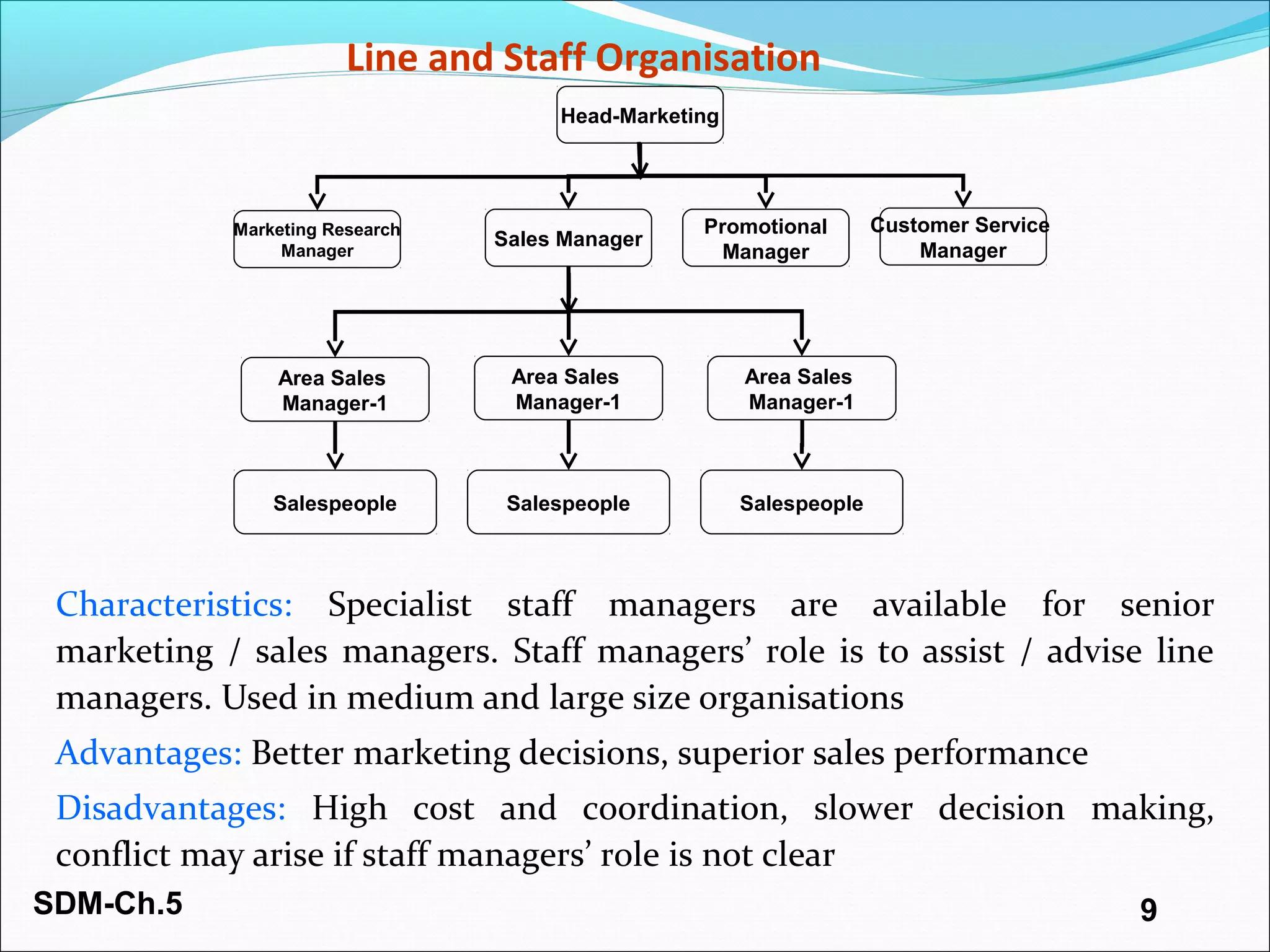
Line and Staff Organisation
Characteristics: Specialist staff managers are available for senior
marketing / sales managers. Staff managers’ role is to assist / advise line
managers. Used in medium and large size organisations
Advantages: Better marketing decisions, superior sales performance
Disadvantages: High cost and coordination, slower decision making,
conflict may arise if staff managers’ role is not clear
Head-Marketing
Marketing Research
Manager
Sales Manager
Promotional
Manager
Customer Service
Manager
Area Sales
Manager-1
Area Sales
Manager-1
Area Sales
Manager-1
Salespeople Salespeople Salespeople
SDM-Ch.5 10
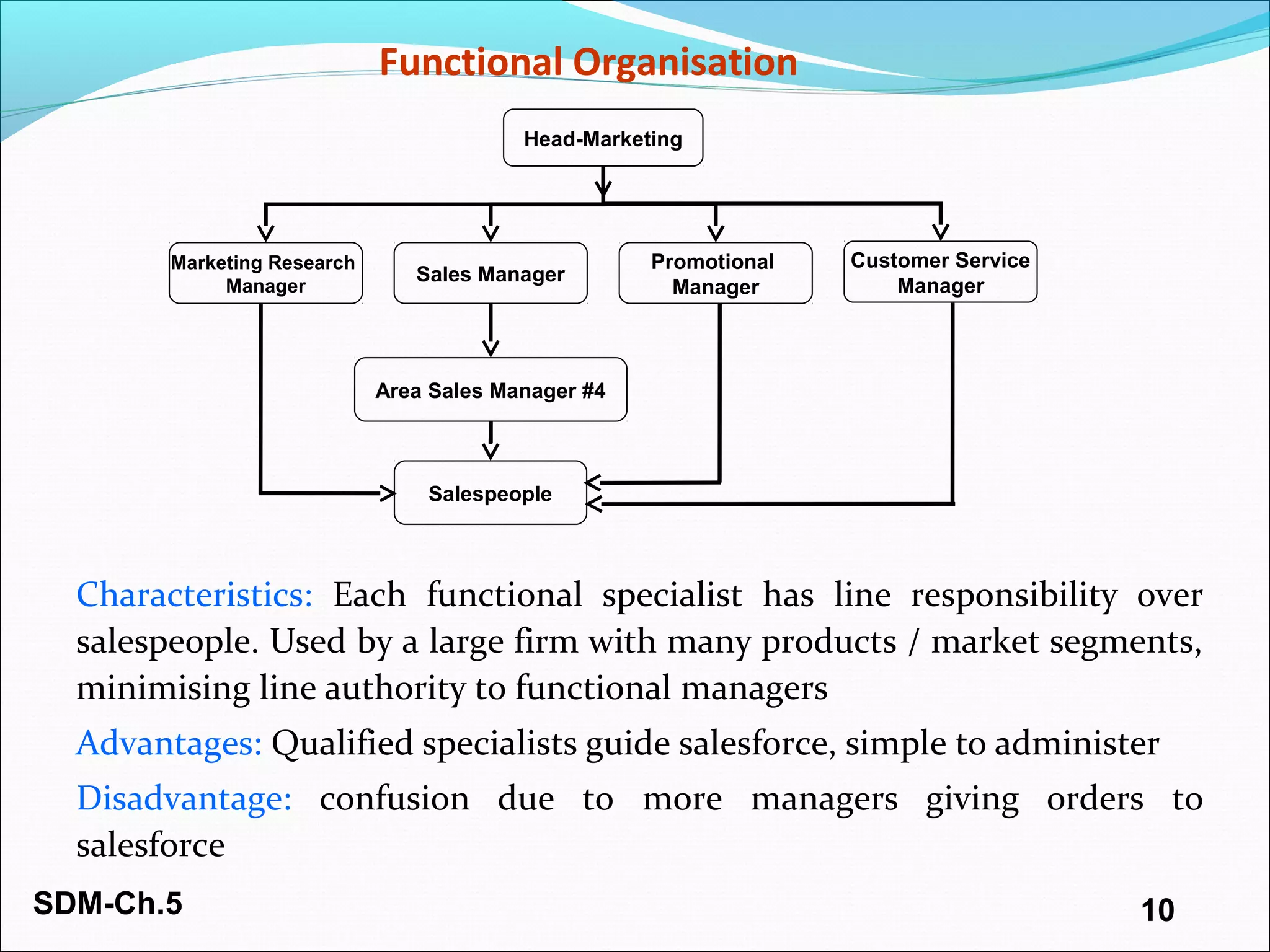
Functional Organisation
Characteristics: Each functional specialist has line responsibility over
salespeople. Used by a large firm with many products / market segments,
minimising line authority to functional managers
Advantages: Qualified specialists guide salesforce, simple to administer
Disadvantage: confusion due to more managers giving orders to
salesforce
Head-Marketing
Marketing Research
Manager
Promotional
Manager
Customer Service
Manager
Sales Manager
Area Sales Manager #4
Salespeople
SDM-Ch.5 11
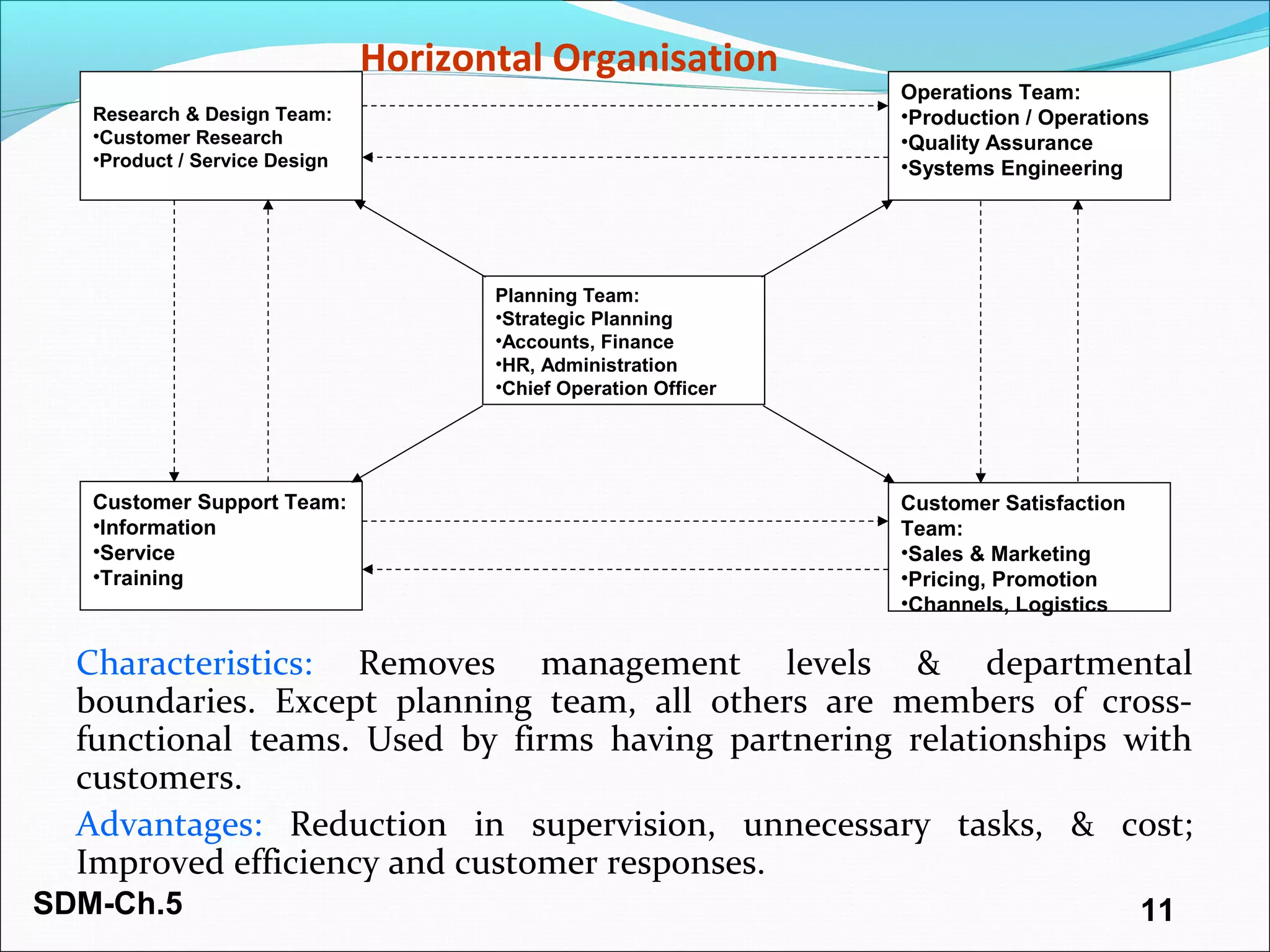
Horizontal Organisation
Characteristics: Removes management levels & departmental
boundaries. Except planning team, all others are members of cross-
functional teams. Used by firms having partnering relationships with
customers.
Advantages: Reduction in supervision, unnecessary tasks, & cost;
Improved efficiency and customer responses.
Research & Design Team:
•Customer Research
•Product / Service Design
Planning Team:
•Strategic Planning
•Accounts, Finance
•HR, Administration
•Chief Operation Officer
Operations Team:
•Production / Operations
•Quality Assurance
•Systems Engineering
Customer Support Team:
•Information
•Service
•Training
Customer Satisfaction
Team:
•Sales & Marketing
•Pricing, Promotion
•Channels, Logistics
SDM-Ch.5 12
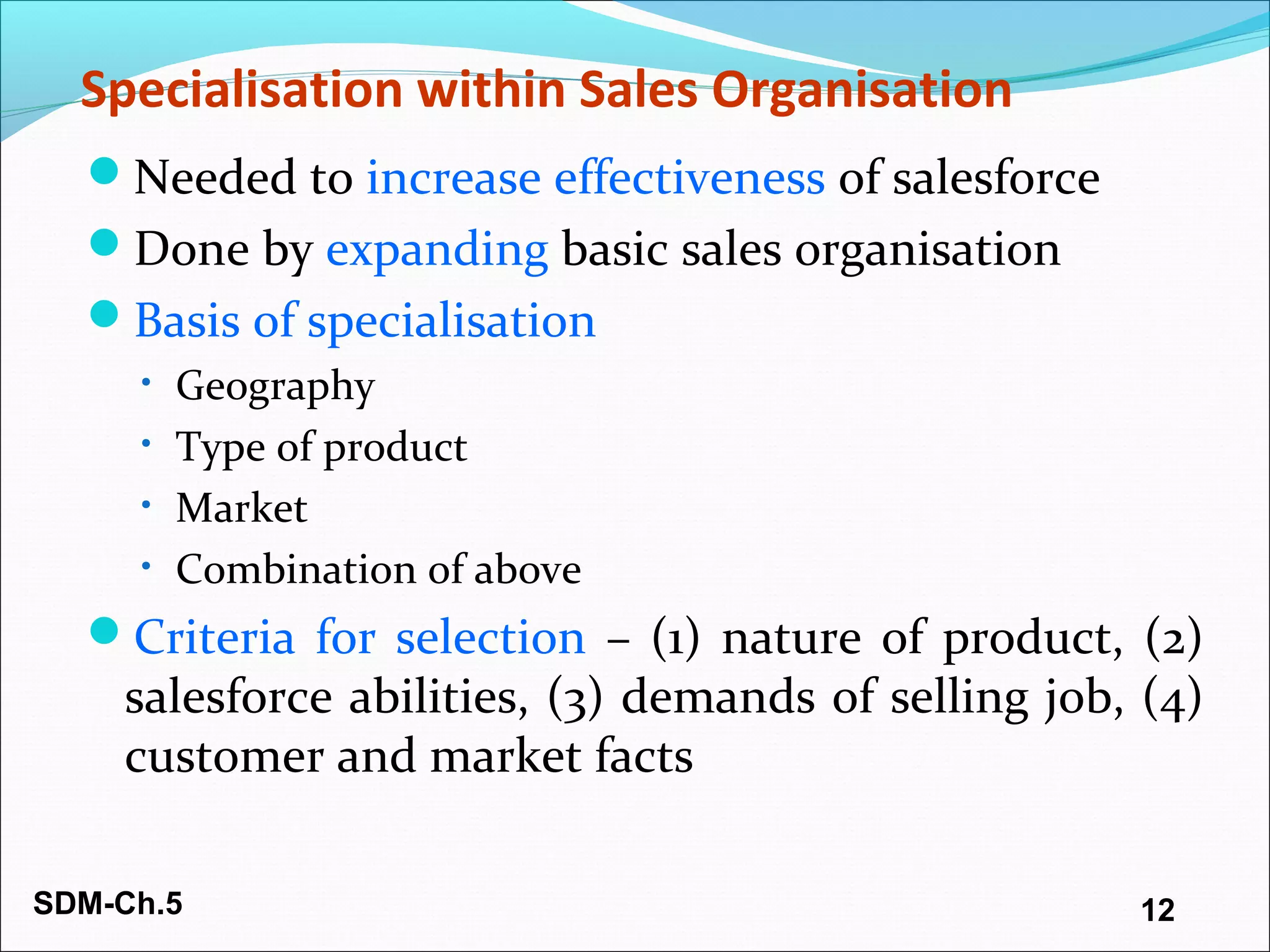
Specialisation within Sales Organisation
Needed to increase effectiveness of salesforce
Done by expanding basic sales organisation
Basis of specialisation
• Geography
• Type of product
• Market
• Combination of above
Criteria for selection – (1) nature of product, (2)
salesforce abilities, (3) demands of selling job, (4)
customer and market facts
SDM-Ch.5 13
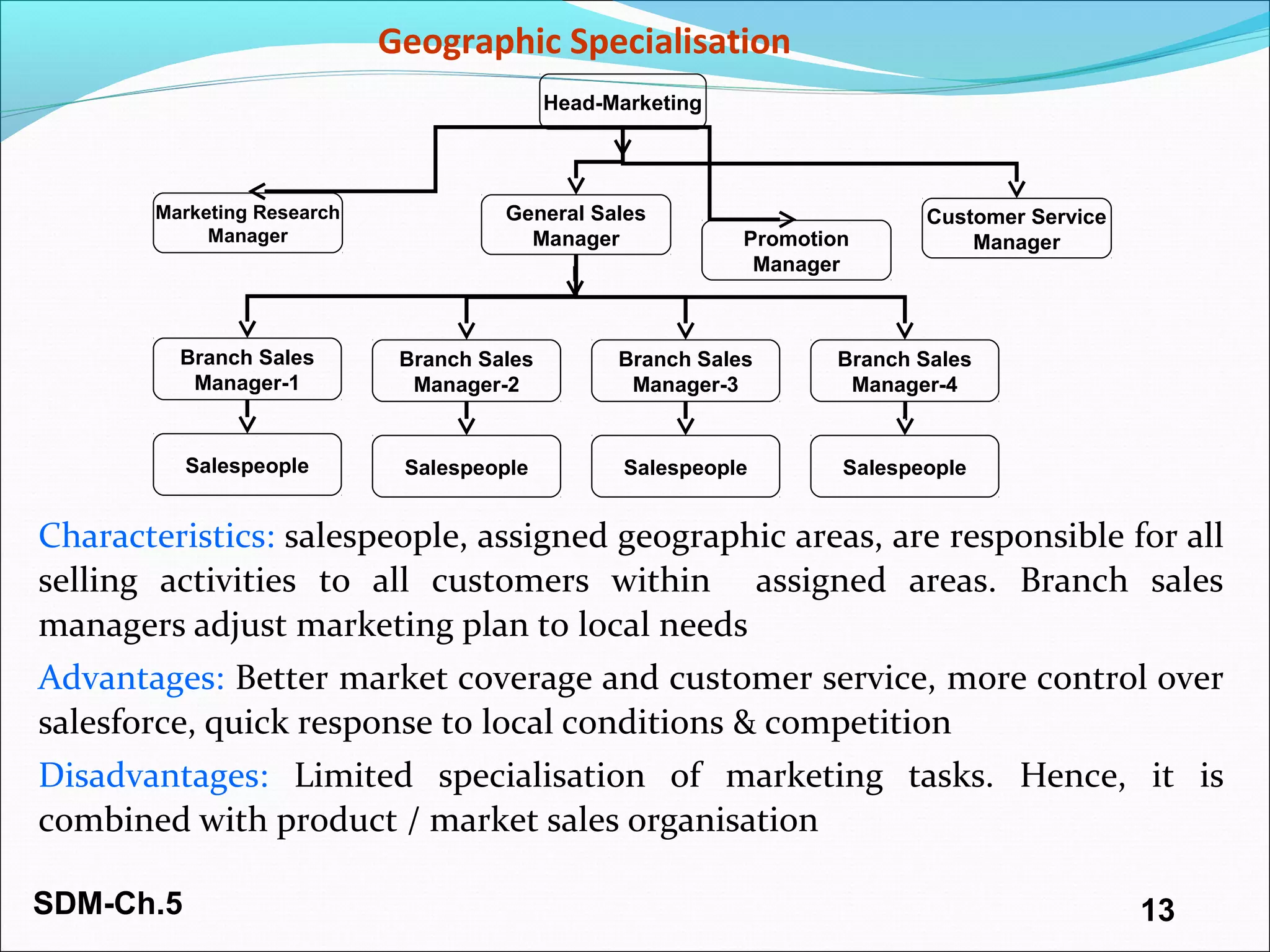
Geographic Specialisation
Characteristics: salespeople, assigned geographic areas, are responsible for all
selling activities to all customers within assigned areas. Branch sales
managers adjust marketing plan to local needs
Advantages: Better market coverage and customer service, more control over
salesforce, quick response to local conditions & competition
Disadvantages: Limited specialisation of marketing tasks. Hence, it is
combined with product / market sales organisation
Head-Marketing
Marketing Research
Manager
General Sales
Manager Promotion
Manager
Customer Service
Manager
Branch Sales
Manager-1
Branch Sales
Manager-2
Branch Sales
Manager-3
Branch Sales
Manager-4
Salespeople Salespeople Salespeople Salespeople
SDM-Ch.5 14
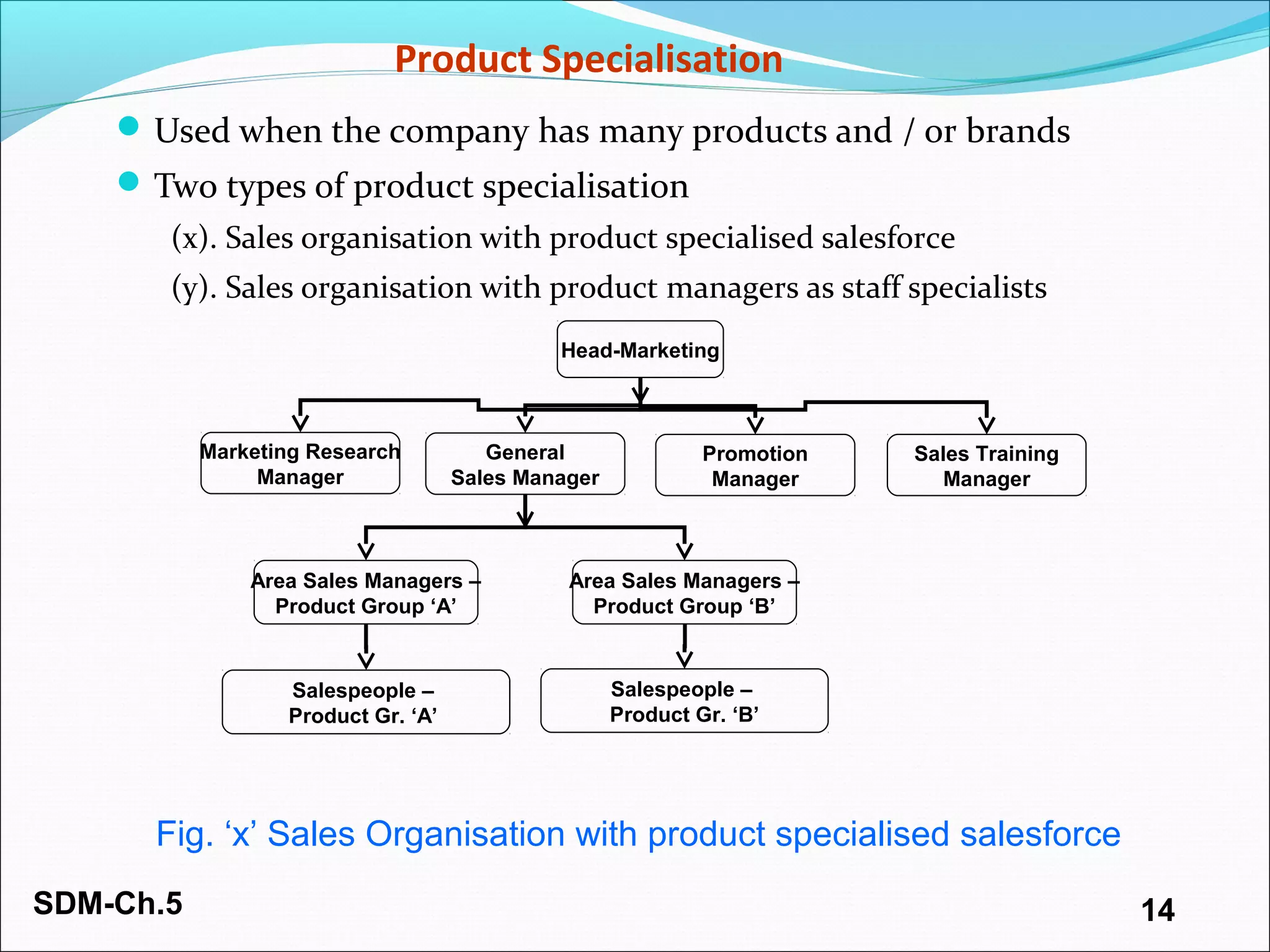
Product Specialisation
Used when the company has many products and / or brands
Two types of product specialisation
(x). Sales organisation with product specialised salesforce
(y). Sales organisation with product managers as staff specialists
Head-Marketing
Marketing Research
Manager
General
Sales Manager
Sales Training
Manager
Promotion
Manager
Area Sales Managers –
Product Group ‘A’
Area Sales Managers –
Product Group ‘B’
Salespeople –
Product Gr. ‘A’
Salespeople –
Product Gr. ‘B’
Fig. ‘x’ Sales Organisation with product specialised salesforce
SDM-Ch.5 15
Fig. ‘y’ Sales Organisation with Product Managers as Staff Specialists
In fig. ‘x’: Characteristics: Salespeople in each product group sell only the products in
that group
Advantage: Each product gets specialised attention from the salesforce
Disadvantage: Sometimes, more salespeople contact the same customer, resulting in
customer dissatisfaction and higher cost
In fig. ‘y’: Characteristics: Each product manager plans and implements marketing
plan, for a product group
Advantage: Corrects the problem of duplication calls on a customer by salespeople
Disadvantage: Lack of product specialisation by salespeople
Head-Marketing
Marketing Research
Manager
Promotion
Manager
Product Manager
Product Gr. ‘B’
Product Manager
Product Gr. ‘A’
General
Sales Manager
Area Sales
Managers
Salespeople
Product Specialisation (Continued)
SDM-Ch.5 16
Market Specialisation
 Characteristics: Desirable when customers are classified by type, user industry,
or channel. Salespeople carry out all activities for all products only for specific
customer groups
 Advantages: Meets needs of specific customer groups, implements customer-
centred philosophy of the company
 Disadvantages: Geographic duplication, high cost
General Sales
Manager
Sales Manager-
International-
Markets
Sales Manager-
Commercial
Sales Manager-
Consumer Markets
Sales Manager-
Government
Area Sales Mgrs
International
Sales Executives
Area Sales Manager-
Commercial
Salespeople
Area Sales Manager-
Government
Salespeople
Area Sales Mgrs-
Consumer Markets
Salespeople
SDM-Ch.5 17
Combination Sales Organisation
Characteristics: Many firms use some combination of specialisation
organisations, called hybrid or combination sales organisation, with a
view to minimise disadvantages and maximise advantages of
specialisation organisations
Figure above shows combination of geographic and market
specialisations
Director – Sales
& Marketing
General Manager
Sales - North
General Manager
Sales - East
General Manager
Sales - South
General Manager
Sales - West
Regional Sales
Mgr. – Govt.
Regional Sales
Mgr. - Dealers
Regional Sales
Mgr. - Commercial
Salespeople Salespeople Salespeople
SDM-Ch.5 18
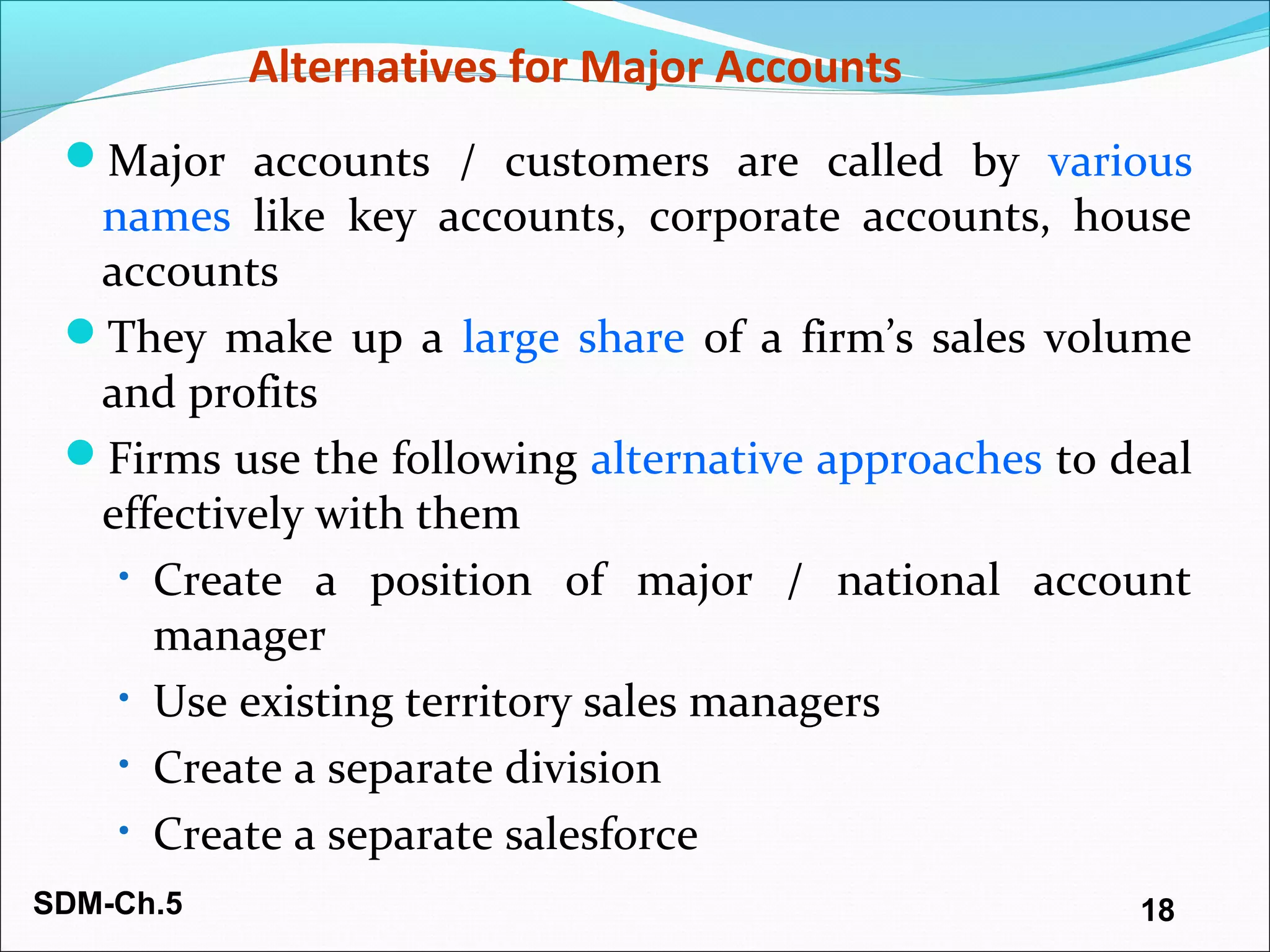
Alternatives for Major Accounts
Major accounts / customers are called by various
names like key accounts, corporate accounts, house
accounts
They make up a large share of a firm’s sales volume
and profits
Firms use the following alternative approaches to deal
effectively with them
• Create a position of major / national account
manager
• Use existing territory sales managers
• Create a separate division
• Create a separate salesforce
SDM-Ch.5 19
Size of the Salesforce
How many salespeople needed (or salesforce size)
to achieve a firm’s sales and profit objectives is a
key decision
Methods available to decide optimum salesforce
size are as follows:
• Workload
• Sales potential (or breakdown)
• Incremental
We shall discuss these methods briefly:
SDM-Ch.5 20
Workload Method
 Assumption: All salespeople have equal workload
 Steps involved to
 salesforce size are:
1) Classify customers as per their sales potential
2) Decide time per sales call and call frequencies for each
class of customers
3) Calculate total market workload = (1) x (2) in hours
4) Decide total work time available per salesperson
5) Divide total work time available by different activities per
salesperson in hours
6) Calculate total number of salespeople needed
)5(
)3(
nsalespersoperavailabletimesellingtotal
workloadmarkettotal
=
SDM-Ch.5 21
Workload Method (Continued)
Advantages: simple method, conceptually sound, used for all
types of selling situations
Disadvantages: Neglects sales productivity & salesforce turnover
Sales Potential / Breakdown Method
The formula used is: , where
N=Number of salespeople needed, or salesforce size
S=Annual sales forecast for the company in value (Rs. Million)
P=Estimated productivity of the average salesperson in sales (Rs.
Million)
T=Estimated percentage of annual salesforce turnover
Advantages: Simple and straight forward
Disadvantages: Conceptually weak; lead time needed for a new
salesperson to reach average productivity
)1( T
P
S
N +=
SDM-Ch.5 22
Incremental Method
It is based on marginal analysis theory of economics
Basic concept: Net profits will increase when
additional salespeople are added, if the incremental
sales revenues exceed the incremental costs
Merit: Conceptually accurate, as it quantifies
relationships between salesforce size, sales, costs,
profits
Demerit: Can not be used if historical data on sales
and costs are not available
SDM-Ch.5 23
Salesforce Staffing
It is one of the most challenging and important
responsibilities / activities of sales management
Salesforce Staffing Process includes following stages:
• Planning
• Recruiting
• Selecting
• Hiring
• Socialisation
We shall briefly discuss each of the above stages
SDM-Ch.5 24
Planning Stage
It consists of three steps:
• Establish responsibility for staffing process
• Decide number of salespeople needed
• Outline the type of salespeople needed
Establish responsibility for staffing process
• Company management decides responsibilities for
various stages / activities of staffing process
• Generally in a medium / large size company, middle
and senior levels H.R. and sales managers are
responsible
• Proper coordination needed between sales, marketing,
and HR executives
SDM-Ch.5 25
Planning Stage (Continued)
Decide the number of salespeople needed
 Steps followed by each territory sales manager to plan
requirement of sales people:
1) Decide optimum salesforce size (using methods discussed
earlier)
2) Add number of promotions, retirements, transfers out,
terminations, resignations expected from existing
salespeople
3) Subtract expected transfers into the territory and existing
salesforce
4) Make a total of new salespersons needed
 Territory sales managers submit their requirements to
national / general sales manager, who calculates the total
number of new salespersons to be hired
SDM-Ch.5 26
Outline Type of Salespeople Needed
The steps involved in the process are:
• Conducting a job analysis
• Preparing a job description
• Developing job qualifications / specifications
Conducting a Job Analysis
• It is done by a person from sales / H. R. department, or
a consultant. It consists of two tasks:
(1) Analyse environment in which the salesperson
would work – E.G. nature of customers, competitors,
products.
(2) Determine duties and responsibilities of the
salesperson. Obtain information from sales managers,
customers, etc.
SDM-Ch.5 27
Preparing a Job Description
It is a written document developed from the job
analysis
The detailed job description is a useful tool for
recruiting, selecting, training, compensating, and
evaluating salespeople
Some of the points it generally covers are:
• Job title, reporting relationship, types of products /
services sold, types of customers, duties and
responsibilities, location and geographic area to be
covered
SDM-Ch.5 28
Developing Job Qualifications / Specifications
These are generally based on job description
Job specifications / qualifications include education, sales
experience, skills, and personality traits
Many studies done, but no generally accepted job
qualifications for selecting salespeople, due to many types
of sales jobs
Some methods used for developing job specifications are
as under:
• Study job description. Useful for a new company
• Analyse personal histories of salespersons
• Ask customers
SDM-Ch.5 29
Recruiting Salesforce
Recruiting include activities to get individuals who will
apply for the job
The general purpose of recruitment is to get enough
qualified candidates, to enable company select the right
persons
H.R. and sales managers must update information on
government employment regulations
Recruiting stage / process includes following activities:
• Finding the sources of sales recruits
• Evaluating and selecting recruiting sources
• Contacting candidates through the selected source
SDM-Ch.5 30
Finding the Sources of Sales Recruits
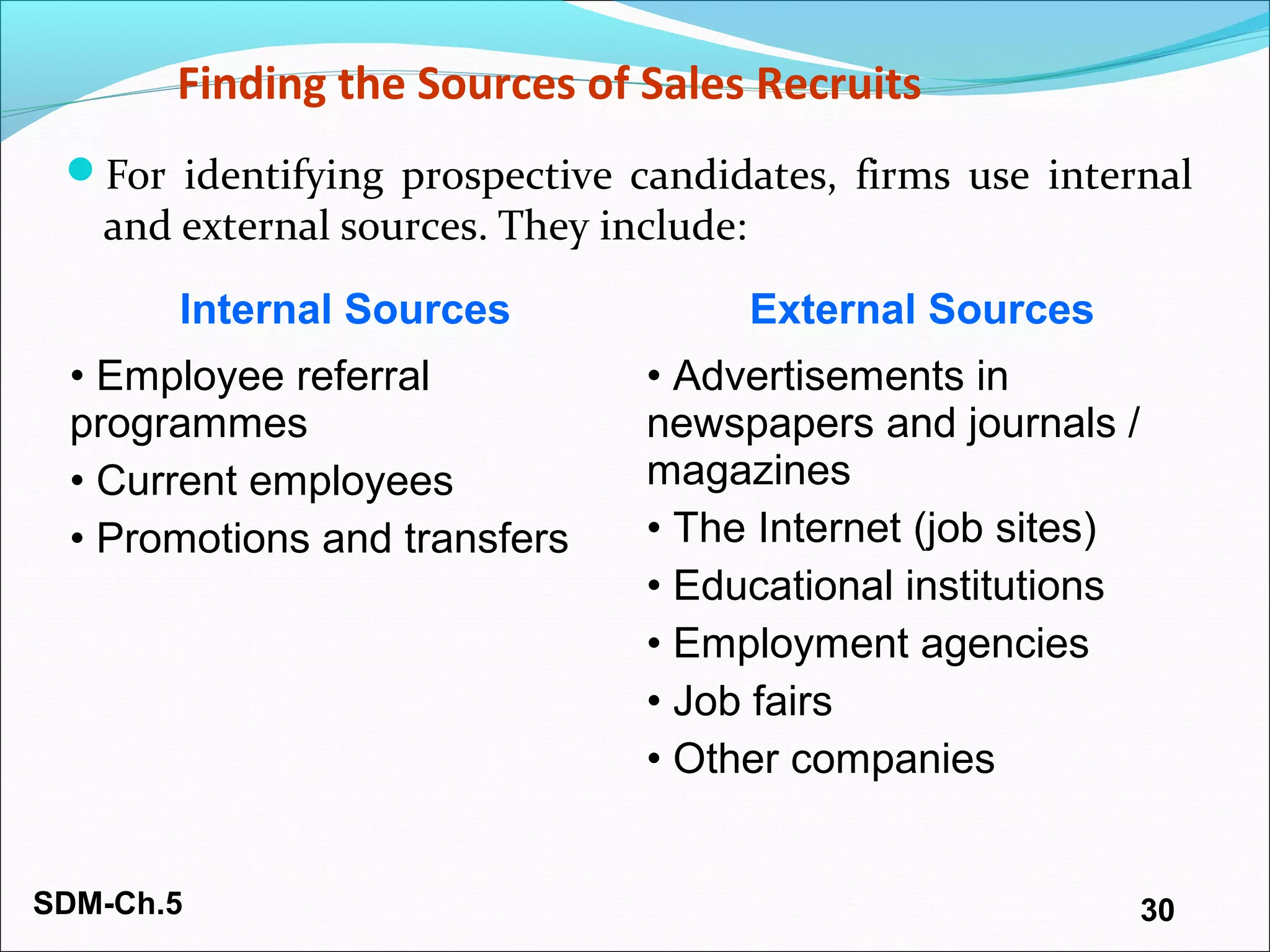
For identifying prospective candidates, firms use internal
and external sources. They include:
Internal Sources External Sources
• Employee referral
programmes
• Current employees
• Promotions and transfers
• Advertisements in
newspapers and journals /
magazines
• The Internet (job sites)
• Educational institutions
• Employment agencies
• Job fairs
• Other companies
SDM-Ch.5 31
Evaluating and selecting Recruiting Sources
Recruiting sources are evaluated based on the database
built over number of years
Evaluating factors are:
• Performance rating of salespeople, after 2 years working
• Percentage of salespeople retained, after 2 years
working
• Total cost of recruiting
• Selecting most effective source of recruiting at least
cost
• For a new company, selection depends on cost
Contacting candidates through the selected source is done
by H. R. department
SDM-Ch.5 32
Selecting Salesforce
Selection process consists of seven major selection steps /
tools
Companies differ in using selection tools, depending on
expenditure budget and time available
Major selection tools / steps are:
• Screening resumes
• Application blank
• Initial interview
• Intensive interview
• Testing
• Reference check
• Physical examination
SDM-Ch.5 33
Screening Resumes
It is done when the company receives many resumes
This step / tool not required, if somebody else like
employment agency does initial screening
Initial screening of resumes are done by comparing with
job specifications
Application Blank
Widely used, it is a methodical way of collecting relevant
information from the applicant
Advantages of using application blank (also called “formal
application form”) are:
(1) Easy comparison of many applicants
(2) Useful for asking question during interview sessions
SDM-Ch.5 34
Interviews
Widely used selection tool
A good predictor of the candidate’s performance
Initial interviews are used for screening candidates
Intensive interviews are conducted to get indepth view of
candidates
Interview structure / type of interviews:
• Structured / patterned / guided interviews
• Unstructured / non-directed / informal interviews
• Semi-structured interviews
• Behaviour and performance based interviews
• Stress interviews
Purpose is to decide a candidate’s fitness for a job
SDM-Ch.5 35
Testing
Many firms use tests as a selection tool – EG P&G, IBM
Purpose of testing: To find whether applicants have traits /
characteristics that lead to success in sales job
Type of selection tests:
• Aptitude tests measure ability for selling and learning
• Intelligence tests find out mental intelligence or intelligence
quotient (IQ)
• Interest tests find out level of interest in a sales career
• Knowledge tests measure knowledge of products, markets,
etc
• Personality tests find out attitude or traits like empathy, self-
confidence
Tests must have reliability and validity
Tests should be one of the selection tools and not the only tool
SDM-Ch.5 36
Reference Checks
They are important due to possibilities of resume frauds and
false personal information
They are done by letters / e-mails, telephones, or personal visits
Instead of candidate’s references, previous employers /
customers to be included for reference checks
Physical Examination
Objective is to find a physical problem that may prevent job
performance of an applicant
Most companies want their prospective employees to undergo
physical examination
Increasing number of firms ask applicant to complete the health
information form without seeing a medical doctor
SDM-Ch.5 37
Hiring Stage
After completing selection process, a list of candidates to be
hired is made
In hiring stage, two activities are performed:
(1) The company making the job offer
(2) Persuading the applicant to accept it
Socialisation Stage
It is the process through which new salespeople learn values,
norms, attitudes, and behaviour of people working in the firm
Socialisation process starts before the new salesperson accepts
the job offer and continues until the person is assimilated into
the company culture
Assimilation is the second stage of socialisation process
Companies have this process, in order to retain new salespeople
SDM-Ch.5 38
Key Learnings
A sales organisation assists a sales manager to carry out
needed tasks efficiently and effectively
Basic types of sales organisations are : (1) line, (2) line and
staff, (3) functional, (4) horizontal
Specialisation within sales organisation, which are needed
to increase effectiveness of salespeople, are: (a)
geographic, (b) product, (c) market, (d) combination
Companies use alternate approaches to deal effectively
with major accounts
Methods available for deciding optimum salesforce size
are: workload, sales potential, and incremental
SDM-Ch.5 39
Key Learnings (Continued)
Salesforce staffing process includes five stages: planning,
recruiting, selecting, hiring, socialisation
Planning stage includes (1) establishing responsibilities, (2)
deciding number of salespeople needed, (3) profiling the type of
salespeople needed
Recruitment stage consists of (a) finding sources of sales recruit,
(b) evaluating and selecting recruitment sources, (c) contacting
candidates
Selection process consists of seven steps / tools: (1) screening
resumes, (2) application blank, (3) initial interview, (4) intensive
interview, (5) testing, (6) reference check, (7) physical
examination
Hiring stage includes (a) making the job offer, (b) persuading
applicant to accept it
Socialisation stage is required to retain new salespeople

Sales organisation sales force management(2)

  • 1.
    SDM-Ch.5 1 Chapter 5 Organisingand Staffing the Salesforce
  • 2.
    SDM-Ch.5 2 In anorganisation Difference between marketing and sales departments Should sales manager be reporting to marketing manager? Should sales be an independent function? Relations with Advertising, HR, Finance, Production, Accounts, Legal deptts. Should sales be an independent function?
  • 3.
    SDM-Ch.5 3 Sales organisationdepends on: Own sales effort or thru agents? Direct selling or through intermediaries: wholesale, C&F agent, distributor, retailer? Telesales or salesmen Payment terms, Inventories Targets Integration with management goals
  • 4.
    SDM-Ch.5 4 Organising salesforce Ordertakers, order creators, or order getters, missionary? Geographic or product/brand? Salesmen compensation, motivation Authority, co-ordination, conflict avoidance How much centralisation? Line organisation, line-and-staff, and functional organisation Brand organisation
  • 5.
    SDM-Ch.5 5 Learning Objectives Tounderstand the concepts of the sales organisation, and the basic types of sales organisations To know specialization within the sales organisation, and alternative organizational approaches for major accounts To determine the size of the salesforce by using various methods To understand the major stages of salesforce staffing process, consisting of planning, recruiting, selecting, hiring, socialisation and assimilation To realise the importance of the various steps included in planning, recruiting, and selection stages
  • 6.
    SDM-Ch.5 6 Concepts ofSales Organisation A sales organisation assists the sales manager to carry out needed tasks efficiently and effectively to achieve results The basic concepts of the sales organisation are: • Degree of centralisation • Degree of specialisation • Line or staff positions • Market orientation • Effective co-ordination
  • 7.
    SDM-Ch.5 7 Basic Typesof Sales Organisations Sales organisations are generally classified into four basic types: • Line Organisation • Line and staff organisation • Functional organisation • Horizontal organisation We shall discuss main characteristics, advantages, and disadvantages of each type of sales organisation
  • 8.
    SDM-Ch.5 8 Line Organisation Characteristics:All managers have line authority to direct and control subordinates. Used in small firms / departments Advantages: Simple organisation, clear authority, quick decisions, low cost Disadvantages: No support to line managers from subordinates who have specialised knowledge / skills. Less time for planning / analysis Head Marketing Sales Manager Area Sales Manager1 Area Sales Manager3 Area Sales Manager2 Area Sales Manager4 salespeople salespeople salespeople salespeople
  • 9.
    SDM-Ch.5 9 Line andStaff Organisation Characteristics: Specialist staff managers are available for senior marketing / sales managers. Staff managers’ role is to assist / advise line managers. Used in medium and large size organisations Advantages: Better marketing decisions, superior sales performance Disadvantages: High cost and coordination, slower decision making, conflict may arise if staff managers’ role is not clear Head-Marketing Marketing Research Manager Sales Manager Promotional Manager Customer Service Manager Area Sales Manager-1 Area Sales Manager-1 Area Sales Manager-1 Salespeople Salespeople Salespeople
  • 10.
    SDM-Ch.5 10 Functional Organisation Characteristics:Each functional specialist has line responsibility over salespeople. Used by a large firm with many products / market segments, minimising line authority to functional managers Advantages: Qualified specialists guide salesforce, simple to administer Disadvantage: confusion due to more managers giving orders to salesforce Head-Marketing Marketing Research Manager Promotional Manager Customer Service Manager Sales Manager Area Sales Manager #4 Salespeople
  • 11.
    SDM-Ch.5 11 Horizontal Organisation Characteristics:Removes management levels & departmental boundaries. Except planning team, all others are members of cross- functional teams. Used by firms having partnering relationships with customers. Advantages: Reduction in supervision, unnecessary tasks, & cost; Improved efficiency and customer responses. Research & Design Team: •Customer Research •Product / Service Design Planning Team: •Strategic Planning •Accounts, Finance •HR, Administration •Chief Operation Officer Operations Team: •Production / Operations •Quality Assurance •Systems Engineering Customer Support Team: •Information •Service •Training Customer Satisfaction Team: •Sales & Marketing •Pricing, Promotion •Channels, Logistics
  • 12.
    SDM-Ch.5 12 Specialisation withinSales Organisation Needed to increase effectiveness of salesforce Done by expanding basic sales organisation Basis of specialisation • Geography • Type of product • Market • Combination of above Criteria for selection – (1) nature of product, (2) salesforce abilities, (3) demands of selling job, (4) customer and market facts
  • 13.
    SDM-Ch.5 13 Geographic Specialisation Characteristics:salespeople, assigned geographic areas, are responsible for all selling activities to all customers within assigned areas. Branch sales managers adjust marketing plan to local needs Advantages: Better market coverage and customer service, more control over salesforce, quick response to local conditions & competition Disadvantages: Limited specialisation of marketing tasks. Hence, it is combined with product / market sales organisation Head-Marketing Marketing Research Manager General Sales Manager Promotion Manager Customer Service Manager Branch Sales Manager-1 Branch Sales Manager-2 Branch Sales Manager-3 Branch Sales Manager-4 Salespeople Salespeople Salespeople Salespeople
  • 14.
    SDM-Ch.5 14 Product Specialisation Usedwhen the company has many products and / or brands Two types of product specialisation (x). Sales organisation with product specialised salesforce (y). Sales organisation with product managers as staff specialists Head-Marketing Marketing Research Manager General Sales Manager Sales Training Manager Promotion Manager Area Sales Managers – Product Group ‘A’ Area Sales Managers – Product Group ‘B’ Salespeople – Product Gr. ‘A’ Salespeople – Product Gr. ‘B’ Fig. ‘x’ Sales Organisation with product specialised salesforce
  • 15.
    SDM-Ch.5 15 Fig. ‘y’Sales Organisation with Product Managers as Staff Specialists In fig. ‘x’: Characteristics: Salespeople in each product group sell only the products in that group Advantage: Each product gets specialised attention from the salesforce Disadvantage: Sometimes, more salespeople contact the same customer, resulting in customer dissatisfaction and higher cost In fig. ‘y’: Characteristics: Each product manager plans and implements marketing plan, for a product group Advantage: Corrects the problem of duplication calls on a customer by salespeople Disadvantage: Lack of product specialisation by salespeople Head-Marketing Marketing Research Manager Promotion Manager Product Manager Product Gr. ‘B’ Product Manager Product Gr. ‘A’ General Sales Manager Area Sales Managers Salespeople Product Specialisation (Continued)
  • 16.
    SDM-Ch.5 16 Market Specialisation Characteristics: Desirable when customers are classified by type, user industry, or channel. Salespeople carry out all activities for all products only for specific customer groups  Advantages: Meets needs of specific customer groups, implements customer- centred philosophy of the company  Disadvantages: Geographic duplication, high cost General Sales Manager Sales Manager- International- Markets Sales Manager- Commercial Sales Manager- Consumer Markets Sales Manager- Government Area Sales Mgrs International Sales Executives Area Sales Manager- Commercial Salespeople Area Sales Manager- Government Salespeople Area Sales Mgrs- Consumer Markets Salespeople
  • 17.
    SDM-Ch.5 17 Combination SalesOrganisation Characteristics: Many firms use some combination of specialisation organisations, called hybrid or combination sales organisation, with a view to minimise disadvantages and maximise advantages of specialisation organisations Figure above shows combination of geographic and market specialisations Director – Sales & Marketing General Manager Sales - North General Manager Sales - East General Manager Sales - South General Manager Sales - West Regional Sales Mgr. – Govt. Regional Sales Mgr. - Dealers Regional Sales Mgr. - Commercial Salespeople Salespeople Salespeople
  • 18.
    SDM-Ch.5 18 Alternatives forMajor Accounts Major accounts / customers are called by various names like key accounts, corporate accounts, house accounts They make up a large share of a firm’s sales volume and profits Firms use the following alternative approaches to deal effectively with them • Create a position of major / national account manager • Use existing territory sales managers • Create a separate division • Create a separate salesforce
  • 19.
    SDM-Ch.5 19 Size ofthe Salesforce How many salespeople needed (or salesforce size) to achieve a firm’s sales and profit objectives is a key decision Methods available to decide optimum salesforce size are as follows: • Workload • Sales potential (or breakdown) • Incremental We shall discuss these methods briefly:
  • 20.
    SDM-Ch.5 20 Workload Method Assumption: All salespeople have equal workload  Steps involved to  salesforce size are: 1) Classify customers as per their sales potential 2) Decide time per sales call and call frequencies for each class of customers 3) Calculate total market workload = (1) x (2) in hours 4) Decide total work time available per salesperson 5) Divide total work time available by different activities per salesperson in hours 6) Calculate total number of salespeople needed )5( )3( nsalespersoperavailabletimesellingtotal workloadmarkettotal =
  • 21.
    SDM-Ch.5 21 Workload Method(Continued) Advantages: simple method, conceptually sound, used for all types of selling situations Disadvantages: Neglects sales productivity & salesforce turnover Sales Potential / Breakdown Method The formula used is: , where N=Number of salespeople needed, or salesforce size S=Annual sales forecast for the company in value (Rs. Million) P=Estimated productivity of the average salesperson in sales (Rs. Million) T=Estimated percentage of annual salesforce turnover Advantages: Simple and straight forward Disadvantages: Conceptually weak; lead time needed for a new salesperson to reach average productivity )1( T P S N +=
  • 22.
    SDM-Ch.5 22 Incremental Method Itis based on marginal analysis theory of economics Basic concept: Net profits will increase when additional salespeople are added, if the incremental sales revenues exceed the incremental costs Merit: Conceptually accurate, as it quantifies relationships between salesforce size, sales, costs, profits Demerit: Can not be used if historical data on sales and costs are not available
  • 23.
    SDM-Ch.5 23 Salesforce Staffing Itis one of the most challenging and important responsibilities / activities of sales management Salesforce Staffing Process includes following stages: • Planning • Recruiting • Selecting • Hiring • Socialisation We shall briefly discuss each of the above stages
  • 24.
    SDM-Ch.5 24 Planning Stage Itconsists of three steps: • Establish responsibility for staffing process • Decide number of salespeople needed • Outline the type of salespeople needed Establish responsibility for staffing process • Company management decides responsibilities for various stages / activities of staffing process • Generally in a medium / large size company, middle and senior levels H.R. and sales managers are responsible • Proper coordination needed between sales, marketing, and HR executives
  • 25.
    SDM-Ch.5 25 Planning Stage(Continued) Decide the number of salespeople needed  Steps followed by each territory sales manager to plan requirement of sales people: 1) Decide optimum salesforce size (using methods discussed earlier) 2) Add number of promotions, retirements, transfers out, terminations, resignations expected from existing salespeople 3) Subtract expected transfers into the territory and existing salesforce 4) Make a total of new salespersons needed  Territory sales managers submit their requirements to national / general sales manager, who calculates the total number of new salespersons to be hired
  • 26.
    SDM-Ch.5 26 Outline Typeof Salespeople Needed The steps involved in the process are: • Conducting a job analysis • Preparing a job description • Developing job qualifications / specifications Conducting a Job Analysis • It is done by a person from sales / H. R. department, or a consultant. It consists of two tasks: (1) Analyse environment in which the salesperson would work – E.G. nature of customers, competitors, products. (2) Determine duties and responsibilities of the salesperson. Obtain information from sales managers, customers, etc.
  • 27.
    SDM-Ch.5 27 Preparing aJob Description It is a written document developed from the job analysis The detailed job description is a useful tool for recruiting, selecting, training, compensating, and evaluating salespeople Some of the points it generally covers are: • Job title, reporting relationship, types of products / services sold, types of customers, duties and responsibilities, location and geographic area to be covered
  • 28.
    SDM-Ch.5 28 Developing JobQualifications / Specifications These are generally based on job description Job specifications / qualifications include education, sales experience, skills, and personality traits Many studies done, but no generally accepted job qualifications for selecting salespeople, due to many types of sales jobs Some methods used for developing job specifications are as under: • Study job description. Useful for a new company • Analyse personal histories of salespersons • Ask customers
  • 29.
    SDM-Ch.5 29 Recruiting Salesforce Recruitinginclude activities to get individuals who will apply for the job The general purpose of recruitment is to get enough qualified candidates, to enable company select the right persons H.R. and sales managers must update information on government employment regulations Recruiting stage / process includes following activities: • Finding the sources of sales recruits • Evaluating and selecting recruiting sources • Contacting candidates through the selected source
  • 30.
    SDM-Ch.5 30 Finding theSources of Sales Recruits For identifying prospective candidates, firms use internal and external sources. They include: Internal Sources External Sources • Employee referral programmes • Current employees • Promotions and transfers • Advertisements in newspapers and journals / magazines • The Internet (job sites) • Educational institutions • Employment agencies • Job fairs • Other companies
  • 31.
    SDM-Ch.5 31 Evaluating andselecting Recruiting Sources Recruiting sources are evaluated based on the database built over number of years Evaluating factors are: • Performance rating of salespeople, after 2 years working • Percentage of salespeople retained, after 2 years working • Total cost of recruiting • Selecting most effective source of recruiting at least cost • For a new company, selection depends on cost Contacting candidates through the selected source is done by H. R. department
  • 32.
    SDM-Ch.5 32 Selecting Salesforce Selectionprocess consists of seven major selection steps / tools Companies differ in using selection tools, depending on expenditure budget and time available Major selection tools / steps are: • Screening resumes • Application blank • Initial interview • Intensive interview • Testing • Reference check • Physical examination
  • 33.
    SDM-Ch.5 33 Screening Resumes Itis done when the company receives many resumes This step / tool not required, if somebody else like employment agency does initial screening Initial screening of resumes are done by comparing with job specifications Application Blank Widely used, it is a methodical way of collecting relevant information from the applicant Advantages of using application blank (also called “formal application form”) are: (1) Easy comparison of many applicants (2) Useful for asking question during interview sessions
  • 34.
    SDM-Ch.5 34 Interviews Widely usedselection tool A good predictor of the candidate’s performance Initial interviews are used for screening candidates Intensive interviews are conducted to get indepth view of candidates Interview structure / type of interviews: • Structured / patterned / guided interviews • Unstructured / non-directed / informal interviews • Semi-structured interviews • Behaviour and performance based interviews • Stress interviews Purpose is to decide a candidate’s fitness for a job
  • 35.
    SDM-Ch.5 35 Testing Many firmsuse tests as a selection tool – EG P&G, IBM Purpose of testing: To find whether applicants have traits / characteristics that lead to success in sales job Type of selection tests: • Aptitude tests measure ability for selling and learning • Intelligence tests find out mental intelligence or intelligence quotient (IQ) • Interest tests find out level of interest in a sales career • Knowledge tests measure knowledge of products, markets, etc • Personality tests find out attitude or traits like empathy, self- confidence Tests must have reliability and validity Tests should be one of the selection tools and not the only tool
  • 36.
    SDM-Ch.5 36 Reference Checks Theyare important due to possibilities of resume frauds and false personal information They are done by letters / e-mails, telephones, or personal visits Instead of candidate’s references, previous employers / customers to be included for reference checks Physical Examination Objective is to find a physical problem that may prevent job performance of an applicant Most companies want their prospective employees to undergo physical examination Increasing number of firms ask applicant to complete the health information form without seeing a medical doctor
  • 37.
    SDM-Ch.5 37 Hiring Stage Aftercompleting selection process, a list of candidates to be hired is made In hiring stage, two activities are performed: (1) The company making the job offer (2) Persuading the applicant to accept it Socialisation Stage It is the process through which new salespeople learn values, norms, attitudes, and behaviour of people working in the firm Socialisation process starts before the new salesperson accepts the job offer and continues until the person is assimilated into the company culture Assimilation is the second stage of socialisation process Companies have this process, in order to retain new salespeople
  • 38.
    SDM-Ch.5 38 Key Learnings Asales organisation assists a sales manager to carry out needed tasks efficiently and effectively Basic types of sales organisations are : (1) line, (2) line and staff, (3) functional, (4) horizontal Specialisation within sales organisation, which are needed to increase effectiveness of salespeople, are: (a) geographic, (b) product, (c) market, (d) combination Companies use alternate approaches to deal effectively with major accounts Methods available for deciding optimum salesforce size are: workload, sales potential, and incremental
  • 39.
    SDM-Ch.5 39 Key Learnings(Continued) Salesforce staffing process includes five stages: planning, recruiting, selecting, hiring, socialisation Planning stage includes (1) establishing responsibilities, (2) deciding number of salespeople needed, (3) profiling the type of salespeople needed Recruitment stage consists of (a) finding sources of sales recruit, (b) evaluating and selecting recruitment sources, (c) contacting candidates Selection process consists of seven steps / tools: (1) screening resumes, (2) application blank, (3) initial interview, (4) intensive interview, (5) testing, (6) reference check, (7) physical examination Hiring stage includes (a) making the job offer, (b) persuading applicant to accept it Socialisation stage is required to retain new salespeople