SDM-Ch.1 1
Introduction to Sales and
Distribution Management
By
Saud Hussain
SDM-Ch.1 2
 To understand evolution, nature and importance
of sales management
 To know role and skills of modern sales
managers
 To understand types of sales managers
 To learn objectives, strategies and tactics of
sales management
 To know emerging trends in sales management
 To understand linkage between sales and
distribution management
SDM-Ch.1 3
Evolution of Sales Management
 Situation before industrial revolution in U.K.
(1760AD)
 Situation after industrial revolutions in U.K., and
U.S.A.
 Marketing function splits into sales and other
functions like market research, advertising,
physical distribution
SDM-Ch.1 4
 One definition: “The management of the
personal selling part of a company’s marketing
function.”
 Another definition: “The process of planning,
directing, and controlling of personal selling,
including recruiting, selecting, equipping,
assigning, supervising, paying, and motivating
the personal sales force.
SDM-Ch.1 5
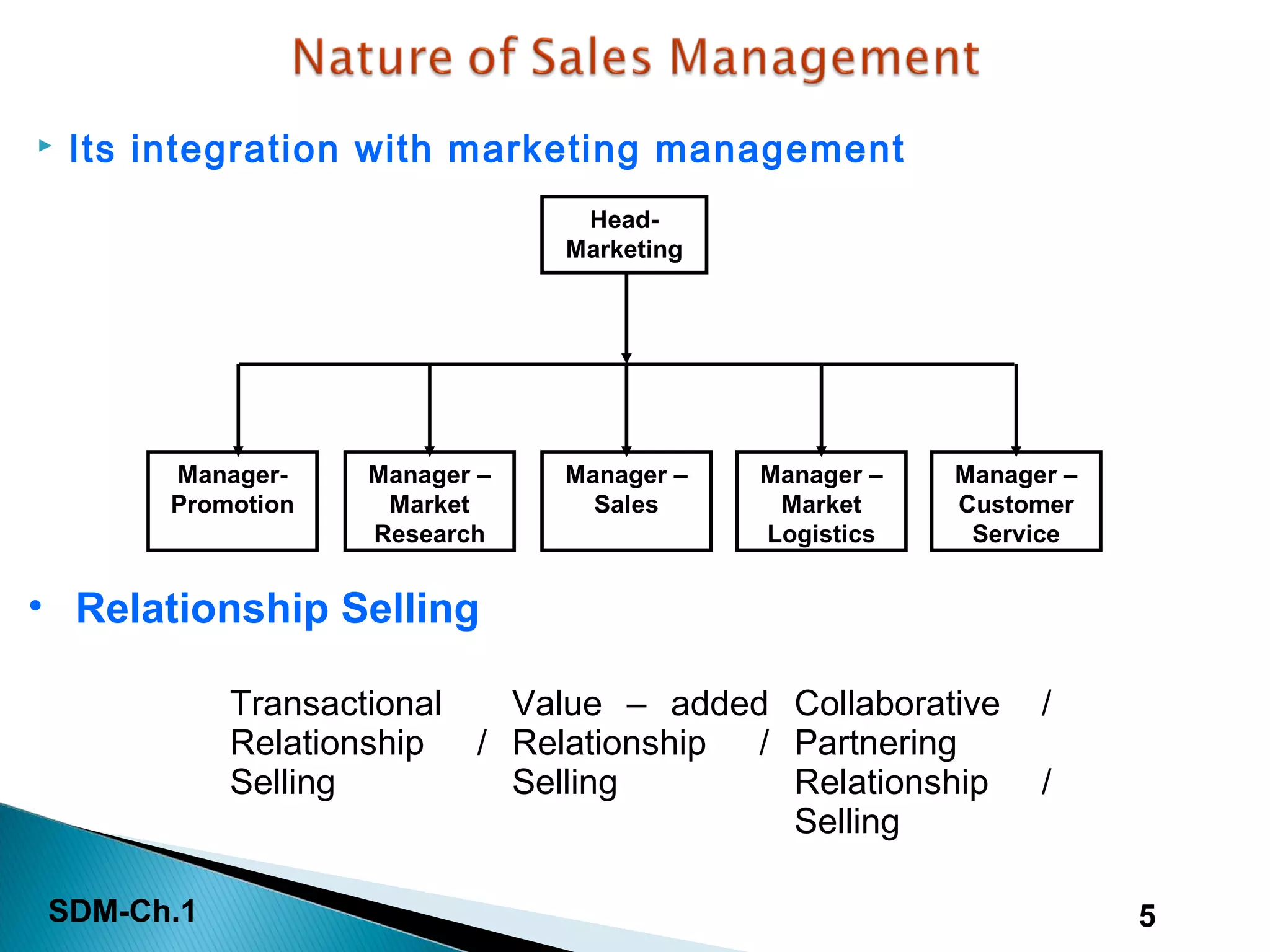
 Its integration with marketing management
• Relationship Selling
Transactional
Relationship /
Selling
Value – added
Relationship /
Selling
Collaborative /
Partnering
Relationship /
Selling
Head-
Marketing
Manager –
Customer
Service
Manager –
Market
Logistics
Manager –
Sales
Manager –
Market
Research
Manager-
Promotion
SDM-Ch.1 6
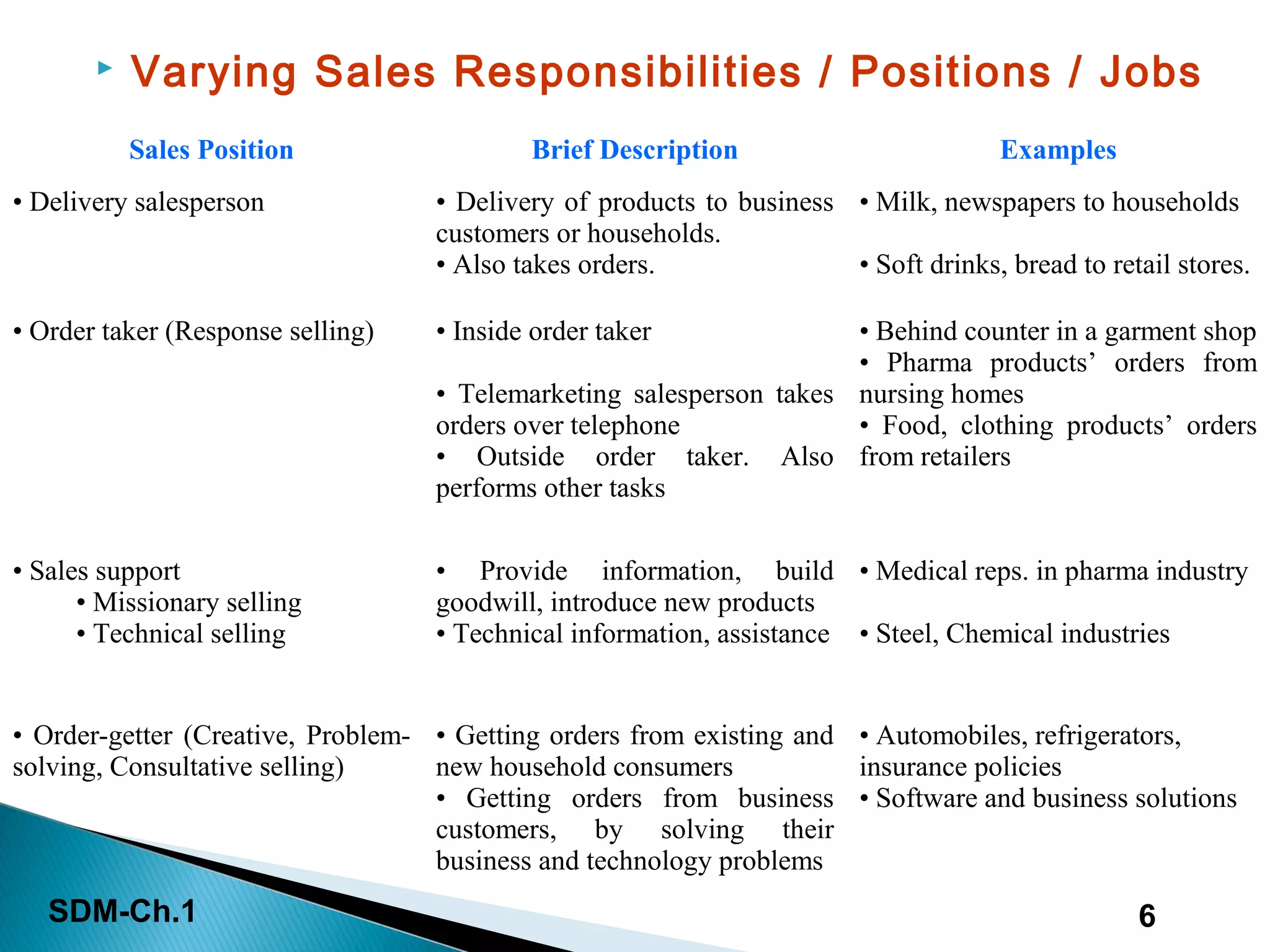
 Varying Sales Responsibilities / Positions / Jobs
Sales Position Brief Description Examples
• Delivery salesperson • Delivery of products to business
customers or households.
• Also takes orders.
• Milk, newspapers to households
• Soft drinks, bread to retail stores.
• Order taker (Response selling) • Inside order taker
• Telemarketing salesperson takes
orders over telephone
• Outside order taker. Also
performs other tasks
• Behind counter in a garment shop
• Pharma products’ orders from
nursing homes
• Food, clothing products’ orders
from retailers
• Sales support
• Missionary selling
• Technical selling
• Provide information, build
goodwill, introduce new products
• Technical information, assistance
• Medical reps. in pharma industry
• Steel, Chemical industries
• Order-getter (Creative, Problem-
solving, Consultative selling)
• Getting orders from existing and
new household consumers
• Getting orders from business
customers, by solving their
business and technology problems
• Automobiles, refrigerators,
insurance policies
• Software and business solutions
SDM-Ch.1 7
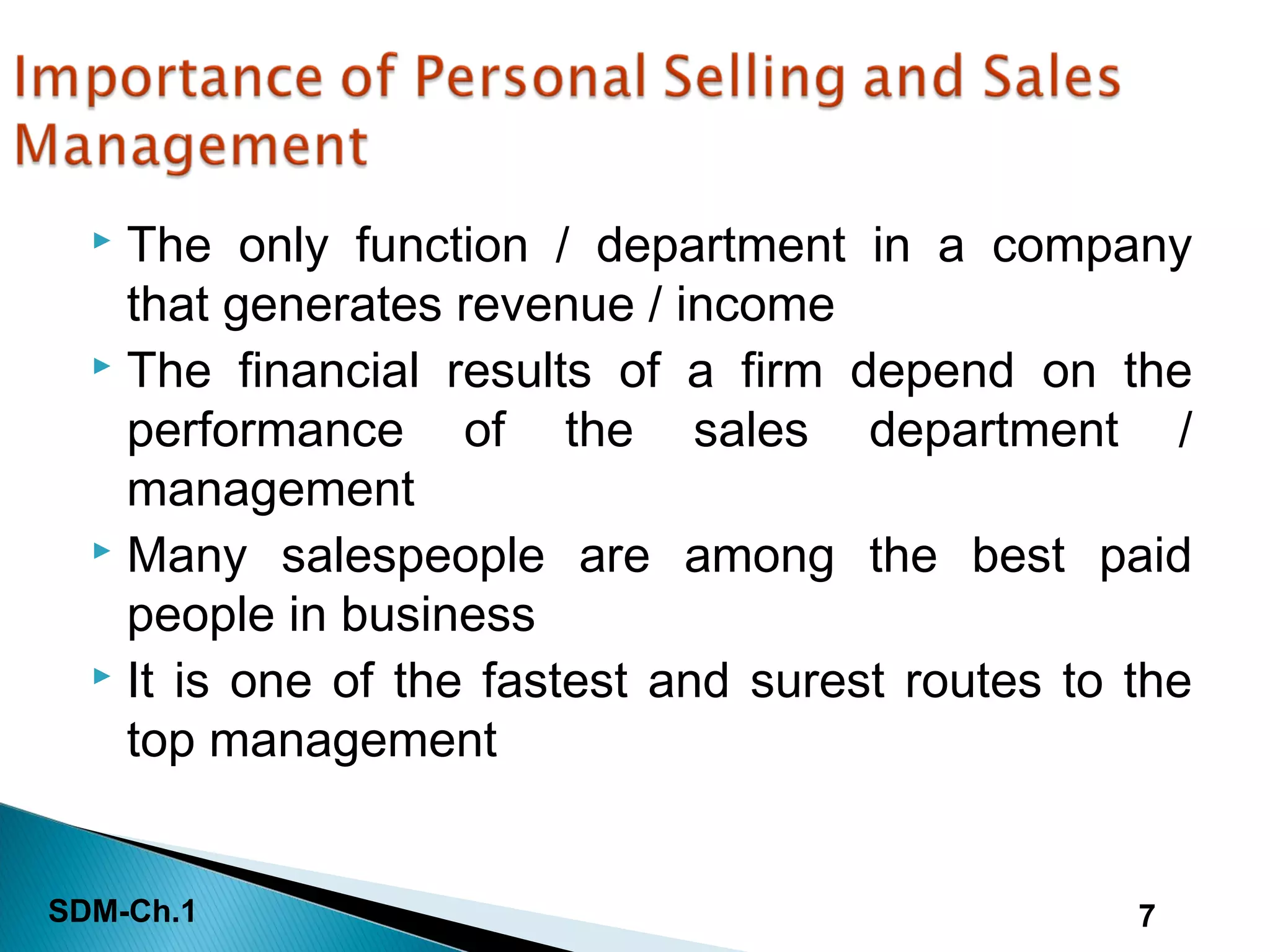
 The only function / department in a company
that generates revenue / income
 The financial results of a firm depend on the
performance of the sales department /
management
 Many salespeople are among the best paid
people in business
 It is one of the fastest and surest routes to the
top management
SDM-Ch.1 8
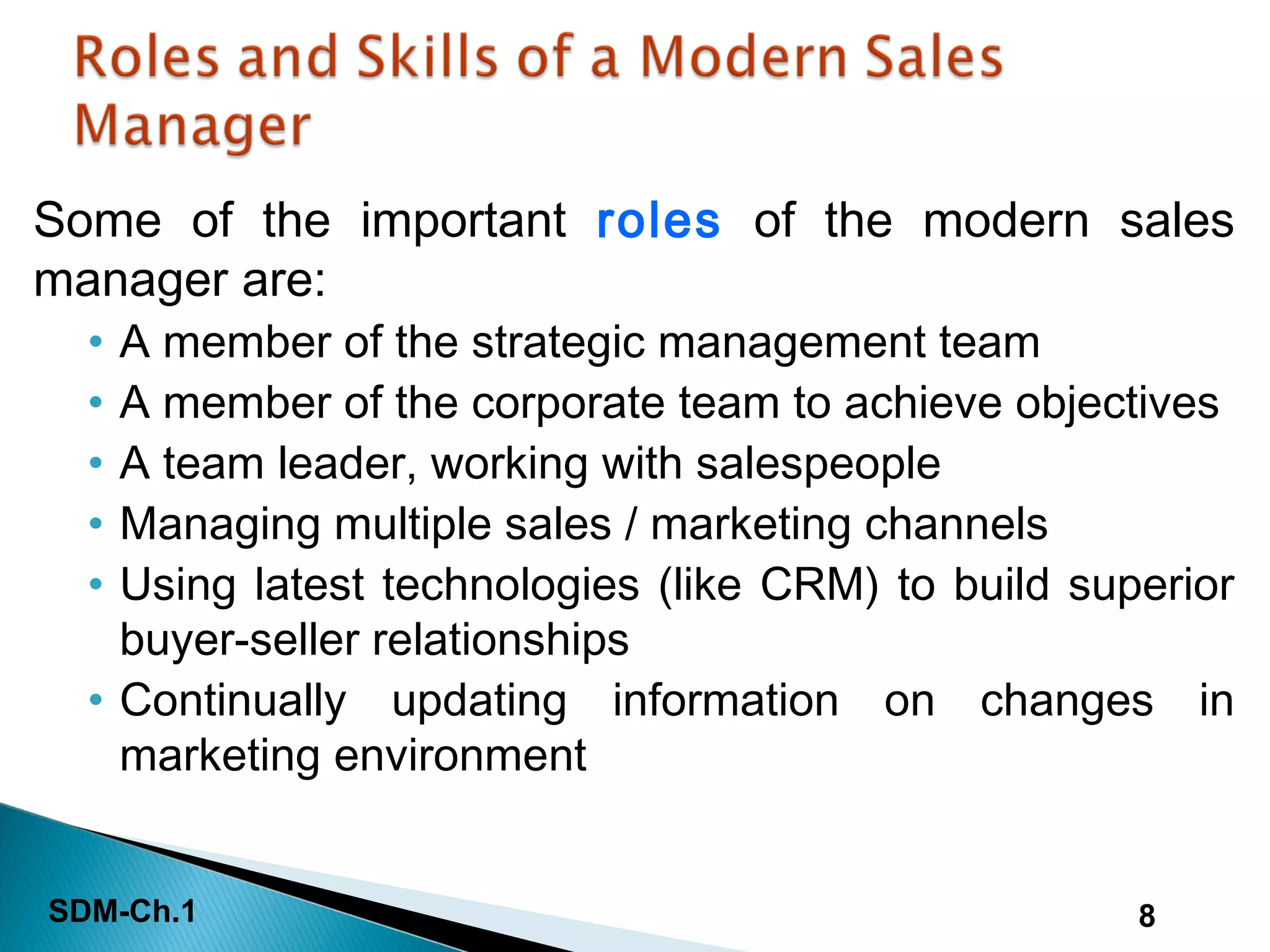
Some of the important roles of the modern sales
manager are:
• A member of the strategic management team
• A member of the corporate team to achieve objectives
• A team leader, working with salespeople
• Managing multiple sales / marketing channels
• Using latest technologies (like CRM) to build superior
buyer-seller relationships
• Continually updating information on changes in
marketing environment
SDM-Ch.1 9
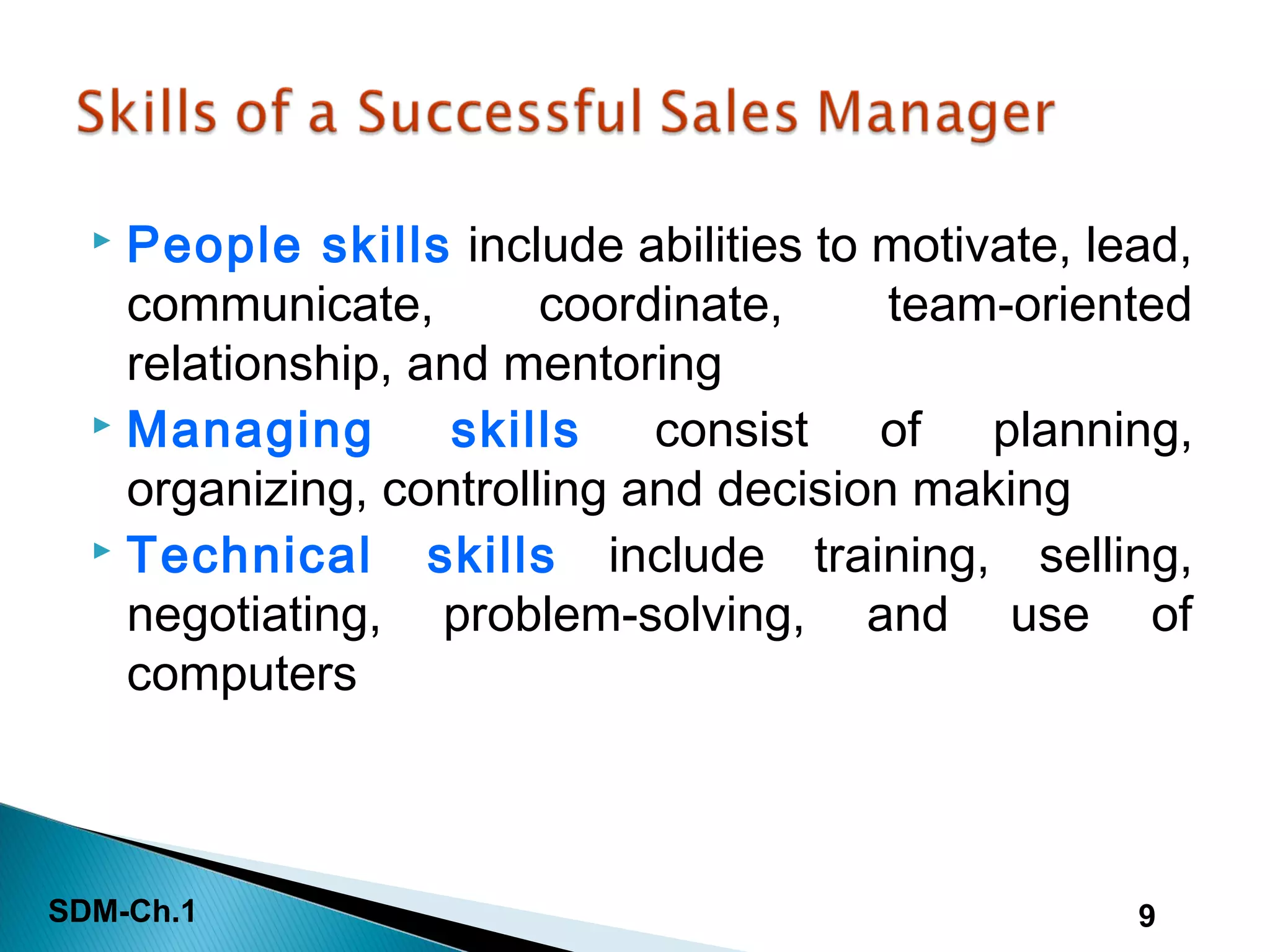
 People skills include abilities to motivate, lead,
communicate, coordinate, team-oriented
relationship, and mentoring
 Managing skills consist of planning,
organizing, controlling and decision making
 Technical skills include training, selling,
negotiating, problem-solving, and use of
computers
SDM-Ch.1 10
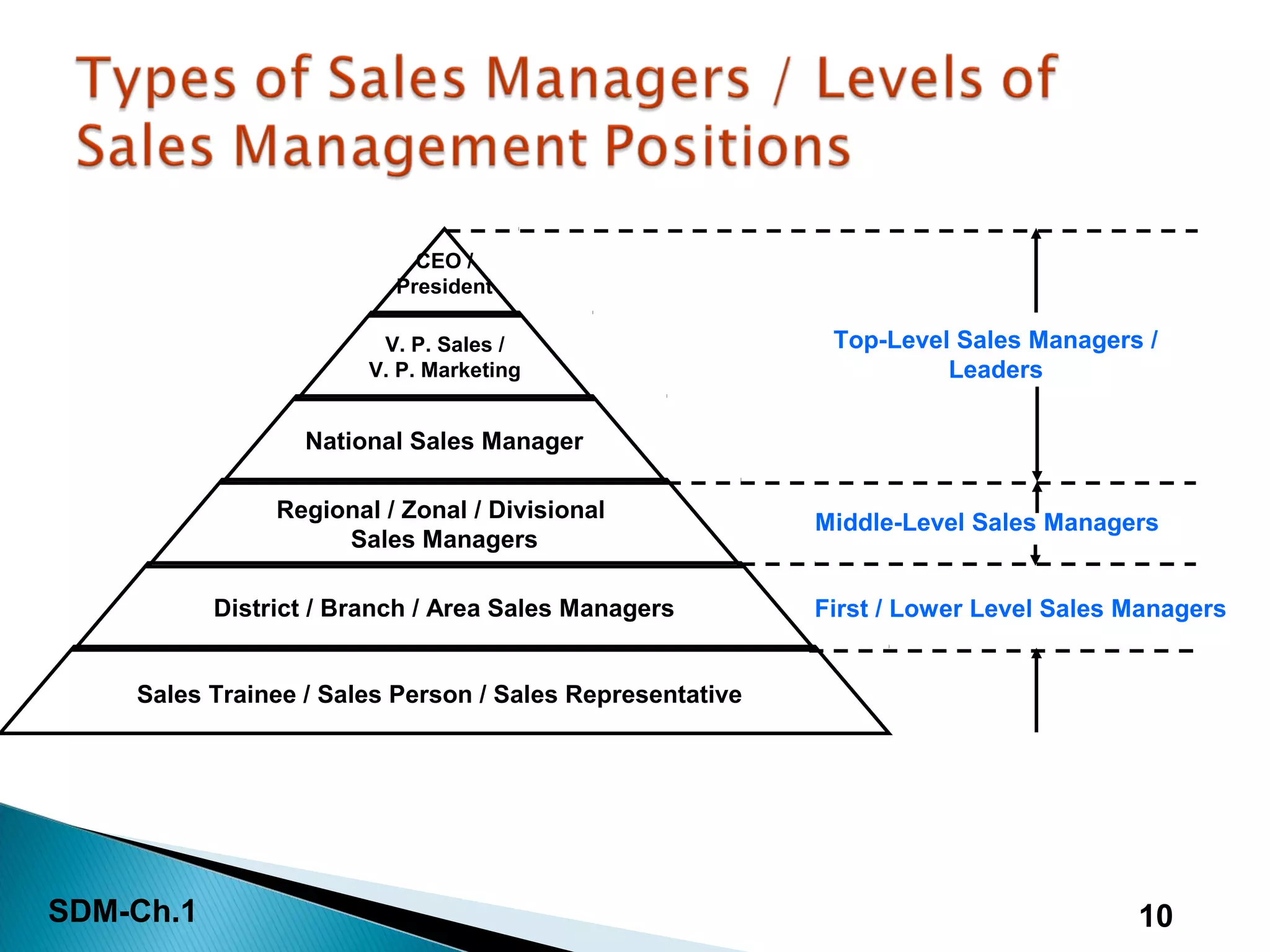
CEO /
President
V. P. Sales /
V. P. Marketing
National Sales Manager
Regional / Zonal / Divisional
Sales Managers
District / Branch / Area Sales Managers
Sales Trainee / Sales Person / Sales Representative
First / Lower Level Sales Managers
Middle-Level Sales Managers
Top-Level Sales Managers /
Leaders
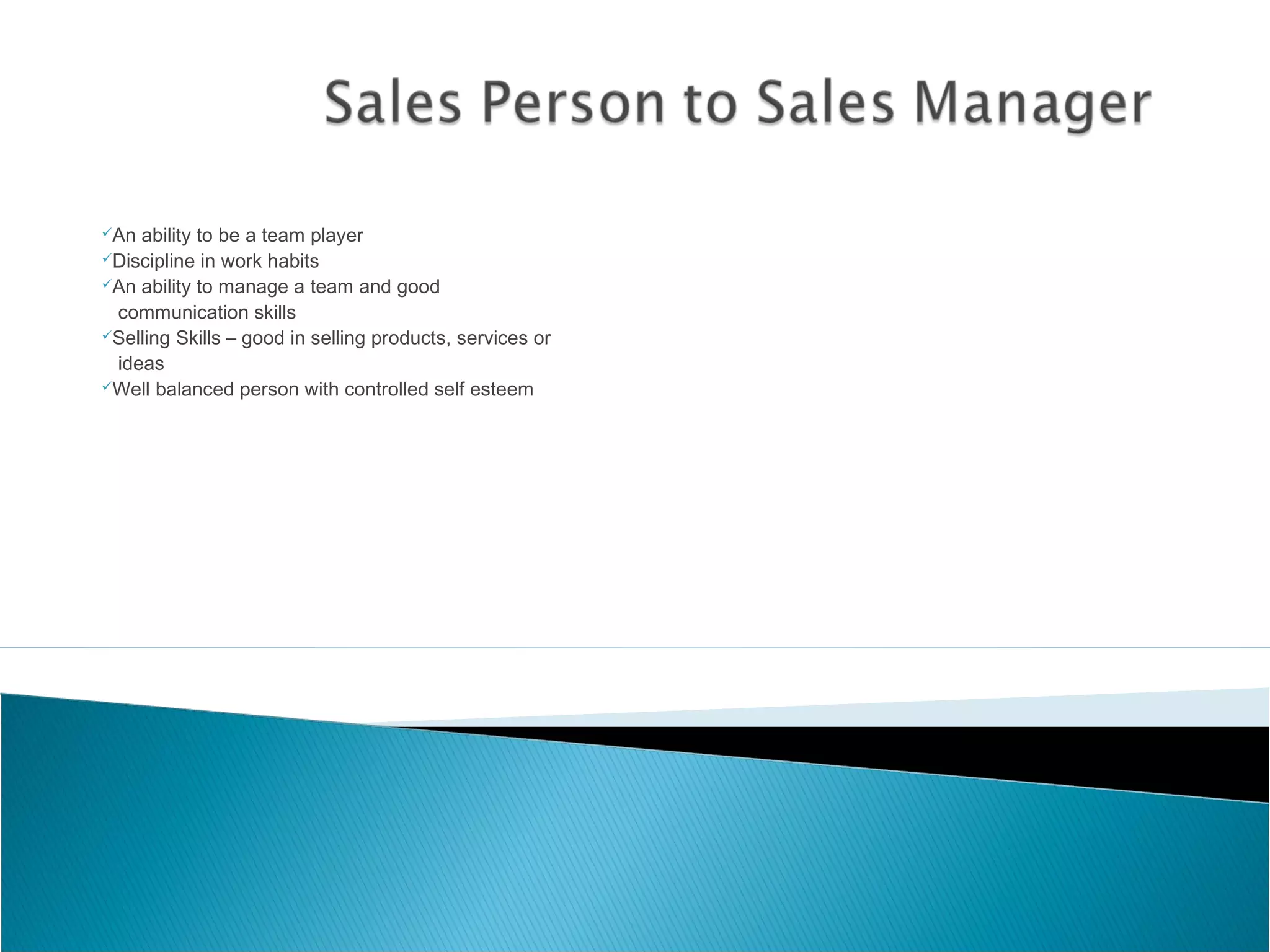
An ability to be a team player
Discipline in work habits
An ability to manage a team and good
communication skills
Selling Skills – good in selling products, services or
ideas
Well balanced person with controlled self esteem
SDM-Ch.1 12
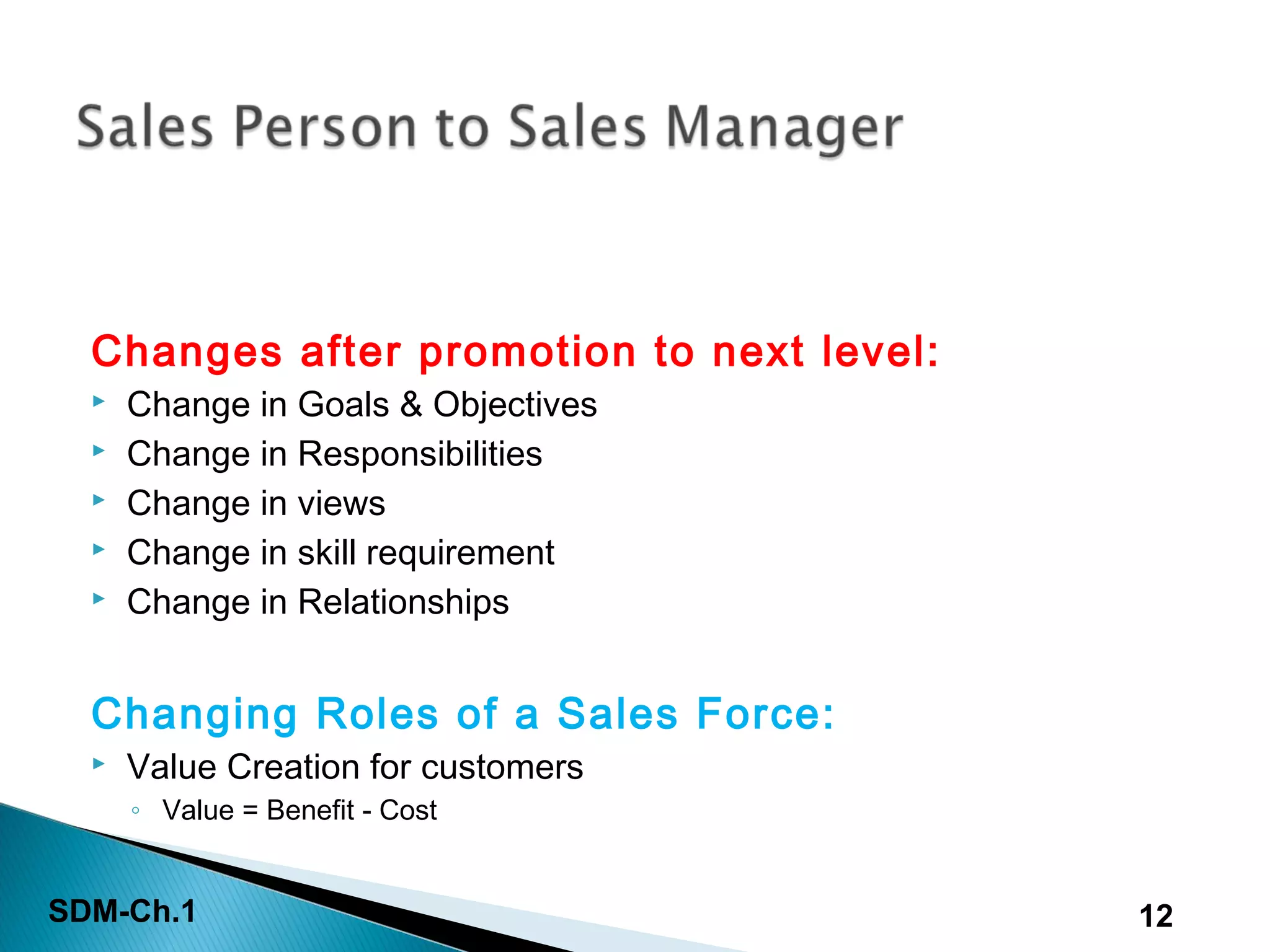
Changes after promotion to next level:
 Change in Goals & Objectives
 Change in Responsibilities
 Change in views
 Change in skill requirement
 Change in Relationships
Changing Roles of a Sales Force:
 Value Creation for customers
◦ Value = Benefit - Cost
SDM-Ch.1 13
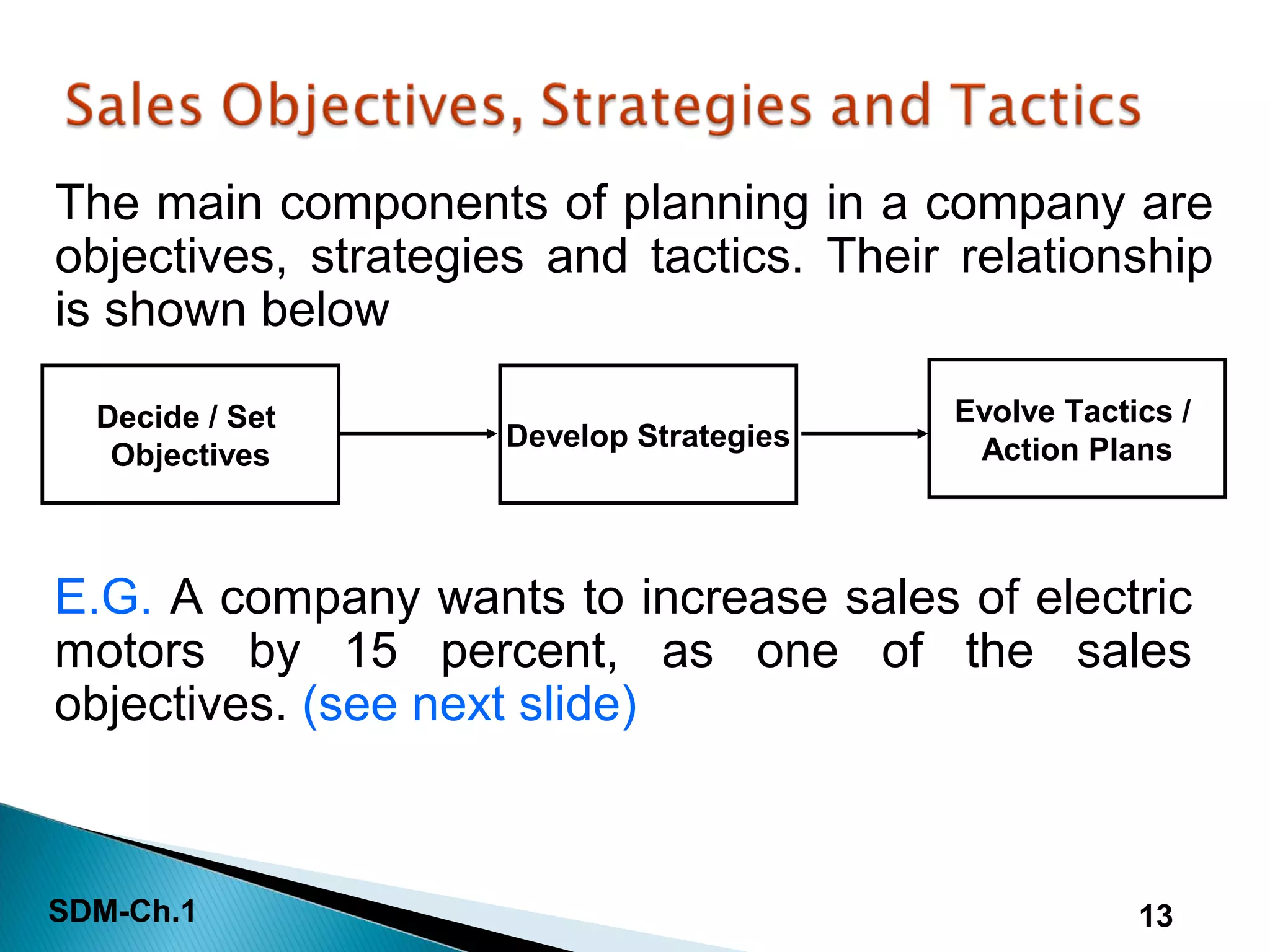
The main components of planning in a company are
objectives, strategies and tactics. Their relationship
is shown below
Decide / Set
Objectives
Develop Strategies
Evolve Tactics /
Action Plans
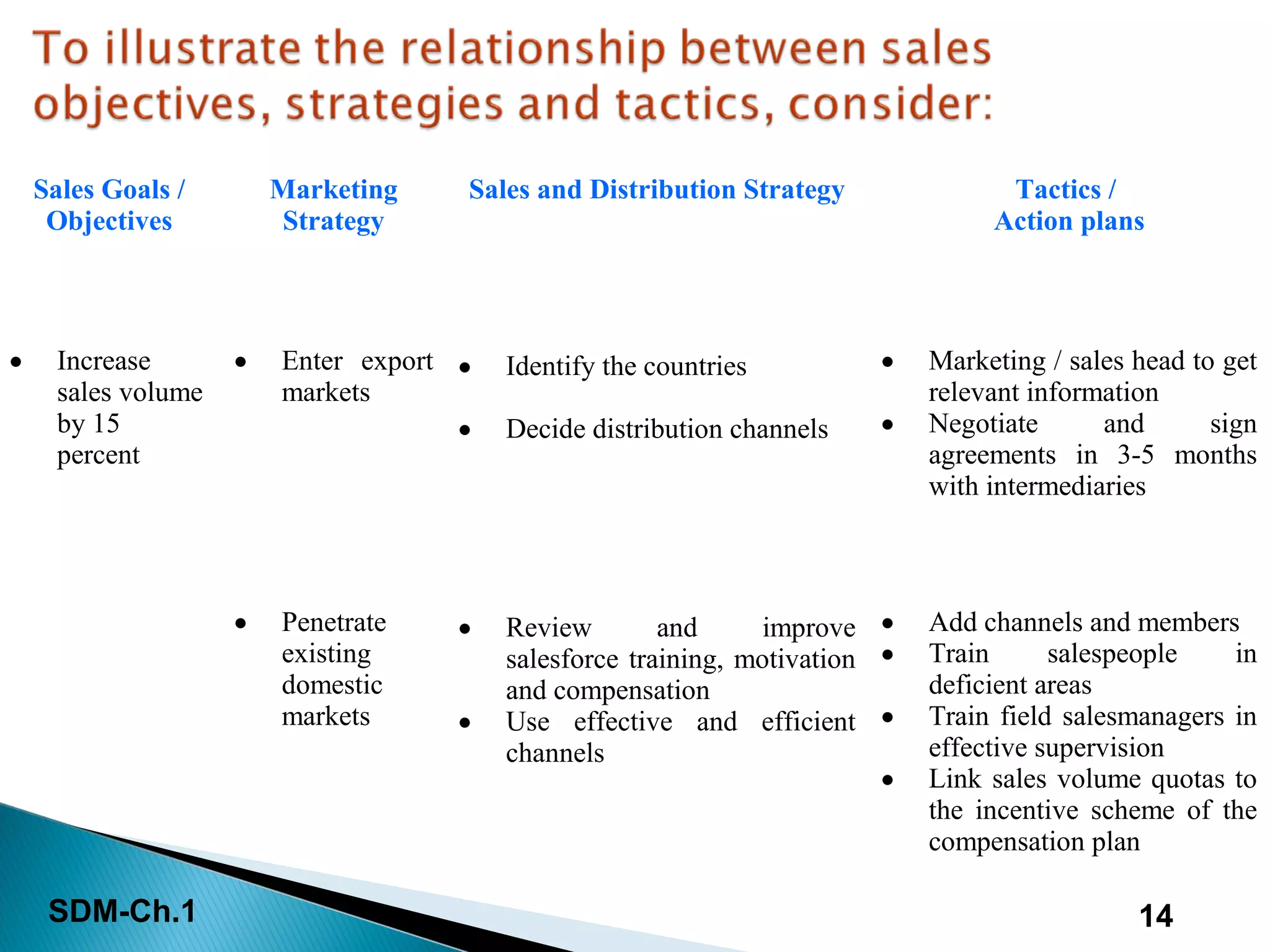
E.G. A company wants to increase sales of electric
motors by 15 percent, as one of the sales
objectives. (see next slide)
SDM-Ch.1 14
Sales Goals /
Objectives
Marketing
Strategy
Sales and Distribution Strategy Tactics /
Action plans
• Increase
sales volume
by 15
percent
• Enter export
markets
• Identify the countries
• Decide distribution channels
• Marketing / sales head to get
relevant information
• Negotiate and sign
agreements in 3-5 months
with intermediaries
• Penetrate
existing
domestic
markets
• Review and improve
salesforce training, motivation
and compensation
• Use effective and efficient
channels
• Add channels and members
• Train salespeople in
deficient areas
• Train field salesmanagers in
effective supervision
• Link sales volume quotas to
the incentive scheme of the
compensation plan
SDM-Ch.1 15
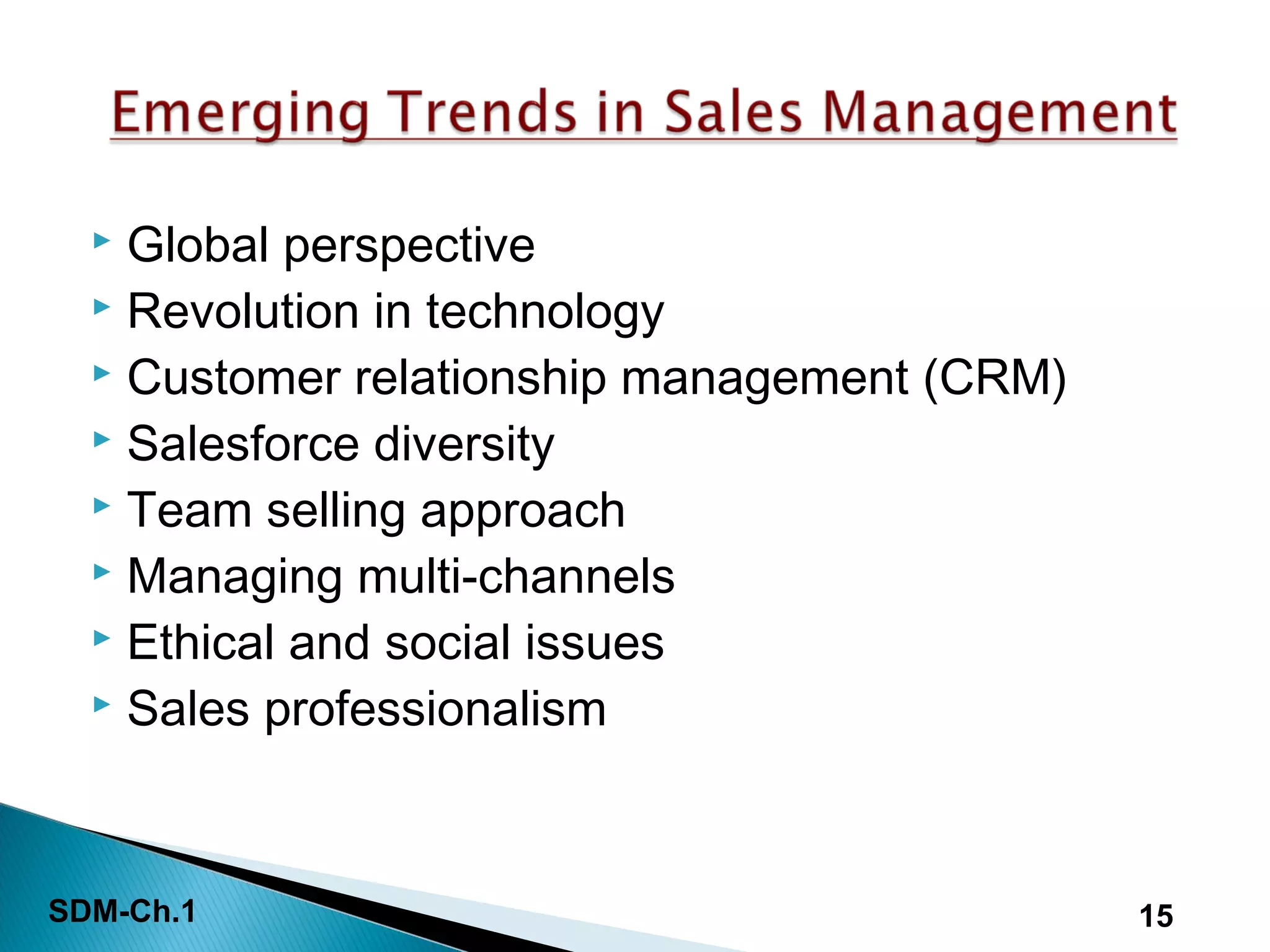
 Global perspective
 Revolution in technology
 Customer relationship management (CRM)
 Salesforce diversity
 Team selling approach
 Managing multi-channels
 Ethical and social issues
 Sales professionalism
SDM-Ch.1 16
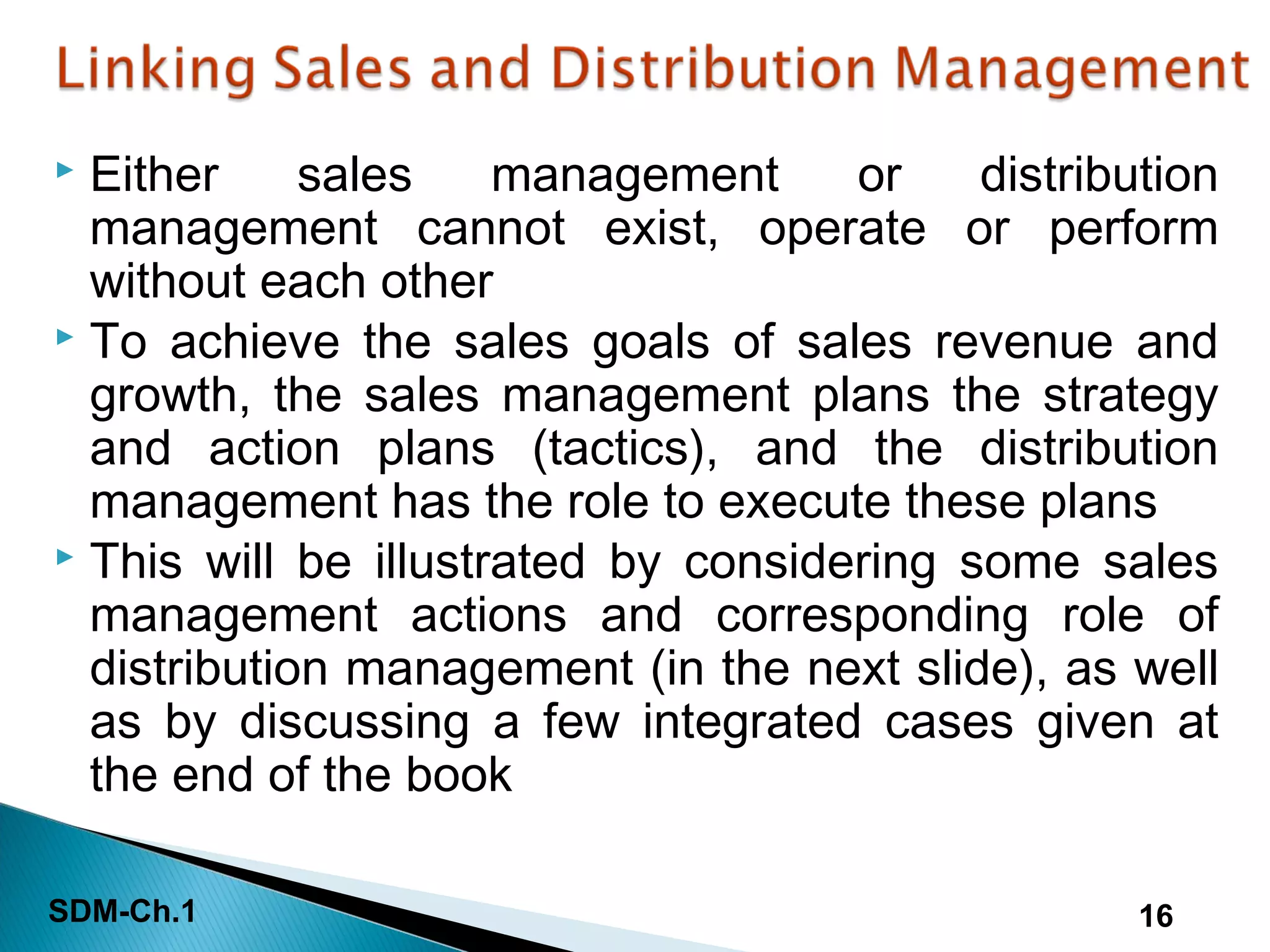
 Either sales management or distribution
management cannot exist, operate or perform
without each other
 To achieve the sales goals of sales revenue and
growth, the sales management plans the strategy
and action plans (tactics), and the distribution
management has the role to execute these plans
 This will be illustrated by considering some sales
management actions and corresponding role of
distribution management (in the next slide), as well
as by discussing a few integrated cases given at
the end of the book
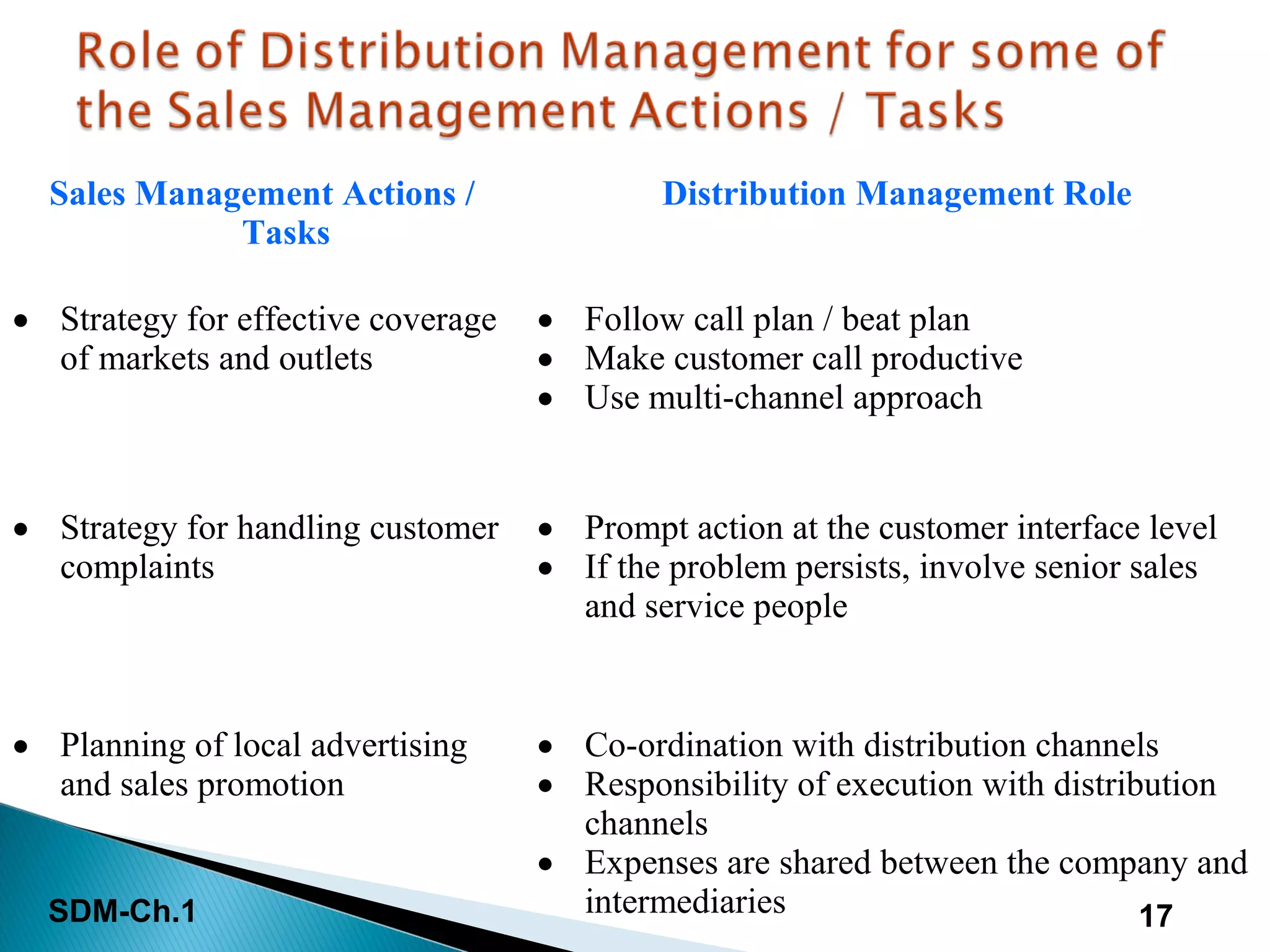
SDM-Ch.1 17
Sales Management Actions /
Tasks
Distribution Management Role
• Strategy for effective coverage
of markets and outlets
• Follow call plan / beat plan
• Make customer call productive
• Use multi-channel approach
• Strategy for handling customer
complaints
• Prompt action at the customer interface level
• If the problem persists, involve senior sales
and service people
• Planning of local advertising
and sales promotion
• Co-ordination with distribution channels
• Responsibility of execution with distribution
channels
• Expenses are shared between the company and
intermediaries
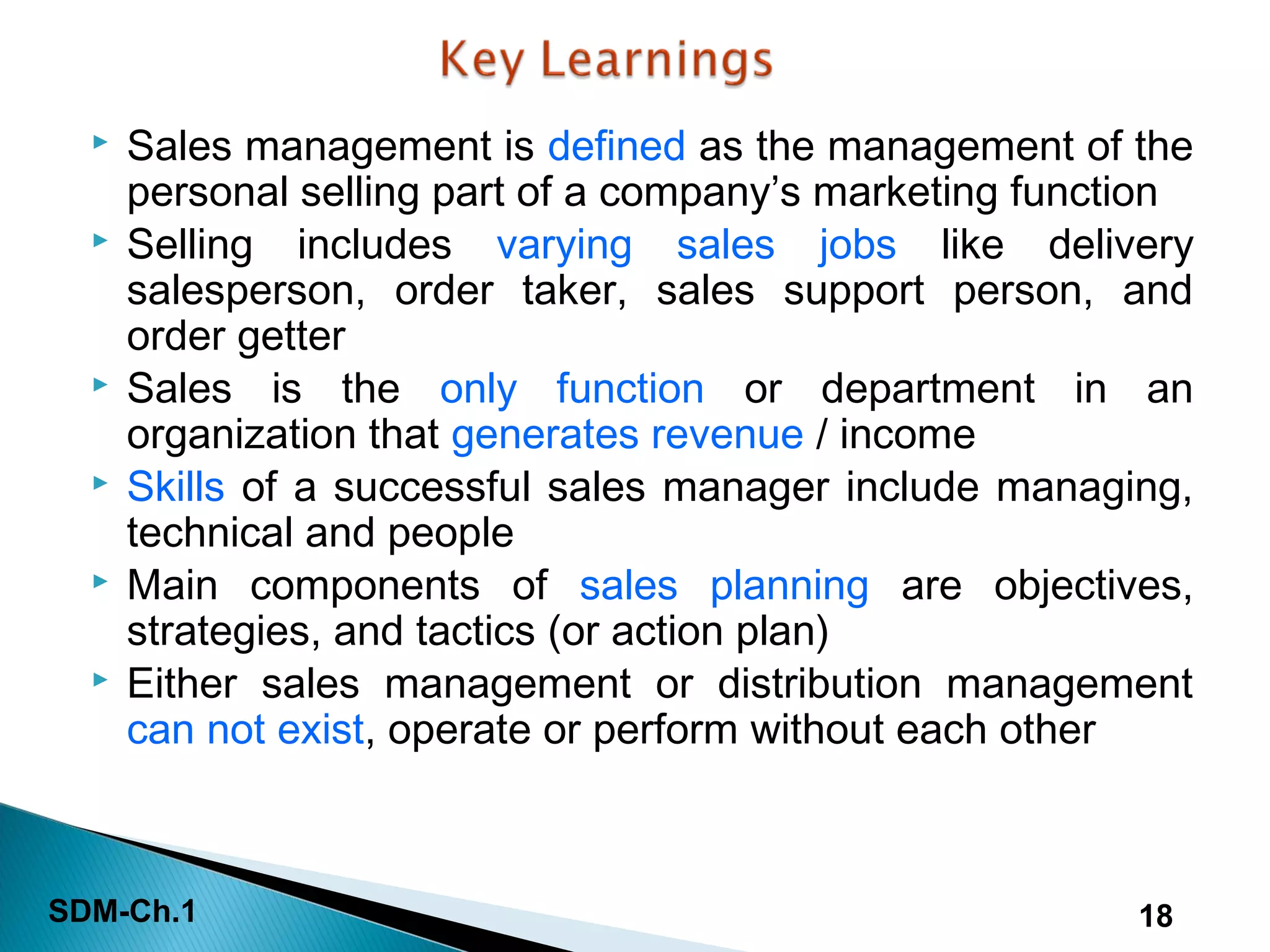
SDM-Ch.1 18
 Sales management is defined as the management of the
personal selling part of a company’s marketing function
 Selling includes varying sales jobs like delivery
salesperson, order taker, sales support person, and
order getter
 Sales is the only function or department in an
organization that generates revenue / income
 Skills of a successful sales manager include managing,
technical and people
 Main components of sales planning are objectives,
strategies, and tactics (or action plan)
 Either sales management or distribution management
can not exist, operate or perform without each other

Intro to sales & distribution management

  • 1.
    SDM-Ch.1 1 Introduction toSales and Distribution Management By Saud Hussain
  • 2.
    SDM-Ch.1 2  Tounderstand evolution, nature and importance of sales management  To know role and skills of modern sales managers  To understand types of sales managers  To learn objectives, strategies and tactics of sales management  To know emerging trends in sales management  To understand linkage between sales and distribution management
  • 3.
    SDM-Ch.1 3 Evolution ofSales Management  Situation before industrial revolution in U.K. (1760AD)  Situation after industrial revolutions in U.K., and U.S.A.  Marketing function splits into sales and other functions like market research, advertising, physical distribution
  • 4.
    SDM-Ch.1 4  Onedefinition: “The management of the personal selling part of a company’s marketing function.”  Another definition: “The process of planning, directing, and controlling of personal selling, including recruiting, selecting, equipping, assigning, supervising, paying, and motivating the personal sales force.
  • 5.
    SDM-Ch.1 5  Itsintegration with marketing management • Relationship Selling Transactional Relationship / Selling Value – added Relationship / Selling Collaborative / Partnering Relationship / Selling Head- Marketing Manager – Customer Service Manager – Market Logistics Manager – Sales Manager – Market Research Manager- Promotion
  • 6.
    SDM-Ch.1 6  VaryingSales Responsibilities / Positions / Jobs Sales Position Brief Description Examples • Delivery salesperson • Delivery of products to business customers or households. • Also takes orders. • Milk, newspapers to households • Soft drinks, bread to retail stores. • Order taker (Response selling) • Inside order taker • Telemarketing salesperson takes orders over telephone • Outside order taker. Also performs other tasks • Behind counter in a garment shop • Pharma products’ orders from nursing homes • Food, clothing products’ orders from retailers • Sales support • Missionary selling • Technical selling • Provide information, build goodwill, introduce new products • Technical information, assistance • Medical reps. in pharma industry • Steel, Chemical industries • Order-getter (Creative, Problem- solving, Consultative selling) • Getting orders from existing and new household consumers • Getting orders from business customers, by solving their business and technology problems • Automobiles, refrigerators, insurance policies • Software and business solutions
  • 7.
    SDM-Ch.1 7  Theonly function / department in a company that generates revenue / income  The financial results of a firm depend on the performance of the sales department / management  Many salespeople are among the best paid people in business  It is one of the fastest and surest routes to the top management
  • 8.
    SDM-Ch.1 8 Some ofthe important roles of the modern sales manager are: • A member of the strategic management team • A member of the corporate team to achieve objectives • A team leader, working with salespeople • Managing multiple sales / marketing channels • Using latest technologies (like CRM) to build superior buyer-seller relationships • Continually updating information on changes in marketing environment
  • 9.
    SDM-Ch.1 9  Peopleskills include abilities to motivate, lead, communicate, coordinate, team-oriented relationship, and mentoring  Managing skills consist of planning, organizing, controlling and decision making  Technical skills include training, selling, negotiating, problem-solving, and use of computers
  • 10.
    SDM-Ch.1 10 CEO / President V.P. Sales / V. P. Marketing National Sales Manager Regional / Zonal / Divisional Sales Managers District / Branch / Area Sales Managers Sales Trainee / Sales Person / Sales Representative First / Lower Level Sales Managers Middle-Level Sales Managers Top-Level Sales Managers / Leaders
  • 11.
    An ability tobe a team player Discipline in work habits An ability to manage a team and good communication skills Selling Skills – good in selling products, services or ideas Well balanced person with controlled self esteem
  • 12.
    SDM-Ch.1 12 Changes afterpromotion to next level:  Change in Goals & Objectives  Change in Responsibilities  Change in views  Change in skill requirement  Change in Relationships Changing Roles of a Sales Force:  Value Creation for customers ◦ Value = Benefit - Cost
  • 13.
    SDM-Ch.1 13 The maincomponents of planning in a company are objectives, strategies and tactics. Their relationship is shown below Decide / Set Objectives Develop Strategies Evolve Tactics / Action Plans E.G. A company wants to increase sales of electric motors by 15 percent, as one of the sales objectives. (see next slide)
  • 14.
    SDM-Ch.1 14 Sales Goals/ Objectives Marketing Strategy Sales and Distribution Strategy Tactics / Action plans • Increase sales volume by 15 percent • Enter export markets • Identify the countries • Decide distribution channels • Marketing / sales head to get relevant information • Negotiate and sign agreements in 3-5 months with intermediaries • Penetrate existing domestic markets • Review and improve salesforce training, motivation and compensation • Use effective and efficient channels • Add channels and members • Train salespeople in deficient areas • Train field salesmanagers in effective supervision • Link sales volume quotas to the incentive scheme of the compensation plan
  • 15.
    SDM-Ch.1 15  Globalperspective  Revolution in technology  Customer relationship management (CRM)  Salesforce diversity  Team selling approach  Managing multi-channels  Ethical and social issues  Sales professionalism
  • 16.
    SDM-Ch.1 16  Eithersales management or distribution management cannot exist, operate or perform without each other  To achieve the sales goals of sales revenue and growth, the sales management plans the strategy and action plans (tactics), and the distribution management has the role to execute these plans  This will be illustrated by considering some sales management actions and corresponding role of distribution management (in the next slide), as well as by discussing a few integrated cases given at the end of the book
  • 17.
    SDM-Ch.1 17 Sales ManagementActions / Tasks Distribution Management Role • Strategy for effective coverage of markets and outlets • Follow call plan / beat plan • Make customer call productive • Use multi-channel approach • Strategy for handling customer complaints • Prompt action at the customer interface level • If the problem persists, involve senior sales and service people • Planning of local advertising and sales promotion • Co-ordination with distribution channels • Responsibility of execution with distribution channels • Expenses are shared between the company and intermediaries
  • 18.
    SDM-Ch.1 18  Salesmanagement is defined as the management of the personal selling part of a company’s marketing function  Selling includes varying sales jobs like delivery salesperson, order taker, sales support person, and order getter  Sales is the only function or department in an organization that generates revenue / income  Skills of a successful sales manager include managing, technical and people  Main components of sales planning are objectives, strategies, and tactics (or action plan)  Either sales management or distribution management can not exist, operate or perform without each other