
Mr. Amit Garg
Asstt. Professor
Management Deptt.
MIMIT, MALOUT
Email: amit.mimit@gmail.com
ADVERTISING CAMPAIGN
An advertising campaign is a series of advertisement
messages that share a single idea and theme which make up
an integrated marketing communication (IMC). Advertising
campaigns appear in different media across a specific time
frame.
The critical part of making an advertising campaign is
determining a champion theme as it sets the tone for the
individual advertisements and other forms of marketing
communications that will be used. The campaign theme is
the central message that will be communicated in the
promotional activities. The campaign themes are usually
developed with the intention of being used for a substantial
period but many of them are short lived due to factors such
as being ineffective or market conditions and/or competition
in the marketplace and marketing mix.
An advertising campaign is an organized series of advertising
messages with identical or similar messages over a particular
period of time.
It is an orderly planned effort consisting of related but self
contained & independent advertisements.
Though the campaign is conveyed through different media,
it has a single theme & unified approach.
There is a psychological continuity due to a unified theme.
The physical continuity is provided by similarity of visuals
and orals.
ADVERTISING CAMPAIGN: TYPES/BASIS
Geographical spread:
Local market campaign
Entire region campaign
National campaign
Pioneering campaigns: introduce new products
Competitive campaigns: emphasise competitive
superiority to retain the present market and to expand it
either by increasing the products consumption or by
wearing the customers away from a competitive brand
Classification in terms of media:
Direct mail campaign
Newspaper campaign
TV campaign etc
On the basis of campaign’s purpose:
Direct action campaign: where a customer is expected to
buy a product
Indirect action campaign
Product promoting campaigns
Corporate image promoting campaigns
ADVERTISING CAMPAIGN: TYPES
Campaign Type 1:
THE WORD HOOK
The word hook is a repeatable catch phrase from ad to ad.
Great examples of advertising campaigns using the word
hook include Verizon's "Can you hear me now?" created by
Bozell/New York to convince the world that Verizon has
the best network.
How effective was it? Consider that in July of 2003, a J.D.
Power & Associates survey ranked Verizon at the top of
the list for wireless quality, while Alltel was ranked
number seven-even though they share the same network
through a nationwide roaming agreement.
Campaign Type 2:
THE CHARACTER HOOK
A character hook uses a hero, villain, or victim to embody a
key attribute of a brand. Great heroic character hooks
include Ronald McDonald, a hero of happiness created in
1963. Ronald helped McDonald's to own family fast food.
 How effective was this character? Consider that 96% of
school children in the United States can identify Ronald
McDonald. Only Santa Claus is more commonly recognized.
Campaign Type 3:
THE REPEATABLE THEME: A repeatable theme is a
situation that plays out again and again calling out the need
for a company's product. Example of a repeatable theme
include the York Peppermint ads created by Cliff Freeman.
Consumers know the punch line that is coming. They love to
see the set-up played out in different situations. It is
satisfying to be in on the joke, before it comes. Repeatable
themes make the target customer feel like they have the
inside track. They know how to play along and thus feel
connected to your brand.
Campaign Type 4:
CONSISTENT LAYOUT: A consistent layout uses a unique,
design look and repeats these elements at each touch point.
This allows customers to easily identify your company in a
blink. The more distinct these elements are from your
competitors, the easier it is to stand out from the clutter.
Great examples of consistent layout include the
Continental ads, with the blue globe, yellow trim, and white
all caps headline. NW Ayer put that design on everything
from print ads to bag tags to cocktail napkins and helped
Continental become the number one airline in the world, as
well as the most profitable. Consistent layouts include
Apple's iPod ads with dancer people on bright backgrounds.
The iconic ads helped make the iPod the number one MP3
player in the world and helped Apple extend its brand from a
computer company to a consumer electronics company.
CAMPAIGN PLANNING
PARAMETERS OF CAMPAIGN PLANNING:
Total advertising budget
Media availability
Consumer profile
Product profile
Campaign’s duration & its timing
Advertising & marketing objectives
Distribution channels
Marketing environment including pressure groups &
competitors
Review of previous advertising effort
Creative considerations
New plans
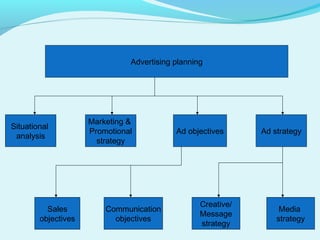
Advertising planning
Situational
analysis
Marketing &
Promotional
strategy
Ad objectives Ad strategy
Media
strategy
Creative/
Message
strategy
Communication
objectives
Sales
objectives
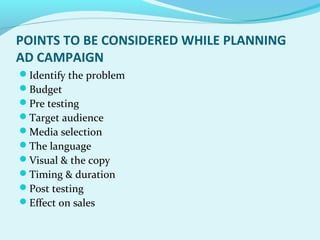
POINTS TO BE CONSIDERED WHILE PLANNING
AD CAMPAIGN
Identify the problem
Budget
Pre testing
Target audience
Media selection
The language
Visual & the copy
Timing & duration
Post testing
Effect on sales
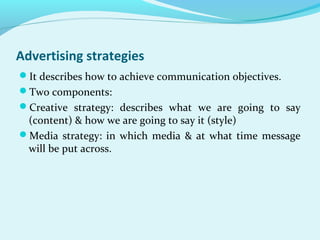
Advertising strategies
It describes how to achieve communication objectives.
Two components:
Creative strategy: describes what we are going to say
(content) & how we are going to say it (style)
Media strategy: in which media & at what time message
will be put across.
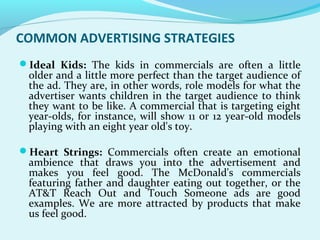
COMMON ADVERTISING STRATEGIES
Ideal Kids: The kids in commercials are often a little
older and a little more perfect than the target audience of
the ad. They are, in other words, role models for what the
advertiser wants children in the target audience to think
they want to be like. A commercial that is targeting eight
year-olds, for instance, will show 11 or 12 year-old models
playing with an eight year old's toy.
Heart Strings: Commercials often create an emotional
ambience that draws you into the advertisement and
makes you feel good. The McDonald's commercials
featuring father and daughter eating out together, or the
AT&T Reach Out and Touch Someone ads are good
examples. We are more attracted by products that make
us feel good.
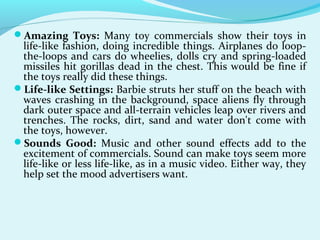
Amazing Toys: Many toy commercials show their toys in
life-like fashion, doing incredible things. Airplanes do loop-
the-loops and cars do wheelies, dolls cry and spring-loaded
missiles hit gorillas dead in the chest. This would be fine if
the toys really did these things.
Life-like Settings: Barbie struts her stuff on the beach with
waves crashing in the background, space aliens fly through
dark outer space and all-terrain vehicles leap over rivers and
trenches. The rocks, dirt, sand and water don't come with
the toys, however.
Sounds Good: Music and other sound effects add to the
excitement of commercials. Sound can make toys seem more
life-like or less life-like, as in a music video. Either way, they
help set the mood advertisers want.
Excitement!: Watch the expressions on children's faces.
Never a dull moment, never boring. "This toy is the most fun
since fried bananas!" they seem to say. How can your child
help thinking the toy's great?
Star Power: Sports heroes, movie stars, and teenage heart
throbs tell our children what to eat and what to wear.
Children listen, not realizing that the star is paid
handsomely for the endorsement.
Thanks

Advertising campaign.ppt

  • 1.
    Mr. Amit Garg Asstt.Professor Management Deptt. MIMIT, MALOUT Email: amit.mimit@gmail.com
  • 2.
    ADVERTISING CAMPAIGN An advertisingcampaign is a series of advertisement messages that share a single idea and theme which make up an integrated marketing communication (IMC). Advertising campaigns appear in different media across a specific time frame. The critical part of making an advertising campaign is determining a champion theme as it sets the tone for the individual advertisements and other forms of marketing communications that will be used. The campaign theme is the central message that will be communicated in the promotional activities. The campaign themes are usually developed with the intention of being used for a substantial period but many of them are short lived due to factors such as being ineffective or market conditions and/or competition in the marketplace and marketing mix.
  • 3.
    An advertising campaignis an organized series of advertising messages with identical or similar messages over a particular period of time. It is an orderly planned effort consisting of related but self contained & independent advertisements. Though the campaign is conveyed through different media, it has a single theme & unified approach. There is a psychological continuity due to a unified theme. The physical continuity is provided by similarity of visuals and orals.
  • 4.
    ADVERTISING CAMPAIGN: TYPES/BASIS Geographicalspread: Local market campaign Entire region campaign National campaign Pioneering campaigns: introduce new products Competitive campaigns: emphasise competitive superiority to retain the present market and to expand it either by increasing the products consumption or by wearing the customers away from a competitive brand
  • 5.
    Classification in termsof media: Direct mail campaign Newspaper campaign TV campaign etc On the basis of campaign’s purpose: Direct action campaign: where a customer is expected to buy a product Indirect action campaign Product promoting campaigns Corporate image promoting campaigns
  • 6.
    ADVERTISING CAMPAIGN: TYPES CampaignType 1: THE WORD HOOK The word hook is a repeatable catch phrase from ad to ad. Great examples of advertising campaigns using the word hook include Verizon's "Can you hear me now?" created by Bozell/New York to convince the world that Verizon has the best network. How effective was it? Consider that in July of 2003, a J.D. Power & Associates survey ranked Verizon at the top of the list for wireless quality, while Alltel was ranked number seven-even though they share the same network through a nationwide roaming agreement.
  • 7.
    Campaign Type 2: THECHARACTER HOOK A character hook uses a hero, villain, or victim to embody a key attribute of a brand. Great heroic character hooks include Ronald McDonald, a hero of happiness created in 1963. Ronald helped McDonald's to own family fast food.  How effective was this character? Consider that 96% of school children in the United States can identify Ronald McDonald. Only Santa Claus is more commonly recognized.
  • 8.
    Campaign Type 3: THEREPEATABLE THEME: A repeatable theme is a situation that plays out again and again calling out the need for a company's product. Example of a repeatable theme include the York Peppermint ads created by Cliff Freeman. Consumers know the punch line that is coming. They love to see the set-up played out in different situations. It is satisfying to be in on the joke, before it comes. Repeatable themes make the target customer feel like they have the inside track. They know how to play along and thus feel connected to your brand.
  • 9.
    Campaign Type 4: CONSISTENTLAYOUT: A consistent layout uses a unique, design look and repeats these elements at each touch point. This allows customers to easily identify your company in a blink. The more distinct these elements are from your competitors, the easier it is to stand out from the clutter. Great examples of consistent layout include the Continental ads, with the blue globe, yellow trim, and white all caps headline. NW Ayer put that design on everything from print ads to bag tags to cocktail napkins and helped Continental become the number one airline in the world, as well as the most profitable. Consistent layouts include Apple's iPod ads with dancer people on bright backgrounds. The iconic ads helped make the iPod the number one MP3 player in the world and helped Apple extend its brand from a computer company to a consumer electronics company.
  • 10.
    CAMPAIGN PLANNING PARAMETERS OFCAMPAIGN PLANNING: Total advertising budget Media availability Consumer profile Product profile Campaign’s duration & its timing Advertising & marketing objectives Distribution channels Marketing environment including pressure groups & competitors
  • 11.
    Review of previousadvertising effort Creative considerations New plans
  • 12.
    Advertising planning Situational analysis Marketing & Promotional strategy Adobjectives Ad strategy Media strategy Creative/ Message strategy Communication objectives Sales objectives
  • 13.
    POINTS TO BECONSIDERED WHILE PLANNING AD CAMPAIGN Identify the problem Budget Pre testing Target audience Media selection The language Visual & the copy Timing & duration Post testing Effect on sales
  • 14.
    Advertising strategies It describeshow to achieve communication objectives. Two components: Creative strategy: describes what we are going to say (content) & how we are going to say it (style) Media strategy: in which media & at what time message will be put across.
  • 15.
    COMMON ADVERTISING STRATEGIES IdealKids: The kids in commercials are often a little older and a little more perfect than the target audience of the ad. They are, in other words, role models for what the advertiser wants children in the target audience to think they want to be like. A commercial that is targeting eight year-olds, for instance, will show 11 or 12 year-old models playing with an eight year old's toy. Heart Strings: Commercials often create an emotional ambience that draws you into the advertisement and makes you feel good. The McDonald's commercials featuring father and daughter eating out together, or the AT&T Reach Out and Touch Someone ads are good examples. We are more attracted by products that make us feel good.
  • 16.
    Amazing Toys: Manytoy commercials show their toys in life-like fashion, doing incredible things. Airplanes do loop- the-loops and cars do wheelies, dolls cry and spring-loaded missiles hit gorillas dead in the chest. This would be fine if the toys really did these things. Life-like Settings: Barbie struts her stuff on the beach with waves crashing in the background, space aliens fly through dark outer space and all-terrain vehicles leap over rivers and trenches. The rocks, dirt, sand and water don't come with the toys, however. Sounds Good: Music and other sound effects add to the excitement of commercials. Sound can make toys seem more life-like or less life-like, as in a music video. Either way, they help set the mood advertisers want.
  • 17.
    Excitement!: Watch theexpressions on children's faces. Never a dull moment, never boring. "This toy is the most fun since fried bananas!" they seem to say. How can your child help thinking the toy's great? Star Power: Sports heroes, movie stars, and teenage heart throbs tell our children what to eat and what to wear. Children listen, not realizing that the star is paid handsomely for the endorsement.
  • 18.