COPYWRITINGCOPYWRITING
Mr. Amit GargMr. Amit Garg
Assistant Professor,Assistant Professor,
Deptt. of Management Studies,Deptt. of Management Studies,
Malout Institute of Management & InformationMalout Institute of Management & Information
Technology, Malout - 152107Technology, Malout - 152107
Distt. Muktsar (Punjab)Distt. Muktsar (Punjab)
84271-0500284271-05002
Email:Email: amit.mimit@gmail.comamit.mimit@gmail.com
CopywritingCopywriting
 Copywriting is the use of words to promote a person,Copywriting is the use of words to promote a person,
business, opinion or idea.business, opinion or idea.
 Broadly the whole ad is called a copy but specifically theBroadly the whole ad is called a copy but specifically the
matter written in words is called copy.matter written in words is called copy.
 The rest of the ad may have visual elements likeThe rest of the ad may have visual elements like
photographs, pictures, illustrations, logos etc.photographs, pictures, illustrations, logos etc.
 Those who write verbal messages are calledThose who write verbal messages are called
copywriters.copywriters.
 The writing aims to achieve business objectives.The writing aims to achieve business objectives.
 Copywriting is a composite art that requires aCopywriting is a composite art that requires a
combination of linguistic ability & business sense.combination of linguistic ability & business sense.
 Copywriters write copy and the associated headlines,Copywriters write copy and the associated headlines,
slogans, base lines etc.slogans, base lines etc.
 They also develop copy for TV, cinema commercial etc.They also develop copy for TV, cinema commercial etc.
 Here copy is the audio part that is co-ordinated with theHere copy is the audio part that is co-ordinated with the
video part.video part.
 They prepare drafts for press releases & promote otherThey prepare drafts for press releases & promote other
promotional materials like direct mailing & catalogues.promotional materials like direct mailing & catalogues.
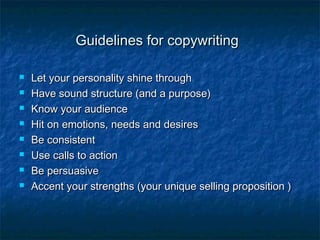
Guidelines for copywritingGuidelines for copywriting
 Let your personality shine throughLet your personality shine through
 Have sound structure (and a purpose)Have sound structure (and a purpose)
 Know your audienceKnow your audience
 Hit on emotions, needs and desiresHit on emotions, needs and desires
 Be consistentBe consistent
 Use calls to actionUse calls to action
 Be persuasiveBe persuasive
 Accent your strengths (your unique selling proposition )Accent your strengths (your unique selling proposition )
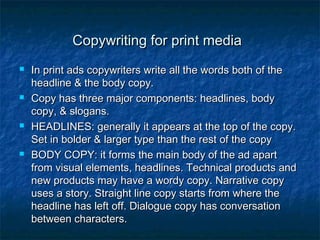
Copywriting for print mediaCopywriting for print media
 In print ads copywriters write all the words both of theIn print ads copywriters write all the words both of the
headline & the body copy.headline & the body copy.
 Copy has three major components: headlines, bodyCopy has three major components: headlines, body
copy, & slogans.copy, & slogans.
 HEADLINES: generally it appears at the top of the copy.HEADLINES: generally it appears at the top of the copy.
Set in bolder & larger type than the rest of the copySet in bolder & larger type than the rest of the copy
 BODY COPY: it forms the main body of the ad apartBODY COPY: it forms the main body of the ad apart
from visual elements, headlines. Technical products andfrom visual elements, headlines. Technical products and
new products may have a wordy copy. Narrative copynew products may have a wordy copy. Narrative copy
uses a story. Straight line copy starts from where theuses a story. Straight line copy starts from where the
headline has left off. Dialogue copy has conversationheadline has left off. Dialogue copy has conversation
between characters.between characters.
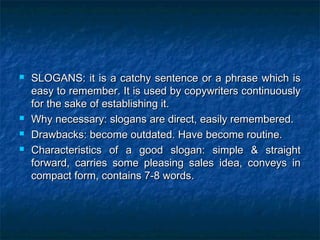
 SLOGANS: it is a catchy sentence or a phrase which isSLOGANS: it is a catchy sentence or a phrase which is
easy to remember. It is used by copywriters continuouslyeasy to remember. It is used by copywriters continuously
for the sake of establishing it.for the sake of establishing it.
 Why necessary: slogans are direct, easily remembered.Why necessary: slogans are direct, easily remembered.
 Drawbacks: become outdated. Have become routine.Drawbacks: become outdated. Have become routine.
 Characteristics of a good slogan: simple & straightCharacteristics of a good slogan: simple & straight
forward, carries some pleasing sales idea, conveys inforward, carries some pleasing sales idea, conveys in
compact form, contains 7-8 words.compact form, contains 7-8 words.
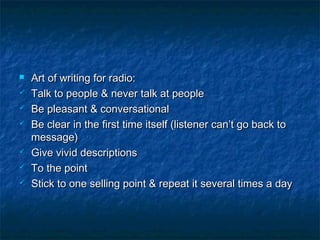
 Art of writing for radio:Art of writing for radio:
 Talk to people & never talk at peopleTalk to people & never talk at people
 Be pleasant & conversationalBe pleasant & conversational
 Be clear in the first time itself (listener can’t go back toBe clear in the first time itself (listener can’t go back to
message)message)
 Give vivid descriptionsGive vivid descriptions
 To the pointTo the point
 Stick to one selling point & repeat it several times a dayStick to one selling point & repeat it several times a day
Copywriting for radio, TV & outdoor mediaCopywriting for radio, TV & outdoor media
 Broadcasting radio commercial spots:Broadcasting radio commercial spots:
 Contains words, music, sound effectsContains words, music, sound effects
 Creates mind pictures among listenersCreates mind pictures among listeners
 Influences listener’s imaginationInfluences listener’s imagination
 Context in which message will appear and audience thatContext in which message will appear and audience that
it will cover should be taken special care of.it will cover should be taken special care of.
 TV copywriting:TV copywriting:
 Scripting for TV commercial: screen output is important,Scripting for TV commercial: screen output is important,
rehearse the script, scripting & camera workrehearse the script, scripting & camera work
 Jingles for TV: catchy little tunes. Each jingle has toJingles for TV: catchy little tunes. Each jingle has to
attend a little story with a beginning, middle & endattend a little story with a beginning, middle & end
 Scripting TV commercials :useful tips;Scripting TV commercials :useful tips;
 Stick to one selling ideaStick to one selling idea
 Whenever possible show the product in useWhenever possible show the product in use
 Use more visuals & fewer wordsUse more visuals & fewer words
 Show the packageShow the package
 Visuals should be uncommon & uniqueVisuals should be uncommon & unique
 Use of product close upsUse of product close ups
 Opening with a surpriseOpening with a surprise
 Use of metaphors: liril girl, lalita ji in surfUse of metaphors: liril girl, lalita ji in surf
 Repeat the ideaRepeat the idea
 Viewer’s involvementViewer’s involvement
 Make the product easy to rememberMake the product easy to remember
 JinglesJingles
 Make actors talkMake actors talk
 Use emotional approachUse emotional approach
 Forms of TV commercials:Forms of TV commercials:
 Use of film genre (film like story)Use of film genre (film like story)
 Use of animalsUse of animals
 Music & soundMusic & sound
 Vignettes: main selling message woven around a seriesVignettes: main selling message woven around a series
of basic situations. (M-Seal ad)of basic situations. (M-Seal ad)
 EndorsementEndorsement
 Anachronism: judicious use of historical or fictionalAnachronism: judicious use of historical or fictional
figures (Akbar-bsnl ad)figures (Akbar-bsnl ad)
 DemonstrationDemonstration
 Humorous commercialsHumorous commercials
 Spoof advertising: business going cold means coca colaSpoof advertising: business going cold means coca cola
 SexSex
 Slice of life: real life problem & its solution throughSlice of life: real life problem & its solution through
productproduct
 DramatizationDramatization
 Copywriting for outdoor & transit commercials:Copywriting for outdoor & transit commercials:
 Essentials of a good poster:Essentials of a good poster:
 Short copyShort copy
 Human interestHuman interest
 Single unique ideaSingle unique idea
 Straightforward messageStraightforward message
 Logo & packageLogo & package
 VisibilityVisibility

Copywriting

  • 1.
    COPYWRITINGCOPYWRITING Mr. Amit GargMr.Amit Garg Assistant Professor,Assistant Professor, Deptt. of Management Studies,Deptt. of Management Studies, Malout Institute of Management & InformationMalout Institute of Management & Information Technology, Malout - 152107Technology, Malout - 152107 Distt. Muktsar (Punjab)Distt. Muktsar (Punjab) 84271-0500284271-05002 Email:Email: amit.mimit@gmail.comamit.mimit@gmail.com
  • 2.
    CopywritingCopywriting  Copywriting isthe use of words to promote a person,Copywriting is the use of words to promote a person, business, opinion or idea.business, opinion or idea.  Broadly the whole ad is called a copy but specifically theBroadly the whole ad is called a copy but specifically the matter written in words is called copy.matter written in words is called copy.  The rest of the ad may have visual elements likeThe rest of the ad may have visual elements like photographs, pictures, illustrations, logos etc.photographs, pictures, illustrations, logos etc.  Those who write verbal messages are calledThose who write verbal messages are called copywriters.copywriters.  The writing aims to achieve business objectives.The writing aims to achieve business objectives.  Copywriting is a composite art that requires aCopywriting is a composite art that requires a combination of linguistic ability & business sense.combination of linguistic ability & business sense.
  • 3.
     Copywriters writecopy and the associated headlines,Copywriters write copy and the associated headlines, slogans, base lines etc.slogans, base lines etc.  They also develop copy for TV, cinema commercial etc.They also develop copy for TV, cinema commercial etc.  Here copy is the audio part that is co-ordinated with theHere copy is the audio part that is co-ordinated with the video part.video part.  They prepare drafts for press releases & promote otherThey prepare drafts for press releases & promote other promotional materials like direct mailing & catalogues.promotional materials like direct mailing & catalogues.
  • 4.
    Guidelines for copywritingGuidelinesfor copywriting  Let your personality shine throughLet your personality shine through  Have sound structure (and a purpose)Have sound structure (and a purpose)  Know your audienceKnow your audience  Hit on emotions, needs and desiresHit on emotions, needs and desires  Be consistentBe consistent  Use calls to actionUse calls to action  Be persuasiveBe persuasive  Accent your strengths (your unique selling proposition )Accent your strengths (your unique selling proposition )
  • 5.
    Copywriting for printmediaCopywriting for print media  In print ads copywriters write all the words both of theIn print ads copywriters write all the words both of the headline & the body copy.headline & the body copy.  Copy has three major components: headlines, bodyCopy has three major components: headlines, body copy, & slogans.copy, & slogans.  HEADLINES: generally it appears at the top of the copy.HEADLINES: generally it appears at the top of the copy. Set in bolder & larger type than the rest of the copySet in bolder & larger type than the rest of the copy  BODY COPY: it forms the main body of the ad apartBODY COPY: it forms the main body of the ad apart from visual elements, headlines. Technical products andfrom visual elements, headlines. Technical products and new products may have a wordy copy. Narrative copynew products may have a wordy copy. Narrative copy uses a story. Straight line copy starts from where theuses a story. Straight line copy starts from where the headline has left off. Dialogue copy has conversationheadline has left off. Dialogue copy has conversation between characters.between characters.
  • 6.
     SLOGANS: itis a catchy sentence or a phrase which isSLOGANS: it is a catchy sentence or a phrase which is easy to remember. It is used by copywriters continuouslyeasy to remember. It is used by copywriters continuously for the sake of establishing it.for the sake of establishing it.  Why necessary: slogans are direct, easily remembered.Why necessary: slogans are direct, easily remembered.  Drawbacks: become outdated. Have become routine.Drawbacks: become outdated. Have become routine.  Characteristics of a good slogan: simple & straightCharacteristics of a good slogan: simple & straight forward, carries some pleasing sales idea, conveys inforward, carries some pleasing sales idea, conveys in compact form, contains 7-8 words.compact form, contains 7-8 words.
  • 7.
     Art ofwriting for radio:Art of writing for radio:  Talk to people & never talk at peopleTalk to people & never talk at people  Be pleasant & conversationalBe pleasant & conversational  Be clear in the first time itself (listener can’t go back toBe clear in the first time itself (listener can’t go back to message)message)  Give vivid descriptionsGive vivid descriptions  To the pointTo the point  Stick to one selling point & repeat it several times a dayStick to one selling point & repeat it several times a day
  • 8.
    Copywriting for radio,TV & outdoor mediaCopywriting for radio, TV & outdoor media  Broadcasting radio commercial spots:Broadcasting radio commercial spots:  Contains words, music, sound effectsContains words, music, sound effects  Creates mind pictures among listenersCreates mind pictures among listeners  Influences listener’s imaginationInfluences listener’s imagination  Context in which message will appear and audience thatContext in which message will appear and audience that it will cover should be taken special care of.it will cover should be taken special care of.
  • 9.
     TV copywriting:TVcopywriting:  Scripting for TV commercial: screen output is important,Scripting for TV commercial: screen output is important, rehearse the script, scripting & camera workrehearse the script, scripting & camera work  Jingles for TV: catchy little tunes. Each jingle has toJingles for TV: catchy little tunes. Each jingle has to attend a little story with a beginning, middle & endattend a little story with a beginning, middle & end
  • 10.
     Scripting TVcommercials :useful tips;Scripting TV commercials :useful tips;  Stick to one selling ideaStick to one selling idea  Whenever possible show the product in useWhenever possible show the product in use  Use more visuals & fewer wordsUse more visuals & fewer words  Show the packageShow the package  Visuals should be uncommon & uniqueVisuals should be uncommon & unique  Use of product close upsUse of product close ups  Opening with a surpriseOpening with a surprise
  • 11.
     Use ofmetaphors: liril girl, lalita ji in surfUse of metaphors: liril girl, lalita ji in surf  Repeat the ideaRepeat the idea  Viewer’s involvementViewer’s involvement  Make the product easy to rememberMake the product easy to remember  JinglesJingles  Make actors talkMake actors talk  Use emotional approachUse emotional approach
  • 12.
     Forms ofTV commercials:Forms of TV commercials:  Use of film genre (film like story)Use of film genre (film like story)  Use of animalsUse of animals  Music & soundMusic & sound  Vignettes: main selling message woven around a seriesVignettes: main selling message woven around a series of basic situations. (M-Seal ad)of basic situations. (M-Seal ad)  EndorsementEndorsement  Anachronism: judicious use of historical or fictionalAnachronism: judicious use of historical or fictional figures (Akbar-bsnl ad)figures (Akbar-bsnl ad)  DemonstrationDemonstration
  • 13.
     Humorous commercialsHumorouscommercials  Spoof advertising: business going cold means coca colaSpoof advertising: business going cold means coca cola  SexSex  Slice of life: real life problem & its solution throughSlice of life: real life problem & its solution through productproduct  DramatizationDramatization
  • 14.
     Copywriting foroutdoor & transit commercials:Copywriting for outdoor & transit commercials:  Essentials of a good poster:Essentials of a good poster:  Short copyShort copy  Human interestHuman interest  Single unique ideaSingle unique idea  Straightforward messageStraightforward message  Logo & packageLogo & package  VisibilityVisibility