Hazards associated withExcavations
► the collapse of the sides;
► materials falling on workers in the excavation;
► falls of people and/or vehicles into the excavation;
► workers being struck by the plant;
► specialist equipment such as pneumatic drills;
► hazardous substances,
► water and entrapment in silt or mud; proximity of stored materials, waste materials
or plant;
► the proximity to adjacent buildings or structures and their stability;
► contact with underground services;
► access and egress to the excavation;
► fumes, lack of oxygen and other health hazards
3.
Excavation and Trench
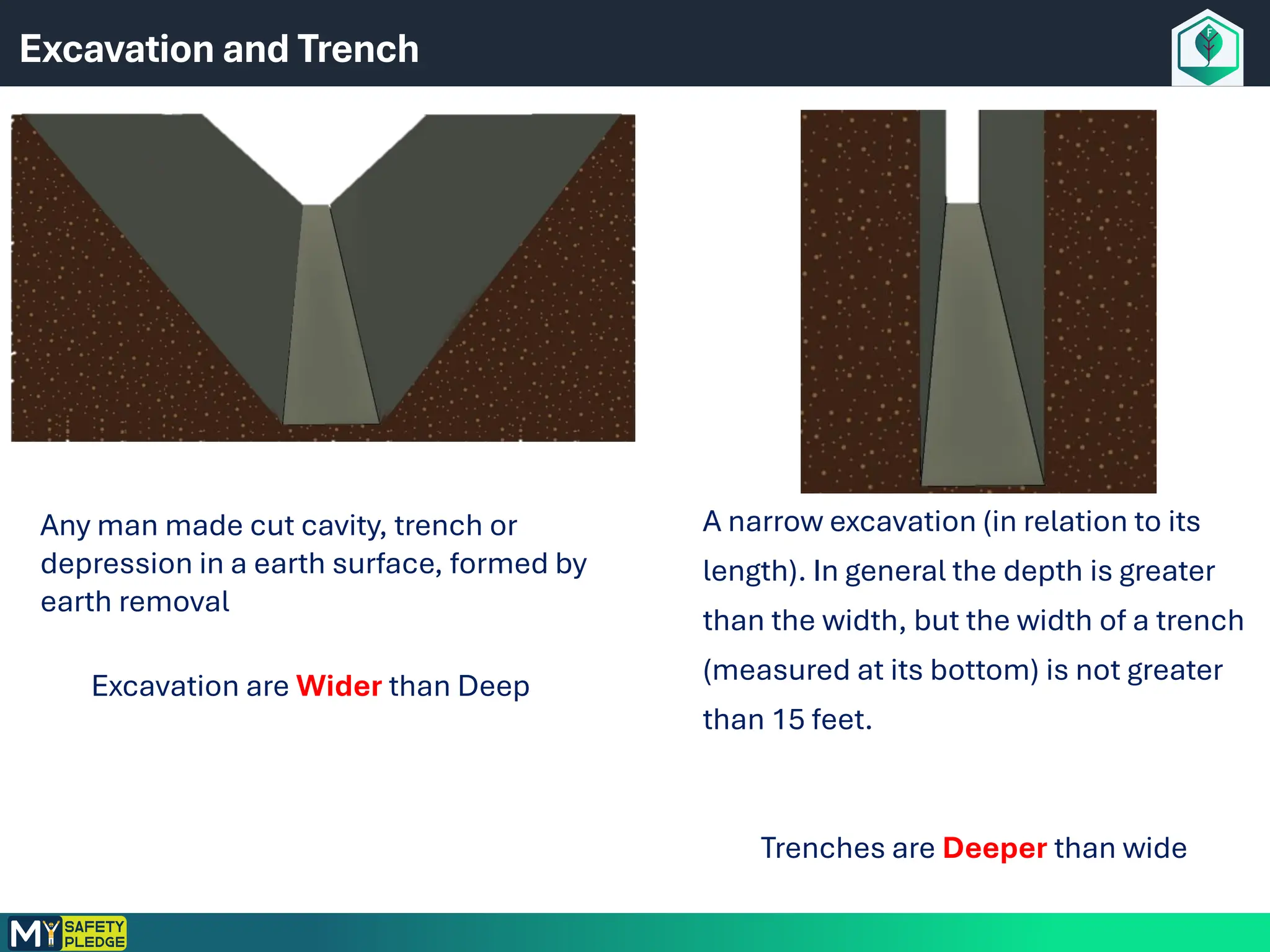
Anyman made cut cavity, trench or
depression in a earth surface, formed by
earth removal
Excavation are Wider than Deep
A narrow excavation (in relation to its
length). In general the depth is greater
than the width, but the width of a trench
(measured at its bottom) is not greater
than 15 feet.
Trenches are Deeper than wide
4.
Excavation
4
Non-Routine & CriticalExcavation
Develop MSRA with engineering
inputs specific to the Excavation
PTW system - Approved
PTW Issued & Execute
Carry out Inspection & CAT Scan
Risk eliminated /
reduced /
controlled within
limits ?
Any changes that
might affect
MSRA &
excavation ?
Continuous BG & Excavation
Is there an existing
relevant MSRA and
excavation profile ?
YES
NO
NO
NO
YES
YES
BG: Breaking Ground
Exhaust utility drawings ,Carry out
Inspection & CAT Scan
Identified any new
hazard /risk ?
NO
Conduct site survey, locate existing
under ground utilities, Soil type, etc
Is this
Continuous
BG &
Excavation?
YES
YES
Pre-Excavation Task Briefing with all relevant
personnel
Conduct Risk Reduction through
Hierarchy of Risk Control
Is this intended
Risk Reduction
achieved ?
NO
NO
YES
Flow Chart
PTW system – Close upon
completion
Competent Person
Competent Personmeans one who can identify existing and predictable
hazards in the surroundings, or working conditions which are unsanitary,
hazardous, or dangerous to employees, and who has authorization to take
prompt corrective measures to eliminate them.
Is able to demonstrate:
1. Documented training, experience, and knowledge of:
→ soil analysis
→ use of protective systems
2. Ability to detect:
→ conditions that could cause cave-in
→ failures in protective systems
→ other hazards including those associated with confined
spaces, dewatering; and has
3. Authorized to take corrective measures
Atmosphere Hazard andTesting
Oxygen deficiency & enrichment
High concentrations of hazardous substances
Concentration of flammable or explosive gas in excess.
When testing for Oxygen levels :-
► Testing must be conducted before employees enter deep excavation &
trench to ensure safe atmospheric condition.
► Frequency of testing should be increased if plant & equipment is
operating in the excavation/ trench.
► Testing frequency should also be increased if welding, cutting, or burning
is done in the excavation/trench.
10.
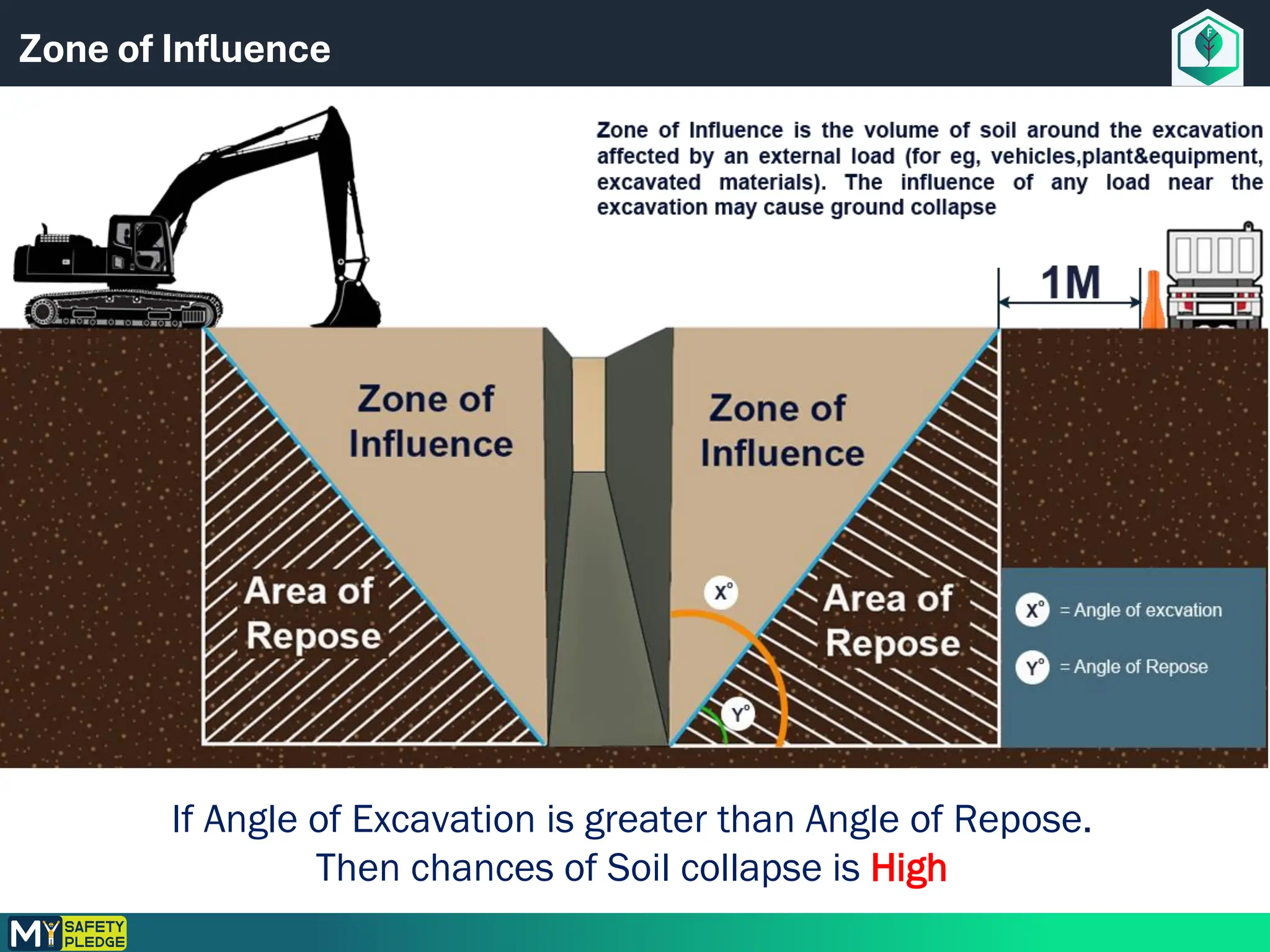
Zone of Influence
IfAngle of Excavation is greater than Angle of Repose.
Then chances of Soil collapse is High
11.
Stress on Edgeof Excavatio
If any load coming over the Zone of Influence stress created on edge of
excavation and there is, chances of Soil collapse.
12.
Underground Utility IdentificationTape & Buffer Zone
The Buffer zone is a pre-defined horizontal
distance extending from the outer edge of a
line or pipe that runs underground. The
exact distance that define this buffer zone
is 18″( it will vary ) on either side of the line
or utility plus the diameter of the line or
utility itself.
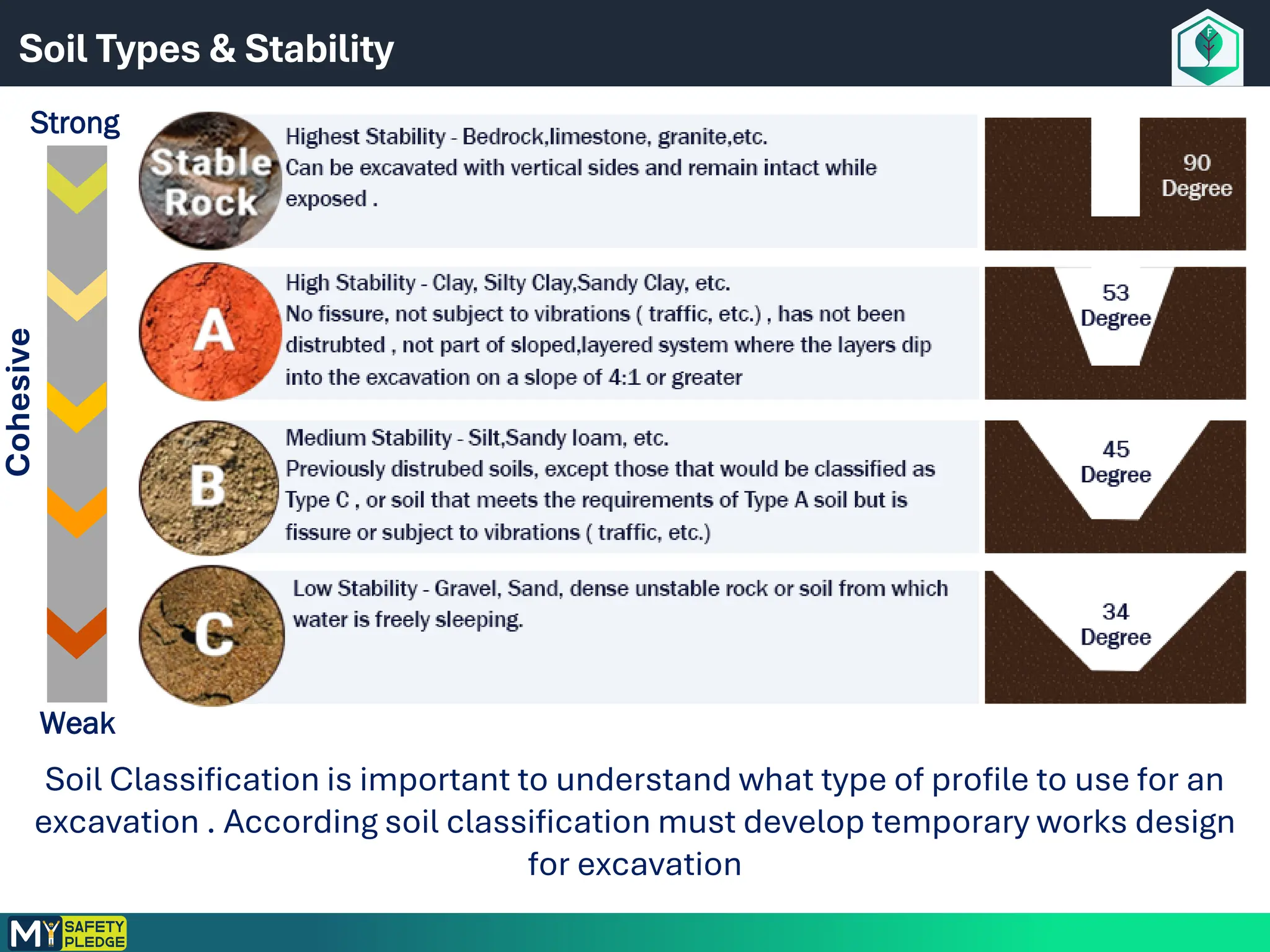
Soil Types &Stability
Strong
Weak
Cohesive
Soil Classification is important to understand what type of profile to use for an
excavation . According soil classification must develop temporary works design
for excavation
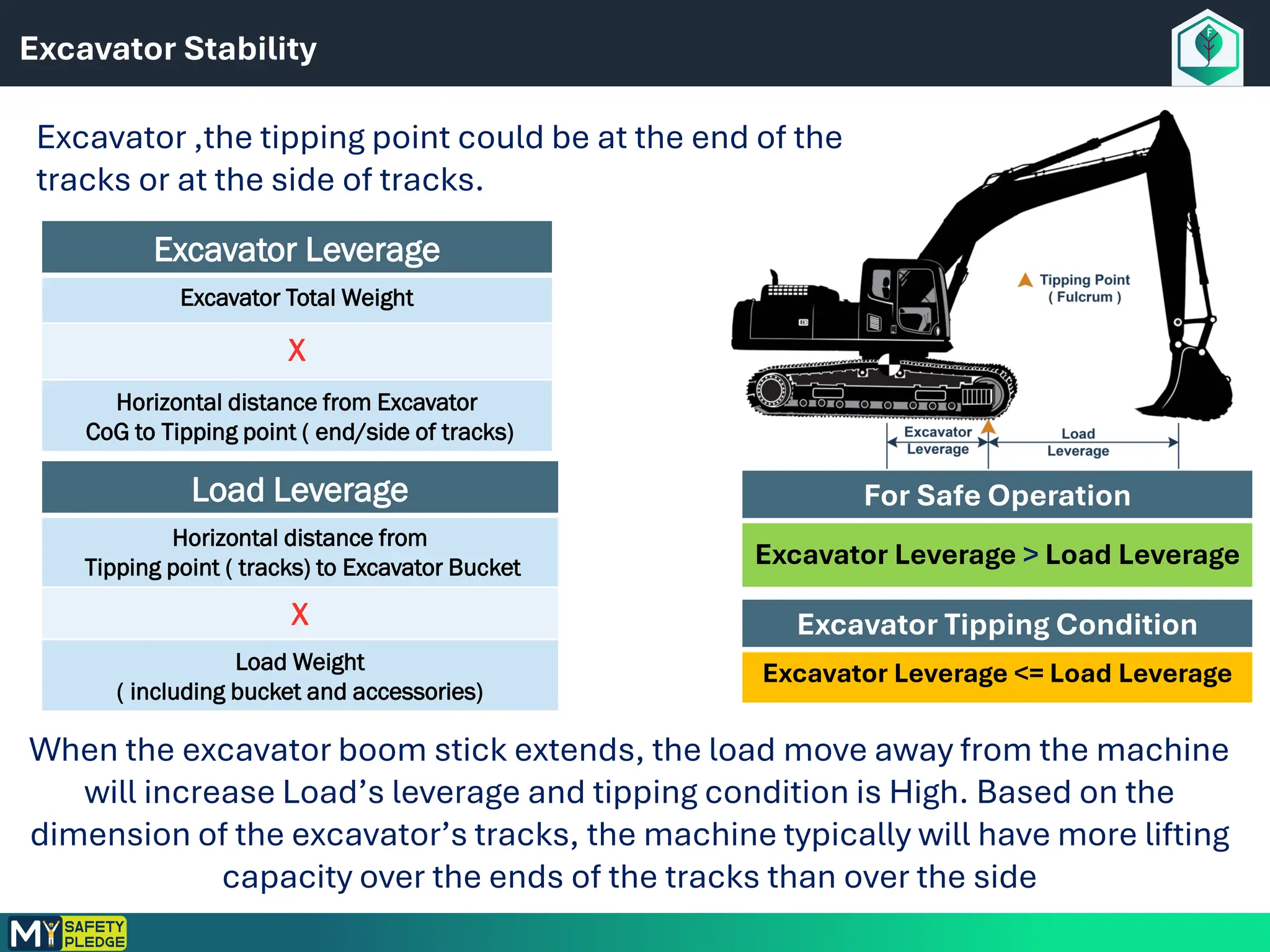
Excavator Stability
Excavator ,thetipping point could be at the end of the
tracks or at the side of tracks.
Excavator Leverage
Excavator Total Weight
X
Horizontal distance from Excavator
CoG to Tipping point ( end/side of tracks)
Load Leverage
Horizontal distance from
Tipping point ( tracks) to Excavator Bucket
X
Load Weight
( including bucket and accessories)
For Safe Operation
Excavator Leverage > Load Leverage
Excavator Tipping Condition
Excavator Leverage <= Load Leverage
When the excavator boom stick extends, the load move away from the machine
will increase Load’s leverage and tipping condition is High. Based on the
dimension of the excavator’s tracks, the machine typically will have more lifting
capacity over the ends of the tracks than over the side
Red Zone
Entry Prohibitedunless the machine
is completely isolated with the slew
arm/attachment/bucket grounded,
the machine immobilized using safety
lever and Engine Switched Off.
Amber Zone
Entry Prohibited until visual contact is
made the plant operator, the slew
arm/attachment/bucket grounded,
the machine immobilized using safety
lever.
Yellow Zone
All personnel involved with the plant
operation much remain within this
zone to maintain visual contact with
the plant operator.
Plant Safe Zone – 360 degree
20.
Overhead Power Lines
Anapproach distance is the minimum space
from an Energised overhead electric line that
should be maintained by a person or an
object held by or in contact with that person.
The approach distance in specified zones
should consider different levels of technical
knowledge and items of plant.
Approach distance are
greater for unauthorized
persons than for authorized
persons who have been
trained and assessed as
having the necessary
technical knowledge and
skills