Session 6
Qualitative Research
Design
Education 5P92 - Collier - Oct. 3, 2019
LAST WEEK
This week in the news / activity
Facilitation
Intro to qualitative research
Tilley discussion
How to record/retrieve/transcribe
Interviews
TODAY
•This week in the news
•Activity – sharing – final paper
•Introduction to field notes and
other qualitative approaches
•Silverman discussion
•Analysis activity/check in re
interviews
ACTIVITY
•Find an image that represents
your research and post it on our
padlet.
•In a small group, tell about your
topic and solicit feedback.
TYPES OF QUALITATIVE RESEARCH
Primary Methods
• Participatory observation: researcher engages in
the activities of those he or she is researching, and
records systematic observations.
• Nonparticipatory observation: researcher
observes the participants in the setting without
engaging in the same activities.
• In practice, there is a continuum of participation.
Ethnography/Field Research
• The oldest qualitative genre.
• Ethnography: writing about culture or a written text
about culture.
• Field research: occurs in natural settings (the field) and
results in an ethnography.
• Relies on direct observations of people in their
natural settings in order to understand social life from
the perspective of the participants.
• Results in “thick descriptions” of social life (Geertz, 1973).
Issues in Field Research
• Gatekeepers (formal and informal): people who can
grant or prevent access to the site
• Insider (emic)–outsider (etic) statuses: the ways
in which you are similar and dissimilar to the
participants (e.g., status characteristics)
• Rapport: how you build relationships in the field
• Key informants: share not only their own
experiences but also introduce you to other possible
participants and/or provide an overview picture of
people and activities in the setting
Self-Data (Autoethnography)
• Uses the researcher’s personal
experience as a method for connecting the
personal to a larger cultural context or
phenomenon (Adams et al., 2015).
• Involves a rigorous writing practice
(e.g., daily journaling and a process of memo
writing).
• May also include fieldwork, interviewing,
content analysis.
Issues in Autoethnography
• Insider–outsider status: explicitly working from
an insider status and with insider knowledge
(Holman Jones et al., 2013)
• Vulnerability: digging deeply into your own
experiences, may release unexpected emotions. You
also need to be prepared to share your personal
experiences
• An ethic of self-care: keep track of self/feelings
(e.g., journaling about your experience in the project,
sharing with trusted peers)
Writing Style
• Draw on conventions of literary writing
• Engaging and accessible
• Storytelling quality
Unobtrusive Methods (Content Analysis)
• A method for systematically investigating texts.
Some refer to content analysis as a way of studying
documented human communications (Adler & Clark,
2011; Babbie, 2013).
• Used to understand the meanings that circulate in texts.
• Relies on nonliving data. Two distinct features:
–noninteractive
–exist independent of the research (Reinharz,
1992, pp. 147–148). Because the data exist in the world
regardless of whether or not the research is occurring,
the data are considered naturalistic (Reinharz, 1992).
Content Analysis Process
• Initial immersion (get a sense of the “big picture”)
• Determine the units of analysis (chunks of data)
• Coding
–May use computer-assisted qualitative data analysis
software (CAQDAS)
• Generate a code for each unit of analysis
• An inductive process, with codes and themes
developing out of a recursive process of data
collection and analysis
Grounded Theory
• An approach by which one collects and
analyzes data, develops new insights, and
then uses those insights to inform the
next round of data collection and
analysis. These steps are repeated until
the saturation point is reached. Codes,
concepts, and insights develop directly
out of the data, and hence are grounded
in the data.
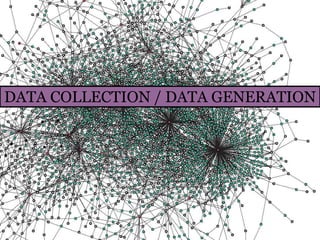
DATA COLLECTION / DATA GENERATION
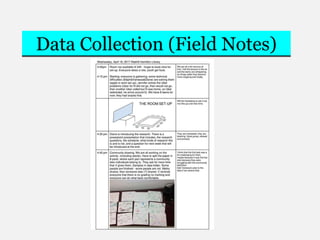
Data Collection (Field Notes)
Field notes: the written or recorded notes of your
observations in the field
• Create an organizational system and catalog field
notes
• Types of field notes:
–On-the-fly notes, thick descriptions, summary
notes, reflexivity notes, conversation and interview
notes, and interpretation notes (Bailey, 1996, 2007;
Hesse-Biber & Leavy, 2011)
Data Collection (Field Notes)
Data Collection (Memo Notes)
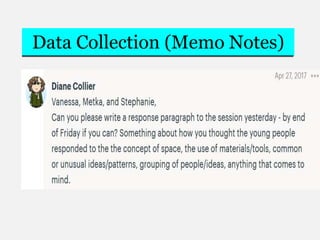
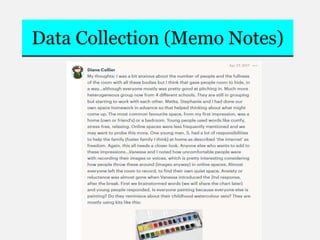
• Memo notes: help you develop your ideas about your
data (field notes), synthesize your data, integrate your
ideas, and discern relationships within the data
(Hesse-Biber & Leavy, 2005, 2011)
Data Collection (Memo Notes)
Activity 2:
Let’s take some field notes
STEP 1
• What will you record
• How will you record
STEP 2
• Record
STEP 3
• Write a memo
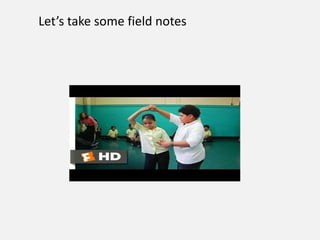
Let’s take some field notes
Silverman
DATA ANALYSIS
Data Analysis and Interpretation
• analysis and interpretation typically occur as a
recursive process
• the general phases of analysis and interpretation
include (1) data preparation and organization,
(2) initial immersion, (3) coding, (4)
categorizing and theming, and (5) interpretation
Data Preparation and Organization
• transcribe the data (e.g., transcribing interview
recordings) or scan the data (e.g., historical
documents)
• organize the data in a repository (requires
sorting the data)
Initial Immersion
• read, look at, and think about the data (Hesse-Biber &
Leavy, 2005, 2011)
• stew on it and let your ideas develop
• helps you “to feel” the pulse of the data (Saldaña,
2014)
• helps you develop your initial ideas (Creswell,
2014)
• may help you begin data reduction (Hesse-Biber &
Leavy, 2005, 2011) and to “prioritize” the data for
analysis by noting which data will best help you
address the research purpose and answer the research
questions (Saldaña, 2014)
Coding
• allows you to reduce and classify the data generated
• the process of assigning a word or phrase to
segments of data (code should summarize that segment
of data) (Saldaña, 2009)
• code by hand or using CAQDAS
• approaches include:
– In vivo coding: relies on using participants’ exact
language to generate codes (Strauss, 1987).
– Descriptive coding: mainly uses nouns to summarize
segments of data (Saldaña, 2014).
– Values coding: focuses on conflicts, struggles, and
power issues (Saldaña, 2014).
• approach should be linked to your research purpose and
research questions
Open
Axial
Categorizing and Theming
• Categorizing is the process of grouping similar
or seemingly related codes together (Saldaña,
2014).
• You may also engage in a process of theming the
data. As you study your codes and categories,
what themes emerge? Differing from short codes,
a theme may be an extended phrase or sentence
that signals the larger meaning behind a code or
group of codes (Saldaña, 2014).
Memo Writing
• Memo writing: thinking and systematically writing about
data you have coded and categorized.
• Memos are a link between your coding and
interpretation, and they document your impressions, ideas,
and emerging understandings (Hesse-Biber & Leavy, 2011).
• Types of memos:
– detailed descriptions or summaries, key quotes, analytic
memos about different codes, interpretive ideas about how
codes and categories are related and what you think
something means, and interpretive ideas about how a theory
or piece of literature relates to a segment of coded data
(Hesse-Biber & Leavy, 2011, p. 314)
Interpretation
• Addresses the question “So what?” (Mills, 2007). What
does it all mean?
• Use your memo notes, look for patterns across your data,
make note of anomalous data, and look for links between
different categories, concepts, and/or themes.
• Triangulation: a commonly used strategy for using
multiple methods or sources of data to address the same
question.
• Types of triangulation:
– Data triangulation, theoretical triangulation
Evaluation Criteria
• Explicitness: methodology disclosed
• Thoroughness: comprehensiveness of
project
• Congruence: components of project fit
together
• Validity/credibility/trustworthiness:
quality of project and establishment of
confidence in assertions
• Triangulation: multiple sources address
same question
Evaluation Criteria (Continued)
• Craft: how the project has been conceived,
designed and executed including innovation,
creativity, and artfulness
• Vividness: detailed and rich descriptions that
can be seen, heard, and imagined
• Transferability: ability to transfer findings
from one context to another based on
“fittingness” (the similarity between the
contexts made clear by a vividness in the data)
Representation
• Formats: journal article, conference
presentation, monograph (book), and/or a
popular form of writing such as a story or blog
• Identify the intended audience(s)
Let’s analyse an interview:
1. Read it through
2. Start open coding
3. Read it again
4. Revise any coding
5. Share with a partner and compare
6. We will discuss
Next week
cc: Stuck in Customs - https://www.flickr.com/photos/95572727@N00

S5. qualitative #2 2019

  • 1.
  • 2.
    LAST WEEK This weekin the news / activity Facilitation Intro to qualitative research Tilley discussion How to record/retrieve/transcribe Interviews
  • 3.
    TODAY •This week inthe news •Activity – sharing – final paper •Introduction to field notes and other qualitative approaches •Silverman discussion •Analysis activity/check in re interviews
  • 4.
    ACTIVITY •Find an imagethat represents your research and post it on our padlet. •In a small group, tell about your topic and solicit feedback.
  • 5.
  • 6.
    Primary Methods • Participatoryobservation: researcher engages in the activities of those he or she is researching, and records systematic observations. • Nonparticipatory observation: researcher observes the participants in the setting without engaging in the same activities. • In practice, there is a continuum of participation.
  • 7.
    Ethnography/Field Research • Theoldest qualitative genre. • Ethnography: writing about culture or a written text about culture. • Field research: occurs in natural settings (the field) and results in an ethnography. • Relies on direct observations of people in their natural settings in order to understand social life from the perspective of the participants. • Results in “thick descriptions” of social life (Geertz, 1973).
  • 8.
    Issues in FieldResearch • Gatekeepers (formal and informal): people who can grant or prevent access to the site • Insider (emic)–outsider (etic) statuses: the ways in which you are similar and dissimilar to the participants (e.g., status characteristics) • Rapport: how you build relationships in the field • Key informants: share not only their own experiences but also introduce you to other possible participants and/or provide an overview picture of people and activities in the setting
  • 9.
    Self-Data (Autoethnography) • Usesthe researcher’s personal experience as a method for connecting the personal to a larger cultural context or phenomenon (Adams et al., 2015). • Involves a rigorous writing practice (e.g., daily journaling and a process of memo writing). • May also include fieldwork, interviewing, content analysis.
  • 10.
    Issues in Autoethnography •Insider–outsider status: explicitly working from an insider status and with insider knowledge (Holman Jones et al., 2013) • Vulnerability: digging deeply into your own experiences, may release unexpected emotions. You also need to be prepared to share your personal experiences • An ethic of self-care: keep track of self/feelings (e.g., journaling about your experience in the project, sharing with trusted peers)
  • 11.
    Writing Style • Drawon conventions of literary writing • Engaging and accessible • Storytelling quality
  • 12.
    Unobtrusive Methods (ContentAnalysis) • A method for systematically investigating texts. Some refer to content analysis as a way of studying documented human communications (Adler & Clark, 2011; Babbie, 2013). • Used to understand the meanings that circulate in texts. • Relies on nonliving data. Two distinct features: –noninteractive –exist independent of the research (Reinharz, 1992, pp. 147–148). Because the data exist in the world regardless of whether or not the research is occurring, the data are considered naturalistic (Reinharz, 1992).
  • 13.
    Content Analysis Process •Initial immersion (get a sense of the “big picture”) • Determine the units of analysis (chunks of data) • Coding –May use computer-assisted qualitative data analysis software (CAQDAS) • Generate a code for each unit of analysis • An inductive process, with codes and themes developing out of a recursive process of data collection and analysis
  • 14.
    Grounded Theory • Anapproach by which one collects and analyzes data, develops new insights, and then uses those insights to inform the next round of data collection and analysis. These steps are repeated until the saturation point is reached. Codes, concepts, and insights develop directly out of the data, and hence are grounded in the data.
  • 15.
    DATA COLLECTION /DATA GENERATION
  • 16.
    Data Collection (FieldNotes) Field notes: the written or recorded notes of your observations in the field • Create an organizational system and catalog field notes • Types of field notes: –On-the-fly notes, thick descriptions, summary notes, reflexivity notes, conversation and interview notes, and interpretation notes (Bailey, 1996, 2007; Hesse-Biber & Leavy, 2011)
  • 17.
  • 18.
    Data Collection (MemoNotes) • Memo notes: help you develop your ideas about your data (field notes), synthesize your data, integrate your ideas, and discern relationships within the data (Hesse-Biber & Leavy, 2005, 2011)
  • 19.
  • 20.
  • 21.
    Activity 2: Let’s takesome field notes STEP 1 • What will you record • How will you record STEP 2 • Record STEP 3 • Write a memo
  • 22.
    Let’s take somefield notes
  • 23.
    Let’s take somefield notes
  • 24.
  • 25.
  • 26.
    Data Analysis andInterpretation • analysis and interpretation typically occur as a recursive process • the general phases of analysis and interpretation include (1) data preparation and organization, (2) initial immersion, (3) coding, (4) categorizing and theming, and (5) interpretation
  • 27.
    Data Preparation andOrganization • transcribe the data (e.g., transcribing interview recordings) or scan the data (e.g., historical documents) • organize the data in a repository (requires sorting the data)
  • 28.
    Initial Immersion • read,look at, and think about the data (Hesse-Biber & Leavy, 2005, 2011) • stew on it and let your ideas develop • helps you “to feel” the pulse of the data (Saldaña, 2014) • helps you develop your initial ideas (Creswell, 2014) • may help you begin data reduction (Hesse-Biber & Leavy, 2005, 2011) and to “prioritize” the data for analysis by noting which data will best help you address the research purpose and answer the research questions (Saldaña, 2014)
  • 29.
    Coding • allows youto reduce and classify the data generated • the process of assigning a word or phrase to segments of data (code should summarize that segment of data) (Saldaña, 2009) • code by hand or using CAQDAS • approaches include: – In vivo coding: relies on using participants’ exact language to generate codes (Strauss, 1987). – Descriptive coding: mainly uses nouns to summarize segments of data (Saldaña, 2014). – Values coding: focuses on conflicts, struggles, and power issues (Saldaña, 2014). • approach should be linked to your research purpose and research questions Open Axial
  • 30.
    Categorizing and Theming •Categorizing is the process of grouping similar or seemingly related codes together (Saldaña, 2014). • You may also engage in a process of theming the data. As you study your codes and categories, what themes emerge? Differing from short codes, a theme may be an extended phrase or sentence that signals the larger meaning behind a code or group of codes (Saldaña, 2014).
  • 31.
    Memo Writing • Memowriting: thinking and systematically writing about data you have coded and categorized. • Memos are a link between your coding and interpretation, and they document your impressions, ideas, and emerging understandings (Hesse-Biber & Leavy, 2011). • Types of memos: – detailed descriptions or summaries, key quotes, analytic memos about different codes, interpretive ideas about how codes and categories are related and what you think something means, and interpretive ideas about how a theory or piece of literature relates to a segment of coded data (Hesse-Biber & Leavy, 2011, p. 314)
  • 32.
    Interpretation • Addresses thequestion “So what?” (Mills, 2007). What does it all mean? • Use your memo notes, look for patterns across your data, make note of anomalous data, and look for links between different categories, concepts, and/or themes. • Triangulation: a commonly used strategy for using multiple methods or sources of data to address the same question. • Types of triangulation: – Data triangulation, theoretical triangulation
  • 33.
    Evaluation Criteria • Explicitness:methodology disclosed • Thoroughness: comprehensiveness of project • Congruence: components of project fit together • Validity/credibility/trustworthiness: quality of project and establishment of confidence in assertions • Triangulation: multiple sources address same question
  • 34.
    Evaluation Criteria (Continued) •Craft: how the project has been conceived, designed and executed including innovation, creativity, and artfulness • Vividness: detailed and rich descriptions that can be seen, heard, and imagined • Transferability: ability to transfer findings from one context to another based on “fittingness” (the similarity between the contexts made clear by a vividness in the data)
  • 35.
    Representation • Formats: journalarticle, conference presentation, monograph (book), and/or a popular form of writing such as a story or blog • Identify the intended audience(s)
  • 36.
    Let’s analyse aninterview: 1. Read it through 2. Start open coding 3. Read it again 4. Revise any coding 5. Share with a partner and compare 6. We will discuss
  • 37.
    Next week cc: Stuckin Customs - https://www.flickr.com/photos/95572727@N00