
Research Perspectives

•  Identifying a Research Topic
•  Format for a Proposal
•  Writing Tips
•  Publishing Your
   Results
•  Ethical Issues
Identifying a Research Topic

•  Read, read, read (record notes)
•  Observation (record notes)
•  Talking with others (record notes)
  –  Mentors
  –  Colleagues
  –  Stakeholders
•  Seek to identify a problem
  –  Something causing a problem for people, resources
  –  Phenomena that are not well understood
Format for a Proposal

•  Introduction
  –  Statement of the problem
     •  Problem stated in one concise sentence
     •  Significance
        –  Who would be interested in your study?
        –  Place your study in the context of bigger problems
Format for a Proposal

•  Introduction (continued)
  –  Purpose and objectives (or research
     questions)
    •  Overall purpose stated in one sentence
    •  Itemize objectives (specific tasks) that must be
       achieved
    •  Objectives could be replaced by research
       questions
Format for a Proposal

•  Introduction (continued)
  –  Research questions or hypotheses
    •  Research question: what do you want to know
       (could be redundant with objectives)
    •  Hypotheses: predictions
       –  Null hypotheses vs. alternate hypotheses
       –  Directional vs. non-directional alternate hypotheses
Format for a Proposal

•  Introduction (continued)
  –  Definition of terms
    •  Define all terms in proposal: title, problem
       statement, purpose & objectives, theory,
       research questions & hypotheses, literature
       review, methods
    •  Define when first used
Format for a Proposal

•  Introduction (continued)
  –  Delimitations and limitations
    •  Delimitations: narrow scope of your study
       (variables, location, approach)
    •  Limitations: potential weaknesses of your
       study
Format for a Proposal

•  Review of the literature
  –  Organize your note-taking by “central
     argument”
  –  Write-down ideas in your words
  –  Demonstrate that you are familiar with the
     literature on this topic
  –  Summarize what is already understood and
     what is still NOT well understood
  –  Do competing schools of thought exist?
Format for a Proposal

•  Review of the literature
  –  Has the topic been studied anywhere? If
     so, what was found? What remains to be
     understood?
  –  Has it been studied in your study area? If
     so, previous findings? If not, what might
     be different about your study area?
Format for a Proposal

•  Methods
  –  General research approach
    •  Quantitative, qualitative, mixed methods
    •  Field, lab, maps, remotely sensed imagery,
       archival…
  –  Techniques of data acquisition
    •  What variables: how many samples, where, how
       often
Format for a Proposal

•  Methods (continued)
  –  Techniques of data analysis
    •  lab work, statistics, computer analyses, etc.
  –  Justify why each procedure is needed and
     why that particular method is best suited
Format for a Proposal

•  Expected Results
  –  Preliminary studies, pilot studies
  –  How will raw data be reported?
    •  Tables, maps, figures, descriptive statistics,…
  –  How will data interpretations appear?
Format for a Proposal

•  References Cited
•  Appendices
  –  Timetable
    •  list of tasks for each objective and when that
       work will be undertaken
  –  Budget
    •  outline the expected costs & sources of funding
  –  Where will findings be reported?
    •  thesis, journal publication, professional
       meeting
Writing Tips

•  Getting started
  –  Take the notes from your literature and set
     next to guidelines for proposal writing
  –  Develop an outline of ideas, sentences
  –  Track objectives/research questions
     through proposal (“coherence”)
     •  Literature review
     •  Methods
     •  Expected results
Writing Tips

•  Write your first draft
  –  Shift and sort your ideas
  –  Share your ideas with friends, colleagues,
     advisor
Writing Tips

•  Readability
  –  Voice tense (in proposal)
     •  Past/present tense in problem statement
     •  Future tense in purpose and objectives: “The
        purpose of this study will be to…
     •  Past tense in literature review: “Jones (2006)
        found…”
     •  Future tense in methods
Writing Tips

•  Readability
  –  Does each paragraph develop one idea
     fully?
  –  Smooth transition between paragraphs?
  –  Proper use of subheadings?
Writing Tips

•  Critique
  –  see Marston handouts
  –  See example of copyediting
Writing Tips

•  Grammar
  –  The word “data” is plural
    •  Write “…the data show” not “the data
       shows.”
  –  Be consistent in using terms: avoid
     synonyms
Publishing Your Results

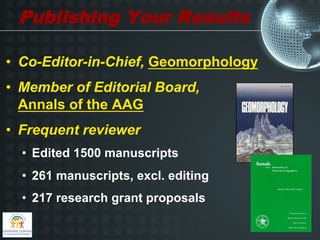
•  Co-Editor-in-Chief, Geomorphology
•  Member of Editorial Board,
   Annals of the AAG
•  Frequent reviewer
  •  Edited 1500 manuscripts
  •  261 manuscripts, excl. editing
  •  217 research grant proposals
Publishing Your Results

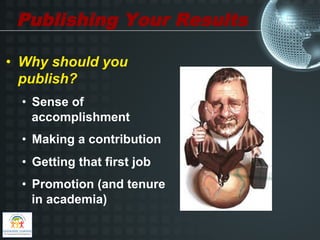
•  Why should you
   publish?
  •  Sense of
     accomplishment
  •  Making a contribution
  •  Getting that first job
  •  Promotion (and tenure
     in academia)
Publishing Your Results

•  Brunn (1987): Five levels of research-
   oriented faculty…seek a good match…you
   & employer
  •  Publish in 4-5 major disciplinary and
     interdisciplinary journals each year
  •  Publish 1-3 major papers per year
  •  Publish a paper every other year
Publishing Your Results

•  Brunn (1987): Five levels of research-
   oriented faculty…seek a good match…you
   & employer
  •  Conduct research but rarely present papers at
     meetings and rarely publish
  •  “Professionally inactive:” no research, do not
     attend meetings, never publish
Publishing Your Results
•  Where should you publish?
  •  Disciplinary journals
    •  Annals of the AAG, The Professional
       Geographer
    •  Geographical Review
  •  Interdisciplinary Journals
    •  Mountain Research and Development
    •  Journal of the American Water Resources
       Association
Publishing Your Results
•  Where should you publish?
  •  Specialty journals
    •  Geomorphology
    •  Physical Geography
  •  Regional journals
Publishing Your Results

•  Manuscripts must be author’s own
   original research
  •  Not previously published elsewhere
  •  Not being considered for publication elsewhere
  •  Properly credits meaningful contribution of co-
     authors
  •  No “shingling”
•  Authors shall not plagiarize the work of
   others
Publishing Your Results
•  Manuscripts must be prepared in the
   format for the journal
  •  Abstract & keywords, text, figures, tables
•  Manuscript must be free from grammatical
   errors
  •  Authors whose native language is not English
•  Recommended general reference: Geowriting
   (5th ed., 2004), by Robert Bates, Marla D.
   Adkins-Heljeson, and Rex Buchanan
Publishing Your Results

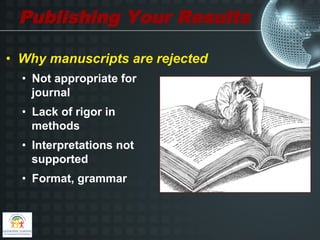
•  Why manuscripts are rejected
  •  Not appropriate for
     journal
  •  Lack of rigor in
     methods
  •  Interpretations not
     supported
  •  Format, grammar
Publishing Your Results

•  If your manuscript is rejected…
  •  Revise and resubmit!
     •  Provide editor with detailed list of how
        you addressed the comments of
        reviewers (item-by-item) and comments
        from editor

  •  Submit to another journal
Publishing Your Results

•  Thank the editor!
Ethical Issues

•  Deception in problem statement,
   purpose, research questions
•  In data collection: letter of disclosure
  –  Permission to access site
  –  Will site be disturbed?
  –  Possibility of information developed during
     the study that could be harmful to
     landowners
Ethical Issues

•  In data collection: Institutional Review
   Board (IRB) when human subjects are
   involved
  –  Must assess risk for damage: physical,
     health, psychological, social, economic,
     legal, groups?
Ethical Issues

–  Must develop Informed Consent Form for
   participants to sign before they are
   engaged
  •  Right to participate is voluntary and they can
     withdraw at any time
  •  Purpose, methods identified
  •  Participants have right to ask questions, privacy
     will be respected, can obtain copy of final study
  •  Benefits of study to individual, groups?
Ethical Issues

•  In data analysis & interpretation
  –  Need to protect anonymity of participants?
  –  Archive data for 5-10 years, then discard
     •  Who owns data? Funding agency? Researcher?
Ethical Issues

•  In data analysis & interpretation (continued)
  –  February 2010 issue of The American Naturalist
     announced an important development in Open Data
     within biology. The essentials of the policy are…
        –  Data underlying an article needs to be archived by the authors
           at the time of publication.
        –  The appropriate form of the data is the final processed form
           used in analysis..
Ethical Issues

•  In data analysis & interpretation (continued)
  –  The essentials of the policy are…
        –  The data must be archived in an approved repository (one that
           makes it publicly available, has a guarantee of persistence, etc).
        –  The author should provide sufficient details so that a third party
           can reasonably interpret the data correctly.
        –  Embargoes of up to one year may be permitted, depending on
           the journal.
        –  Exceptions may be granted at the discretion of the editor,
           especially for sensitive information such as human subject data
           or the location of endangered species.
Ethical Issues

•  In disseminating results of research
  –  Are results proprietary?
  –  Avoid language that express bias against
     groups on basis of gender, sexual
     orientation, ethnicity, disability, age, …
  –  Anticipate repercussions of reporting
     results to individuals, groups
Ethical Issues

•  Research fraud
  –  Plagiarizing
    •  Plagiarism is easy to avoid; credit your
       sources. Always credit your sources. Always.
    •  Plagiarism is easy to detect--your professors
       simply pop over to the Google line (Google
       classic, Google Scholar and Google Books)
       plus a few of the journal article databases the
       Libraries subscribe to like Expanded
       Academic and JStor.
    •  And, in the classic phrase of third-graders
       everywhere, "Don't be stupid.”
Ethical Issues

•  Research fraud
  –  Fabricating results
    •  Suppressing
    •  Inventing
    •  Falsifying

Research Perspectives

  • 1.
    Research Perspectives •  Identifyinga Research Topic •  Format for a Proposal •  Writing Tips •  Publishing Your Results •  Ethical Issues
  • 2.
    Identifying a ResearchTopic •  Read, read, read (record notes) •  Observation (record notes) •  Talking with others (record notes) –  Mentors –  Colleagues –  Stakeholders •  Seek to identify a problem –  Something causing a problem for people, resources –  Phenomena that are not well understood
  • 3.
    Format for aProposal •  Introduction –  Statement of the problem •  Problem stated in one concise sentence •  Significance –  Who would be interested in your study? –  Place your study in the context of bigger problems
  • 4.
    Format for aProposal •  Introduction (continued) –  Purpose and objectives (or research questions) •  Overall purpose stated in one sentence •  Itemize objectives (specific tasks) that must be achieved •  Objectives could be replaced by research questions
  • 5.
    Format for aProposal •  Introduction (continued) –  Research questions or hypotheses •  Research question: what do you want to know (could be redundant with objectives) •  Hypotheses: predictions –  Null hypotheses vs. alternate hypotheses –  Directional vs. non-directional alternate hypotheses
  • 6.
    Format for aProposal •  Introduction (continued) –  Definition of terms •  Define all terms in proposal: title, problem statement, purpose & objectives, theory, research questions & hypotheses, literature review, methods •  Define when first used
  • 7.
    Format for aProposal •  Introduction (continued) –  Delimitations and limitations •  Delimitations: narrow scope of your study (variables, location, approach) •  Limitations: potential weaknesses of your study
  • 8.
    Format for aProposal •  Review of the literature –  Organize your note-taking by “central argument” –  Write-down ideas in your words –  Demonstrate that you are familiar with the literature on this topic –  Summarize what is already understood and what is still NOT well understood –  Do competing schools of thought exist?
  • 9.
    Format for aProposal •  Review of the literature –  Has the topic been studied anywhere? If so, what was found? What remains to be understood? –  Has it been studied in your study area? If so, previous findings? If not, what might be different about your study area?
  • 10.
    Format for aProposal •  Methods –  General research approach •  Quantitative, qualitative, mixed methods •  Field, lab, maps, remotely sensed imagery, archival… –  Techniques of data acquisition •  What variables: how many samples, where, how often
  • 11.
    Format for aProposal •  Methods (continued) –  Techniques of data analysis •  lab work, statistics, computer analyses, etc. –  Justify why each procedure is needed and why that particular method is best suited
  • 12.
    Format for aProposal •  Expected Results –  Preliminary studies, pilot studies –  How will raw data be reported? •  Tables, maps, figures, descriptive statistics,… –  How will data interpretations appear?
  • 13.
    Format for aProposal •  References Cited •  Appendices –  Timetable •  list of tasks for each objective and when that work will be undertaken –  Budget •  outline the expected costs & sources of funding –  Where will findings be reported? •  thesis, journal publication, professional meeting
  • 14.
    Writing Tips •  Gettingstarted –  Take the notes from your literature and set next to guidelines for proposal writing –  Develop an outline of ideas, sentences –  Track objectives/research questions through proposal (“coherence”) •  Literature review •  Methods •  Expected results
  • 15.
    Writing Tips •  Writeyour first draft –  Shift and sort your ideas –  Share your ideas with friends, colleagues, advisor
  • 16.
    Writing Tips •  Readability –  Voice tense (in proposal) •  Past/present tense in problem statement •  Future tense in purpose and objectives: “The purpose of this study will be to… •  Past tense in literature review: “Jones (2006) found…” •  Future tense in methods
  • 17.
    Writing Tips •  Readability –  Does each paragraph develop one idea fully? –  Smooth transition between paragraphs? –  Proper use of subheadings?
  • 18.
    Writing Tips •  Critique –  see Marston handouts –  See example of copyediting
  • 19.
    Writing Tips •  Grammar –  The word “data” is plural •  Write “…the data show” not “the data shows.” –  Be consistent in using terms: avoid synonyms
  • 20.
    Publishing Your Results • Co-Editor-in-Chief, Geomorphology •  Member of Editorial Board, Annals of the AAG •  Frequent reviewer •  Edited 1500 manuscripts •  261 manuscripts, excl. editing •  217 research grant proposals
  • 21.
    Publishing Your Results • Why should you publish? •  Sense of accomplishment •  Making a contribution •  Getting that first job •  Promotion (and tenure in academia)
  • 22.
    Publishing Your Results • Brunn (1987): Five levels of research- oriented faculty…seek a good match…you & employer •  Publish in 4-5 major disciplinary and interdisciplinary journals each year •  Publish 1-3 major papers per year •  Publish a paper every other year
  • 23.
    Publishing Your Results • Brunn (1987): Five levels of research- oriented faculty…seek a good match…you & employer •  Conduct research but rarely present papers at meetings and rarely publish •  “Professionally inactive:” no research, do not attend meetings, never publish
  • 24.
    Publishing Your Results • Where should you publish? •  Disciplinary journals •  Annals of the AAG, The Professional Geographer •  Geographical Review •  Interdisciplinary Journals •  Mountain Research and Development •  Journal of the American Water Resources Association
  • 25.
    Publishing Your Results • Where should you publish? •  Specialty journals •  Geomorphology •  Physical Geography •  Regional journals
  • 26.
    Publishing Your Results • Manuscripts must be author’s own original research •  Not previously published elsewhere •  Not being considered for publication elsewhere •  Properly credits meaningful contribution of co- authors •  No “shingling” •  Authors shall not plagiarize the work of others
  • 27.
    Publishing Your Results • Manuscripts must be prepared in the format for the journal •  Abstract & keywords, text, figures, tables •  Manuscript must be free from grammatical errors •  Authors whose native language is not English •  Recommended general reference: Geowriting (5th ed., 2004), by Robert Bates, Marla D. Adkins-Heljeson, and Rex Buchanan
  • 28.
    Publishing Your Results • Why manuscripts are rejected •  Not appropriate for journal •  Lack of rigor in methods •  Interpretations not supported •  Format, grammar
  • 29.
    Publishing Your Results • If your manuscript is rejected… •  Revise and resubmit! •  Provide editor with detailed list of how you addressed the comments of reviewers (item-by-item) and comments from editor •  Submit to another journal
  • 30.
  • 31.
    Ethical Issues •  Deceptionin problem statement, purpose, research questions •  In data collection: letter of disclosure –  Permission to access site –  Will site be disturbed? –  Possibility of information developed during the study that could be harmful to landowners
  • 32.
    Ethical Issues •  Indata collection: Institutional Review Board (IRB) when human subjects are involved –  Must assess risk for damage: physical, health, psychological, social, economic, legal, groups?
  • 33.
    Ethical Issues –  Mustdevelop Informed Consent Form for participants to sign before they are engaged •  Right to participate is voluntary and they can withdraw at any time •  Purpose, methods identified •  Participants have right to ask questions, privacy will be respected, can obtain copy of final study •  Benefits of study to individual, groups?
  • 34.
    Ethical Issues •  Indata analysis & interpretation –  Need to protect anonymity of participants? –  Archive data for 5-10 years, then discard •  Who owns data? Funding agency? Researcher?
  • 35.
    Ethical Issues •  Indata analysis & interpretation (continued) –  February 2010 issue of The American Naturalist announced an important development in Open Data within biology. The essentials of the policy are… –  Data underlying an article needs to be archived by the authors at the time of publication. –  The appropriate form of the data is the final processed form used in analysis..
  • 36.
    Ethical Issues •  Indata analysis & interpretation (continued) –  The essentials of the policy are… –  The data must be archived in an approved repository (one that makes it publicly available, has a guarantee of persistence, etc). –  The author should provide sufficient details so that a third party can reasonably interpret the data correctly. –  Embargoes of up to one year may be permitted, depending on the journal. –  Exceptions may be granted at the discretion of the editor, especially for sensitive information such as human subject data or the location of endangered species.
  • 37.
    Ethical Issues •  Indisseminating results of research –  Are results proprietary? –  Avoid language that express bias against groups on basis of gender, sexual orientation, ethnicity, disability, age, … –  Anticipate repercussions of reporting results to individuals, groups
  • 38.
    Ethical Issues •  Researchfraud –  Plagiarizing •  Plagiarism is easy to avoid; credit your sources. Always credit your sources. Always. •  Plagiarism is easy to detect--your professors simply pop over to the Google line (Google classic, Google Scholar and Google Books) plus a few of the journal article databases the Libraries subscribe to like Expanded Academic and JStor. •  And, in the classic phrase of third-graders everywhere, "Don't be stupid.”
  • 39.
    Ethical Issues •  Researchfraud –  Fabricating results •  Suppressing •  Inventing •  Falsifying