Understanding and Using Persuasive Modes
of Oral and Written Communication
Vicki LeQuire ~ English Department, Appalachian State University
Plato and Aristotle depicted in The
School of Athens by Raphael (1509-1511)
Apostolic Palace, Vatican City
What is Rhetoric?
• Rhetoric is a primarily verbal,
situationally contingent, epistemic art
that is both philosophical and practical
and gives rise to potentially active
texts (Covino and Jolliffe, RC-24).
• The study of speaking and writing
effectively
• The examination of persuasive
techniquesAristotle by Rembrandt (1653)
Metropolitan Museum of Art
One of the most powerful
thinkers in history
Asked series of questions to
show that people hold
many contradictory
opinions
Question-and-Answer
approach is known as the
Socratic Method
Originally named Aristocles
A student of Socrates, who
gave him the nickname
Plato
Founded a school called The
Academy in 387 B.C.E.
The Academy lasted
approximately 900 years
Studied at Plato’s Academy
After Plato’s death, Aristotle
opened his own school in
Athens called the Lyceum.
“It is the art of an educated
mind to be able to entertain
a thought without accepting
it.”
469-399 BCE 427-347 BCE 384-322 BCE
Aristotle’s Rhetorical Appeals
•Logos – The appeal to logic
•Ethos – The appeal to ethics
•Pathos – The appeal to emotions
Aristotle (lifetime bust), Artist
Unknown (1st c. CE)
Acropolis Museum, Athens, Greece
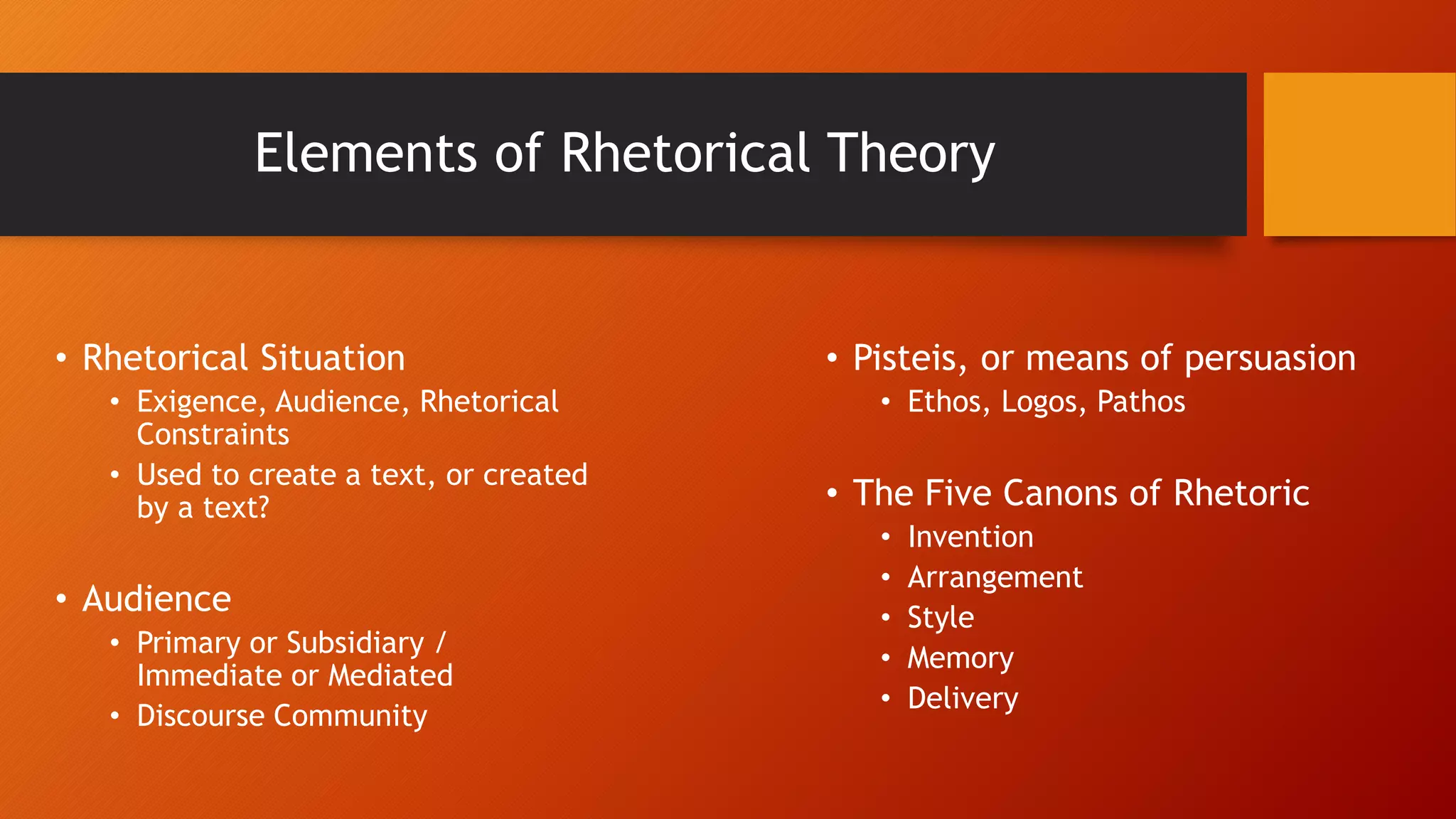
Elements of Rhetorical Theory
• Rhetorical Situation
• Exigence, Audience, Rhetorical
Constraints
• Used to create a text, or created
by a text?
• Audience
• Primary or Subsidiary /
Immediate or Mediated
• Discourse Community
• Pisteis, or means of persuasion
• Ethos, Logos, Pathos
• The Five Canons of Rhetoric
• Invention
• Arrangement
• Style
• Memory
• Delivery
Academic Argument
• Takes a stand
• Presents evidence
• Uses logic
What is Rhetorical Analysis?
• A text is potentially active when the rhetor intends it to do
something, to affect or change the auditors’ minds or actions or
environments.
• Rhetorical analysis is the study of whether and how texts actually
do affect, influence, or change auditors (Covino and Jolliffe, RC-
27).
• Examines the effectiveness of an argument rather than the topic
of the argument
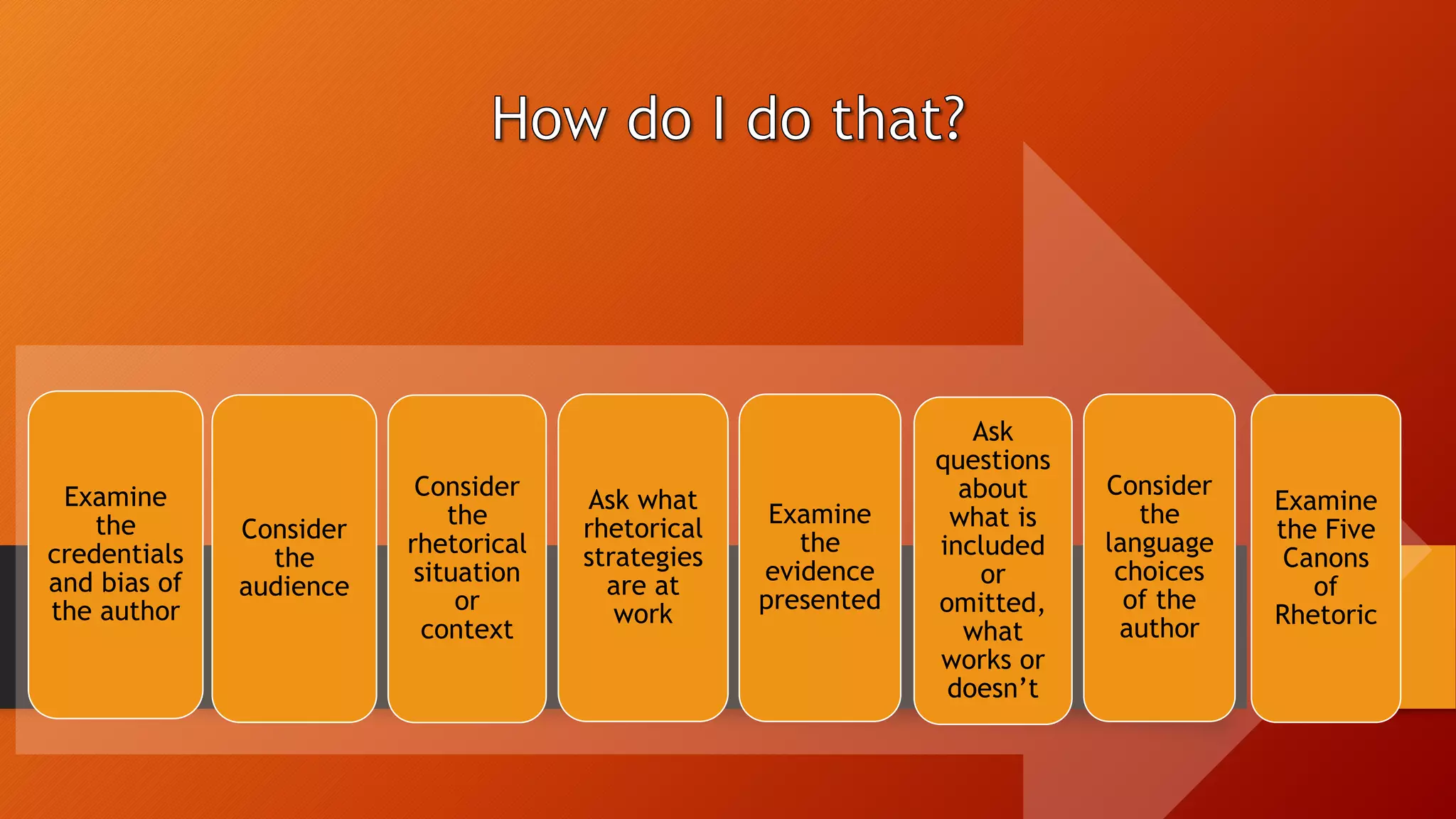
Examine
the
credentials
and bias of
the author
Examine
the
evidence
presented
Consider
the
audience
Ask what
rhetorical
strategies
are at
work
Ask
questions
about
what is
included
or
omitted,
what
works or
doesn’t
Consider
the
rhetorical
situation
or
context
Consider
the
language
choices
of the
author
Examine
the Five
Canons
of
Rhetoric
Journal: Rhetorical Analysis Prewriting
•As we work through the remaining lecture
slides, refer to the article(s) you selected
for analysis and create a detailed list of
answers to the following questions.
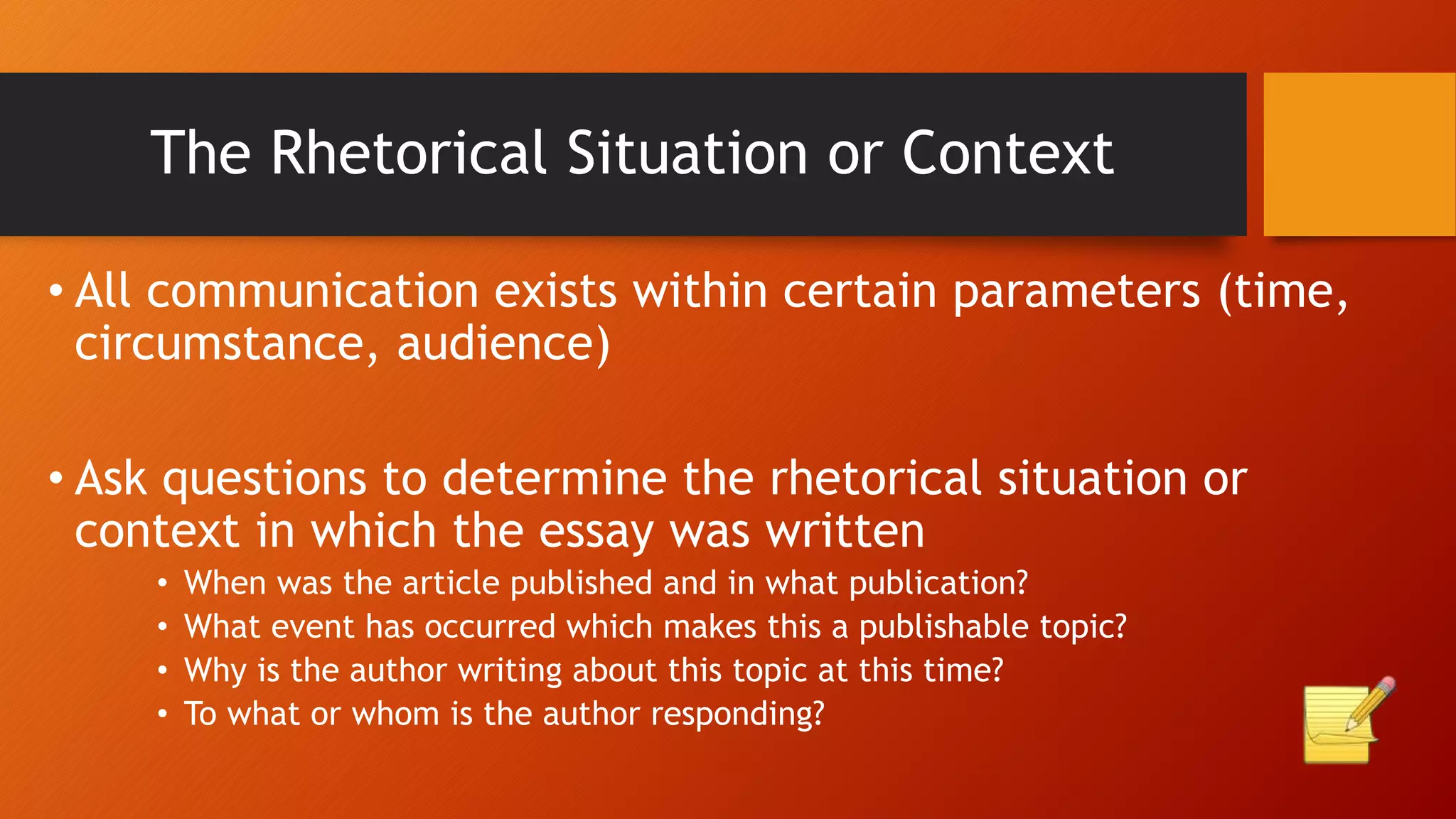
The Rhetorical Situation or Context
• All communication exists within certain parameters (time,
circumstance, audience)
• Ask questions to determine the rhetorical situation or
context in which the essay was written
• When was the article published and in what publication?
• What event has occurred which makes this a publishable topic?
• Why is the author writing about this topic at this time?
• To what or whom is the author responding?
Ethos in Action
Who is the
author, and
what are his or
her credentials?
Does the writer
demonstrate
knowledge of
the subject?
What steps are
taken to
present the
argument as
reasonable?
Does the
argument seem
fair?
Do the sources
seem both
reliable and
credible?
Does the writer
include proper
documentation?
Does the writer
show respect
for opposing
viewpoints?
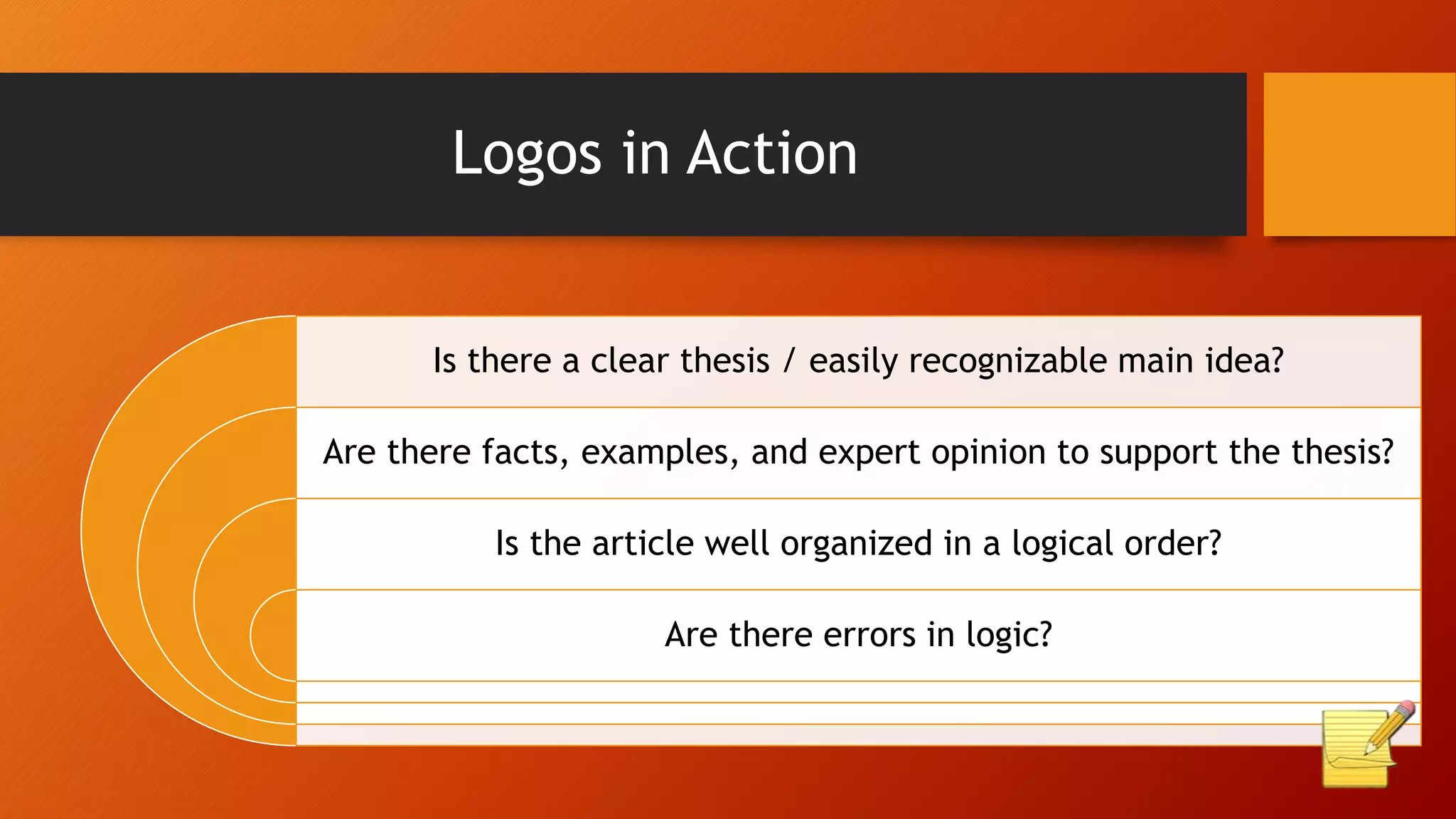
Logos in Action
Is there a clear thesis / easily recognizable main idea?
Are there facts, examples, and expert opinion to support the thesis?
Is the article well organized in a logical order?
Are there errors in logic?
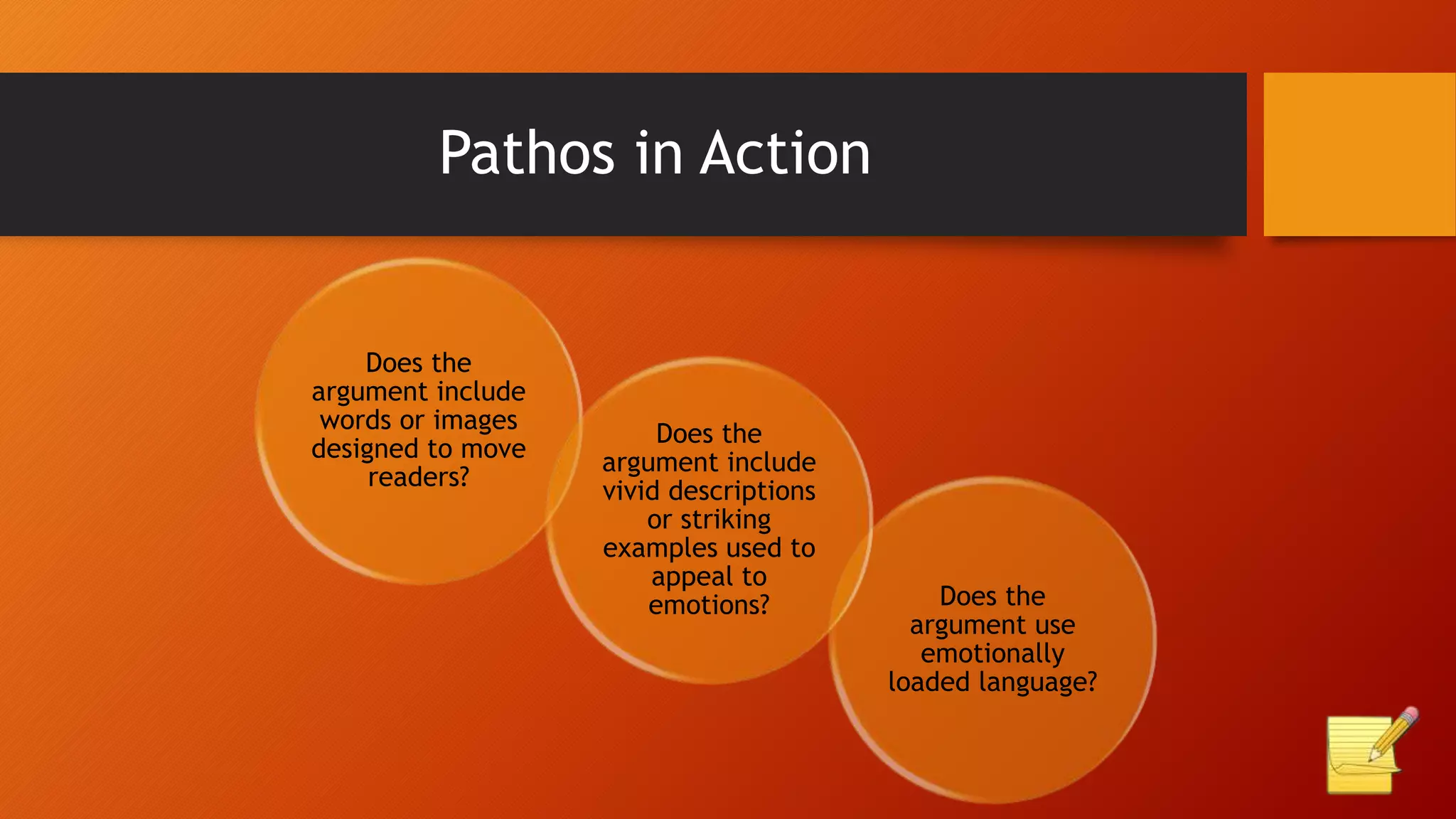
Pathos in Action
Does the
argument include
words or images
designed to move
readers?
Does the
argument use
emotionally
loaded language?
Does the
argument include
vivid descriptions
or striking
examples used to
appeal to
emotions?
Examining Rhetorical Choices
• What choices in persuasive technique has the author made?
• What choices in supporting sources has the author made?
• What choices in language has the author made?
• What choices in inclusion or exclusion of detail,
opposing opinion, and logic has the author made?
The Five Canons of Rhetoric
• Invention
• Deals with strategies used to get ready to write – research, prewriting, outlining, etc.
• Arrangement
• Is the arrangement of the article effective and easy to navigate? Does it meet the standards of
the field for which it is written?
• Style
• What style techniques are employed – sentence structure, writing style, imagery, emotionally
loaded language, tone, etc. – and are these techniques effective? Are they in keeping with the
standards of writing in the discipline for which it is written?
• Memory
• Deals with memorization of ideas in its simplest form, but also deals with finding a place for this
work within our collective memory
• Delivery
• Refers to the delivery methods of the text – online audiences, academic journal, textbooks,
oration, etc.
Writing the Introduction
• Introduce the author and the text in the opening paragraph
• Include the author’s background
• Discuss the author’s credentials and bias
• Develop a thesis statement which focuses on the
effectiveness of the argument, not on the topic of the
article
Writing the Second Paragraph
• Briefly summarize the text
• Provide background information on the topic
• Discuss the rhetorical situation or context
Writing the Body Paragraphs
• Discuss the author’s rhetorical strategies
• Discuss the validity of the evidence
• Discuss what has been omitted, what works and what
doesn’t
• Discuss the language choices
Using Evidence from the Text
Topic Sentence – wherein you state your claim
about the argument
First Supporting Evidence from the Text
Second Supporting Evidence from the Text
Third Supporting Evidence from the Text
Discussion - wherein you build your argument for
the effectiveness of the work you are reviewing
Writing the Conclusion
• Reiterate the thesis statement
• Sum up your points about the effectiveness of the
article
• Write commentary that is smart, accurate, and
stylish to keep the reader’s interest
Questions for Discussion
• What does a rhetorical analysis actually do?
• What is your purpose in writing a rhetorical analysis?
• What types of evidence are you looking for in writing
a rhetorical analysis?
• How important is the topic of the argument?
• How important is your opinion?
Works Cited
• Kirszner, Laurie G. and Stephen R. Mandell. Practical Argument: A Text and
Anthology, 2nd ed. New York: Bedford/St. Martin’s, 2014.
• Ruszkiewicz, John J. and Jay T. Dolmage. How to Write Anything, 2nd ed.
NY: Bedford/St. Martin’s, 2012.
• Smith, Trixie G., Allison D. Smith, and Holly Hamby. Building Bridges through
Writing. Southlake, TX: Fountainhead Press, 2014.
• “Understanding Writing: The Rhetorical Situation.” The Purdue OWL. The
Purdue U Writing Lab, 2010. https://owl.english.purdue.edu/owl/

Rhetoric & Argumentation

  • 1.
    Understanding and UsingPersuasive Modes of Oral and Written Communication Vicki LeQuire ~ English Department, Appalachian State University Plato and Aristotle depicted in The School of Athens by Raphael (1509-1511) Apostolic Palace, Vatican City
  • 2.
    What is Rhetoric? •Rhetoric is a primarily verbal, situationally contingent, epistemic art that is both philosophical and practical and gives rise to potentially active texts (Covino and Jolliffe, RC-24). • The study of speaking and writing effectively • The examination of persuasive techniquesAristotle by Rembrandt (1653) Metropolitan Museum of Art
  • 3.
    One of themost powerful thinkers in history Asked series of questions to show that people hold many contradictory opinions Question-and-Answer approach is known as the Socratic Method Originally named Aristocles A student of Socrates, who gave him the nickname Plato Founded a school called The Academy in 387 B.C.E. The Academy lasted approximately 900 years Studied at Plato’s Academy After Plato’s death, Aristotle opened his own school in Athens called the Lyceum. “It is the art of an educated mind to be able to entertain a thought without accepting it.” 469-399 BCE 427-347 BCE 384-322 BCE
  • 4.
    Aristotle’s Rhetorical Appeals •Logos– The appeal to logic •Ethos – The appeal to ethics •Pathos – The appeal to emotions Aristotle (lifetime bust), Artist Unknown (1st c. CE) Acropolis Museum, Athens, Greece
  • 6.
    Elements of RhetoricalTheory • Rhetorical Situation • Exigence, Audience, Rhetorical Constraints • Used to create a text, or created by a text? • Audience • Primary or Subsidiary / Immediate or Mediated • Discourse Community • Pisteis, or means of persuasion • Ethos, Logos, Pathos • The Five Canons of Rhetoric • Invention • Arrangement • Style • Memory • Delivery
  • 8.
    Academic Argument • Takesa stand • Presents evidence • Uses logic
  • 9.
    What is RhetoricalAnalysis? • A text is potentially active when the rhetor intends it to do something, to affect or change the auditors’ minds or actions or environments. • Rhetorical analysis is the study of whether and how texts actually do affect, influence, or change auditors (Covino and Jolliffe, RC- 27). • Examines the effectiveness of an argument rather than the topic of the argument
  • 10.
    Examine the credentials and bias of theauthor Examine the evidence presented Consider the audience Ask what rhetorical strategies are at work Ask questions about what is included or omitted, what works or doesn’t Consider the rhetorical situation or context Consider the language choices of the author Examine the Five Canons of Rhetoric
  • 11.
    Journal: Rhetorical AnalysisPrewriting •As we work through the remaining lecture slides, refer to the article(s) you selected for analysis and create a detailed list of answers to the following questions.
  • 12.
    The Rhetorical Situationor Context • All communication exists within certain parameters (time, circumstance, audience) • Ask questions to determine the rhetorical situation or context in which the essay was written • When was the article published and in what publication? • What event has occurred which makes this a publishable topic? • Why is the author writing about this topic at this time? • To what or whom is the author responding?
  • 13.
    Ethos in Action Whois the author, and what are his or her credentials? Does the writer demonstrate knowledge of the subject? What steps are taken to present the argument as reasonable? Does the argument seem fair? Do the sources seem both reliable and credible? Does the writer include proper documentation? Does the writer show respect for opposing viewpoints?
  • 14.
    Logos in Action Isthere a clear thesis / easily recognizable main idea? Are there facts, examples, and expert opinion to support the thesis? Is the article well organized in a logical order? Are there errors in logic?
  • 15.
    Pathos in Action Doesthe argument include words or images designed to move readers? Does the argument use emotionally loaded language? Does the argument include vivid descriptions or striking examples used to appeal to emotions?
  • 16.
    Examining Rhetorical Choices •What choices in persuasive technique has the author made? • What choices in supporting sources has the author made? • What choices in language has the author made? • What choices in inclusion or exclusion of detail, opposing opinion, and logic has the author made?
  • 17.
    The Five Canonsof Rhetoric • Invention • Deals with strategies used to get ready to write – research, prewriting, outlining, etc. • Arrangement • Is the arrangement of the article effective and easy to navigate? Does it meet the standards of the field for which it is written? • Style • What style techniques are employed – sentence structure, writing style, imagery, emotionally loaded language, tone, etc. – and are these techniques effective? Are they in keeping with the standards of writing in the discipline for which it is written? • Memory • Deals with memorization of ideas in its simplest form, but also deals with finding a place for this work within our collective memory • Delivery • Refers to the delivery methods of the text – online audiences, academic journal, textbooks, oration, etc.
  • 18.
    Writing the Introduction •Introduce the author and the text in the opening paragraph • Include the author’s background • Discuss the author’s credentials and bias • Develop a thesis statement which focuses on the effectiveness of the argument, not on the topic of the article
  • 19.
    Writing the SecondParagraph • Briefly summarize the text • Provide background information on the topic • Discuss the rhetorical situation or context
  • 20.
    Writing the BodyParagraphs • Discuss the author’s rhetorical strategies • Discuss the validity of the evidence • Discuss what has been omitted, what works and what doesn’t • Discuss the language choices
  • 21.
    Using Evidence fromthe Text Topic Sentence – wherein you state your claim about the argument First Supporting Evidence from the Text Second Supporting Evidence from the Text Third Supporting Evidence from the Text Discussion - wherein you build your argument for the effectiveness of the work you are reviewing
  • 22.
    Writing the Conclusion •Reiterate the thesis statement • Sum up your points about the effectiveness of the article • Write commentary that is smart, accurate, and stylish to keep the reader’s interest
  • 23.
    Questions for Discussion •What does a rhetorical analysis actually do? • What is your purpose in writing a rhetorical analysis? • What types of evidence are you looking for in writing a rhetorical analysis? • How important is the topic of the argument? • How important is your opinion?
  • 24.
    Works Cited • Kirszner,Laurie G. and Stephen R. Mandell. Practical Argument: A Text and Anthology, 2nd ed. New York: Bedford/St. Martin’s, 2014. • Ruszkiewicz, John J. and Jay T. Dolmage. How to Write Anything, 2nd ed. NY: Bedford/St. Martin’s, 2012. • Smith, Trixie G., Allison D. Smith, and Holly Hamby. Building Bridges through Writing. Southlake, TX: Fountainhead Press, 2014. • “Understanding Writing: The Rhetorical Situation.” The Purdue OWL. The Purdue U Writing Lab, 2010. https://owl.english.purdue.edu/owl/