Thematic analysis
Part 3: Six phases of reflexive thematic
analysis
Presentation by
Victoria
Clarke
Associate Professor of
Qualitative and Critical
Psychology, UWE
May 2019
PowerPoint slides from the Braun, Clarke &
Hayfield Qualitative Methods Online Teaching &
Learning Resources Collaboration (QMOTLRC)
• Narration by Victoria Clarke
Topic overview
o Understanding the key features of thematic analysis and
specifically of the Braun & Clarke reflexive approach to thematic
analysis.
o Understanding how to undertake a reflexive thematic analysis of
qualitative data, including coding and theme generation.
o Understand how to conduct a high quality thematic analysis and
avoid common problems.
o There are some activities throughout the lecture – you can pause
the audio-lecture and work through the task on the slide.
Topic overview
o Part 1: What is thematic analysis?
o Part 2: Thematic analysis is uniquely flexible
o Part 3: Six phases of reflexive thematic analysis
o Part 4: Avoiding common problems
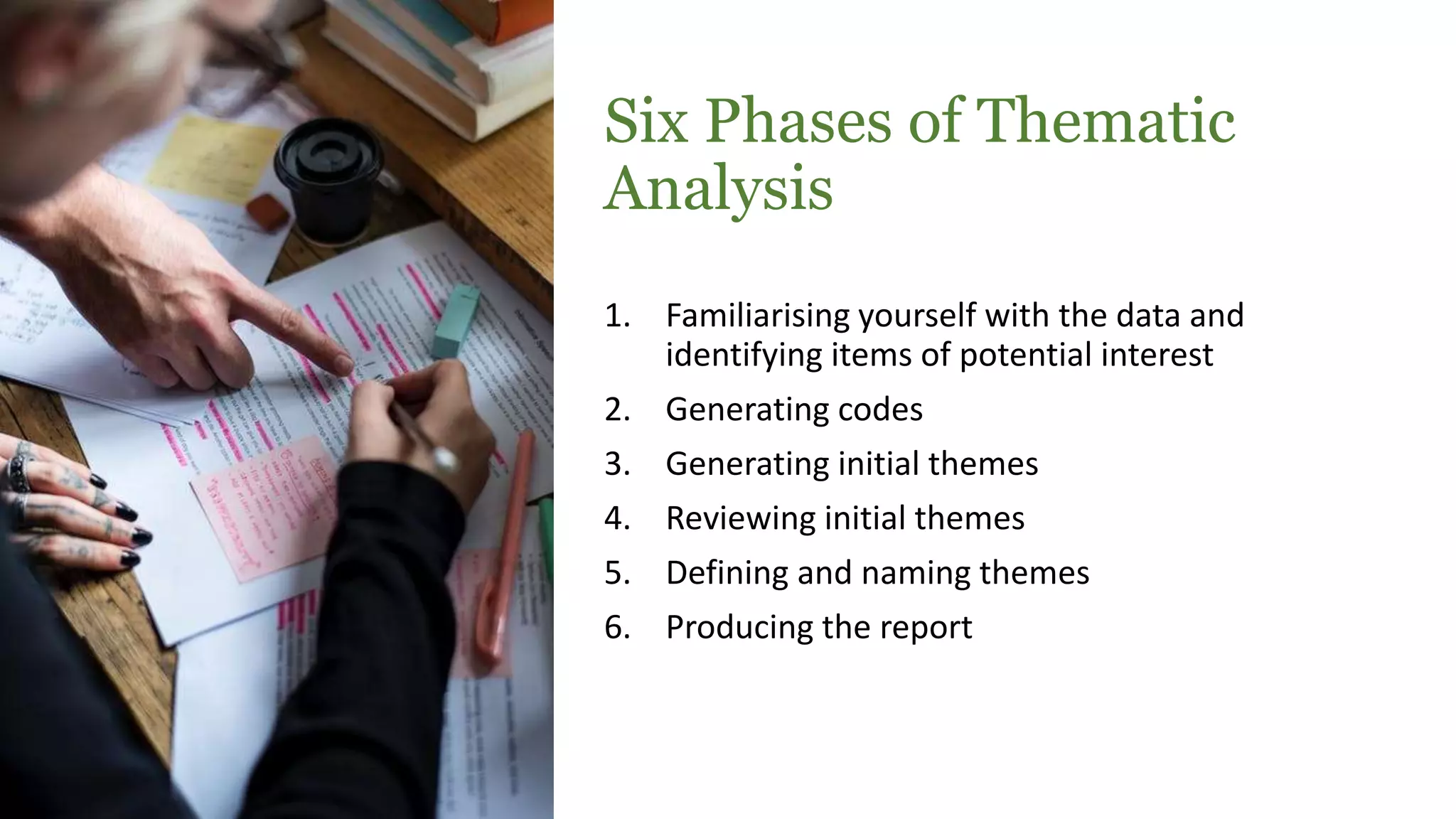
Six Phases of Thematic
Analysis
1. Familiarising yourself with the data and
identifying items of potential interest
2. Generating codes
3. Generating initial themes
4. Reviewing initial themes
5. Defining and naming themes
6. Producing the report
• For transcription of audio-data, we recommend Braun and Clarke’s
(2013) notation system
Side-bar: Preparing audio recorded data
for analysis
1) Familiarizing yourself with the data
and identifying items of interest
• Read through each data item individually
• Note items of interest
• Try to be as inclusive as possible
• Do this for all data items
• Read actively, analytically and critically (read
data as data)
oTry to unpick the assumptions that
underpin your analytic observations
oWhat struck you about the data?
oWhat was familiar?
oWhat was unfamiliar/surprising?
oWhat was common?
Activity
• This activity is based on data extract from a study exploring LGBT students
experiences of university life conducted around 2004/5.
• The participant is a gay man – a mature student, who spoke English as a
second language.
• The extract comes from early in the interview and in response to a
question about whether he is ‘out’ as a gay man at university – whether he
is openly gay.
• First, we invite you to pause the recording and reflect on your assumptions
and expectations about this topic, and your positioning in relation to this
topic (are you an insider researcher? Outsider?).
• Second, read the data extract and make some familiarisation notes.
• Pause the recording and reflect…
Activity - Pause the recording to read the data
extract and make familiarisation notes
• Andreas: ...I sometimes try to erm not conceal it that’s not the right word but erm
let’s say I’m in a in a seminar and somebody- a a man says to me ‘oh look at her’
(Int: mm) I’m not going ‘oh actually I’m gay’ (Int: mm [laughter]) I’ll just go like ‘oh
yeah’ (Int: mmhm) you know I won’t fall into the other one and say ‘oh yeah’ (Int:
yep) ‘she looks really brilliant’ (Int: yep) but I sorta then and after them you hate
myself for it because I I don’t know how this person would react because that
person might then either not talk to me anymore or erm might sort of yeah (Int:
yep) or next time we met not not sit next to me or that sort of thing (Int: yep) so I
think these this back to this question are you out yes but I think wherever you go
you always have to start afresh (Int: yep) this sort of li-lifelong process of being
courageous in a way or not
Our familiarisation notes on this
particularly rich data extract
• Andreas reports a common experience of presumed heterosexuality,
coming out is not an obvious option.
• Social norms dictate a certain response; the presumption of
heterosexuality appears dilemmatic, and he colludes in the
presumption, but minimally (to avoid social awkwardness).
• Looking a bit more deeply, we speculated that:
• Andreas values honesty and being true to yourself, but he recognises
a socio-political context in which that is constrained, and walks a
‘tightrope’ trying to balance his values and the expectations of the
context.
(2) Generating codes
• A code is a pithy label that captures what is analytically
interesting about the data.
• ‘Take away the data’ test…
• Code inclusively, comprehensively and systematically.
• Codes can be semantic or latent; coding can be fine or
coarse.
• Code each data item equally.
• More than one sweep of coding may be necessary.
• End this phase, with a list of codes and all the data
relevant to each code collated (important for next
phase).
Semantic and latent codes
• Semantic codes capture the surface
meaning of the data.
• Latent codes capture the assumptions
underpinning the surface meanings, or use
pre-existing theories and concepts to
interpret the data.
• Don’t reify these!
o ‘Types’ of codes (e.g., latent, semantic)
are conceptual tools for analytic
development.
• Retain fluidity in thinking and
conceptualisation.
• Neither is necessarily better – most analyses
will use both types of code.
• When we lack experience, we tend to rely on
descriptive codes; conceptual codes can be
harder to ‘see’ in the data.
Managing the coding
process
• Code on the (hard copy or electronic) transcripts/data
items with wide margins – highlighting/underlining
/commenting on the relevant data (helps stay close to
the data) – and then collate data.
• File cards (old school!) or CAQDAS
• These coding strategies allow for simultaneous
coding and collation of coded extracts and can
help you to code beyond the data surface.
Activity – Have a go at coding the
Andreas data extract
• Pause the recording on the next slide and
have a go at coding the Andreas data
extract.
• Try to develop at least one latent code as
well as semantic codes to clarify your
understanding of the semantic-latent
distinction.
Activity - Pause the recording to code the
data extract
• Andreas: ...I sometimes try to erm not conceal it that’s not the right word but erm
let’s say I’m in a in a seminar and somebody- a a man says to me ‘oh look at her’
(Int: mm) I’m not going ‘oh actually I’m gay’ (Int: mm [laughter]) I’ll just go like ‘oh
yeah’ (Int: mmhm) you know I won’t fall into the other one and say ‘oh yeah’ (Int:
yep) ‘she looks really brilliant’ (Int: yep) but I sorta then and after them you hate
myself for it because I I don’t know how this person would react because that
person might then either not talk to me anymore or erm might sort of yeah (Int:
yep) or next time we met not not sit next to me or that sort of thing (Int: yep) so I
think these this back to this question are you out yes but I think wherever you go
you always have to start afresh (Int: yep) this sort of li-lifelong process of being
courageous in a way or not
Activity – Pause the recording to reflect
on your coding practice
• Try to reflect on your assumptions in coding the data:
• What worldview does your coding reflect?
• Where do your codes locate meaning – in Andrea’s psychological
world ‘in there’ or in the social world ‘out there’?
• Now reflect on the challenges (and pleasures – if there were any!) of
coding the data.
• What questions, if any, has this exercise raised for you about thematic
analysis, and qualitative analysis more broadly?
Our reflections on using the Andreas extract
in (psychology) teaching over several years
“We’re always struck by the myriad of different ways people make sense of this short extract.
Psychologists, particularly therapists, tend to focus on Andreas’ psychological experience: what it
must feel like to be in the situation he describes. Critical social psychologists tend to focus on the
wider social context, and the ways in which Andreas’ account is reflective of social norms around
sexuality. People with no personal or professional experience around non-heterosexualities, and
who are embedded in culturally-dominant sense-making frameworks around sexuality
(neoliberalism and libertarianism; Brickell, 2001), tend to view Andreas as overly fearful and lacking
confidence in his sexuality. By contrast, people with personal or professional experience of non-
heterosexualities tend to view Andreas as responding rationally to a heteronormative university
environment. These interpretations (and others) are neither ‘wrong’ nor ‘right’; they’re analytic
observations based on researcher experience. What were your observations? What assumptions
underpinned your observations?” (Clarke, Braun & Hayfield, 2015: 230)
Examples of semantic and latent codes
for the Andreas extract
• Semantic codes capture the
surface meaning of the data; the
meanings Andreas was
intentionally communicating:
• Fear/anxiety about people’s
reaction to his homosexuality
• Not hiding (but not shouting)
• Latent codes capture the
assumptions underpinning the
surface meanings, or use pre-
existing theories and concepts to
interpret the data:
• It’s important to be honest &
authentic
• Hidden curriculum of
heteronormativity (this is a
theoretical concept from research
on sexuality and education)
To read more about our coding of the Andreas extract see Braun & Clarke (2012).
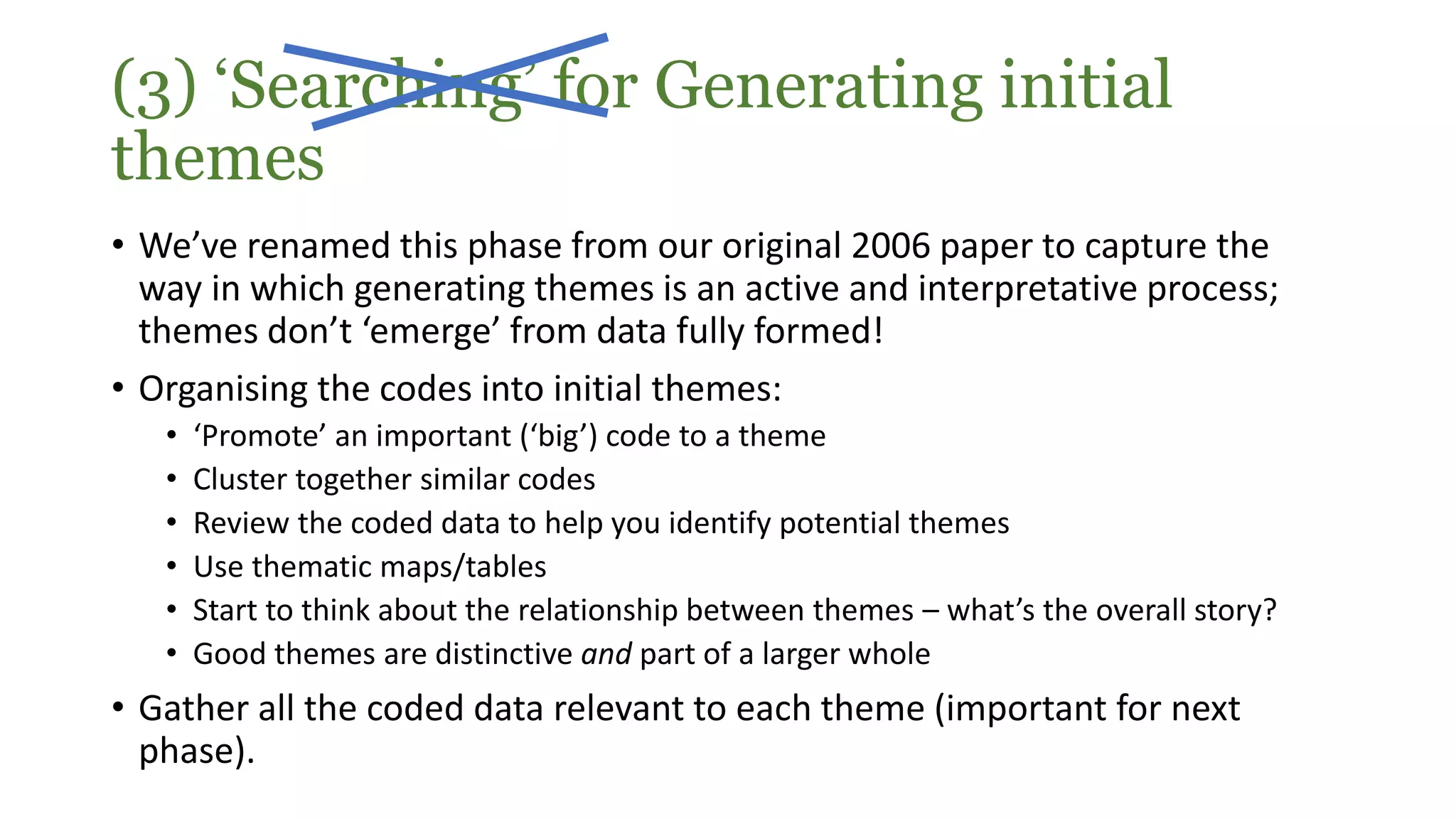
• We’ve renamed this phase from our original 2006 paper to capture the
way in which generating themes is an active and interpretative process;
themes don’t ‘emerge’ from data fully formed!
• Organising the codes into initial themes:
• ‘Promote’ an important (‘big’) code to a theme
• Cluster together similar codes
• Review the coded data to help you identify potential themes
• Use thematic maps/tables
• Start to think about the relationship between themes – what’s the overall story?
• Good themes are distinctive and part of a larger whole
• Gather all the coded data relevant to each theme (important for next
phase).
(3) ‘Searching’ for Generating initial
themes
Sidebar: Is counting bad?
• Should we report frequency counts for themes?
• Suggests prevalence as the most important
criterion for determining themes and accuracy is
important and intelligible.
• Problematic when analysing participant-led data
collection methods.
• Counting may be useful when reporting concrete
practices.
• Start to identify the nature or character of the potential themes.
• Questions to ask:
• Is this a theme?
• What is the quality of this theme?
• What are the boundaries of this theme?
• Are there enough (meaningful) data to support this theme?
• Are the data too diverse and wide-ranging?
• Check if the themes work in relation to (a) the coded extracts and (b) the
entire data set.
• Be prepared to let things go.
• Finalise your thematic map.
4) Reviewing initial themes
• A name or label - beware one word theme names!
• Avoid domain summary-type names too (e.g. Benefits of… Barriers to…
Experiences of…).
• Write a definition and short description or ‘abstract’ of each theme (a few
hundred words at most).
• Refine the specifics of each theme and the overall story of your analysis.
• How many themes are enough (or too many)?
• There is no magic formula that states that if you have X amount of data,
and you’re writing a report of Y length, you should have Z number of
themes!
• However, lots of themes and sub-themes are suggestive of a fragmented
and under-developed analysis.
5) Defining and naming your themes
Side bar: Theme levels
• We suggest a maximum of three theme
levels (to avoid the risk of fragmentation
and an under-developed analysis):
• Overarching themes – often used to
organise.
• Themes – organised around a central
concept.
• Sub-themes – capture and highlight
an important facet of a theme.
6) Producing the report
• Final chance for analysis!
• Analysis consists of analytic commentary, data extracts and
themes.
• Decide on the order in which to present your themes.
• Select vivid and compelling examples of data to illustrate
each theme.
• Final analysis of selected examples (if using data analytically
to further your analysis).
• Relate analysis to research question and the literature (and
the wider context).
• (Still) be prepared to let things go.
References
• Braun, V. & Clarke, V. (2006). Using thematic analysis in psychology.
Qualitative Research in Psychology, 3(2), 77-101.
• Braun, V. & Clarke, V. (2012). Thematic analysis. In H. Cooper, P. M.
Camic, D. L. Long, A. T. Panter, D. Rindskopf, & K. J. Sher (Eds.), APA
handbook of research methods in psychology, Vol. 2: Research
designs: Quantitative, qualitative, neuropsychological, and biological
(pp. 57-71). Washington, DC: American Psychological Association.
• Braun, V. & Clarke, V. (2013). Successful qualitative research: A
practical guide for beginners. London: Sage.
• Clarke, V., Braun, V. & Hayfield, N. (2015). Thematic analysis. In J.
Smith (Ed.), Qualitative psychology: A practical guide to research
methods, 3rd ed. (pp. 222-248). London: Sage.

Braun, Clarke & Hayfield Thematic Analysis Part 3

  • 1.
    Thematic analysis Part 3:Six phases of reflexive thematic analysis Presentation by Victoria Clarke Associate Professor of Qualitative and Critical Psychology, UWE May 2019
  • 2.
    PowerPoint slides fromthe Braun, Clarke & Hayfield Qualitative Methods Online Teaching & Learning Resources Collaboration (QMOTLRC) • Narration by Victoria Clarke
  • 3.
    Topic overview o Understandingthe key features of thematic analysis and specifically of the Braun & Clarke reflexive approach to thematic analysis. o Understanding how to undertake a reflexive thematic analysis of qualitative data, including coding and theme generation. o Understand how to conduct a high quality thematic analysis and avoid common problems. o There are some activities throughout the lecture – you can pause the audio-lecture and work through the task on the slide.
  • 4.
    Topic overview o Part1: What is thematic analysis? o Part 2: Thematic analysis is uniquely flexible o Part 3: Six phases of reflexive thematic analysis o Part 4: Avoiding common problems
  • 5.
    Six Phases ofThematic Analysis 1. Familiarising yourself with the data and identifying items of potential interest 2. Generating codes 3. Generating initial themes 4. Reviewing initial themes 5. Defining and naming themes 6. Producing the report
  • 6.
    • For transcriptionof audio-data, we recommend Braun and Clarke’s (2013) notation system Side-bar: Preparing audio recorded data for analysis
  • 7.
    1) Familiarizing yourselfwith the data and identifying items of interest • Read through each data item individually • Note items of interest • Try to be as inclusive as possible • Do this for all data items • Read actively, analytically and critically (read data as data) oTry to unpick the assumptions that underpin your analytic observations oWhat struck you about the data? oWhat was familiar? oWhat was unfamiliar/surprising? oWhat was common?
  • 8.
    Activity • This activityis based on data extract from a study exploring LGBT students experiences of university life conducted around 2004/5. • The participant is a gay man – a mature student, who spoke English as a second language. • The extract comes from early in the interview and in response to a question about whether he is ‘out’ as a gay man at university – whether he is openly gay. • First, we invite you to pause the recording and reflect on your assumptions and expectations about this topic, and your positioning in relation to this topic (are you an insider researcher? Outsider?). • Second, read the data extract and make some familiarisation notes. • Pause the recording and reflect…
  • 9.
    Activity - Pausethe recording to read the data extract and make familiarisation notes • Andreas: ...I sometimes try to erm not conceal it that’s not the right word but erm let’s say I’m in a in a seminar and somebody- a a man says to me ‘oh look at her’ (Int: mm) I’m not going ‘oh actually I’m gay’ (Int: mm [laughter]) I’ll just go like ‘oh yeah’ (Int: mmhm) you know I won’t fall into the other one and say ‘oh yeah’ (Int: yep) ‘she looks really brilliant’ (Int: yep) but I sorta then and after them you hate myself for it because I I don’t know how this person would react because that person might then either not talk to me anymore or erm might sort of yeah (Int: yep) or next time we met not not sit next to me or that sort of thing (Int: yep) so I think these this back to this question are you out yes but I think wherever you go you always have to start afresh (Int: yep) this sort of li-lifelong process of being courageous in a way or not
  • 10.
    Our familiarisation noteson this particularly rich data extract • Andreas reports a common experience of presumed heterosexuality, coming out is not an obvious option. • Social norms dictate a certain response; the presumption of heterosexuality appears dilemmatic, and he colludes in the presumption, but minimally (to avoid social awkwardness). • Looking a bit more deeply, we speculated that: • Andreas values honesty and being true to yourself, but he recognises a socio-political context in which that is constrained, and walks a ‘tightrope’ trying to balance his values and the expectations of the context.
  • 11.
    (2) Generating codes •A code is a pithy label that captures what is analytically interesting about the data. • ‘Take away the data’ test… • Code inclusively, comprehensively and systematically. • Codes can be semantic or latent; coding can be fine or coarse. • Code each data item equally. • More than one sweep of coding may be necessary. • End this phase, with a list of codes and all the data relevant to each code collated (important for next phase).
  • 12.
    Semantic and latentcodes • Semantic codes capture the surface meaning of the data. • Latent codes capture the assumptions underpinning the surface meanings, or use pre-existing theories and concepts to interpret the data. • Don’t reify these! o ‘Types’ of codes (e.g., latent, semantic) are conceptual tools for analytic development. • Retain fluidity in thinking and conceptualisation. • Neither is necessarily better – most analyses will use both types of code. • When we lack experience, we tend to rely on descriptive codes; conceptual codes can be harder to ‘see’ in the data.
  • 13.
    Managing the coding process •Code on the (hard copy or electronic) transcripts/data items with wide margins – highlighting/underlining /commenting on the relevant data (helps stay close to the data) – and then collate data. • File cards (old school!) or CAQDAS • These coding strategies allow for simultaneous coding and collation of coded extracts and can help you to code beyond the data surface.
  • 14.
    Activity – Havea go at coding the Andreas data extract • Pause the recording on the next slide and have a go at coding the Andreas data extract. • Try to develop at least one latent code as well as semantic codes to clarify your understanding of the semantic-latent distinction.
  • 15.
    Activity - Pausethe recording to code the data extract • Andreas: ...I sometimes try to erm not conceal it that’s not the right word but erm let’s say I’m in a in a seminar and somebody- a a man says to me ‘oh look at her’ (Int: mm) I’m not going ‘oh actually I’m gay’ (Int: mm [laughter]) I’ll just go like ‘oh yeah’ (Int: mmhm) you know I won’t fall into the other one and say ‘oh yeah’ (Int: yep) ‘she looks really brilliant’ (Int: yep) but I sorta then and after them you hate myself for it because I I don’t know how this person would react because that person might then either not talk to me anymore or erm might sort of yeah (Int: yep) or next time we met not not sit next to me or that sort of thing (Int: yep) so I think these this back to this question are you out yes but I think wherever you go you always have to start afresh (Int: yep) this sort of li-lifelong process of being courageous in a way or not
  • 16.
    Activity – Pausethe recording to reflect on your coding practice • Try to reflect on your assumptions in coding the data: • What worldview does your coding reflect? • Where do your codes locate meaning – in Andrea’s psychological world ‘in there’ or in the social world ‘out there’? • Now reflect on the challenges (and pleasures – if there were any!) of coding the data. • What questions, if any, has this exercise raised for you about thematic analysis, and qualitative analysis more broadly?
  • 17.
    Our reflections onusing the Andreas extract in (psychology) teaching over several years “We’re always struck by the myriad of different ways people make sense of this short extract. Psychologists, particularly therapists, tend to focus on Andreas’ psychological experience: what it must feel like to be in the situation he describes. Critical social psychologists tend to focus on the wider social context, and the ways in which Andreas’ account is reflective of social norms around sexuality. People with no personal or professional experience around non-heterosexualities, and who are embedded in culturally-dominant sense-making frameworks around sexuality (neoliberalism and libertarianism; Brickell, 2001), tend to view Andreas as overly fearful and lacking confidence in his sexuality. By contrast, people with personal or professional experience of non- heterosexualities tend to view Andreas as responding rationally to a heteronormative university environment. These interpretations (and others) are neither ‘wrong’ nor ‘right’; they’re analytic observations based on researcher experience. What were your observations? What assumptions underpinned your observations?” (Clarke, Braun & Hayfield, 2015: 230)
  • 18.
    Examples of semanticand latent codes for the Andreas extract • Semantic codes capture the surface meaning of the data; the meanings Andreas was intentionally communicating: • Fear/anxiety about people’s reaction to his homosexuality • Not hiding (but not shouting) • Latent codes capture the assumptions underpinning the surface meanings, or use pre- existing theories and concepts to interpret the data: • It’s important to be honest & authentic • Hidden curriculum of heteronormativity (this is a theoretical concept from research on sexuality and education) To read more about our coding of the Andreas extract see Braun & Clarke (2012).
  • 19.
    • We’ve renamedthis phase from our original 2006 paper to capture the way in which generating themes is an active and interpretative process; themes don’t ‘emerge’ from data fully formed! • Organising the codes into initial themes: • ‘Promote’ an important (‘big’) code to a theme • Cluster together similar codes • Review the coded data to help you identify potential themes • Use thematic maps/tables • Start to think about the relationship between themes – what’s the overall story? • Good themes are distinctive and part of a larger whole • Gather all the coded data relevant to each theme (important for next phase). (3) ‘Searching’ for Generating initial themes
  • 20.
    Sidebar: Is countingbad? • Should we report frequency counts for themes? • Suggests prevalence as the most important criterion for determining themes and accuracy is important and intelligible. • Problematic when analysing participant-led data collection methods. • Counting may be useful when reporting concrete practices.
  • 21.
    • Start toidentify the nature or character of the potential themes. • Questions to ask: • Is this a theme? • What is the quality of this theme? • What are the boundaries of this theme? • Are there enough (meaningful) data to support this theme? • Are the data too diverse and wide-ranging? • Check if the themes work in relation to (a) the coded extracts and (b) the entire data set. • Be prepared to let things go. • Finalise your thematic map. 4) Reviewing initial themes
  • 22.
    • A nameor label - beware one word theme names! • Avoid domain summary-type names too (e.g. Benefits of… Barriers to… Experiences of…). • Write a definition and short description or ‘abstract’ of each theme (a few hundred words at most). • Refine the specifics of each theme and the overall story of your analysis. • How many themes are enough (or too many)? • There is no magic formula that states that if you have X amount of data, and you’re writing a report of Y length, you should have Z number of themes! • However, lots of themes and sub-themes are suggestive of a fragmented and under-developed analysis. 5) Defining and naming your themes
  • 23.
    Side bar: Themelevels • We suggest a maximum of three theme levels (to avoid the risk of fragmentation and an under-developed analysis): • Overarching themes – often used to organise. • Themes – organised around a central concept. • Sub-themes – capture and highlight an important facet of a theme.
  • 24.
    6) Producing thereport • Final chance for analysis! • Analysis consists of analytic commentary, data extracts and themes. • Decide on the order in which to present your themes. • Select vivid and compelling examples of data to illustrate each theme. • Final analysis of selected examples (if using data analytically to further your analysis). • Relate analysis to research question and the literature (and the wider context). • (Still) be prepared to let things go.
  • 25.
    References • Braun, V.& Clarke, V. (2006). Using thematic analysis in psychology. Qualitative Research in Psychology, 3(2), 77-101. • Braun, V. & Clarke, V. (2012). Thematic analysis. In H. Cooper, P. M. Camic, D. L. Long, A. T. Panter, D. Rindskopf, & K. J. Sher (Eds.), APA handbook of research methods in psychology, Vol. 2: Research designs: Quantitative, qualitative, neuropsychological, and biological (pp. 57-71). Washington, DC: American Psychological Association. • Braun, V. & Clarke, V. (2013). Successful qualitative research: A practical guide for beginners. London: Sage. • Clarke, V., Braun, V. & Hayfield, N. (2015). Thematic analysis. In J. Smith (Ed.), Qualitative psychology: A practical guide to research methods, 3rd ed. (pp. 222-248). London: Sage.