Chapter 5
Qualitative Research
Design
Education 5P92 - Collier - Sept. 26, 2019
Last week
cc: Kevin Wong - https://unsplash.com/@goodchinese?utm_source=haikudeck&utm_medium=referral&utm_campaign=api-credit
•Updates: assignments, library, key terms
•Sharing the news
•Ethics and research - Collier
•Readings - discussion
•Planning for first assignment 4a)
•Interview questions/preparation
TODAY
This week in the news
Facilitation
Intro to qualitative research
Tilley discussion
How to record/retrieve/transcribe
Interviews
Chapter 5
Qualitative Research
Design
This week in the news
Discuss:
• What were the research questions?
• What were the methods or research
design?
• Why is a qualitative approach most
fitting here?
Facilitation
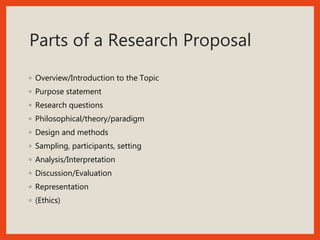
Parts of a Research Proposal
◦ Overview/Introduction to the Topic
◦ Purpose statement
◦ Research questions
◦ Philosophical/theory/paradigm
◦ Design and methods
◦ Sampling, participants, setting
◦ Analysis/Interpretation
◦ Discussion/Evaluation
◦ Representation
◦ (Ethics)
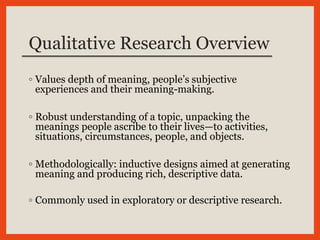
Qualitative Research Overview
◦ Values depth of meaning, people’s subjective
experiences and their meaning-making.
◦ Robust understanding of a topic, unpacking the
meanings people ascribe to their lives—to activities,
situations, circumstances, people, and objects.
◦ Methodologically: inductive designs aimed at generating
meaning and producing rich, descriptive data.
◦ Commonly used in exploratory or descriptive research.
Purpose statement: example
The purpose of this study is to examine the processes of multimodal text making of three
children across and within different contexts. The interactive potentials of the cultural
resources, including modes of textual expression as well as resources connected to
popular culture, and other family and community resources, are the focus of this
examination. This study is designed to examine children's multimodal text production in
order to trace how multimodal resources are used and how texts are constructed.
From a wider social justice perspective, I operate from a desire to shift how others might
see children, especially children who are socially and economically disadvantaged or
marginalized. This requires looking at lives up close and taking seriously the idea that:
“Change also has to entail a moral shift, a willingness to open oneself up to the
possibility of seeing those who differ from us. This is very hard work, but work that lies at
the heart of teaching” (Hicks, 2002, p. 152). I am interested in the possibilities to
transform practices and to suggest new ways of seeing how children can successfully
negotiate and create their paths in a range of multimodal literacy practices. One of the
implications of this study will be to suggest possible ways that educators might support
a wider range of multimodal identities and experiences for more children. If a wider
range of modes (i.e., beyond print literacy – reading and writing) are acknowledged and
more resources can be used and valued, than more children may be able to participate in
a range of literacy practices and a range of contexts with more success.
Research Questions
◦ Qualitative research questions are inductive (open-
ended) and often begin with the words what or how.
◦ They may employ nondirectional language,
including words and phrases such as explore,
describe, illuminate, unearth, unpack, generate,
build meaning, and seek to understand.
Research Questions: example
◦ How do both constraints and freedom facilitate learning to improvise at
the piano, in ways that simultaneously encourage creativity and skill
development in pianists?
◦ What are the benefits and challenges for piano students who improvise,
as they take ownership of creating a piece of music?
• How does the training that peer reviewers receive on the peer review
process for writing impact their own writing skills?
• How does the training that peer reviewers receive on the peer review
process for writing impact their ability to be effective peer reviewers?
• How does the experience as a peer reviewer impact the reviewer’s own
writing skills?
Philosophical Statement
◦ discussion of the paradigm or worldview -
focuses on the theoretical school of thought (or
theoretical framework) shaping your perspective and
design choices.
Interpretive or Constructivist
Paradigm
◦ Examines how people engage in processes of
constructing and reconstructing meanings
through daily interactions.
◦ Attention is drawn to people’s patterns of interaction and
the interpretive processes by which they assign meanings
to events, situations, etc.
◦ Major theoretical schools of thought: symbolic
interactionism, phenomenology, ethnomethodology,
dramaturgy.
Theoretical Schools of Thought
◦ Symbolic Interactionism: individuals and small groups use
shared symbols during interactions to communicate meaning
◦ Phenomenology: how individuals experience
◦ Ethnomethodology: strategies people use to negotiate
meanings in their interactions
◦ Dramaturgy: uses the metaphor of theatre and examines
people’s presentation of self in “front” and “back” stages of social
life
Critical Paradigm
◦ Considers issues of power in social life and the
research process (e.g., the micro-politics of
power).
◦ Assumes people are operating within power-rich
environments.
◦ Major theoretical schools of thought: postmodernist,
poststructuralist, feminist, critical race, indigenous,
and queer theoretical frameworks.
Theoretical Schools of Thought
◦ Postmodernism: dominant ideologies and symbols and discourses of
power
◦ Post-structuralism: deconstruct unified narratives to expose how
dominant ideology works
◦ Indigenous theory: resist colonizing research practices and value
indigenous knowledge
◦ Critical race theory: injustice and difference based on race
◦ Queer theory: injustice and difference based on sexual orientation and
identity
◦ Feminist theory: injustice and difference based on sex and gender
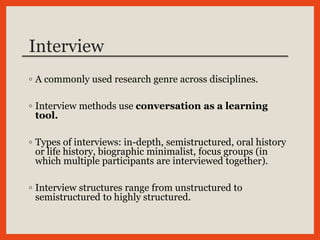
Interview
◦ A commonly used research genre across disciplines.
◦ Interview methods use conversation as a learning
tool.
◦ Types of interviews: in-depth, semistructured, oral history
or life history, biographic minimalist, focus groups (in
which multiple participants are interviewed together).
◦ Interview structures range from unstructured to
semistructured to highly structured.
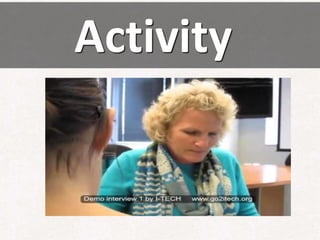
Activity
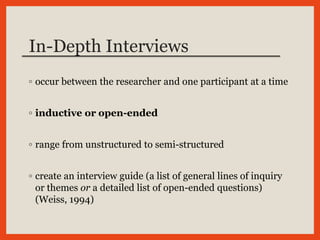
In-Depth Interviews
◦ occur between the researcher and one participant at a time
◦ inductive or open-ended
◦ range from unstructured to semi-structured
◦ create an interview guide (a list of general lines of inquiry
or themes or a detailed list of open-ended questions)
(Weiss, 1994)
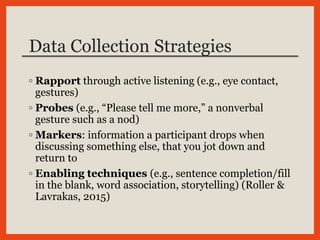
Data Collection Strategies
◦ Rapport through active listening (e.g., eye contact,
gestures)
◦ Probes (e.g., “Please tell me more,” a nonverbal
gesture such as a nod)
◦ Markers: information a participant drops when
discussing something else, that you jot down and
return to
◦ Enabling techniques (e.g., sentence completion/fill
in the blank, word association, storytelling) (Roller &
Lavrakas, 2015)
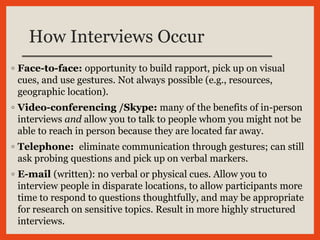
How Interviews Occur
◦ Face-to-face: opportunity to build rapport, pick up on visual
cues, and use gestures. Not always possible (e.g., resources,
geographic location).
◦ Video-conferencing /Skype: many of the benefits of in-person
interviews and allow you to talk to people whom you might not be
able to reach in person because they are located far away.
◦ Telephone: eliminate communication through gestures; can still
ask probing questions and pick up on verbal markers.
◦ E-mail (written): no verbal or physical cues. Allow you to
interview people in disparate locations, to allow participants more
time to respond to questions thoughtfully, and may be appropriate
for research on sensitive topics. Result in more highly structured
interviews.
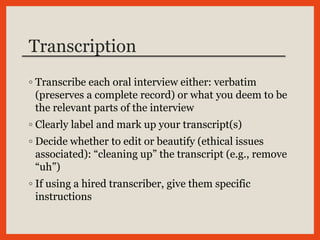
Transcription
◦ Transcribe each oral interview either: verbatim
(preserves a complete record) or what you deem to be
the relevant parts of the interview
◦ Clearly label and mark up your transcript(s)
◦ Decide whether to edit or beautify (ethical issues
associated): “cleaning up” the transcript (e.g., remove
“uh”)
◦ If using a hired transcriber, give them specific
instructions
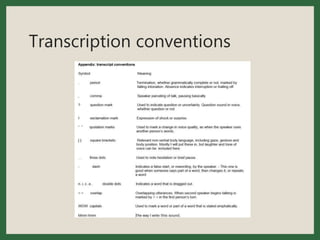
Transcription conventions
INTERVIEW 1
Find a quiet place.
Interview.
Thank your participant.
Come back.
cc: Matt From London - https://www.flickr.com/photos/57868312@N00
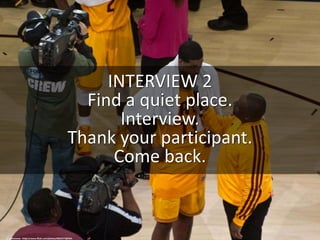
INTERVIEW 2
Find a quiet place.
Interview.
Thank your participant.
Come back.
cc: pianowow - https://www.flickr.com/photos/9602477@N03
Initial Immersion
◦ read, look at, and think about the data (Hesse-Biber &
Leavy, 2005, 2011)
◦ stew on it and let your ideas develop
◦ helps you “to feel” the pulse of the data (Saldaña, 2014)
◦ helps you develop your initial ideas (Creswell, 2014)
◦ may help you begin data reduction (Hesse-Biber &
Leavy, 2005, 2011) and to “prioritize” the data for analysis
by noting which data will best help you address the
research purpose and answer the research questions
(Saldaña, 2014)
Memo Writing
◦ Memo writing: thinking and systematically writing about data
you have coded and categorized.
◦ Memos are a link between your coding and
interpretation, and they document your impressions, ideas,
and emerging understandings (Hesse-Biber & Leavy, 2011).
◦ Types of memos:
◦ detailed descriptions or summaries, key quotes, analytic
memos about different codes, interpretive ideas about how
codes and categories are related and what you think
something means, and interpretive ideas about how a theory
or piece of literature relates to a segment of coded data
(Hesse-Biber & Leavy, 2011, p. 314)
Next week
◦2 readings
◦Transcribe + 2nd reflective
memo
◦Start thinking about paper for
critical review

S4. qualitative 2019

  • 1.
    Chapter 5 Qualitative Research Design Education5P92 - Collier - Sept. 26, 2019
  • 2.
    Last week cc: KevinWong - https://unsplash.com/@goodchinese?utm_source=haikudeck&utm_medium=referral&utm_campaign=api-credit •Updates: assignments, library, key terms •Sharing the news •Ethics and research - Collier •Readings - discussion •Planning for first assignment 4a) •Interview questions/preparation
  • 3.
    TODAY This week inthe news Facilitation Intro to qualitative research Tilley discussion How to record/retrieve/transcribe Interviews
  • 4.
  • 5.
    This week inthe news Discuss: • What were the research questions? • What were the methods or research design? • Why is a qualitative approach most fitting here?
  • 6.
  • 7.
    Parts of aResearch Proposal ◦ Overview/Introduction to the Topic ◦ Purpose statement ◦ Research questions ◦ Philosophical/theory/paradigm ◦ Design and methods ◦ Sampling, participants, setting ◦ Analysis/Interpretation ◦ Discussion/Evaluation ◦ Representation ◦ (Ethics)
  • 8.
    Qualitative Research Overview ◦Values depth of meaning, people’s subjective experiences and their meaning-making. ◦ Robust understanding of a topic, unpacking the meanings people ascribe to their lives—to activities, situations, circumstances, people, and objects. ◦ Methodologically: inductive designs aimed at generating meaning and producing rich, descriptive data. ◦ Commonly used in exploratory or descriptive research.
  • 9.
    Purpose statement: example Thepurpose of this study is to examine the processes of multimodal text making of three children across and within different contexts. The interactive potentials of the cultural resources, including modes of textual expression as well as resources connected to popular culture, and other family and community resources, are the focus of this examination. This study is designed to examine children's multimodal text production in order to trace how multimodal resources are used and how texts are constructed. From a wider social justice perspective, I operate from a desire to shift how others might see children, especially children who are socially and economically disadvantaged or marginalized. This requires looking at lives up close and taking seriously the idea that: “Change also has to entail a moral shift, a willingness to open oneself up to the possibility of seeing those who differ from us. This is very hard work, but work that lies at the heart of teaching” (Hicks, 2002, p. 152). I am interested in the possibilities to transform practices and to suggest new ways of seeing how children can successfully negotiate and create their paths in a range of multimodal literacy practices. One of the implications of this study will be to suggest possible ways that educators might support a wider range of multimodal identities and experiences for more children. If a wider range of modes (i.e., beyond print literacy – reading and writing) are acknowledged and more resources can be used and valued, than more children may be able to participate in a range of literacy practices and a range of contexts with more success.
  • 10.
    Research Questions ◦ Qualitativeresearch questions are inductive (open- ended) and often begin with the words what or how. ◦ They may employ nondirectional language, including words and phrases such as explore, describe, illuminate, unearth, unpack, generate, build meaning, and seek to understand.
  • 11.
    Research Questions: example ◦How do both constraints and freedom facilitate learning to improvise at the piano, in ways that simultaneously encourage creativity and skill development in pianists? ◦ What are the benefits and challenges for piano students who improvise, as they take ownership of creating a piece of music? • How does the training that peer reviewers receive on the peer review process for writing impact their own writing skills? • How does the training that peer reviewers receive on the peer review process for writing impact their ability to be effective peer reviewers? • How does the experience as a peer reviewer impact the reviewer’s own writing skills?
  • 12.
    Philosophical Statement ◦ discussionof the paradigm or worldview - focuses on the theoretical school of thought (or theoretical framework) shaping your perspective and design choices.
  • 13.
    Interpretive or Constructivist Paradigm ◦Examines how people engage in processes of constructing and reconstructing meanings through daily interactions. ◦ Attention is drawn to people’s patterns of interaction and the interpretive processes by which they assign meanings to events, situations, etc. ◦ Major theoretical schools of thought: symbolic interactionism, phenomenology, ethnomethodology, dramaturgy.
  • 14.
    Theoretical Schools ofThought ◦ Symbolic Interactionism: individuals and small groups use shared symbols during interactions to communicate meaning ◦ Phenomenology: how individuals experience ◦ Ethnomethodology: strategies people use to negotiate meanings in their interactions ◦ Dramaturgy: uses the metaphor of theatre and examines people’s presentation of self in “front” and “back” stages of social life
  • 15.
    Critical Paradigm ◦ Considersissues of power in social life and the research process (e.g., the micro-politics of power). ◦ Assumes people are operating within power-rich environments. ◦ Major theoretical schools of thought: postmodernist, poststructuralist, feminist, critical race, indigenous, and queer theoretical frameworks.
  • 16.
    Theoretical Schools ofThought ◦ Postmodernism: dominant ideologies and symbols and discourses of power ◦ Post-structuralism: deconstruct unified narratives to expose how dominant ideology works ◦ Indigenous theory: resist colonizing research practices and value indigenous knowledge ◦ Critical race theory: injustice and difference based on race ◦ Queer theory: injustice and difference based on sexual orientation and identity ◦ Feminist theory: injustice and difference based on sex and gender
  • 17.
    Interview ◦ A commonlyused research genre across disciplines. ◦ Interview methods use conversation as a learning tool. ◦ Types of interviews: in-depth, semistructured, oral history or life history, biographic minimalist, focus groups (in which multiple participants are interviewed together). ◦ Interview structures range from unstructured to semistructured to highly structured.
  • 18.
  • 19.
    In-Depth Interviews ◦ occurbetween the researcher and one participant at a time ◦ inductive or open-ended ◦ range from unstructured to semi-structured ◦ create an interview guide (a list of general lines of inquiry or themes or a detailed list of open-ended questions) (Weiss, 1994)
  • 20.
    Data Collection Strategies ◦Rapport through active listening (e.g., eye contact, gestures) ◦ Probes (e.g., “Please tell me more,” a nonverbal gesture such as a nod) ◦ Markers: information a participant drops when discussing something else, that you jot down and return to ◦ Enabling techniques (e.g., sentence completion/fill in the blank, word association, storytelling) (Roller & Lavrakas, 2015)
  • 21.
    How Interviews Occur ◦Face-to-face: opportunity to build rapport, pick up on visual cues, and use gestures. Not always possible (e.g., resources, geographic location). ◦ Video-conferencing /Skype: many of the benefits of in-person interviews and allow you to talk to people whom you might not be able to reach in person because they are located far away. ◦ Telephone: eliminate communication through gestures; can still ask probing questions and pick up on verbal markers. ◦ E-mail (written): no verbal or physical cues. Allow you to interview people in disparate locations, to allow participants more time to respond to questions thoughtfully, and may be appropriate for research on sensitive topics. Result in more highly structured interviews.
  • 22.
    Transcription ◦ Transcribe eachoral interview either: verbatim (preserves a complete record) or what you deem to be the relevant parts of the interview ◦ Clearly label and mark up your transcript(s) ◦ Decide whether to edit or beautify (ethical issues associated): “cleaning up” the transcript (e.g., remove “uh”) ◦ If using a hired transcriber, give them specific instructions
  • 23.
  • 24.
    INTERVIEW 1 Find aquiet place. Interview. Thank your participant. Come back. cc: Matt From London - https://www.flickr.com/photos/57868312@N00
  • 25.
    INTERVIEW 2 Find aquiet place. Interview. Thank your participant. Come back. cc: pianowow - https://www.flickr.com/photos/9602477@N03
  • 26.
    Initial Immersion ◦ read,look at, and think about the data (Hesse-Biber & Leavy, 2005, 2011) ◦ stew on it and let your ideas develop ◦ helps you “to feel” the pulse of the data (Saldaña, 2014) ◦ helps you develop your initial ideas (Creswell, 2014) ◦ may help you begin data reduction (Hesse-Biber & Leavy, 2005, 2011) and to “prioritize” the data for analysis by noting which data will best help you address the research purpose and answer the research questions (Saldaña, 2014)
  • 27.
    Memo Writing ◦ Memowriting: thinking and systematically writing about data you have coded and categorized. ◦ Memos are a link between your coding and interpretation, and they document your impressions, ideas, and emerging understandings (Hesse-Biber & Leavy, 2011). ◦ Types of memos: ◦ detailed descriptions or summaries, key quotes, analytic memos about different codes, interpretive ideas about how codes and categories are related and what you think something means, and interpretive ideas about how a theory or piece of literature relates to a segment of coded data (Hesse-Biber & Leavy, 2011, p. 314)
  • 28.
    Next week ◦2 readings ◦Transcribe+ 2nd reflective memo ◦Start thinking about paper for critical review