Solutions to Worksheet for Section 5.1
                         Areas and Distances
                                     V63.0121, Calculus I
                                          Summer 2010

1. Draw the graph of f (x) = ex on the interval [0, 1]. We are going to find the area below the
   curve on this interval.

   Solution. Here is the region:
                                                   y
                                               3

                                               2

                                               1

                                                            x
                                                        1


2. Estimate the area by computing with a calculator.
     (i) L2 and R2
    (ii) L4 and R4
   (iii) L8 and R8

   Solution. We have
                                   L2 = e0 (0.5) + e0.5 (0.5) = 1.32436
                                   R2 = e0.5 (0.5) + e1.0 (0.5) = 2.18350


   And   so on.
    n         Rn          Ln
    2     2.18350    1.32436
    4     1.94201    1.51244
    8     1.82791    1.61313

                                                   1
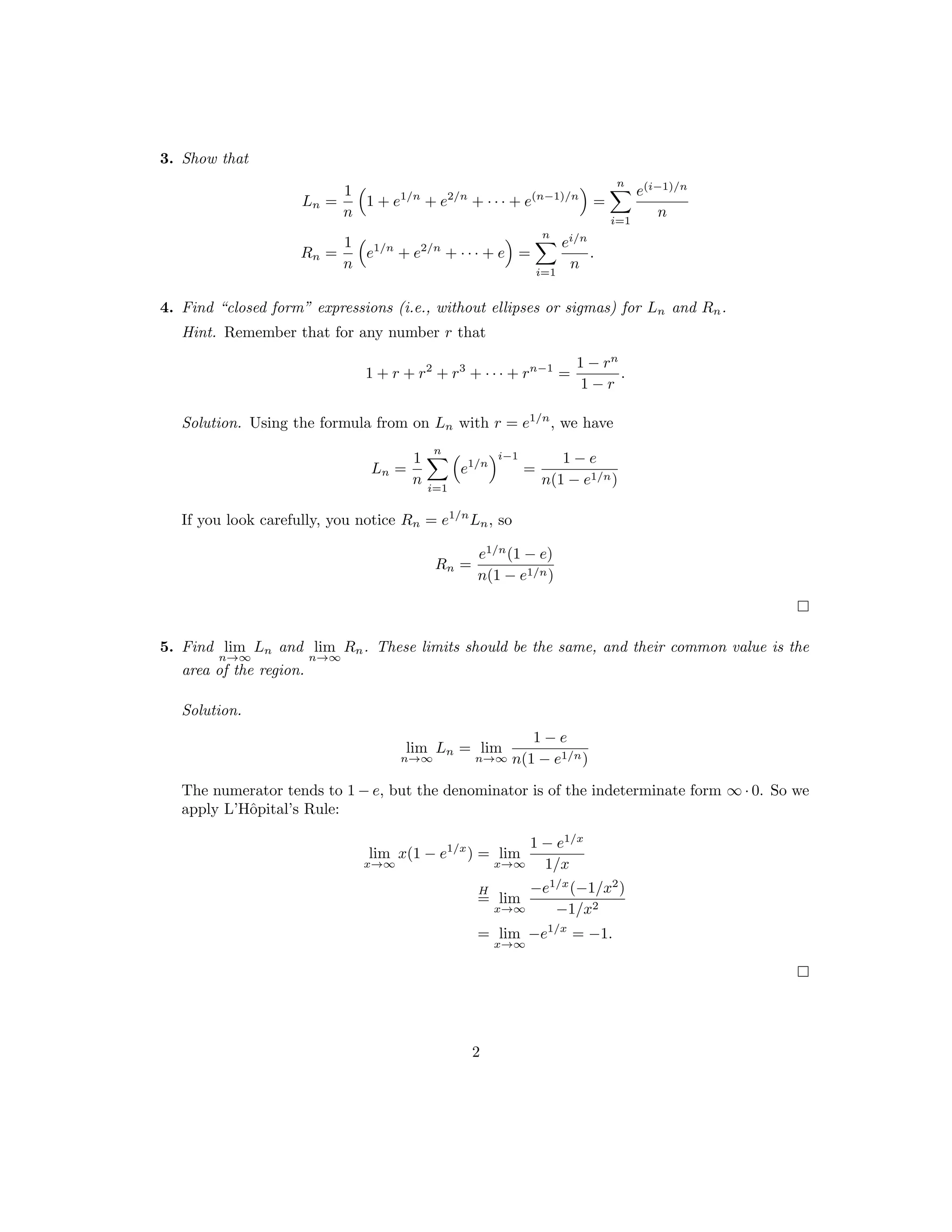
3. Show that
                                                                               n
                          1                                                          e(i−1)/n
                     Ln =   1 + e1/n + e2/n + · · · + e(n−1)/n =
                          n                                                    i=1
                                                                                         n
                                                                n
                          1 1/n                                       ei/n
                     Rn =   e   + e2/n + · · · + e =                       .
                          n                                     i=1
                                                                       n

4. Find “closed form” expressions (i.e., without ellipses or sigmas) for Ln and Rn .
   Hint. Remember that for any number r that
                                                                        1 − rn
                               1 + r + r2 + r3 + · · · + rn−1 =                .
                                                                         1−r

   Solution. Using the formula from on Ln with r = e1/n , we have
                                           n
                                     1                i−1          1−e
                                Ln =           e1/n         =
                                     n   i=1
                                                                n(1 − e1/n )

   If you look carefully, you notice Rn = e1/n Ln , so

                                                  e1/n (1 − e)
                                           Rn =
                                                  n(1 − e1/n )


5. Find lim Ln and lim Rn . These limits should be the same, and their common value is the
        n→∞            n→∞
   area of the region.

   Solution.
                                                           1−e
                                     lim Ln = lim
                                     n→∞          n→∞   n(1 − e1/n )

   The numerator tends to 1 − e, but the denominator is of the indeterminate form ∞ · 0. So we
   apply L’Hˆpital’s Rule:
            o

                                                          1 − e1/x
                               lim x(1 − e1/x ) = lim
                               x→∞                    x→∞   1/x
                                                  H       −e1/x (−1/x2 )
                                                  = lim
                                                      x→∞    −1/x2
                                                  = lim −e1/x = −1.
                                                      x→∞


                                                  2

Lesson 24: Area and Distances (worksheet solutions)

  • 1.
    Solutions to Worksheetfor Section 5.1 Areas and Distances V63.0121, Calculus I Summer 2010 1. Draw the graph of f (x) = ex on the interval [0, 1]. We are going to find the area below the curve on this interval. Solution. Here is the region: y 3 2 1 x 1 2. Estimate the area by computing with a calculator. (i) L2 and R2 (ii) L4 and R4 (iii) L8 and R8 Solution. We have L2 = e0 (0.5) + e0.5 (0.5) = 1.32436 R2 = e0.5 (0.5) + e1.0 (0.5) = 2.18350 And so on. n Rn Ln 2 2.18350 1.32436 4 1.94201 1.51244 8 1.82791 1.61313 1
  • 2.
    3. Show that n 1 e(i−1)/n Ln = 1 + e1/n + e2/n + · · · + e(n−1)/n = n i=1 n n 1 1/n ei/n Rn = e + e2/n + · · · + e = . n i=1 n 4. Find “closed form” expressions (i.e., without ellipses or sigmas) for Ln and Rn . Hint. Remember that for any number r that 1 − rn 1 + r + r2 + r3 + · · · + rn−1 = . 1−r Solution. Using the formula from on Ln with r = e1/n , we have n 1 i−1 1−e Ln = e1/n = n i=1 n(1 − e1/n ) If you look carefully, you notice Rn = e1/n Ln , so e1/n (1 − e) Rn = n(1 − e1/n ) 5. Find lim Ln and lim Rn . These limits should be the same, and their common value is the n→∞ n→∞ area of the region. Solution. 1−e lim Ln = lim n→∞ n→∞ n(1 − e1/n ) The numerator tends to 1 − e, but the denominator is of the indeterminate form ∞ · 0. So we apply L’Hˆpital’s Rule: o 1 − e1/x lim x(1 − e1/x ) = lim x→∞ x→∞ 1/x H −e1/x (−1/x2 ) = lim x→∞ −1/x2 = lim −e1/x = −1. x→∞ 2