GEK1544 The Mathematics of Games
                         Suggested Solutions to Tutorial 6

1.   In a poker hand of getting 5 consequent cards out of 52 cards, find the following.

         P ( three of a kind , no better)        &     P ( two pairs , no better) .

Conclude that

            P ( three of a kind , no better) < P ( two pairs , no better) .


Suggested solution. There are 4 Aces, and we need three of them. The count is C(4,
3). Likewise for a pair of K, Q, J, 10,., 2. We have

                                        13 · C(4, 3)

ways to form three of a kind. The remaining two cards must be different from the three of
a kind, and must be different from each other. the choices are 4 × 12 and 4 × 11 . Finally
the order to obtain the last two cards is not important, so the total count is

                       [13 · C(4, 3)] · [4 × 12] · [4 × 11]
                                                            = 54, 912 .
                                    P (2, 2)
                                                           54, 912
            =⇒ P ( three of a kind , no better) =                   ≈ 0.021129.
                                                           C(52, 5)
Likewise, there are 4 Aces, and we just need two of them. The count is C(4, 2). Likewise
for a pair of K, Q, J, 10,., 2. We have

                                        13 · C(4, 2)

ways to a pair. The other pair must be different, so there are

                                        12 · C(4, 2)

ways. The remaining card must be different from the pairs – the choices are 4 × 11.
Finally the order to obtain the two pairs is not important, so the total count is

                    [13 · C(4, 2)] · [12 · C(4, 2)] · [4 × 11]
                                                               = 123, 552 .
                                     P (2, 2)
                                                       123, 552
                =⇒ P ( two pairs , no better) =                 ≈ 0.047539.
                                                       C(52, 5)
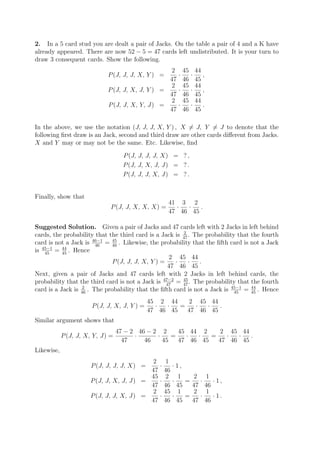
2. In a 5 card stud you are dealt a pair of Jacks. On the table a pair of 4 and a K have
already appeared. There are now 52 − 5 = 47 cards left undistributed. It is your turn to
draw 3 consequent cards. Show the following.
                                                  2           45     44
                             P (J, J, J, X, Y ) =           ·      ·    ,
                                                  47          46     45
                                                  2           45     44
                             P (J, J, X, J, Y ) =           ·      ·    ,
                                                  47          46     45
                                                  2           45     44
                             P (J, J, X, Y, J) =            ·      ·    .
                                                  47          46     45

In the above, we use the notation (J, J, J, X, Y ) , X = J, Y = J to denote that the
following first draw is an Jack, second and third draw are other cards different from Jacks.
X and Y may or may not be the same. Etc. Likewise, find

                                    P (J, J, J, J, X) = ? ,
                                    P (J, J, X, J, J) = ? .
                                    P (J, J, J, X, J) = ? .


Finally, show that
                                                     41 3 2
                              P (J, J, X, X, X) =      ·  ·   .
                                                     47 46 45

Suggested Solution. Given a pair of Jacks and 47 cards left with 2 Jacks in left behind
                                                        2
cards, the probability that the third card is a Jack is 47 . The probability that the fourth
card is not a Jack is 46−1 = 46 . Likewise, the probability that the fifth card is not a Jack
                        46
                              45

is 45−1 = 44 . Hence
    45     45
                                                    2 45 44
                              P (J, J, J, X, Y ) =    ·    ·   .
                                                   47 46 45
Next, given a pair of Jacks and 47 cards left with 2 Jacks in left behind cards, the
probability that the third card is not a Jack is 47−2 = 45 . The probability that the fourth
                                                   47   47
card is a Jack is 46 . The probability that the fifth card is not a Jack is 45−1 = 44 . Hence
                  2
                                                                            45    45

                                              45 2 44     2 45 44
                       P (J, J, X, J, Y ) =     ·  ·   =   ·  ·   .
                                              47 46 45   47 46 45
Similar argument shows that
                                  47 − 2 46 − 2 2     45 44 2    2 45 44
            P (J, J, X, Y, J) =         ·      ·    =   ·  ·   =   ·  ·   .
                                    47     46    45   47 46 45   47 46 45
Likewise,
                                          2         1
                      P (J, J, J, J, X) =        ·      · 1,
                                          47       46
                                          45        2      1   2 1
                      P (J, J, X, J, J) =        ·      ·    =   ·   · 1,
                                          47       46     45   47 46
                                          2        45      1   2 1
                      P (J, J, J, X, J) =        ·      ·    =   ·   · 1.
                                          47       46     45   47 46
As a pair of 4 has appeared, X = 4 . Suppose X = K, the probability to obtain three
consequent X is
                                        4 3 2
                                         ·   ·
                                       47 46 45
and there are 13 − 1 − 1 − 1 choice of X (X = 4, J, & K), hence the total is
                                     4 3 2      40 3 2
                              10 ·     ·  ·   =   ·  · .
                                     47 46 45   47 46 45
If X = K, then the probability is
                                            3 3 1
                                             ·  ·   .
                                           47 46 45
Hence the total is
          40 3 2    3 2 1     40 3 2    1 2 3     41 3 2
            ·  ·  +  ·  ·   =   ·  ·  +  ·  ·   =   ·  ·
          47 46 45 47 46 45   47 46 45 47 46 45   47 46 45


3. Let {x1 , x2 , ···, xn } be a collection of n numbers, among which k of them are the same,
and the remaining n − k numbers are all distinct. (E.g, for the numbers { 4, 4 , 3, 2 } ,
n = 4 and k = 2 .) Show that there are
                                                         n!
                                       P (n, n − k) =
                                                         k!
ways to arrange the n-numbers in order. E.g. P (4, 2) = 4 · 3 = 12 :

                                4,   4,   3,   2    2,   3,   4,   4
                                4,   4,   2,   3    3,   2,   4,   4
                                4,   3,   4,   2    2,   4,   3,   4
                                4,   3,   2,   4    4,   2,   3,   4
                                3,   4,   4,   2    2,   4,   4,   3
                                3,   4,   2,   4    4,   2,   4,   3


Suggested Solution. Consider n persons and r = n − k seats. The number of ways to
fill the seats in the order important manner is
                                        n!             n!          n!
                       P (n, r) =              =                 =    .
                                     (n − r) !   [n − (n − k)] !   k!
We relate this to the present problem by the following picture. Assume without loss of
generality that
                                  x1 = x2 = · · · = xk
and xk+1 , · · ·, xn are all distinct. There are n empty space to be filled with the numbers
{x1 , x2 , · · ·, xn } . E.g. in case {4, 4, 3, 2}
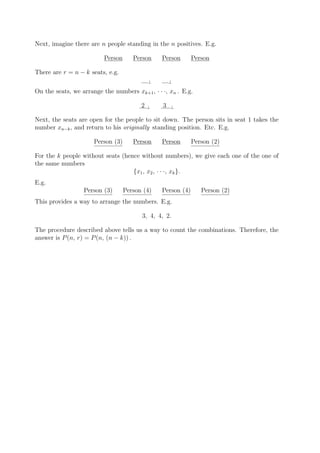
Next, imagine there are n people standing in the n positives. E.g.

                          Person      Person     Person       Person

There are r = n − k seats, e.g.
                                             ⊥       ⊥

On the seats, we arrange the numbers xk+1 , · · ·, xn . E.g.

                                         2   ⊥   3   ⊥


Next, the seats are open for the people to sit down. The person sits in seat 1 takes the
number xn−k , and return to his originally standing position. Etc. E.g.

                      Person (3)      Person     Person       Person (2)

For the k people without seats (hence without numbers), we give each one of the one of
the same numbers
                                   {x1 , x2 , · · ·, xk }.
E.g.
                  Person (3)       Person (4)    Person (4)      Person (2)
This provides a way to arrange the numbers. E.g.

                                         3, 4, 4, 2.

The procedure described above tells us a way to count the combinations. Therefore, the
answer is P (n, r) = P (n, (n − k)) .

S 6

  • 1.
    GEK1544 The Mathematicsof Games Suggested Solutions to Tutorial 6 1. In a poker hand of getting 5 consequent cards out of 52 cards, find the following. P ( three of a kind , no better) & P ( two pairs , no better) . Conclude that P ( three of a kind , no better) < P ( two pairs , no better) . Suggested solution. There are 4 Aces, and we need three of them. The count is C(4, 3). Likewise for a pair of K, Q, J, 10,., 2. We have 13 · C(4, 3) ways to form three of a kind. The remaining two cards must be different from the three of a kind, and must be different from each other. the choices are 4 × 12 and 4 × 11 . Finally the order to obtain the last two cards is not important, so the total count is [13 · C(4, 3)] · [4 × 12] · [4 × 11] = 54, 912 . P (2, 2) 54, 912 =⇒ P ( three of a kind , no better) = ≈ 0.021129. C(52, 5) Likewise, there are 4 Aces, and we just need two of them. The count is C(4, 2). Likewise for a pair of K, Q, J, 10,., 2. We have 13 · C(4, 2) ways to a pair. The other pair must be different, so there are 12 · C(4, 2) ways. The remaining card must be different from the pairs – the choices are 4 × 11. Finally the order to obtain the two pairs is not important, so the total count is [13 · C(4, 2)] · [12 · C(4, 2)] · [4 × 11] = 123, 552 . P (2, 2) 123, 552 =⇒ P ( two pairs , no better) = ≈ 0.047539. C(52, 5)
  • 2.
    2. In a5 card stud you are dealt a pair of Jacks. On the table a pair of 4 and a K have already appeared. There are now 52 − 5 = 47 cards left undistributed. It is your turn to draw 3 consequent cards. Show the following. 2 45 44 P (J, J, J, X, Y ) = · · , 47 46 45 2 45 44 P (J, J, X, J, Y ) = · · , 47 46 45 2 45 44 P (J, J, X, Y, J) = · · . 47 46 45 In the above, we use the notation (J, J, J, X, Y ) , X = J, Y = J to denote that the following first draw is an Jack, second and third draw are other cards different from Jacks. X and Y may or may not be the same. Etc. Likewise, find P (J, J, J, J, X) = ? , P (J, J, X, J, J) = ? . P (J, J, J, X, J) = ? . Finally, show that 41 3 2 P (J, J, X, X, X) = · · . 47 46 45 Suggested Solution. Given a pair of Jacks and 47 cards left with 2 Jacks in left behind 2 cards, the probability that the third card is a Jack is 47 . The probability that the fourth card is not a Jack is 46−1 = 46 . Likewise, the probability that the fifth card is not a Jack 46 45 is 45−1 = 44 . Hence 45 45 2 45 44 P (J, J, J, X, Y ) = · · . 47 46 45 Next, given a pair of Jacks and 47 cards left with 2 Jacks in left behind cards, the probability that the third card is not a Jack is 47−2 = 45 . The probability that the fourth 47 47 card is a Jack is 46 . The probability that the fifth card is not a Jack is 45−1 = 44 . Hence 2 45 45 45 2 44 2 45 44 P (J, J, X, J, Y ) = · · = · · . 47 46 45 47 46 45 Similar argument shows that 47 − 2 46 − 2 2 45 44 2 2 45 44 P (J, J, X, Y, J) = · · = · · = · · . 47 46 45 47 46 45 47 46 45 Likewise, 2 1 P (J, J, J, J, X) = · · 1, 47 46 45 2 1 2 1 P (J, J, X, J, J) = · · = · · 1, 47 46 45 47 46 2 45 1 2 1 P (J, J, J, X, J) = · · = · · 1. 47 46 45 47 46
  • 3.
    As a pairof 4 has appeared, X = 4 . Suppose X = K, the probability to obtain three consequent X is 4 3 2 · · 47 46 45 and there are 13 − 1 − 1 − 1 choice of X (X = 4, J, & K), hence the total is 4 3 2 40 3 2 10 · · · = · · . 47 46 45 47 46 45 If X = K, then the probability is 3 3 1 · · . 47 46 45 Hence the total is 40 3 2 3 2 1 40 3 2 1 2 3 41 3 2 · · + · · = · · + · · = · · 47 46 45 47 46 45 47 46 45 47 46 45 47 46 45 3. Let {x1 , x2 , ···, xn } be a collection of n numbers, among which k of them are the same, and the remaining n − k numbers are all distinct. (E.g, for the numbers { 4, 4 , 3, 2 } , n = 4 and k = 2 .) Show that there are n! P (n, n − k) = k! ways to arrange the n-numbers in order. E.g. P (4, 2) = 4 · 3 = 12 : 4, 4, 3, 2 2, 3, 4, 4 4, 4, 2, 3 3, 2, 4, 4 4, 3, 4, 2 2, 4, 3, 4 4, 3, 2, 4 4, 2, 3, 4 3, 4, 4, 2 2, 4, 4, 3 3, 4, 2, 4 4, 2, 4, 3 Suggested Solution. Consider n persons and r = n − k seats. The number of ways to fill the seats in the order important manner is n! n! n! P (n, r) = = = . (n − r) ! [n − (n − k)] ! k! We relate this to the present problem by the following picture. Assume without loss of generality that x1 = x2 = · · · = xk and xk+1 , · · ·, xn are all distinct. There are n empty space to be filled with the numbers {x1 , x2 , · · ·, xn } . E.g. in case {4, 4, 3, 2}
  • 4.
    Next, imagine thereare n people standing in the n positives. E.g. Person Person Person Person There are r = n − k seats, e.g. ⊥ ⊥ On the seats, we arrange the numbers xk+1 , · · ·, xn . E.g. 2 ⊥ 3 ⊥ Next, the seats are open for the people to sit down. The person sits in seat 1 takes the number xn−k , and return to his originally standing position. Etc. E.g. Person (3) Person Person Person (2) For the k people without seats (hence without numbers), we give each one of the one of the same numbers {x1 , x2 , · · ·, xk }. E.g. Person (3) Person (4) Person (4) Person (2) This provides a way to arrange the numbers. E.g. 3, 4, 4, 2. The procedure described above tells us a way to count the combinations. Therefore, the answer is P (n, r) = P (n, (n − k)) .