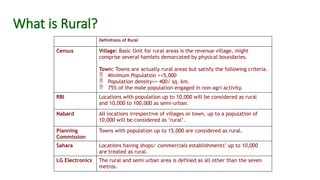
What is Rural?
Definitionsof Rural
Census Village: Basic Unit for rural areas is the revenue village, might
comprise several hamlets demarcated by physical boundaries.
Town: Towns are actually rural areas but satisfy the following criteria.
Minimum Population >=5,000
Population density>= 400/ sq. km.
75% of the male population engaged in non-agri activity.
RBI Locations with population up to 10,000 will be considered as rural
and 10,000 to 100,000 as semi-urban.
Nabard All locations irrespective of villages or town, up to a population of
10,000 will be considered as ‘rural’.
Planning
Commission
Towns with population up to 15,000 are considered as rural.
Sahara Locations having shops/ commercials establishments’ up to 10,000
are treated as rural.
LG Electronics The rural and semi urban area is defined as all other than the seven
metros.
3.
What is RuralMarketing?
• According to the National Sample Survey Organization
(NSSO), rural marketing is buying, selling, and promoting
goods and services in rural areas. Rural marketing is distinct
from urban marketing as it has to deal with different
customers whose needs are also different. Also, their
preferences and buying behaviour are different. Rural
marketing is a complex process in which rural consumers
have unique socio-economic and cultural factors affecting
their buying behaviour.
4.
• “Rural Marketingcan be defined as a function that manages all
activities involved in assessing, stimulating, and converting the
purchasing power of rural consumers into an effective demand for
specific products and services and moving these products and
services to the people in rural areas to create satisfaction and a better
standard of living and thereby achieving organizational goals.”
-Pradeep Kashyap
5.
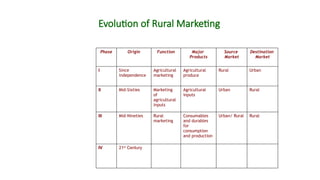
Evolution of RuralMarketing
Phase Origin Function Major
Products
Source
Market
Destination
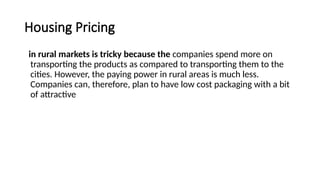
Market
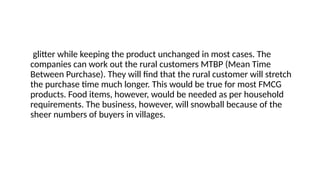
I Since
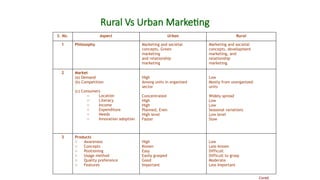
independence
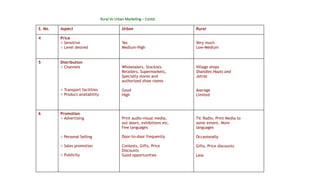
Agricultural
marketing
Agricultural
produce
Rural Urban
II Mid-Sixties Marketing
of
agricultural
inputs
Agricultural
inputs
Urban Rural
III Mid-Nineties Rural
marketing
Consumables
and durables
for
consumption
and production
Urban/ Rural Rural
IV 21st
Century
6.
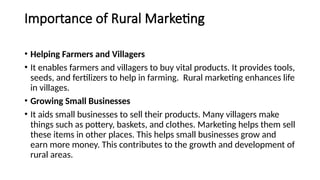
Importance of RuralMarketing
• Helping Farmers and Villagers
• It enables farmers and villagers to buy vital products. It provides tools,
seeds, and fertilizers to help in farming. Rural marketing enhances life
in villages.
• Growing Small Businesses
• It aids small businesses to sell their products. Many villagers make
things such as pottery, baskets, and clothes. Marketing helps them sell
these items in other places. This helps small businesses grow and
earn more money. This contributes to the growth and development of
rural areas.
7.
• Bringing ModernProducts to Villages
• Rural marketing connects villages to big cities. A farmer can sell his
products in the city market.
• All city businesses take their products to a village. This exchange of goods
facilitates both villages and cities to grow.
• Rural marketing ensures that people at both ends obtain what they need.
• Rural marketing helps develop the economy of villages.
• More employment takes place, and people lead their lives better
8.
Features of RuralMarketing
• It focuses on selling products in villages and small towns.
• The prices are usually lower to match the income of rural people.
• Advertising in rural marketing is simple and easy to understand.
• The people in rural areas often trust local shops and word-of-mouth
more than big advertisements.
• Rural marketing also deals with seasonal changes, such as farming
cycles, which affect when people buy things.
• It requires strong distribution networks to reach places that are far
from cities.
9.
Scope of RuralMarketing
• It aspires to sell foods, clothes, and household utilities to villagers.
• The scope of rural marketing also includes selling agricultural tools
and seeds to farmers.
• It provides business opportunities to touch new customers who may
be existing in far-flung areas.
10.
• Many firmsare now focusing on rural markets because
that demand for products is on the rise.
• The growth of better roads and technology helps make marketing in
villages easier.
• Rural marketing can also create jobs and improve the lives of people
living in rural areas.
11.
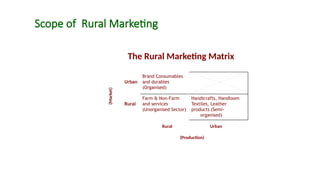
Scope of RuralMarketing
The Rural Marketing Matrix
(Market)
Handicrafts, Handloom
Textiles, Leather
products (Semi-
organised)
Farm & Non-Farm
and services
(Unorganised Sector)
Rural
Brand Consumables
and durables
(Organised)
Urban
Rural Urban
(Production)
12.
Objectives of RuralMarketing
• The main objective of rural marketing is to make the product available
in the rural area.
• It focuses on understanding what people in the villages need and
helps meet their needs.
• In addition, it helps businesses find new customers in the countryside.
• It focuses on offering products at affordable prices suitable for the
income of rural families.
13.
• Another aimis to bring products close to the places of choice, making
rural products easily available to buy there.
• It also aims at creating awareness of new products and services by
simple and easy advertisements.
• Lastly, rural marketing helps make the villagers' quality of life better
by bringing useful things closer to them.
14.
Nature and Characteristicsof Rural
Market
• Agriculture is main source of income.
• The income is seasonal in nature. It is fluctuating also as it
• depends on crop production.
• Though large, the rural market is geographically scattered.
• It shows linguistic, religious and cultural diversities and
• economic disparities.
15.
• The marketis undeveloped, as the people who constitute it
• still lack adequate purchasing power.
• It is largely agricultural oriented, with poor standard of living,
• low-per capital income, and socio-cultural backwardness.
16.
• It exhibitssharper and varied regional preferences with distinct
• predilections, habit patterns and behavioral characteristics.
• Rural marketing process is both a catalyst as well as an outcome of
the general rural.
17.
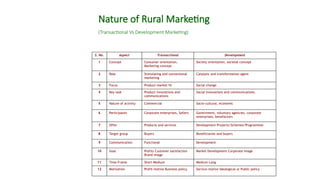
Nature of RuralMarketing
(Transactional Vs Development Marketing)
S. No. Aspect Transactional Development
1 Concept Consumer orientation,
Marketing concept
Society orientation, societal concept
2 Role Stimulating and conversional
marketing
Catalytic and transformation agent
3 Focus Product-market fit Social change
4 Key task Product innovations and
communications
Social Innovations and communications.
5 Nature of activity Commercial Socio-cultural, economic
6 Participants Corporate enterprises, Sellers Government, voluntary agencies, corporate
enterprises, benefactors
7 Offer Products and services Development Projects/Schemes/Programmes
8 Target group Buyers Beneficiaries and buyers
9 Communication Functional Development
10 Goal Profits Customer satisfaction
Brand image
Market Development Corporate Image
11 Time-Frame Short-Medium Medium-Long
12 Motivation Profit-motive Business policy Service-motive Ideological or Public policy
18.
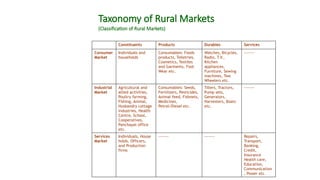
Taxonomy of RuralMarkets
(Classification of Rural Markets)
Constituents Products Durables Services
Consumer
Market
Individuals and
households
Consumables: Foods
products, Toiletries,
Cosmetics, Textiles
and Garments, Foot
Wear etc.
Watches, Bicycles,
Radio, T.V.,
Kitchen
appliances,
Furniture, Sewing
machines, Two
Wheelers etc.
-------
Industrial
Market
Agricultural and
allied activities,
Poultry farming,
Fishing, Animal,
Husbandry cottage
industries, Health
Centre, School,
Cooperatives,
Panchayat office
etc.
Consumables: Seeds,
Fertilizers, Pesticides,
Animal feed, Fishnets,
Medicines,
Petrol/Diesel etc.
Tillers, Tractors,
Pump sets,
Generators,
Harvesters, Boats
etc.
-------
Services
Market
Individuals, House
holds, Officers,
and Production
firms
------- ------- Repairs,
Transport,
Banking,
Credit,
Insurance
Health care,
Education,
Communication
, Power etc.
19.
Classification of RuralMarketing
• Marketing of Consumer Goods
• Consumer goods are everyday items that villagers need. These include
food, clothes, soaps, and cooking oil.
• Companies sell these products in small and affordable packs. This
helps villagers buy what they need without spending too much
money.
• Shops in villages sell these goods so people do not have to travel far.
Rural marketing makes sure villagers get essential items easily.
20.
• Marketing ofAgricultural Products
• Farmers grow crops like wheat, rice, and vegetables. They sell these
products in local markets or big city markets.
• Businesses also buy farm products to make flour, oil, and packaged
foods.
• Good marketing helps farmers get fair prices for their crops.
• This improves their income and helps them live better lives.
• Rural marketing connects farmers with buyers.
21.
• Marketing ofAgricultural Tools and Machines
• Farmers require adequate tools to ensure crop growth.
• Companies sell these tractors, plows, fertilizers, and seeds so that
they do.
• These also make farming simple and increase more food production
because when farmers possess good tools to grow better crops.
• Many of the businesses take up selling this farm equipment
specifically to rural locations. This results in making their villages more
productive
22.
• Marketing ofHandmade and Village Products
• Many villagers manufacture items like pottery, baskets, and
handmade clothes. These items are sold in local and city markets.
People love to purchase these unique handmade items.
• Selling village products helps small businesses grow. Rural marketing
helps villagers earn more money by selling their crafts.
23.
• Marketing ofServices in Rural Areas
• People in villages require services such as banking, health care, and
education. Companies bring these services to rural areas through
mobile banks, health camps, and schools.
• Mobile phone companies also provide network services in villages.
These services enhance the quality of life for villagers.
• Rural marketing ensures that people in villages receive the services
they require
24.
Factors Affecting RuralMarketing
• People in rural settings have different traditions and values, hence
they prefer specific products;
• These people generally earn lesser sums of money and are very
cautious of their spending habits;
• The roads, electricity, and internet in rural areas are a bit poorer and
affect delivery.
25.
• Advertisements formost of these products need to be very simple,
since people may not be educated much.
• The villagers have their word, usually through a family member or a
neighbor.
• The seasons affect what the farmer buys and consumes because there
will be some surplus amount when they get good harvests.
26.
Advantages and Disadvantagesof Rural Marketing
• Advantages of Rural Marketing
• Rural marketing provides an opportunity for businesses to reach
several customers.
• Villages harbor a significant population, and so companies can sell
their goods to many people.
•
27.
• Villagers requirebasic items like food, garments, and tools for
cultivating crops, so there is the demand.
• With better connectivity through roads and technology, businesses
easily transport their goods to the villages.
• There is also relatively less competition in rural areas compared to
cities, so businesses can grow rapidly.
• "Rural marketing helps both companies and villages blossom
together".
28.
• Low-Cost Advertising
•In the case of rural marketing, advertisements are cheaper.
• People in many villages may listen to the radio or read posters in their
respective towns.
• It may be cost-effective for offering products to these people. The companies
do not have to spend much money on expensive TV ads or cyber campaigns.
• Simple and clear-cut advertisements go to reach more people across the rural
areas.
• It makes advertisement cost-effective and effective for the business
organizations.
29.
Negative Aspects ofRural Marketing
• Rural marketing also has certain drawbacks.
• Transportation is often cumbersome in many rural villages as there
are poor roads.
• It's time and expense consuming to cover the distances leading to
high expenses.
• The rural people are very slow to respond to new things.
30.
• They seemto be resistant to adopting things they have always used
for such a long period.
• This means that the companies need to work hard on convincing
villagers to try out their new products.
• Rural marketing, therefore, demands careful planning and patience.
31.
• Less Accessto Technology
• There are many villagers who do not use the internet or even
smartphones. This will make it very difficult for companies to market
their products online.
• Other methods, such as radio or posters, may be used to achieve
advertising goals. For instance, with poor access to modern
technology, businesses have a hard time reaching all customers.
• This limits the potentials of some marketing campaigns. Companies
thus have to find alternative ways of connecting with rural customers.
32.
• Seasonal Demand
•Demand in rural areas for products may be seasonal. At harvest time,
farmers have a lot of money to spend, but other times they cannot
afford many products. This makes the sales less predictable.
• Companies need to plan marketing according to the seasons and
festivals.
• The seasonal nature of demand can make it harder for businesses to
maintain steady sales. Understanding the seasons is important for
successful rural marketing.
33.
Challenges in IndianRural Markets
• Understanding the Rural Consumer
• Poor Infrastructure
• Physical Distribution
• Channel Management
• Promotion and Marketing Communication
34.
Distribution and logistics:Infrastructure
• a challenge in rural India. Moreover, the lack of an efficient
distribution network prevents penetration of products/services into
rural India.
• One of the most innovative models in recent times has been the
usage of the postal service by mobile operators to penetrate scratch
cards to the villages.
35.
Payment collection
• Themajority of the rural population is still unbanked. Clearly,
noncash collection becomes rather unlikely. Cash collections, on the
other hand, are messy and difficult to monitor, especially since cash
cards or technology-enabled centralized POS (like Suvidha or
ItzWorld) have still not reached rural areas.
36.
• The timetested manufacturer-distributor-retailer network has been
the only real success so far but setting up such a structure is rarely
feasible. Partnering with MFIs comes to mind but often, the MFIs
don’t cater to the relatively more privileged/affluent segments of the
rural economy who are likely to be early adopters.
37.
Pricing
• Disposable income,though, isn’t always high since the bulk of rural
India is agricultural and income cycles in agricultural are very erratic
and not as predictable as in the case of us salaried individuals.
38.
Scaling across geographies
•India is a land of many cultures, the contrast becomes that much
starker in the case of rural India. Setting up operations on a pan-India
level presents different types of hurdles in different states
• ranging from political juggling to downright local factors
39.
• Any modelwhere scalability involves scaling on-ground operations
(and not merely an increase in downloads) is bound to run into
myriad issues as we move from one state to the next.
• Add to that the greater differences in consumer tastes and behavior
across geographies than in the relatively more cosmopolitan urban
population.
40.
Developing inorganic scale:
•Developing synthetic scale through partnerships typically results in
larger overheads in the rural context.
• Finding the right partner with reach and presence in villages is
difficult to start with. More importantly, there are very few players
who are strong on these counts across multiple geographies.
41.
• Hence, apan-India rollout typically requires multiple partnerships
resulting in higher partner management overheads
• Social and cultural challenges: The cyber café (or kiosk)
42.
Whether Rural Marketsare
Attractive?
• Large population
• Rising prosperity
• Growth in consumption
• Life-style changes
• Life-cycle advantages
• Market growth rates higher than Urban
• Rural marketing is not expensive
• Remoteness is no longer a problem.
43.
Rural Products
1. FMCGproducts like cosmetics, food items, cooking oil, kerosene,
and medicines
2. Consumer durables like refrigerators, stoves, motor cycles
44.
3. Farm productslike tractors, harvesters, seeders, seeds, fertilizers,
and diesel, water supply for household use including drinking
purposes and for watering farms
4. Services like, health clinics, water supply, electricity, eateries, inns
45.
Housing Pricing
in ruralmarkets is tricky because the companies spend more on
transporting the products as compared to transporting them to the
cities. However, the paying power in rural areas is much less.
Companies can, therefore, plan to have low cost packaging with a bit
of attractive
46.
glitter while keepingthe product unchanged in most cases. The
companies can work out the rural customers MTBP (Mean Time
Between Purchase). They will find that the rural customer will stretch
the purchase time much longer. This would be true for most FMCG
products. Food items, however, would be needed as per household
requirements. The business, however, will snowball because of the
sheer numbers of buyers in villages.
47.
Rural Vs UrbanMarketing
S. No. Aspect Urban Rural
1 Philosophy Marketing and societal
concepts, Green
marketing
and relationship
marketing
Marketing and societal
concepts, development
marketing, and
relationship
marketing.
2 Market
(a) Demand
(b) Competition
(c) Consumers
o Location
o Literacy
o Income
o Expenditure
o Needs
o Innovation adoption
High
Among units in organized
sector
Concentrated
High
High
Planned, Even
High level
Faster
Low
Mostly from unorganized
units
Widely spread
Low
Low
Seasonal variations
Low level
Slow
3 Products
o Awareness
o Concepts
o Positioning
o Usage method
o Quality preference
o Features
High
Known
Easy
Easily grasped
Good
Important
Low
Less known
Difficult
Difficult to grasp
Moderate
Less Important
Contd.
48.
Rural Vs UrbanMarketing – Contd.
S. No. Aspect Urban Rural
4 Price
o Sensitive
o Level desired
Yes
Medium-High
Very much
Low-Medium
5 Distribution
o Channels
o Transport facilities
o Product availability
Wholesalers, Stockists
Retailers, Supermarkets,
Specialty stores and
authorized show rooms
Good
High
Village shops
Shandies Haats and
Jatras
Average
Limited
6 Promotion
o Advertising
o Personal Selling
o Sales promotion
o Publicity
Print audio-visual media,
out doors, exhibitions etc.
Few languages
Door-to-door frequently
Contests, Gifts, Price
Discounts
Good opportunities
TV, Radio, Print Media to
some extent. More
languages
Occasionally
Gifts, Price discounts
Less
49.
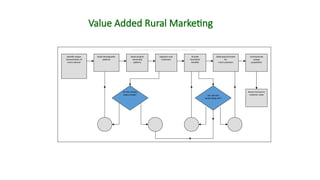
Value Added RuralMarketing
Ensure increase in
customer value
Communicate
unique
proposition
Build special brands
for
rural customers
Provide
functional
benefits
Segment rural
customers
Study demographic
patterns
Study product
ownership
patterns
Identify unique
characteristics of
rural customer
HOW TO ADD VALUE THROUGH RURAL MARKETING
Are relevant
needs being met?
Are the clusters
large enough?
No Yes
No No