Rural Areas
Characteristics,
Issues and
Problems
Who lives in rural
areas?
The term “rural” comes from the Latin word
“ruralis” which means “the country, rural
land”.
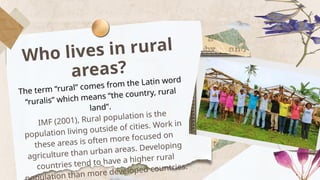
IMF (2001), Rural population is the
population living outside of cities. Work in
these areas is often more focused on
agriculture than urban areas. Developing
countries tend to have a higher rural
lation than more developed countries.
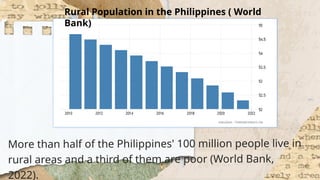
More than half of the Philippines' 100 million people live in
rural areas and a third of them are poor (World Bank,
2022).
Rural Population in the Philippines ( World
Bank)
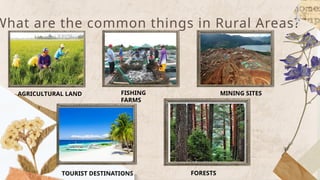
What are the common things in Rural Areas?
FISHING
FARMS
MINING SITES
AGRICULTURAL LAND
FORESTS
TOURIST DESTINATIONS
Characteristics of rural areas
1.Agricultural Dependence: Rural areas
in the Philippines are characterized by
their strong reliance on agriculture as
the primary source of livelihood for the
majority of the population.
2.Limited Infrastructure: Rural areas
often lack basic infrastructure such as
roads, transportation facilities, clean
water supply, electricity, health care
facilities, and educational institutions.
3.High Poverty Rates: Poverty rates tend
to be higher in rural areas compared
to urban areas due to limited economic
opportunities, lack of access to
education and healthcare, and
inadequate social services.
4.Close- Knit Communities: Rural areas
foster close relationships among
community members, as people often
rely on each other for support,
cooperation, and social activities.
5.Natural Beauty: Many rural areas in the
Philippines are known for their scenic
landscapes, natural resources, and
biodiversity, offering potential for
ecotourism.
6.Traditional Lifestyle: Rural
communities often maintain a more
traditional way of life, preserving their
cultural practices, beliefs, and customs.
Strong family ties and close-knit
communities are commonly observed.
7.Lower Cost of Living: Compared to
urban areas, the cost of living in
rural communities is generally
lower. Basic necessities, housing,
and land prices are often more
affordable.
8.Environmental Challenges: Rural areas
face various environmental challenges,
including deforestation, land
degradation, and vulnerability to
natural disasters like typhoons and
earthquakes.
9.Limited Employment Opportunities:
Due to a heavy emphasis on
agriculture, rural areas may have
limited employment opportunities
outside the farming sector. This can
lead to migration to urban areas in
search of better job prospects.
10.Traditional Housing: Rural dwellings
in the Philippines often consist of
bamboo, thatched roofs, or simple
concrete houses. Traditional
architectural designs are prevalent in
these areas.
11.Strong Community Spirit: Rural
communities often nurture a sense of
unity, with people actively participating
in community activities, celebrations,
and cooperative endeavors.
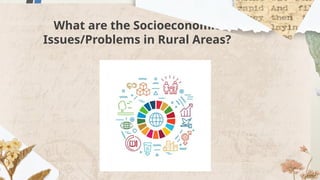
What are the Socioeconomic
Issues/Problems in Rural Areas?
1.Limited access to basic services: Many rural areas
lack access to essential services like healthcare
facilities, education, and clean water. This results in
inadequate healthcare, limited educational
opportunities, and poor sanitation.
2.Poverty and limited employment opportunities: The
lack of industries and economic development in these
areas leads to unemployment and lower income
levels.
3. Agricultural Challenges: farmers face
challenges such as outdated farming
techniques, lack of access to credit and
markets, and vulnerability to natural
disasters.
4. Limited infrastructure: Rural areas often
lack proper infrastructure like roads,
electricity, and telecommunications.
5. Environmental degradation: Some rural
areas face environmental issues like
deforestation, soil erosion, and improper
waste management.
6. Inadequate access to healthcare: Rural
areas in the Philippines often have limited
access to healthcare facilities and medical
professionals.
What are the
Environmental
Issues/Problems in Rural
Areas?
Some environmental issues in rural areas
1. Deforestation
2. Water pollution
3. Soil degradation
4. Solid waste management
5. Air pollution
6. Mining impacts
Thank
you for
listening.

rural areas; Characteristics, Issues and Problems .pptx

  • 1.
  • 2.
    Who lives inrural areas? The term “rural” comes from the Latin word “ruralis” which means “the country, rural land”. IMF (2001), Rural population is the population living outside of cities. Work in these areas is often more focused on agriculture than urban areas. Developing countries tend to have a higher rural lation than more developed countries.
  • 3.
    More than halfof the Philippines' 100 million people live in rural areas and a third of them are poor (World Bank, 2022). Rural Population in the Philippines ( World Bank)
  • 4.
    What are thecommon things in Rural Areas? FISHING FARMS MINING SITES AGRICULTURAL LAND FORESTS TOURIST DESTINATIONS
  • 5.
    Characteristics of ruralareas 1.Agricultural Dependence: Rural areas in the Philippines are characterized by their strong reliance on agriculture as the primary source of livelihood for the majority of the population.
  • 6.
    2.Limited Infrastructure: Ruralareas often lack basic infrastructure such as roads, transportation facilities, clean water supply, electricity, health care facilities, and educational institutions.
  • 7.
    3.High Poverty Rates:Poverty rates tend to be higher in rural areas compared to urban areas due to limited economic opportunities, lack of access to education and healthcare, and inadequate social services.
  • 8.
    4.Close- Knit Communities:Rural areas foster close relationships among community members, as people often rely on each other for support, cooperation, and social activities.
  • 9.
    5.Natural Beauty: Manyrural areas in the Philippines are known for their scenic landscapes, natural resources, and biodiversity, offering potential for ecotourism.
  • 10.
    6.Traditional Lifestyle: Rural communitiesoften maintain a more traditional way of life, preserving their cultural practices, beliefs, and customs. Strong family ties and close-knit communities are commonly observed.
  • 11.
    7.Lower Cost ofLiving: Compared to urban areas, the cost of living in rural communities is generally lower. Basic necessities, housing, and land prices are often more affordable.
  • 12.
    8.Environmental Challenges: Ruralareas face various environmental challenges, including deforestation, land degradation, and vulnerability to natural disasters like typhoons and earthquakes.
  • 13.
    9.Limited Employment Opportunities: Dueto a heavy emphasis on agriculture, rural areas may have limited employment opportunities outside the farming sector. This can lead to migration to urban areas in search of better job prospects.
  • 14.
    10.Traditional Housing: Ruraldwellings in the Philippines often consist of bamboo, thatched roofs, or simple concrete houses. Traditional architectural designs are prevalent in these areas.
  • 15.
    11.Strong Community Spirit:Rural communities often nurture a sense of unity, with people actively participating in community activities, celebrations, and cooperative endeavors.
  • 16.
    What are theSocioeconomic Issues/Problems in Rural Areas?
  • 17.
    1.Limited access tobasic services: Many rural areas lack access to essential services like healthcare facilities, education, and clean water. This results in inadequate healthcare, limited educational opportunities, and poor sanitation. 2.Poverty and limited employment opportunities: The lack of industries and economic development in these areas leads to unemployment and lower income levels.
  • 18.
    3. Agricultural Challenges:farmers face challenges such as outdated farming techniques, lack of access to credit and markets, and vulnerability to natural disasters. 4. Limited infrastructure: Rural areas often lack proper infrastructure like roads, electricity, and telecommunications.
  • 19.
    5. Environmental degradation:Some rural areas face environmental issues like deforestation, soil erosion, and improper waste management. 6. Inadequate access to healthcare: Rural areas in the Philippines often have limited access to healthcare facilities and medical professionals.
  • 20.
  • 21.
    Some environmental issuesin rural areas 1. Deforestation 2. Water pollution 3. Soil degradation 4. Solid waste management 5. Air pollution 6. Mining impacts
  • 22.