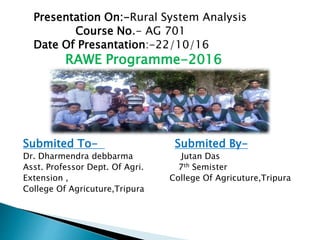
Presentation On:-Rural System Analysis
Course No.- AG 701
Date Of Presantation:-22/10/16
RAWE Programme-2016
Submited To- Submited By-
Dr. Dharmendra debbarma Jutan Das
Asst. Professor Dept. Of Agri. 7th Semister
Extension , College Of Agricuture,Tripura
College Of Agricuture,Tripura
1.Experience in Divyodaya Krishi Vigyan
Kendra(DKVK).
2.Work In Bharaman Pushkurini Village.
In Divyodaya Krishi Vigyan Kendra we are
worked total 29 days in our RAWE
programme and I have lernt so many thing
in Rural System Analysis Course and that is
discuss in next slides.
Pic.- First day in DKVK
Practical works done in DKVK-
1. Participatory Rural Apprisal(PRA).
2. Nurserybed preparation.
3. Farmers training program.
4. Preparation of Jelly,coconut milk,carambola pickle and pineapple squash.
5. Netting of fishes.
6. Asexual propagation of different fruits and flowers.
7. Scientific bee keeping.
8. Mushroom production.
9. Soil and water testing.
10. Visit to piggery house.
PRA Tools:-Preference ranking map on vegetables
crops.
Pic.-Preference ranking
chart
Pic.-Discuss in front of
all farmers
Pic.-Social and Resources map
PRA Tools:-Social and Resources map of purbo
kunjoban village.
Pic.- Social and Resources in
floor
Pic.-Social and Resources
chart
Pic.-Preference ranking map Pic.-Matrix ranking map
STRENGTH:-
They are educated and skilled.
 They have enough land for cultivation of Rice and various vegetables.
 They have irrigation facility from Khowai river.
 They are capable of adopting new technology.
WEAKNESSES:-
 Some of them are less skilled .
 They keep rice fields fallow in rabi season.
They have no godown to store their agril. Produce.
OPPORTUNITIES:-
 Market is very near.
 As they have watershed, they can grow off season crops.
 Scope for allied sectors.
THREATS:-
 Pest and disease attack.
 Uneven rainfall.
 Decrease in market demand.
STRENGTHS:-
 Farmers are skilled and educated.
 Irrigation facility.
 Agricultural store at Kalyanpur.
WEAKNESSES:-
 Some farmers are less skilled and educated.
 Less land holding.
Don’t adopt new technologies easily.
OPPORTUNITIES:-
 Near to Kalyanpur market.
 Khowai river is very near.
 Scope for allied sectors.
THREATS:-
 Less number of pump machines. Pump machines also defaults frequently.
 Mainly depends on vegetable cultivations.
Pic.-Spadeing
the bed
Pic.-Mixing sand,soil
and manure(1:1:1)
Pic.-Sprade the
mixing material
Pic.-Sowing the
seeds
Pic.-Watering the
bed
Pic.-Young
seedling
Pic.-Nursery raising technique
discuss infront of farmers
Pic.-Nursery raising technique of vegetables
Pic.-Piece of guava
Pic.-Prepared guava jelly
Pic.-Extracted the
guava juice
Pic.-Boiling the guava
piece
Pic.-Extracted
pineapple juice
Pic.-Filtering the
juice
Pic.-Pressure the
filtering cloth
Pic.-Mixing the
preservative and get final
product
Pic.-Filtering the coconut
milk
Pic.-Prepared coconut milk
Pic.-Slice of carambola Pic.-Prepared carambola pickle
Pic.-Netting of fishes
Pic.-Identify different fish
species
Select the plant branch
Remove the leaves from 4 inch below and above select part
Remove the plant barke in ring shape
Use root promoting hormone
Prepare the media & warp arround the ring
Warp polythene films & tie with jute fibre
Cut the new rooted stem after 1.5 month
Grow in nursery & give shade facility
Pic.-Litchi Air
Layering
2-3 node present pencil thickness stem is select
Remove all the leaves from that stem
Apply rooting hormone its base
Poke the hole in that soil and placing that cutting
After rooting transfer it in poly bag
Pic.-Citrus cutting nurserybed
Pic.-Putting the chysenthimum
cutting
Pic.-Rooting hormone
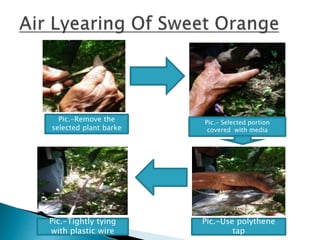
Pic.-Remove the
selected plant barke
Pic.- Selected portion
covered with media
Pic.-Use polythene
tap
Pic.-Tightly tying
with plastic wire
Collect the desirable bud
T-shape bud will attach with our desirable site of rose stem
Warp the bud with polythene tape
After 3-4 weeks remove the warp
Pic.-Rose T-budding
Rootstock selection:- Six month to one year old plant select which
thickness is 3/8 to 1 inch.
Scion selection:- Select the scion from healthy regular bearing
mother plant and its thickness is equal or less than from
rootstock thickness.
Pic.-Mango Rootstock
Pic.-Mango scion
Pic.-selected scion
Pic.-Selected rootstock
Pic.-Scion
preparation Pic.-Cuttint upper
part of rootstock
Pic.-Tying the scion and
rootstock with polythene tap
TOPICS COVERED
Different castes of bees and their
function
Species of honey bees
Diseases and pests of honey bees.
Benefits of bee keeping
Constraints of bee keeping
Practical exposure to bee hive in DKVK
campus, by Mr. Ratan Chandra Das
Pic.-Bee hive
Pic.-HoneyPic.-Honey chamber
Pic.-Exparts
Pic.-opening bee
hive
Pic.-Collection of
rice straw
Pic.-Cutting the
straw of rice
Pic.-Small piece
rice straw
Pic.-chemicalPic.-Treated waterPic.-Rice straw
emerges in water
Pic.-Mushroom spawn
Pic.-Preparation of
mushroom bag
Pic.-Growing
Mushroom
Pic.-Tyeing the bag
Pic.-Soil pH testing Pic.-Phosphorus test
Pic.-Water testing
kit
Pic.-Water pH test
Pic.-Fluride test
Pic.-Pigery house
Pic.-Biofertilizer
Pic.-First day in the village Bramhan Puskarani
Name of the village:- Bramhan Puskarani
Name of the Gram Panchayat:- West Kamalghat
Name of the block:- Mohanpur R.D Block
Name of the district:- West Tripura
Warde No.- 6
Name of the ward member:- Thakur Chand Sarkar
Name of the GRS:- Supratim Das
Name of the Pradhan:- Mangalmoti Debbarma
Growing Crops:- Okra,ridge gourd, bitter gourd, brinjal, sweet gourd, cowpea,
cucumber, lab lab bean,paddy, etc.
Markets :Kalibazar, Kamalghat.
School No. : 1
Ration shop: 1
Agro-processing industry:- 2 rice mail
Mass media:- Mobile(~100%),Television(~96%),News paper(~5%).
Available inputs:- Seeds,fertilizers etc.
On going scheme:- MGNREGA,IWMP
Land category:- Wet land crop,Dry land crop,Kitchen garden.
Irrigation system:- Water pump,pond water.
Village status:- Agriculture based village.
 Name of the farmer: Khukan Sarkar
 Age : 34years
 Gender : Male
 Gram panchayat : West Kamalghat
 Block : Mohanpur
 Occupassion : Farming
 Education : (viii)passed.
Pic.-My contact farmer
Sl.
No.
Name Gender Age Education Relationship
with head
Occupation
1. Khukan Sarkar Male 34 Class(ix) Head Farmer
2. Anjana Sarkar Female 30 Class(viii) Wife House wife
3. Rupak Sarkar Male 12 Class(vi) Son Student
4. Susmita Sarkar Female 11 Class(v) Daughter Student
5. Sukhen Sarkar Male 26 Metric fail Brother Service
 Total holding area: 7.5 kani.
 Area under agricultural crops : 6.5 kani.
 Area under house hold : 1kani.
 Irrigated area : 5.5 kani.
 Unirrigsted area: 1 kani.
 Livestock : 2 cattle,20 nos.hen,
6 nos.cock,2 ducks
 Spades : 2 Nos.
 Sprayer : 1 No.
 Sickles: 3 Nos.
 Nirani: 2Nos.
 He is occasionaly contact with one veterinary extension person.
 He get the agriculture informations from one chemical
company(Byaer) and his neighbours.
 No benefits derived from any development departments.
Pic.-Collection farmer infomation
 He borrowed the money from his friends and
relatives for crop production and repay the
money as 5% interest and installment wise.
Innovative ideas:
(1)Ash used as a liming material.
(2)Frequently weeding the brinjal bed in rainy
season to prevent the water loging condition.
(3)Utilization of crops straw as mulch of
vegetable cultivation.
ITKs :
(1)Paddy seed soaking for 2 days in water.
(2)Drainage channel properly.
(3)Used banana leaves in seedbed.
(4)Used bamboo stick in brinjal.
Pic.-Used Dola for paddy storing Pic.-Used bsmboo stick
Pic.-Remove the lower leaves of
brinjal plant
Pic.-Prevent birds attack
Pic.-Farmer fertilizer store Pic.-For seed purpose
Major crops: Brinjal,Paddy,Lablab bean.
Season: Rabi and Kharif season.
Variety: Local and Hybrid Seeds.
Sources of seed: Market and Owned field.
Method of seed treatment: Paddy- Seed soaking in water.
Method of harvesting: Picking and cutting.
Yield: Brinjal(1000kg/kani),Lablab bean(700kg/kani) and
paddy(700kg/kani).
 Total cost of cultivation:33000/-
 Gross return:52000/-
 Net return:19000/-
 Benefit cost ratio:1.57
 Weed management: Hand weeding wnd
weedicide,
 Economic loss:Medium
 Fertilizer application system:Basal and Split.
 Pest and Diseases control: Cultural and chemical practices.
 He is attain one chemical fertilizer use guide line training
programme under Byaer chemical company.
 Problem faced by the farmer related to crop
production:1)Unavailability of good seed.
2)High cost labour.
3)High rate of fertilizers and protection chemicals.
4)Unavailability of proper irrigation system.
Pic.-Weeding Pic.-Sprying weedicide
Pic.-Fertilizer application Pic.-Chemical spray
Pic.-Climbing the lablab bean Pic.-Nylon wire prepare for
lablab bean climbing
Crop strength weakness opportunities threat
Brinjal Availability of
seed,good
soil condition
Attact of
insect pest
and diseases,
higher rate of
labour cost.
Available
irrigation
water,good
market price.
Uncertainity
of market
value and
climate.
Lablab bean Favourable
land and
seed
availabality
Marketing
problem,pest
and disease
infestation.
Better market
price,improve
the soil
condition.
Declining
fruits quality
and quantity
due to pest
and disease
infestation.
What is PRA ?
 PRA is a methodology of learning rural life and their
environment from the rural people.
Different tools of PRA done in Bramhan Puskarani village :
1)Daily activaties of women.
2)Preference ranking map.
3)Communication system.
4)Timeline.
5)Seasonal map.
6)Resource mobility map.
7)Social and Resources map
Pic.-PRA chart discussion
Pic.-Group picture
Pic.-PRA char making
Pic.-Resource mobility
map
Pic.-Timeline
Pic.-Communication
system
Pic.-Preference
ranking map
Pic.-Daily activaties
of women
Pic.-Social and
Resources map
Pic.-Seasonal
map
Pic.-Group discussion
 Diseases(Yellow mosaic,Powdery mildew), Pests(fruits borer), Weeds
problem, Nutrient deficiency problems.
Suggetion-
 Control the insect vector by application of Dimethoate 30 EC(Rogor)
@1.5ml/litre of water.
 Powdery mildew control by using Dusting Sulphur 80 WP@15Kg/ha.
 Follow the crop rotation.
 Maintained the field sanitation.
feedback:-
Farmers are very satisfied by getting the information.
Pic.-Group discussion
Pic.-Community work
Seed Treatment:-
Chemical compounds-Captan,Thiram,Carbendazim,Mancozeb etc.
Procedure:-1)Dry method->2-4 gm chemical are finely mixed with 1
kg seed.
2)By solution:-Prepared the solution by using 2-4 gm chemical with 1
litre of water and seeds aredeep in this water for about 20-30
minutes.After that these seeds are dey in shade area about two hourse.
Which diseases are control ?
Different rooting diseases of all vegetables and Damping off,leaf
spot,blight,stem rooting etc.
Pic.-Seed tretment chart Pic.-Demonstrate the seed
treatment
Procedure:-1)Soil solarization:After the ploughing of the land
it should be wet by watering and covered the land by polythene
for about 5-6 weeks.
2)Summer Ploughing:Before the monsoon rain the land is deeply
ploughing in about 15-20 days interval.
Pic.-Demonstrate the soil
treatmentPic.-Soil treatment chart
Pic.-vermicompost preparation
Pic.-Disease identification Pic.-Pest identification
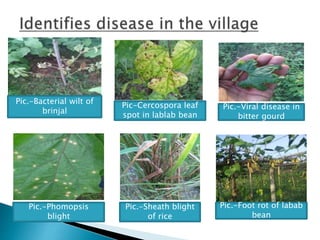
Pic.-Bacterial wilt of
brinjal
Pic-Cercospora leaf
spot in lablab bean
Pic.-Viral disease in
bitter gourd
Pic.-Phomopsis
blight
Pic.-Sheath blight
of rice
Pic.-Foot rot of labab
bean
Pic.-Brinjal fruit and shoot
borer
Pic.-Black aphid in lablab
bean
Pic.-Rice caterpiller
Pic.-Leaf folder adult in
rice
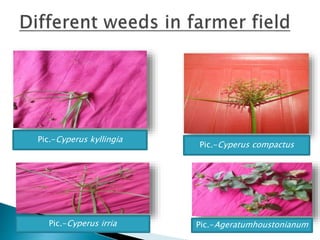
Pic.-Cyperus kyllingia
Pic.-Cyperus compactus
Pic.-AgeratumhoustonianumPic.-Cyperus irria
Bio-gas plant stracture:-
Owner name-Laxman Bhowmik
Village-Meghlipara
Category-Floating type biogas plant.
Capacity-1000 litre
Raw material-Cow dung slurry
Cow dung required-30-32 kg/day
Total no. of cow-4 nos.
Total setup cost-24000/-
Pic.-Biogas plant structure
Information:-
Name of the group-Deepshika SHG
Setup-2014
Member no.-12
Monthly income-15000-20000/-
Parafin box rate-25000/-
Pic.-Candle making industry
Pic.-Dukli Agril. Sub-divion office
Pic.-Soil sample collection
Pic.-soil testing
Pic.-Soil sample
storage
Conclusion:
In Rural System Analysis Course I have lernt so many thing like how
to work with rural peoples,PRA practice,Group discussion,Method
demonstration,Community cleaning etc.It is help to outsider to
overview the village farming system,ITKs,Farmers innovative
ideas,Major growing crop,Cropping pattern,Resources available in
the village,Marketing behavior,Socio-econonomic structure,Political
and cultural structure of the village.PRA is also help to know about
the rural experience with the participation of the farmers.Group
discussion and method demonstration helps to know their present
problems in crop production and adopt new cultivation pactices.
THANK YOU SIR

Rural system Analysis{RAWE Programme}

  • 1.
    Presentation On:-Rural SystemAnalysis Course No.- AG 701 Date Of Presantation:-22/10/16 RAWE Programme-2016 Submited To- Submited By- Dr. Dharmendra debbarma Jutan Das Asst. Professor Dept. Of Agri. 7th Semister Extension , College Of Agricuture,Tripura College Of Agricuture,Tripura
  • 2.
    1.Experience in DivyodayaKrishi Vigyan Kendra(DKVK). 2.Work In Bharaman Pushkurini Village.
  • 3.
    In Divyodaya KrishiVigyan Kendra we are worked total 29 days in our RAWE programme and I have lernt so many thing in Rural System Analysis Course and that is discuss in next slides. Pic.- First day in DKVK
  • 4.
    Practical works donein DKVK- 1. Participatory Rural Apprisal(PRA). 2. Nurserybed preparation. 3. Farmers training program. 4. Preparation of Jelly,coconut milk,carambola pickle and pineapple squash. 5. Netting of fishes. 6. Asexual propagation of different fruits and flowers. 7. Scientific bee keeping. 8. Mushroom production. 9. Soil and water testing. 10. Visit to piggery house.
  • 5.
    PRA Tools:-Preference rankingmap on vegetables crops. Pic.-Preference ranking chart Pic.-Discuss in front of all farmers
  • 6.
  • 7.
    PRA Tools:-Social andResources map of purbo kunjoban village. Pic.- Social and Resources in floor Pic.-Social and Resources chart
  • 8.
    Pic.-Preference ranking mapPic.-Matrix ranking map
  • 9.
    STRENGTH:- They are educatedand skilled.  They have enough land for cultivation of Rice and various vegetables.  They have irrigation facility from Khowai river.  They are capable of adopting new technology. WEAKNESSES:-  Some of them are less skilled .  They keep rice fields fallow in rabi season. They have no godown to store their agril. Produce. OPPORTUNITIES:-  Market is very near.  As they have watershed, they can grow off season crops.  Scope for allied sectors. THREATS:-  Pest and disease attack.  Uneven rainfall.  Decrease in market demand.
  • 10.
    STRENGTHS:-  Farmers areskilled and educated.  Irrigation facility.  Agricultural store at Kalyanpur. WEAKNESSES:-  Some farmers are less skilled and educated.  Less land holding. Don’t adopt new technologies easily. OPPORTUNITIES:-  Near to Kalyanpur market.  Khowai river is very near.  Scope for allied sectors. THREATS:-  Less number of pump machines. Pump machines also defaults frequently.  Mainly depends on vegetable cultivations.
  • 11.
    Pic.-Spadeing the bed Pic.-Mixing sand,soil andmanure(1:1:1) Pic.-Sprade the mixing material Pic.-Sowing the seeds Pic.-Watering the bed Pic.-Young seedling
  • 12.
    Pic.-Nursery raising technique discussinfront of farmers Pic.-Nursery raising technique of vegetables
  • 13.
    Pic.-Piece of guava Pic.-Preparedguava jelly Pic.-Extracted the guava juice Pic.-Boiling the guava piece
  • 14.
    Pic.-Extracted pineapple juice Pic.-Filtering the juice Pic.-Pressurethe filtering cloth Pic.-Mixing the preservative and get final product
  • 15.
  • 16.
    Pic.-Slice of carambolaPic.-Prepared carambola pickle
  • 17.
  • 18.
    Select the plantbranch Remove the leaves from 4 inch below and above select part Remove the plant barke in ring shape Use root promoting hormone Prepare the media & warp arround the ring Warp polythene films & tie with jute fibre Cut the new rooted stem after 1.5 month Grow in nursery & give shade facility Pic.-Litchi Air Layering
  • 19.
    2-3 node presentpencil thickness stem is select Remove all the leaves from that stem Apply rooting hormone its base Poke the hole in that soil and placing that cutting After rooting transfer it in poly bag Pic.-Citrus cutting nurserybed
  • 20.
  • 21.
    Pic.-Remove the selected plantbarke Pic.- Selected portion covered with media Pic.-Use polythene tap Pic.-Tightly tying with plastic wire
  • 22.
    Collect the desirablebud T-shape bud will attach with our desirable site of rose stem Warp the bud with polythene tape After 3-4 weeks remove the warp Pic.-Rose T-budding
  • 23.
    Rootstock selection:- Sixmonth to one year old plant select which thickness is 3/8 to 1 inch. Scion selection:- Select the scion from healthy regular bearing mother plant and its thickness is equal or less than from rootstock thickness. Pic.-Mango Rootstock Pic.-Mango scion
  • 24.
    Pic.-selected scion Pic.-Selected rootstock Pic.-Scion preparationPic.-Cuttint upper part of rootstock Pic.-Tying the scion and rootstock with polythene tap
  • 25.
    TOPICS COVERED Different castesof bees and their function Species of honey bees Diseases and pests of honey bees. Benefits of bee keeping Constraints of bee keeping Practical exposure to bee hive in DKVK campus, by Mr. Ratan Chandra Das Pic.-Bee hive
  • 26.
  • 27.
    Pic.-Collection of rice straw Pic.-Cuttingthe straw of rice Pic.-Small piece rice straw Pic.-chemicalPic.-Treated waterPic.-Rice straw emerges in water
  • 28.
    Pic.-Mushroom spawn Pic.-Preparation of mushroombag Pic.-Growing Mushroom Pic.-Tyeing the bag
  • 29.
    Pic.-Soil pH testingPic.-Phosphorus test
  • 30.
  • 31.
  • 32.
  • 33.
    Pic.-First day inthe village Bramhan Puskarani
  • 34.
    Name of thevillage:- Bramhan Puskarani Name of the Gram Panchayat:- West Kamalghat Name of the block:- Mohanpur R.D Block Name of the district:- West Tripura Warde No.- 6 Name of the ward member:- Thakur Chand Sarkar Name of the GRS:- Supratim Das Name of the Pradhan:- Mangalmoti Debbarma Growing Crops:- Okra,ridge gourd, bitter gourd, brinjal, sweet gourd, cowpea, cucumber, lab lab bean,paddy, etc. Markets :Kalibazar, Kamalghat. School No. : 1 Ration shop: 1 Agro-processing industry:- 2 rice mail Mass media:- Mobile(~100%),Television(~96%),News paper(~5%). Available inputs:- Seeds,fertilizers etc. On going scheme:- MGNREGA,IWMP Land category:- Wet land crop,Dry land crop,Kitchen garden. Irrigation system:- Water pump,pond water. Village status:- Agriculture based village.
  • 35.
     Name ofthe farmer: Khukan Sarkar  Age : 34years  Gender : Male  Gram panchayat : West Kamalghat  Block : Mohanpur  Occupassion : Farming  Education : (viii)passed. Pic.-My contact farmer
  • 36.
    Sl. No. Name Gender AgeEducation Relationship with head Occupation 1. Khukan Sarkar Male 34 Class(ix) Head Farmer 2. Anjana Sarkar Female 30 Class(viii) Wife House wife 3. Rupak Sarkar Male 12 Class(vi) Son Student 4. Susmita Sarkar Female 11 Class(v) Daughter Student 5. Sukhen Sarkar Male 26 Metric fail Brother Service
  • 37.
     Total holdingarea: 7.5 kani.  Area under agricultural crops : 6.5 kani.  Area under house hold : 1kani.  Irrigated area : 5.5 kani.  Unirrigsted area: 1 kani.  Livestock : 2 cattle,20 nos.hen, 6 nos.cock,2 ducks  Spades : 2 Nos.  Sprayer : 1 No.  Sickles: 3 Nos.  Nirani: 2Nos.  He is occasionaly contact with one veterinary extension person.  He get the agriculture informations from one chemical company(Byaer) and his neighbours.  No benefits derived from any development departments. Pic.-Collection farmer infomation
  • 38.
     He borrowedthe money from his friends and relatives for crop production and repay the money as 5% interest and installment wise. Innovative ideas: (1)Ash used as a liming material. (2)Frequently weeding the brinjal bed in rainy season to prevent the water loging condition. (3)Utilization of crops straw as mulch of vegetable cultivation. ITKs : (1)Paddy seed soaking for 2 days in water. (2)Drainage channel properly. (3)Used banana leaves in seedbed. (4)Used bamboo stick in brinjal.
  • 39.
    Pic.-Used Dola forpaddy storing Pic.-Used bsmboo stick
  • 40.
    Pic.-Remove the lowerleaves of brinjal plant Pic.-Prevent birds attack
  • 41.
    Pic.-Farmer fertilizer storePic.-For seed purpose
  • 42.
    Major crops: Brinjal,Paddy,Lablabbean. Season: Rabi and Kharif season. Variety: Local and Hybrid Seeds. Sources of seed: Market and Owned field. Method of seed treatment: Paddy- Seed soaking in water. Method of harvesting: Picking and cutting. Yield: Brinjal(1000kg/kani),Lablab bean(700kg/kani) and paddy(700kg/kani).
  • 43.
     Total costof cultivation:33000/-  Gross return:52000/-  Net return:19000/-  Benefit cost ratio:1.57  Weed management: Hand weeding wnd weedicide,  Economic loss:Medium  Fertilizer application system:Basal and Split.
  • 44.
     Pest andDiseases control: Cultural and chemical practices.  He is attain one chemical fertilizer use guide line training programme under Byaer chemical company.  Problem faced by the farmer related to crop production:1)Unavailability of good seed. 2)High cost labour. 3)High rate of fertilizers and protection chemicals. 4)Unavailability of proper irrigation system. Pic.-Weeding Pic.-Sprying weedicide
  • 45.
  • 46.
    Pic.-Climbing the lablabbean Pic.-Nylon wire prepare for lablab bean climbing
  • 47.
    Crop strength weaknessopportunities threat Brinjal Availability of seed,good soil condition Attact of insect pest and diseases, higher rate of labour cost. Available irrigation water,good market price. Uncertainity of market value and climate. Lablab bean Favourable land and seed availabality Marketing problem,pest and disease infestation. Better market price,improve the soil condition. Declining fruits quality and quantity due to pest and disease infestation.
  • 48.
    What is PRA?  PRA is a methodology of learning rural life and their environment from the rural people. Different tools of PRA done in Bramhan Puskarani village : 1)Daily activaties of women. 2)Preference ranking map. 3)Communication system. 4)Timeline. 5)Seasonal map. 6)Resource mobility map. 7)Social and Resources map
  • 49.
    Pic.-PRA chart discussion Pic.-Grouppicture Pic.-PRA char making
  • 50.
  • 51.
  • 52.
     Diseases(Yellow mosaic,Powderymildew), Pests(fruits borer), Weeds problem, Nutrient deficiency problems. Suggetion-  Control the insect vector by application of Dimethoate 30 EC(Rogor) @1.5ml/litre of water.  Powdery mildew control by using Dusting Sulphur 80 WP@15Kg/ha.  Follow the crop rotation.  Maintained the field sanitation. feedback:- Farmers are very satisfied by getting the information.
  • 53.
  • 54.
  • 55.
    Seed Treatment:- Chemical compounds-Captan,Thiram,Carbendazim,Mancozebetc. Procedure:-1)Dry method->2-4 gm chemical are finely mixed with 1 kg seed. 2)By solution:-Prepared the solution by using 2-4 gm chemical with 1 litre of water and seeds aredeep in this water for about 20-30 minutes.After that these seeds are dey in shade area about two hourse. Which diseases are control ? Different rooting diseases of all vegetables and Damping off,leaf spot,blight,stem rooting etc. Pic.-Seed tretment chart Pic.-Demonstrate the seed treatment
  • 56.
    Procedure:-1)Soil solarization:After theploughing of the land it should be wet by watering and covered the land by polythene for about 5-6 weeks. 2)Summer Ploughing:Before the monsoon rain the land is deeply ploughing in about 15-20 days interval. Pic.-Demonstrate the soil treatmentPic.-Soil treatment chart
  • 57.
  • 58.
  • 59.
    Pic.-Bacterial wilt of brinjal Pic-Cercosporaleaf spot in lablab bean Pic.-Viral disease in bitter gourd Pic.-Phomopsis blight Pic.-Sheath blight of rice Pic.-Foot rot of labab bean
  • 60.
    Pic.-Brinjal fruit andshoot borer Pic.-Black aphid in lablab bean Pic.-Rice caterpiller Pic.-Leaf folder adult in rice
  • 61.
  • 62.
    Bio-gas plant stracture:- Ownername-Laxman Bhowmik Village-Meghlipara Category-Floating type biogas plant. Capacity-1000 litre Raw material-Cow dung slurry Cow dung required-30-32 kg/day Total no. of cow-4 nos. Total setup cost-24000/- Pic.-Biogas plant structure
  • 63.
    Information:- Name of thegroup-Deepshika SHG Setup-2014 Member no.-12 Monthly income-15000-20000/- Parafin box rate-25000/- Pic.-Candle making industry
  • 64.
  • 65.
    Pic.-Soil sample collection Pic.-soiltesting Pic.-Soil sample storage
  • 66.
    Conclusion: In Rural SystemAnalysis Course I have lernt so many thing like how to work with rural peoples,PRA practice,Group discussion,Method demonstration,Community cleaning etc.It is help to outsider to overview the village farming system,ITKs,Farmers innovative ideas,Major growing crop,Cropping pattern,Resources available in the village,Marketing behavior,Socio-econonomic structure,Political and cultural structure of the village.PRA is also help to know about the rural experience with the participation of the farmers.Group discussion and method demonstration helps to know their present problems in crop production and adopt new cultivation pactices.
  • 67.