Developing a Rubric  for Assessment
What is a rubric? A scoring tool that lays out  specific expectations  for an assignment. Divides assignments into component  parts . Provides a  detailed description  of what constitutes acceptable levels of performance for each part. Can be used for  grading  variety of assignments.  Used to get  consistent  scores across all students.  Allows students to be more aware of the expectations  for performance and consequently improve their performance.
Do you need a rubric? YES - a rubric is a  flexible tool  that can be used to measure student learning related specifically to course objectives. YES - rubrics provide descriptions of each score level,  it is easier to use a rubric to grade consistently across students . YES - students are aware of  expectations  before they start an assignment. YES - eliminates the need to occupy an entire class session with a discussion of assignment requirements.
What are the Parts of a Good Rubric? Good rubrics tend to have four basic parts: The assignment or task description A scale or levels of achievement and/or points The dimensions of the assignment- skills involved Descriptions of what constitutes each level of performance
Step 1:  Clearly define the assignment Consider the  topic , the  process  that the students will work through + the  product  they are expected to produce.
Step 2:  Consider what learning outcomes (criteria) will be assessed Often with a project, students are expected to demonstrate several course outcomes. For example, outcomes related to writing + critical thinking may be assessed, as well as more discipline-specific outcomes.
Step 3:  Establish clear + detailed descriptions for each performance level for each criteria Determine what the different levels of performance look like within each criteria Give examples of high, mid and low performers Begin by describing the highest level of performance Use specific language for performance level  descriptors
Step 4:  Test drive your new rubric Sample a few examples of student work from previous semesters to see if the rubric yields a consistent score.
How do rubrics  enhance  student learning?  When students are made aware of the rubrics prior to instruction + assessment, they know the level of performance expected and  they are more motivated to reach those  standards .
Using rubrics for assessment Share your rubric with students  before  they complete an assignment. This will help them understand the performance standards.  Rubrics provide both a grade (summative) + detailed feedback to improve future performance (formative). Rubrics promote student self-assessment- making them more responsible for their learning + performance.
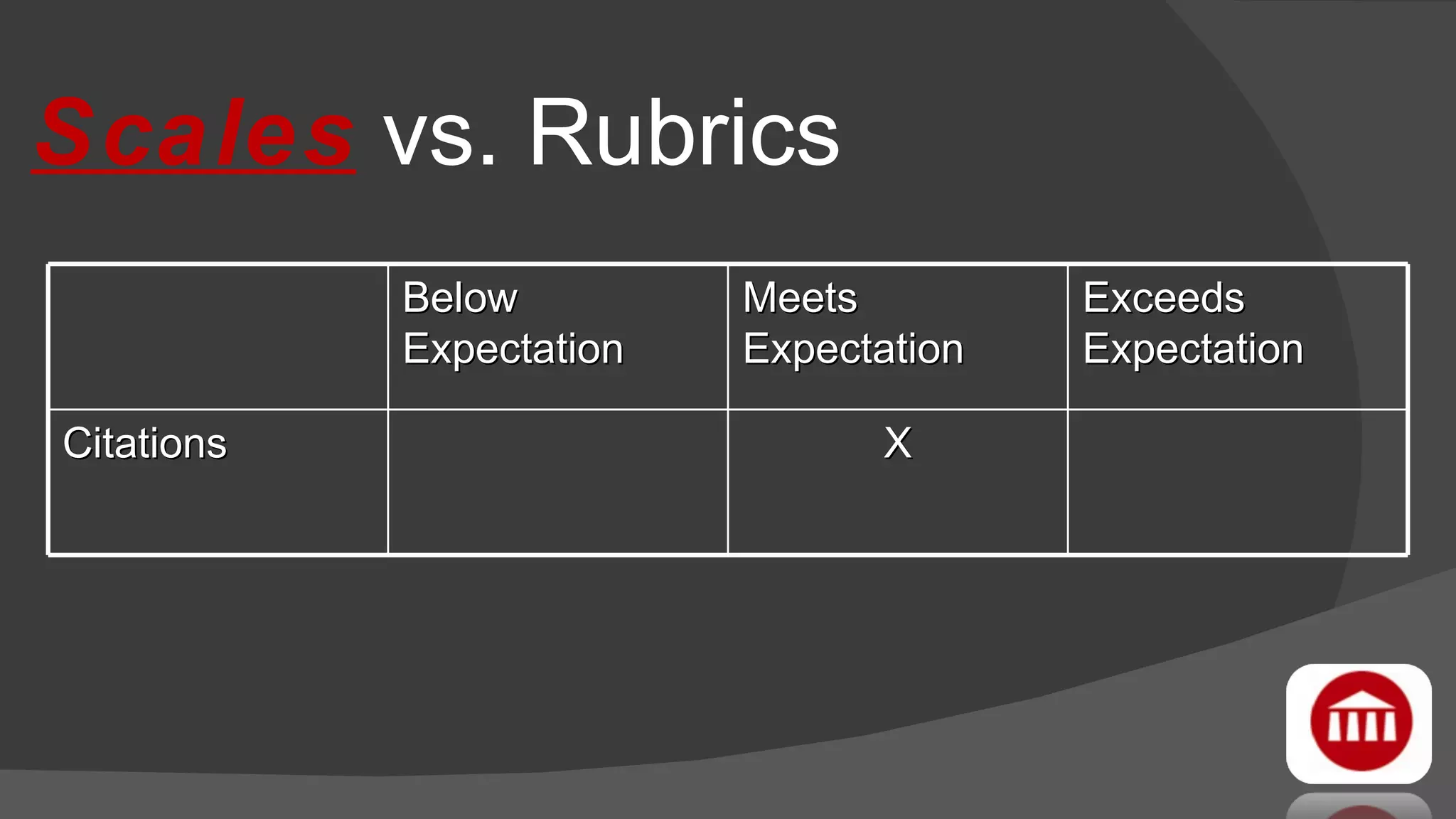
Scales  vs. Rubrics Below Expectation Meets Expectation Exceeds Expectation Citations X
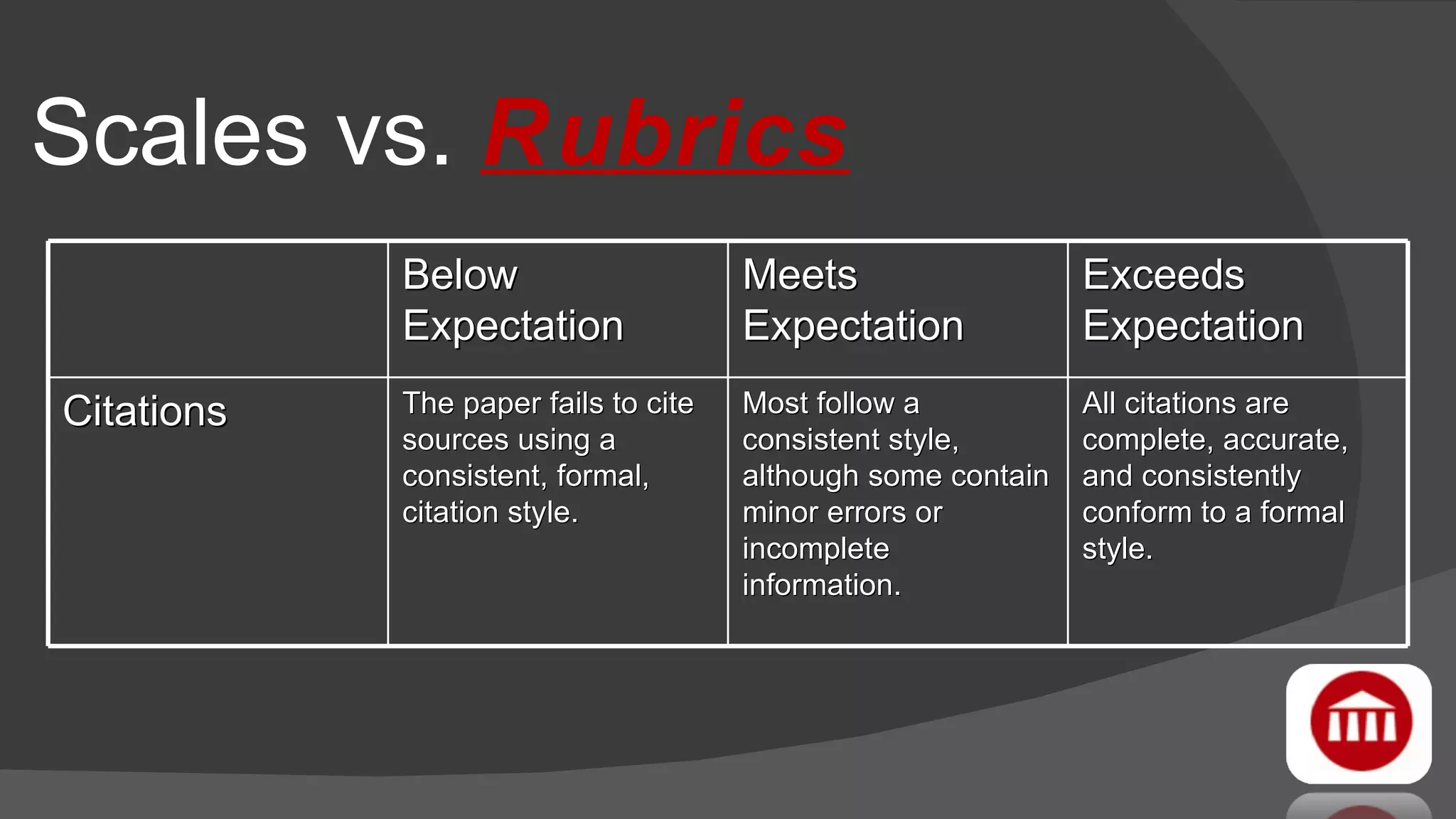
Scales vs.  Rubrics Below Expectation Meets Expectation Exceeds Expectation Citations The paper fails to cite sources using a consistent, formal, citation style.  Most follow a consistent style, although some contain minor errors or incomplete information. All citations are complete, accurate, and consistently conform to a formal style.
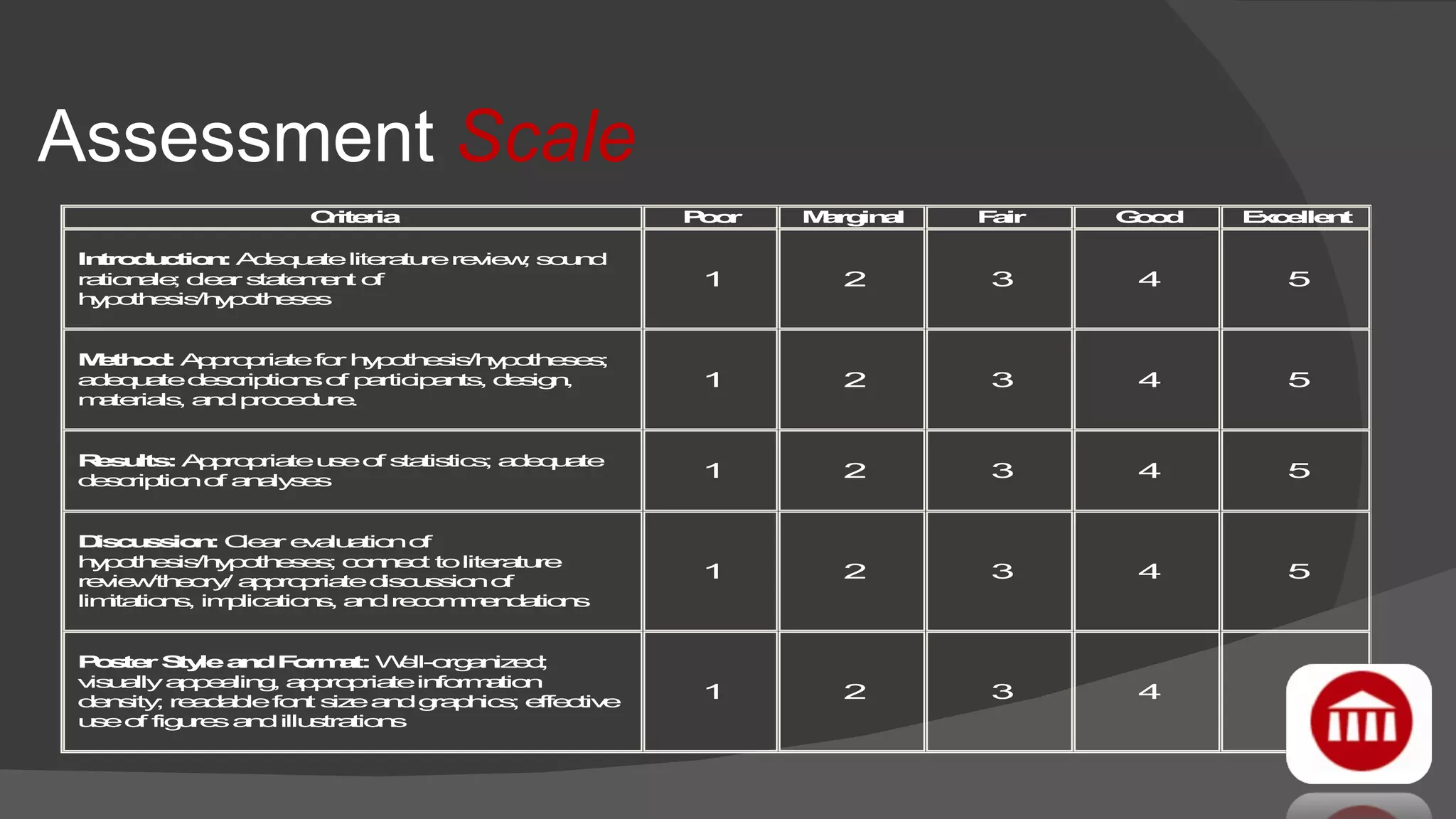
Assessment  Scale
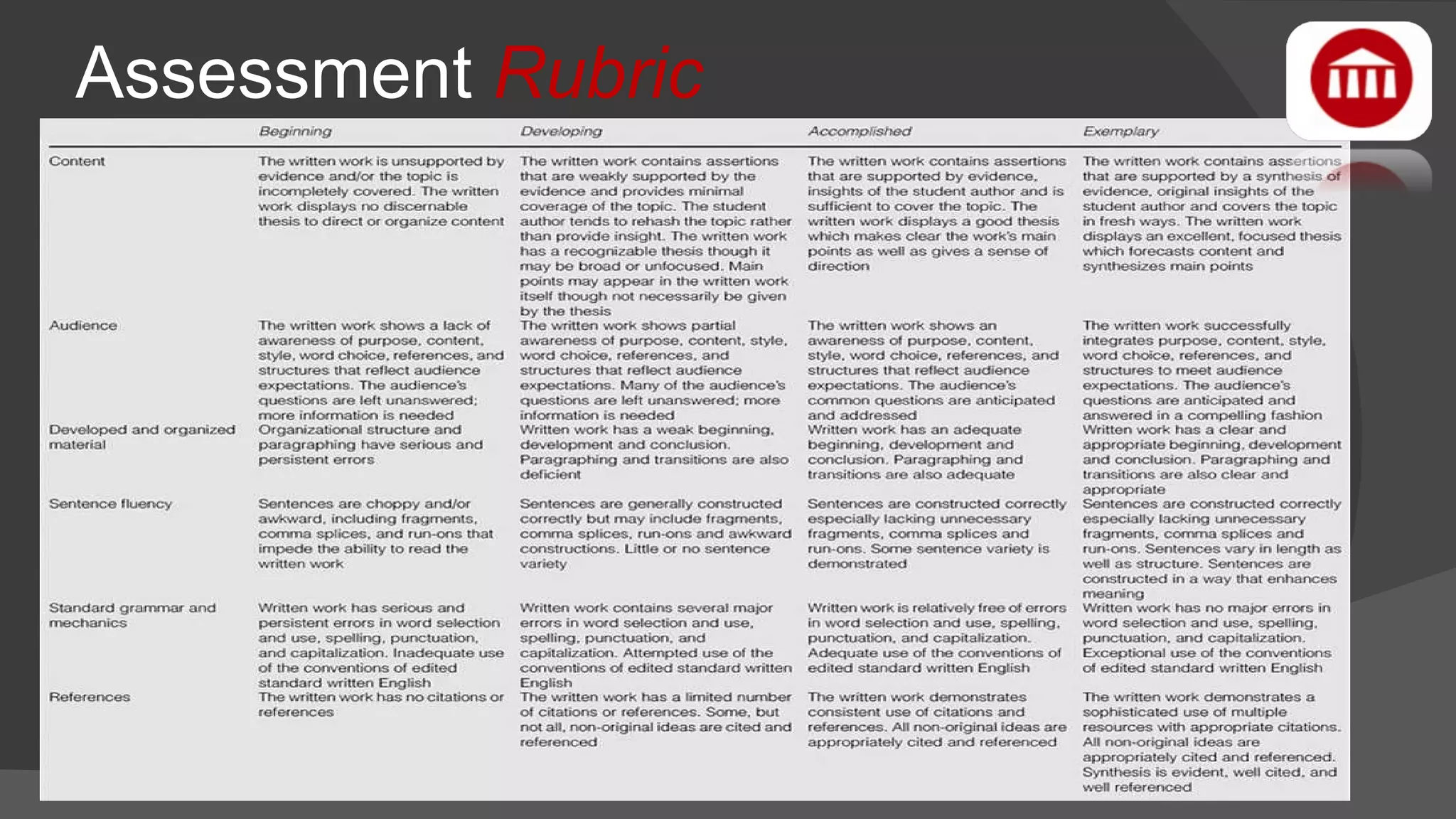
Assessment   Rubric
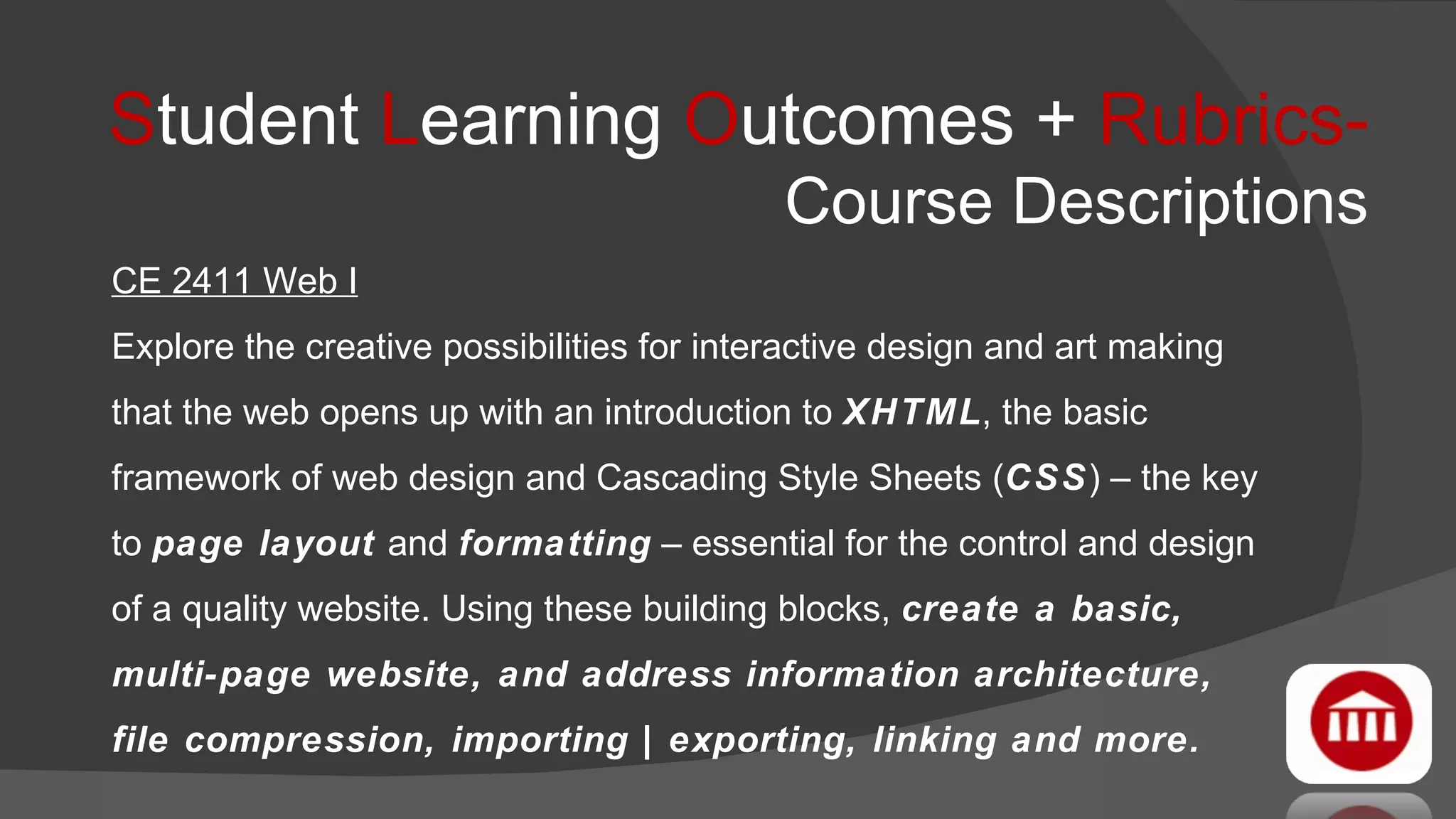
S tudent  L earning  O utcomes +  Rubrics-   Course Descriptions CE 2411 Web I Explore the creative possibilities for interactive design and art making that the web opens up with an introduction to  XHTML , the basic framework of web design and Cascading Style Sheets ( CSS ) – the key to  page layout  and  formatting  – essential for the control and design of a quality website. Using these building blocks,  create a basic, multi-page website, and address information architecture, file compression, importing | exporting, linking and more.
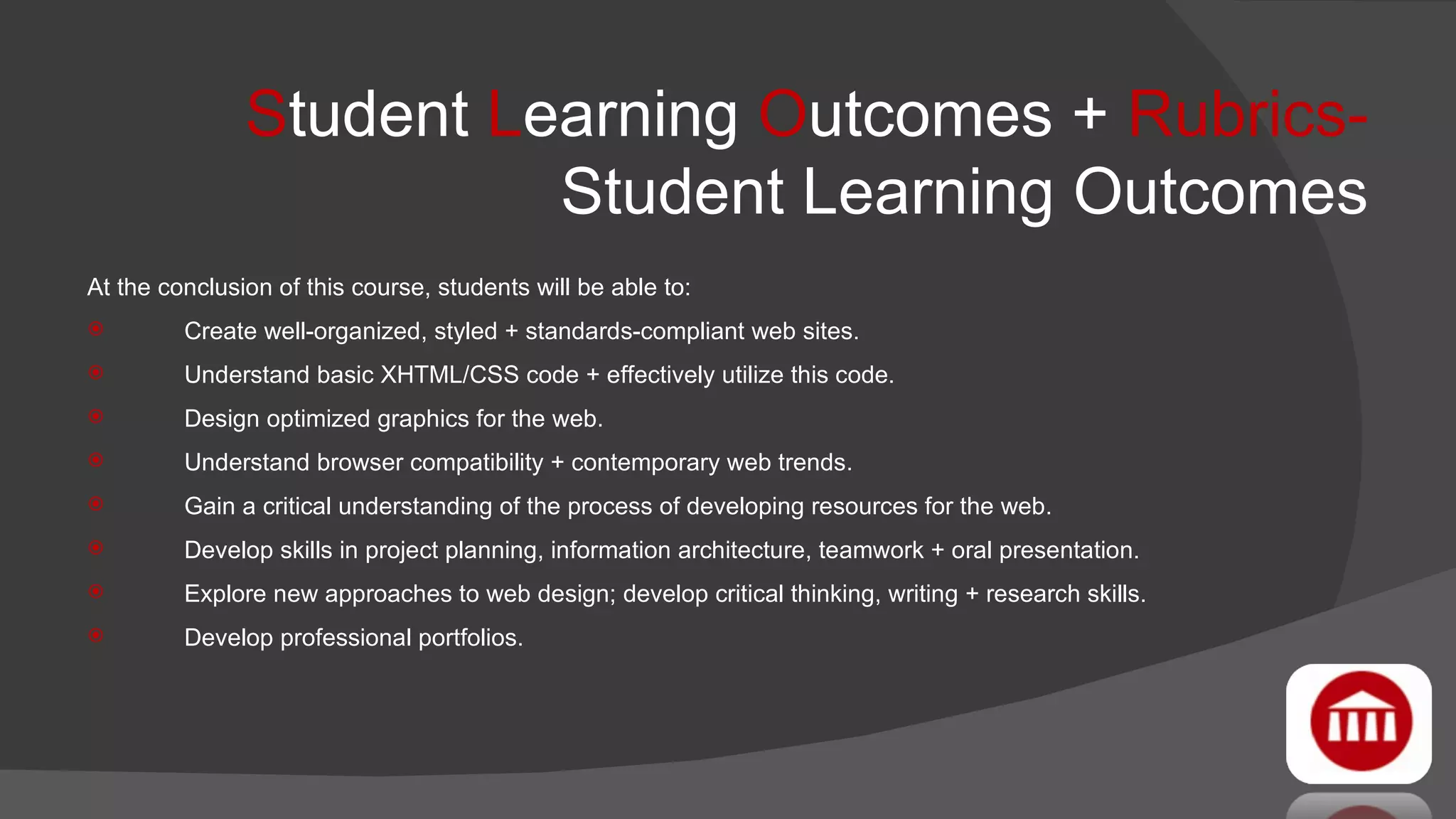
S tudent  L earning  O utcomes +  Rubrics-  Student Learning Outcomes At the conclusion of this course, students will be able to: Create well-organized, styled + standards-compliant web sites. Understand basic XHTML/CSS code + effectively utilize this code. Design optimized graphics for the web. Understand browser compatibility + contemporary web trends. Gain a critical understanding of the process of developing resources for the web. Develop skills in project planning, information architecture, teamwork + oral presentation. Explore new approaches to web design; develop critical thinking, writing + research skills. Develop professional portfolios.
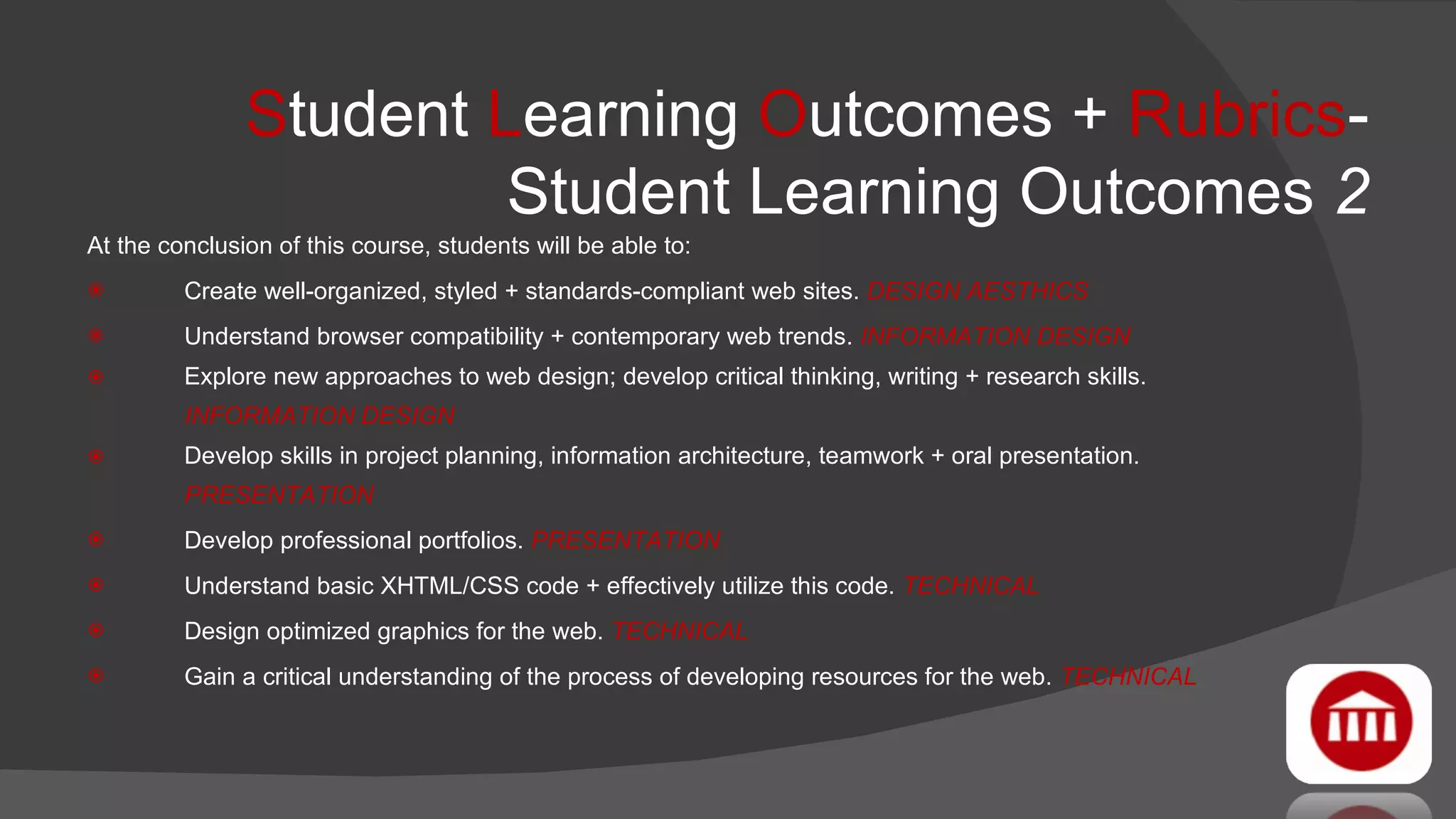
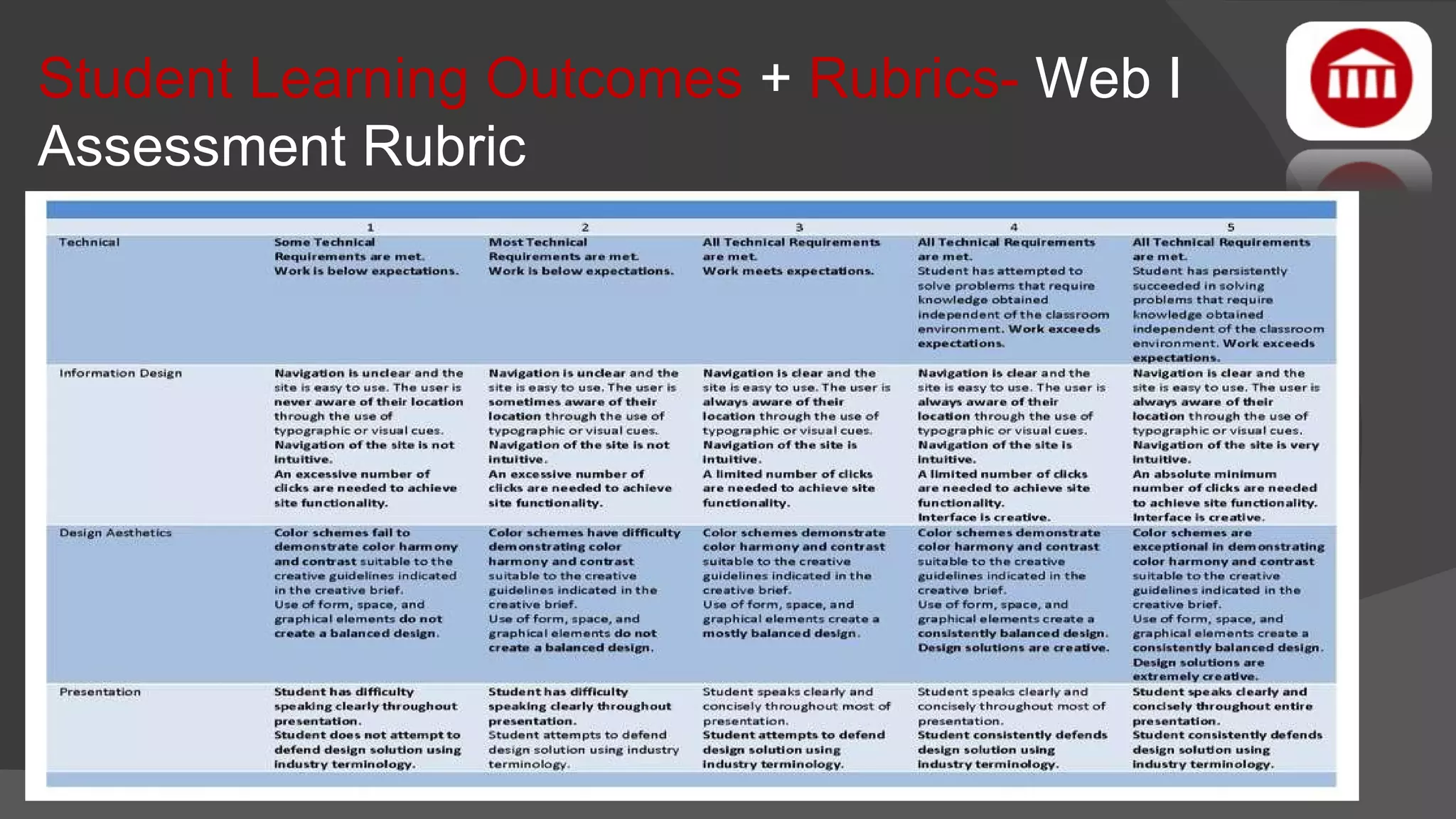
S tudent  L earning  O utcomes +  Rubrics - Student Learning Outcomes  2 At the conclusion of this course, students will be able to: Create well-organized, styled + standards-compliant web sites.  DESIGN AESTHICS  Understand browser compatibility + contemporary web trends.  INFORMATION DESIGN   Explore new approaches to web design; develop critical thinking, writing + research skills.  INFORMATION DESIGN   Develop skills in project planning, information architecture, teamwork + oral presentation.  PRESENTATION   Develop professional portfolios.  PRESENTATION Understand basic XHTML/CSS code + effectively utilize this code.  TECHNICAL   Design optimized graphics for the web.  TECHNICAL   Gain a critical understanding of the process of developing resources for the web.  TECHNICAL
Student Learning Outcomes  +  Rubrics-  Web I Assessment Rubric
Using  Rubrics All  assignments should be scored using the rubric. Discuss  scores with students after initial assignment- demonstrate how rubric was used + the correlation between their final score + the rubric criteria .
Practice ‘ Select’ a rubric that is currently being used: Is it a rubric or a scale? Are there multiple descriptions of the criteria (at least 3)? Are the descriptions clear and easy to use? Would other faculty agree on the descriptors?
Where to start Get ideas by looking at what others have done. Lots of sample rubrics for many disciplines at:  http://www.winona.edu/air/rubrics.htm   Online tool for developing rubric (with more samples):  Rubistar for Teachers:  http://rubistar.4teachers.org/index.php Online module for using the Rubistar at:  http://www.vcu.edu/cte/resources/videos/Rubistar_tutorial/index.html

Effective Implementation of Rubrics in CE classes

  • 1.
    Developing a Rubric for Assessment
  • 2.
    What is arubric? A scoring tool that lays out specific expectations for an assignment. Divides assignments into component parts . Provides a detailed description of what constitutes acceptable levels of performance for each part. Can be used for grading variety of assignments. Used to get consistent scores across all students. Allows students to be more aware of the expectations for performance and consequently improve their performance.
  • 3.
    Do you needa rubric? YES - a rubric is a flexible tool that can be used to measure student learning related specifically to course objectives. YES - rubrics provide descriptions of each score level, it is easier to use a rubric to grade consistently across students . YES - students are aware of expectations before they start an assignment. YES - eliminates the need to occupy an entire class session with a discussion of assignment requirements.
  • 4.
    What are theParts of a Good Rubric? Good rubrics tend to have four basic parts: The assignment or task description A scale or levels of achievement and/or points The dimensions of the assignment- skills involved Descriptions of what constitutes each level of performance
  • 5.
    Step 1: Clearly define the assignment Consider the topic , the process that the students will work through + the product they are expected to produce.
  • 6.
    Step 2: Consider what learning outcomes (criteria) will be assessed Often with a project, students are expected to demonstrate several course outcomes. For example, outcomes related to writing + critical thinking may be assessed, as well as more discipline-specific outcomes.
  • 7.
    Step 3: Establish clear + detailed descriptions for each performance level for each criteria Determine what the different levels of performance look like within each criteria Give examples of high, mid and low performers Begin by describing the highest level of performance Use specific language for performance level descriptors
  • 8.
    Step 4: Test drive your new rubric Sample a few examples of student work from previous semesters to see if the rubric yields a consistent score.
  • 9.
    How do rubrics enhance student learning? When students are made aware of the rubrics prior to instruction + assessment, they know the level of performance expected and they are more motivated to reach those standards .
  • 10.
    Using rubrics forassessment Share your rubric with students before they complete an assignment. This will help them understand the performance standards. Rubrics provide both a grade (summative) + detailed feedback to improve future performance (formative). Rubrics promote student self-assessment- making them more responsible for their learning + performance.
  • 11.
    Scales vs.Rubrics Below Expectation Meets Expectation Exceeds Expectation Citations X
  • 12.
    Scales vs. Rubrics Below Expectation Meets Expectation Exceeds Expectation Citations The paper fails to cite sources using a consistent, formal, citation style. Most follow a consistent style, although some contain minor errors or incomplete information. All citations are complete, accurate, and consistently conform to a formal style.
  • 13.
  • 14.
  • 15.
    S tudent L earning O utcomes + Rubrics- Course Descriptions CE 2411 Web I Explore the creative possibilities for interactive design and art making that the web opens up with an introduction to XHTML , the basic framework of web design and Cascading Style Sheets ( CSS ) – the key to page layout and formatting – essential for the control and design of a quality website. Using these building blocks, create a basic, multi-page website, and address information architecture, file compression, importing | exporting, linking and more.
  • 16.
    S tudent L earning O utcomes + Rubrics- Student Learning Outcomes At the conclusion of this course, students will be able to: Create well-organized, styled + standards-compliant web sites. Understand basic XHTML/CSS code + effectively utilize this code. Design optimized graphics for the web. Understand browser compatibility + contemporary web trends. Gain a critical understanding of the process of developing resources for the web. Develop skills in project planning, information architecture, teamwork + oral presentation. Explore new approaches to web design; develop critical thinking, writing + research skills. Develop professional portfolios.
  • 17.
    S tudent L earning O utcomes + Rubrics - Student Learning Outcomes 2 At the conclusion of this course, students will be able to: Create well-organized, styled + standards-compliant web sites. DESIGN AESTHICS Understand browser compatibility + contemporary web trends. INFORMATION DESIGN Explore new approaches to web design; develop critical thinking, writing + research skills. INFORMATION DESIGN Develop skills in project planning, information architecture, teamwork + oral presentation. PRESENTATION Develop professional portfolios. PRESENTATION Understand basic XHTML/CSS code + effectively utilize this code. TECHNICAL Design optimized graphics for the web. TECHNICAL Gain a critical understanding of the process of developing resources for the web. TECHNICAL
  • 18.
    Student Learning Outcomes + Rubrics- Web I Assessment Rubric
  • 19.
    Using RubricsAll assignments should be scored using the rubric. Discuss scores with students after initial assignment- demonstrate how rubric was used + the correlation between their final score + the rubric criteria .
  • 20.
    Practice ‘ Select’a rubric that is currently being used: Is it a rubric or a scale? Are there multiple descriptions of the criteria (at least 3)? Are the descriptions clear and easy to use? Would other faculty agree on the descriptors?
  • 21.
    Where to startGet ideas by looking at what others have done. Lots of sample rubrics for many disciplines at: http://www.winona.edu/air/rubrics.htm Online tool for developing rubric (with more samples): Rubistar for Teachers: http://rubistar.4teachers.org/index.php Online module for using the Rubistar at: http://www.vcu.edu/cte/resources/videos/Rubistar_tutorial/index.html