Zion	
  Gezaw	
  	
  
Unit	
  Title:	
  Analyzing	
  Historical	
  Artifacts	
  	
  
Standards:	
  
CCSS.ELA-LITERACY.W.9-10.4
Produce clear and coherent writing in which the
development, organization, and style are appropriate
to task, purpose, and audience. (Grade-specific
expectations for writing types are defined in standards
1-3 above.)
CCSS.ELA-LITERACY.W.9-10.5
Develop and strengthen writing as needed by
planning, revising, editing, rewriting, or trying a new
approach, focusing on addressing what is most
significant for a specific purpose and audience.
(Editing for conventions should demonstrate
command of Language standards 1-3 up to and
including grades 9-10 here.)
CCSS.ELA-LITERACY.W.9-10.9
Draw evidence from literary or informational texts to
support analysis, reflection, and research.


Essential	
  Questions:	
  
Overarching:
1.)  How do historical artifacts help us relate to our own
current events today?
2.)  How has our society’s view of equity changed over
time?
Topical:
1.)  How do MLK’s speeches relate to your everyday
life?
How is MLK using his writing (speeches, letters, etc.) to
influence his audience?	


Big	
  Understandings:	
  
•   SWBAT identify how history is illustrated
differently depending on the perspectives and
multiple identities of people at the time of the
civil rights movement.
•   SWBAT understand that historical events are
viewed, analyzed and evaluated differently by
various types of people.


Knowledge	
  and	
  Skills:	
  
Knowledge	
  and	
  Skills	
  
Students will know…
•   Interpreting evidence from text to support their ideas
and analysis.
•   Understand how to revise their essays within each step
of the writing process.
 
Key Terms/Events:
•   Civil Rights Movement
•   Historical Document
•   Dr. Martin Luther King Jr.
•   Racism
•   Equity
•   Empathy
•   Microaggressions
	
  
Key Skills
Students will be able to…
•   Connect their conclusion paragraph to their
introductory/assertion paragraph.
•   Applying evidence from the historical texts to support
their ideas about how the letters connect to their
everyday life.
•   Formulating arguments from historical texts in valid,
clear and concise sentences.
•   Annotating different historical texts to their own
understanding and developing arguments based on how
they connect to the text itself.	
  
Performance	
  Task:	
  
Description	
  of	
  performance	
  task	
  (2-­‐3	
  paragraphs)	


  A	
   10th
	
   honors	
   English	
   Literature	
   class	
   will	
   be	
   interpreting	
   and	
   analyzing	
   different	
   Dr.	
   Martin	
   Luther	
   King	
   Jr.’s	
   speeches	
   and	
  
letters.	
  While	
  dissecting	
  these	
  works,	
  students	
  should	
  be	
  annotating	
  and	
  making	
  connections	
  to	
  the	
  outside	
  world	
  in	
  order	
  to	
  gain	
  
perspective	
  of	
  the	
  world	
  back	
  then	
  and	
  the	
  world	
  now.	
  	
  They	
  are	
  building	
  an	
  understanding	
  of	
  awareness	
  of	
  what	
  is	
  happening	
  to	
  
people	
  in	
  the	
  outside	
  world	
  and	
  show	
  empathy	
  for	
  other	
  people	
  around	
  them,	
  while	
  being	
  mindful	
  of	
  their	
  feelings	
  and	
  other	
  
viewpoints.	
   Students	
   will	
   be	
   examining	
   these	
   works	
   and	
   understanding	
   how	
   these	
   historical	
   events	
   are	
   viewed,	
   analyzed	
   and	
  
evaluated	
  differently	
  by	
  various	
  types	
  of	
  people.	
  	
  
Performance	
  Task:	
  Letter	
  to	
  the	
  President	
  of	
  the	
  United	
  States	


  Imagine	
  you	
  are	
  writing	
  a	
  letter	
  to	
  the	
  President	
  of	
  the	
  United	
  States.	
  In	
  this	
  letter,	
  you	
  will	
  be	
  discussing	
  a	
  problem	
  in	
  today’s	
  
society	
  that	
  you	
  want	
  to	
  change,	
  whether	
  that	
  be	
  social	
  justice	
  issues,	
  socioeconomic	
  issues,	
  etc.	
  You	
  will	
  formulate	
  an	
  argument	
  
about	
  why	
  this	
  issue	
  should	
  be	
  changed,	
  how	
  it	
  is	
  negatively	
  affecting	
  our	
  society	
  and	
  how	
  you	
  plan	
  to	
  change	
  this	
  specific	
  issue.	
  
You	
  are	
  expected	
  to	
  utilize	
  evidence	
  from	
  the	
  various	
  historical	
  texts	
  that	
  we	
  have	
  been	
  analyzing,	
  all	
  while	
  following	
  the	
  ACEIT-­‐
CIET	
  model	
  for	
  this	
  letter.	
  Historical	
  evidence	
  will	
  be	
  used	
  to	
  provide	
  context	
  for	
  the	
  issues	
  students	
  will	
  be	
  discussing	
  and	
  to	
  
compare	
  and	
  contrast	
  the	
  issues	
  that	
  are	
  happening	
  today	
  and	
  those	
  of	
  the	
  past.	
  All	
  letters	
  will	
  be	
  shared	
  out	
  to	
  peers	
  in	
  small	
  
groups	
  once	
  letters	
  are	
  complete.	


First,	
  students	
  will	
  be	
  looking	
  at	
  real	
  historical	
  artifacts	
  from	
  the	
  Civil	
  Rights	
  movement.	
  Then,	
  they	
  will	
  examine	
  and	
  annotate	
  
different	
  news	
  articles	
  that	
  resemble	
  the	
  problems	
  that	
  happened	
  during	
  the	
  civil	
  rights	
  movement.	
  To	
  prepare	
  for	
  the	
  letter	
  to	
  the	
  
president,	
  students	
  will	
  plan	
  out	
  a	
  rough	
  draft	
  two	
  days	
  prior	
  to	
  the	
  day	
  it	
  is	
  due	
  and	
  write	
  out	
  thoughts	
  they	
  have	
  on	
  what	
  issue	
  
they	
  want	
  to	
  change,	
  why	
  they	
  want	
  to	
  change	
  it	
  and	
  how	
  they	
  are	
  prepared	
  to	
  solve	
  the	
  issue.	
  Each	
  student	
  should	
  have	
  at	
  least	
  4	
  
pieces	
  of	
  evidence	
  from	
  the	
  MLK	
  works	
  we	
  have	
  dissected	
  and	
  at	
  least	
  2	
  pieces	
  of	
  evidence	
  from	
  the	
  recent	
  news	
  articles	
  we	
  have	
  
been	
  annotating.	
  For	
  the	
  plan,	
  the	
  students	
  should	
  have	
  the	
  ACEIT-­‐CIET	
  model	
  completed	
  in	
  their	
  outline.	


Letter	
  to	
  the	
  President	
  Day:	
  Students	
  should	
  each	
  have	
  their	
  outline	
  ready	
  with	
  their	
  evidence	
  prepared	
  as	
  well.	
  Using	
  the	
  ACEIT-­‐
CIET	
  model,	
  students	
  will	
  have	
  approximately	
  45	
  minutes	
  to	
  write	
  their	
  letter	
  using	
  all	
  of	
  the	
  evidence	
  and	
  construct	
  a	
  detailed	
  
letter	
  to	
  the	
  President	
  explaining	
  their	
  issue	
  and	
  how	
  they	
  want	
  it	
  resolved.	
  	
  
Once	
  students	
  are	
  done	
  writing	
  their	
  essays,	
  they	
  will	
  get	
  into	
  small	
  groups	
  and	
  present	
  their	
  ideas	
  to	
  their	
  peers,	
  while	
  pretending	
  
that	
  their	
  peers	
  are	
  the	
  President(s)	
  of	
  the	
  United	
  States.	
  Students	
  will	
  have	
  ‘grading’	
  sheets	
  where	
  they	
  will	
  be	
  able	
  to	
  use	
  the	
  
rubric	
   to	
   grade	
   their	
   peers	
   and	
   make	
   sure	
   that	
   they	
   delivered	
   their	
   letter	
   loud	
   and	
   proud	
   and	
   completed/included	
   all	
   of	
   the	
  
necessary	
  components	
  of	
  the	
  rubric.	
  
 
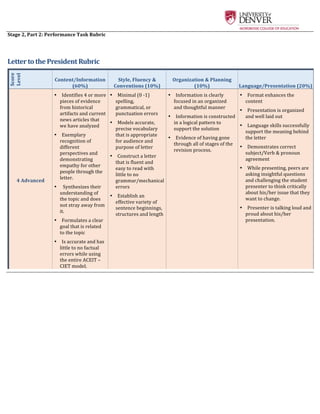
Stage	
  2,	
  Part	
  2:	
  Performance	
  Task	
  Rubric	


Letter	
  to	
  the	
  President	
  Rubric	
  
Score	
  
Level	
  
Content/Information	
  
(60%)	
  	
  
Style,	
  Fluency	
  &	
  
Conventions	
  (10%)	
  
Organization	
  &	
  Planning	
  
(10%)	
  	
   Language/Presentation	
  (20%)	


4	
  Advanced	
  	
  
•   Identifies	
  4	
  or	
  more	
  
pieces	
  of	
  evidence	
  
from	
  historical	
  
artifacts	
  and	
  current	
  
news	
  articles	
  that	
  
we	
  have	
  analyzed	
  
•   Exemplary	
  
recognition	
  of	
  
different	
  
perspectives	
  and	
  
demonstrating	
  
empathy	
  for	
  other	
  
people	
  through	
  the	
  
letter.	
  
•   	
  Synthesizes	
  their	
  
understanding	
  of	
  
the	
  topic	
  and	
  does	
  
not	
  stray	
  away	
  from	
  
it.	
  
•   Formulates	
  a	
  clear	
  
goal	
  that	
  is	
  related	
  
to	
  the	
  topic	
  
•   Is	
  accurate	
  and	
  has	
  
little	
  to	
  no	
  factual	
  
errors	
  while	
  using	
  
the	
  entire	
  ACEIT	
  –	
  
CIET	
  model.	


•   Minimal	
  (0	
  -­‐‑1)	
  
spelling,	
  
grammatical,	
  or	
  
punctuation	
  errors	
  
•   Models	
  accurate,	
  
precise	
  vocabulary	
  
that	
  is	
  appropriate	
  
for	
  audience	
  and	
  
purpose	
  of	
  letter	
  
•   Construct	
  a	
  letter	
  
that	
  is	
  fluent	
  and	
  
easy	
  to	
  read	
  with	
  
little	
  to	
  no	
  
grammar/mechanical	
  
errors	
  
•   Establish	
  an	
  
effective	
  variety	
  of	
  
sentence	
  beginnings,	
  
structures	
  and	
  length	
  	
  
•   Information	
  is	
  clearly	
  
focused	
  in	
  an	
  organized	
  
and	
  thoughtful	
  manner	
  
•   Information	
  is	
  constructed	
  
in	
  a	
  logical	
  pattern	
  to	
  
support	
  the	
  solution	
  
•   Evidence	
  of	
  having	
  gone	
  
through	
  all	
  of	
  stages	
  of	
  the	
  
revision	
  process.	
  	
  
•   Format	
  enhances	
  the	
  
content	
  
•   Presentation	
  is	
  organized	
  
and	
  well	
  laid	
  out	
  
•   Language	
  skills	
  successfully	
  
support	
  the	
  meaning	
  behind	
  
the	
  letter	
  	
  
•   Demonstrates	
  correct	
  
subject/Verb	
  &	
  pronoun	
  
agreement	
  	
  
•   While	
  presenting,	
  peers	
  are	
  
asking	
  insightful	
  questions	
  
and	
  challenging	
  the	
  student	
  
presenter	
  to	
  think	
  critically	
  
about	
  his/her	
  issue	
  that	
  they	
  
want	
  to	
  change.	
  
•   Presenter	
  is	
  talking	
  loud	
  and	
  
proud	
  about	
  his/her	
  
presentation.	


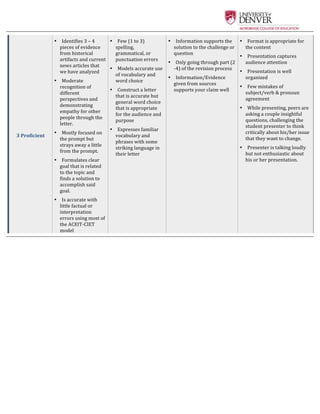
3	
  Proficient	
  	
  
•   Identifies	
  3	
  –	
  4	
  
pieces	
  of	
  evidence	
  
from	
  historical	
  
artifacts	
  and	
  current	
  
news	
  articles	
  that	
  
we	
  have	
  analyzed	


•   Moderate	
  
recognition	
  of	
  
different	
  
perspectives	
  and	
  
demonstrating	
  
empathy	
  for	
  other	
  
people	
  through	
  the	
  
letter.	
  
•   Mostly	
  focused	
  on	
  
the	
  prompt	
  but	
  
strays	
  away	
  a	
  little	
  
from	
  the	
  prompt.	
  
•   Formulates	
  clear	
  
goal	
  that	
  is	
  related	
  
to	
  the	
  topic	
  and	
  
finds	
  a	
  solution	
  to	
  
accomplish	
  said	
  
goal.	
  
•   Is	
  accurate	
  with	
  
little	
  factual	
  or	
  
interpretation	
  
errors	
  using	
  most	
  of	
  
the	
  ACEIT-­‐‑CIET	
  
model	
  
•   Few	
  (1	
  to	
  3)	
  
spelling,	
  
grammatical,	
  or	
  
punctuation	
  errors	
  
•   Models	
  accurate	
  use	
  
of	
  vocabulary	
  and	
  
word	
  choice	
  
•   Construct	
  a	
  letter	
  
that	
  is	
  accurate	
  but	
  
general	
  word	
  choice	
  
that	
  is	
  appropriate	
  
for	
  the	
  audience	
  and	
  
purpose	
  	
  
•   Expresses	
  familiar	
  
vocabulary	
  and	
  
phrases	
  with	
  some	
  
striking	
  language	
  in	
  
their	
  letter	
  	
  
•   Information	
  supports	
  the	
  
solution	
  to	
  the	
  challenge	
  or	
  
question	
  
•   Only	
  going	
  through	
  part	
  (2	
  
-­‐‑4)	
  of	
  the	
  revision	
  process	
  	
  
•   Information/Evidence	
  
given	
  from	
  sources	
  
supports	
  your	
  claim	
  well	
  	
  
•   Format	
  is	
  appropriate	
  for	
  
the	
  content	
  
•   Presentation	
  captures	
  
audience	
  attention	
  
•   Presentation	
  is	
  well	
  
organized	
  
•   Few	
  mistakes	
  of	
  
subject/verb	
  &	
  pronoun	
  
agreement	
  	
  
•   While	
  presenting,	
  peers	
  are	
  
asking	
  a	
  couple	
  insightful	
  
questions,	
  challenging	
  the	
  
student	
  presenter	
  to	
  think	
  
critically	
  about	
  his/her	
  issue	
  
that	
  they	
  want	
  to	
  change.	
  
•   Presenter	
  is	
  talking	
  loudly	
  
but	
  not	
  enthusiastic	
  about	
  
his	
  or	
  her	
  presentation.	


2	
  Developing	
  	
  
•   Identifies	
  2-­‐‑3	
  
pieces	
  of	
  evidence	
  
from	
  historical	
  
artifacts	
  and	
  current	
  
news	
  articles	
  that	
  
we	
  have	
  analyzed	
  	
  
•   Some	
  recognition	
  
of	
  different	
  
perspectives	
  and	
  
demonstrating	
  
empathy	
  for	
  other	
  
people	
  through	
  the	
  
letter.	
  	
  
•   Not	
  fully	
  invested	
  
with	
  the	
  prompt	
  
•   Does	
  not	
  formulate	
  
the	
  end	
  goal	
  in	
  their	
  
essay	
  	
  
•   Has	
  some	
  factual	
  
errors	
  or	
  
inconsistencies	
  &	
  
only	
  uses	
  the	
  ACEIT	
  
or	
  CIET	
  part	
  of	
  the	
  
model.	
  	
  
•   Minimal	
  (3	
  to	
  5)	
  
spelling,	
  
grammatical,	
  or	
  
punctuation	
  errors	
  
•   Models	
  low-­‐‑level	
  use	
  
of	
  vocabulary	
  and	
  
word	
  choice	
  
•   Utilizes	
  general	
  
word	
  choice	
  that	
  may	
  
include	
  occasional	
  
errors	
  in	
  word	
  usage	
  	
  
•   Uses	
  a	
  few	
  active	
  
verbs	
  but	
  most	
  are	
  
imprecise	
  or	
  
colorless	
  	
  
•   Demonstrates	
  a	
  
variety	
  of	
  sentence	
  
beginnings,	
  structure	
  
or	
  length	
  but	
  has	
  
many	
  rambling	
  or	
  
choppy	
  sentences.	
  
•   Information	
  appears	
  to	
  
have	
  a	
  pattern,	
  but	
  the	
  
pattern	
  is	
  not	
  consistently	
  
carried	
  out	
  in	
  the	
  project	
  
•   Information	
  loosely	
  
supports	
  the	
  solution	
  
•   Having	
  gone	
  through	
  only	
  
2	
  of	
  the	
  revision	
  steps	
  	
  
•   Format	
  does	
  not	
  suit	
  the	
  
content	
  
•   Presentation	
  does	
  not	
  
capture	
  audience	
  attention	
  
•   Presentation	
  is	
  loosely	
  
organized	
  
•   Many	
  subject/verb	
  &	
  
pronoun	
  agreement	
  mistakes	
  
•   While	
  presenting,	
  peers	
  are	
  
not	
  asking	
  insightful	
  
questions	
  or	
  challenging	
  the	
  
student	
  presenter	
  to	
  think	
  
critically	
  about	
  his/her	
  issue	
  
that	
  they	
  want	
  to	
  change.	


•   Presenter	
  is	
  not	
  speaking	
  
loudly	
  or	
  interested	
  in	
  his	
  
presentation.	


1	
  Unsatisfactory	
  	
  
•   Identifies	
  0-­‐‑1	
  
pieces	
  of	
  evidence	
  
from	
  historical	
  
artifacts	
  and	
  current	
  
news	
  articles	
  that	
  
we	
  have	
  analyzed	
  	
  
•   No	
  recognition	
  of	
  
different	
  
perspectives	
  and	
  
demonstrating	
  
empathy	
  for	
  other	
  
people	
  through	
  the	
  
letter.	
  
•   Provides	
  
inconsistent	
  
information	
  
supporting	
  the	
  
student’s	
  argument	
  	
  
•   Has	
  no	
  application	
  
of	
  critical	
  thinking	
  
throughout	
  the	
  
paper.	


•   Has	
  significant	
  
factual	
  errors,	
  
misconceptions	
  or	
  
misinterpretations	
  
of	
  the	
  texts	
  analyzed	
  
in	
  class.	
  Does	
  not	
  
use	
  the	
  ACEIT	
  –	
  
CIET	
  model	
  at	
  all.	


•   More	
  than	
  5	
  spelling,	
  
grammatical,	
  or	
  
punctuation	
  errors	
  
•   Poor	
  use	
  of	
  
vocabulary	
  and	
  word	
  
choice	
  
•   Utilizes	
  inaccurate	
  
or	
  repetitive	
  word	
  
choice	
  that	
  is	
  
occasionally	
  
inappropriate	
  for	
  
audience	
  and	
  
purpose	
  	
  
•   Practices	
  passive,	
  
colorless	
  or	
  
imprecise	
  verbs	
  	
  
•   Demonstrates	
  vague	
  
language	
  or	
  frequent	
  
clichés.	
  	
  
•   Uses	
  simple,	
  
repetitive	
  sentence	
  
beginnings,	
  
structures	
  and	
  
lengths.	
  	
  
•   Delivery	
  of	
  the	
  content	
  is	
  
unfocused	
  and	
  unclear	
  	
  
•   Information	
  does	
  not	
  
support	
  the	
  solution	
  to	
  the	
  
challenge	
  or	
  question	
  
•   Information	
  has	
  no	
  
apparent	
  pattern	
  
•   Did	
  not	
  go	
  through	
  any	
  
revision	
  steps	
  (no	
  evidence	
  
of	
  planning).	
  	
  
•   Presentation	
  appears	
  sloppy	
  
and/or	
  unfinished	
  
•   Format	
  does	
  not	
  enhance	
  
content	
  
•   Presentation	
  has	
  no	
  clear	
  
organization	
  as	
  writing	
  is	
  not	
  
clear	
  and	
  concise.	
  	
  
•   While	
  presenting,	
  peers	
  are	
  
not	
  paying	
  attention	
  to	
  the	
  
student	
  presenter	
  and	
  are	
  off	
  
task.	
  	
  
•   Presenter	
  is	
  very	
  quiet	
  and	
  
unenthusiastic	
  about	
  his/her	
  
presentation.	


Lesson	
   Objective,	
  Rationale,	
  and	
  Active	
  Engagement	
  Strategy	
   Assessment	
  
1	
   Objective:	
  SWBAT	
  identify,	
  in	
  writing,	
  how	
  the	
  issues	
  in	
  historical	
  artifacts	
  
compare	
  and	
  contrast	
  to	
  today’s	
  current	
  society,	
  while	
  using	
  comparative	
  
adjectives.	
  	
  
Rationale:	
  It	
  is	
  important	
  for	
  students	
  to	
  be	
  able	
  to	
  analyze	
  how	
  different	
  
issues,	
  between	
  the	
  past	
  and	
  present,	
  compare	
  to	
  one	
  another	
  and	
  understand	
  
that	
  not	
  much	
  has	
  changed	
  over	
  the	
  years.	
  Students	
  will	
  be	
  able	
  to	
  address	
  
issues	
  of	
  social	
  justice	
  through	
  the	
  different	
  texts	
  we	
  will	
  be	
  reading.	
  	
  
Active	
  Engagement	
  Strategy:	
  Venn	
  Diagram	


Students	
  will	
  read	
  different	
  letters	
  and	
  speeches	
  during	
  the	
  Civil	
  Rights	
  
Movement	
  and	
  identify	
  the	
  different	
  issues	
  that	
  happened	
  during	
  that	
  time	
  
and	
  compare	
  them	
  to	
  the	
  issues	
  that	
  are	
  happening	
  currently.	
  (Small	
  Group	
  
Activity)	
  	
  
Venn	
  Diagram	
  	
  
In	
  groups,	
  students	
  will	
  create	
  a	
  
Venn	
  Diagram	
  to	
  compare	
  and	
  
contrast	
  the	
  article	
  read	
  for	
  the	
  
day.	


2	
   Objective:	
  SWBAT	
  interpret	
  evidence,	
  by	
  reading	
  the	
  historical	
  texts,	
  and	
  
distinguishing	
  the	
  events	
  that	
  have	
  happened	
  throughout	
  the	
  text	
  and	
  
understanding	
  each	
  event’s	
  importance,	
  while	
  using	
  key	
  vocabulary	
  and	
  nouns.	
  	
  
Rationale:	
  In	
  order	
  to	
  understand	
  the	
  narrative	
  of	
  each	
  text,	
  students	
  need	
  to	
  
interpret	
  the	
  importance	
  of	
  each	
  event	
  that	
  has	
  happened	
  in	
  the	
  writing.	
  
Students	
  will	
  also	
  understand	
  the	
  events	
  that	
  have	
  happened	
  in	
  history	
  and	
  
compare	
  them	
  to	
  today’s	
  current	
  society.	
  	
  
Active	
  Engagement	
  Strategy:	
  Story	
  Map	
  	
  
Students	
  will	
  reread	
  the	
  text	
  given	
  to	
  them	
  and	
  retell	
  the	
  plot	
  of	
  the	
  text	
  
(beginning,	
  middle	
  and	
  end)	
  in	
  a	
  story	
  map,	
  in	
  order	
  to	
  summarize	
  their	
  
understanding	
  of	
  the	
  text.	
  (Small	
  Group	
  Activity)	
  	
  
Story	
  Map	
  	
  
Students	
  will	
  read	
  the	
  text	
  from	
  
today	
  and	
  fill	
  out	
  the	
  story	
  map	
  
outline	
  in	
  groups.	


3	
   Objective:	
  SWBAT	
  categorize	
  the	
  different	
  events	
  in	
  the	
  historical	
  text,	
  by	
  
illustrating	
  the	
  cause	
  and	
  effects	
  of	
  the	
  plotline	
  in	
  each	
  text	
  we	
  analyze,	
  while	
  
using	
  past	
  tense	
  verbs	
  and	
  perfect	
  aspect	
  (present	
  and	
  past).	
  	
  
Rationale:	
  If	
  students	
  can	
  categorize	
  and	
  recognize	
  the	
  cause	
  and	
  effects	
  in	
  a	
  
text,	
  then	
  they	
  are	
  demonstrating	
  their	
  understanding	
  of	
  that	
  specific	
  text	
  and	
  
can	
  draw	
  conclusions	
  from	
  their	
  cause	
  and	
  effect	
  illustrations;	
  this	
  is	
  also	
  an	
  
example	
  to	
  prepare	
  them	
  for	
  college	
  readiness.	
  	
  
Active	
  Engagement	
  Strategy:	
  Cause	
  and	
  Effect	
  Illustrations	
  	
  
Students	
  will	
  be	
  summarizing	
  the	
  text	
  by	
  using	
  a	
  cause	
  and	
  effect	
  map,	
  where	
  
they	
  will	
  illustrate	
  the	
  events	
  that	
  have	
  happened	
  throughout	
  the	
  text;	
  
students	
  will	
  also	
  use	
  captions	
  in	
  order	
  to	
  explain	
  their	
  thought	
  process	
  under	
  
Cause	
  and	
  Effect	
  Illustration	
  	
  
Students	
  will	
  use	
  the	
  cause	
  and	
  
effect	
  map	
  to	
  illustrate	
  the	
  series	
  
of	
  events	
  that	
  happened	
  in	
  the	
  
article	
  read	
  for	
  the	
  day.	


each	
  figure.	
  (Partner	
  Activity	
  then	
  Jigsaw)	


4	
   Objective:	
  SWBAT	
  explore	
  their	
  identity,	
  in	
  writing,	
  while	
  trying	
  to	
  relate	
  their	
  
personal	
  life	
  stories	
  to	
  the	
  texts	
  we	
  have	
  read	
  and	
  analyzed,	
  by	
  using	
  
indirect/direct	
  object	
  pronouns	
  and	
  correct	
  subject/verb	
  agreement.	
  
Rationale:	
  As	
  students	
  are	
  relating	
  their	
  personal	
  life	
  to	
  the	
  texts	
  we	
  have	
  read,	
  
they	
  are	
  starting	
  to	
  familiarize	
  themselves	
  with	
  perspectives	
  and	
  understanding	
  
another	
  person’s	
  point	
  of	
  view	
  by	
  empathizing	
  with	
  them.	
  This	
  helps	
  students	
  
make	
  connections	
  to	
  their	
  everyday	
  lives	
  and	
  family	
  culture	
  as	
  well.	
  	
  
Active	
  Engagement	
  Strategy:	
  “I”	
  Poem	
  	
  
Students	
  will	
  create	
  an	
  “I”	
  poem;	
  they	
  can	
  choose	
  to	
  use	
  the	
  template	
  provided	
  
or	
  free	
  write	
  a	
  poem	
  about	
  their	
  identity	
  and	
  try	
  to	
  relate	
  their	
  personal	
  life	
  
stories	
  to	
  the	
  texts	
  we	
  have	
  read	
  and	
  analyzed.	
  (Individual	
  Activity	
  and	
  then	
  
share	
  out	
  or	
  do	
  turn	
  and	
  talk)	
  	
  
“I”	
  Poem	
  	
  
Students	
  will	
  create	
  an	
  “I”	
  poem	
  
that	
  discusses	
  who	
  they	
  are	
  as	
  a	
  
person,	
  then	
  do	
  a	
  turn	
  and	
  talk	
  
with	
  a	
  partner.	


5	
   Objective:	
  SWBAT	
  synthesize	
  their	
  thoughts,	
  in	
  writing,	
  by	
  classifying	
  one	
  issue	
  
that	
  they	
  are	
  passionate	
  about	
  changing	
  within	
  their	
  society,	
  all	
  while	
  using	
  
correct	
  sentence	
  structure.	
  	
  
Rationale:	
  If	
  students	
  are	
  able	
  to	
  classify	
  their	
  issue,	
  then	
  they	
  will	
  be	
  able	
  to	
  
critically	
  think	
  about	
  why	
  it	
  is	
  an	
  issue	
  in	
  the	
  first	
  place.	
  This	
  will	
  help	
  with	
  
college	
  readiness	
  and	
  help	
  them	
  get	
  their	
  points	
  across	
  in	
  an	
  organized	
  and	
  
detailed	
  manner.	
  	
  
Active	
  Engagement	
  Strategy:	
  	
  Today’s	
  Tweet:	
  
In	
  140	
  words	
  or	
  less,	
  students	
  will	
  explain	
  one	
  thing	
  in	
  this	
  world	
  that	
  they	
  
want	
  to	
  change.	
  It	
  can	
  be	
  anything	
  in	
  this	
  world	
  but	
  it	
  must	
  be	
  class	
  
appropriate	
  and	
  they	
  need	
  to	
  explain	
  their	
  thinking.	
  (Individual	
  Activity	
  and	
  
whole	
  group	
  share	
  out)	


Exit	
  Ticket:	
  	
  
Write	
  an	
  assertion	
  statement	
  
defending	
  your	
  stance	
  on	
  the	
  
issue	
  you	
  have	
  chosen.	


6	
   Objective:	
  SWBAT	
  theorize	
  and	
  identify	
  patterns,	
  in	
  writing,	
  why	
  different	
  issues	
  
happening	
  in	
  our	
  society	
  are	
  the	
  same	
  issues	
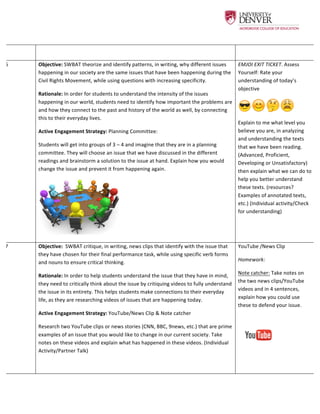
  that	
  have	
  been	
  happening	
  during	
  the	
  
Civil	
  Rights	
  Movement,	
  while	
  using	
  questions	
  with	
  increasing	
  specificity.	


Rationale:	
  In	
  order	
  for	
  students	
  to	
  understand	
  the	
  intensity	
  of	
  the	
  issues	
  
happening	
  in	
  our	
  world,	
  students	
  need	
  to	
  identify	
  how	
  important	
  the	
  problems	
  are	
  
and	
  how	
  they	
  connect	
  to	
  the	
  past	
  and	
  history	
  of	
  the	
  world	
  as	
  well,	
  by	
  connecting	
  
this	
  to	
  their	
  everyday	
  lives.	
  	
  
Active	
  Engagement	
  Strategy:	
  Planning	
  Committee:	
  	
  
Students	
  will	
  get	
  into	
  groups	
  of	
  3	
  –	
  4	
  and	
  imagine	
  that	
  they	
  are	
  in	
  a	
  planning	
  
committee.	
  They	
  will	
  choose	
  an	
  issue	
  that	
  we	
  have	
  discussed	
  in	
  the	
  different	
  
readings	
  and	
  brainstorm	
  a	
  solution	
  to	
  the	
  issue	
  at	
  hand.	
  Explain	
  how	
  you	
  would	
  
change	
  the	
  issue	
  and	
  prevent	
  it	
  from	
  happening	
  again.	


EMJOI	
  EXIT	
  TICKET.	
  Assess	
  
Yourself:	
  Rate	
  your	
  
understanding	
  of	
  today’s	
  
objective	


Explain	
  to	
  me	
  what	
  level	
  you	
  
believe	
  you	
  are,	
  in	
  analyzing	
  
and	
  understanding	
  the	
  texts	
  
that	
  we	
  have	
  been	
  reading.	
  
(Advanced,	
  Proficient,	
  
Developing	
  or	
  Unsatisfactory)	
  
then	
  explain	
  what	
  we	
  can	
  do	
  to	
  
help	
  you	
  better	
  understand	
  
these	
  texts.	
  (resources?	
  
Examples	
  of	
  annotated	
  texts,	
  
etc.)	
  (Individual	
  activity/Check	
  
for	
  understanding)	
  
7	
   Objective:	
  	
  SWBAT	
  critique,	
  in	
  writing,	
  news	
  clips	
  that	
  identify	
  with	
  the	
  issue	
  that	
  
they	
  have	
  chosen	
  for	
  their	
  final	
  performance	
  task,	
  while	
  using	
  specific	
  verb	
  forms	
  
and	
  nouns	
  to	
  ensure	
  critical	
  thinking.	
  	
  
Rationale:	
  In	
  order	
  to	
  help	
  students	
  understand	
  the	
  issue	
  that	
  they	
  have	
  in	
  mind,	
  
they	
  need	
  to	
  critically	
  think	
  about	
  the	
  issue	
  by	
  critiquing	
  videos	
  to	
  fully	
  understand	
  
the	
  issue	
  in	
  its	
  entirety.	
  This	
  helps	
  students	
  make	
  connections	
  to	
  their	
  everyday	
  
life,	
  as	
  they	
  are	
  researching	
  videos	
  of	
  issues	
  that	
  are	
  happening	
  today.	
  	
  
Active	
  Engagement	
  Strategy:	
  YouTube/News	
  Clip	
  &	
  Note	
  catcher	
  	
  
Research	
  two	
  YouTube	
  clips	
  or	
  news	
  stories	
  (CNN,	
  BBC,	
  9news,	
  etc.)	
  that	
  are	
  prime	
  
examples	
  of	
  an	
  issue	
  that	
  you	
  would	
  like	
  to	
  change	
  in	
  our	
  current	
  society.	
  Take	
  
notes	
  on	
  these	
  videos	
  and	
  explain	
  what	
  has	
  happened	
  in	
  these	
  videos.	
  (Individual	
  
Activity/Partner	
  Talk)	


YouTube	
  /News	
  Clip	
  	
  
Homework:	
  	
  
Note	
  catcher:	
  Take	
  notes	
  on	
  
the	
  two	
  news	
  clips/YouTube	
  
videos	
  and	
  in	
  4	
  sentences,	
  
explain	
  how	
  you	
  could	
  use	
  
these	
  to	
  defend	
  your	
  issue.	


8	
   Objective:	
  SWBAT	
  critically	
  analyze	
  data,	
  while	
  reading	
  and	
  writing,	
  in	
  order	
  to	
  
familiarize	
  themselves	
  with	
  a	
  few	
  issues	
  that	
  they	
  would	
  like	
  to	
  change	
  in	
  their	
  
community,	
  while	
  using	
  common	
  and	
  collective	
  nouns	
  and	
  verbs	
  to	
  brainstorm	
  
their	
  various	
  ideas.	
  	
  
Rationale:	
  By	
  having	
  the	
  opportunity	
  to	
  analyze	
  research	
  and	
  data	
  about	
  a	
  few	
  
issues,	
  students	
  will	
  start	
  to	
  comprehend	
  the	
  depth	
  of	
  problems	
  happening	
  in	
  their	
  
community	
  and	
  connect	
  it	
  to	
  their	
  everyday	
  lives.	
  	
  
Active	
  Engagement	
  Strategy:	
  Research	
  Day	
  in	
  the	
  Library	
  	
  
Students	
  will	
  research	
  different	
  news	
  articles	
  using	
  peer	
  reviewed	
  journals	
  online	
  
to	
  investigate	
  different	
  issues	
  happening	
  in	
  our	
  society	
  and	
  use	
  that	
  evidence	
  to	
  
pick	
  what	
  issue	
  is	
  most	
  important	
  to	
  them.	
  They	
  will	
  be	
  taking	
  notes	
  using	
  a	
  note	
  
catcher	
  as	
  well	
  to	
  organize	
  their	
  thoughts.	
  (Individual	
  Activity)	
  	
  
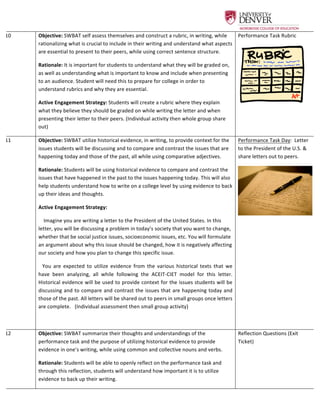
BRAINSTORMING	
  &	
  PICKING	
  
YOUR	
  ISSUE.	
  	
  
Write	
  down	
  3	
  issues	
  that	
  you	
  
want	
  to	
  change	
  in	
  our	
  society	
  
and	
  explain	
  why	
  they	
  are	
  all	
  
important	
  to	
  you.	
  Once	
  you’ve	
  
picked	
  3,	
  narrow	
  it	
  down	
  to	
  the	
  
most	
  important	
  issue	
  and	
  write	
  
an	
  assertion	
  statement	
  as	
  to	
  
why	
  you	
  want	
  this	
  issue	
  fixed	
  
and	
  why	
  it’s	
  important.	


9	
   Objective:	
  SWBAT	
  apply	
  their	
  knowledge	
  of	
  the	
  issue	
  they	
  have	
  chosen,	
  in	
  writing	
  
and	
  illustration,	
  by	
  sketching	
  a	
  billboard	
  with	
  a	
  message	
  about	
  the	
  importance	
  of	
  
said	
  issue,	
  while	
  using	
  common	
  and	
  collective	
  nouns	
  and	
  verbs.	
  	
  
Rationale:	
  Students	
  will	
  be	
  using	
  their	
  knowledge	
  of	
  the	
  issue	
  they	
  have	
  chosen	
  
and	
  thinking	
  on	
  a	
  creative	
  level	
  to	
  try	
  to	
  make	
  the	
  issue	
  known	
  to	
  the	
  public,	
  by	
  
creating	
  a	
  billboard.	
  They	
  will	
  use	
  the	
  billboard	
  to	
  address	
  issues	
  of	
  social	
  justice	
  
happening	
  in	
  their	
  community.	
  	
  
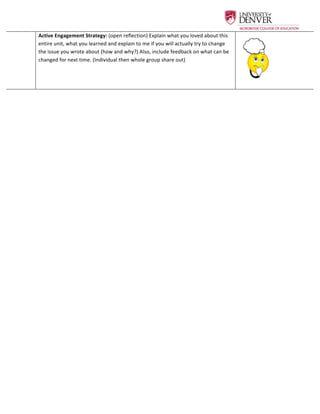
Active	
  Engagement	
  Strategy:	
  Drawing	
  a	
  Billboard	
  Activity	
  	
  
Students	
  will	
  need	
  to	
  draw	
  a	
  billboard	
  about	
  their	
  issue	
  and	
  pretend	
  that	
  they	
  are	
  
trying	
  to	
  make	
  their	
  issue	
  visible	
  to	
  the	
  public.	
  Students	
  need	
  to	
  be	
  creative	
  and	
  
try	
  to	
  make	
  it	
  interesting,	
  in	
  order	
  to	
  have	
  it	
  be	
  engaging	
  to	
  the	
  public.	
  (Think	
  Pair	
  
Share)	


Exit	
  Ticket:	
  	
  
Use	
  the	
  notes	
  from	
  last	
  class	
  
and	
  the	
  research	
  we	
  did	
  in	
  the	
  
library	
  to	
  do	
  an	
  ACEIT	
  
paragraph	
  about	
  the	
  issue	
  that	
  
you	
  chose.	


10	
   Objective:	
  SWBAT	
  self	
  assess	
  themselves	
  and	
  construct	
  a	
  rubric,	
  in	
  writing,	
  while	
  
rationalizing	
  what	
  is	
  crucial	
  to	
  include	
  in	
  their	
  writing	
  and	
  understand	
  what	
  aspects	
  
are	
  essential	
  to	
  present	
  to	
  their	
  peers,	
  while	
  using	
  correct	
  sentence	
  structure.	


Rationale:	
  It	
  is	
  important	
  for	
  students	
  to	
  understand	
  what	
  they	
  will	
  be	
  graded	
  on,	
  
as	
  well	
  as	
  understanding	
  what	
  is	
  important	
  to	
  know	
  and	
  include	
  when	
  presenting	
  
to	
  an	
  audience.	
  Student	
  will	
  need	
  this	
  to	
  prepare	
  for	
  college	
  in	
  order	
  to	
  
understand	
  rubrics	
  and	
  why	
  they	
  are	
  essential.	
  	
  
Active	
  Engagement	
  Strategy:	
  Students	
  will	
  create	
  a	
  rubric	
  where	
  they	
  explain	
  
what	
  they	
  believe	
  they	
  should	
  be	
  graded	
  on	
  while	
  writing	
  the	
  letter	
  and	
  when	
  
presenting	
  their	
  letter	
  to	
  their	
  peers.	
  (Individual	
  activity	
  then	
  whole	
  group	
  share	
  
out)	
  	
  
Performance	
  Task	
  Rubric	


11	
   Objective:	
  SWBAT	
  utilize	
  historical	
  evidence,	
  in	
  writing,	
  to	
  provide	
  context	
  for	
  the	
  
issues	
  students	
  will	
  be	
  discussing	
  and	
  to	
  compare	
  and	
  contrast	
  the	
  issues	
  that	
  are	
  
happening	
  today	
  and	
  those	
  of	
  the	
  past,	
  all	
  while	
  using	
  comparative	
  adjectives.	
  	
  
Rationale:	
  Students	
  will	
  be	
  using	
  historical	
  evidence	
  to	
  compare	
  and	
  contrast	
  the	
  
issues	
  that	
  have	
  happened	
  in	
  the	
  past	
  to	
  the	
  issues	
  happening	
  today.	
  This	
  will	
  also	
  
help	
  students	
  understand	
  how	
  to	
  write	
  on	
  a	
  college	
  level	
  by	
  using	
  evidence	
  to	
  back	
  
up	
  their	
  ideas	
  and	
  thoughts.	
  	
  
Active	
  Engagement	
  Strategy:	


  Imagine	
  you	
  are	
  writing	
  a	
  letter	
  to	
  the	
  President	
  of	
  the	
  United	
  States.	
  In	
  this	
  
letter,	
  you	
  will	
  be	
  discussing	
  a	
  problem	
  in	
  today’s	
  society	
  that	
  you	
  want	
  to	
  change,	
  
whether	
  that	
  be	
  social	
  justice	
  issues,	
  socioeconomic	
  issues,	
  etc.	
  You	
  will	
  formulate	
  
an	
  argument	
  about	
  why	
  this	
  issue	
  should	
  be	
  changed,	
  how	
  it	
  is	
  negatively	
  affecting	
  
our	
  society	
  and	
  how	
  you	
  plan	
  to	
  change	
  this	
  specific	
  issue.	


  You	
   are	
   expected	
   to	
   utilize	
   evidence	
   from	
   the	
   various	
   historical	
   texts	
   that	
   we	
  
have	
   been	
   analyzing,	
   all	
   while	
   following	
   the	
   ACEIT-­‐CIET	
   model	
   for	
   this	
   letter.	
  
Historical	
  evidence	
  will	
  be	
  used	
  to	
  provide	
  context	
  for	
  the	
  issues	
  students	
  will	
  be	
  
discussing	
  and	
  to	
  compare	
  and	
  contrast	
  the	
  issues	
  that	
  are	
  happening	
  today	
  and	
  
those	
  of	
  the	
  past.	
  All	
  letters	
  will	
  be	
  shared	
  out	
  to	
  peers	
  in	
  small	
  groups	
  once	
  letters	
  
are	
  complete.	
  	
  	
  (Individual	
  assessment	
  then	
  small	
  group	
  activity)	


Performance	
  Task	
  Day:	
  	
  Letter	
  
to	
  the	
  President	
  of	
  the	
  U.S.	
  &	
  
share	
  letters	
  out	
  to	
  peers.	


12	
   Objective:	
  SWBAT	
  summarize	
  their	
  thoughts	
  and	
  understandings	
  of	
  the	
  
performance	
  task	
  and	
  the	
  purpose	
  of	
  utilizing	
  historical	
  evidence	
  to	
  provide	
  
evidence	
  in	
  one’s	
  writing,	
  while	
  using	
  common	
  and	
  collective	
  nouns	
  and	
  verbs.	
  	
  
Rationale:	
  Students	
  will	
  be	
  able	
  to	
  openly	
  reflect	
  on	
  the	
  performance	
  task	
  and	
  
through	
  this	
  reflection,	
  students	
  will	
  understand	
  how	
  important	
  it	
  is	
  to	
  utilize	
  
evidence	
  to	
  back	
  up	
  their	
  writing.	
  	
  
Reflection	
  Questions	
  (Exit	
  
Ticket)	


Active	
  Engagement	
  Strategy:	
  (open	
  reflection)	
  Explain	
  what	
  you	
  loved	
  about	
  this	
  
entire	
  unit,	
  what	
  you	
  learned	
  and	
  explain	
  to	
  me	
  if	
  you	
  will	
  actually	
  try	
  to	
  change	
  
the	
  issue	
  you	
  wrote	
  about	
  (how	
  and	
  why?)	
  Also,	
  include	
  feedback	
  on	
  what	
  can	
  be	
  
changed	
  for	
  next	
  time.	
  (Individual	
  then	
  whole	
  group	
  share	
  out)	


Lesson	
  Plan	
  Template	
  
I.   Pre-­‐Assessment	
  Data	
  
Guiding	
  Questions:	
  What	
  do	
  students	
  already	
  know	
  about	
  this	
  topic?	
  What	
  data	
  (formal	
  or	
  informal)	
  is	
  
available?	
  
In	
  this	
  10th
	
  grade	
  English	
  class,	
  we	
  have	
  just	
  begun	
  our	
  unit	
  on	
  analyzing	
  historical	
  artifacts	
  and	
  relating	
  them	
  back	
  to	
  
our	
  everyday	
  life.	
  Prior	
  to	
  starting	
  the	
  lesson,	
  the	
  students	
  already	
  had	
  an	
  informal	
  understanding	
  of	
  the	
  justice	
  system	
  
and	
  the	
  “good	
  vs.	
  bad”	
  that	
  happens	
  through	
  our	
  justice	
  system,	
  as	
  well	
  as	
  through	
  our	
  everyday	
  lives.	
  Students	
  will	
  be	
  
connecting	
  the	
  news	
  article	
  we	
  will	
  be	
  reading	
  to	
  historical	
  texts	
  that	
  we	
  have	
  read	
  from	
  the	
  Civil	
  Rights	
  Movement,	
  as	
  
well	
  as	
  compare	
  and	
  contrast	
  the	
  two.	
  	
  
II.   Content	
  and	
  Language	
  Objective	
  *Must	
  be	
  conveyed	
  to	
  students	
  
Guiding	
  Question:	
  What	
  will	
  students	
  be	
  able	
  to	
  do	
  at	
  the	
  end	
  of	
  today’s	
  lesson?	
  How	
  will	
  this	
  support	
  
language	
  development?	
  
¨	
  Describe	
  ¨	
  Explain	
  ¨	
  Apply	
  ¨	
  Analyze	
  ¨	
  Compare	
  ¨	
  Evaluate	
  ¨	
  Defend	
  ¨	
  Create¨	
  Interpret	
  ¨	
  
Formulate	
  
CLO:	
  Students	
  will	
  be	
  able	
  to	
  theorize	
  and	
  identify	
  patterns,	
  in	
  writing,	
  why	
  different	
  issues	
  happening	
  in	
  our	
  society	
  
are	
  the	
  same	
  issues	
  that	
  have	
  been	
  happening	
  in	
  the	
  past,	
  all	
  while	
  using	
  questions	
  with	
  increasing	
  specificity.	


Standard:	
  CCSS.ELA-­‐LITERACY.SL.11-­‐12.1.B	
  
Work	
  with	
  peers	
  to	
  promote	
  civil,	
  democratic	
  discussions	
  and	
  decision-­‐making,	
  set	
  clear	
  goals	
  and	
  deadlines,	
  and	
  
establish	
  individual	
  roles	
  as	
  needed.	


Key	
  
Vocabulary:	
  	
  
Public	
  Defender,	
  Problem,	
  Solution,	
  Civil	
  Rights	
  Movement	


III.   Rationale	
  *	
  Must	
  be	
  conveyed	
  to	
  students	
  
Guiding	
  Questions:	
  Why	
  is	
  this	
  important	
  to	
  students?	
  How	
  is	
  this	
  related	
  to	
  unit	
  goals,	
  essential	
  questions,	
  or	
  
relevant	
  standards?	
  How	
  does	
  this	
  connect	
  to	
  students’	
  real	
  lives	
  and	
  cultures?	


Rationale:	
  In	
  order	
  for	
  students	
  to	
  understand	
  the	
  intensity	
  of	
  the	
  issues	
  happening	
  in	
  our	
  world,	
  students	
  need	
  to	
  
identify	
  how	
  important	
  the	
  problems	
  are	
  and	
  how	
  they	
  connect	
  to	
  the	
  past	
  and	
  history	
  of	
  the	
  world	
  as	
  well,	
  by	
  
connecting	
  this	
  to	
  their	
  everyday	
  lives.	


IV.   Assessment	
  *	
  Must	
  be	
  conveyed	
  to	
  students	
  
Guiding	
  Questions:	
  How	
  will	
  you	
  measure	
  students’	
  progress	
  toward	
  the	
  objective?	
  Will	
  the	
  data	
  you	
  gather	
  
 
allow	
  you	
  to	
  differentiate	
  future	
  instruction?	
  
Read	
  and	
  Annotate:	
  “When	
  the	
  Public	
  Defender	
  Says,	
  ‘I	
  Can’t	
  Help’”	
  By	
  Derwyn	
  Bunton	
  	
  
Students	
  will	
  circle	
  words	
  they	
  might	
  not	
  understand	
  and	
  underline	
  sentences	
  that	
  they	
  find	
  interesting.	
  Write	
  
question	
  or	
  comments	
  in	
  the	
  margins.	
  Use	
  cornell	
  notes	
  to	
  write	
  notes	
  about	
  article,	
  if	
  they	
  would	
  prefer	
  to.	
  	
  
Active	
  Engagement	
  Strategy:	
  Planning	
  Committee:	
  	
  
Students	
   will	
   get	
   into	
   groups	
   of	
   3	
   –	
   4	
   and	
   imagine	
   that	
   they	
   are	
   in	
   a	
   planning	
   committee.	
   They	
   will	
   brainstorm	
   a	
  
solution	
   to	
   the	
   issue	
   at	
   hand	
   stated	
   in	
   the	
   article.	
   Explain	
   how	
   you	
   would	
   change	
   the	
   issue	
   and	
   prevent	
   it	
   from	
  
happening	
  again.	
  	
  Students	
  will	
  prepare	
  a	
  skit	
  pretending	
  to	
  be	
  the	
  planning	
  committee	
  and	
  reveal	
  their	
  plan	
  of	
  change	
  
to	
  the	
  community	
  members.	
  Students	
  can	
  use	
  white	
  boards	
  as	
  a	
  tool	
  if	
  they	
  would	
  like	
  to	
  write	
  down	
  their	
  thoughts.	


V.   Differentiation	
  
Guiding	
  Questions:	
  How	
  will	
  you	
  use	
  data	
  to	
  intentionally	
  group	
  students	
  according	
  to	
  skills/readiness?	
  What	
  
choice	
  will	
  students	
  have	
  in	
  the	
  process	
  or	
  product	
  associated	
  with	
  this	
  lesson?	


Students	
  will	
  do	
  a	
  “do	
  now”	
  in	
  the	
  beginning	
  of	
  class	
  then	
  share	
  out	
  to	
  their	
  table	
  partners.	
  Students	
  will	
  read	
  an	
  article	
  
individually	
  and	
  annotate	
  the	
  article,	
  then	
  get	
  into	
  small	
  groups	
  to	
  be	
  in	
  a	
  planning	
  committee,	
  then	
  prepare	
  a	
  skit	
  to	
  
share	
  with	
  the	
  class.	
  Once	
  they	
  are	
  done,	
  they	
  will	
  do	
  an	
  exit	
  ticket	
  for	
  a	
  check	
  for	
  understanding	
  at	
  the	
  end	
  of	
  class.	


VI.   Lesson	
  Components	
  
ü   Active	
  Engagement	
  Strategies	
  
ü   Oral	
  language	
  development	
  
ü   Cooperative	
  learning	
  
ü   Critical	
  thinking	
  
ü   Arts	
  Integration	


ü   Checks	
  for	
  understanding	
  
ü   Frequent	
  feedback	
  
ü   Student	
  voice	
  and	
  choice	
  
ü   Scaffolding	


ü   Strategies	
  to	
  support	
  ELLs	
  
o   Visual	
  supports	
  
o   Explicit	
  vocabulary	
  
o   Realia	
  
o   Native	
  language	
  support	
  
Component	
   Time	
  
requi
red	
  
 
A.   Lesson	
  Introduction:	
  ‘Hook’	
  students	
  into	
  content.	
  Explain	
  objective,	
  rationale,	
  and	
  assessment	


DO	
  NOW:	
  List	
  2	
  things	
  you	
  would	
  like	
  to	
  change	
  about	
  the	
  justice	
  system.	
  Please	
  explain	
  why	
  you	
  want	
  to	
  change	
  
these	
  things.	
  Please	
  try	
  to	
  relate	
  this	
  to	
  the	
  other	
  articles	
  that	
  we	
  have	
  read,	
  by	
  giving	
  examples	
  from	
  them.	
  
Students	
  should	
  be	
  prepared	
  to	
  share	
  out	
  their	
  answers	
  to	
  their	
  table	
  members.	


Objective:	
  SWBAT	
  theorize	
  and	
  identify	
  patterns,	
  in	
  writing,	
  why	
  different	
  issues	
  happening	
  in	
  our	
  society	
  are	
  the	
  
same	
  issues	
  that	
  have	
  been	
  happening	
  in	
  the	
  past,	
  all	
  while	
  using	
  questions	
  with	
  increasing	
  specificity.	


Rationale:	
  In	
  order	
  for	
  students	
  to	
  understand	
  the	
  intensity	
  of	
  the	
  issues	
  happening	
  in	
  our	
  world,	
  students	
  need	
  to	
  
identify	
  how	
  important	
  the	
  problems	
  are	
  and	
  how	
  they	
  connect	
  to	
  the	
  past	
  and	
  history	
  of	
  the	
  world	
  as	
  well,	
  by	
  
connecting	
  this	
  to	
  their	
  everyday	
  lives.	


Read	
  and	
  Annotate:	
  “When	
  the	
  Public	
  Defender	
  Says,	
  ‘I	
  Can’t	
  Help’”	
  By	
  Derwyn	
  Bunton	
  	
  
-­‐Number	
  the	
  paragraphs,	
  find	
  the	
  author,	
  publisher	
  (if	
  possible)	
  and	
  date.	
  	
  
-­‐Students	
  will	
  circle	
  words	
  they	
  might	
  not	
  understand	
  and	
  underline	
  sentences	
  that	
  they	
  find	
  interesting.	
  	
  
-­‐Write	
  question	
  or	
  comments	
  in	
  the	
  margins.	
  Use	
  cornell	
  notes	
  to	
  write	
  notes	
  about	
  article	
  as	
  well.	


Active	
  Engagement	
  Strategy:	
  Planning	
  Committee:	
  	
  
Students	
  will	
  get	
  into	
  groups	
  of	
  3	
  –	
  4	
  and	
  imagine	
  that	
  they	
  are	
  in	
  a	
  planning	
  committee.	
  They	
  will	
  brainstorm	
  a	
  
solution	
  to	
  the	
  issue	
  at	
  hand	
  stated	
  in	
  the	
  article.	
  Explain	
  how	
  you	
  would	
  change	
  the	
  issue	
  and	
  prevent	
  it	
  from	
  
happening	
  again.	
  	
  Students	
  will	
  prepare	
  a	
  skit	
  pretending	
  to	
  be	
  the	
  planning	
  committee	
  and	
  reveal	
  their	
  plan	
  of	
  
change	
  to	
  the	
  community	
  members.	
  Students	
  can	
  use	
  white	
  boards	
  as	
  a	
  tool	
  if	
  they	
  would	
  like	
  to	
  write	
  down	
  their	
  
thoughts.	


10	
  
min	


25	
  
min	


50	
  
min	
  
B.   Body	
  of	
  Lesson	
  
Think	
  about	
  management:	
  ¨	
  Precise	
  Directions	
  ¨	
  Positive	
  Narration	
  ¨	
  Whole-­‐class	
  Incentives	
  	
  ¨Discipline	
  Hierarchy	


Teacher	
  Does…	


-  Gives	
  precise	
  directions	
  about	
  what	
  is	
  expected	
  
of	
  them	
  while	
  completing	
  the	
  do	
  now	
  
activity,	
  reading	
  and	
  annotating	
  the	
  article,	
  
the	
  planning	
  committee	
  activity/skit	
  and	
  the	
  
exit	
  ticket.	


-  Explains	
  that	
  the	
  class	
  is	
  a	
  safe	
  environment	
  
and	
  students	
  must	
  give	
  each	
  student	
  
respect,	
  especially	
  when	
  they	
  are	
  sharing	
  
their	
  do	
  nows	
  and	
  their	
  planning	
  committee	
  
ideas.	


Students	
  Do…	
  
•   Raise	
  hands	
  when	
  wanting	
  to	
  answer	
  a	
  question	
  
•   Participate	
  throughout	
  the	
  class	
  period	
  (both	
  in	
  
small	
  and	
  whole	
  group	
  discussion)	
  
•   Remember	
  the	
  classroom	
  is	
  a	
  safe	
  space	
  and	
  to	
  
be	
  respectful	
  to	
  your	
  peers	


-   Do	
  Now	
  	
  
-   Read	
  &	
  Annotate	
  	
  
-   Planning	
  Committee/Skit	
  	
  
-   Exit	
  Ticket	


We	
  do…	
  	
  
•   Respect	
  each	
  other	
  and	
  listen	
  to	
  each	
  other,	
  
especially	
  during	
  the	
  do	
  now	
  activity	
  	
  
•   Read	
  and	
  Annotate	
  the	
  article	
  “When	
  the	
  Public	
  
Defender	
  Says,	
  ‘I	
  Can’t	
  Help’”	
  By	
  Derwyn	
  
Bunton	
  
-   Give	
  a	
  thoughtful	
  answer	
  for	
  the	
  emjoi	
  exit	
  
ticket	


C.   Closing:	
  Review	
  progress	
  toward	
  objective	
  (may	
  include	
  student	
  self-­‐assessment)	


  EMJOI	
  EXIT	
  TICKET.	
  	
  Assess	
  Yourself:	
  Rate	
  your	
  understanding	
  of	
  today’s	
  objective	


Explain	
  what	
  level	
  you	
  believe	
  you	
  are,	
  in	
  analyzing	
  and	
  understanding	
  the	
  texts	
  that	
  we	
  have	
  been	
  reading.	
  
(Advanced,	
  Proficient,	
  Developing	
  or	
  Unsatisfactory)	
  then	
  explain	
  what	
  we	
  can	
  do	
  to	
  help	
  you	
  better	
  understand	
  
these	
  texts.	
  (resources?	
  Examples	
  of	
  annotated	
  texts,	
  etc.)	


ALSO	
  ANSWER	
  THE	
  FOLLOWING	
  QUESTION:	
  	
  
How	
  did	
  today’s	
  activity	
  align	
  with	
  our	
  objective	
  for	
  today?	
  Did	
  we	
  discuss	
  how	
  different	
  issues	
  happening	
  in	
  our	
  
society	
  are	
  the	
  same	
  issues	
  that	
  have	
  been	
  happening	
  in	
  the	
  past?	
  Explain	
  these	
  issues	
  and	
  how	
  they’re	
  similar.	
  	
  
5	
  min	
  
 
Materials	
  and	
  Resources	
  Needed	


-­‐Article	
  “When	
  the	
  Public	
  Defender	
  Says,	
  ‘I	
  Can’t	
  Help’”	
  
By	
  Derwyn	
  Bunton	


-­‐White	
  boards	
  and	
  markers.	
  	
  
Extension	
  of	
  Learning	
  (e.g.,	
  homework)	


No	
  homework.	


Lesson	
  Plan	
  Template	
  
VII.  Pre-­‐Assessment	
  Data	
  
Guiding	
  Questions:	
  What	
  do	
  students	
  already	
  know	
  about	
  this	
  topic?	
  What	
  data	
  (formal	
  or	
  informal)	
  is	
  available?	
  
We	
  have	
  been	
  reading	
  various	
  articles	
  from	
  the	
  Civil	
  Rights	
  Movement	
  and	
  current	
  articles	
  discussing	
  social	
  justice	
  issues.	
  
Students	
  in	
  my	
  10th
	
  grade	
  English	
  Literature	
  class	
  already	
  have	
  prior	
  knowledge	
  about	
  what	
  has	
  happened	
  during	
  the	
  Civil	
  
Rights	
  Movement	
  because	
  they	
  have	
  already	
  learned	
  it	
  in	
  their	
  history	
  or	
  civics	
  classes	
  at	
  George	
  Washington	
  High	
  School.	
  
This	
  unit	
  is	
  relatively	
  new	
  and	
  this	
  lesson	
  is	
  going	
  to	
  be	
  used	
  to	
  introduce	
  the	
  unit	
  and	
  help	
  students	
  understand	
  different	
  
perspectives	
  and	
  empathize	
  with	
  others.	
  	
  
VIII.   Content	
  and	
  Language	
  Objective	
  *Must	
  be	
  conveyed	
  to	
  students	
  
Guiding	
  Question:	
  What	
  will	
  students	
  be	
  able	
  to	
  do	
  at	
  the	
  end	
  of	
  today’s	
  lesson?	
  How	
  will	
  this	
  support	
  language	
  
development?	
  
¨	
  Describe	
  ¨	
  Explain	
  ¨	
  Apply	
  ¨	
  Analyze	
  ¨	
  Compare	
  ¨	
  Evaluate	
  ¨	
  Defend	
  ¨	
  Create¨	
  Interpret	
  ¨	
  Formulate	


CLO:	
  Students	
  will	
  be	
  able	
  to	
  explore	
  their	
  identity,	
  in	
  writing,	
  while	
  trying	
  to	
  relate	
  their	
  personal	
  life	
  stories	
  to	
  the	
  texts	
  
we	
  have	
  read	
  and	
  analyzed,	
  by	
  using	
  indirect/direct	
  object	
  pronouns	
  and	
  correct	
  subject/verb	
  agreement.	


Standard:	
  CCSS.ELA-­‐LITERACY.SL.9-­‐10.1.D	
  
Respond	
  thoughtfully	
  to	
  diverse	
  perspectives,	
  summarize	
  points	
  of	
  agreement	
  and	
  disagreement,	
  and,	
  when	
  warranted,	
  
qualify	
  or	
  justify	
  their	
  own	
  views	
  and	
  understanding	
  and	
  make	
  new	
  connections	
  in	
  light	
  of	
  the	
  evidence	
  and	
  reasoning	
  
presented.	


Key	
  
Vocabulary:	
  	
  
Identity	
  and	
  Civil	
  Rights	
  Movement,	
  Perspective,	
  Empathize	


IX.   Rationale	
  *	
  Must	
  be	
  conveyed	
  to	
  students	
  
Guiding	
  Questions:	
  Why	
  is	
  this	
  important	
  to	
  students?	
  How	
  is	
  this	
  related	
  to	
  unit	
  goals,	
  essential	
  questions,	
  or	
  
relevant	
  standards?	
  How	
  does	
  this	
  connect	
  to	
  students’	
  real	
  lives	
  and	
  cultures?	


As	
  students	
  are	
  relating	
  their	
  personal	
  life	
  to	
  the	
  texts	
  we	
  have	
  read,	
  they	
  are	
  starting	
  to	
  familiarize	
  themselves	
  with	
  
different	
  perspectives	
  and	
  understanding	
  another	
  person’s	
  point	
  of	
  view	
  by	
  empathizing	
  with	
  them.	
  This	
  helps	
  students	
  
make	
  connections	
  to	
  their	
  everyday	
  lives	
  and	
  family	
  culture	
  as	
  well.	
  
X.   Assessment	
  *	
  Must	
  be	
  conveyed	
  to	
  students	
  
Guiding	
  Questions:	
  How	
  will	
  you	
  measure	
  students’	
  progress	
  toward	
  the	
  objective?	
  Will	
  the	
  data	
  you	
  gather	
  allow	
  
you	
  to	
  differentiate	
  future	
  instruction?	


“I”	
  Poem:	
  	
  Students	
  will	
  create	
  an	
  “I”	
  poem;	
  they	
  can	
  choose	
  to	
  use	
  the	
  template	
  provided	
  or	
  free	
  write	
  a	
  poem	
  about	
  
their	
  identity	
  and	
  try	
  to	
  relate	
  their	
  personal	
  life	
  stories	
  to	
  the	
  texts	
  we	
  have	
  read	
  and	
  analyzed.	
  (Individual	
  Activity	
  and	
  
then	
  share	
  out	
  or	
  do	
  turn	
  and	
  talk).	
  	
  
Students	
  will	
  create	
  an	
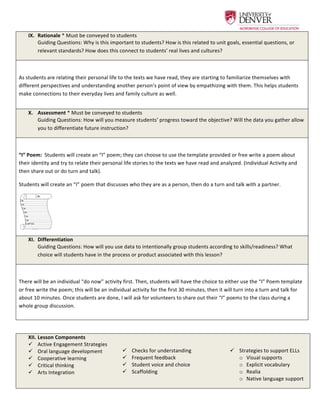
  “I”	
  poem	
  that	
  discusses	
  who	
  they	
  are	
  as	
  a	
  person,	
  then	
  do	
  a	
  turn	
  and	
  talk	
  with	
  a	
  partner.	


XI.   Differentiation	
  
Guiding	
  Questions:	
  How	
  will	
  you	
  use	
  data	
  to	
  intentionally	
  group	
  students	
  according	
  to	
  skills/readiness?	
  What	
  
choice	
  will	
  students	
  have	
  in	
  the	
  process	
  or	
  product	
  associated	
  with	
  this	
  lesson?	


There	
  will	
  be	
  an	
  individual	
  “do	
  now”	
  activity	
  first.	
  Then,	
  students	
  will	
  have	
  the	
  choice	
  to	
  either	
  use	
  the	
  “I”	
  Poem	
  template	
  
or	
  free	
  write	
  the	
  poem;	
  this	
  will	
  be	
  an	
  individual	
  activity	
  for	
  the	
  first	
  30	
  minutes,	
  then	
  it	
  will	
  turn	
  into	
  a	
  turn	
  and	
  talk	
  for	
  
about	
  10	
  minutes.	
  Once	
  students	
  are	
  done,	
  I	
  will	
  ask	
  for	
  volunteers	
  to	
  share	
  out	
  their	
  “I”	
  poems	
  to	
  the	
  class	
  during	
  a	
  
whole	
  group	
  discussion.	


XII.  Lesson	
  Components	
  
ü   Active	
  Engagement	
  Strategies	
  
ü   Oral	
  language	
  development	
  
ü   Cooperative	
  learning	
  
ü   Critical	
  thinking	
  
ü   Arts	
  Integration	


ü   Checks	
  for	
  understanding	
  
ü   Frequent	
  feedback	
  
ü   Student	
  voice	
  and	
  choice	
  
ü   Scaffolding	


ü   Strategies	
  to	
  support	
  ELLs	
  
o   Visual	
  supports	
  
o   Explicit	
  vocabulary	
  
o   Realia	
  
o   Native	
  language	
  support	
  
 
Component	
   Time	
  
requi
red	
  
D.   Lesson	
  Introduction:	
  ‘Hook’	
  students	
  into	
  content.	
  Explain	
  objective,	
  rationale,	
  and	
  assessment	


DO	
  NOW:	
  	
  
Students	
  will	
  have	
  5	
  minutes	
  to	
  quick	
  write	
  and	
  finish	
  the	
  following	
  sentence:	
  What	
  people	
  do	
  not	
  understand	
  
about	
  my	
  culture	
  is…?	


Once	
  students	
  are	
  done,	
  we	
  will	
  do	
  a	
  turn	
  and	
  talk	
  and	
  have	
  students	
  share	
  out	
  their	
  statements	
  for	
  5	
  minutes.	


Objective:	
  SWBAT	
  explore	
  their	
  identity,	
  in	
  writing,	
  while	
  trying	
  to	
  relate	
  their	
  personal	
  life	
  stories	
  to	
  the	
  texts	
  we	
  
have	
  read	
  and	
  analyzed,	
  by	
  using	
  indirect/direct	
  object	
  pronouns	
  and	
  correct	
  subject/verb	
  agreement.	


Rationale:	
  As	
  students	
  are	
  relating	
  their	
  personal	
  life	
  to	
  the	
  texts	
  we	
  have	
  read,	
  they	
  are	
  starting	
  to	
  familiarize	
  
themselves	
  with	
  perspectives	
  and	
  understanding	
  another	
  person’s	
  point	
  of	
  view	
  by	
  empathizing	
  with	
  them.	
  This	
  
helps	
  students	
  make	
  connections	
  to	
  their	
  everyday	
  lives	
  and	
  family	
  culture	
  as	
  well.	


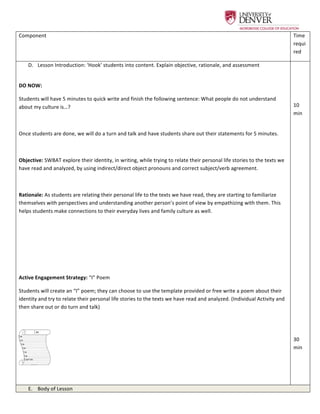
Active	
  Engagement	
  Strategy:	
  “I”	
  Poem	
  	
  
Students	
  will	
  create	
  an	
  “I”	
  poem;	
  they	
  can	
  choose	
  to	
  use	
  the	
  template	
  provided	
  or	
  free	
  write	
  a	
  poem	
  about	
  their	
  
identity	
  and	
  try	
  to	
  relate	
  their	
  personal	
  life	
  stories	
  to	
  the	
  texts	
  we	
  have	
  read	
  and	
  analyzed.	
  (Individual	
  Activity	
  and	
  
then	
  share	
  out	
  or	
  do	
  turn	
  and	
  talk)	


10	
  
min	


30	
  
min	
  
E.   Body	
  of	
  Lesson	
  
 
Think	
  about	
  management:	
  ¨	
  Precise	
  Directions	
  ¨	
  Positive	
  Narration	
  ¨	
  Whole-­‐class	
  Incentives	
  	
  ¨Discipline	
  Hierarchy	


Teacher	
  Does…	


-  Gives	
  precise	
  directions	
  about	
  what	
  is	
  expected	
  
of	
  them	
  while	
  completing	
  the	
  do	
  now	
  
activity,	
  “I”	
  poem,	
  and	
  the	
  exit	
  ticket.	


-  Explains	
  that	
  the	
  class	
  is	
  a	
  safe	
  environment	
  
and	
  students	
  must	
  give	
  each	
  student	
  
respect,	
  especially	
  when	
  they	
  are	
  sharing	
  
their	
  do	
  nows	
  and	
  “I”	
  poems.	


Students	
  Do…	
  
•   Raise	
  hands	
  when	
  wanting	
  to	
  answer	
  a	
  question	
  
•   Participate	
  throughout	
  the	
  class	
  period	
  (both	
  in	
  
small	
  and	
  whole	
  group	
  discussion)	
  
•   Remember	
  the	
  classroom	
  is	
  a	
  safe	
  space	
  and	
  to	
  
be	
  respectful	
  to	
  your	
  peers	


-   Do	
  Now	
  	
  
-   “I”	
  Poem	
  
-   Exit	
  Ticket	


We	
  do…	
  	
  
•   Respect	
  each	
  other	
  and	
  listen	
  to	
  each	
  other,	
  
especially	
  during	
  the	
  do	
  now	
  activity	
  	
  
•   Try	
  your	
  best	
  to	
  make	
  the	
  “I”	
  poem	
  personal	
  
and	
  have	
  it	
  reflect	
  your	
  identity	
  	
  
•   Give	
  a	
  thoughtful	
  answer	
  for	
  the	
  journal	
  entry	
  
(exit	
  ticket)	


F.   Closing:	
  Review	
  progress	
  toward	
  objective	
  (may	
  include	
  student	
  self-­‐assessment)	


Exit	
  Ticket:	
  Journal	
  Entry	


In	
  one	
  paragraph,	
  explain	
  what	
  you	
  learned	
  about	
  yourself	
  and	
  your	
  peers	
  through	
  this	
  activity.	
  Did	
  this	
  activity	
  
help	
  you	
  empathize	
  with	
  anyone	
  or	
  help	
  you	
  see	
  other	
  perspectives	
  other	
  than	
  your	
  own?	
  Provide	
  examples	
  if	
  
possible	
  and	
  use	
  pseudonyms	
  (fake	
  names)	
  if	
  you	
  would	
  feel	
  more	
  comfortable.	


10	
  
min	
  
 
Materials	
  and	
  Resources	
  Needed	


“I”	
  Poem	
  template	
  	
  
Extension	
  of	
  Learning	
  (e.g.,	
  homework)	


No	
  homework	
  will	
  be	
  given.	


© Freeology.com
I Am Poem
I am ______________________________________________________________
(Two special characteristics)
I wonder ___________________________________________________________
(Something you are curious about)
I hear _____________________________________________________________
(An imaginary sound)
I see ______________________________________________________________
(An imaginary sight)
I want _____________________________________________________________
(A desire you have)
I am ______________________________________________________________
(The first line of the poem repeated)
I pretend ____________________________________________________________
(Something you pretend to do)
I feel _____________________________________________________________
(A feeling about something imaginary)
I touch _____________________________________________________________
(An imaginary touch)
I worry _____________________________________________________________
(Something that bothers you)
I cry _____________________________________________________________
(Something that makes you sad)
I am _____________________________________________________________
(The first line of the poem repeated)
I understand _______________________________________________________
(Something you know is true)
I say _____________________________________________________________
(Something you believe in)
I dream _____________________________________________________________
(Something you dream about)
I try _____________________________________________________________
(Something you make an effort on)
I hope _____________________________________________________________
(Something you hope for)
I am _____________________________________________________________
(The first line of the poem repeated)
 
7 Reasons Why Gentrification Hurts Communities of Color
September 12, 2014 by Patricia Valoy
When I was growing up in East New York, Brooklyn in the early 90s, most residents were
Black or Latinx. Today, the demographics are still about the same, and very little has
changed about the neighborhood.
I distinctly remember noticing that there were no white people that lived near me and that
the neighborhoods that had a large percentage of white residents were simply better:
They had better schools, nicer streets, more businesses, less crime, and no visible drug
use.
It was everything I wanted my neighborhood to be.
As ashamed as I am to admit this now, I assumed that the only way neighborhoods could be
bettered is by having white residents, so I hoped that my neighborhood would become like
Williamsburg, Brooklyn. At the time, Williamsburg was rapidly changing, and what used to
be dirty streets and run-down businesses were now tree-lined blocks and shiny Starbucks.
What I failed to understand then was that the gentrification of neighborhoods might make the space
look better, but my family would never be able to afford the price of living there.
Although my childhood neighborhood is still far from gentrification due to its distance from
New York City and history of gang violence, drug use, and poverty, things seem to be
changing, as this real estate listing demonstrates by calling East New York “the new
frontier.”
Gentrification is new-wave colonialism, and it has economic, societal, and public health
repercussions for poor communities of color.
Many times when wealthy people move into a low-income neighborhood, they truly want
to help. Oftentimes, they even start community programs and become leaders in the
 
community, often through beautification projects. And while I get why this seems to be
good at first glance, it really isn’t.
When neighborhoods are gentrified, those moving in are looking for cheap rent and the
ability to make a better life for themselves.
And while wealthier people may feel entitled to buy or rent wherever they wish (as is
indeed their right), they must also understand the consequences of their actions.
As our neighborhoods become “up-and-coming areas” that “evoke images of burned-out
buildings, riots, and poverty,” the people that lived there through the poverty and disrepair
deserve to stay in their homes and have a community that supports their needs.
We need to understand that gentrification isn’t about beautifying neighborhoods and
making them safer. It is the systematic displacement of people of color from their homes.
Gentrification hurts communities of color, and these are some of the ways how.
1. As wealthier people move into poor neighborhoods, landlords raise their rents to cash in from the wealth of the new influx of
residents.
As this study states, the median rent prices in New York City rose 75% since 2001. This
same trend can be seen in other neighborhoods that have currently become gentrified,
like Oakland, California.
It’s common to see landlords bully low-income tenants into moving out by not maintaining
apartments or not renewing their lease, forcing residents to move out.
I’ve seen this happen to many of my relatives that moved to New York City in the early
70s and settled in the Lower East Side and Soho neighborhoods of lower Manhattan.
While these areas are now the first choice of home for celebrities and ritzy events like the
TriBeCa Film Festival, they were previously filled with tenement buildings and low-income
housing.
One of my aunts who still lives in what is now the very trendy Soho pays for all repairs and
upgrades in her apartment, as the building owners refuse to do so in an effort to bully her
into leaving and renting her apartment at a much higher cost.
Yes, it’s illegal, but they know she could never afford a lawyer.
 
None of her neighbors remain, and none of the local businesses she frequented are still
the same. Even her local church no longer offer services in her language.
I ask her often why does she remain, although I know the answer: That’s her home!
Poor people of color living in gentrified neighborhoods find themselves between a rock
and a hard place. They are often unable to move because they could never afford housing
elsewhere, but are constantly pushed to the limit by landlords looking to rent at higher
prices.
It’s illegal, but that doesn’t help a person who does not understand the law or hire
someone to help them navigate the legal system.
Many of these communities are comprised of immigrants that have lived in the United
States for decades, yet have no resources left in their communities. They face language,
cultural, and societal barriers that set them at a disadvantage next to real estate
companies and developers.
2. Local businesses suffer as large competitors start opening shops in what were previously undesired locales.
If wealthier residents are moving into a low-income neighborhood, it follows that they will
spend more on local businesses and generate more profit for them. Yet, unfortunately, this
is rarely the case.
Businesses have a hard time catering to two different types of clientele, though they often try to do
so.
It’s common to see grocery stores start selling a wider variety of products to attract new
residents, but few actually see the increase in profits they thought they would because
new residents often shop in places they feel more comfortable in.
Likewise, new businesses that open up specifically to cater to the new residents bring new
competition to the old ones, further straining the local community.
New businesses open to cater to the wealthier residents of the neighborhood and existing
shops are forced to either a) change their practices to appeal to new residents and survive
or b) stick with their old clientele and likely lose their business.
Additionally, rent increases affect businesses as much as they do low-income residents.
 
The only businesses that can thrive under these circumstances are large corporations like
Whole Foods.
Whole Foods, unlike other local supermarkets, attract a new set of people and completely
changes a neighborhood. This is evident in the way Whole Foods changed the
neighborhood of Jamaica Plain in Boston. While Jamaica Plain already had a large and
affordable supermarket called Hi-Lo, open since 1964 and known for selling Latin
American products, it couldn’t compete with Whole Foods.
Needless to say, Hi-Lo had to close because it could not keep up with Whole Foods, and
just like that, low-income residents of Jamaica Plain were left without a place to shop for
groceries that were affordable and culturally relevant.
As this article states, “That’s because Hi-Lo and Whole Foods aren’t just stores, they’re
ideas that lead to similar ideas, and attract people who identify with those ideas in cyclical
fashion.”
3. People of color are criminalized because new people feel ‘in danger.’
People of color, and especially Black people, are often perceived as dangerous and
thuggish.
As the recent shooting of Mike Brown – an unarmed young Black man in Ferguson,
Missouri – further proves, the stereotyping of racial minorities has dangerous
consequences.
Black and Latino men are disproportionately arrested, especially for marijuana use and
distribution, while white men who do the same are celebrated.
And we can’t assume that justice is the same for everyone.
In this article, un-ironically titled “I Spent a Day Delivering Weed in New York City,” the
author repeatedly states that these are not your “normal” drug dealers, therefore, not a
threat to your safety.
Our neighborhoods are often the only place where we can feel at home, but as neighborhoods get
gentrified, activities such as panhandling and sleeping in public places become criminalized, too.
While not having poor people live on your streets might be a priority for wealthier
residents, the response should be to help them, not arrest them.
 
If people of color are getting arrested for everything from drug use to being poor, I don’t
think it’s safe to say that gentrification is improving our neighborhoods and making them
safer.
The reality is that the incarceration of Black and Brown men create the illusion of safety for
white residents, but it’s a sense of security based on stereotypes of Black and Brown men
being thugs, criminals, and dangerous.
The need to feel safe, which is an absolute human right, is a necessity, but the way we
achieve that in gentrified neighborhoods is missing the mark. Crime happens because
former residents of gentrified neighborhoods live in poverty and suffer from lack of
resources and poor educational and health services.
4. New developments are profit-driven and not community-driven.
Gentrification is driven by the private sector.
Close-knit communities thrive on socially conscious business practices that benefit
everyone. Local shops often allow families to shop on credit and use public assistance
funds without shame.
Communities often get together for block parties and potlucks, and in general, there is a
sense that you will be taken care of. But when newcomers see existing residents as
dangerous, this feeling of community is hampered.
In my childhood neighborhood, I would often babysit and tutor younger children that lived
near me. Although some parents would give me some form of payment, I did it because it
was the only way to serve my community – a community that had few affordable childcare
centers and no tutoring services.
It was a community, as imperfect as it may be.
Today, I live in a different neighborhood – one that is far more gentrified than the place
where my family still lives, and a lot less reassuring.
I have a dog park, a Planet Fitness, a yoga studio, and a coffee shop all within reach, but I
have neighbors I have never met, and I could never ask my local grocer to give me a loaf
of bread on credit.
 
And I will be sincerely honest: I absolutely love that every Sunday, I have a community
garden where I can go shop for local and organic produce and walk one block back to my
apartment. But it will never compare to the free hot dogs I ate while playing near the fire
hydrant on a hot summer day in Brooklyn.
5. Children’s education suffers.
Children who live in areas of concentrated poverty never fare well. They often have low
graduation rates and deal with constant violence.
So it follows that gentrification should improve the lives of poor children of color.
There is no denying that diverse schools, both economically and racially, are a good
learning space for all children. When children are exposed to a variety of individuals, they
have a better understanding of the world.
However, what happens to neighborhoods also happens to schools.
As former residents are pushed out, so are the children attending local schools, which
disturbs their learning process.
While schools do tend to improve and start providing amenities that children benefit from
with the increase in capital coming in from the higher income of new residents, few
minority children stick around to enjoy these perks.
With poverty rates for children at a staggering 22% in the United States, it’s important to
make sure that all amenities and community programs that come with gentrification are also
available to poor residents.
Yet with the profit-driven model that arises as communities are gentrified, it’s unlikely that
any children will benefit from gentrification.
Children succeed when their parents are capable of providing for them. When parents are
unable to afford their own neighborhood amenities, their children start seeing the
difference along racial and social barriers and internalize it.
6. Culture shifts, and communities lose their safety net.
Vibrant communities that rely on social networking are torn apart with gentrification.
 
Neighbors that people once relied on move out, and services that were beneficial to the
community are replaced.
For those that stay, they become outsiders in their own communities.
In a similar manner, communities that have historically banded to build a community
through strife – like Black people in Harlem, New York and Latinxs in the Mission District
of San Francisco – begin to see their tight-knit and flourishing communities disbanded.
This is evident in the way Vogue categorically dismissed the neighborhood of Bushwick in
Brooklyn as a “disfavored neighborhood.” A year later — and a lot more white and affluent
residents to sell magazines to — it’s the 7th
coolest neighborhood, due in part to the new
influx of white artists to the previously “grimy, industrial Bushwick.”
Yet Bushwick already had a thriving community of artists all along, and it’s where
celebrities such as Rosie Perez and Eddie Murphy hailed from.
While it’s understandable that communities can (and do!) change as time passes, their histories
must be protected. After all, we still associate Plymouth Rock and lower Manhattan with
Dutch settlers, and that was over 500 years ago.
The truth is that new developments and fancy coffee shops will never replace the social
network that helped local residents survive.
7. Public health of residents suffers.
Residents that fear being displaced and losing their social network are under a lot of
stress.
Those who want to remain grapple with rising rent and food prices, while those that leave
lose a lot of their hard-earned capital.
Disparities in health become acute when neighborhoods change rapidly and existing marginalized
communities are pushed to the peripheries.
External problems manifest themselves in mental and physical health issues, such as
anxiety and depression, or high blood pressure and heart problems.
 
The psychological effects of losing one’s tight-knit community and deep social links can be
traumatizing for some. It’s important to note that gentrification doesn’t just affect our views;
it affects our perceptions and mentality.
Public health programs must address issues that displaced people deal with daily, from
lack of access to affordable healthy food to subpar housing.
***
Neighborhoods are not static. They change through the years, and there is nothing wrong
with an organic shift in the demographics of a neighborhood. But it shouldn’t happen at the
expense of poor people and people of color.
Poor communities of color have spent years battling disinvestment and abandonment, but
redevelopment only seems to occur when white and wealthy people move into a neighborhood.
It’s important to keep in mind that gentrification might make a neighborhood beautiful, but
only for a select few people. If we truly believe in improving and redeveloping our
neighborhoods, we must do so for everyone – regardless of social, racial, or economic
status.
 
http://money.cnn.com/2015/11/12/news/economy/gentrification-may-help-poor-people/
How gentrification may benefit the
poor
Gentrification has long been a dirty word for
forcing poor people out of neighborhoods across
U.S. cities.
When a poor neighborhood attracts higher income residents, expensive cafes and pricy
vintage clothing stores move in, making daily living more expensive. The narrative is that
gentrification displaces low income residents and in the worst case scenario ​causes
homelessness​.
Now, a new storyline is emerging that shows that it isn't fair to blame gentrification for
displacing low income residents and that there might actually even be some benefits.
A study by the ​Philadelphia Federal Reserve​ recently concluded that poor people are no
more likely to move out of a gentrifying neighborhood than from a non-gentrifying one.
That doesn't mean low income people are not pushed out of their neighborhoods. They are
just not more likely to be displaced than a person of similar income in a neighborhood that's
not gentrifying.
Experts say there are may even be some benefits for the low-income residents that decide to
stay in gentrifying neighborhoods.
-- New job opportunities emerge as more stores open and construction picks up.
-- Longtime homeowners benefit from rising property values.
-- There's often a decline in crime.
-- On average, credit scores of the poor residents improve in gentrifying neighborhoods.


The Opinion Pages | OP-ED CONTRIBUTOR
When the Public Defender Says, ‘I Can’t Help’
By DERWYN BUNTONFEB. 19, 2016
New Orleans — ON an ordinary day, the Criminal District Court here begins with a parade of handcuffed
and shackled defendants being led out from cages behind the judge’s bench by sheriff’s deputies. They are
clad in orange jumpsuits and are almost exclusively African-American men. They rattle and shuffle their way
onto benches and into the empty jury box, waiting for the judge.
When their case is called, a lawyer from the public defender’s office will rise and say: “Your Honor, we do
not have a lawyer for this person at this time.”
Eight-five percent of these defendants are unable to afford their own lawyer and will need a public defender
to represent them. But in New Orleans, where I am in charge of the public defender’s office, we simply don’t
have enough lawyers to handle the caseload. Last month, we began refusing new cases.
In a state with one of the nation’s highest poverty rates, the system to defend the poor is broken.
To understand why, look at the other people in the courtroom sitting on benches set aside for the audience.
Most of these people aren’t there to watch the proceedings. Many were subpoenaed for failing to pay fines or
fees for minor offenses and had to take time from work to appear in court or be charged with contempt.
Those fines and fees pay for two-thirds of the Louisiana public defender system. The rest comes from the
state.
It is not an exaggeration to say that fines from traffic offenses, which, in Louisiana, can result in jail time,
play a big part in determining whether one of those men in the orange jumpsuits receives an adequate defense
required by the Sixth Amendment to the Constitution.
Poor people must pay $40 to apply for representation, and an additional $45 if they plead guilty or are found
guilty. No other states lean so heavily on fines and fees paid mostly by the poor. And there is a reason for
that. The system isn’t working.
Louisiana spends nearly $3.5 billion a year to investigate, arrest, prosecute, adjudicate and incarcerate its
citizens. Less than 2 percent of that is spent on legal representation for the poor.
It is little wonder that Louisiana has the nation’s highest rates of incarceration and exoneration for wrongful
convictions.
 
Last fall, at a hearing ordered by the Criminal District Court in response to this crisis, years of underfunding
by the state were chronicled. Public defenders have weathered more than $5 million in budget cuts over the
last five years. For the second time in four years, we have been forced to impose a hiring freeze and, now,
have begun turning down cases.
In response, judges are ordering private lawyers to take poor clients. Other poor defendants have been left to
represent themselves. And in some cases, judges have threatened public defenders with contempt for refusing
to take a case.
James Dixon, the state public defender, and members of my staff and I filed affidavits and testified about
how our workloads had reached unmanageable levels. Many public defenders are unable to visit clients, file
motions in a timely manner or conduct the necessary investigations. In fact, our workload is now twice the
standard recommended by the American Bar Association.
Ellen Yaroshefsky, a professor at Cardozo Law School in New York City and one of three experts who
testified, said it was a misnomer to call the New Orleans court system a “justice system.” Professor
Yaroshefsky told the judge: “You’re not operating a justice system here. You’re operating a processing
system.”
While the situation here may sound extreme, overloaded public defenders are struggling across the country.
A 2013 study in Missouri provided a snapshot of the problem. For serious felonies, defenders spent an
average of only nine hours preparing their cases; 47 hours were needed. For misdemeanors, they spent two
hours when 12 hours were necessary. Similar studies are underway in Colorado, Rhode Island, Tennessee
and here in Louisiana.
“The problem of grossly underfunded public defender organizations with grossly excessive caseloads is a
systemic, endemic problem going back 50 years,” said Stephen F. Hanlon, general counsel for the National
Association for Public Defense, who is overseeing the current studies.
In New Orleans, our decision to refuse new cases didn’t come easily. No one becomes a public defender to
tell a poor person, “No, I can’t help you.” But the outcome of an arrest in a shooting at Bunny Friend
Park here last November that left 17 people wounded influenced my decision to stop taking cases.
A 32-year-old man was arrested in the case and held on $1.7 million bond. He had immediately asserted his
innocence but the police said a witness had identified him. His family hired a private lawyer who went to
Houston to locate video of the suspect shopping with his girlfriend at the time of the shooting. The charges
were dropped.
Reading about this case, I realized my office could not have guaranteed the timely retrieval of this important
evidence before it would have been routinely erased. That would have left an innocent man to face trial for
his life for what was labeled an act of “domestic terrorism” by the mayor of New Orleans.
Louisiana needs fundamentally to reform its system of public defense funding. The state needs to arrange
adequate and stable financing based on reasoned projections of the workload. Fines and fees, to the extent
they exist at all, should act as a supplemental source of financing.
The role of the public defender is to protect the innocent, defend the Constitution and demand justice and
fairness. But when resources are out of balance, as they are in Louisiana, so is the system. The poor are the
ones who are hurt.
 
Do Nows:


Possible	
  Reading	
  List	
  2017-­‐2018:	
  	
  
My	
  Name	
  is	
  not	
  Easy	
  –	
  Debby	
  Dahl	
  Edwardson	
  (identity	
  realization)	
  
Night	
  –	
  Elie	
  Wiesel	
  (holocaust)	
  	
  
Just	
  Like	
  Us	
  –	
  Helen	
  Thorpe	
  (true	
  story	
  of	
  4	
  Mexican	
  girls	
  coming	
  of	
  age	
  in	
  America)	
  	
  
Freedom	
  Writers	
  –	
  Erin	
  Gruwell	
  &	
  Freedom	
  Writers	
  (identity,	
  gang	
  violence,	
  college	
  prep…)	
  
Monster	
  –	
  Walter	
  Dean	
  Myers	
  (young	
  Black	
  male	
  accused	
  of	
  murder	
  –	
  play)	
  	
  
Tyrell	
  –	
  Coe	
  Booth	
  (young	
  Black	
  male	
  living	
  in	
  a	
  homeless	
  shelter…)	
  
Mexican	
  Whiteboy	
  –	
  (young	
  Mexican	
  male	
  dealing	
  with	
  identity	
  crisis)	
  	
  
Nickel	
  and	
  Dimed	
  –	
  Barbara	
  Ehrenreich	
  (social	
  class)	
  	
  
Class	
  Matters	
  –	
  Bill	
  Keller	
  (social	
  class)	
  	
  
The	
  Boy	
  in	
  the	
  Striped	
  Pajamas	
  –	
  John	
  Boyne	
  (holocaust)	
  
The	
  Skin	
  I’m	
  In	
  –	
  Sharon	
  G.	
  Flake	
  (identity)	


Final Unit Plan

  • 1.
      Zion  Gezaw     Unit  Title:  Analyzing  Historical  Artifacts     Standards:   CCSS.ELA-LITERACY.W.9-10.4 Produce clear and coherent writing in which the development, organization, and style are appropriate to task, purpose, and audience. (Grade-specific expectations for writing types are defined in standards 1-3 above.) CCSS.ELA-LITERACY.W.9-10.5 Develop and strengthen writing as needed by planning, revising, editing, rewriting, or trying a new approach, focusing on addressing what is most significant for a specific purpose and audience. (Editing for conventions should demonstrate command of Language standards 1-3 up to and including grades 9-10 here.) CCSS.ELA-LITERACY.W.9-10.9 Draw evidence from literary or informational texts to support analysis, reflection, and research.     Essential  Questions:   Overarching: 1.)  How do historical artifacts help us relate to our own current events today? 2.)  How has our society’s view of equity changed over time? Topical: 1.)  How do MLK’s speeches relate to your everyday life? How is MLK using his writing (speeches, letters, etc.) to influence his audience?       Big  Understandings:   •   SWBAT identify how history is illustrated differently depending on the perspectives and multiple identities of people at the time of the civil rights movement. •   SWBAT understand that historical events are viewed, analyzed and evaluated differently by various types of people.     Knowledge  and  Skills:   Knowledge  and  Skills   Students will know… •   Interpreting evidence from text to support their ideas and analysis. •   Understand how to revise their essays within each step of the writing process.
  • 2.
      Key Terms/Events: •  Civil Rights Movement •   Historical Document •   Dr. Martin Luther King Jr. •   Racism •   Equity •   Empathy •   Microaggressions   Key Skills Students will be able to… •   Connect their conclusion paragraph to their introductory/assertion paragraph. •   Applying evidence from the historical texts to support their ideas about how the letters connect to their everyday life. •   Formulating arguments from historical texts in valid, clear and concise sentences. •   Annotating different historical texts to their own understanding and developing arguments based on how they connect to the text itself.   Performance  Task:   Description  of  performance  task  (2-­‐3  paragraphs)            A   10th   honors   English   Literature   class   will   be   interpreting   and   analyzing   different   Dr.   Martin   Luther   King   Jr.’s   speeches   and   letters.  While  dissecting  these  works,  students  should  be  annotating  and  making  connections  to  the  outside  world  in  order  to  gain   perspective  of  the  world  back  then  and  the  world  now.    They  are  building  an  understanding  of  awareness  of  what  is  happening  to   people  in  the  outside  world  and  show  empathy  for  other  people  around  them,  while  being  mindful  of  their  feelings  and  other   viewpoints.   Students   will   be   examining   these   works   and   understanding   how   these   historical   events   are   viewed,   analyzed   and   evaluated  differently  by  various  types  of  people.     Performance  Task:  Letter  to  the  President  of  the  United  States      Imagine  you  are  writing  a  letter  to  the  President  of  the  United  States.  In  this  letter,  you  will  be  discussing  a  problem  in  today’s   society  that  you  want  to  change,  whether  that  be  social  justice  issues,  socioeconomic  issues,  etc.  You  will  formulate  an  argument   about  why  this  issue  should  be  changed,  how  it  is  negatively  affecting  our  society  and  how  you  plan  to  change  this  specific  issue.   You  are  expected  to  utilize  evidence  from  the  various  historical  texts  that  we  have  been  analyzing,  all  while  following  the  ACEIT-­‐ CIET  model  for  this  letter.  Historical  evidence  will  be  used  to  provide  context  for  the  issues  students  will  be  discussing  and  to   compare  and  contrast  the  issues  that  are  happening  today  and  those  of  the  past.  All  letters  will  be  shared  out  to  peers  in  small   groups  once  letters  are  complete.         First,  students  will  be  looking  at  real  historical  artifacts  from  the  Civil  Rights  movement.  Then,  they  will  examine  and  annotate   different  news  articles  that  resemble  the  problems  that  happened  during  the  civil  rights  movement.  To  prepare  for  the  letter  to  the   president,  students  will  plan  out  a  rough  draft  two  days  prior  to  the  day  it  is  due  and  write  out  thoughts  they  have  on  what  issue   they  want  to  change,  why  they  want  to  change  it  and  how  they  are  prepared  to  solve  the  issue.  Each  student  should  have  at  least  4   pieces  of  evidence  from  the  MLK  works  we  have  dissected  and  at  least  2  pieces  of  evidence  from  the  recent  news  articles  we  have   been  annotating.  For  the  plan,  the  students  should  have  the  ACEIT-­‐CIET  model  completed  in  their  outline.          
  • 3.
      Letter  to  the  President  Day:  Students  should  each  have  their  outline  ready  with  their  evidence  prepared  as  well.  Using  the  ACEIT-­‐ CIET  model,  students  will  have  approximately  45  minutes  to  write  their  letter  using  all  of  the  evidence  and  construct  a  detailed   letter  to  the  President  explaining  their  issue  and  how  they  want  it  resolved.     Once  students  are  done  writing  their  essays,  they  will  get  into  small  groups  and  present  their  ideas  to  their  peers,  while  pretending   that  their  peers  are  the  President(s)  of  the  United  States.  Students  will  have  ‘grading’  sheets  where  they  will  be  able  to  use  the   rubric   to   grade   their   peers   and   make   sure   that   they   delivered   their   letter   loud   and   proud   and   completed/included   all   of   the   necessary  components  of  the  rubric.  
  • 4.
      Stage  2,  Part  2:  Performance  Task  Rubric         Letter  to  the  President  Rubric   Score   Level   Content/Information   (60%)     Style,  Fluency  &   Conventions  (10%)   Organization  &  Planning   (10%)     Language/Presentation  (20%)       4  Advanced     •   Identifies  4  or  more   pieces  of  evidence   from  historical   artifacts  and  current   news  articles  that   we  have  analyzed   •   Exemplary   recognition  of   different   perspectives  and   demonstrating   empathy  for  other   people  through  the   letter.   •    Synthesizes  their   understanding  of   the  topic  and  does   not  stray  away  from   it.   •   Formulates  a  clear   goal  that  is  related   to  the  topic   •   Is  accurate  and  has   little  to  no  factual   errors  while  using   the  entire  ACEIT  –   CIET  model.       •   Minimal  (0  -­‐‑1)   spelling,   grammatical,  or   punctuation  errors   •   Models  accurate,   precise  vocabulary   that  is  appropriate   for  audience  and   purpose  of  letter   •   Construct  a  letter   that  is  fluent  and   easy  to  read  with   little  to  no   grammar/mechanical   errors   •   Establish  an   effective  variety  of   sentence  beginnings,   structures  and  length     •   Information  is  clearly   focused  in  an  organized   and  thoughtful  manner   •   Information  is  constructed   in  a  logical  pattern  to   support  the  solution   •   Evidence  of  having  gone   through  all  of  stages  of  the   revision  process.     •   Format  enhances  the   content   •   Presentation  is  organized   and  well  laid  out   •   Language  skills  successfully   support  the  meaning  behind   the  letter     •   Demonstrates  correct   subject/Verb  &  pronoun   agreement     •   While  presenting,  peers  are   asking  insightful  questions   and  challenging  the  student   presenter  to  think  critically   about  his/her  issue  that  they   want  to  change.   •   Presenter  is  talking  loud  and   proud  about  his/her   presentation.      
  • 5.
      3  Proficient     •   Identifies  3  –  4   pieces  of  evidence   from  historical   artifacts  and  current   news  articles  that   we  have  analyzed       •   Moderate   recognition  of   different   perspectives  and   demonstrating   empathy  for  other   people  through  the   letter.   •   Mostly  focused  on   the  prompt  but   strays  away  a  little   from  the  prompt.   •   Formulates  clear   goal  that  is  related   to  the  topic  and   finds  a  solution  to   accomplish  said   goal.   •   Is  accurate  with   little  factual  or   interpretation   errors  using  most  of   the  ACEIT-­‐‑CIET   model   •   Few  (1  to  3)   spelling,   grammatical,  or   punctuation  errors   •   Models  accurate  use   of  vocabulary  and   word  choice   •   Construct  a  letter   that  is  accurate  but   general  word  choice   that  is  appropriate   for  the  audience  and   purpose     •   Expresses  familiar   vocabulary  and   phrases  with  some   striking  language  in   their  letter     •   Information  supports  the   solution  to  the  challenge  or   question   •   Only  going  through  part  (2   -­‐‑4)  of  the  revision  process     •   Information/Evidence   given  from  sources   supports  your  claim  well     •   Format  is  appropriate  for   the  content   •   Presentation  captures   audience  attention   •   Presentation  is  well   organized   •   Few  mistakes  of   subject/verb  &  pronoun   agreement     •   While  presenting,  peers  are   asking  a  couple  insightful   questions,  challenging  the   student  presenter  to  think   critically  about  his/her  issue   that  they  want  to  change.   •   Presenter  is  talking  loudly   but  not  enthusiastic  about   his  or  her  presentation.      
  • 6.
      2  Developing     •   Identifies  2-­‐‑3   pieces  of  evidence   from  historical   artifacts  and  current   news  articles  that   we  have  analyzed     •   Some  recognition   of  different   perspectives  and   demonstrating   empathy  for  other   people  through  the   letter.     •   Not  fully  invested   with  the  prompt   •   Does  not  formulate   the  end  goal  in  their   essay     •   Has  some  factual   errors  or   inconsistencies  &   only  uses  the  ACEIT   or  CIET  part  of  the   model.     •   Minimal  (3  to  5)   spelling,   grammatical,  or   punctuation  errors   •   Models  low-­‐‑level  use   of  vocabulary  and   word  choice   •   Utilizes  general   word  choice  that  may   include  occasional   errors  in  word  usage     •   Uses  a  few  active   verbs  but  most  are   imprecise  or   colorless     •   Demonstrates  a   variety  of  sentence   beginnings,  structure   or  length  but  has   many  rambling  or   choppy  sentences.   •   Information  appears  to   have  a  pattern,  but  the   pattern  is  not  consistently   carried  out  in  the  project   •   Information  loosely   supports  the  solution   •   Having  gone  through  only   2  of  the  revision  steps     •   Format  does  not  suit  the   content   •   Presentation  does  not   capture  audience  attention   •   Presentation  is  loosely   organized   •   Many  subject/verb  &   pronoun  agreement  mistakes   •   While  presenting,  peers  are   not  asking  insightful   questions  or  challenging  the   student  presenter  to  think   critically  about  his/her  issue   that  they  want  to  change.       •   Presenter  is  not  speaking   loudly  or  interested  in  his   presentation.        
  • 7.
      1  Unsatisfactory     •   Identifies  0-­‐‑1   pieces  of  evidence   from  historical   artifacts  and  current   news  articles  that   we  have  analyzed     •   No  recognition  of   different   perspectives  and   demonstrating   empathy  for  other   people  through  the   letter.   •   Provides   inconsistent   information   supporting  the   student’s  argument     •   Has  no  application   of  critical  thinking   throughout  the   paper.       •   Has  significant   factual  errors,   misconceptions  or   misinterpretations   of  the  texts  analyzed   in  class.  Does  not   use  the  ACEIT  –   CIET  model  at  all.       •   More  than  5  spelling,   grammatical,  or   punctuation  errors   •   Poor  use  of   vocabulary  and  word   choice   •   Utilizes  inaccurate   or  repetitive  word   choice  that  is   occasionally   inappropriate  for   audience  and   purpose     •   Practices  passive,   colorless  or   imprecise  verbs     •   Demonstrates  vague   language  or  frequent   clichés.     •   Uses  simple,   repetitive  sentence   beginnings,   structures  and   lengths.     •   Delivery  of  the  content  is   unfocused  and  unclear     •   Information  does  not   support  the  solution  to  the   challenge  or  question   •   Information  has  no   apparent  pattern   •   Did  not  go  through  any   revision  steps  (no  evidence   of  planning).     •   Presentation  appears  sloppy   and/or  unfinished   •   Format  does  not  enhance   content   •   Presentation  has  no  clear   organization  as  writing  is  not   clear  and  concise.     •   While  presenting,  peers  are   not  paying  attention  to  the   student  presenter  and  are  off   task.     •   Presenter  is  very  quiet  and   unenthusiastic  about  his/her   presentation.                          
  • 8.
      Lesson   Objective,  Rationale,  and  Active  Engagement  Strategy   Assessment   1   Objective:  SWBAT  identify,  in  writing,  how  the  issues  in  historical  artifacts   compare  and  contrast  to  today’s  current  society,  while  using  comparative   adjectives.     Rationale:  It  is  important  for  students  to  be  able  to  analyze  how  different   issues,  between  the  past  and  present,  compare  to  one  another  and  understand   that  not  much  has  changed  over  the  years.  Students  will  be  able  to  address   issues  of  social  justice  through  the  different  texts  we  will  be  reading.     Active  Engagement  Strategy:  Venn  Diagram       Students  will  read  different  letters  and  speeches  during  the  Civil  Rights   Movement  and  identify  the  different  issues  that  happened  during  that  time   and  compare  them  to  the  issues  that  are  happening  currently.  (Small  Group   Activity)     Venn  Diagram     In  groups,  students  will  create  a   Venn  Diagram  to  compare  and   contrast  the  article  read  for  the   day.       2   Objective:  SWBAT  interpret  evidence,  by  reading  the  historical  texts,  and   distinguishing  the  events  that  have  happened  throughout  the  text  and   understanding  each  event’s  importance,  while  using  key  vocabulary  and  nouns.     Rationale:  In  order  to  understand  the  narrative  of  each  text,  students  need  to   interpret  the  importance  of  each  event  that  has  happened  in  the  writing.   Students  will  also  understand  the  events  that  have  happened  in  history  and   compare  them  to  today’s  current  society.     Active  Engagement  Strategy:  Story  Map     Students  will  reread  the  text  given  to  them  and  retell  the  plot  of  the  text   (beginning,  middle  and  end)  in  a  story  map,  in  order  to  summarize  their   understanding  of  the  text.  (Small  Group  Activity)     Story  Map     Students  will  read  the  text  from   today  and  fill  out  the  story  map   outline  in  groups.     3   Objective:  SWBAT  categorize  the  different  events  in  the  historical  text,  by   illustrating  the  cause  and  effects  of  the  plotline  in  each  text  we  analyze,  while   using  past  tense  verbs  and  perfect  aspect  (present  and  past).     Rationale:  If  students  can  categorize  and  recognize  the  cause  and  effects  in  a   text,  then  they  are  demonstrating  their  understanding  of  that  specific  text  and   can  draw  conclusions  from  their  cause  and  effect  illustrations;  this  is  also  an   example  to  prepare  them  for  college  readiness.     Active  Engagement  Strategy:  Cause  and  Effect  Illustrations     Students  will  be  summarizing  the  text  by  using  a  cause  and  effect  map,  where   they  will  illustrate  the  events  that  have  happened  throughout  the  text;   students  will  also  use  captions  in  order  to  explain  their  thought  process  under   Cause  and  Effect  Illustration     Students  will  use  the  cause  and   effect  map  to  illustrate  the  series   of  events  that  happened  in  the   article  read  for  the  day.    
  • 9.
      each  figure.  (Partner  Activity  then  Jigsaw)       4   Objective:  SWBAT  explore  their  identity,  in  writing,  while  trying  to  relate  their   personal  life  stories  to  the  texts  we  have  read  and  analyzed,  by  using   indirect/direct  object  pronouns  and  correct  subject/verb  agreement.   Rationale:  As  students  are  relating  their  personal  life  to  the  texts  we  have  read,   they  are  starting  to  familiarize  themselves  with  perspectives  and  understanding   another  person’s  point  of  view  by  empathizing  with  them.  This  helps  students   make  connections  to  their  everyday  lives  and  family  culture  as  well.     Active  Engagement  Strategy:  “I”  Poem     Students  will  create  an  “I”  poem;  they  can  choose  to  use  the  template  provided   or  free  write  a  poem  about  their  identity  and  try  to  relate  their  personal  life   stories  to  the  texts  we  have  read  and  analyzed.  (Individual  Activity  and  then   share  out  or  do  turn  and  talk)     “I”  Poem     Students  will  create  an  “I”  poem   that  discusses  who  they  are  as  a   person,  then  do  a  turn  and  talk   with  a  partner.     5   Objective:  SWBAT  synthesize  their  thoughts,  in  writing,  by  classifying  one  issue   that  they  are  passionate  about  changing  within  their  society,  all  while  using   correct  sentence  structure.     Rationale:  If  students  are  able  to  classify  their  issue,  then  they  will  be  able  to   critically  think  about  why  it  is  an  issue  in  the  first  place.  This  will  help  with   college  readiness  and  help  them  get  their  points  across  in  an  organized  and   detailed  manner.     Active  Engagement  Strategy:    Today’s  Tweet:   In  140  words  or  less,  students  will  explain  one  thing  in  this  world  that  they   want  to  change.  It  can  be  anything  in  this  world  but  it  must  be  class   appropriate  and  they  need  to  explain  their  thinking.  (Individual  Activity  and   whole  group  share  out)       Exit  Ticket:     Write  an  assertion  statement   defending  your  stance  on  the   issue  you  have  chosen.        
  • 10.
              6   Objective:  SWBAT  theorize  and  identify  patterns,  in  writing,  why  different  issues   happening  in  our  society  are  the  same  issues  that  have  been  happening  during  the   Civil  Rights  Movement,  while  using  questions  with  increasing  specificity.         Rationale:  In  order  for  students  to  understand  the  intensity  of  the  issues   happening  in  our  world,  students  need  to  identify  how  important  the  problems  are   and  how  they  connect  to  the  past  and  history  of  the  world  as  well,  by  connecting   this  to  their  everyday  lives.     Active  Engagement  Strategy:  Planning  Committee:     Students  will  get  into  groups  of  3  –  4  and  imagine  that  they  are  in  a  planning   committee.  They  will  choose  an  issue  that  we  have  discussed  in  the  different   readings  and  brainstorm  a  solution  to  the  issue  at  hand.  Explain  how  you  would   change  the  issue  and  prevent  it  from  happening  again.           EMJOI  EXIT  TICKET.  Assess   Yourself:  Rate  your   understanding  of  today’s   objective     Explain  to  me  what  level  you   believe  you  are,  in  analyzing   and  understanding  the  texts   that  we  have  been  reading.   (Advanced,  Proficient,   Developing  or  Unsatisfactory)   then  explain  what  we  can  do  to   help  you  better  understand   these  texts.  (resources?   Examples  of  annotated  texts,   etc.)  (Individual  activity/Check   for  understanding)   7   Objective:    SWBAT  critique,  in  writing,  news  clips  that  identify  with  the  issue  that   they  have  chosen  for  their  final  performance  task,  while  using  specific  verb  forms   and  nouns  to  ensure  critical  thinking.     Rationale:  In  order  to  help  students  understand  the  issue  that  they  have  in  mind,   they  need  to  critically  think  about  the  issue  by  critiquing  videos  to  fully  understand   the  issue  in  its  entirety.  This  helps  students  make  connections  to  their  everyday   life,  as  they  are  researching  videos  of  issues  that  are  happening  today.     Active  Engagement  Strategy:  YouTube/News  Clip  &  Note  catcher     Research  two  YouTube  clips  or  news  stories  (CNN,  BBC,  9news,  etc.)  that  are  prime   examples  of  an  issue  that  you  would  like  to  change  in  our  current  society.  Take   notes  on  these  videos  and  explain  what  has  happened  in  these  videos.  (Individual   Activity/Partner  Talk)       YouTube  /News  Clip     Homework:     Note  catcher:  Take  notes  on   the  two  news  clips/YouTube   videos  and  in  4  sentences,   explain  how  you  could  use   these  to  defend  your  issue.        
  • 11.
      8   Objective:  SWBAT  critically  analyze  data,  while  reading  and  writing,  in  order  to   familiarize  themselves  with  a  few  issues  that  they  would  like  to  change  in  their   community,  while  using  common  and  collective  nouns  and  verbs  to  brainstorm   their  various  ideas.     Rationale:  By  having  the  opportunity  to  analyze  research  and  data  about  a  few   issues,  students  will  start  to  comprehend  the  depth  of  problems  happening  in  their   community  and  connect  it  to  their  everyday  lives.     Active  Engagement  Strategy:  Research  Day  in  the  Library     Students  will  research  different  news  articles  using  peer  reviewed  journals  online   to  investigate  different  issues  happening  in  our  society  and  use  that  evidence  to   pick  what  issue  is  most  important  to  them.  They  will  be  taking  notes  using  a  note   catcher  as  well  to  organize  their  thoughts.  (Individual  Activity)     BRAINSTORMING  &  PICKING   YOUR  ISSUE.     Write  down  3  issues  that  you   want  to  change  in  our  society   and  explain  why  they  are  all   important  to  you.  Once  you’ve   picked  3,  narrow  it  down  to  the   most  important  issue  and  write   an  assertion  statement  as  to   why  you  want  this  issue  fixed   and  why  it’s  important.     9   Objective:  SWBAT  apply  their  knowledge  of  the  issue  they  have  chosen,  in  writing   and  illustration,  by  sketching  a  billboard  with  a  message  about  the  importance  of   said  issue,  while  using  common  and  collective  nouns  and  verbs.     Rationale:  Students  will  be  using  their  knowledge  of  the  issue  they  have  chosen   and  thinking  on  a  creative  level  to  try  to  make  the  issue  known  to  the  public,  by   creating  a  billboard.  They  will  use  the  billboard  to  address  issues  of  social  justice   happening  in  their  community.     Active  Engagement  Strategy:  Drawing  a  Billboard  Activity     Students  will  need  to  draw  a  billboard  about  their  issue  and  pretend  that  they  are   trying  to  make  their  issue  visible  to  the  public.  Students  need  to  be  creative  and   try  to  make  it  interesting,  in  order  to  have  it  be  engaging  to  the  public.  (Think  Pair   Share)         Exit  Ticket:     Use  the  notes  from  last  class   and  the  research  we  did  in  the   library  to  do  an  ACEIT   paragraph  about  the  issue  that   you  chose.      
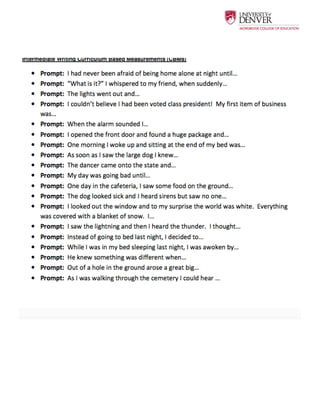
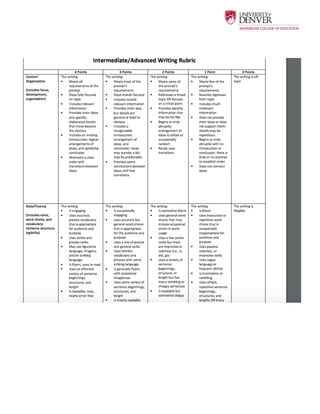
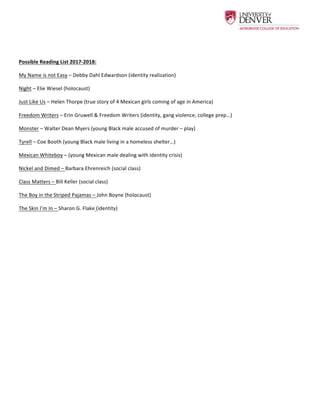
  • 12.
      10   Objective:  SWBAT  self  assess  themselves  and  construct  a  rubric,  in  writing,  while   rationalizing  what  is  crucial  to  include  in  their  writing  and  understand  what  aspects   are  essential  to  present  to  their  peers,  while  using  correct  sentence  structure.       Rationale:  It  is  important  for  students  to  understand  what  they  will  be  graded  on,   as  well  as  understanding  what  is  important  to  know  and  include  when  presenting   to  an  audience.  Student  will  need  this  to  prepare  for  college  in  order  to   understand  rubrics  and  why  they  are  essential.     Active  Engagement  Strategy:  Students  will  create  a  rubric  where  they  explain   what  they  believe  they  should  be  graded  on  while  writing  the  letter  and  when   presenting  their  letter  to  their  peers.  (Individual  activity  then  whole  group  share   out)     Performance  Task  Rubric         11   Objective:  SWBAT  utilize  historical  evidence,  in  writing,  to  provide  context  for  the   issues  students  will  be  discussing  and  to  compare  and  contrast  the  issues  that  are   happening  today  and  those  of  the  past,  all  while  using  comparative  adjectives.     Rationale:  Students  will  be  using  historical  evidence  to  compare  and  contrast  the   issues  that  have  happened  in  the  past  to  the  issues  happening  today.  This  will  also   help  students  understand  how  to  write  on  a  college  level  by  using  evidence  to  back   up  their  ideas  and  thoughts.     Active  Engagement  Strategy:          Imagine  you  are  writing  a  letter  to  the  President  of  the  United  States.  In  this   letter,  you  will  be  discussing  a  problem  in  today’s  society  that  you  want  to  change,   whether  that  be  social  justice  issues,  socioeconomic  issues,  etc.  You  will  formulate   an  argument  about  why  this  issue  should  be  changed,  how  it  is  negatively  affecting   our  society  and  how  you  plan  to  change  this  specific  issue.          You   are   expected   to   utilize   evidence   from   the   various   historical   texts   that   we   have   been   analyzing,   all   while   following   the   ACEIT-­‐CIET   model   for   this   letter.   Historical  evidence  will  be  used  to  provide  context  for  the  issues  students  will  be   discussing  and  to  compare  and  contrast  the  issues  that  are  happening  today  and   those  of  the  past.  All  letters  will  be  shared  out  to  peers  in  small  groups  once  letters   are  complete.      (Individual  assessment  then  small  group  activity)       Performance  Task  Day:    Letter   to  the  President  of  the  U.S.  &   share  letters  out  to  peers.       12   Objective:  SWBAT  summarize  their  thoughts  and  understandings  of  the   performance  task  and  the  purpose  of  utilizing  historical  evidence  to  provide   evidence  in  one’s  writing,  while  using  common  and  collective  nouns  and  verbs.     Rationale:  Students  will  be  able  to  openly  reflect  on  the  performance  task  and   through  this  reflection,  students  will  understand  how  important  it  is  to  utilize   evidence  to  back  up  their  writing.     Reflection  Questions  (Exit   Ticket)    
  • 13.
      Active  Engagement  Strategy:  (open  reflection)  Explain  what  you  loved  about  this   entire  unit,  what  you  learned  and  explain  to  me  if  you  will  actually  try  to  change   the  issue  you  wrote  about  (how  and  why?)  Also,  include  feedback  on  what  can  be   changed  for  next  time.  (Individual  then  whole  group  share  out)                                              
  • 14.
      Lesson  Plan  Template   I.   Pre-­‐Assessment  Data   Guiding  Questions:  What  do  students  already  know  about  this  topic?  What  data  (formal  or  informal)  is   available?   In  this  10th  grade  English  class,  we  have  just  begun  our  unit  on  analyzing  historical  artifacts  and  relating  them  back  to   our  everyday  life.  Prior  to  starting  the  lesson,  the  students  already  had  an  informal  understanding  of  the  justice  system   and  the  “good  vs.  bad”  that  happens  through  our  justice  system,  as  well  as  through  our  everyday  lives.  Students  will  be   connecting  the  news  article  we  will  be  reading  to  historical  texts  that  we  have  read  from  the  Civil  Rights  Movement,  as   well  as  compare  and  contrast  the  two.     II.   Content  and  Language  Objective  *Must  be  conveyed  to  students   Guiding  Question:  What  will  students  be  able  to  do  at  the  end  of  today’s  lesson?  How  will  this  support   language  development?   ¨  Describe  ¨  Explain  ¨  Apply  ¨  Analyze  ¨  Compare  ¨  Evaluate  ¨  Defend  ¨  Create¨  Interpret  ¨   Formulate   CLO:  Students  will  be  able  to  theorize  and  identify  patterns,  in  writing,  why  different  issues  happening  in  our  society   are  the  same  issues  that  have  been  happening  in  the  past,  all  while  using  questions  with  increasing  specificity.           Standard:  CCSS.ELA-­‐LITERACY.SL.11-­‐12.1.B   Work  with  peers  to  promote  civil,  democratic  discussions  and  decision-­‐making,  set  clear  goals  and  deadlines,  and   establish  individual  roles  as  needed.     Key   Vocabulary:     Public  Defender,  Problem,  Solution,  Civil  Rights  Movement       III.   Rationale  *  Must  be  conveyed  to  students   Guiding  Questions:  Why  is  this  important  to  students?  How  is  this  related  to  unit  goals,  essential  questions,  or   relevant  standards?  How  does  this  connect  to  students’  real  lives  and  cultures?     Rationale:  In  order  for  students  to  understand  the  intensity  of  the  issues  happening  in  our  world,  students  need  to   identify  how  important  the  problems  are  and  how  they  connect  to  the  past  and  history  of  the  world  as  well,  by   connecting  this  to  their  everyday  lives.       IV.   Assessment  *  Must  be  conveyed  to  students   Guiding  Questions:  How  will  you  measure  students’  progress  toward  the  objective?  Will  the  data  you  gather  
  • 15.
      allow  you  to  differentiate  future  instruction?   Read  and  Annotate:  “When  the  Public  Defender  Says,  ‘I  Can’t  Help’”  By  Derwyn  Bunton     Students  will  circle  words  they  might  not  understand  and  underline  sentences  that  they  find  interesting.  Write   question  or  comments  in  the  margins.  Use  cornell  notes  to  write  notes  about  article,  if  they  would  prefer  to.     Active  Engagement  Strategy:  Planning  Committee:     Students   will   get   into   groups   of   3   –   4   and   imagine   that   they   are   in   a   planning   committee.   They   will   brainstorm   a   solution   to   the   issue   at   hand   stated   in   the   article.   Explain   how   you   would   change   the   issue   and   prevent   it   from   happening  again.    Students  will  prepare  a  skit  pretending  to  be  the  planning  committee  and  reveal  their  plan  of  change   to  the  community  members.  Students  can  use  white  boards  as  a  tool  if  they  would  like  to  write  down  their  thoughts.           V.   Differentiation   Guiding  Questions:  How  will  you  use  data  to  intentionally  group  students  according  to  skills/readiness?  What   choice  will  students  have  in  the  process  or  product  associated  with  this  lesson?     Students  will  do  a  “do  now”  in  the  beginning  of  class  then  share  out  to  their  table  partners.  Students  will  read  an  article   individually  and  annotate  the  article,  then  get  into  small  groups  to  be  in  a  planning  committee,  then  prepare  a  skit  to   share  with  the  class.  Once  they  are  done,  they  will  do  an  exit  ticket  for  a  check  for  understanding  at  the  end  of  class.         VI.   Lesson  Components   ü   Active  Engagement  Strategies   ü   Oral  language  development   ü   Cooperative  learning   ü   Critical  thinking   ü   Arts  Integration     ü   Checks  for  understanding   ü   Frequent  feedback   ü   Student  voice  and  choice   ü   Scaffolding       ü   Strategies  to  support  ELLs   o   Visual  supports   o   Explicit  vocabulary   o   Realia   o   Native  language  support   Component   Time   requi red  
  • 16.
      A.   Lesson  Introduction:  ‘Hook’  students  into  content.  Explain  objective,  rationale,  and  assessment     DO  NOW:  List  2  things  you  would  like  to  change  about  the  justice  system.  Please  explain  why  you  want  to  change   these  things.  Please  try  to  relate  this  to  the  other  articles  that  we  have  read,  by  giving  examples  from  them.   Students  should  be  prepared  to  share  out  their  answers  to  their  table  members.       Objective:  SWBAT  theorize  and  identify  patterns,  in  writing,  why  different  issues  happening  in  our  society  are  the   same  issues  that  have  been  happening  in  the  past,  all  while  using  questions  with  increasing  specificity.           Rationale:  In  order  for  students  to  understand  the  intensity  of  the  issues  happening  in  our  world,  students  need  to   identify  how  important  the  problems  are  and  how  they  connect  to  the  past  and  history  of  the  world  as  well,  by   connecting  this  to  their  everyday  lives.       Read  and  Annotate:  “When  the  Public  Defender  Says,  ‘I  Can’t  Help’”  By  Derwyn  Bunton     -­‐Number  the  paragraphs,  find  the  author,  publisher  (if  possible)  and  date.     -­‐Students  will  circle  words  they  might  not  understand  and  underline  sentences  that  they  find  interesting.     -­‐Write  question  or  comments  in  the  margins.  Use  cornell  notes  to  write  notes  about  article  as  well.       Active  Engagement  Strategy:  Planning  Committee:     Students  will  get  into  groups  of  3  –  4  and  imagine  that  they  are  in  a  planning  committee.  They  will  brainstorm  a   solution  to  the  issue  at  hand  stated  in  the  article.  Explain  how  you  would  change  the  issue  and  prevent  it  from   happening  again.    Students  will  prepare  a  skit  pretending  to  be  the  planning  committee  and  reveal  their  plan  of   change  to  the  community  members.  Students  can  use  white  boards  as  a  tool  if  they  would  like  to  write  down  their   thoughts.                       10   min                       25   min             50   min   B.   Body  of  Lesson   Think  about  management:  ¨  Precise  Directions  ¨  Positive  Narration  ¨  Whole-­‐class  Incentives    ¨Discipline  Hierarchy      
  • 17.
        Teacher  Does…     -  Gives  precise  directions  about  what  is  expected   of  them  while  completing  the  do  now   activity,  reading  and  annotating  the  article,   the  planning  committee  activity/skit  and  the   exit  ticket.     -  Explains  that  the  class  is  a  safe  environment   and  students  must  give  each  student   respect,  especially  when  they  are  sharing   their  do  nows  and  their  planning  committee   ideas.             Students  Do…   •   Raise  hands  when  wanting  to  answer  a  question   •   Participate  throughout  the  class  period  (both  in   small  and  whole  group  discussion)   •   Remember  the  classroom  is  a  safe  space  and  to   be  respectful  to  your  peers       -   Do  Now     -   Read  &  Annotate     -   Planning  Committee/Skit     -   Exit  Ticket     We  do…     •   Respect  each  other  and  listen  to  each  other,   especially  during  the  do  now  activity     •   Read  and  Annotate  the  article  “When  the  Public   Defender  Says,  ‘I  Can’t  Help’”  By  Derwyn   Bunton   -   Give  a  thoughtful  answer  for  the  emjoi  exit   ticket     C.   Closing:  Review  progress  toward  objective  (may  include  student  self-­‐assessment)      EMJOI  EXIT  TICKET.    Assess  Yourself:  Rate  your  understanding  of  today’s  objective     Explain  what  level  you  believe  you  are,  in  analyzing  and  understanding  the  texts  that  we  have  been  reading.   (Advanced,  Proficient,  Developing  or  Unsatisfactory)  then  explain  what  we  can  do  to  help  you  better  understand   these  texts.  (resources?  Examples  of  annotated  texts,  etc.)             ALSO  ANSWER  THE  FOLLOWING  QUESTION:     How  did  today’s  activity  align  with  our  objective  for  today?  Did  we  discuss  how  different  issues  happening  in  our   society  are  the  same  issues  that  have  been  happening  in  the  past?  Explain  these  issues  and  how  they’re  similar.     5  min  
  • 18.
      Materials  and  Resources  Needed     -­‐Article  “When  the  Public  Defender  Says,  ‘I  Can’t  Help’”   By  Derwyn  Bunton     -­‐White  boards  and  markers.     Extension  of  Learning  (e.g.,  homework)     No  homework.           Lesson  Plan  Template   VII.  Pre-­‐Assessment  Data   Guiding  Questions:  What  do  students  already  know  about  this  topic?  What  data  (formal  or  informal)  is  available?   We  have  been  reading  various  articles  from  the  Civil  Rights  Movement  and  current  articles  discussing  social  justice  issues.   Students  in  my  10th  grade  English  Literature  class  already  have  prior  knowledge  about  what  has  happened  during  the  Civil   Rights  Movement  because  they  have  already  learned  it  in  their  history  or  civics  classes  at  George  Washington  High  School.   This  unit  is  relatively  new  and  this  lesson  is  going  to  be  used  to  introduce  the  unit  and  help  students  understand  different   perspectives  and  empathize  with  others.     VIII.   Content  and  Language  Objective  *Must  be  conveyed  to  students   Guiding  Question:  What  will  students  be  able  to  do  at  the  end  of  today’s  lesson?  How  will  this  support  language   development?   ¨  Describe  ¨  Explain  ¨  Apply  ¨  Analyze  ¨  Compare  ¨  Evaluate  ¨  Defend  ¨  Create¨  Interpret  ¨  Formulate     CLO:  Students  will  be  able  to  explore  their  identity,  in  writing,  while  trying  to  relate  their  personal  life  stories  to  the  texts   we  have  read  and  analyzed,  by  using  indirect/direct  object  pronouns  and  correct  subject/verb  agreement.     Standard:  CCSS.ELA-­‐LITERACY.SL.9-­‐10.1.D   Respond  thoughtfully  to  diverse  perspectives,  summarize  points  of  agreement  and  disagreement,  and,  when  warranted,   qualify  or  justify  their  own  views  and  understanding  and  make  new  connections  in  light  of  the  evidence  and  reasoning   presented.     Key   Vocabulary:     Identity  and  Civil  Rights  Movement,  Perspective,  Empathize      
  • 19.
      IX.   Rationale  *  Must  be  conveyed  to  students   Guiding  Questions:  Why  is  this  important  to  students?  How  is  this  related  to  unit  goals,  essential  questions,  or   relevant  standards?  How  does  this  connect  to  students’  real  lives  and  cultures?     As  students  are  relating  their  personal  life  to  the  texts  we  have  read,  they  are  starting  to  familiarize  themselves  with   different  perspectives  and  understanding  another  person’s  point  of  view  by  empathizing  with  them.  This  helps  students   make  connections  to  their  everyday  lives  and  family  culture  as  well.   X.   Assessment  *  Must  be  conveyed  to  students   Guiding  Questions:  How  will  you  measure  students’  progress  toward  the  objective?  Will  the  data  you  gather  allow   you  to  differentiate  future  instruction?     “I”  Poem:    Students  will  create  an  “I”  poem;  they  can  choose  to  use  the  template  provided  or  free  write  a  poem  about   their  identity  and  try  to  relate  their  personal  life  stories  to  the  texts  we  have  read  and  analyzed.  (Individual  Activity  and   then  share  out  or  do  turn  and  talk).     Students  will  create  an  “I”  poem  that  discusses  who  they  are  as  a  person,  then  do  a  turn  and  talk  with  a  partner.       XI.   Differentiation   Guiding  Questions:  How  will  you  use  data  to  intentionally  group  students  according  to  skills/readiness?  What   choice  will  students  have  in  the  process  or  product  associated  with  this  lesson?     There  will  be  an  individual  “do  now”  activity  first.  Then,  students  will  have  the  choice  to  either  use  the  “I”  Poem  template   or  free  write  the  poem;  this  will  be  an  individual  activity  for  the  first  30  minutes,  then  it  will  turn  into  a  turn  and  talk  for   about  10  minutes.  Once  students  are  done,  I  will  ask  for  volunteers  to  share  out  their  “I”  poems  to  the  class  during  a   whole  group  discussion.       XII.  Lesson  Components   ü   Active  Engagement  Strategies   ü   Oral  language  development   ü   Cooperative  learning   ü   Critical  thinking   ü   Arts  Integration     ü   Checks  for  understanding   ü   Frequent  feedback   ü   Student  voice  and  choice   ü   Scaffolding       ü   Strategies  to  support  ELLs   o   Visual  supports   o   Explicit  vocabulary   o   Realia   o   Native  language  support  
  • 20.
      Component   Time   requi red   D.   Lesson  Introduction:  ‘Hook’  students  into  content.  Explain  objective,  rationale,  and  assessment     DO  NOW:     Students  will  have  5  minutes  to  quick  write  and  finish  the  following  sentence:  What  people  do  not  understand   about  my  culture  is…?       Once  students  are  done,  we  will  do  a  turn  and  talk  and  have  students  share  out  their  statements  for  5  minutes.       Objective:  SWBAT  explore  their  identity,  in  writing,  while  trying  to  relate  their  personal  life  stories  to  the  texts  we   have  read  and  analyzed,  by  using  indirect/direct  object  pronouns  and  correct  subject/verb  agreement.     Rationale:  As  students  are  relating  their  personal  life  to  the  texts  we  have  read,  they  are  starting  to  familiarize   themselves  with  perspectives  and  understanding  another  person’s  point  of  view  by  empathizing  with  them.  This   helps  students  make  connections  to  their  everyday  lives  and  family  culture  as  well.             Active  Engagement  Strategy:  “I”  Poem     Students  will  create  an  “I”  poem;  they  can  choose  to  use  the  template  provided  or  free  write  a  poem  about  their   identity  and  try  to  relate  their  personal  life  stories  to  the  texts  we  have  read  and  analyzed.  (Individual  Activity  and   then  share  out  or  do  turn  and  talk)               10   min                                   30   min   E.   Body  of  Lesson  
  • 21.
      Think  about  management:  ¨  Precise  Directions  ¨  Positive  Narration  ¨  Whole-­‐class  Incentives    ¨Discipline  Hierarchy         Teacher  Does…     -  Gives  precise  directions  about  what  is  expected   of  them  while  completing  the  do  now   activity,  “I”  poem,  and  the  exit  ticket.     -  Explains  that  the  class  is  a  safe  environment   and  students  must  give  each  student   respect,  especially  when  they  are  sharing   their  do  nows  and  “I”  poems.         Students  Do…   •   Raise  hands  when  wanting  to  answer  a  question   •   Participate  throughout  the  class  period  (both  in   small  and  whole  group  discussion)   •   Remember  the  classroom  is  a  safe  space  and  to   be  respectful  to  your  peers       -   Do  Now     -   “I”  Poem   -   Exit  Ticket         We  do…     •   Respect  each  other  and  listen  to  each  other,   especially  during  the  do  now  activity     •   Try  your  best  to  make  the  “I”  poem  personal   and  have  it  reflect  your  identity     •   Give  a  thoughtful  answer  for  the  journal  entry   (exit  ticket)           F.   Closing:  Review  progress  toward  objective  (may  include  student  self-­‐assessment)     Exit  Ticket:  Journal  Entry       In  one  paragraph,  explain  what  you  learned  about  yourself  and  your  peers  through  this  activity.  Did  this  activity   help  you  empathize  with  anyone  or  help  you  see  other  perspectives  other  than  your  own?  Provide  examples  if   possible  and  use  pseudonyms  (fake  names)  if  you  would  feel  more  comfortable.         10   min  
  • 22.
      Materials  and  Resources  Needed     “I”  Poem  template     Extension  of  Learning  (e.g.,  homework)     No  homework  will  be  given.          
  • 23.
          © Freeology.com I Am Poem I am ______________________________________________________________ (Two special characteristics) I wonder ___________________________________________________________ (Something you are curious about) I hear _____________________________________________________________ (An imaginary sound) I see ______________________________________________________________ (An imaginary sight) I want _____________________________________________________________ (A desire you have) I am ______________________________________________________________ (The first line of the poem repeated) I pretend ____________________________________________________________ (Something you pretend to do) I feel _____________________________________________________________ (A feeling about something imaginary) I touch _____________________________________________________________ (An imaginary touch) I worry _____________________________________________________________ (Something that bothers you) I cry _____________________________________________________________ (Something that makes you sad) I am _____________________________________________________________ (The first line of the poem repeated) I understand _______________________________________________________ (Something you know is true) I say _____________________________________________________________ (Something you believe in) I dream _____________________________________________________________ (Something you dream about) I try _____________________________________________________________ (Something you make an effort on) I hope _____________________________________________________________ (Something you hope for) I am _____________________________________________________________ (The first line of the poem repeated)
  • 24.
      7 Reasons WhyGentrification Hurts Communities of Color September 12, 2014 by Patricia Valoy When I was growing up in East New York, Brooklyn in the early 90s, most residents were Black or Latinx. Today, the demographics are still about the same, and very little has changed about the neighborhood. I distinctly remember noticing that there were no white people that lived near me and that the neighborhoods that had a large percentage of white residents were simply better: They had better schools, nicer streets, more businesses, less crime, and no visible drug use. It was everything I wanted my neighborhood to be. As ashamed as I am to admit this now, I assumed that the only way neighborhoods could be bettered is by having white residents, so I hoped that my neighborhood would become like Williamsburg, Brooklyn. At the time, Williamsburg was rapidly changing, and what used to be dirty streets and run-down businesses were now tree-lined blocks and shiny Starbucks. What I failed to understand then was that the gentrification of neighborhoods might make the space look better, but my family would never be able to afford the price of living there. Although my childhood neighborhood is still far from gentrification due to its distance from New York City and history of gang violence, drug use, and poverty, things seem to be changing, as this real estate listing demonstrates by calling East New York “the new frontier.” Gentrification is new-wave colonialism, and it has economic, societal, and public health repercussions for poor communities of color. Many times when wealthy people move into a low-income neighborhood, they truly want to help. Oftentimes, they even start community programs and become leaders in the
  • 25.
      community, often throughbeautification projects. And while I get why this seems to be good at first glance, it really isn’t. When neighborhoods are gentrified, those moving in are looking for cheap rent and the ability to make a better life for themselves. And while wealthier people may feel entitled to buy or rent wherever they wish (as is indeed their right), they must also understand the consequences of their actions. As our neighborhoods become “up-and-coming areas” that “evoke images of burned-out buildings, riots, and poverty,” the people that lived there through the poverty and disrepair deserve to stay in their homes and have a community that supports their needs. We need to understand that gentrification isn’t about beautifying neighborhoods and making them safer. It is the systematic displacement of people of color from their homes. Gentrification hurts communities of color, and these are some of the ways how. 1. As wealthier people move into poor neighborhoods, landlords raise their rents to cash in from the wealth of the new influx of residents. As this study states, the median rent prices in New York City rose 75% since 2001. This same trend can be seen in other neighborhoods that have currently become gentrified, like Oakland, California. It’s common to see landlords bully low-income tenants into moving out by not maintaining apartments or not renewing their lease, forcing residents to move out. I’ve seen this happen to many of my relatives that moved to New York City in the early 70s and settled in the Lower East Side and Soho neighborhoods of lower Manhattan. While these areas are now the first choice of home for celebrities and ritzy events like the TriBeCa Film Festival, they were previously filled with tenement buildings and low-income housing. One of my aunts who still lives in what is now the very trendy Soho pays for all repairs and upgrades in her apartment, as the building owners refuse to do so in an effort to bully her into leaving and renting her apartment at a much higher cost. Yes, it’s illegal, but they know she could never afford a lawyer.
  • 26.
      None of herneighbors remain, and none of the local businesses she frequented are still the same. Even her local church no longer offer services in her language. I ask her often why does she remain, although I know the answer: That’s her home! Poor people of color living in gentrified neighborhoods find themselves between a rock and a hard place. They are often unable to move because they could never afford housing elsewhere, but are constantly pushed to the limit by landlords looking to rent at higher prices. It’s illegal, but that doesn’t help a person who does not understand the law or hire someone to help them navigate the legal system. Many of these communities are comprised of immigrants that have lived in the United States for decades, yet have no resources left in their communities. They face language, cultural, and societal barriers that set them at a disadvantage next to real estate companies and developers. 2. Local businesses suffer as large competitors start opening shops in what were previously undesired locales. If wealthier residents are moving into a low-income neighborhood, it follows that they will spend more on local businesses and generate more profit for them. Yet, unfortunately, this is rarely the case. Businesses have a hard time catering to two different types of clientele, though they often try to do so. It’s common to see grocery stores start selling a wider variety of products to attract new residents, but few actually see the increase in profits they thought they would because new residents often shop in places they feel more comfortable in. Likewise, new businesses that open up specifically to cater to the new residents bring new competition to the old ones, further straining the local community. New businesses open to cater to the wealthier residents of the neighborhood and existing shops are forced to either a) change their practices to appeal to new residents and survive or b) stick with their old clientele and likely lose their business. Additionally, rent increases affect businesses as much as they do low-income residents.
  • 27.
      The only businessesthat can thrive under these circumstances are large corporations like Whole Foods. Whole Foods, unlike other local supermarkets, attract a new set of people and completely changes a neighborhood. This is evident in the way Whole Foods changed the neighborhood of Jamaica Plain in Boston. While Jamaica Plain already had a large and affordable supermarket called Hi-Lo, open since 1964 and known for selling Latin American products, it couldn’t compete with Whole Foods. Needless to say, Hi-Lo had to close because it could not keep up with Whole Foods, and just like that, low-income residents of Jamaica Plain were left without a place to shop for groceries that were affordable and culturally relevant. As this article states, “That’s because Hi-Lo and Whole Foods aren’t just stores, they’re ideas that lead to similar ideas, and attract people who identify with those ideas in cyclical fashion.” 3. People of color are criminalized because new people feel ‘in danger.’ People of color, and especially Black people, are often perceived as dangerous and thuggish. As the recent shooting of Mike Brown – an unarmed young Black man in Ferguson, Missouri – further proves, the stereotyping of racial minorities has dangerous consequences. Black and Latino men are disproportionately arrested, especially for marijuana use and distribution, while white men who do the same are celebrated. And we can’t assume that justice is the same for everyone. In this article, un-ironically titled “I Spent a Day Delivering Weed in New York City,” the author repeatedly states that these are not your “normal” drug dealers, therefore, not a threat to your safety. Our neighborhoods are often the only place where we can feel at home, but as neighborhoods get gentrified, activities such as panhandling and sleeping in public places become criminalized, too. While not having poor people live on your streets might be a priority for wealthier residents, the response should be to help them, not arrest them.
  • 28.
      If people ofcolor are getting arrested for everything from drug use to being poor, I don’t think it’s safe to say that gentrification is improving our neighborhoods and making them safer. The reality is that the incarceration of Black and Brown men create the illusion of safety for white residents, but it’s a sense of security based on stereotypes of Black and Brown men being thugs, criminals, and dangerous. The need to feel safe, which is an absolute human right, is a necessity, but the way we achieve that in gentrified neighborhoods is missing the mark. Crime happens because former residents of gentrified neighborhoods live in poverty and suffer from lack of resources and poor educational and health services. 4. New developments are profit-driven and not community-driven. Gentrification is driven by the private sector. Close-knit communities thrive on socially conscious business practices that benefit everyone. Local shops often allow families to shop on credit and use public assistance funds without shame. Communities often get together for block parties and potlucks, and in general, there is a sense that you will be taken care of. But when newcomers see existing residents as dangerous, this feeling of community is hampered. In my childhood neighborhood, I would often babysit and tutor younger children that lived near me. Although some parents would give me some form of payment, I did it because it was the only way to serve my community – a community that had few affordable childcare centers and no tutoring services. It was a community, as imperfect as it may be. Today, I live in a different neighborhood – one that is far more gentrified than the place where my family still lives, and a lot less reassuring. I have a dog park, a Planet Fitness, a yoga studio, and a coffee shop all within reach, but I have neighbors I have never met, and I could never ask my local grocer to give me a loaf of bread on credit.
  • 29.
      And I willbe sincerely honest: I absolutely love that every Sunday, I have a community garden where I can go shop for local and organic produce and walk one block back to my apartment. But it will never compare to the free hot dogs I ate while playing near the fire hydrant on a hot summer day in Brooklyn. 5. Children’s education suffers. Children who live in areas of concentrated poverty never fare well. They often have low graduation rates and deal with constant violence. So it follows that gentrification should improve the lives of poor children of color. There is no denying that diverse schools, both economically and racially, are a good learning space for all children. When children are exposed to a variety of individuals, they have a better understanding of the world. However, what happens to neighborhoods also happens to schools. As former residents are pushed out, so are the children attending local schools, which disturbs their learning process. While schools do tend to improve and start providing amenities that children benefit from with the increase in capital coming in from the higher income of new residents, few minority children stick around to enjoy these perks. With poverty rates for children at a staggering 22% in the United States, it’s important to make sure that all amenities and community programs that come with gentrification are also available to poor residents. Yet with the profit-driven model that arises as communities are gentrified, it’s unlikely that any children will benefit from gentrification. Children succeed when their parents are capable of providing for them. When parents are unable to afford their own neighborhood amenities, their children start seeing the difference along racial and social barriers and internalize it. 6. Culture shifts, and communities lose their safety net. Vibrant communities that rely on social networking are torn apart with gentrification.
  • 30.
      Neighbors that peopleonce relied on move out, and services that were beneficial to the community are replaced. For those that stay, they become outsiders in their own communities. In a similar manner, communities that have historically banded to build a community through strife – like Black people in Harlem, New York and Latinxs in the Mission District of San Francisco – begin to see their tight-knit and flourishing communities disbanded. This is evident in the way Vogue categorically dismissed the neighborhood of Bushwick in Brooklyn as a “disfavored neighborhood.” A year later — and a lot more white and affluent residents to sell magazines to — it’s the 7th coolest neighborhood, due in part to the new influx of white artists to the previously “grimy, industrial Bushwick.” Yet Bushwick already had a thriving community of artists all along, and it’s where celebrities such as Rosie Perez and Eddie Murphy hailed from. While it’s understandable that communities can (and do!) change as time passes, their histories must be protected. After all, we still associate Plymouth Rock and lower Manhattan with Dutch settlers, and that was over 500 years ago. The truth is that new developments and fancy coffee shops will never replace the social network that helped local residents survive. 7. Public health of residents suffers. Residents that fear being displaced and losing their social network are under a lot of stress. Those who want to remain grapple with rising rent and food prices, while those that leave lose a lot of their hard-earned capital. Disparities in health become acute when neighborhoods change rapidly and existing marginalized communities are pushed to the peripheries. External problems manifest themselves in mental and physical health issues, such as anxiety and depression, or high blood pressure and heart problems.
  • 31.
      The psychological effectsof losing one’s tight-knit community and deep social links can be traumatizing for some. It’s important to note that gentrification doesn’t just affect our views; it affects our perceptions and mentality. Public health programs must address issues that displaced people deal with daily, from lack of access to affordable healthy food to subpar housing. *** Neighborhoods are not static. They change through the years, and there is nothing wrong with an organic shift in the demographics of a neighborhood. But it shouldn’t happen at the expense of poor people and people of color. Poor communities of color have spent years battling disinvestment and abandonment, but redevelopment only seems to occur when white and wealthy people move into a neighborhood. It’s important to keep in mind that gentrification might make a neighborhood beautiful, but only for a select few people. If we truly believe in improving and redeveloping our neighborhoods, we must do so for everyone – regardless of social, racial, or economic status.
  • 32.
      http://money.cnn.com/2015/11/12/news/economy/gentrification-may-help-poor-people/ How gentrification maybenefit the poor Gentrification has long been a dirty word for forcing poor people out of neighborhoods across U.S. cities. When a poor neighborhood attracts higher income residents, expensive cafes and pricy vintage clothing stores move in, making daily living more expensive. The narrative is that gentrification displaces low income residents and in the worst case scenario ​causes homelessness​. Now, a new storyline is emerging that shows that it isn't fair to blame gentrification for displacing low income residents and that there might actually even be some benefits. A study by the ​Philadelphia Federal Reserve​ recently concluded that poor people are no more likely to move out of a gentrifying neighborhood than from a non-gentrifying one. That doesn't mean low income people are not pushed out of their neighborhoods. They are just not more likely to be displaced than a person of similar income in a neighborhood that's not gentrifying. Experts say there are may even be some benefits for the low-income residents that decide to stay in gentrifying neighborhoods. -- New job opportunities emerge as more stores open and construction picks up. -- Longtime homeowners benefit from rising property values. -- There's often a decline in crime. -- On average, credit scores of the poor residents improve in gentrifying neighborhoods.  
  • 33.
      The Opinion Pages| OP-ED CONTRIBUTOR When the Public Defender Says, ‘I Can’t Help’ By DERWYN BUNTONFEB. 19, 2016 New Orleans — ON an ordinary day, the Criminal District Court here begins with a parade of handcuffed and shackled defendants being led out from cages behind the judge’s bench by sheriff’s deputies. They are clad in orange jumpsuits and are almost exclusively African-American men. They rattle and shuffle their way onto benches and into the empty jury box, waiting for the judge. When their case is called, a lawyer from the public defender’s office will rise and say: “Your Honor, we do not have a lawyer for this person at this time.” Eight-five percent of these defendants are unable to afford their own lawyer and will need a public defender to represent them. But in New Orleans, where I am in charge of the public defender’s office, we simply don’t have enough lawyers to handle the caseload. Last month, we began refusing new cases. In a state with one of the nation’s highest poverty rates, the system to defend the poor is broken. To understand why, look at the other people in the courtroom sitting on benches set aside for the audience. Most of these people aren’t there to watch the proceedings. Many were subpoenaed for failing to pay fines or fees for minor offenses and had to take time from work to appear in court or be charged with contempt. Those fines and fees pay for two-thirds of the Louisiana public defender system. The rest comes from the state. It is not an exaggeration to say that fines from traffic offenses, which, in Louisiana, can result in jail time, play a big part in determining whether one of those men in the orange jumpsuits receives an adequate defense required by the Sixth Amendment to the Constitution. Poor people must pay $40 to apply for representation, and an additional $45 if they plead guilty or are found guilty. No other states lean so heavily on fines and fees paid mostly by the poor. And there is a reason for that. The system isn’t working. Louisiana spends nearly $3.5 billion a year to investigate, arrest, prosecute, adjudicate and incarcerate its citizens. Less than 2 percent of that is spent on legal representation for the poor. It is little wonder that Louisiana has the nation’s highest rates of incarceration and exoneration for wrongful convictions.
  • 34.
      Last fall, ata hearing ordered by the Criminal District Court in response to this crisis, years of underfunding by the state were chronicled. Public defenders have weathered more than $5 million in budget cuts over the last five years. For the second time in four years, we have been forced to impose a hiring freeze and, now, have begun turning down cases. In response, judges are ordering private lawyers to take poor clients. Other poor defendants have been left to represent themselves. And in some cases, judges have threatened public defenders with contempt for refusing to take a case. James Dixon, the state public defender, and members of my staff and I filed affidavits and testified about how our workloads had reached unmanageable levels. Many public defenders are unable to visit clients, file motions in a timely manner or conduct the necessary investigations. In fact, our workload is now twice the standard recommended by the American Bar Association. Ellen Yaroshefsky, a professor at Cardozo Law School in New York City and one of three experts who testified, said it was a misnomer to call the New Orleans court system a “justice system.” Professor Yaroshefsky told the judge: “You’re not operating a justice system here. You’re operating a processing system.” While the situation here may sound extreme, overloaded public defenders are struggling across the country. A 2013 study in Missouri provided a snapshot of the problem. For serious felonies, defenders spent an average of only nine hours preparing their cases; 47 hours were needed. For misdemeanors, they spent two hours when 12 hours were necessary. Similar studies are underway in Colorado, Rhode Island, Tennessee and here in Louisiana. “The problem of grossly underfunded public defender organizations with grossly excessive caseloads is a systemic, endemic problem going back 50 years,” said Stephen F. Hanlon, general counsel for the National Association for Public Defense, who is overseeing the current studies. In New Orleans, our decision to refuse new cases didn’t come easily. No one becomes a public defender to tell a poor person, “No, I can’t help you.” But the outcome of an arrest in a shooting at Bunny Friend Park here last November that left 17 people wounded influenced my decision to stop taking cases. A 32-year-old man was arrested in the case and held on $1.7 million bond. He had immediately asserted his innocence but the police said a witness had identified him. His family hired a private lawyer who went to Houston to locate video of the suspect shopping with his girlfriend at the time of the shooting. The charges were dropped. Reading about this case, I realized my office could not have guaranteed the timely retrieval of this important evidence before it would have been routinely erased. That would have left an innocent man to face trial for his life for what was labeled an act of “domestic terrorism” by the mayor of New Orleans. Louisiana needs fundamentally to reform its system of public defense funding. The state needs to arrange adequate and stable financing based on reasoned projections of the workload. Fines and fees, to the extent they exist at all, should act as a supplemental source of financing. The role of the public defender is to protect the innocent, defend the Constitution and demand justice and fairness. But when resources are out of balance, as they are in Louisiana, so is the system. The poor are the ones who are hurt.
  • 35.
      Do Nows:            
  • 36.
                       
  • 37.
                         
  • 38.
          Possible  Reading  List  2017-­‐2018:     My  Name  is  not  Easy  –  Debby  Dahl  Edwardson  (identity  realization)   Night  –  Elie  Wiesel  (holocaust)     Just  Like  Us  –  Helen  Thorpe  (true  story  of  4  Mexican  girls  coming  of  age  in  America)     Freedom  Writers  –  Erin  Gruwell  &  Freedom  Writers  (identity,  gang  violence,  college  prep…)   Monster  –  Walter  Dean  Myers  (young  Black  male  accused  of  murder  –  play)     Tyrell  –  Coe  Booth  (young  Black  male  living  in  a  homeless  shelter…)   Mexican  Whiteboy  –  (young  Mexican  male  dealing  with  identity  crisis)     Nickel  and  Dimed  –  Barbara  Ehrenreich  (social  class)     Class  Matters  –  Bill  Keller  (social  class)     The  Boy  in  the  Striped  Pajamas  –  John  Boyne  (holocaust)   The  Skin  I’m  In  –  Sharon  G.  Flake  (identity)