Kutluhan Utku TÜMEN
2018 / 2019
GLASS AND GLAZE
SEGER FORMULATION
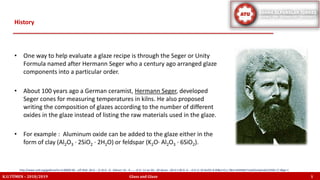
• One way to help evaluate a glaze recipe is through the Seger or Unity
Formula named after Hermann Seger who a century ago arranged glaze
components into a particular order.
• About 100 years ago a German ceramist, Hermann Seger, developed
Seger cones for measuring temperatures in kilns. He also proposed
writing the composition of glazes according to the number of different
oxides in the glaze instead of listing the raw materials used in the glaze.
• For example : Aluminum oxide can be added to the glaze either in the
form of clay (Al2O3 · 2SiO2 · 2H2O) or feldspar (K2O· Al2O3 · 6SiO2).
History
K.U.TÜMEN – 2018/2019 Glass and Glaze 1
http://www.nzdl.org/gsdlmod?e=d-00000-00---off-0hdl--00-0----0-10-0---0---0direct-10---4-------0-1l--11-en-50---20-about---00-0-1-00-0--4----0-0-11-10-0utfZz-8-00&cl=CL1.7&d=HASHb8171ab02a10e3ab23250b.17.2&gt=1
• The products in which the glazes are applied and their firing temperatures are vary. For this
reasons or other as well as the properties sought in the conditions usage and the use of
different raw materials for the same oxide necessitated the emergence of very different
glaze recipes.
• In this case, the glaze formula called SEGER formulation was developed in order to compare
glaze recipes easily with each other in terms of their composition as well as to interpret
them in terms of their melting behavior and usage characteristics.
Definition
K.U.TÜMEN – 2018/2019 Glass and Glaze 2
https://www.researchgate.net/publication/261860212_Glaze_calculation_software_based_on_the_Seger_method_with_recipe_mixing_utilities_limit_formulas_and_toxicity_measurements
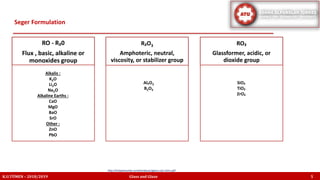
• The oxides used in glazes are divided into three groups according to the way the oxides work in
the glaze.
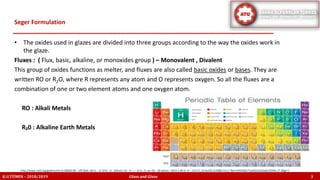
Fluxes : ( Flux, basic, alkaline, or monoxides group ) – Monovalent , Divalent
This group of oxides functions as melter, and fluxes are also called basic oxides or bases. They are
written RO or R2O, where R represents any atom and O represents oxygen. So all the fluxes are a
combination of one or two element atoms and one oxygen atom.
RO : Alkali Metals
R₂0 : Alkaline Earth Metals
Seger Formulation
K.U.TÜMEN – 2018/2019 Glass and Glaze 3
http://www.nzdl.org/gsdlmod?e=d-00000-00---off-0hdl--00-0----0-10-0---0---0direct-10---4-------0-1l--11-en-50---20-about---00-0-1-00-0--4----0-0-11-10-0utfZz-8-00&cl=CL1.7&d=HASHb8171ab02a10e3ab23250b.17.2&gt=1
Stabilizers : ( Amphoteric, neutral, viscosity, or stabilizer group ) – Trivalent
These work as stiffeners in the melted glaze to prevent it from running too much. They are
considered neutral oxides and are writen as R2O3 or two atoms of some element combined with
three oxygen atoms.
R2O3 : Al₂O3 , B2O3
Glass formers : ( Glassformer, acidic, or dioxide group ) – Tetravalent, Pentavalent
These form the non-crystalline structure of the glaze. They are called acidic oxides and are written
as RO2 or one element atom combined with two oxygen atoms.
RO2 : SiO₂ , TiO₂ , ZrO₂
Seger Formulation
K.U.TÜMEN – 2018/2019 Glass and Glaze 4
http://www.nzdl.org/gsdlmod?e=d-00000-00---off-0hdl--00-0----0-10-0---0---0direct-10---4-------0-1l--11-en-50---20-about---00-0-1-00-0--4----0-0-11-10-0utfZz-8-00&cl=CL1.7&d=HASHb8171ab02a10e3ab23250b.17.2&gt=1
Seger Formulation
K.U.TÜMEN – 2018/2019 Glass and Glaze 5
RO - R₂0
Flux , basic, alkaline or
monoxides group
R₂O3
Amphoteric, neutral,
viscosity, or stabilizer group
RO₂
Glassformer, acidic, or
dioxide group
Alkalis :
K2O
Li2O
Na2O
Alkaline Earths :
CaO
MgO
BaO
SrO
Other :
ZnO
PbO
Al₂O3
B2O3
SiO₂
TiO₂
ZrO₂
http://lindaarbuckle.com/handouts/glaze-calc-intro.pdf
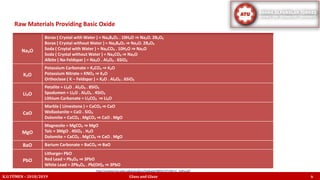
Na₂O
Borax ( Crystal with Water ) = Na₂B₄O₇ . 10H₂O ⇒ Na₂O. 2B₂O₃
Borax ( Crystal without Water ) = Na₂B₄O₇ ⇒ Na₂O. 2B₂O₃
Soda ( Crsytal with Water ) = Na₂CO₃ . 10H₂O ⇒ Na₂O
Soda ( Crystal without Water ) = Na₂CO₃ ⇒ Na₂O
Albite ( Na-Feldspar ) = Na₂O . Al₂O₃ . 6SiO₂
K₂O
Potassium Carbonate = K₂CO₃ ⇒ K₂O
Potassium Nitrate = KNO₃ ⇒ K₂O
Orthoclase ( K – Feldspar ) = K₂O . Al₂O₃ . 6SiO₂
Li₂O
Petalite = Li₂O . Al₂O₃ . 8SiO₂
Spodumen = Li₂O . Al₂O₃ . 4SiO₂
Lithium Carbonate = Li₂CO₃ ⇒ Li₂O
CaO
Marble ( Limestone ) = CaCO₃ ⇒ CaO
Wollastanite = CaO . SiO₂
Dolomite = CaCO₃ . MgCO₃ ⇒ CaO . MgO
MgO
Magnesite = MgCO₃ ⇒ MgO
Talc = 3MgO . 4SiO₂ . H₂O
Dolomite = CaCO₃ . MgCO₃ ⇒ CaO . MgO
BaO Barium Carbonate = BaCO₃ ⇒ BaO
PbO
Litharge= PbO
Red Lead = Pb₃O₄ ⇒ 3PbO
White Lead = 2Pb₃O₄ . Pb(OH)₂ ⇒ 3PbO
Raw Materials Providing Basic Oxide
K.U.TÜMEN – 2018/2019 Glass and Glaze 6
http://content.lms.sabis.sakarya.edu.tr/Uploads/48931/37158/12_.hafta.pdf
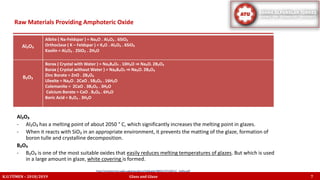
Al₂O₃
- Al₂O₃ has a melting point of about 2050 ° C, which significantly increases the melting point in glazes.
- When it reacts with SiO₂ in an appropriate environment, it prevents the matting of the glaze, formation of
boron tulle and crystalline decomposition.
B₂O₃
- B₂O₃ is one of the most suitable oxides that easily reduces melting temperatures of glazes. But which is used
in a large amount in glaze, white covering is formed.
Raw Materials Providing Amphoteric Oxide
K.U.TÜMEN – 2018/2019 Glass and Glaze 7
http://content.lms.sabis.sakarya.edu.tr/Uploads/48931/37158/12_.hafta.pdf
Al₂O₃
Albite ( Na-Feldspar ) = Na₂O . Al₂O₃ . 6SiO₂
Orthoclase ( K – Feldspar ) = K₂O . Al₂O₃ . 6SiO₂
Kaolin = Al₂O₃ . 2SiO₂ . 2H₂O
B₂O₃
Borax ( Crystal with Water ) = Na₂B₄O₇ . 10H₂O ⇒ Na₂O. 2B₂O₃
Borax ( Crystal without Water ) = Na₂B₄O₇ ⇒ Na₂O. 2B₂O₃
Zinc Borate = ZnO . 2B₂O₃
Ulexite = Na₂O . 2CaO . 5B₂O₃ . 16H₂O
Colemanite = 2CaO . 3B₂O₃ . 3H₂O
Calcium Borate = CaO . B₂O₃ . 6H₂O
Boric Acid = B₂O₃ . 3H₂O
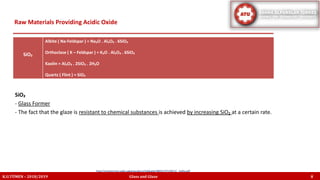
Raw Materials Providing Acidic Oxide
K.U.TÜMEN – 2018/2019 Glass and Glaze 8
http://content.lms.sabis.sakarya.edu.tr/Uploads/48931/37158/12_.hafta.pdf
SiO₂
Albite ( Na-Feldspar ) = Na₂O . Al₂O₃ . 6SiO₂
Orthoclase ( K – Feldspar ) = K₂O . Al₂O₃ . 6SiO₂
Kaolin = Al₂O₃ . 2SiO₂ . 2H₂O
Quartz ( Flint ) = SiO₂
SiO₂
- Glass Former
- The fact that the glaze is resistant to chemical substances is achieved by increasing SiO₂ at a certain rate.
• There are some basic rules for the ratio of oxides in the 3 different groups, according to
glaze temperature. These are called limit formulas. They should only be considered
guidelines, as many glazes exceed the limits in practice.
• Addition of 0.1 part SiO₂ to a glaze will increase the melting point by about 20°C.
• Addition of 0.05 part B₂O₃ will lower the melting point by 20°C .
Seger Formulation
K.U.TÜMEN – 2018/2019 Glass and Glaze 9
http://dx.doi.org/10.1007/978-3-663-06865-5
Calculating the Seger formulation
K.U.TÜMEN – 2018/2019 Glass and Glaze 10
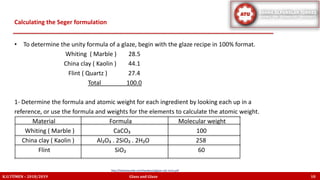
• To determine the unity formula of a glaze, begin with the glaze recipe in 100% format.
Whiting ( Marble ) 28.5
China clay ( Kaolin ) 44.1
Flint ( Quartz ) 27.4
Total 100.0
1- Determine the formula and atomic weight for each ingredient by looking each up in a
reference, or use the formula and weights for the elements to calculate the atomic weight.
Material Formula Molecular weight
Whiting ( Marble ) CaCO₃ 100
China clay ( Kaolin ) Al₂O₃ . 2SiO₂ . 2H₂O 258
Flint SiO₂ 60
http://lindaarbuckle.com/handouts/glaze-calc-intro.pdf
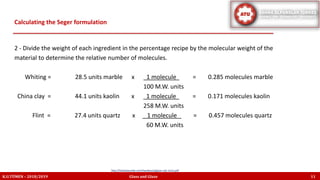
2 - Divide the weight of each ingredient in the percentage recipe by the molecular weight of the
material to determine the relative number of molecules.
Whiting = 28.5 units marble x 1 molecule = 0.285 molecules marble
100 M.W. units
China clay = 44.1 units kaolin x 1 molecule = 0.171 molecules kaolin
258 M.W. units
Flint = 27.4 units quartz x 1 molecule = 0.457 molecules quartz
60 M.W. units
Calculating the Seger formulation
K.U.TÜMEN – 2018/2019 Glass and Glaze 11
http://lindaarbuckle.com/handouts/glaze-calc-intro.pdf
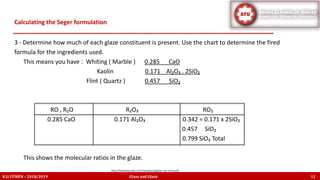
3 - Determine how much of each glaze constituent is present. Use the chart to determine the fired
formula for the ingredients used.
This means you have : Whiting ( Marble ) 0.285 CaO
Kaolin 0.171 Al₂O₃ . 2SiO₂
Flint ( Quartz ) 0.457 SiO₂
RO , R₂O R₂O₃ RO₂
0.285 CaO 0.171 Al₂O₃ 0.342 = 0.171 x 2SiO₂
0.457 SiO₂
0.799 SiO₂ Total
This shows the molecular ratios in the glaze.
Calculating the Seger formulation
K.U.TÜMEN – 2018/2019 Glass and Glaze 12
http://lindaarbuckle.com/handouts/glaze-calc-intro.pdf
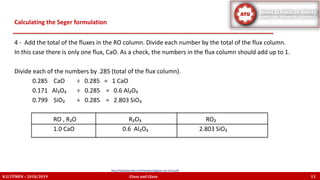
4 - Add the total of the fluxes in the RO column. Divide each number by the total of the flux column.
In this case there is only one flux, CaO. As a check, the numbers in the flux column should add up to 1.
Divide each of the numbers by .285 (total of the flux column).
0.285 CaO ÷ 0.285 = 1 CaO
0.171 Al₂O₃ ÷ 0.285 = 0.6 Al₂O₃
0.799 SiO₂ ÷ 0.285 = 2.803 SiO₂
RO , R₂O R₂O₃ RO₂
1.0 CaO 0.6 Al₂O₃ 2.803 SiO₂
Calculating the Seger formulation
K.U.TÜMEN – 2018/2019 Glass and Glaze 13
http://lindaarbuckle.com/handouts/glaze-calc-intro.pdf
• The purpose of this calculation is to determine what raw materials in what amounts will yield
the ratio of the unity formula.
• A unity formula represents the ratio of molecules of the ceramic oxides present in the glaze.
• A batch recipe gives the raw materials needed and their quantities as weights.
• The purpose of glaze calculation is to determine the total amount of each element present in a
glaze, and the proportions relative to each other.
• It is possible to calculate materials substitutions, revise melting points, and do other useful
calculations.
Calculating the Seger formulation
K.U.TÜMEN – 2018/2019 Glass and Glaze 14
http://lindaarbuckle.com/handouts/glaze-calc-intro.pdf
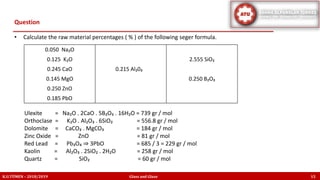
• Calculate the raw material percentages ( % ) of the following seger formula.
Ulexite = Na₂O . 2CaO . 5B₂O₃ . 16H₂O = 739 gr / mol
Orthoclase = K₂O . Al₂O₃ . 6SiO₂ = 556.8 gr / mol
Dolomite = CaCO₃ . MgCO₃ = 184 gr / mol
Zinc Oxide = ZnO = 81 gr / mol
Red Lead = Pb₃O₄ ⇒ 3PbO = 685 / 3 = 229 gr / mol
Kaolin = Al₂O₃ . 2SiO₂ . 2H₂O = 258 gr / mol
Quartz = SiO₂ = 60 gr / mol
Question
K.U.TÜMEN – 2018/2019 Glass and Glaze 15
0.050 Na₂O
0.125 K₂O 2.555 SiO₂
0.245 CaO 0.215 Al₂0₃
0.145 MgO 0.250 B₂O₃
0.250 ZnO
0.185 PbO
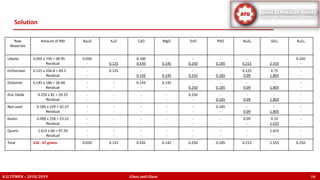
Raw
Materials
Amount of RM Na₂O K₂O CaO MgO ZnO PbO Al₂0₃ SiO₂ B₂O₃
Ulexite 0.050 x 739 = 36.95
Residual
0.050
-
-
0.125
0.100
0.145
-
0.145
-
0.250
-
0.185
-
0.215
-
2.555
0.250
-
Orthoclase 0.125 x 556.8 = 69.5
Residual
-
-
0.125
-
-
0.145
-
0.145
-
0.250
-
0.185
0.125
0.09
0.75
1.805
-
-
Dolomite 0.145 x 184 = 26.68
Residual
-
-
-
-
0.145
-
0.145
-
-
0.250
-
0.185
-
0.09
-
1.805
-
-
Zinc Oxide 0.250 x 81 = 20.25
Residual
-
-
-
-
-
-
-
-
0.250
-
-
0.185
-
0.09
-
1.805
-
-
Red Lead 0.185 x 229 = 42.37
Residual
-
-
-
-
-
-
-
-
-
-
0.185
-
-
0.09
-
1.805
-
-
Kaolin 0.090 x 258 = 23.22
Residual
-
-
-
-
-
-
-
-
-
-
-
-
0.09
-
0.19
1.625
-
-
Quartz 1.615 x 60 = 97.50
Residual
-
-
-
-
-
-
-
-
-
-
-
-
-
-
1.625
-
-
-
Total 316 . 47 grams 0.050 0.125 0.245 0.145 0.250 0.185 0.215 2.555 0.250
Solution
K.U.TÜMEN – 2018/2019 Glass and Glaze 16
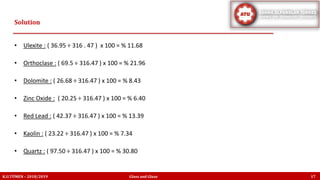
• Ulexite : ( 36.95 ÷ 316 . 47 ) x 100 = % 11.68
• Orthoclase : ( 69.5 ÷ 316.47 ) x 100 = % 21.96
• Dolomite : ( 26.68 ÷ 316.47 ) x 100 = % 8.43
• Zinc Oxide : ( 20.25 ÷ 316.47 ) x 100 = % 6.40
• Red Lead : ( 42.37 ÷ 316.47 ) x 100 = % 13.39
• Kaolin : ( 23.22 ÷ 316.47 ) x 100 = % 7.34
• Quartz : ( 97.50 ÷ 316.47 ) x 100 = % 30.80
Solution
K.U.TÜMEN – 2018/2019 Glass and Glaze 17
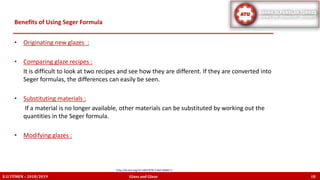
• Originating new glazes :
• Comparing glaze recipes :
It is difficult to look at two recipes and see how they are different. If they are converted into
Seger formulas, the differences can easily be seen.
• Substituting materials :
If a material is no longer available, other materials can be substituted by working out the
quantities in the Seger formula.
• Modifying glazes :
Benefits of Using Seger Formula
K.U.TÜMEN – 2018/2019 Glass and Glaze 18
http://dx.doi.org/10.1007/978-3-663-06865-5
THANK YOU
FOR
PARTICIPATING AND LISTENING
K.U.TÜMEN – 2018/2019 Glass and Glaze 19

Seger Formulation-Glass and Glaze

  • 1.
    Kutluhan Utku TÜMEN 2018/ 2019 GLASS AND GLAZE SEGER FORMULATION
  • 2.
    • One wayto help evaluate a glaze recipe is through the Seger or Unity Formula named after Hermann Seger who a century ago arranged glaze components into a particular order. • About 100 years ago a German ceramist, Hermann Seger, developed Seger cones for measuring temperatures in kilns. He also proposed writing the composition of glazes according to the number of different oxides in the glaze instead of listing the raw materials used in the glaze. • For example : Aluminum oxide can be added to the glaze either in the form of clay (Al2O3 · 2SiO2 · 2H2O) or feldspar (K2O· Al2O3 · 6SiO2). History K.U.TÜMEN – 2018/2019 Glass and Glaze 1 http://www.nzdl.org/gsdlmod?e=d-00000-00---off-0hdl--00-0----0-10-0---0---0direct-10---4-------0-1l--11-en-50---20-about---00-0-1-00-0--4----0-0-11-10-0utfZz-8-00&cl=CL1.7&d=HASHb8171ab02a10e3ab23250b.17.2&gt=1
  • 3.
    • The productsin which the glazes are applied and their firing temperatures are vary. For this reasons or other as well as the properties sought in the conditions usage and the use of different raw materials for the same oxide necessitated the emergence of very different glaze recipes. • In this case, the glaze formula called SEGER formulation was developed in order to compare glaze recipes easily with each other in terms of their composition as well as to interpret them in terms of their melting behavior and usage characteristics. Definition K.U.TÜMEN – 2018/2019 Glass and Glaze 2 https://www.researchgate.net/publication/261860212_Glaze_calculation_software_based_on_the_Seger_method_with_recipe_mixing_utilities_limit_formulas_and_toxicity_measurements
  • 4.
    • The oxidesused in glazes are divided into three groups according to the way the oxides work in the glaze. Fluxes : ( Flux, basic, alkaline, or monoxides group ) – Monovalent , Divalent This group of oxides functions as melter, and fluxes are also called basic oxides or bases. They are written RO or R2O, where R represents any atom and O represents oxygen. So all the fluxes are a combination of one or two element atoms and one oxygen atom. RO : Alkali Metals R₂0 : Alkaline Earth Metals Seger Formulation K.U.TÜMEN – 2018/2019 Glass and Glaze 3 http://www.nzdl.org/gsdlmod?e=d-00000-00---off-0hdl--00-0----0-10-0---0---0direct-10---4-------0-1l--11-en-50---20-about---00-0-1-00-0--4----0-0-11-10-0utfZz-8-00&cl=CL1.7&d=HASHb8171ab02a10e3ab23250b.17.2&gt=1
  • 5.
    Stabilizers : (Amphoteric, neutral, viscosity, or stabilizer group ) – Trivalent These work as stiffeners in the melted glaze to prevent it from running too much. They are considered neutral oxides and are writen as R2O3 or two atoms of some element combined with three oxygen atoms. R2O3 : Al₂O3 , B2O3 Glass formers : ( Glassformer, acidic, or dioxide group ) – Tetravalent, Pentavalent These form the non-crystalline structure of the glaze. They are called acidic oxides and are written as RO2 or one element atom combined with two oxygen atoms. RO2 : SiO₂ , TiO₂ , ZrO₂ Seger Formulation K.U.TÜMEN – 2018/2019 Glass and Glaze 4 http://www.nzdl.org/gsdlmod?e=d-00000-00---off-0hdl--00-0----0-10-0---0---0direct-10---4-------0-1l--11-en-50---20-about---00-0-1-00-0--4----0-0-11-10-0utfZz-8-00&cl=CL1.7&d=HASHb8171ab02a10e3ab23250b.17.2&gt=1
  • 6.
    Seger Formulation K.U.TÜMEN –2018/2019 Glass and Glaze 5 RO - R₂0 Flux , basic, alkaline or monoxides group R₂O3 Amphoteric, neutral, viscosity, or stabilizer group RO₂ Glassformer, acidic, or dioxide group Alkalis : K2O Li2O Na2O Alkaline Earths : CaO MgO BaO SrO Other : ZnO PbO Al₂O3 B2O3 SiO₂ TiO₂ ZrO₂ http://lindaarbuckle.com/handouts/glaze-calc-intro.pdf
  • 7.
    Na₂O Borax ( Crystalwith Water ) = Na₂B₄O₇ . 10H₂O ⇒ Na₂O. 2B₂O₃ Borax ( Crystal without Water ) = Na₂B₄O₇ ⇒ Na₂O. 2B₂O₃ Soda ( Crsytal with Water ) = Na₂CO₃ . 10H₂O ⇒ Na₂O Soda ( Crystal without Water ) = Na₂CO₃ ⇒ Na₂O Albite ( Na-Feldspar ) = Na₂O . Al₂O₃ . 6SiO₂ K₂O Potassium Carbonate = K₂CO₃ ⇒ K₂O Potassium Nitrate = KNO₃ ⇒ K₂O Orthoclase ( K – Feldspar ) = K₂O . Al₂O₃ . 6SiO₂ Li₂O Petalite = Li₂O . Al₂O₃ . 8SiO₂ Spodumen = Li₂O . Al₂O₃ . 4SiO₂ Lithium Carbonate = Li₂CO₃ ⇒ Li₂O CaO Marble ( Limestone ) = CaCO₃ ⇒ CaO Wollastanite = CaO . SiO₂ Dolomite = CaCO₃ . MgCO₃ ⇒ CaO . MgO MgO Magnesite = MgCO₃ ⇒ MgO Talc = 3MgO . 4SiO₂ . H₂O Dolomite = CaCO₃ . MgCO₃ ⇒ CaO . MgO BaO Barium Carbonate = BaCO₃ ⇒ BaO PbO Litharge= PbO Red Lead = Pb₃O₄ ⇒ 3PbO White Lead = 2Pb₃O₄ . Pb(OH)₂ ⇒ 3PbO Raw Materials Providing Basic Oxide K.U.TÜMEN – 2018/2019 Glass and Glaze 6 http://content.lms.sabis.sakarya.edu.tr/Uploads/48931/37158/12_.hafta.pdf
  • 8.
    Al₂O₃ - Al₂O₃ hasa melting point of about 2050 ° C, which significantly increases the melting point in glazes. - When it reacts with SiO₂ in an appropriate environment, it prevents the matting of the glaze, formation of boron tulle and crystalline decomposition. B₂O₃ - B₂O₃ is one of the most suitable oxides that easily reduces melting temperatures of glazes. But which is used in a large amount in glaze, white covering is formed. Raw Materials Providing Amphoteric Oxide K.U.TÜMEN – 2018/2019 Glass and Glaze 7 http://content.lms.sabis.sakarya.edu.tr/Uploads/48931/37158/12_.hafta.pdf Al₂O₃ Albite ( Na-Feldspar ) = Na₂O . Al₂O₃ . 6SiO₂ Orthoclase ( K – Feldspar ) = K₂O . Al₂O₃ . 6SiO₂ Kaolin = Al₂O₃ . 2SiO₂ . 2H₂O B₂O₃ Borax ( Crystal with Water ) = Na₂B₄O₇ . 10H₂O ⇒ Na₂O. 2B₂O₃ Borax ( Crystal without Water ) = Na₂B₄O₇ ⇒ Na₂O. 2B₂O₃ Zinc Borate = ZnO . 2B₂O₃ Ulexite = Na₂O . 2CaO . 5B₂O₃ . 16H₂O Colemanite = 2CaO . 3B₂O₃ . 3H₂O Calcium Borate = CaO . B₂O₃ . 6H₂O Boric Acid = B₂O₃ . 3H₂O
  • 9.
    Raw Materials ProvidingAcidic Oxide K.U.TÜMEN – 2018/2019 Glass and Glaze 8 http://content.lms.sabis.sakarya.edu.tr/Uploads/48931/37158/12_.hafta.pdf SiO₂ Albite ( Na-Feldspar ) = Na₂O . Al₂O₃ . 6SiO₂ Orthoclase ( K – Feldspar ) = K₂O . Al₂O₃ . 6SiO₂ Kaolin = Al₂O₃ . 2SiO₂ . 2H₂O Quartz ( Flint ) = SiO₂ SiO₂ - Glass Former - The fact that the glaze is resistant to chemical substances is achieved by increasing SiO₂ at a certain rate.
  • 10.
    • There aresome basic rules for the ratio of oxides in the 3 different groups, according to glaze temperature. These are called limit formulas. They should only be considered guidelines, as many glazes exceed the limits in practice. • Addition of 0.1 part SiO₂ to a glaze will increase the melting point by about 20°C. • Addition of 0.05 part B₂O₃ will lower the melting point by 20°C . Seger Formulation K.U.TÜMEN – 2018/2019 Glass and Glaze 9 http://dx.doi.org/10.1007/978-3-663-06865-5
  • 11.
    Calculating the Segerformulation K.U.TÜMEN – 2018/2019 Glass and Glaze 10 • To determine the unity formula of a glaze, begin with the glaze recipe in 100% format. Whiting ( Marble ) 28.5 China clay ( Kaolin ) 44.1 Flint ( Quartz ) 27.4 Total 100.0 1- Determine the formula and atomic weight for each ingredient by looking each up in a reference, or use the formula and weights for the elements to calculate the atomic weight. Material Formula Molecular weight Whiting ( Marble ) CaCO₃ 100 China clay ( Kaolin ) Al₂O₃ . 2SiO₂ . 2H₂O 258 Flint SiO₂ 60 http://lindaarbuckle.com/handouts/glaze-calc-intro.pdf
  • 12.
    2 - Dividethe weight of each ingredient in the percentage recipe by the molecular weight of the material to determine the relative number of molecules. Whiting = 28.5 units marble x 1 molecule = 0.285 molecules marble 100 M.W. units China clay = 44.1 units kaolin x 1 molecule = 0.171 molecules kaolin 258 M.W. units Flint = 27.4 units quartz x 1 molecule = 0.457 molecules quartz 60 M.W. units Calculating the Seger formulation K.U.TÜMEN – 2018/2019 Glass and Glaze 11 http://lindaarbuckle.com/handouts/glaze-calc-intro.pdf
  • 13.
    3 - Determinehow much of each glaze constituent is present. Use the chart to determine the fired formula for the ingredients used. This means you have : Whiting ( Marble ) 0.285 CaO Kaolin 0.171 Al₂O₃ . 2SiO₂ Flint ( Quartz ) 0.457 SiO₂ RO , R₂O R₂O₃ RO₂ 0.285 CaO 0.171 Al₂O₃ 0.342 = 0.171 x 2SiO₂ 0.457 SiO₂ 0.799 SiO₂ Total This shows the molecular ratios in the glaze. Calculating the Seger formulation K.U.TÜMEN – 2018/2019 Glass and Glaze 12 http://lindaarbuckle.com/handouts/glaze-calc-intro.pdf
  • 14.
    4 - Addthe total of the fluxes in the RO column. Divide each number by the total of the flux column. In this case there is only one flux, CaO. As a check, the numbers in the flux column should add up to 1. Divide each of the numbers by .285 (total of the flux column). 0.285 CaO ÷ 0.285 = 1 CaO 0.171 Al₂O₃ ÷ 0.285 = 0.6 Al₂O₃ 0.799 SiO₂ ÷ 0.285 = 2.803 SiO₂ RO , R₂O R₂O₃ RO₂ 1.0 CaO 0.6 Al₂O₃ 2.803 SiO₂ Calculating the Seger formulation K.U.TÜMEN – 2018/2019 Glass and Glaze 13 http://lindaarbuckle.com/handouts/glaze-calc-intro.pdf
  • 15.
    • The purposeof this calculation is to determine what raw materials in what amounts will yield the ratio of the unity formula. • A unity formula represents the ratio of molecules of the ceramic oxides present in the glaze. • A batch recipe gives the raw materials needed and their quantities as weights. • The purpose of glaze calculation is to determine the total amount of each element present in a glaze, and the proportions relative to each other. • It is possible to calculate materials substitutions, revise melting points, and do other useful calculations. Calculating the Seger formulation K.U.TÜMEN – 2018/2019 Glass and Glaze 14 http://lindaarbuckle.com/handouts/glaze-calc-intro.pdf
  • 16.
    • Calculate theraw material percentages ( % ) of the following seger formula. Ulexite = Na₂O . 2CaO . 5B₂O₃ . 16H₂O = 739 gr / mol Orthoclase = K₂O . Al₂O₃ . 6SiO₂ = 556.8 gr / mol Dolomite = CaCO₃ . MgCO₃ = 184 gr / mol Zinc Oxide = ZnO = 81 gr / mol Red Lead = Pb₃O₄ ⇒ 3PbO = 685 / 3 = 229 gr / mol Kaolin = Al₂O₃ . 2SiO₂ . 2H₂O = 258 gr / mol Quartz = SiO₂ = 60 gr / mol Question K.U.TÜMEN – 2018/2019 Glass and Glaze 15 0.050 Na₂O 0.125 K₂O 2.555 SiO₂ 0.245 CaO 0.215 Al₂0₃ 0.145 MgO 0.250 B₂O₃ 0.250 ZnO 0.185 PbO
  • 17.
    Raw Materials Amount of RMNa₂O K₂O CaO MgO ZnO PbO Al₂0₃ SiO₂ B₂O₃ Ulexite 0.050 x 739 = 36.95 Residual 0.050 - - 0.125 0.100 0.145 - 0.145 - 0.250 - 0.185 - 0.215 - 2.555 0.250 - Orthoclase 0.125 x 556.8 = 69.5 Residual - - 0.125 - - 0.145 - 0.145 - 0.250 - 0.185 0.125 0.09 0.75 1.805 - - Dolomite 0.145 x 184 = 26.68 Residual - - - - 0.145 - 0.145 - - 0.250 - 0.185 - 0.09 - 1.805 - - Zinc Oxide 0.250 x 81 = 20.25 Residual - - - - - - - - 0.250 - - 0.185 - 0.09 - 1.805 - - Red Lead 0.185 x 229 = 42.37 Residual - - - - - - - - - - 0.185 - - 0.09 - 1.805 - - Kaolin 0.090 x 258 = 23.22 Residual - - - - - - - - - - - - 0.09 - 0.19 1.625 - - Quartz 1.615 x 60 = 97.50 Residual - - - - - - - - - - - - - - 1.625 - - - Total 316 . 47 grams 0.050 0.125 0.245 0.145 0.250 0.185 0.215 2.555 0.250 Solution K.U.TÜMEN – 2018/2019 Glass and Glaze 16
  • 18.
    • Ulexite :( 36.95 ÷ 316 . 47 ) x 100 = % 11.68 • Orthoclase : ( 69.5 ÷ 316.47 ) x 100 = % 21.96 • Dolomite : ( 26.68 ÷ 316.47 ) x 100 = % 8.43 • Zinc Oxide : ( 20.25 ÷ 316.47 ) x 100 = % 6.40 • Red Lead : ( 42.37 ÷ 316.47 ) x 100 = % 13.39 • Kaolin : ( 23.22 ÷ 316.47 ) x 100 = % 7.34 • Quartz : ( 97.50 ÷ 316.47 ) x 100 = % 30.80 Solution K.U.TÜMEN – 2018/2019 Glass and Glaze 17
  • 19.
    • Originating newglazes : • Comparing glaze recipes : It is difficult to look at two recipes and see how they are different. If they are converted into Seger formulas, the differences can easily be seen. • Substituting materials : If a material is no longer available, other materials can be substituted by working out the quantities in the Seger formula. • Modifying glazes : Benefits of Using Seger Formula K.U.TÜMEN – 2018/2019 Glass and Glaze 18 http://dx.doi.org/10.1007/978-3-663-06865-5
  • 20.
    THANK YOU FOR PARTICIPATING ANDLISTENING K.U.TÜMEN – 2018/2019 Glass and Glaze 19