IOSR Journal of Engineering (IOSRJEN) www.iosrjen.org
ISSN (e): 2250-3021, ISSN (p): 2278-8719
Vol. 05, Issue 02 (February. 2015), ||V1|| PP 27-36
International organization of Scientific Research 27 | P a g e
Concrete Made for Energy Conservation Using Recycled Rubber
Aggregates of Multiple Sizes and Shapes
Moayyad Al-Nasra1
1
Civil Engineering Department, Applied Science University, Amman – Jordan
Abstract: - Many studies have been performed about adding used rubber tires in concrete, but most of these
studies remained as scattered efforts without leading to any standardized procedure or process. This study uses
two different types of conditioned rubber aggregates; rubber blocks, and shredded rubber. The focus of this
study is mainly to produce concrete for better energy conservation, providing a practical solution to many
environmental issues related to discarded used rubber tires, and lay the foundation for future studies in this area.
Two different batches of concrete mixed with each type of rubber aggregates were prepare. In the first batch
10% of the mineral aggregates are replaced by rubber aggregates by volume and in the second batch 20% of the
mineral aggregates are replaced by the rubber aggregates by volume. Out of each batch, three groups of samples
were prepared to study the compressive strength of concrete, splitting strength of concrete, and the thermal
properties of concrete. New well insulated hot box is built to study the concrete thermal conductivity. Slabs of
concrete with and without rubber aggregates were prepared and placed in the center of the hot box. Several
thermal sensors were installed to measure the temperature increase, in addition to a constant heat source. The
hot box is divided into two compartments separated by the concrete slab. The results of these experimental tests
are presented in terms of graphs and charts. The results also show that the new modified concrete can be used as
structural and non-structural components in concrete structures. The increase in the amount of rubber in
concrete improves the insulating properties of concrete and decreases the concrete strength. The tests of
concrete strength mixed with rubber aggregates as well as the control samples are conducted at room
temperature and the results are expected to change at high temperature.
Keywords:- Rubber aggregates, Robber blocks, Shredded rubber, Thermal conductivity, Energy conservation,
Concrete insulation.
I. INTRODUCTION
The amount of discarded rubber tires is on the rise every year. Also, the number of manufactured
vehicles is on the rise leading to the increase in the demand of rubber tires. At the foreseen future, the amount of
used and discarded tires will continue to increase especially in the developing countries. For many years, cities
have been faced with increasing problems with the disposal of recycled materials, such as rubber, glass, and
plastics. In 2010, the world's rubber consumption reached nearly 24.9 million tons (IRSG 2012). In the U.S.
alone 3.9 million tons of scrap tires are produced annually from that 1.36 million tons are recycled and 2.54
million tons are burned or land filled (Department of Energy and Environmental Protection). Despite the large
market for scrap tires, roughly a quarter of all scrap tires end up in landfills each year numbering to
approximately 27 million tires or roughly 6 million tons annually making up over 12% of all solid waste (US
EPA, 2003). Due to the cross-links between the rubber polymer chains, numerous additives, and stabilizers
within its structure, the rubber is extremely resistant to natural degradation making it troublesome for landfill
storage (Stevenson et al., 2008). When these materials are sent to landfills they become expensive to dispose of,
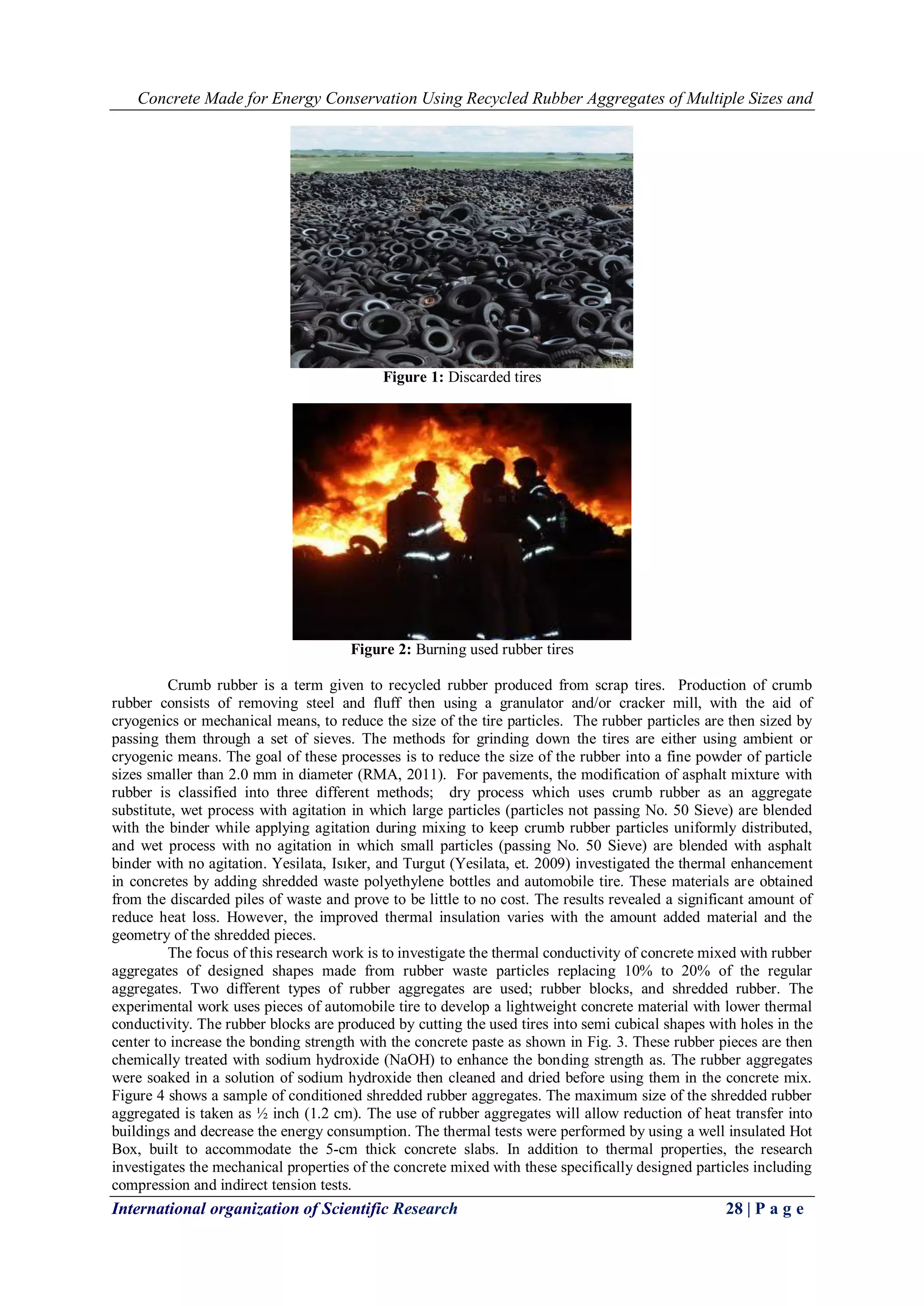
decrease the number of landfills, and become a hazard towards the environment (Koren 2003). Fig. 1 shows
typical site of discarded tires. As stated by the Rubber Manufactures Association (RMA), rubber tire piles can
become a breeding place for disease carrying mosquitoes and can catch fire through arson, or accident, that are
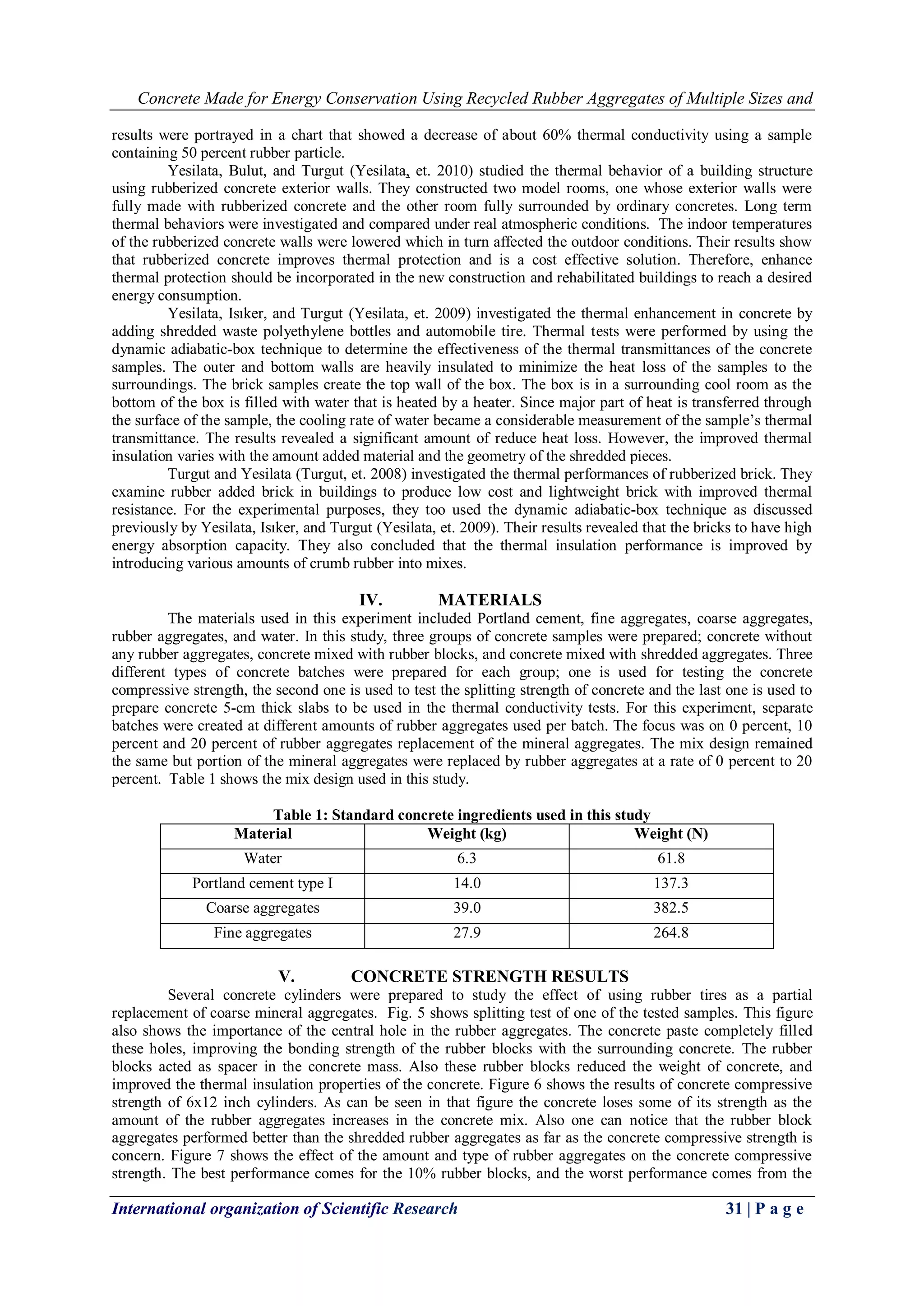
difficult to put out, produce heavy smoke, and toxic runoff into waterways (R.M.A. 2011). Fig. 2 shows burning
of used tires that can be considered as an environmental critical issue. Based on this information, crumb rubber
use in concrete and pavements provides an environmentally sustainable method for disposing the millions of
tires generated annually.
Concrete Made for Energy Conservation Using Recycled Rubber Aggregates of Multiple Sizes and
International organization of Scientific Research 28 | P a g e
Figure 1: Discarded tires
Figure 2: Burning used rubber tires
Crumb rubber is a term given to recycled rubber produced from scrap tires. Production of crumb
rubber consists of removing steel and fluff then using a granulator and/or cracker mill, with the aid of
cryogenics or mechanical means, to reduce the size of the tire particles. The rubber particles are then sized by
passing them through a set of sieves. The methods for grinding down the tires are either using ambient or
cryogenic means. The goal of these processes is to reduce the size of the rubber into a fine powder of particle
sizes smaller than 2.0 mm in diameter (RMA, 2011). For pavements, the modification of asphalt mixture with
rubber is classified into three different methods; dry process which uses crumb rubber as an aggregate
substitute, wet process with agitation in which large particles (particles not passing No. 50 Sieve) are blended
with the binder while applying agitation during mixing to keep crumb rubber particles uniformly distributed,
and wet process with no agitation in which small particles (passing No. 50 Sieve) are blended with asphalt
binder with no agitation. Yesilata, Isıker, and Turgut (Yesilata, et. 2009) investigated the thermal enhancement
in concretes by adding shredded waste polyethylene bottles and automobile tire. These materials are obtained
from the discarded piles of waste and prove to be little to no cost. The results revealed a significant amount of
reduce heat loss. However, the improved thermal insulation varies with the amount added material and the
geometry of the shredded pieces.
The focus of this research work is to investigate the thermal conductivity of concrete mixed with rubber
aggregates of designed shapes made from rubber waste particles replacing 10% to 20% of the regular
aggregates. Two different types of rubber aggregates are used; rubber blocks, and shredded rubber. The
experimental work uses pieces of automobile tire to develop a lightweight concrete material with lower thermal
conductivity. The rubber blocks are produced by cutting the used tires into semi cubical shapes with holes in the
center to increase the bonding strength with the concrete paste as shown in Fig. 3. These rubber pieces are then
chemically treated with sodium hydroxide (NaOH) to enhance the bonding strength as. The rubber aggregates
were soaked in a solution of sodium hydroxide then cleaned and dried before using them in the concrete mix.
Figure 4 shows a sample of conditioned shredded rubber aggregates. The maximum size of the shredded rubber
aggregated is taken as ½ inch (1.2 cm). The use of rubber aggregates will allow reduction of heat transfer into
buildings and decrease the energy consumption. The thermal tests were performed by using a well insulated Hot
Box, built to accommodate the 5-cm thick concrete slabs. In addition to thermal properties, the research
investigates the mechanical properties of the concrete mixed with these specifically designed particles including
compression and indirect tension tests.
Concrete Made for Energy Conservation Using Recycled Rubber Aggregates of Multiple Sizes and
International organization of Scientific Research 29 | P a g e
Figure 3: Rubber blocks used in this study Conditioned with Sodium Hydroxide
Figure 4: Conditioned shredded rubber
Concrete Made for Energy Conservation Using Recycled Rubber Aggregates of Multiple Sizes and
International organization of Scientific Research 30 | P a g e
II. BACKGROUND
Sustainable materials should be used by the construction industry to compensate for the increasing
waste problem. Automobile tires have been used in several rubber products, production of electricity, or fuel.
Portland cement is the principle binder in concrete and is a major contributor to greenhouse gas emissions and
the Portland cement industry is one of the two largest carbon dioxide producers (Mehta 2004). Khatib and
Bayomy (Khatib, et. 1999) investigated rubberized Portland cement concrete using fine crumb rubber and
course tire chips. The rubber concrete mixes were tested for compressive and flexural strength in accordance to
ASTM standards. Their results showed rubber contents should not exceed 20 percent of the total aggregate
volume and may be suitable for nonstructural purposes such as lightweight concrete walls, building facades, and
architectural units. Frankkowski (Frankowski 1995) investigated rubber crumb reinforced cement concrete for
structures. His results showed that rubber crumb reinforced cement concrete provided resistance to cracking,
increased the resistance to acid rain, lowered the weight, improved shock wave absorption, lowered heat
conductivity and improved the acoustical environment.
A solution to reduce waste and large quantities of industrial by-products is to use recycled concrete
aggregate (RCA) from construction and demolition projects, rubber tires from landfills, and fly ash from
burning coal into a production of concrete. Yet, most concrete structures are designed to last up to 50 years
(Mehta 2004). Yilmaz and Degirmenci (Yilmaz, et. 2009) investigated the use of rubber and fly ash waste in
Portland cement as construction material. They found the compressive strength decreased with the increase of
rubber content and would increase with the increase of fly ash. They also proved tire rubber particles have
sufficient strength for masonry applications. Toutanji (Toutanji 1996) investigated the use of rubber tire
particles in concrete to replace mineral aggregates. He tested for compressive and flexural strength and revealed
that high toughness was displayed along with a reduction in compressive and flexural strength with the increase
of rubber added. Biel and Lee (Biel, et. 1996) investigated Portland cement and magnesium oxychloride cement
as binders for concretes with rubber aggregate. The concrete samples were tested for both compressive and
splitting tensile strengths to determine if the cement with tire rubber would improve concrete properties. With
25 percent of rubber by volume, both Portland and magnesium oxychloride cement concretes lost 90 percent of
their compressive strength. Tensile strength, Portland cement concrete retained 20 percent and magnesium
oxychloride retained 35 percent.
Another sustainable aspect is energy consumption and energy use in buildings. Approximately 25-30
percent of the total energy that is consumed in the world today is used in buildings. Whereas in commercial and
residential buildings, around 80 percent of total energy consumed is used for space heating and cooling
(Yesilata, et. 2010). Therefore, enhance thermal protection is key to acquiring a reasonable energy consumption
level in construction of buildings. Asan and Sancaktar (Asan, et. 1998) investigate the thermo physical
properties and wall thickness of buildings on time lag and decrement factor. They solved for heat conduction
under convection boundary conditions and found that time lag and decrement was affected by thermo physical
properties. Papadopoulos and Giama (Papadopoulos, et. 2007) investigated the environmental performance of
thermal insulation materials and its impact on buildings. They show that contemporary insulation materials
achieve thermal conductivity values of less than 0.04W. Their results obtained were used to set environmental
condition indicators on the ISO 14031 standard and met the Environmental Performance Evaluation.
The production of thermal insulation materials is a key solution to solve the greater problem of
recycling industrial and domestic waste, and energy consumption in construction. Sukontasukkul
(Sukontasukkul 2009) studied the thermal and sound properties of crumb rubber concrete panels. Replacing
10%, 20%, and 30% of crumb rubber in concrete, the results indicated a lighter, higher sound absorption, and
lower heat transfer properties than the conventional concrete panel. Phan and Carino (Phan, et. 2000)
investigated fire performance in high strength concrete(HSC) and normal strength concrete(NSC). The
differences are most pronounced in the temperature range 20 degrees Celsius and 400 degrees Celsius in which
their results conclude recommended research needs. In their work, they used rubber waste particles and fly ash
as raw materials, to develop a lightweight construction material with lower thermal conductivity. This will allow
reduction of heat transfer into buildings and decrease the energy consumption.
III. THERMAL CONDUCTIVITY TEST
Benazzouk, Douzane, Mezreb, Laidoudi, and Queneudec (Benazzouk, et. 2008) studied thermal
conductivity of cement composites containing rubber waste particles of 10 percent to 50 percent with 10 percent
increment by volume. For their experiment, they used shredded automobile tire and cement with Standard NF P
15-301. Using the transient plane source (TPS) method, they created a three-dimensional heat flow inside the
sample. A disk shaped TPS element was placed in between two cubic samples, all pressed together by chucking
device to ensure contact between the TPS sensor and the sample. A constant pulse was passed through the
heating element. The temperature was then recorded by recording the voltage increase. The duration of the
experiment lasted 360 seconds and revealed that the addition of rubber improved the thermal conductivity. The
Concrete Made for Energy Conservation Using Recycled Rubber Aggregates of Multiple Sizes and
International organization of Scientific Research 31 | P a g e
results were portrayed in a chart that showed a decrease of about 60% thermal conductivity using a sample
containing 50 percent rubber particle.
Yesilata, Bulut, and Turgut (Yesilata, et. 2010) studied the thermal behavior of a building structure
using rubberized concrete exterior walls. They constructed two model rooms, one whose exterior walls were
fully made with rubberized concrete and the other room fully surrounded by ordinary concretes. Long term
thermal behaviors were investigated and compared under real atmospheric conditions. The indoor temperatures
of the rubberized concrete walls were lowered which in turn affected the outdoor conditions. Their results show
that rubberized concrete improves thermal protection and is a cost effective solution. Therefore, enhance
thermal protection should be incorporated in the new construction and rehabilitated buildings to reach a desired
energy consumption.
Yesilata, Isıker, and Turgut (Yesilata, et. 2009) investigated the thermal enhancement in concrete by
adding shredded waste polyethylene bottles and automobile tire. Thermal tests were performed by using the
dynamic adiabatic-box technique to determine the effectiveness of the thermal transmittances of the concrete
samples. The outer and bottom walls are heavily insulated to minimize the heat loss of the samples to the
surroundings. The brick samples create the top wall of the box. The box is in a surrounding cool room as the
bottom of the box is filled with water that is heated by a heater. Since major part of heat is transferred through
the surface of the sample, the cooling rate of water became a considerable measurement of the sample’s thermal
transmittance. The results revealed a significant amount of reduce heat loss. However, the improved thermal
insulation varies with the amount added material and the geometry of the shredded pieces.
Turgut and Yesilata (Turgut, et. 2008) investigated the thermal performances of rubberized brick. They
examine rubber added brick in buildings to produce low cost and lightweight brick with improved thermal
resistance. For the experimental purposes, they too used the dynamic adiabatic-box technique as discussed
previously by Yesilata, Isıker, and Turgut (Yesilata, et. 2009). Their results revealed that the bricks to have high
energy absorption capacity. They also concluded that the thermal insulation performance is improved by
introducing various amounts of crumb rubber into mixes.
IV. MATERIALS
The materials used in this experiment included Portland cement, fine aggregates, coarse aggregates,
rubber aggregates, and water. In this study, three groups of concrete samples were prepared; concrete without
any rubber aggregates, concrete mixed with rubber blocks, and concrete mixed with shredded aggregates. Three
different types of concrete batches were prepared for each group; one is used for testing the concrete
compressive strength, the second one is used to test the splitting strength of concrete and the last one is used to
prepare concrete 5-cm thick slabs to be used in the thermal conductivity tests. For this experiment, separate
batches were created at different amounts of rubber aggregates used per batch. The focus was on 0 percent, 10
percent and 20 percent of rubber aggregates replacement of the mineral aggregates. The mix design remained
the same but portion of the mineral aggregates were replaced by rubber aggregates at a rate of 0 percent to 20
percent. Table 1 shows the mix design used in this study.
Table 1: Standard concrete ingredients used in this study
Material Weight (kg) Weight (N)
Water 6.3 61.8
Portland cement type I 14.0 137.3
Coarse aggregates 39.0 382.5
Fine aggregates 27.9 264.8
V. CONCRETE STRENGTH RESULTS
Several concrete cylinders were prepared to study the effect of using rubber tires as a partial
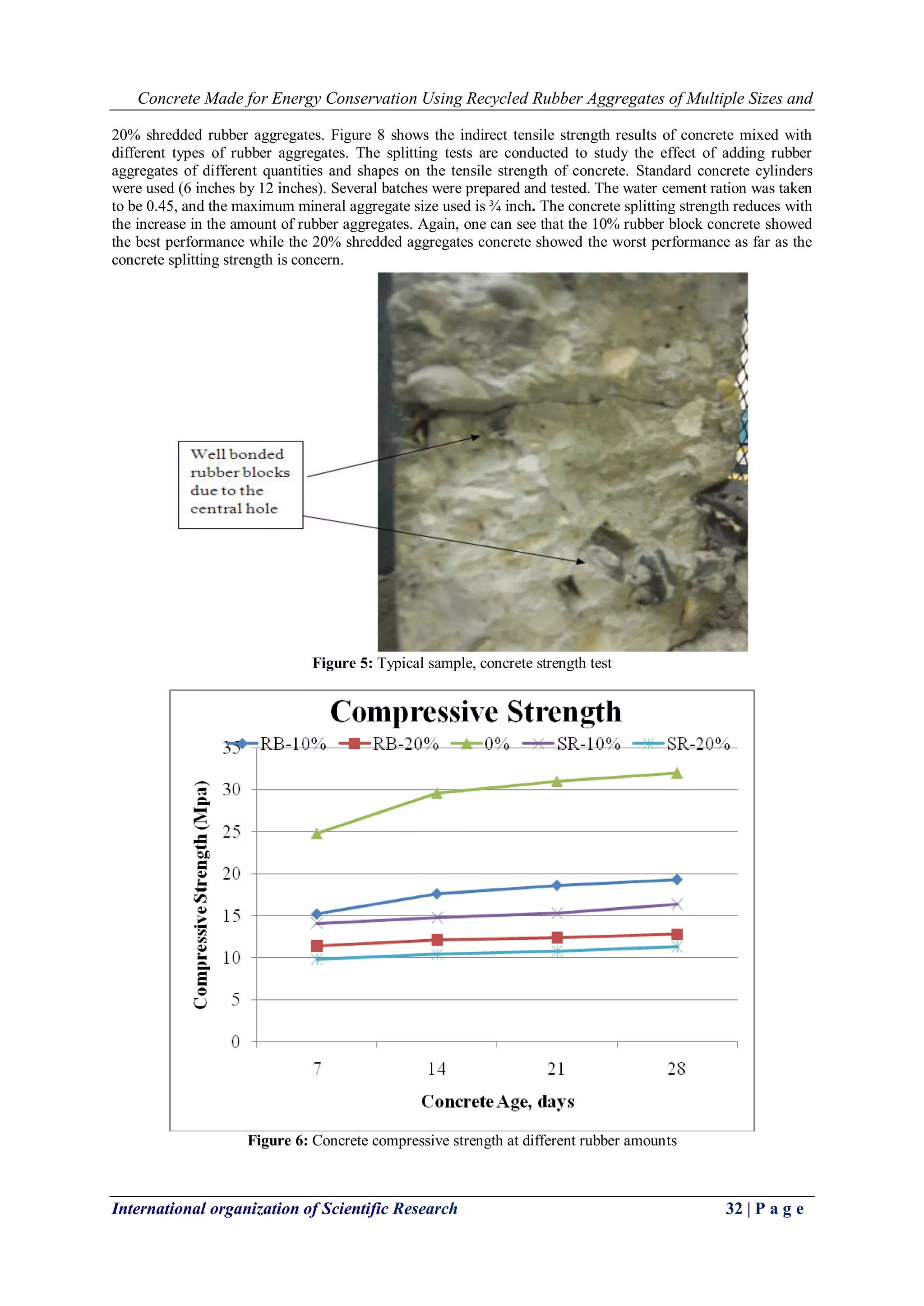
replacement of coarse mineral aggregates. Fig. 5 shows splitting test of one of the tested samples. This figure
also shows the importance of the central hole in the rubber aggregates. The concrete paste completely filled
these holes, improving the bonding strength of the rubber blocks with the surrounding concrete. The rubber
blocks acted as spacer in the concrete mass. Also these rubber blocks reduced the weight of concrete, and
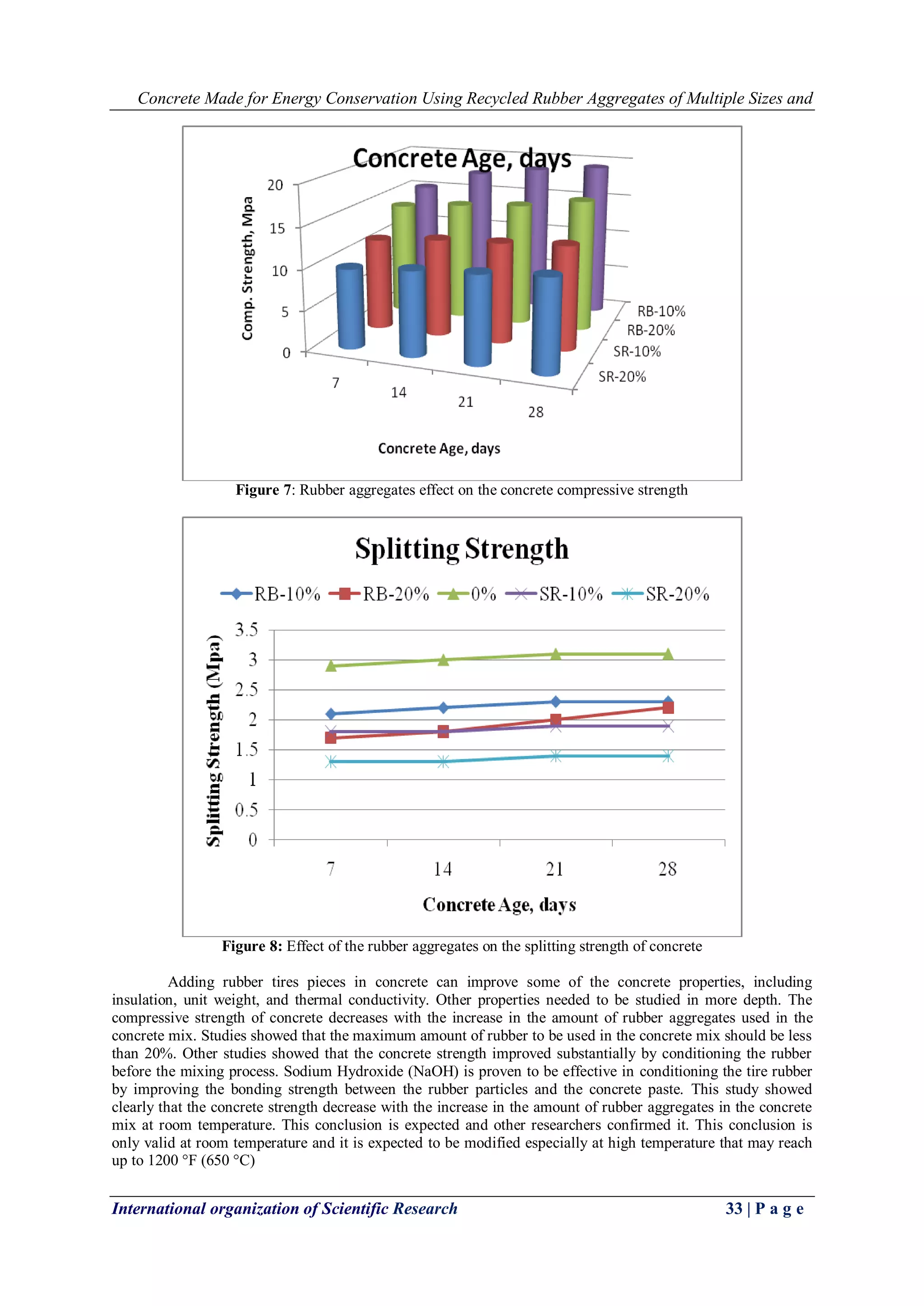
improved the thermal insulation properties of the concrete. Figure 6 shows the results of concrete compressive
strength of 6x12 inch cylinders. As can be seen in that figure the concrete loses some of its strength as the
amount of the rubber aggregates increases in the concrete mix. Also one can notice that the rubber block
aggregates performed better than the shredded rubber aggregates as far as the concrete compressive strength is
concern. Figure 7 shows the effect of the amount and type of rubber aggregates on the concrete compressive
strength. The best performance comes for the 10% rubber blocks, and the worst performance comes from the
Concrete Made for Energy Conservation Using Recycled Rubber Aggregates of Multiple Sizes and
International organization of Scientific Research 32 | P a g e
20% shredded rubber aggregates. Figure 8 shows the indirect tensile strength results of concrete mixed with
different types of rubber aggregates. The splitting tests are conducted to study the effect of adding rubber
aggregates of different quantities and shapes on the tensile strength of concrete. Standard concrete cylinders
were used (6 inches by 12 inches). Several batches were prepared and tested. The water cement ration was taken
to be 0.45, and the maximum mineral aggregate size used is ¾ inch. The concrete splitting strength reduces with
the increase in the amount of rubber aggregates. Again, one can see that the 10% rubber block concrete showed
the best performance while the 20% shredded aggregates concrete showed the worst performance as far as the
concrete splitting strength is concern.
Figure 5: Typical sample, concrete strength test
Figure 6: Concrete compressive strength at different rubber amounts
Concrete Made for Energy Conservation Using Recycled Rubber Aggregates of Multiple Sizes and
International organization of Scientific Research 33 | P a g e
Figure 7: Rubber aggregates effect on the concrete compressive strength
Figure 8: Effect of the rubber aggregates on the splitting strength of concrete
Adding rubber tires pieces in concrete can improve some of the concrete properties, including
insulation, unit weight, and thermal conductivity. Other properties needed to be studied in more depth. The
compressive strength of concrete decreases with the increase in the amount of rubber aggregates used in the
concrete mix. Studies showed that the maximum amount of rubber to be used in the concrete mix should be less
than 20%. Other studies showed that the concrete strength improved substantially by conditioning the rubber
before the mixing process. Sodium Hydroxide (NaOH) is proven to be effective in conditioning the tire rubber
by improving the bonding strength between the rubber particles and the concrete paste. This study showed
clearly that the concrete strength decrease with the increase in the amount of rubber aggregates in the concrete
mix at room temperature. This conclusion is expected and other researchers confirmed it. This conclusion is
only valid at room temperature and it is expected to be modified especially at high temperature that may reach
up to 1200 °F (650 °C)
Concrete Made for Energy Conservation Using Recycled Rubber Aggregates of Multiple Sizes and
International organization of Scientific Research 34 | P a g e
VI. THERMAL PROPERTIES OF CONCRETE WITH RUBBER AGGREGATES
As Yesilata and Bulut concluded from their experimental study, addition of rubber pieces lowers
indoor and outdoor temperature variations and the effect of outdoor conditions (Yesilata, et. 2010). They also
revealed an 11 percent improvement in thermal protection of a rubberized concrete wall that proves cost
effective for people of low income and/or living in rural areas. Yesilata and Islker also concluded with the
addition of selected materials, such as fly ash and rubber into the concrete mix, the thermal insulation
performance will be significantly improve (Yesilata, et. 2009). The degree of thermal insulation improvement
was based on the geometry of the shredded rubber and the amount.
Figure 9 shows the well insulated hot box cube of 85 cm side length. Figure 10 shows the design of the
hot box used in this study. The concrete slab sample of 2 inches (5 cm) thick is placed in the center of the hot
box. A total of eight thermal sensors were used to measure the temperature change at 5 minutes interval. The
difference between the temperature reading in the compartment of the heat source and the temperature reading
of the upper compartment is recorded. The rate of temperature increase in the top compartment and the bottom
compartment is also recorded. The rate of the temperature increase in the lower compartment is kept constant,
and the rate of the temperature increase in the upper compartment is recorded every five minutes. The rate is
used as an indication for the concrete thermal conductivity. The lower the rate of temperature increase in the
upper compartment, the better insulation property of the concrete slab is. Five different slab samples were
studied; plain concrete sample with no rubber aggregates (0%) which is used as the control sample, 10% rubber
block aggregates replacement, 20% rubber block aggregates replacement, 10% shredded rubber aggregates
replacement, and 20% shredded rubber aggregates replacement.
The rate of heat transfer (Q) is defined as
Q=kA(T1-T2)/t
Where
Q = Heat transfer rate, W
k = Heat transfer coefficient, W/m/°C
A = Area m2
(T1-T2) = Temperature difference, °C
t = Concrete slab thickness, m
Figure 9: The insulated hot box
Concrete Made for Energy Conservation Using Recycled Rubber Aggregates of Multiple Sizes and
International organization of Scientific Research 35 | P a g e
Figure 10: Hot box design
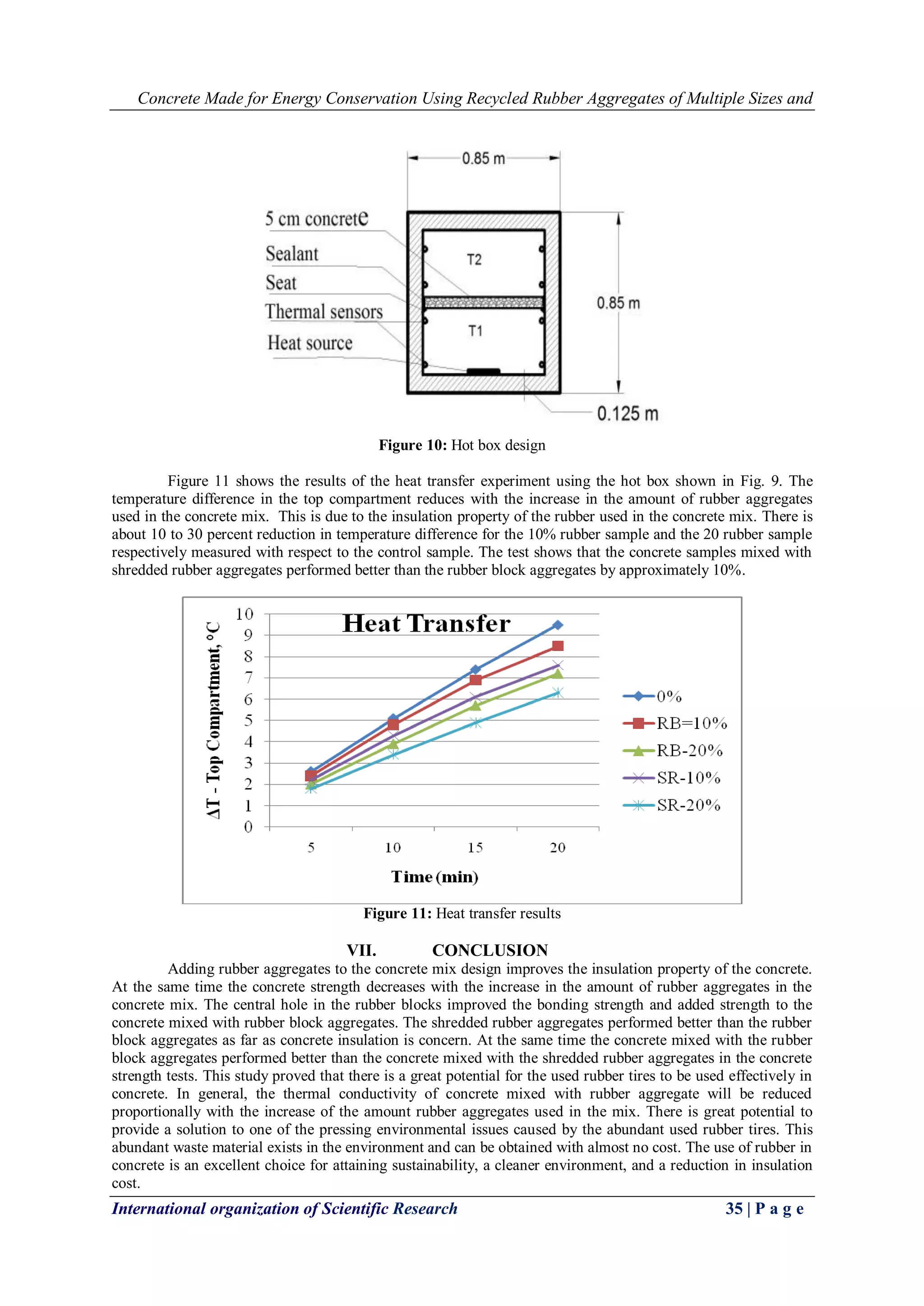
Figure 11 shows the results of the heat transfer experiment using the hot box shown in Fig. 9. The
temperature difference in the top compartment reduces with the increase in the amount of rubber aggregates
used in the concrete mix. This is due to the insulation property of the rubber used in the concrete mix. There is
about 10 to 30 percent reduction in temperature difference for the 10% rubber sample and the 20 rubber sample
respectively measured with respect to the control sample. The test shows that the concrete samples mixed with
shredded rubber aggregates performed better than the rubber block aggregates by approximately 10%.
Figure 11: Heat transfer results
VII. CONCLUSION
Adding rubber aggregates to the concrete mix design improves the insulation property of the concrete.
At the same time the concrete strength decreases with the increase in the amount of rubber aggregates in the
concrete mix. The central hole in the rubber blocks improved the bonding strength and added strength to the
concrete mixed with rubber block aggregates. The shredded rubber aggregates performed better than the rubber
block aggregates as far as concrete insulation is concern. At the same time the concrete mixed with the rubber
block aggregates performed better than the concrete mixed with the shredded rubber aggregates in the concrete
strength tests. This study proved that there is a great potential for the used rubber tires to be used effectively in
concrete. In general, the thermal conductivity of concrete mixed with rubber aggregate will be reduced
proportionally with the increase of the amount rubber aggregates used in the mix. There is great potential to
provide a solution to one of the pressing environmental issues caused by the abundant used rubber tires. This
abundant waste material exists in the environment and can be obtained with almost no cost. The use of rubber in
concrete is an excellent choice for attaining sustainability, a cleaner environment, and a reduction in insulation
cost.
Concrete Made for Energy Conservation Using Recycled Rubber Aggregates of Multiple Sizes and
International organization of Scientific Research 36 | P a g e
REFERENCES
[1]. Asan, H. and Sancaktar, Y. (1998). "Effects of Wall's thermophysical properties on time lag and
decrement factor." Energy and Buildings Journal, Elsevier, Vol. 28, No. (2), page 159-166, DOI:
http://dx.doi.org/10.1016/S0378-7788(98)00007-3.
[2]. Benazzouk, A., Douzane, O., et al. (2008). "Thermal conductivity of cement composites containing
rubber waste particles: Experimental study and modelling." Construction and Building Materials Journal
Elsevier, Vol. 22 No. (4) pages 573-579, www.sciecedirect.com
[3]. Biel, T. D. and Lee, H. (1996). "Magnesium oxychloride cement concrete with recycled tire rubber."
Transportation Research Record: Journal of the Transportation Research Board No. 1561, Tranportation
Research Board, Washington DC, pages 6-12.
[4]. Frankowski, R. (1995). Rubber-crumb-reinforced cement concrete, US Patents # 5,391,226.
[5]. Hernandezolivares, F. (2004). "Fire performance of recycled rubber-filled high-strength concrete."
Cement and Concrete Research Vol. 34 No. (1) pages: 109-117, www.sciecedirect.com
[6]. International Rubber Study Group (IRSG). 2012. Statistical summary of world rubber situation. Available
at http://www.rubberstudy.com/documents/WebSiteData.pdf, accessed March 15, 2012.
[7]. Khatib, Z. K. and Bayomy, F. M. (1999). "Rubberized Portland Cement Concrete." Journal of Materials
in Civil Engineering Elsveir, Vol. 11 No. (3), pages 206 2013, http://dx.doi.org/10.1061/(ASCE)0899-
1561(1999)11:3(206).
[8]. Koren, H. and Bisesi, M.S. (2002). Handbook of Environmental Health (4th ed.) Vol. II. Pollutant
Interactions in Air, Water and Soil. CRC Press (Taylor-Francis Group) Boca Rotan, FL
http://cph.osu.edu/people/mbisesi#sthash.kYXZOUNO.dpuf
[9]. Mehta, P. K. (2004). "High-Performance, High-Volume Fly Ash Concrete for Sustainable Development,"
Proceedings of the International Workshop on Sustainable Development & Concrete Technology, pp. 3-
14; May 2004.
[10]. NETZSCH (2009). "Differential Scanning Calorimetry/ Differential Thermal Analysis." from
www.netzsch-thermal-analysis.com.
[11]. Papadopoulos, A. and Giama, E. (2007). "Environmental performance evaluation of thermal insulation
materials and its impact on the building." Building and environment, Vol. 42 No. (5) pages 2178-2187.
[12]. Phan, L. T. and Carino, N. J. (2000). Fire performance of high strength concrete: research needs
Advanced Technology in Structural Engineering. ASCE/SEI Structures Congress 2000. Proceedings.
May 8-10, 2000, Philadelphia, PA, Elgaaly, M., Editor(s), 2000.
[13]. R.M.A., R. (2011). "Scrap Tires and the Environment." Retrieved 07/15/2011, from http://www.rma.org.
[14]. Sukontasukkul, P. (2009). "Use of crumb rubber to improve thermal and sound properties of pre-cast
concrete panel." Construction & Building Materials, Vol. 23 No. (2), pages1084-1092.
[15]. Stevenson, K., Stallwood, B., & Hart, A. G. (200, " Tire Rubber Recycling and Bioremediation: A
Review, " Bioremediation Journal, Vol. 12 No. (1), pages 1-11.
[16]. Toutanji, H. A. (1996). "The Use of Rubber Tire Particles in Concrete.", Cement and Concrete
Composites, Vol. 18, No. 2, pp. 135-139. doi:10.1016/0958-9465(95)00010-0
[17]. Turgut, P. and Yesilata, B. (2008). "Physico-mechanical and thermal performances of newly developed
rubber-added bricks." Energy and Buildings Vol. 40 No. (5), pages 679-688, www.sciencedirect.co.
[18]. Yesilata, B., Bulut, H. (2011). "Experimental study on thermal behavior of a building structure using
rubberized exterior-walls." Elseveir, Energy and Buildings, Vol. 43, Issues 2-3, pages 393-399
[19]. Yesilata, B., IsIker, Y., Turgut, P. (2009). "Thermal insulation enhancement in concretes by adding waste
PET and rubber pieces," Elseveir, Construction and Building Materials, Vol. 23 No. (5), pages1878-1882.
[20]. Yilmaz, A. and Degirmenci, N. (2009). "Possibility of using waste tire rubber and fly ash with Portland
cement as construction materials." Waste Management, Vol. 29 No. (5), pages1541-1546.

D05212736

  • 1.
    IOSR Journal ofEngineering (IOSRJEN) www.iosrjen.org ISSN (e): 2250-3021, ISSN (p): 2278-8719 Vol. 05, Issue 02 (February. 2015), ||V1|| PP 27-36 International organization of Scientific Research 27 | P a g e Concrete Made for Energy Conservation Using Recycled Rubber Aggregates of Multiple Sizes and Shapes Moayyad Al-Nasra1 1 Civil Engineering Department, Applied Science University, Amman – Jordan Abstract: - Many studies have been performed about adding used rubber tires in concrete, but most of these studies remained as scattered efforts without leading to any standardized procedure or process. This study uses two different types of conditioned rubber aggregates; rubber blocks, and shredded rubber. The focus of this study is mainly to produce concrete for better energy conservation, providing a practical solution to many environmental issues related to discarded used rubber tires, and lay the foundation for future studies in this area. Two different batches of concrete mixed with each type of rubber aggregates were prepare. In the first batch 10% of the mineral aggregates are replaced by rubber aggregates by volume and in the second batch 20% of the mineral aggregates are replaced by the rubber aggregates by volume. Out of each batch, three groups of samples were prepared to study the compressive strength of concrete, splitting strength of concrete, and the thermal properties of concrete. New well insulated hot box is built to study the concrete thermal conductivity. Slabs of concrete with and without rubber aggregates were prepared and placed in the center of the hot box. Several thermal sensors were installed to measure the temperature increase, in addition to a constant heat source. The hot box is divided into two compartments separated by the concrete slab. The results of these experimental tests are presented in terms of graphs and charts. The results also show that the new modified concrete can be used as structural and non-structural components in concrete structures. The increase in the amount of rubber in concrete improves the insulating properties of concrete and decreases the concrete strength. The tests of concrete strength mixed with rubber aggregates as well as the control samples are conducted at room temperature and the results are expected to change at high temperature. Keywords:- Rubber aggregates, Robber blocks, Shredded rubber, Thermal conductivity, Energy conservation, Concrete insulation. I. INTRODUCTION The amount of discarded rubber tires is on the rise every year. Also, the number of manufactured vehicles is on the rise leading to the increase in the demand of rubber tires. At the foreseen future, the amount of used and discarded tires will continue to increase especially in the developing countries. For many years, cities have been faced with increasing problems with the disposal of recycled materials, such as rubber, glass, and plastics. In 2010, the world's rubber consumption reached nearly 24.9 million tons (IRSG 2012). In the U.S. alone 3.9 million tons of scrap tires are produced annually from that 1.36 million tons are recycled and 2.54 million tons are burned or land filled (Department of Energy and Environmental Protection). Despite the large market for scrap tires, roughly a quarter of all scrap tires end up in landfills each year numbering to approximately 27 million tires or roughly 6 million tons annually making up over 12% of all solid waste (US EPA, 2003). Due to the cross-links between the rubber polymer chains, numerous additives, and stabilizers within its structure, the rubber is extremely resistant to natural degradation making it troublesome for landfill storage (Stevenson et al., 2008). When these materials are sent to landfills they become expensive to dispose of, decrease the number of landfills, and become a hazard towards the environment (Koren 2003). Fig. 1 shows typical site of discarded tires. As stated by the Rubber Manufactures Association (RMA), rubber tire piles can become a breeding place for disease carrying mosquitoes and can catch fire through arson, or accident, that are difficult to put out, produce heavy smoke, and toxic runoff into waterways (R.M.A. 2011). Fig. 2 shows burning of used tires that can be considered as an environmental critical issue. Based on this information, crumb rubber use in concrete and pavements provides an environmentally sustainable method for disposing the millions of tires generated annually.
  • 2.
    Concrete Made forEnergy Conservation Using Recycled Rubber Aggregates of Multiple Sizes and International organization of Scientific Research 28 | P a g e Figure 1: Discarded tires Figure 2: Burning used rubber tires Crumb rubber is a term given to recycled rubber produced from scrap tires. Production of crumb rubber consists of removing steel and fluff then using a granulator and/or cracker mill, with the aid of cryogenics or mechanical means, to reduce the size of the tire particles. The rubber particles are then sized by passing them through a set of sieves. The methods for grinding down the tires are either using ambient or cryogenic means. The goal of these processes is to reduce the size of the rubber into a fine powder of particle sizes smaller than 2.0 mm in diameter (RMA, 2011). For pavements, the modification of asphalt mixture with rubber is classified into three different methods; dry process which uses crumb rubber as an aggregate substitute, wet process with agitation in which large particles (particles not passing No. 50 Sieve) are blended with the binder while applying agitation during mixing to keep crumb rubber particles uniformly distributed, and wet process with no agitation in which small particles (passing No. 50 Sieve) are blended with asphalt binder with no agitation. Yesilata, Isıker, and Turgut (Yesilata, et. 2009) investigated the thermal enhancement in concretes by adding shredded waste polyethylene bottles and automobile tire. These materials are obtained from the discarded piles of waste and prove to be little to no cost. The results revealed a significant amount of reduce heat loss. However, the improved thermal insulation varies with the amount added material and the geometry of the shredded pieces. The focus of this research work is to investigate the thermal conductivity of concrete mixed with rubber aggregates of designed shapes made from rubber waste particles replacing 10% to 20% of the regular aggregates. Two different types of rubber aggregates are used; rubber blocks, and shredded rubber. The experimental work uses pieces of automobile tire to develop a lightweight concrete material with lower thermal conductivity. The rubber blocks are produced by cutting the used tires into semi cubical shapes with holes in the center to increase the bonding strength with the concrete paste as shown in Fig. 3. These rubber pieces are then chemically treated with sodium hydroxide (NaOH) to enhance the bonding strength as. The rubber aggregates were soaked in a solution of sodium hydroxide then cleaned and dried before using them in the concrete mix. Figure 4 shows a sample of conditioned shredded rubber aggregates. The maximum size of the shredded rubber aggregated is taken as ½ inch (1.2 cm). The use of rubber aggregates will allow reduction of heat transfer into buildings and decrease the energy consumption. The thermal tests were performed by using a well insulated Hot Box, built to accommodate the 5-cm thick concrete slabs. In addition to thermal properties, the research investigates the mechanical properties of the concrete mixed with these specifically designed particles including compression and indirect tension tests.
  • 3.
    Concrete Made forEnergy Conservation Using Recycled Rubber Aggregates of Multiple Sizes and International organization of Scientific Research 29 | P a g e Figure 3: Rubber blocks used in this study Conditioned with Sodium Hydroxide Figure 4: Conditioned shredded rubber
  • 4.
    Concrete Made forEnergy Conservation Using Recycled Rubber Aggregates of Multiple Sizes and International organization of Scientific Research 30 | P a g e II. BACKGROUND Sustainable materials should be used by the construction industry to compensate for the increasing waste problem. Automobile tires have been used in several rubber products, production of electricity, or fuel. Portland cement is the principle binder in concrete and is a major contributor to greenhouse gas emissions and the Portland cement industry is one of the two largest carbon dioxide producers (Mehta 2004). Khatib and Bayomy (Khatib, et. 1999) investigated rubberized Portland cement concrete using fine crumb rubber and course tire chips. The rubber concrete mixes were tested for compressive and flexural strength in accordance to ASTM standards. Their results showed rubber contents should not exceed 20 percent of the total aggregate volume and may be suitable for nonstructural purposes such as lightweight concrete walls, building facades, and architectural units. Frankkowski (Frankowski 1995) investigated rubber crumb reinforced cement concrete for structures. His results showed that rubber crumb reinforced cement concrete provided resistance to cracking, increased the resistance to acid rain, lowered the weight, improved shock wave absorption, lowered heat conductivity and improved the acoustical environment. A solution to reduce waste and large quantities of industrial by-products is to use recycled concrete aggregate (RCA) from construction and demolition projects, rubber tires from landfills, and fly ash from burning coal into a production of concrete. Yet, most concrete structures are designed to last up to 50 years (Mehta 2004). Yilmaz and Degirmenci (Yilmaz, et. 2009) investigated the use of rubber and fly ash waste in Portland cement as construction material. They found the compressive strength decreased with the increase of rubber content and would increase with the increase of fly ash. They also proved tire rubber particles have sufficient strength for masonry applications. Toutanji (Toutanji 1996) investigated the use of rubber tire particles in concrete to replace mineral aggregates. He tested for compressive and flexural strength and revealed that high toughness was displayed along with a reduction in compressive and flexural strength with the increase of rubber added. Biel and Lee (Biel, et. 1996) investigated Portland cement and magnesium oxychloride cement as binders for concretes with rubber aggregate. The concrete samples were tested for both compressive and splitting tensile strengths to determine if the cement with tire rubber would improve concrete properties. With 25 percent of rubber by volume, both Portland and magnesium oxychloride cement concretes lost 90 percent of their compressive strength. Tensile strength, Portland cement concrete retained 20 percent and magnesium oxychloride retained 35 percent. Another sustainable aspect is energy consumption and energy use in buildings. Approximately 25-30 percent of the total energy that is consumed in the world today is used in buildings. Whereas in commercial and residential buildings, around 80 percent of total energy consumed is used for space heating and cooling (Yesilata, et. 2010). Therefore, enhance thermal protection is key to acquiring a reasonable energy consumption level in construction of buildings. Asan and Sancaktar (Asan, et. 1998) investigate the thermo physical properties and wall thickness of buildings on time lag and decrement factor. They solved for heat conduction under convection boundary conditions and found that time lag and decrement was affected by thermo physical properties. Papadopoulos and Giama (Papadopoulos, et. 2007) investigated the environmental performance of thermal insulation materials and its impact on buildings. They show that contemporary insulation materials achieve thermal conductivity values of less than 0.04W. Their results obtained were used to set environmental condition indicators on the ISO 14031 standard and met the Environmental Performance Evaluation. The production of thermal insulation materials is a key solution to solve the greater problem of recycling industrial and domestic waste, and energy consumption in construction. Sukontasukkul (Sukontasukkul 2009) studied the thermal and sound properties of crumb rubber concrete panels. Replacing 10%, 20%, and 30% of crumb rubber in concrete, the results indicated a lighter, higher sound absorption, and lower heat transfer properties than the conventional concrete panel. Phan and Carino (Phan, et. 2000) investigated fire performance in high strength concrete(HSC) and normal strength concrete(NSC). The differences are most pronounced in the temperature range 20 degrees Celsius and 400 degrees Celsius in which their results conclude recommended research needs. In their work, they used rubber waste particles and fly ash as raw materials, to develop a lightweight construction material with lower thermal conductivity. This will allow reduction of heat transfer into buildings and decrease the energy consumption. III. THERMAL CONDUCTIVITY TEST Benazzouk, Douzane, Mezreb, Laidoudi, and Queneudec (Benazzouk, et. 2008) studied thermal conductivity of cement composites containing rubber waste particles of 10 percent to 50 percent with 10 percent increment by volume. For their experiment, they used shredded automobile tire and cement with Standard NF P 15-301. Using the transient plane source (TPS) method, they created a three-dimensional heat flow inside the sample. A disk shaped TPS element was placed in between two cubic samples, all pressed together by chucking device to ensure contact between the TPS sensor and the sample. A constant pulse was passed through the heating element. The temperature was then recorded by recording the voltage increase. The duration of the experiment lasted 360 seconds and revealed that the addition of rubber improved the thermal conductivity. The
  • 5.
    Concrete Made forEnergy Conservation Using Recycled Rubber Aggregates of Multiple Sizes and International organization of Scientific Research 31 | P a g e results were portrayed in a chart that showed a decrease of about 60% thermal conductivity using a sample containing 50 percent rubber particle. Yesilata, Bulut, and Turgut (Yesilata, et. 2010) studied the thermal behavior of a building structure using rubberized concrete exterior walls. They constructed two model rooms, one whose exterior walls were fully made with rubberized concrete and the other room fully surrounded by ordinary concretes. Long term thermal behaviors were investigated and compared under real atmospheric conditions. The indoor temperatures of the rubberized concrete walls were lowered which in turn affected the outdoor conditions. Their results show that rubberized concrete improves thermal protection and is a cost effective solution. Therefore, enhance thermal protection should be incorporated in the new construction and rehabilitated buildings to reach a desired energy consumption. Yesilata, Isıker, and Turgut (Yesilata, et. 2009) investigated the thermal enhancement in concrete by adding shredded waste polyethylene bottles and automobile tire. Thermal tests were performed by using the dynamic adiabatic-box technique to determine the effectiveness of the thermal transmittances of the concrete samples. The outer and bottom walls are heavily insulated to minimize the heat loss of the samples to the surroundings. The brick samples create the top wall of the box. The box is in a surrounding cool room as the bottom of the box is filled with water that is heated by a heater. Since major part of heat is transferred through the surface of the sample, the cooling rate of water became a considerable measurement of the sample’s thermal transmittance. The results revealed a significant amount of reduce heat loss. However, the improved thermal insulation varies with the amount added material and the geometry of the shredded pieces. Turgut and Yesilata (Turgut, et. 2008) investigated the thermal performances of rubberized brick. They examine rubber added brick in buildings to produce low cost and lightweight brick with improved thermal resistance. For the experimental purposes, they too used the dynamic adiabatic-box technique as discussed previously by Yesilata, Isıker, and Turgut (Yesilata, et. 2009). Their results revealed that the bricks to have high energy absorption capacity. They also concluded that the thermal insulation performance is improved by introducing various amounts of crumb rubber into mixes. IV. MATERIALS The materials used in this experiment included Portland cement, fine aggregates, coarse aggregates, rubber aggregates, and water. In this study, three groups of concrete samples were prepared; concrete without any rubber aggregates, concrete mixed with rubber blocks, and concrete mixed with shredded aggregates. Three different types of concrete batches were prepared for each group; one is used for testing the concrete compressive strength, the second one is used to test the splitting strength of concrete and the last one is used to prepare concrete 5-cm thick slabs to be used in the thermal conductivity tests. For this experiment, separate batches were created at different amounts of rubber aggregates used per batch. The focus was on 0 percent, 10 percent and 20 percent of rubber aggregates replacement of the mineral aggregates. The mix design remained the same but portion of the mineral aggregates were replaced by rubber aggregates at a rate of 0 percent to 20 percent. Table 1 shows the mix design used in this study. Table 1: Standard concrete ingredients used in this study Material Weight (kg) Weight (N) Water 6.3 61.8 Portland cement type I 14.0 137.3 Coarse aggregates 39.0 382.5 Fine aggregates 27.9 264.8 V. CONCRETE STRENGTH RESULTS Several concrete cylinders were prepared to study the effect of using rubber tires as a partial replacement of coarse mineral aggregates. Fig. 5 shows splitting test of one of the tested samples. This figure also shows the importance of the central hole in the rubber aggregates. The concrete paste completely filled these holes, improving the bonding strength of the rubber blocks with the surrounding concrete. The rubber blocks acted as spacer in the concrete mass. Also these rubber blocks reduced the weight of concrete, and improved the thermal insulation properties of the concrete. Figure 6 shows the results of concrete compressive strength of 6x12 inch cylinders. As can be seen in that figure the concrete loses some of its strength as the amount of the rubber aggregates increases in the concrete mix. Also one can notice that the rubber block aggregates performed better than the shredded rubber aggregates as far as the concrete compressive strength is concern. Figure 7 shows the effect of the amount and type of rubber aggregates on the concrete compressive strength. The best performance comes for the 10% rubber blocks, and the worst performance comes from the
  • 6.
    Concrete Made forEnergy Conservation Using Recycled Rubber Aggregates of Multiple Sizes and International organization of Scientific Research 32 | P a g e 20% shredded rubber aggregates. Figure 8 shows the indirect tensile strength results of concrete mixed with different types of rubber aggregates. The splitting tests are conducted to study the effect of adding rubber aggregates of different quantities and shapes on the tensile strength of concrete. Standard concrete cylinders were used (6 inches by 12 inches). Several batches were prepared and tested. The water cement ration was taken to be 0.45, and the maximum mineral aggregate size used is ¾ inch. The concrete splitting strength reduces with the increase in the amount of rubber aggregates. Again, one can see that the 10% rubber block concrete showed the best performance while the 20% shredded aggregates concrete showed the worst performance as far as the concrete splitting strength is concern. Figure 5: Typical sample, concrete strength test Figure 6: Concrete compressive strength at different rubber amounts
  • 7.
    Concrete Made forEnergy Conservation Using Recycled Rubber Aggregates of Multiple Sizes and International organization of Scientific Research 33 | P a g e Figure 7: Rubber aggregates effect on the concrete compressive strength Figure 8: Effect of the rubber aggregates on the splitting strength of concrete Adding rubber tires pieces in concrete can improve some of the concrete properties, including insulation, unit weight, and thermal conductivity. Other properties needed to be studied in more depth. The compressive strength of concrete decreases with the increase in the amount of rubber aggregates used in the concrete mix. Studies showed that the maximum amount of rubber to be used in the concrete mix should be less than 20%. Other studies showed that the concrete strength improved substantially by conditioning the rubber before the mixing process. Sodium Hydroxide (NaOH) is proven to be effective in conditioning the tire rubber by improving the bonding strength between the rubber particles and the concrete paste. This study showed clearly that the concrete strength decrease with the increase in the amount of rubber aggregates in the concrete mix at room temperature. This conclusion is expected and other researchers confirmed it. This conclusion is only valid at room temperature and it is expected to be modified especially at high temperature that may reach up to 1200 °F (650 °C)
  • 8.
    Concrete Made forEnergy Conservation Using Recycled Rubber Aggregates of Multiple Sizes and International organization of Scientific Research 34 | P a g e VI. THERMAL PROPERTIES OF CONCRETE WITH RUBBER AGGREGATES As Yesilata and Bulut concluded from their experimental study, addition of rubber pieces lowers indoor and outdoor temperature variations and the effect of outdoor conditions (Yesilata, et. 2010). They also revealed an 11 percent improvement in thermal protection of a rubberized concrete wall that proves cost effective for people of low income and/or living in rural areas. Yesilata and Islker also concluded with the addition of selected materials, such as fly ash and rubber into the concrete mix, the thermal insulation performance will be significantly improve (Yesilata, et. 2009). The degree of thermal insulation improvement was based on the geometry of the shredded rubber and the amount. Figure 9 shows the well insulated hot box cube of 85 cm side length. Figure 10 shows the design of the hot box used in this study. The concrete slab sample of 2 inches (5 cm) thick is placed in the center of the hot box. A total of eight thermal sensors were used to measure the temperature change at 5 minutes interval. The difference between the temperature reading in the compartment of the heat source and the temperature reading of the upper compartment is recorded. The rate of temperature increase in the top compartment and the bottom compartment is also recorded. The rate of the temperature increase in the lower compartment is kept constant, and the rate of the temperature increase in the upper compartment is recorded every five minutes. The rate is used as an indication for the concrete thermal conductivity. The lower the rate of temperature increase in the upper compartment, the better insulation property of the concrete slab is. Five different slab samples were studied; plain concrete sample with no rubber aggregates (0%) which is used as the control sample, 10% rubber block aggregates replacement, 20% rubber block aggregates replacement, 10% shredded rubber aggregates replacement, and 20% shredded rubber aggregates replacement. The rate of heat transfer (Q) is defined as Q=kA(T1-T2)/t Where Q = Heat transfer rate, W k = Heat transfer coefficient, W/m/°C A = Area m2 (T1-T2) = Temperature difference, °C t = Concrete slab thickness, m Figure 9: The insulated hot box
  • 9.
    Concrete Made forEnergy Conservation Using Recycled Rubber Aggregates of Multiple Sizes and International organization of Scientific Research 35 | P a g e Figure 10: Hot box design Figure 11 shows the results of the heat transfer experiment using the hot box shown in Fig. 9. The temperature difference in the top compartment reduces with the increase in the amount of rubber aggregates used in the concrete mix. This is due to the insulation property of the rubber used in the concrete mix. There is about 10 to 30 percent reduction in temperature difference for the 10% rubber sample and the 20 rubber sample respectively measured with respect to the control sample. The test shows that the concrete samples mixed with shredded rubber aggregates performed better than the rubber block aggregates by approximately 10%. Figure 11: Heat transfer results VII. CONCLUSION Adding rubber aggregates to the concrete mix design improves the insulation property of the concrete. At the same time the concrete strength decreases with the increase in the amount of rubber aggregates in the concrete mix. The central hole in the rubber blocks improved the bonding strength and added strength to the concrete mixed with rubber block aggregates. The shredded rubber aggregates performed better than the rubber block aggregates as far as concrete insulation is concern. At the same time the concrete mixed with the rubber block aggregates performed better than the concrete mixed with the shredded rubber aggregates in the concrete strength tests. This study proved that there is a great potential for the used rubber tires to be used effectively in concrete. In general, the thermal conductivity of concrete mixed with rubber aggregate will be reduced proportionally with the increase of the amount rubber aggregates used in the mix. There is great potential to provide a solution to one of the pressing environmental issues caused by the abundant used rubber tires. This abundant waste material exists in the environment and can be obtained with almost no cost. The use of rubber in concrete is an excellent choice for attaining sustainability, a cleaner environment, and a reduction in insulation cost.
  • 10.
    Concrete Made forEnergy Conservation Using Recycled Rubber Aggregates of Multiple Sizes and International organization of Scientific Research 36 | P a g e REFERENCES [1]. Asan, H. and Sancaktar, Y. (1998). "Effects of Wall's thermophysical properties on time lag and decrement factor." Energy and Buildings Journal, Elsevier, Vol. 28, No. (2), page 159-166, DOI: http://dx.doi.org/10.1016/S0378-7788(98)00007-3. [2]. Benazzouk, A., Douzane, O., et al. (2008). "Thermal conductivity of cement composites containing rubber waste particles: Experimental study and modelling." Construction and Building Materials Journal Elsevier, Vol. 22 No. (4) pages 573-579, www.sciecedirect.com [3]. Biel, T. D. and Lee, H. (1996). "Magnesium oxychloride cement concrete with recycled tire rubber." Transportation Research Record: Journal of the Transportation Research Board No. 1561, Tranportation Research Board, Washington DC, pages 6-12. [4]. Frankowski, R. (1995). Rubber-crumb-reinforced cement concrete, US Patents # 5,391,226. [5]. Hernandezolivares, F. (2004). "Fire performance of recycled rubber-filled high-strength concrete." Cement and Concrete Research Vol. 34 No. (1) pages: 109-117, www.sciecedirect.com [6]. International Rubber Study Group (IRSG). 2012. Statistical summary of world rubber situation. Available at http://www.rubberstudy.com/documents/WebSiteData.pdf, accessed March 15, 2012. [7]. Khatib, Z. K. and Bayomy, F. M. (1999). "Rubberized Portland Cement Concrete." Journal of Materials in Civil Engineering Elsveir, Vol. 11 No. (3), pages 206 2013, http://dx.doi.org/10.1061/(ASCE)0899- 1561(1999)11:3(206). [8]. Koren, H. and Bisesi, M.S. (2002). Handbook of Environmental Health (4th ed.) Vol. II. Pollutant Interactions in Air, Water and Soil. CRC Press (Taylor-Francis Group) Boca Rotan, FL http://cph.osu.edu/people/mbisesi#sthash.kYXZOUNO.dpuf [9]. Mehta, P. K. (2004). "High-Performance, High-Volume Fly Ash Concrete for Sustainable Development," Proceedings of the International Workshop on Sustainable Development & Concrete Technology, pp. 3- 14; May 2004. [10]. NETZSCH (2009). "Differential Scanning Calorimetry/ Differential Thermal Analysis." from www.netzsch-thermal-analysis.com. [11]. Papadopoulos, A. and Giama, E. (2007). "Environmental performance evaluation of thermal insulation materials and its impact on the building." Building and environment, Vol. 42 No. (5) pages 2178-2187. [12]. Phan, L. T. and Carino, N. J. (2000). Fire performance of high strength concrete: research needs Advanced Technology in Structural Engineering. ASCE/SEI Structures Congress 2000. Proceedings. May 8-10, 2000, Philadelphia, PA, Elgaaly, M., Editor(s), 2000. [13]. R.M.A., R. (2011). "Scrap Tires and the Environment." Retrieved 07/15/2011, from http://www.rma.org. [14]. Sukontasukkul, P. (2009). "Use of crumb rubber to improve thermal and sound properties of pre-cast concrete panel." Construction & Building Materials, Vol. 23 No. (2), pages1084-1092. [15]. Stevenson, K., Stallwood, B., & Hart, A. G. (200, " Tire Rubber Recycling and Bioremediation: A Review, " Bioremediation Journal, Vol. 12 No. (1), pages 1-11. [16]. Toutanji, H. A. (1996). "The Use of Rubber Tire Particles in Concrete.", Cement and Concrete Composites, Vol. 18, No. 2, pp. 135-139. doi:10.1016/0958-9465(95)00010-0 [17]. Turgut, P. and Yesilata, B. (2008). "Physico-mechanical and thermal performances of newly developed rubber-added bricks." Energy and Buildings Vol. 40 No. (5), pages 679-688, www.sciencedirect.co. [18]. Yesilata, B., Bulut, H. (2011). "Experimental study on thermal behavior of a building structure using rubberized exterior-walls." Elseveir, Energy and Buildings, Vol. 43, Issues 2-3, pages 393-399 [19]. Yesilata, B., IsIker, Y., Turgut, P. (2009). "Thermal insulation enhancement in concretes by adding waste PET and rubber pieces," Elseveir, Construction and Building Materials, Vol. 23 No. (5), pages1878-1882. [20]. Yilmaz, A. and Degirmenci, N. (2009). "Possibility of using waste tire rubber and fly ash with Portland cement as construction materials." Waste Management, Vol. 29 No. (5), pages1541-1546.