RTOS
CASE STUDY OF CODING FOR SENDING
APPLICATION LAYER BYTE STREAMS ON
A TCP/IP NETWORK USING RTOS VX
Works
1/25/2015 J.SUDARSHANREDDY
1. Specifications
TCP/IP Stack
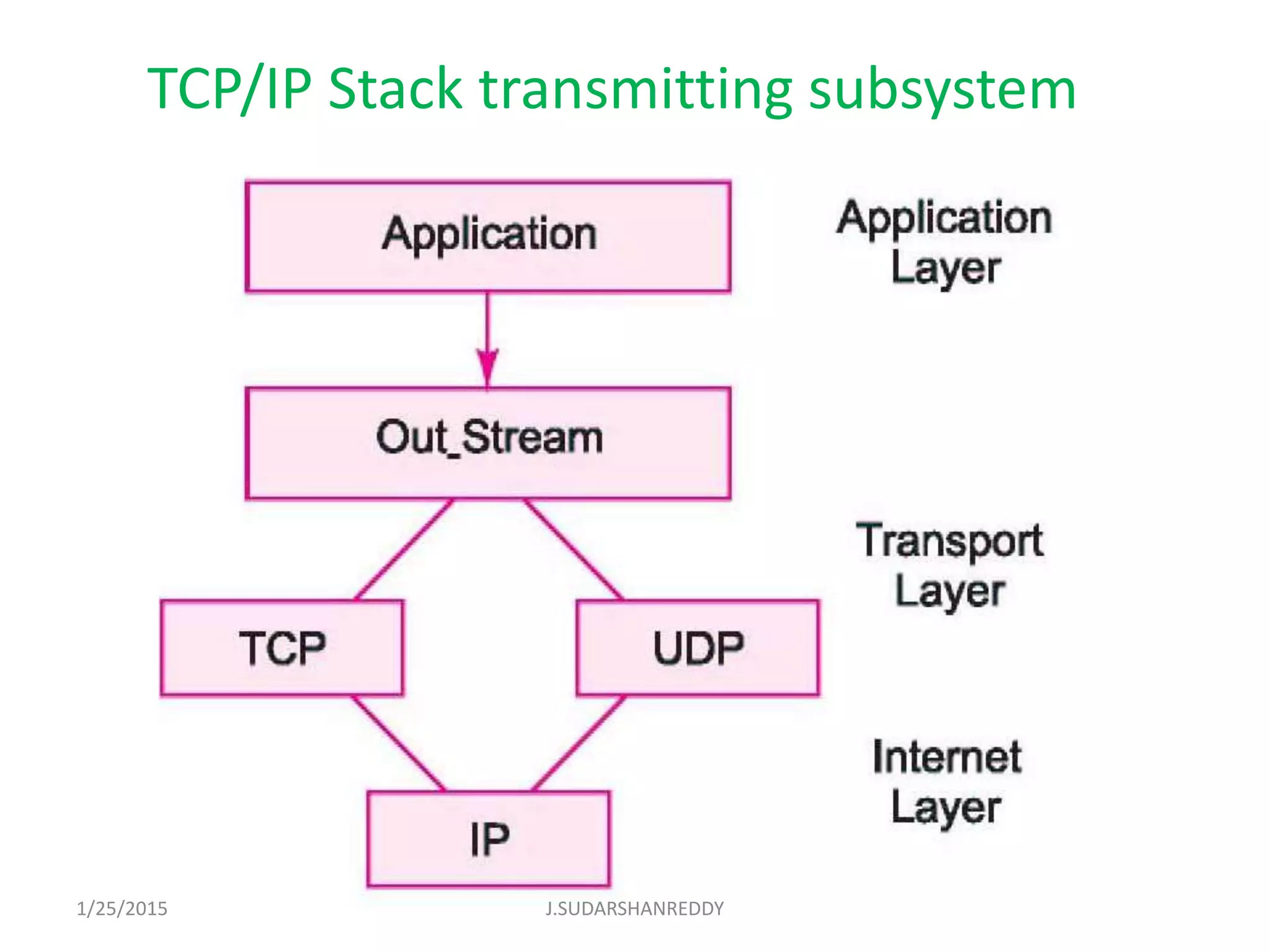
 In TCP/IP suite of protocols,
application layer transfers the
data with appropriate header
words to transport layer.
 At transport layer, either UDP
or TCP protocol is used and
additional header words placed.1/25/2015 J.SUDARSHANREDDY
TCP/IP Stack transmitting subsystem
1/25/2015 J.SUDARSHANREDDY
TCP/IP Stack
 UDP is connection-less protocol for
datagram transfer of total size including
headers of less than 216 Byte.
 TCP is connection oriented protocol, in
which data of unlimited size can be
transferred in multiple sequences to the
internet layer
 At internet layer, the IP protocol is used and
IP packets are formed, each packet with an
IP header transfers to the network through
network driver subsystem.
1/25/2015 J.SUDARSHANREDDY
TCP/IP stack
 Since the objective of case study is to
learn the use of IPCs in multitasking
RTOS through a case study.
 However, the present case study,
without resorting to the network socket
driver APIs in VxWorks, the required
software to be embedded in the system
is described to understand applications
of IPC functions in VxWorks.1/25/2015 J.SUDARSHANREDDY
2. Requirements
Purpose
 To generate the byte stream for
sending on the network using TCP
or UDP protocol at transport layer
and IP protocol at network layer
Signals, Events and Notifications
 After forming the packets at IP layer,
SemPktFlag for network driver task
1/25/2015 J.SUDARSHANREDDY
Inputs
 Bytes from application layer
 Notification Sem TCPFlag or
SemUDPFlag in case of TCP
sequences or UDP datagram,
respectively
Outputs
 TCP or UDP Byte stream to
destination socket
1/25/2015 J.SUDARSHANREDDY
Functions of the system
 An HTTP application data is sent after
encoding headers at transport and
network
layers.
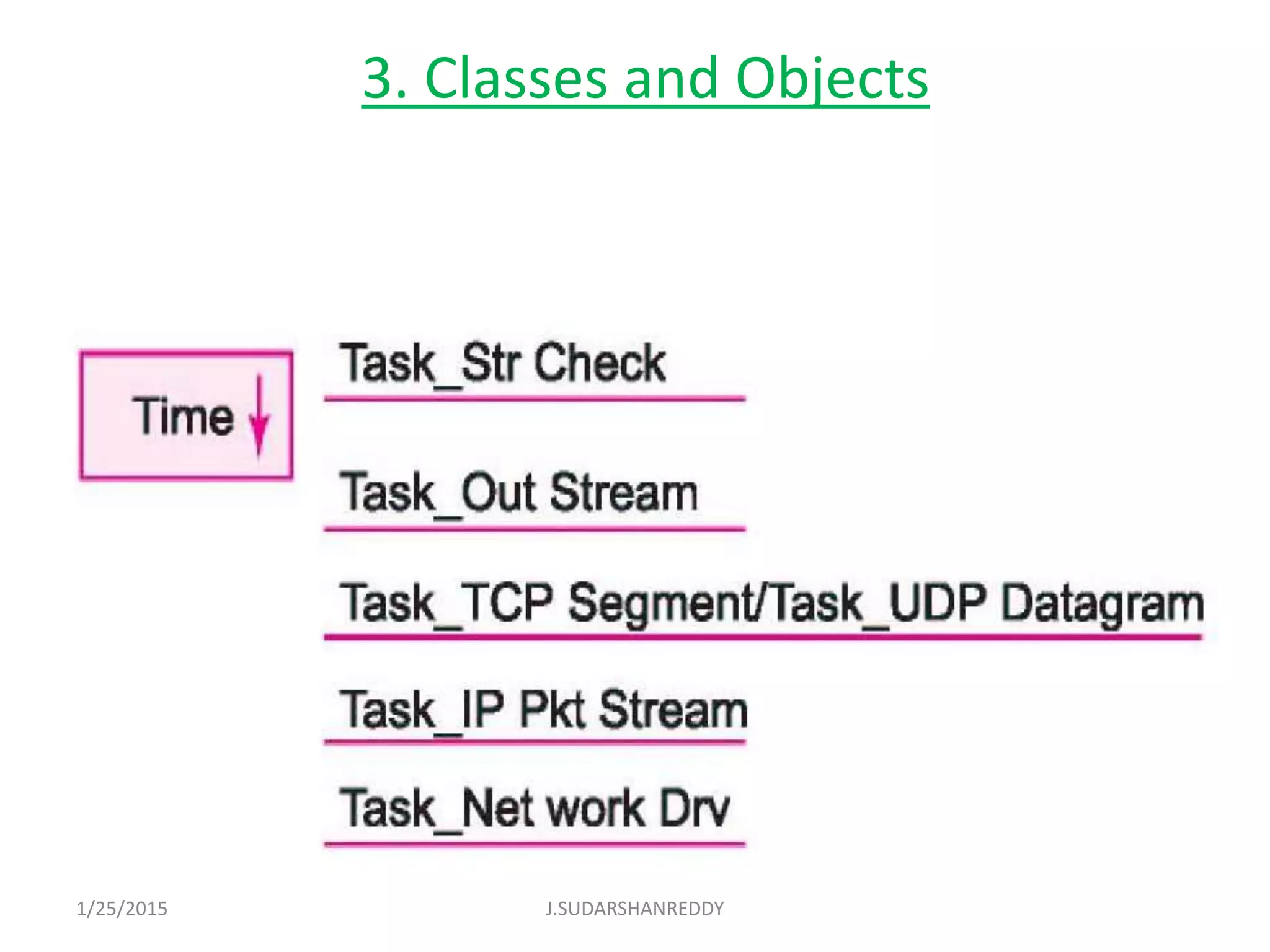
 Tasks are scheduled in five sequences
1. Task_StrCheck,
2. Task_OutStream,
3. Task_TCPSegment or ask_UDPDatagram,
4. Task_IPPktStream
5. Task_NetworkDrv1/25/2015 J.SUDARSHANREDDY
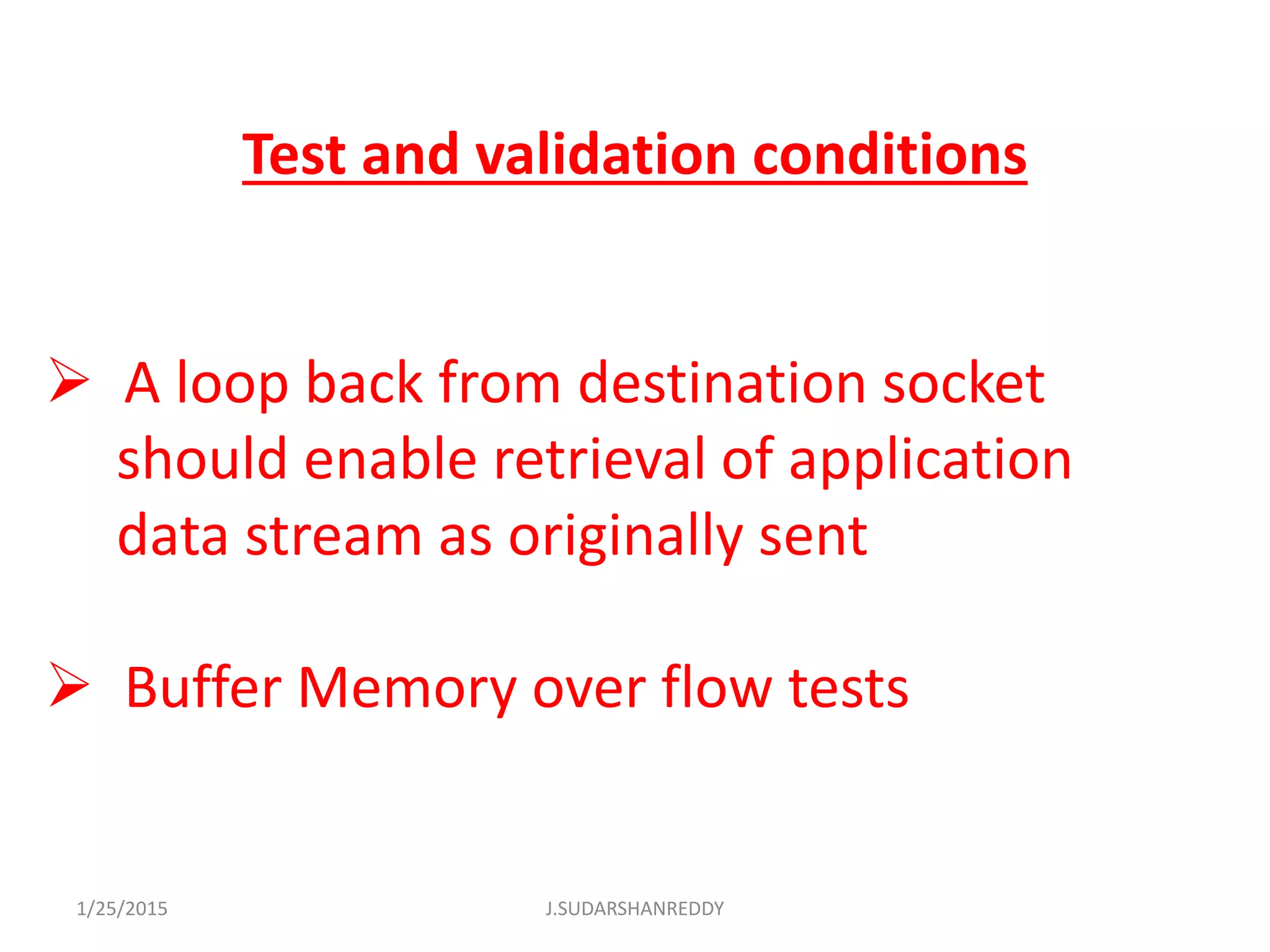
Test and validation conditions
 A loop back from destination socket
should enable retrieval of application
data stream as originally sent
 Buffer Memory over flow tests
1/25/2015 J.SUDARSHANREDDY
3. Classes and Objects
Tasks and their scheduling sequence in TCP/IP
Stack
transmitting subsystem
1/25/2015 J.SUDARSHANREDDY
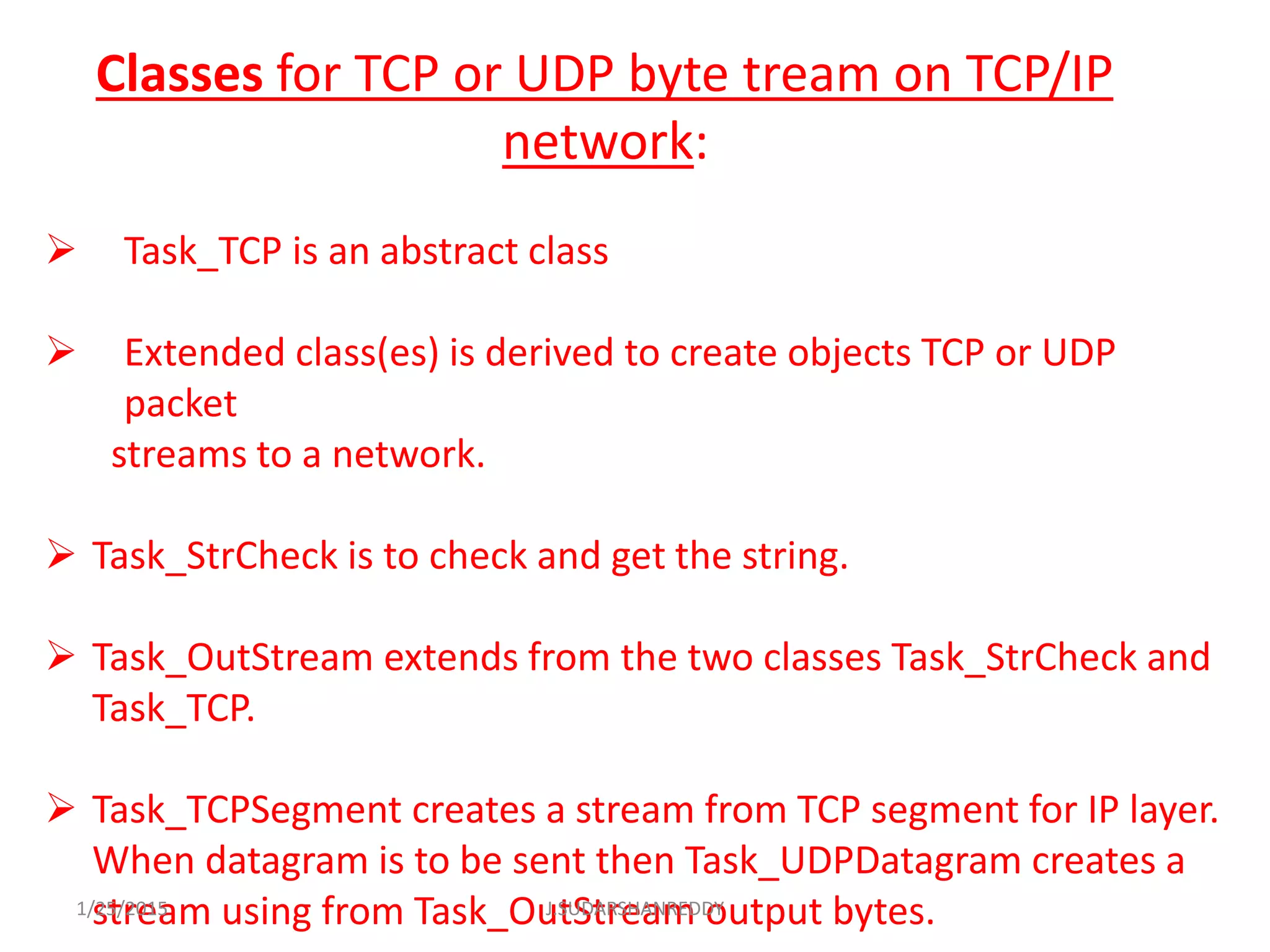
Classes for TCP or UDP byte tream on TCP/IP
network:
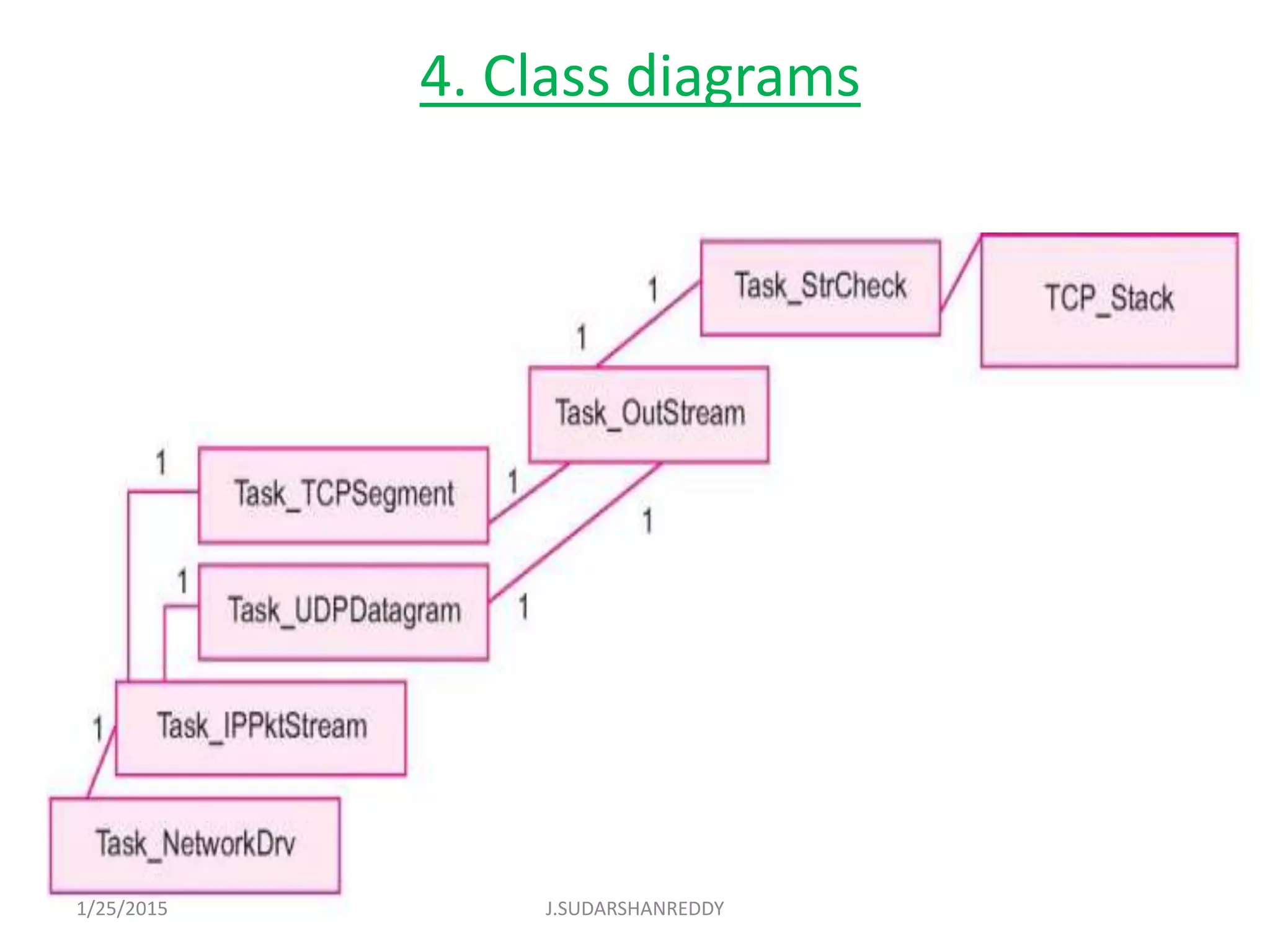
 Task_TCP is an abstract class
 Extended class(es) is derived to create objects TCP or UDP
packet
streams to a network.
 Task_StrCheck is to check and get the string.
 Task_OutStream extends from the two classes Task_StrCheck and
Task_TCP.
 Task_TCPSegment creates a stream from TCP segment for IP layer.
When datagram is to be sent then Task_UDPDatagram creates a
stream using from Task_OutStream output bytes.1/25/2015 J.SUDARSHANREDDY
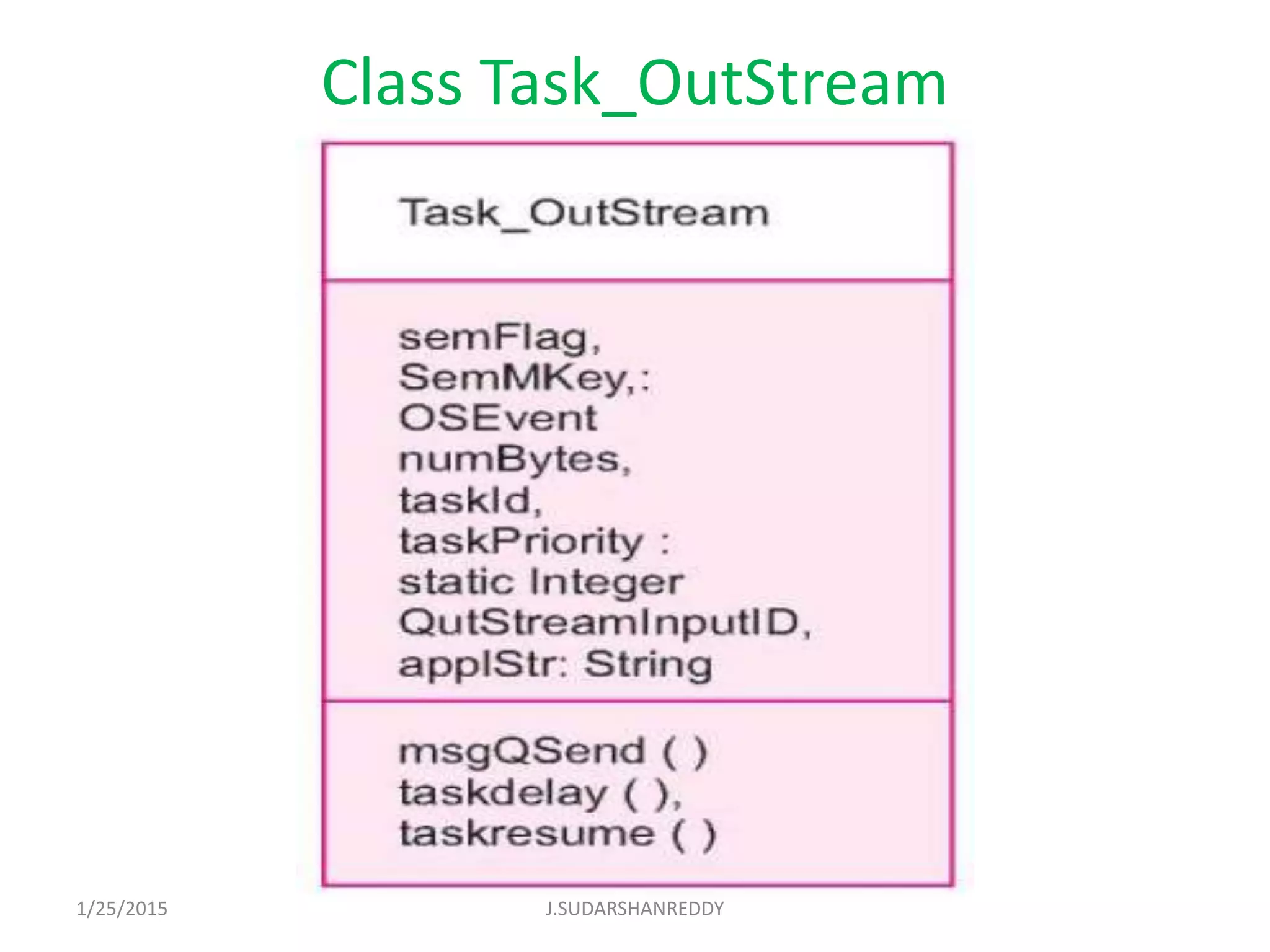
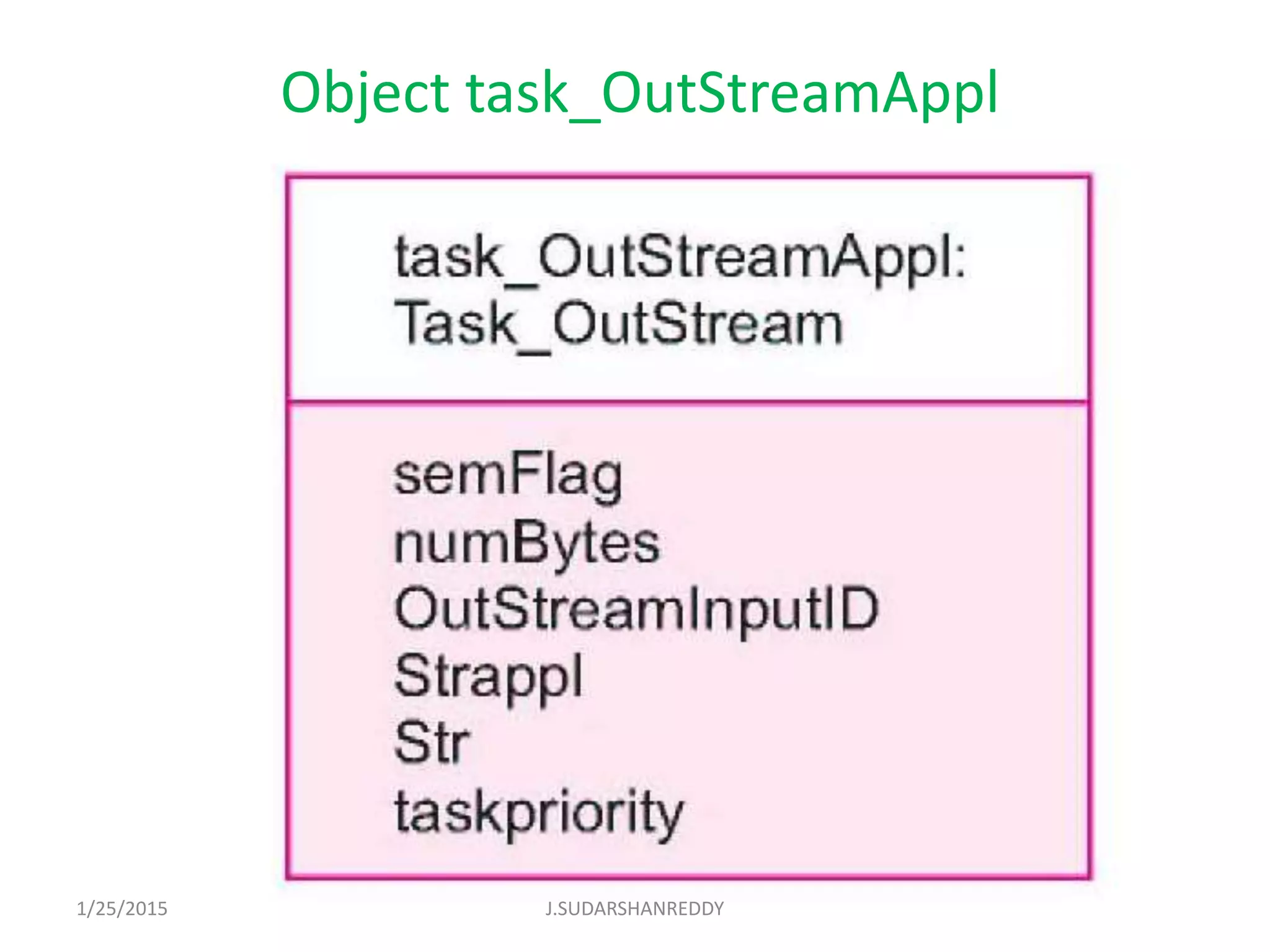
Class Task_OutStream
1/25/2015 J.SUDARSHANREDDY
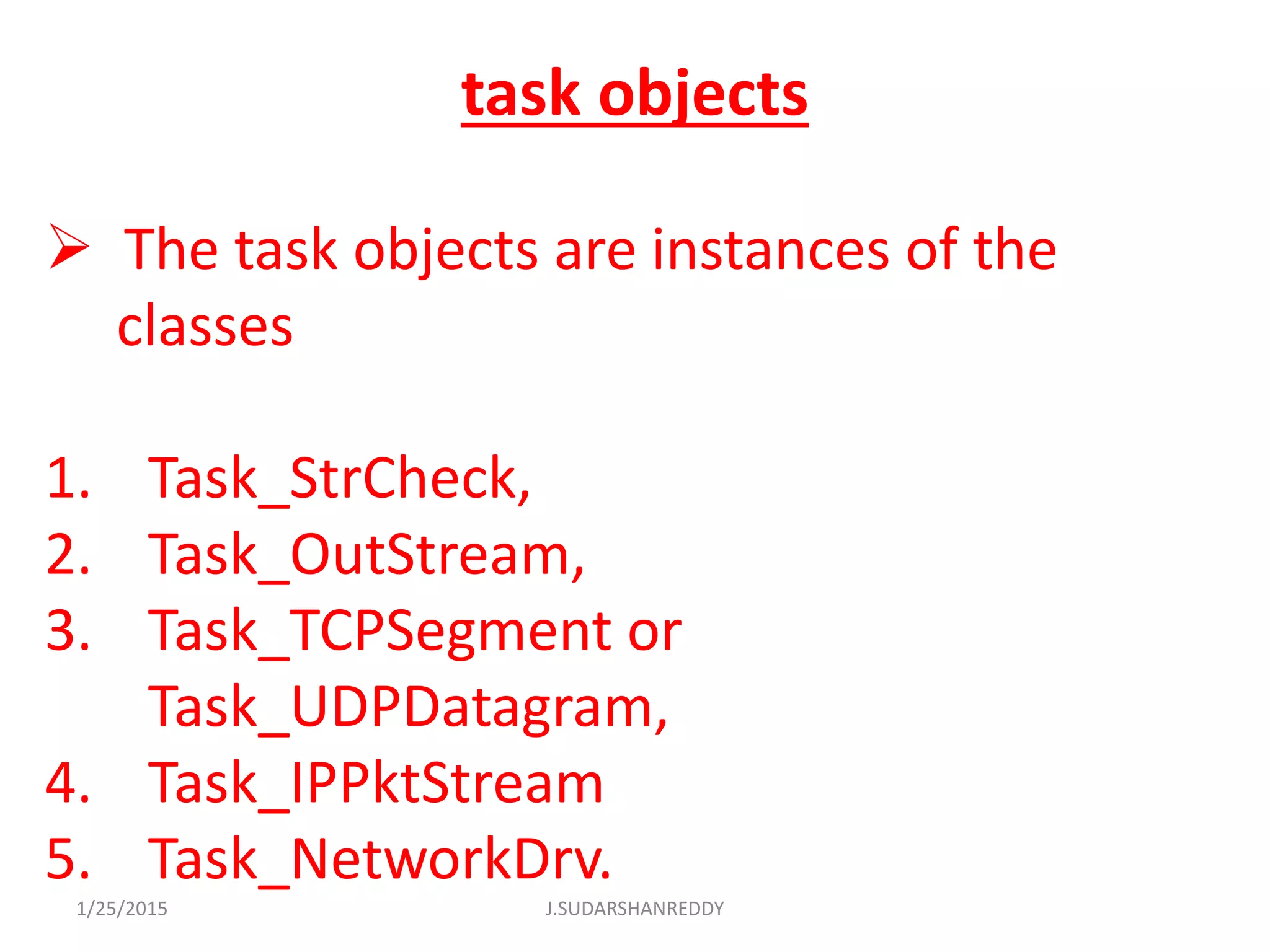
task objects
 The task objects are instances of the
classes
1. Task_StrCheck,
2. Task_OutStream,
3. Task_TCPSegment or
Task_UDPDatagram,
4. Task_IPPktStream
5. Task_NetworkDrv.
1/25/2015 J.SUDARSHANREDDY
Object task_OutStreamAppl
1/25/2015 J.SUDARSHANREDDY
4. Class diagrams
Class diagram for sending TCP/IP stacka
1/25/2015 J.SUDARSHANREDDY
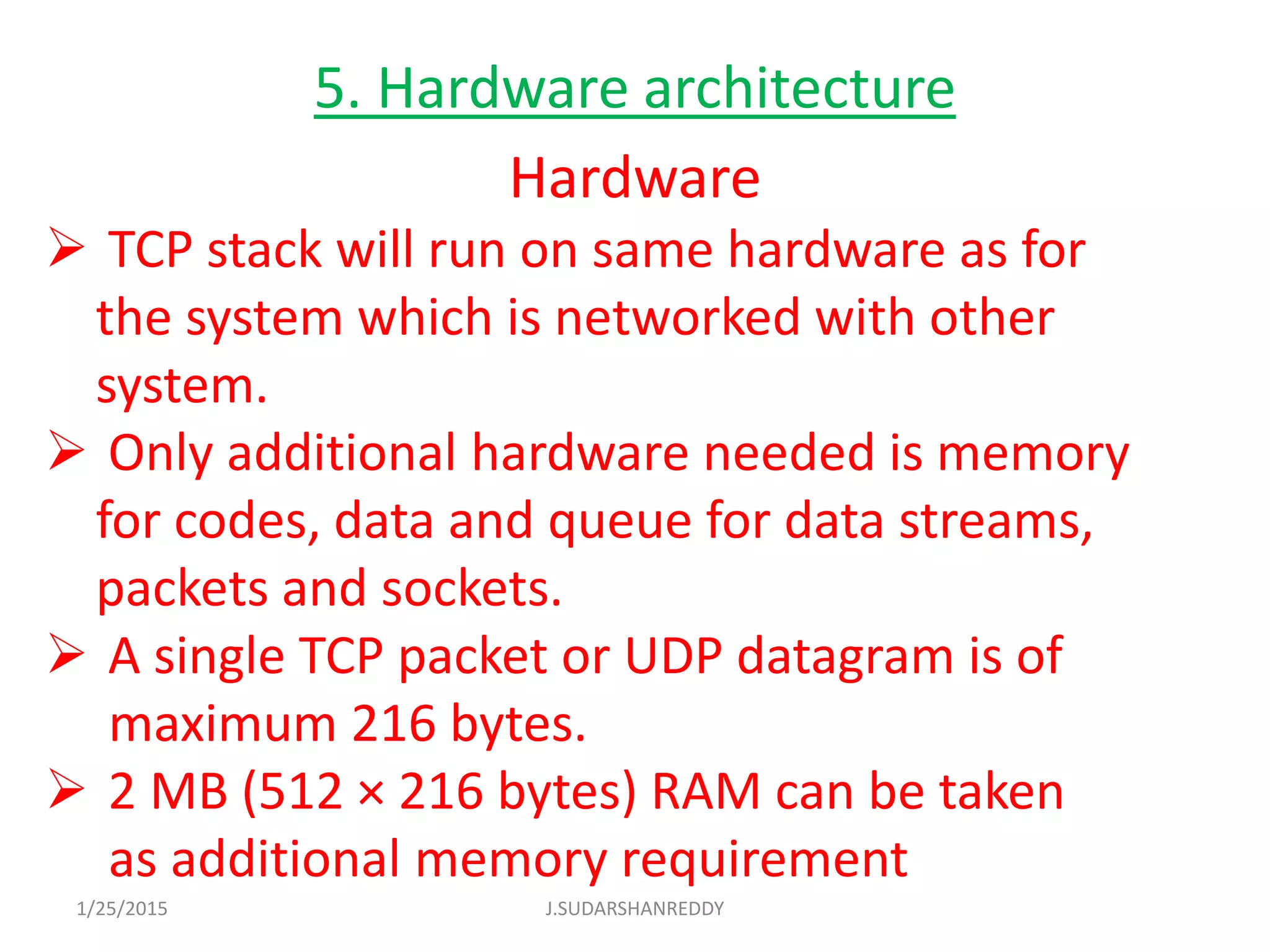
5. Hardware architecture
Hardware
 TCP stack will run on same hardware as for
the system which is networked with other
system.
 Only additional hardware needed is memory
for codes, data and queue for data streams,
packets and sockets.
 A single TCP packet or UDP datagram is of
maximum 216 bytes.
 2 MB (512 × 216 bytes) RAM can be taken
as additional memory requirement
1/25/2015 J.SUDARSHANREDDY
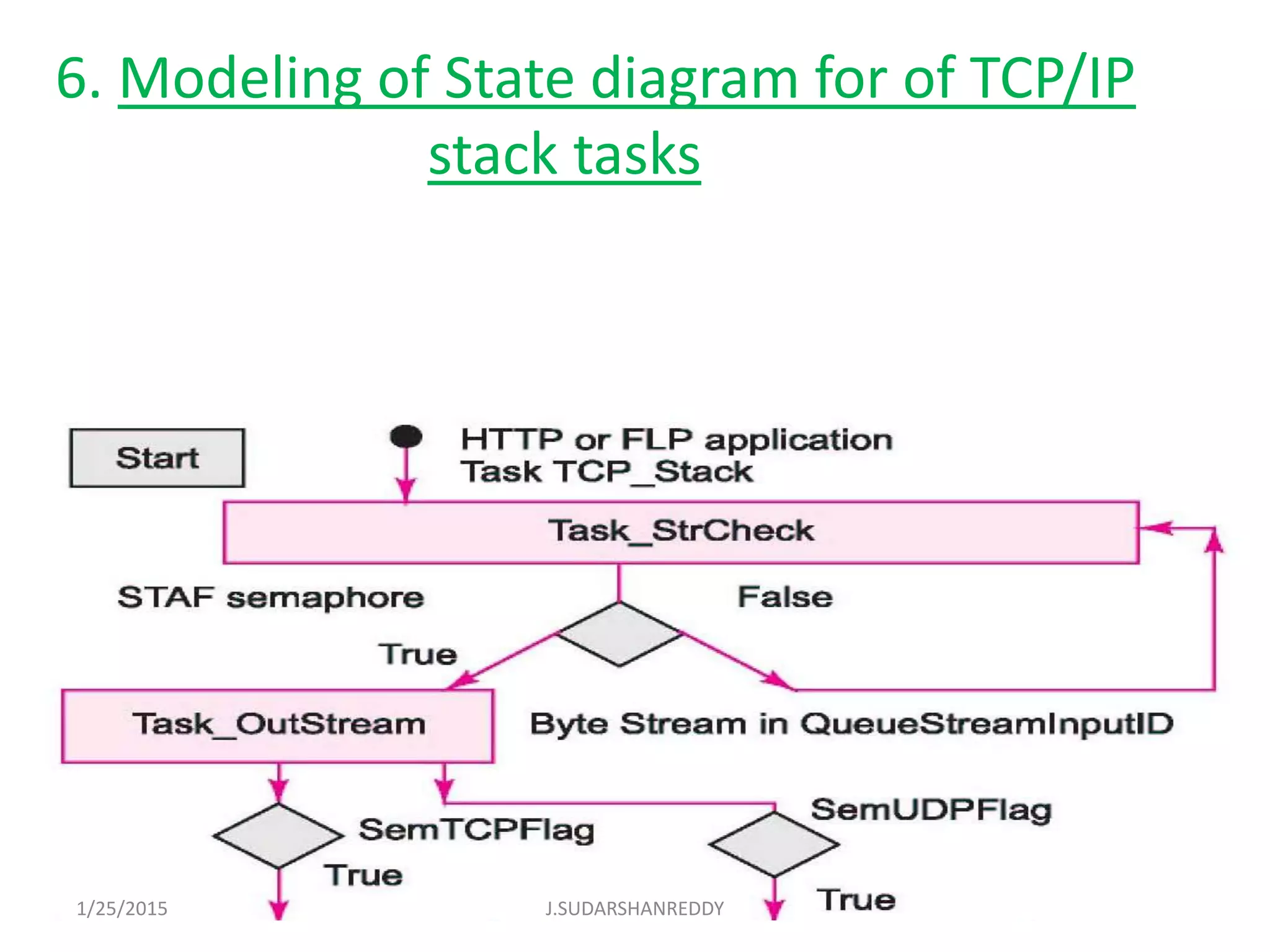
6. Modeling of State diagram for of TCP/IP
stack tasks
State diagram for synchronization of TCP/IP
stack tasks- Part 1
1/25/2015 J.SUDARSHANREDDY
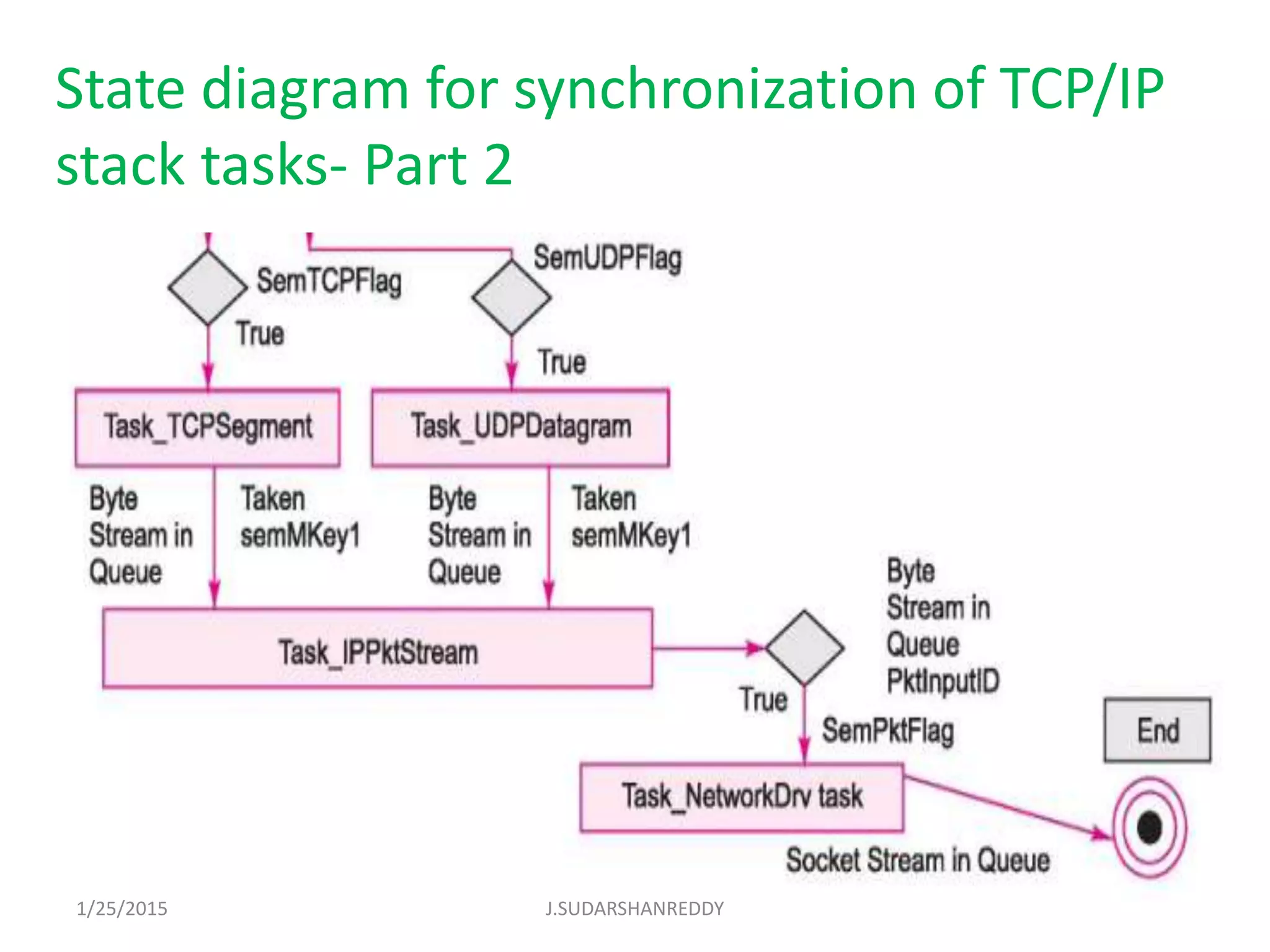
State diagram for synchronization of TCP/IP
stack tasks- Part 2
1/25/2015 J.SUDARSHANREDDY
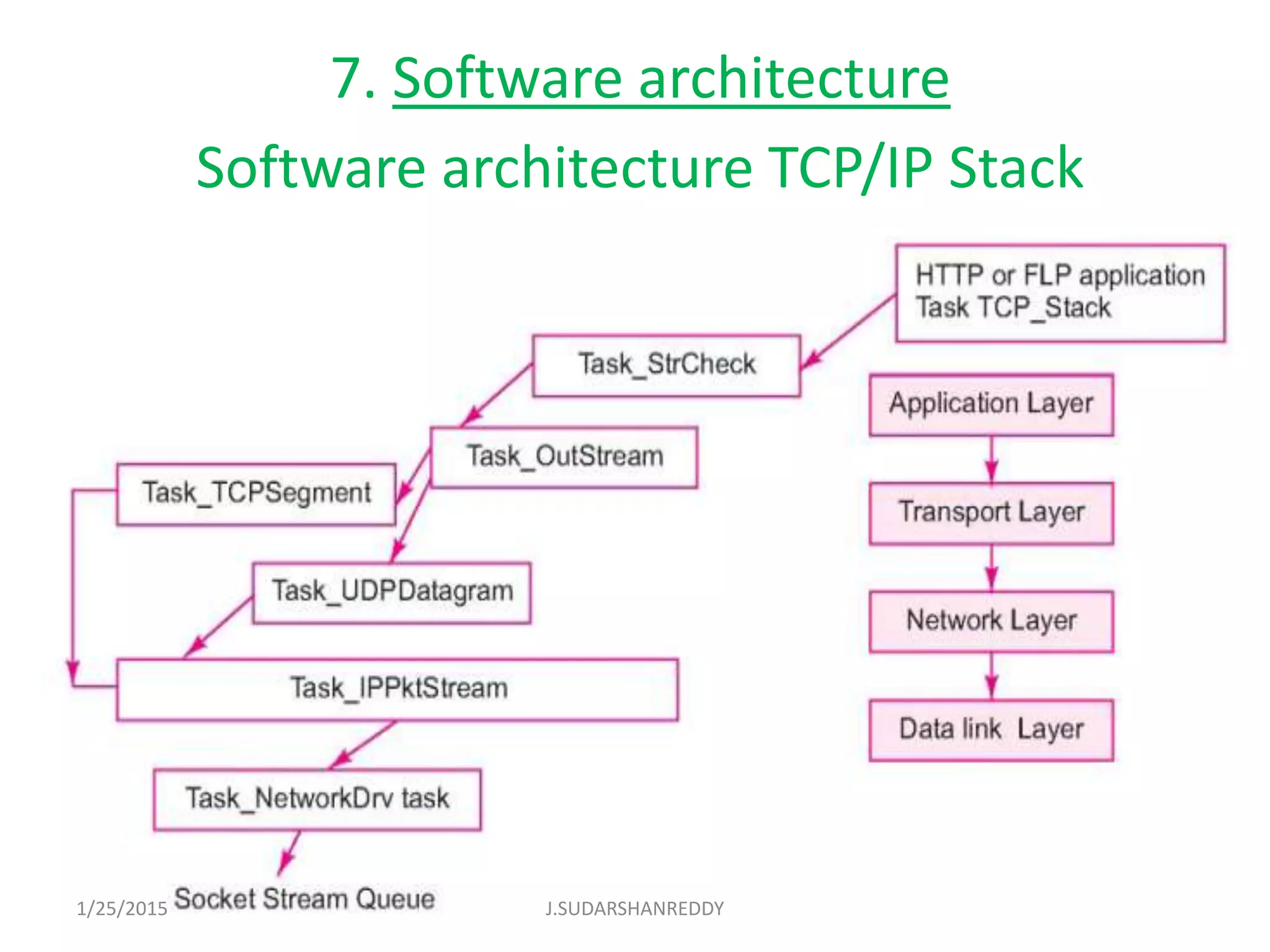
7. Software architecture
Software architecture TCP/IP Stack
1/25/2015 J.SUDARSHANREDDY
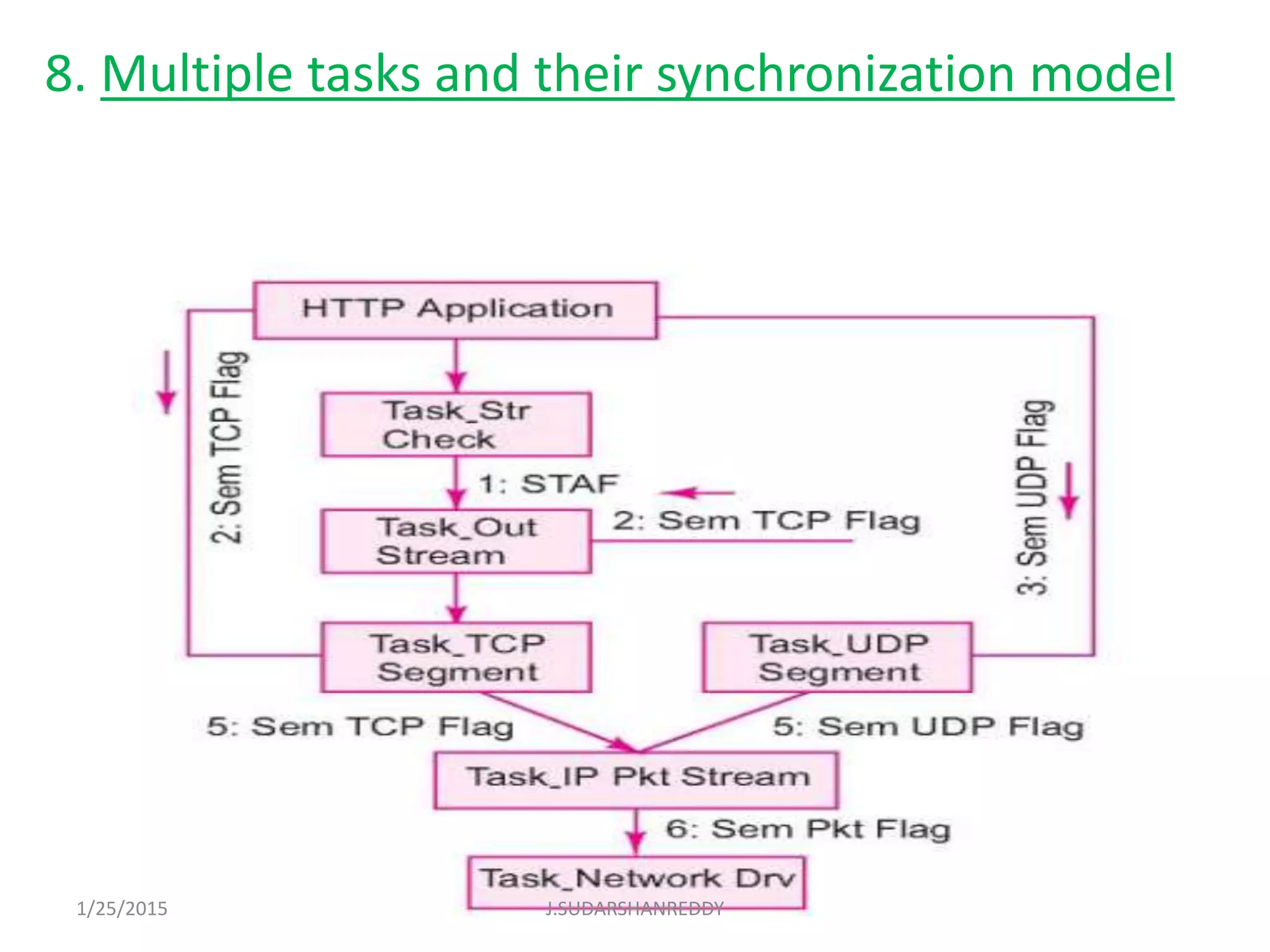
8. Multiple tasks and their synchronization model
Multiple tasks and their synchronization model
using
semaphores and mailbox messages
1/25/2015 J.SUDARSHANREDDY
9. Tasks and their priority, action and IPCs
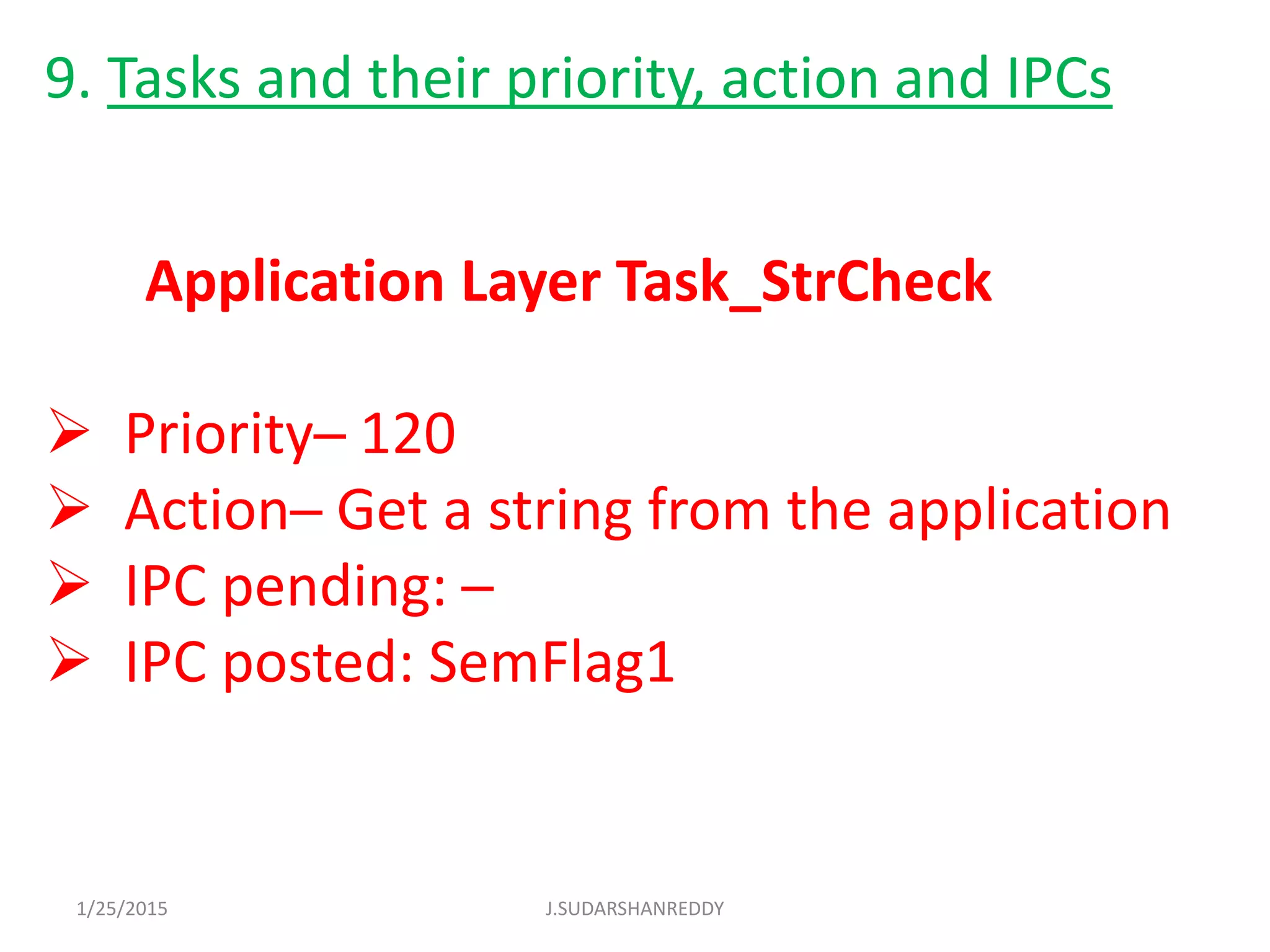
Application Layer Task_StrCheck
 Priority─ 120
 Action─ Get a string from the application
 IPC pending: ─
 IPC posted: SemFlag1
1/25/2015 J.SUDARSHANREDDY
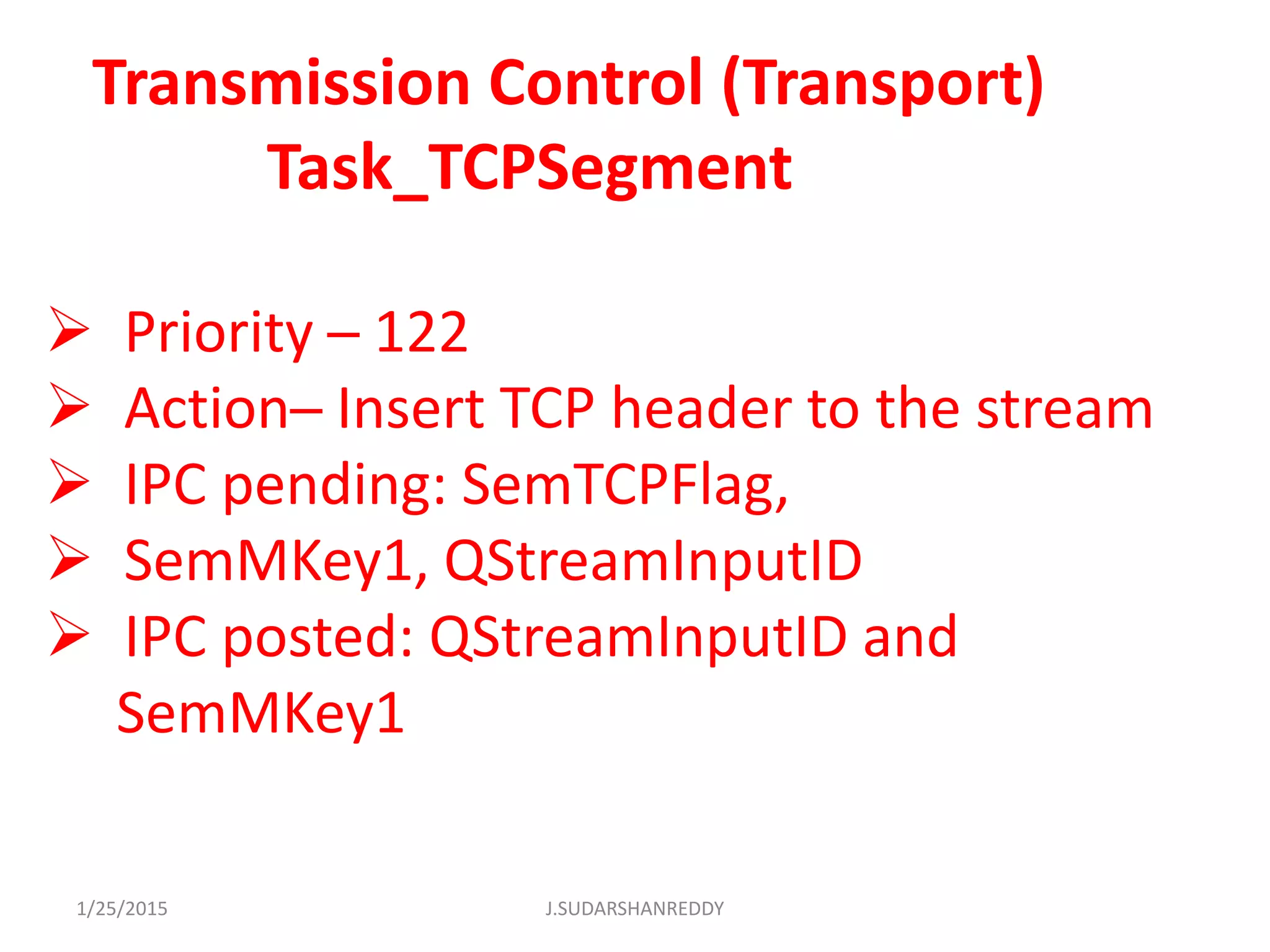
Transmission Control (Transport)
Task_TCPSegment
 Priority ─ 122
 Action─ Insert TCP header to the stream
 IPC pending: SemTCPFlag,
 SemMKey1, QStreamInputID
 IPC posted: QStreamInputID and
SemMKey1
1/25/2015 J.SUDARSHANREDDY
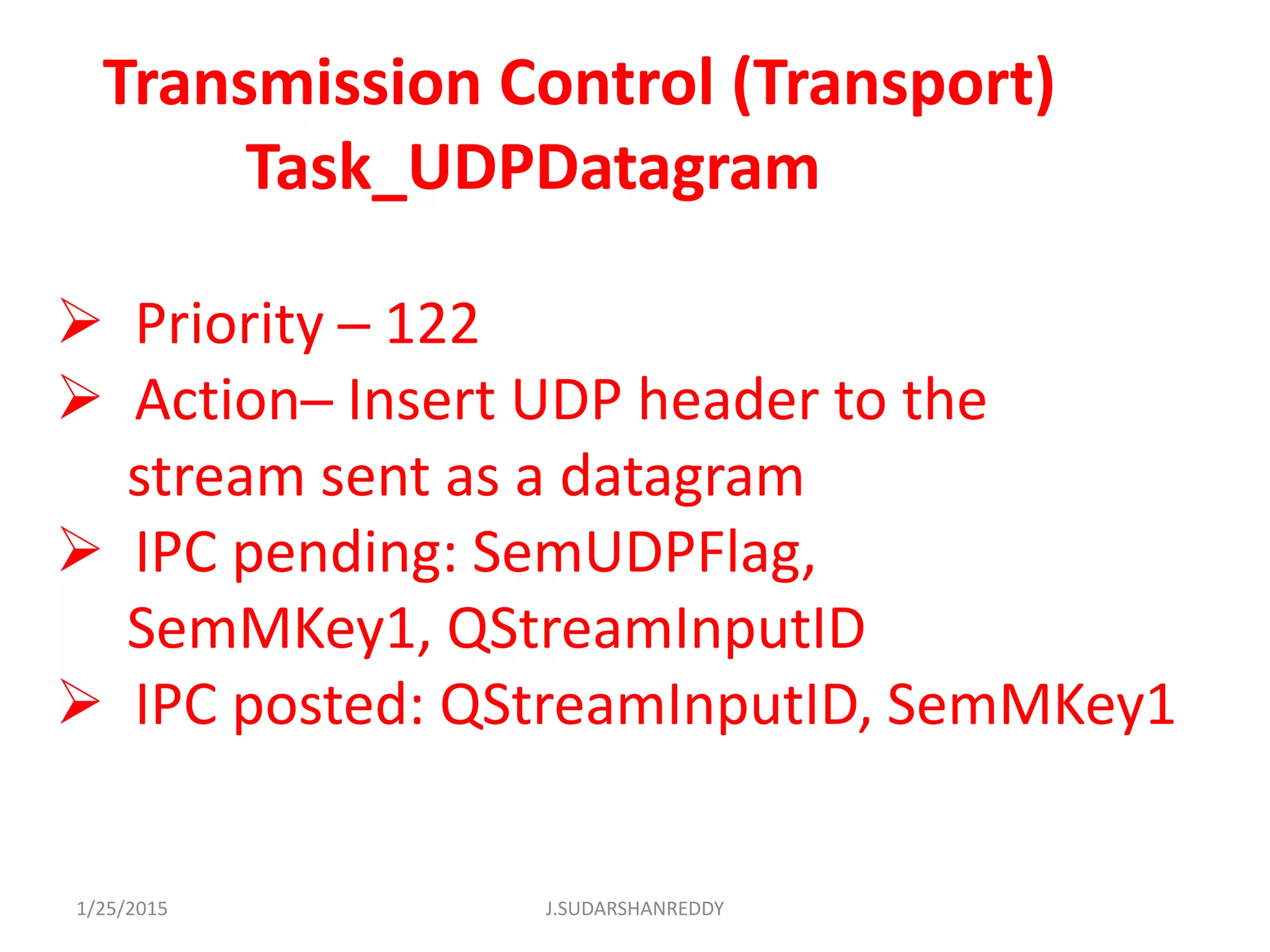
Transmission Control (Transport)
Task_UDPDatagram
 Priority ─ 122
 Action─ Insert UDP header to the
stream sent as a datagram
 IPC pending: SemUDPFlag,
SemMKey1, QStreamInputID
 IPC posted: QStreamInputID, SemMKey1
1/25/2015 J.SUDARSHANREDDY
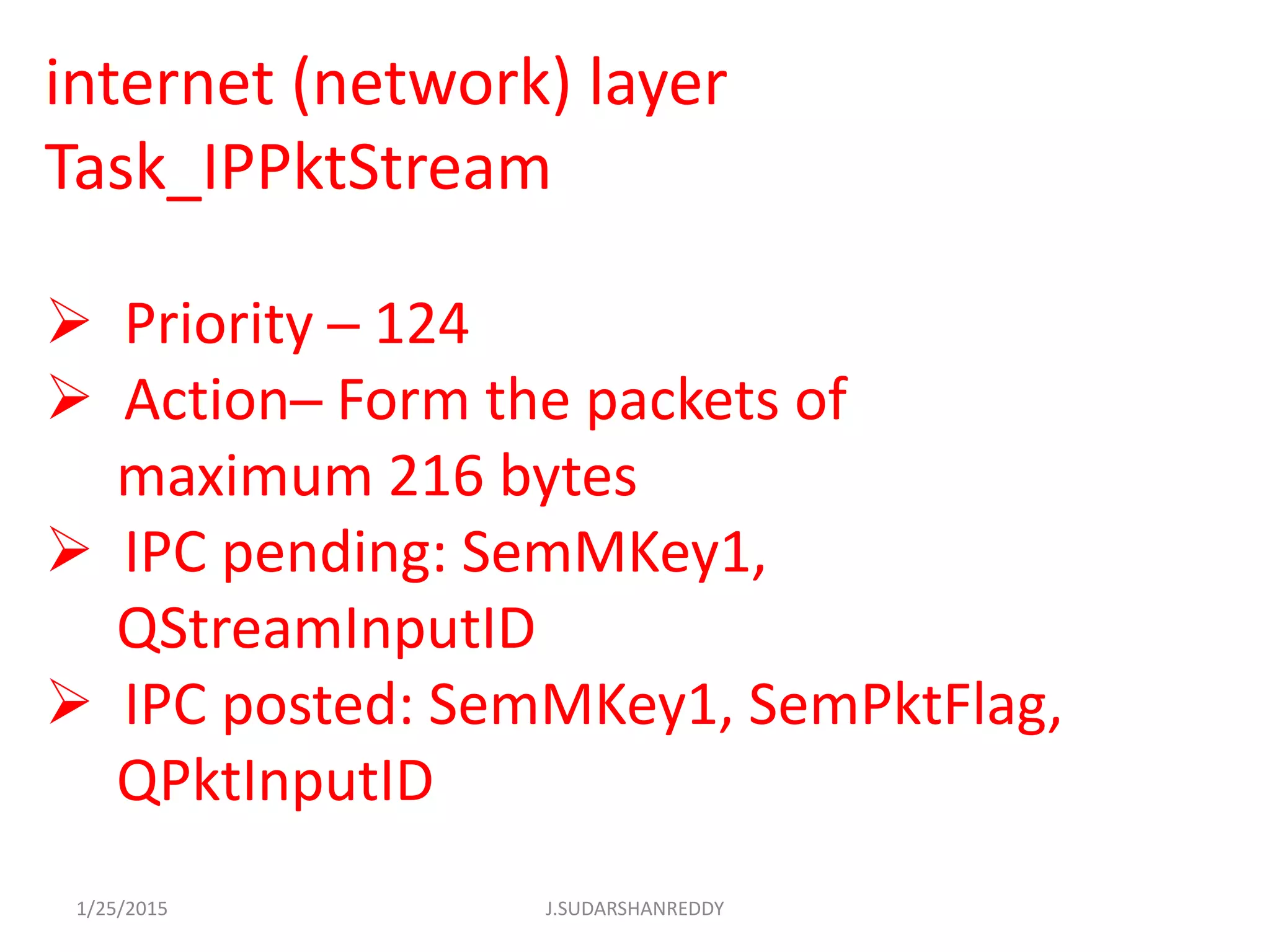
internet (network) layer
Task_IPPktStream
 Priority ─ 124
 Action─ Form the packets of
maximum 216 bytes
 IPC pending: SemMKey1,
QStreamInputID
 IPC posted: SemMKey1, SemPktFlag,
QPktInputID
1/25/2015 J.SUDARSHANREDDY
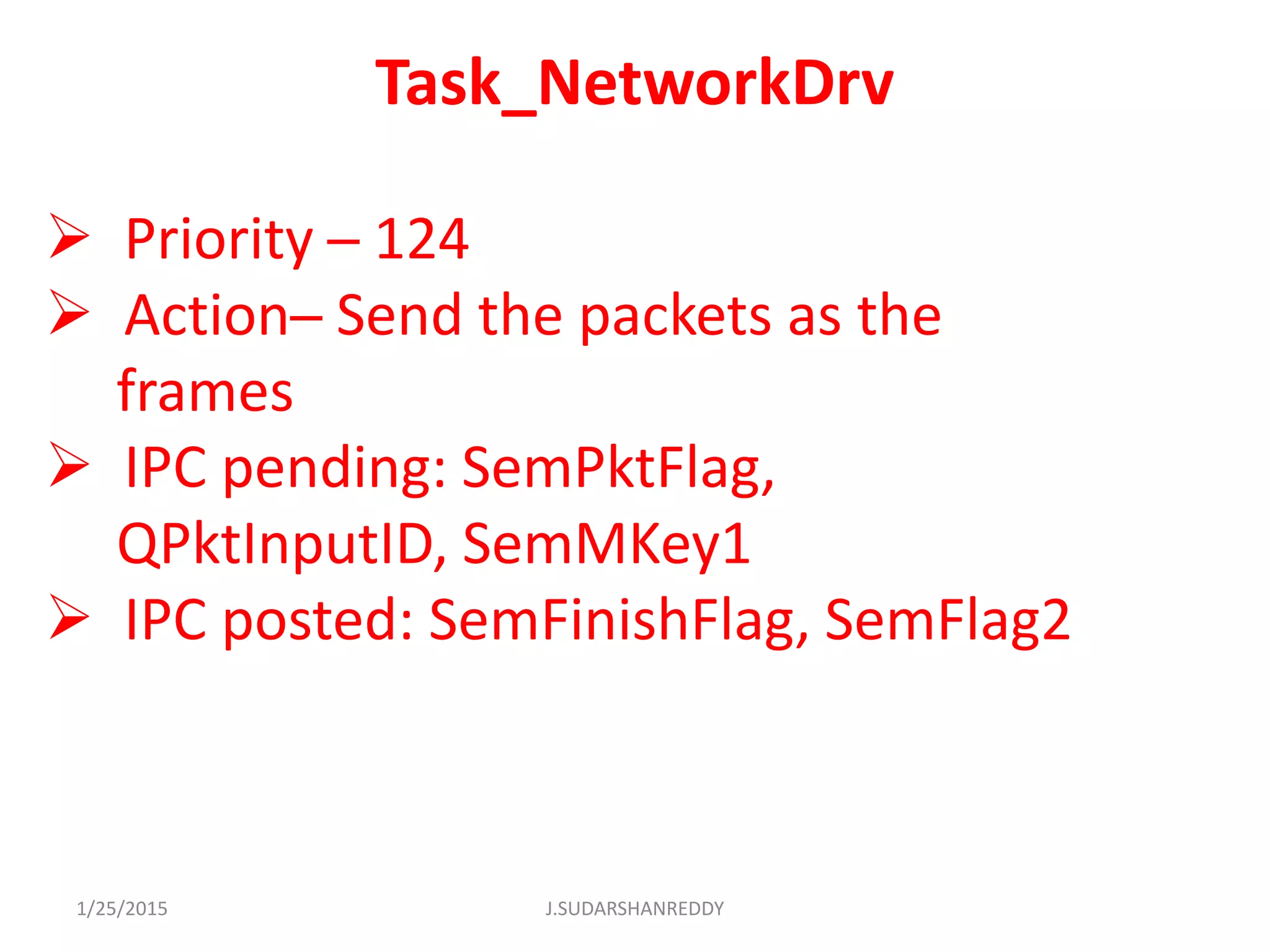
Task_NetworkDrv
 Priority ─ 124
 Action─ Send the packets as the
frames
 IPC pending: SemPktFlag,
QPktInputID, SemMKey1
 IPC posted: SemFinishFlag, SemFlag2
1/25/2015 J.SUDARSHANREDDY
10.Coding using VxWorks RTOS IPCfunctions
Coding using VxWorks RTOS
 Refer Example 11.2 in Section 11.3.4
 At each step the explanation for the set
of statements given there.
1/25/2015 J.SUDARSHANREDDY
We learnt
 VxWorks RTOS used for embedded
system codes for driving a network
card
 after generating the TCP/IP stack.
Exemplary codes show a method of
code designing for sending the byte
streams on a network
Thank You1/25/2015 J.SUDARSHANREDDY

RTOS CASE STUDY OF CODING FOR SENDING APPLICATION LAYER BYTE STREAMS ON A TCP/IP NETWORK USING RTOS VX Works

  • 1.
    RTOS CASE STUDY OFCODING FOR SENDING APPLICATION LAYER BYTE STREAMS ON A TCP/IP NETWORK USING RTOS VX Works 1/25/2015 J.SUDARSHANREDDY
  • 2.
    1. Specifications TCP/IP Stack In TCP/IP suite of protocols, application layer transfers the data with appropriate header words to transport layer.  At transport layer, either UDP or TCP protocol is used and additional header words placed.1/25/2015 J.SUDARSHANREDDY
  • 3.
    TCP/IP Stack transmittingsubsystem 1/25/2015 J.SUDARSHANREDDY
  • 4.
    TCP/IP Stack  UDPis connection-less protocol for datagram transfer of total size including headers of less than 216 Byte.  TCP is connection oriented protocol, in which data of unlimited size can be transferred in multiple sequences to the internet layer  At internet layer, the IP protocol is used and IP packets are formed, each packet with an IP header transfers to the network through network driver subsystem. 1/25/2015 J.SUDARSHANREDDY
  • 5.
    TCP/IP stack  Sincethe objective of case study is to learn the use of IPCs in multitasking RTOS through a case study.  However, the present case study, without resorting to the network socket driver APIs in VxWorks, the required software to be embedded in the system is described to understand applications of IPC functions in VxWorks.1/25/2015 J.SUDARSHANREDDY
  • 6.
    2. Requirements Purpose  Togenerate the byte stream for sending on the network using TCP or UDP protocol at transport layer and IP protocol at network layer Signals, Events and Notifications  After forming the packets at IP layer, SemPktFlag for network driver task 1/25/2015 J.SUDARSHANREDDY
  • 7.
    Inputs  Bytes fromapplication layer  Notification Sem TCPFlag or SemUDPFlag in case of TCP sequences or UDP datagram, respectively Outputs  TCP or UDP Byte stream to destination socket 1/25/2015 J.SUDARSHANREDDY
  • 8.
    Functions of thesystem  An HTTP application data is sent after encoding headers at transport and network layers.  Tasks are scheduled in five sequences 1. Task_StrCheck, 2. Task_OutStream, 3. Task_TCPSegment or ask_UDPDatagram, 4. Task_IPPktStream 5. Task_NetworkDrv1/25/2015 J.SUDARSHANREDDY
  • 9.
    Test and validationconditions  A loop back from destination socket should enable retrieval of application data stream as originally sent  Buffer Memory over flow tests 1/25/2015 J.SUDARSHANREDDY
  • 10.
    3. Classes andObjects Tasks and their scheduling sequence in TCP/IP Stack transmitting subsystem 1/25/2015 J.SUDARSHANREDDY
  • 11.
    Classes for TCPor UDP byte tream on TCP/IP network:  Task_TCP is an abstract class  Extended class(es) is derived to create objects TCP or UDP packet streams to a network.  Task_StrCheck is to check and get the string.  Task_OutStream extends from the two classes Task_StrCheck and Task_TCP.  Task_TCPSegment creates a stream from TCP segment for IP layer. When datagram is to be sent then Task_UDPDatagram creates a stream using from Task_OutStream output bytes.1/25/2015 J.SUDARSHANREDDY
  • 12.
  • 13.
    task objects  Thetask objects are instances of the classes 1. Task_StrCheck, 2. Task_OutStream, 3. Task_TCPSegment or Task_UDPDatagram, 4. Task_IPPktStream 5. Task_NetworkDrv. 1/25/2015 J.SUDARSHANREDDY
  • 14.
  • 15.
    4. Class diagrams Classdiagram for sending TCP/IP stacka 1/25/2015 J.SUDARSHANREDDY
  • 16.
    5. Hardware architecture Hardware TCP stack will run on same hardware as for the system which is networked with other system.  Only additional hardware needed is memory for codes, data and queue for data streams, packets and sockets.  A single TCP packet or UDP datagram is of maximum 216 bytes.  2 MB (512 × 216 bytes) RAM can be taken as additional memory requirement 1/25/2015 J.SUDARSHANREDDY
  • 17.
    6. Modeling ofState diagram for of TCP/IP stack tasks State diagram for synchronization of TCP/IP stack tasks- Part 1 1/25/2015 J.SUDARSHANREDDY
  • 18.
    State diagram forsynchronization of TCP/IP stack tasks- Part 2 1/25/2015 J.SUDARSHANREDDY
  • 19.
    7. Software architecture Softwarearchitecture TCP/IP Stack 1/25/2015 J.SUDARSHANREDDY
  • 20.
    8. Multiple tasksand their synchronization model Multiple tasks and their synchronization model using semaphores and mailbox messages 1/25/2015 J.SUDARSHANREDDY
  • 21.
    9. Tasks andtheir priority, action and IPCs Application Layer Task_StrCheck  Priority─ 120  Action─ Get a string from the application  IPC pending: ─  IPC posted: SemFlag1 1/25/2015 J.SUDARSHANREDDY
  • 22.
    Transmission Control (Transport) Task_TCPSegment Priority ─ 122  Action─ Insert TCP header to the stream  IPC pending: SemTCPFlag,  SemMKey1, QStreamInputID  IPC posted: QStreamInputID and SemMKey1 1/25/2015 J.SUDARSHANREDDY
  • 23.
    Transmission Control (Transport) Task_UDPDatagram Priority ─ 122  Action─ Insert UDP header to the stream sent as a datagram  IPC pending: SemUDPFlag, SemMKey1, QStreamInputID  IPC posted: QStreamInputID, SemMKey1 1/25/2015 J.SUDARSHANREDDY
  • 24.
    internet (network) layer Task_IPPktStream Priority ─ 124  Action─ Form the packets of maximum 216 bytes  IPC pending: SemMKey1, QStreamInputID  IPC posted: SemMKey1, SemPktFlag, QPktInputID 1/25/2015 J.SUDARSHANREDDY
  • 25.
    Task_NetworkDrv  Priority ─124  Action─ Send the packets as the frames  IPC pending: SemPktFlag, QPktInputID, SemMKey1  IPC posted: SemFinishFlag, SemFlag2 1/25/2015 J.SUDARSHANREDDY
  • 26.
    10.Coding using VxWorksRTOS IPCfunctions Coding using VxWorks RTOS  Refer Example 11.2 in Section 11.3.4  At each step the explanation for the set of statements given there. 1/25/2015 J.SUDARSHANREDDY
  • 27.
    We learnt  VxWorksRTOS used for embedded system codes for driving a network card  after generating the TCP/IP stack. Exemplary codes show a method of code designing for sending the byte streams on a network Thank You1/25/2015 J.SUDARSHANREDDY