Rotator Cuff Syndrome
Abbas Rashid FRCS (Tr&Orth)
My Service
• Fellowship trained
- shoulder & elbow surgeon
- secondary & tertiary
- arthroscopy
- arthroplasty
- reconstruction
• Base
- UCLH
- ISEH, Wellington & Docklands
• Mandate
- translational research
- evidence based treatment
Overview
Definitions
Kinematics
Aetiology
Pathogenesis
Prevalence
Clinical assessment
Imaging
Staging
Treatment
Common mistakes
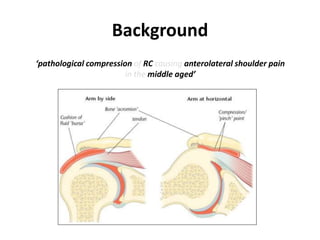
Background
‘pathological compression of RC causing anterolateral shoulder pain
in the middle aged’
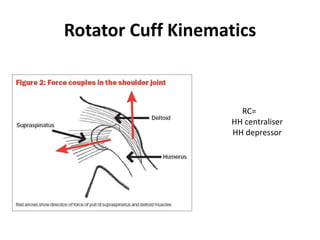
Rotator Cuff Kinematics
RC=
HH centraliser
HH depressor
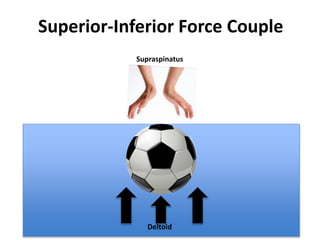
Deltoid
Supraspinatus
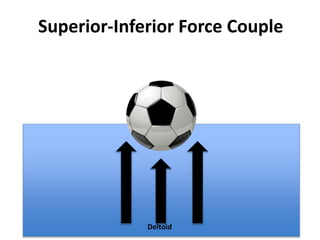
Superior-Inferior Force Couple
Deltoid
Superior-Inferior Force Couple
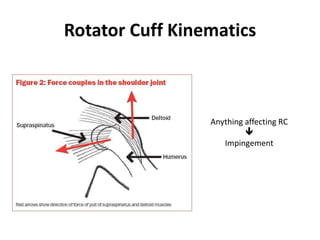
Rotator Cuff Kinematics
Anything affecting RC

Impingement
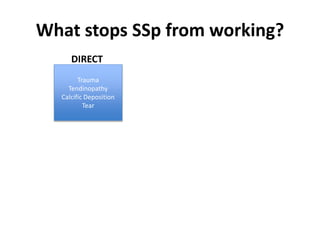
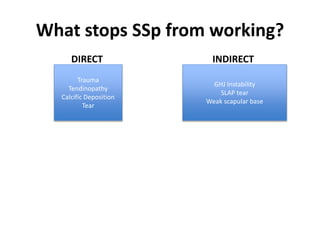
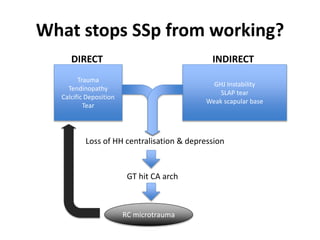
What stops SSp from working?
DIRECT
Trauma
Tendinopathy
Calcific Deposition
Tear
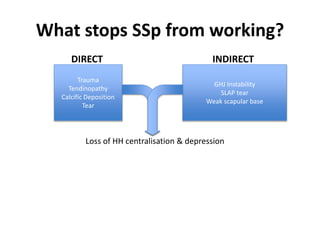
What stops SSp from working?
DIRECT INDIRECT
GHJ Instability
SLAP tear
Weak scapular base
Trauma
Tendinopathy
Calcific Deposition
Tear
What stops SSp from working?
DIRECT INDIRECT
GHJ Instability
SLAP tear
Weak scapular base
Trauma
Tendinopathy
Calcific Deposition
Tear
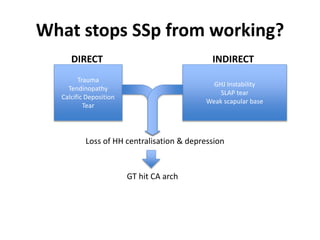
Loss of HH centralisation & depression
What stops SSp from working?
DIRECT INDIRECT
GHJ Instability
SLAP tear
Weak scapular base
Trauma
Tendinopathy
Calcific Deposition
Tear
Loss of HH centralisation & depression
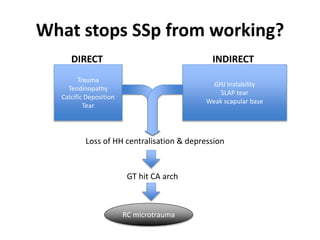
GT hit CA arch
What stops SSp from working?
DIRECT INDIRECT
GHJ Instability
SLAP tear
Weak scapular base
Trauma
Tendinopathy
Calcific Deposition
Tear
Loss of HH centralisation & depression
GT hit CA arch
RC microtrauma
What stops SSp from working?
DIRECT INDIRECT
GHJ Instability
SLAP tear
Weak scapular base
Trauma
Tendinopathy
Calcific Deposition
Tear
Loss of HH centralisation & depression
GT hit CA arch
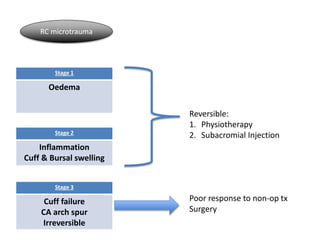
RC microtrauma
Stage 1
Oedema
Stage 2
Inflammation
Cuff & Bursal swelling
Stage 3
Cuff failure
CA arch spur
Irreversible
RC microtrauma
Reversible:
1. Physiotherapy
2. Subacromial Injection
Poor response to non-op tx
Surgery
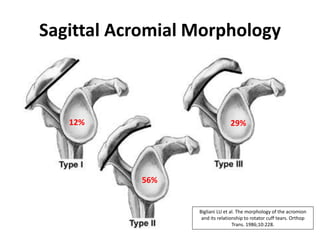
Sagittal Acromial Morphology
12%
56%
29%
Bigliani LU et al. The morphology of the acromion
and its relationship to rotator cuff tears. Orthop
Trans. 1986;10:228.
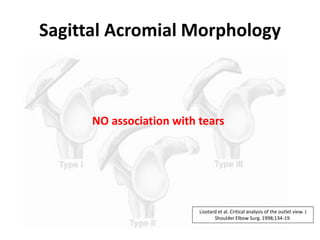
Sagittal Acromial Morphology
NO association with tears
Lisotard et al. Critical analysis of the outlet view. J
Shoulder Elbow Surg. 1998;134-19.
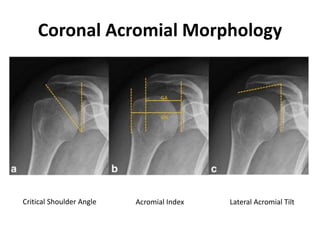
Coronal Acromial Morphology
Critical Shoulder Angle Acromial Index Lateral Acromial Tilt
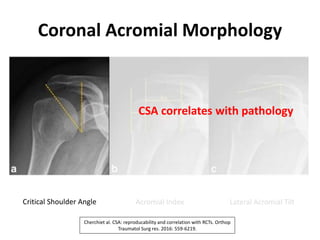
Coronal Acromial Morphology
Critical Shoulder Angle Acromial Index Lateral Acromial Tilt
CSA correlates with pathology
Cherchiet al. CSA: reproducability and correlation with RCTs. Orthop
Traumatol Surg res. 2016: 559-6219.
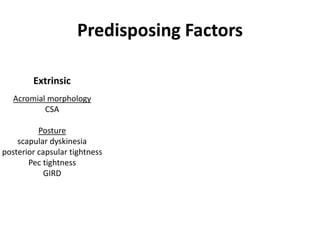
Predisposing Factors
Extrinsic
Acromial morphology
CSA
Posture
scapular dyskinesia
posterior capsular tightness
Pec tightness
GIRD
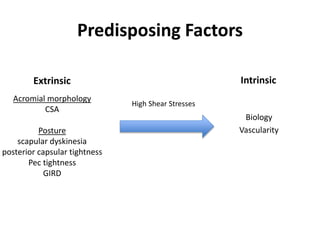
Predisposing Factors
Intrinsic
Biology
Vascularity
Extrinsic
Acromial morphology
CSA
Posture
scapular dyskinesia
posterior capsular tightness
Pec tightness
GIRD
High Shear Stresses
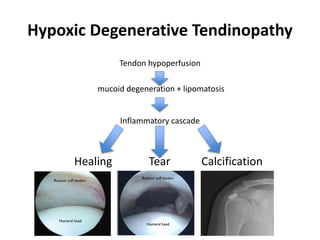
Hypoxic Degenerative Tendinopathy
Tendon hypoperfusion
mucoid degeneration + lipomatosis
Inflammatory cascade
Healing Tear Calcification
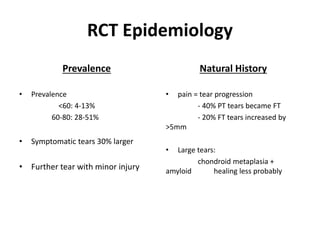
RCT Epidemiology
Prevalence
• Prevalence
<60: 4-13%
60-80: 28-51%
• Symptomatic tears 30% larger
• Further tear with minor injury
Natural History
• pain = tear progression
- 40% PT tears became FT
- 20% FT tears increased by
>5mm
• Large tears:
chondroid metaplasia +
amyloid healing less probably
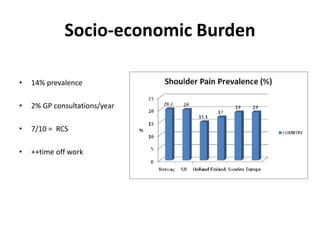
Socio-economic Burden
• 14% prevalence
• 2% GP consultations/year
• 7/10 = RCS
• ++time off work
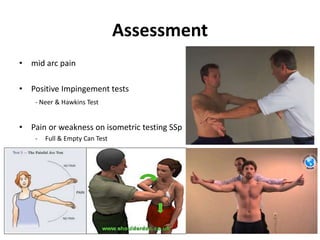
Assessment
• mid arc pain
• Positive Impingement tests
- Neer & Hawkins Test
• Pain or weakness on isometric testing SSp
- Full & Empty Can Test
Imaging
Non-operative Treatment
Cochrane review 2009 : 71 systematic reviews, RCTs & observational studies
Analgesics:
✗ topical NSAIDs, oral corticosteroids, paracetamol or opioid analgesics
✓ oral NSAIDs (short term)
Adjuncs & therapy:
✗ Acupuncture = Placebo
✗ autologous blood, intra-articular NSAID, ice or ultrasound
✓ Shockwave: calcific tendonitis
✓ Physiotherapy
• ? PRP may improve the speed of recovery
• ? Long-term damage of corticosteroid injection
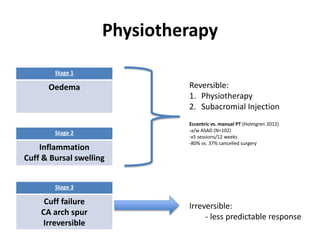
Physiotherapy
Stage 1
Oedema
Stage 2
Inflammation
Cuff & Bursal swelling
Stage 3
Cuff failure
CA arch spur
Irreversible
Reversible:
1. Physiotherapy
2. Subacromial Injection
Irreversible:
- less predictable response
Eccentric vs. manual PT (Holmgren 2012)
-a/w ASAD (N=102)
-x5 sessions/12 weeks
-80% vs. 37% cancelled surgery
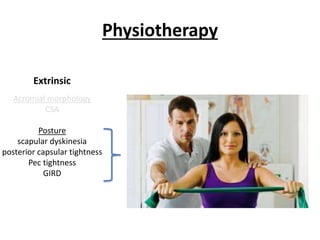
Physiotherapy
Extrinsic
Acromial morphology
CSA
Posture
scapular dyskinesia
posterior capsular tightness
Pec tightness
GIRD
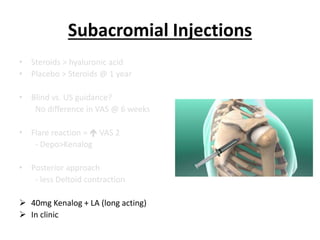
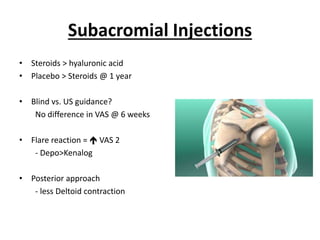
Subacromial Injections
• Steroids > hyaluronic acid
• Placebo > Steroids @ 1 year
• Blind vs. US guidance?
No difference in VAS @ 6 weeks
• Flare reaction =  VAS 2
- Depo>Kenalog
• Posterior approach
- less Deltoid contraction
Subacromial Injections
• Steroids > hyaluronic acid
• Placebo > Steroids @ 1 year
• Blind vs. US guidance?
No difference in VAS @ 6 weeks
• Flare reaction =  VAS 2
- Depo>Kenalog
• Posterior approach
- less Deltoid contraction
 40mg Kenalog + LA (long acting)
 In clinic
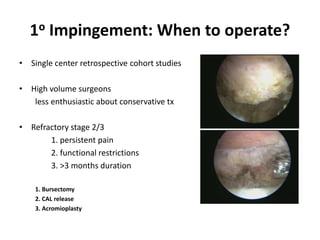
1o Impingement: When to operate?
• Single center retrospective cohort studies
• High volume surgeons
less enthusiastic about conservative tx
• Refractory stage 2/3
1. persistent pain
2. functional restrictions
3. >3 months duration
1. Bursectomy
2. CAL release
3. Acromioplasty
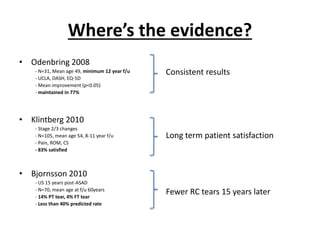
Where’s the evidence?
• Odenbring 2008
- N=31, Mean age 49, minimum 12 year f/u
- UCLA, DASH, EQ-5D
- Mean improvement (p<0.05)
- maintained in 77%
• Klintberg 2010
- Stage 2/3 changes
- N=105, mean age 54, 8-11 year f/u
- Pain, ROM, CS
- 83% satisfied
• Bjornsson 2010
- US 15 years post-ASAD
- N=70, mean age at f/u 60years
- 14% PT tear, 4% FT tear
- Less than 40% predicted rate
Consistent results
Long term patient satisfaction
Fewer RC tears 15 years later
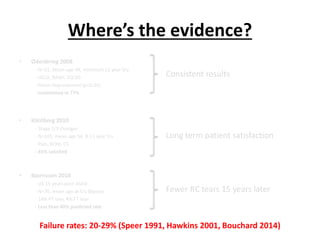
Where’s the evidence?
• Odenbring 2008
- N=31, Mean age 49, minimum 12 year f/u
- UCLA, DASH, EQ-5D
- Mean improvement (p<0.05)
- maintained in 77%
• Klintberg 2010
- Stage 2/3 changes
- N=105, mean age 54, 8-11 year f/u
- Pain, ROM, CS
- 83% satisfied
• Bjornsson 2010
- US 15 years post-ASAD
- N=70, mean age at f/u 60years
- 14% PT tear, 4% FT tear
- Less than 40% predicted rate
Consistent results
Long term patient satisfaction
Fewer RC tears 15 years later
Failure rates: 20-29% (Speer 1991, Hawkins 2001, Bouchard 2014)
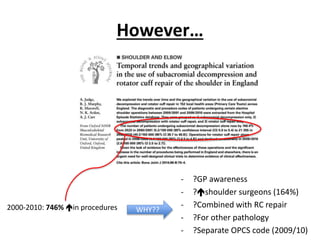
However…
- ?GP awareness
- ?shoulder surgeons (164%)
- ?Combined with RC repair
- ?For other pathology
- ?Separate OPCS code (2009/10)
2000-2010: 746% in procedures WHY??
Evidence
• ARTHRITIS UK funded
• physio vs. ASAD
• 12 month f/u
• recruiting till 2017
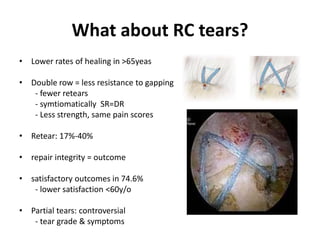
What about RC tears?
• Lower rates of healing in >65yeas
• Double row = less resistance to gapping
- fewer retears
- symtiomatically SR=DR
- Less strength, same pain scores
• Retear: 17%-40%
• repair integrity = outcome
• satisfactory outcomes in 74.6%
- lower satisfaction <60y/o
• Partial tears: controversial
- tear grade & symptoms
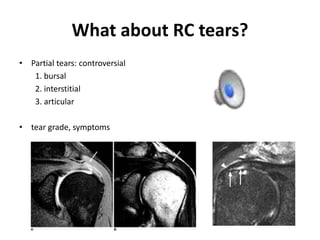
What about RC tears?
• Partial tears: controversial
1. bursal
2. interstitial
3. articular
• tear grade, symptoms
Evidence
• 2007-2010
• NIHR funded
• Arthroscopic vs. mini open repair
• 77% crossover PT to surgery
• 1year imaging
• 2year PROMS
• Same results
• Arthroscopic>expensive
Failure
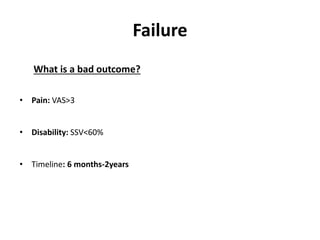
What is a bad outcome?
• Pain: VAS>3
• Disability: SSV<60%
• Timeline: 6 months-2years
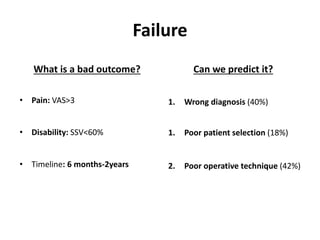
Can we predict it?
1. Wrong Diagnosis (40%)
2. Poor patient Selection (18%)
3. Poor Operative Technique (42%)
Failure
What is a bad outcome?
• Pain: VAS>3
• Disability: SSV<60%
• Timeline: 6 months-2years
Can we predict it?
1. Wrong diagnosis (40%)
1. Poor patient selection (18%)
2. Poor operative technique (42%)
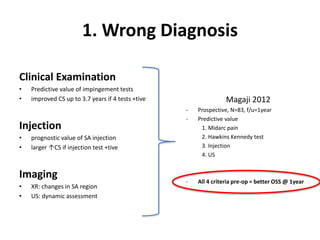
1. Wrong Diagnosis
Clinical Examination
• Predictive value of impingement tests
• improved CS up to 3.7 years if 4 tests +tive
Injection
• prognostic value of SA injection
• larger ↑CS if injection test +tive
Imaging
• XR: changes in SA region
• US: dynamic assessment
Magaji 2012
- Prospective, N=83, f/u=1year
- Predictive value
1. Midarc pain
2. Hawkins Kennedy test
3. Injection
4. US
- All 4 criteria pre-op = better OSS @ 1year
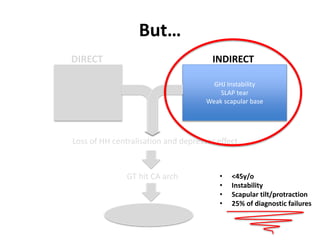
But…
DIRECT INDIRECT
GHJ Instability
SLAP tear
Weak scapular base
Strain
Tendinopathy
Calcific Deposition
Tear
Loss of HH centralisation and depressor effect
GT hit CA arch
RC microtrauma
• <45y/o
• Instability
• Scapular tilt/protraction
• 25% of diagnostic failures
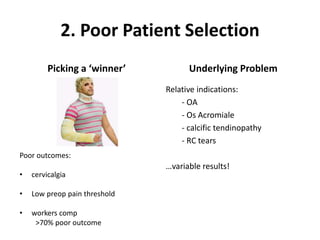
2. Poor Patient Selection
Picking a ‘winner’
Poor outcomes:
• cervicalgia
• Low preop pain threshold
• workers comp
>70% poor outcome
Underlying Problem
Relative indications:
- OA
- Os Acromiale
- calcific tendinopathy
- RC tears
…variable results!
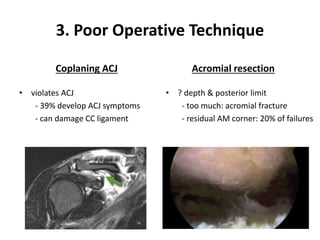
3. Poor Operative Technique
Coplaning ACJ
• violates ACJ
- 39% develop ACJ symptoms
- can damage CC ligament
Acromial resection
• ? depth & posterior limit
- too much: acromial fracture
- residual AM corner: 20% of failures
Revision SAD
• 50% success @ 2-6 year f/u
• 85% RTW
• Confounding factor:
workers comp - 47%
non-workers comp – 75%
• Causes
1. <45y/o: missed labral tear or scapular dyskinesia
2. >45y/o: inadequate decompression
3. other pain generators (e.g. OA)
4. acromial fractures
Conclusion
 Impingement is NOT a diagnosis but a constellation of symptoms!
 Patient selection: valid & well defined criteria
 <45y/o Exclude scapular base problem & instability
 Trial of non-operative tx
 Correct operative technique
 High failure rates in workers comp
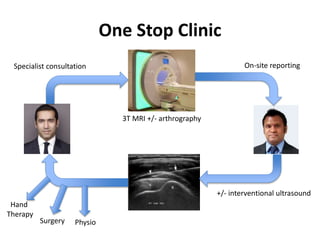
One Stop Clinic
Specialist consultation
3T MRI +/- arthrography
On-site reporting
+/- interventional ultrasound
PhysioSurgery
Hand
Therapy
References
1. Neer CS 2nd. Anterior acromioplasty for the chronic impingement syndrome in the shoulder. 1972. J Bone
Joint Surg Am. 2005 Jun;87(6):1399.
2. Neer S 2nd. J Bone Joint Surg Am. Anterior acromioplasty for the chronic impingement syndrome in the
shoulder: a preliminary report. 1972 Jan;54(1):41-50.
3. Ellman H1, Kay SP. Arthroscopic subacromial decompression for chronic impingement. Two- to five-year
results. J Bone Joint Surg Br. 1991 May;73(3):395-8.
4. Ellman H1. Arthroscopic subacromial decompression: analysis of one- to three-year results. Arthroscopy.
1987;3(3):173-81.
5. Altchek DW1, Carson EW. Arthroscopic acromioplasty. Current status. Orthop Clin North Am. 1997
Apr;28(2):157-68.
6. Holmgren T1, Björnsson Hallgren H, Öberg B, Adolfsson L, Johansson K. Effect of specific exercise strategy on
need for surgery in patients with subacromial impingement syndrome: randomised controlled study. BMJ.
2012 Feb 20;344:e787. doi: 10.1136/bmj.e787.
7. Klintberg IH1, Svantesson U, Karlsson J. Long-term patient satisfaction and functional outcome 8-11 years
after subacromial decompression. Knee Surg Sports Traumatol Arthrosc. 2010 Mar;18(3):394-403. doi:
10.1007/s00167-009-0963-1. Epub 2009 Oct 23.
8. Judge A1, Murphy RJ, Maxwell R, Arden NK, Carr AJ. Temporal trends and geographical variation in the use of
subacromial decompression and rotator cuff repair of the shoulder in England. Bone Joint J. 2014 Jan;96-
B(1):70-4. doi: 10.1302/0301-620X.96B1.32556.
9. Speer KP1, Lohnes J, Garrett WE Jr. Arthroscopic subacromial decompression: results in advanced
impingement syndrome. Arthroscopy. 1991;7(3):291-6.
10. Hawkins RJ1, Plancher KD, Saddemi SR, Brezenoff LS, Moor JT. Arthroscopic subacromial decompression. J
Shoulder Elbow Surg. 2001 May-Jun;10(3):225-30.
11. Bouchard A1, Garret J2, Favard L3, Charles H4, Ollat D5. Failed subacromial decompression. Risk factors.
Orthop Traumatol Surg Res. 2014 Dec;100(8 Suppl):S365-9. doi: 10.1016/j.otsr.2014.09.006. Epub 2014 Oct
29.
12. Odenbring S1, Wagner P, Atroshi I. Long-term outcomes of arthroscopic acromioplasty for chronic shoulder
impingement syndrome: a prospective cohort study with a minimum of 12 years' follow-up. Arthroscopy.
2008 Oct;24(10):1092-8. doi: 10.1016/j.arthro.2008.04.073. Epub 2008 Jun 16.
13. Klintberg IH1, Svantesson U, Karlsson J. Long-term patient satisfaction and functional outcome 8-11 years
after subacromial decompression. Knee Surg Sports Traumatol Arthrosc. 2010 Mar;18(3):394-403. doi:
10.1007/s00167-009-0963-1. Epub 2009 Oct 23.
14. Björnsson H1, Norlin R, Knutsson A, Adolfsson L. Fewer rotator cuff tears fifteen years after arthroscopic
subacromial decompression. J Shoulder Elbow Surg. 2010 Jan;19(1):111-5. doi: 10.1016/j.jse.2009.04.014.
15. Arcand MA1, O'Rourke P, Zeman CA, Burkhead WZ Jr. Revision surgery after failed subacromial
decompression. Int Orthop. 2000;24(2):61-4.
16. Kappe T1, Knappe K, Elsharkawi M, Reichel H, Cakir B. Predictive value of preoperative clinical examination
for subacromial decompression in impingement syndrome. Knee Surg Sports Traumatol Arthrosc. 2013 Jan
22. [Epub ahead of print]
17. Lim JT1, Acornley A, Dodenhoff RM. Recovery after arthroscopic subacromial decompression: prognostic
value of the subacromial injection test. Arthroscopy. 2005 Jun;21(6):680-3.
18. Singh HP1, Mehta SS2, Pandey R2. A preoperative scoring system to select patients for arthroscopic
subacromial decompression. J Shoulder Elbow Surg. 2014 Sep;23(9):1251-6. doi: 10.1016/j.jse.2014.05.030.
19. Ogilvie-Harris DJ1, Wiley AM, Sattarian J. Failed acromioplasty for impingement syndrome. J
Bone Joint Surg Br. 1990 Nov;72(6):1070-2.
20. Magaji SA1, Singh HP, Pandey RK. Arthroscopic subacromial decompression is effective in selected patients
with shoulder impingement syndrome. J Bone Joint Surg Br. 2012 Aug;94(8):1086-9. doi: 10.1302/0301-
620X.94B8.29001.
21. Dopirak R1, Ryu RK. Management of the failed arthroscopic subacromial decompression: causation and
treatment. Sports Med Arthrosc. 2010 Sep;18(3):207-12. doi: 10.1097/JSA.0b013e3181eb6ce8.
22. Gartsman GM1, O'connor DP. Arthroscopic rotator cuff repair with and without arthroscopic subacromial
decompression: a prospective, randomized study of one-year outcomes. J Shoulder Elbow Surg. 2004 Jul-
Aug;13(4):424-6.
23. Massoud SN, Levy O, Copeland SA. Subacromial decompression. Treatment for small- and medium-sized tears
of the rotator cuff. J Bone Joint Surg Br. 2002 Sep;84(7):955-60.
24. Weinstein DM1, Bucchieri JS, Pollock RG, Flatow EL, Bigliani LU. Arthroscopic debridement of the shoulder for
osteoarthritis. Arthroscopy. 2000 Jul-Aug;16(5):471-6.
25. Guyette TM1, Bae H, Warren RF, Craig E, Wickiewicz TL. Results of arthroscopic subacromial decompression
in patients with subacromial impingement and glenohumeral degenerative joint disease. J Shoulder Elbow
Surg. 2002 Jul-Aug;11(4):299-304.
26. Hutchinson MR1, Veenstra MA. Arthroscopic decompression of shoulder impingement secondary to Os
acromiale. Arthroscopy. 1993;9(1):28-32.
27. Wright RW1, Heller MA, Quick DC, Buss DD. Arthroscopic decompression for impingement syndrome
secondary to an unstable os acromiale. Arthroscopy. 2000 Sep;16(6):595-9.
28. Youm T1, Hommen JP, Ong BC, Chen AL, Shin C. Os acromiale: evaluation and treatment. Am J Orthop (Belle
Mead NJ). 2005 Jun;34(6):277-83.
29. Marder RA1, Heiden EA, Kim S. Calcific tendonitis of the shoulder: is subacromial decompression in
combination with removal of the calcific deposit beneficial? J Shoulder Elbow Surg. 2011 Sep;20(6):955-60.
doi: 10.1016/j.jse.2010.10.038. Epub 2011 Feb 1.
30. Balke M1, Bielefeld R, Schmidt C, Dedy N, Liem D. Calcifying tendinitis of the shoulder: midterm results after
arthroscopic treatment. Am J Sports Med. 2012 Mar;40(3):657-61. doi: 10.1177/0363546511430202. Epub
2011 Dec 8.
31. Tillander BM1, Norlin RO. Change of calcifications after arthroscopic subacromial decompression. J Shoulder
Elbow Surg. 1998 May-Jun;7(3):213-7.
32. Fischer BW1, Gross RM, McCarthy JA, Arroyo JS. Incidence of acromioclavicular joint complications after
arthroscopic subacromial decompression. Arthroscopy. 1999 Apr;15(3):241-8.
33. Barber FA1. Coplaning of the acromioclavicular joint. Arthroscopy. 2001 Nov-Dec;17(9):913-7.
34. Kharrazi FD1, Busfield BT, Khorshad DS. Acromioclavicular joint reoperation after arthroscopic subacromial
decompression with and without concomitant acromioclavicular surgery. Arthroscopy. 2007 Aug;23(8):804-8.
35. Soyer J1, Vaz S, Pries P, Clarac JP. The relationship between clinical outcomes and the amount of arthroscopic
acromial resection. Arthroscopy. 2003 Jan;19(1):34-9.
36. Donigan JA1, Wolf BR. Arthroscopic subacromial decompression: acromioplasty versus bursectomy alone--
does it really matter? A systematic review. Iowa Orthop J. 2011;31:121-6.
37. Güven Z1. Rehabilitation following anterior acromioplastyActa Orthop Traumatol Turc. 2003;37 Suppl 1:119-
27.
38. Hultenheim Klintberg I1, Gunnarsson AC, Styf J, Karlsson J. Early activation or a more protective regime after
arthroscopic subacromial decompression--a description of clinical changes with two different physiotherapy
treatment protocols--a prospective, randomized pilot study with a two-year follow-up. Clin Rehabil. 2008 Oct-
Nov;22(10-11):951-65. doi: 10.1177/0269215508090771.
The Good
• 1o impingement
• >45
• Anterolateral shoulder pain with elevation
• +tive impingement signs
• Pain on isometric testing of RC
• US = dynamic evidence of impingement
• MRI = tendinosis +/- RC tear, subacromial bursal fluid
• SA injection = excellent pain response
1. Physio + Injection 3/12
2. Surgery
The Good
• 1o impingement
• >45
• Anterolateral shoulder pain with elevation
• +tive impingement signs
• Pain on isometric testing of RC
• US = dynamic evidence of impingement
• MRI = tendinosis +/- RC tear, subacromial bursal fluid
• SA injection = excellent pain response
1. Physio + Injection 3/12
2. Surgery
The Bad
• 2o impingement
• <45
• Anterolateral shoulder pain with sports (e.g. bench press)
• +tive impingement signs
• Pain on isometric testing of RC
- signs resolve with scapular assistance: scapular dyskinesia
• Positive labral loading tests
• MRI arthrogram: labral tear
1. No labral tear: scapular base strengthening
2. Labral tear: arthroscopic labral repair
The Bad
• 2o impingement
• <45
• Anterolateral shoulder pain with sports (e.g. bench press)
• +tive impingement signs
• Pain on isometric testing of RC
- signs resolve with scapular assistance: scapular dyskinesia
• Positive labral loading tests
• MRI arthrogram: labral tear
1. No labral tear: scapular base strengthening
2. Labral tear: arthroscopic labral repair
The Ugly
• 2o impingement already operated on elsewhere
• Any age
• SAD with poor result
• +/- revision SAD + ACJ excision
• ++chronic pain
• Difficult assessment: everything hurts
• MRI (+arthrogram if <45y/o)
• No labral tear: pain management + scapular rehab + manage
expectations
• Labral tear: diagnostic glenoumeral injection +/- labral repair
The Ugly
• 2o impingement already operated on elsewhere
• Any age
• SAD with poor result
• +/- revision SAD + ACJ excision
• ++chronic pain
• Difficult assessment: everything hurts
• MRI (+arthrogram if <45y/o) +/- MRI c-spine
• Target pain generator with diagnostic injection
• Positive response: surgery + manage expectations
• Negative response: pain management
How are we different?
1. State of the art clinic
2. One stop clinic
3. Evidence based treatment
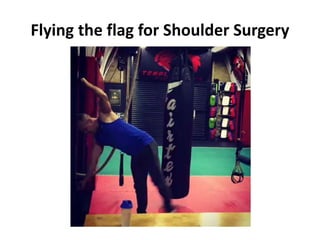
Flying the flag for Shoulder Surgery
Thank you
surgeon@abbasrashid.com

Rotator cuff syndrome

  • 1.
    Rotator Cuff Syndrome AbbasRashid FRCS (Tr&Orth)
  • 2.
    My Service • Fellowshiptrained - shoulder & elbow surgeon - secondary & tertiary - arthroscopy - arthroplasty - reconstruction • Base - UCLH - ISEH, Wellington & Docklands • Mandate - translational research - evidence based treatment
  • 3.
  • 4.
    Background ‘pathological compression ofRC causing anterolateral shoulder pain in the middle aged’
  • 5.
    Rotator Cuff Kinematics RC= HHcentraliser HH depressor
  • 6.
  • 7.
  • 8.
    Rotator Cuff Kinematics Anythingaffecting RC  Impingement
  • 9.
    What stops SSpfrom working? DIRECT Trauma Tendinopathy Calcific Deposition Tear
  • 10.
    What stops SSpfrom working? DIRECT INDIRECT GHJ Instability SLAP tear Weak scapular base Trauma Tendinopathy Calcific Deposition Tear
  • 11.
    What stops SSpfrom working? DIRECT INDIRECT GHJ Instability SLAP tear Weak scapular base Trauma Tendinopathy Calcific Deposition Tear Loss of HH centralisation & depression
  • 12.
    What stops SSpfrom working? DIRECT INDIRECT GHJ Instability SLAP tear Weak scapular base Trauma Tendinopathy Calcific Deposition Tear Loss of HH centralisation & depression GT hit CA arch
  • 13.
    What stops SSpfrom working? DIRECT INDIRECT GHJ Instability SLAP tear Weak scapular base Trauma Tendinopathy Calcific Deposition Tear Loss of HH centralisation & depression GT hit CA arch RC microtrauma
  • 14.
    What stops SSpfrom working? DIRECT INDIRECT GHJ Instability SLAP tear Weak scapular base Trauma Tendinopathy Calcific Deposition Tear Loss of HH centralisation & depression GT hit CA arch RC microtrauma
  • 15.
    Stage 1 Oedema Stage 2 Inflammation Cuff& Bursal swelling Stage 3 Cuff failure CA arch spur Irreversible RC microtrauma Reversible: 1. Physiotherapy 2. Subacromial Injection Poor response to non-op tx Surgery
  • 16.
    Sagittal Acromial Morphology 12% 56% 29% BiglianiLU et al. The morphology of the acromion and its relationship to rotator cuff tears. Orthop Trans. 1986;10:228.
  • 17.
    Sagittal Acromial Morphology NOassociation with tears Lisotard et al. Critical analysis of the outlet view. J Shoulder Elbow Surg. 1998;134-19.
  • 18.
    Coronal Acromial Morphology CriticalShoulder Angle Acromial Index Lateral Acromial Tilt
  • 19.
    Coronal Acromial Morphology CriticalShoulder Angle Acromial Index Lateral Acromial Tilt CSA correlates with pathology Cherchiet al. CSA: reproducability and correlation with RCTs. Orthop Traumatol Surg res. 2016: 559-6219.
  • 20.
    Predisposing Factors Extrinsic Acromial morphology CSA Posture scapulardyskinesia posterior capsular tightness Pec tightness GIRD
  • 21.
    Predisposing Factors Intrinsic Biology Vascularity Extrinsic Acromial morphology CSA Posture scapulardyskinesia posterior capsular tightness Pec tightness GIRD High Shear Stresses
  • 22.
    Hypoxic Degenerative Tendinopathy Tendonhypoperfusion mucoid degeneration + lipomatosis Inflammatory cascade Healing Tear Calcification
  • 23.
    RCT Epidemiology Prevalence • Prevalence <60:4-13% 60-80: 28-51% • Symptomatic tears 30% larger • Further tear with minor injury Natural History • pain = tear progression - 40% PT tears became FT - 20% FT tears increased by >5mm • Large tears: chondroid metaplasia + amyloid healing less probably
  • 24.
    Socio-economic Burden • 14%prevalence • 2% GP consultations/year • 7/10 = RCS • ++time off work
  • 25.
    Assessment • mid arcpain • Positive Impingement tests - Neer & Hawkins Test • Pain or weakness on isometric testing SSp - Full & Empty Can Test
  • 26.
  • 27.
    Non-operative Treatment Cochrane review2009 : 71 systematic reviews, RCTs & observational studies Analgesics: ✗ topical NSAIDs, oral corticosteroids, paracetamol or opioid analgesics ✓ oral NSAIDs (short term) Adjuncs & therapy: ✗ Acupuncture = Placebo ✗ autologous blood, intra-articular NSAID, ice or ultrasound ✓ Shockwave: calcific tendonitis ✓ Physiotherapy • ? PRP may improve the speed of recovery • ? Long-term damage of corticosteroid injection
  • 28.
    Physiotherapy Stage 1 Oedema Stage 2 Inflammation Cuff& Bursal swelling Stage 3 Cuff failure CA arch spur Irreversible Reversible: 1. Physiotherapy 2. Subacromial Injection Irreversible: - less predictable response Eccentric vs. manual PT (Holmgren 2012) -a/w ASAD (N=102) -x5 sessions/12 weeks -80% vs. 37% cancelled surgery
  • 29.
  • 30.
    Subacromial Injections • Steroids> hyaluronic acid • Placebo > Steroids @ 1 year • Blind vs. US guidance? No difference in VAS @ 6 weeks • Flare reaction =  VAS 2 - Depo>Kenalog • Posterior approach - less Deltoid contraction
  • 31.
    Subacromial Injections • Steroids> hyaluronic acid • Placebo > Steroids @ 1 year • Blind vs. US guidance? No difference in VAS @ 6 weeks • Flare reaction =  VAS 2 - Depo>Kenalog • Posterior approach - less Deltoid contraction  40mg Kenalog + LA (long acting)  In clinic
  • 32.
    1o Impingement: Whento operate? • Single center retrospective cohort studies • High volume surgeons less enthusiastic about conservative tx • Refractory stage 2/3 1. persistent pain 2. functional restrictions 3. >3 months duration 1. Bursectomy 2. CAL release 3. Acromioplasty
  • 33.
    Where’s the evidence? •Odenbring 2008 - N=31, Mean age 49, minimum 12 year f/u - UCLA, DASH, EQ-5D - Mean improvement (p<0.05) - maintained in 77% • Klintberg 2010 - Stage 2/3 changes - N=105, mean age 54, 8-11 year f/u - Pain, ROM, CS - 83% satisfied • Bjornsson 2010 - US 15 years post-ASAD - N=70, mean age at f/u 60years - 14% PT tear, 4% FT tear - Less than 40% predicted rate Consistent results Long term patient satisfaction Fewer RC tears 15 years later
  • 34.
    Where’s the evidence? •Odenbring 2008 - N=31, Mean age 49, minimum 12 year f/u - UCLA, DASH, EQ-5D - Mean improvement (p<0.05) - maintained in 77% • Klintberg 2010 - Stage 2/3 changes - N=105, mean age 54, 8-11 year f/u - Pain, ROM, CS - 83% satisfied • Bjornsson 2010 - US 15 years post-ASAD - N=70, mean age at f/u 60years - 14% PT tear, 4% FT tear - Less than 40% predicted rate Consistent results Long term patient satisfaction Fewer RC tears 15 years later Failure rates: 20-29% (Speer 1991, Hawkins 2001, Bouchard 2014)
  • 35.
    However… - ?GP awareness -?shoulder surgeons (164%) - ?Combined with RC repair - ?For other pathology - ?Separate OPCS code (2009/10) 2000-2010: 746% in procedures WHY??
  • 36.
    Evidence • ARTHRITIS UKfunded • physio vs. ASAD • 12 month f/u • recruiting till 2017
  • 37.
    What about RCtears? • Lower rates of healing in >65yeas • Double row = less resistance to gapping - fewer retears - symtiomatically SR=DR - Less strength, same pain scores • Retear: 17%-40% • repair integrity = outcome • satisfactory outcomes in 74.6% - lower satisfaction <60y/o • Partial tears: controversial - tear grade & symptoms
  • 38.
    What about RCtears? • Partial tears: controversial 1. bursal 2. interstitial 3. articular • tear grade, symptoms
  • 39.
    Evidence • 2007-2010 • NIHRfunded • Arthroscopic vs. mini open repair • 77% crossover PT to surgery • 1year imaging • 2year PROMS • Same results • Arthroscopic>expensive
  • 40.
    Failure What is abad outcome? • Pain: VAS>3 • Disability: SSV<60% • Timeline: 6 months-2years Can we predict it? 1. Wrong Diagnosis (40%) 2. Poor patient Selection (18%) 3. Poor Operative Technique (42%)
  • 41.
    Failure What is abad outcome? • Pain: VAS>3 • Disability: SSV<60% • Timeline: 6 months-2years Can we predict it? 1. Wrong diagnosis (40%) 1. Poor patient selection (18%) 2. Poor operative technique (42%)
  • 42.
    1. Wrong Diagnosis ClinicalExamination • Predictive value of impingement tests • improved CS up to 3.7 years if 4 tests +tive Injection • prognostic value of SA injection • larger ↑CS if injection test +tive Imaging • XR: changes in SA region • US: dynamic assessment Magaji 2012 - Prospective, N=83, f/u=1year - Predictive value 1. Midarc pain 2. Hawkins Kennedy test 3. Injection 4. US - All 4 criteria pre-op = better OSS @ 1year
  • 43.
    But… DIRECT INDIRECT GHJ Instability SLAPtear Weak scapular base Strain Tendinopathy Calcific Deposition Tear Loss of HH centralisation and depressor effect GT hit CA arch RC microtrauma • <45y/o • Instability • Scapular tilt/protraction • 25% of diagnostic failures
  • 44.
    2. Poor PatientSelection Picking a ‘winner’ Poor outcomes: • cervicalgia • Low preop pain threshold • workers comp >70% poor outcome Underlying Problem Relative indications: - OA - Os Acromiale - calcific tendinopathy - RC tears …variable results!
  • 45.
    3. Poor OperativeTechnique Coplaning ACJ • violates ACJ - 39% develop ACJ symptoms - can damage CC ligament Acromial resection • ? depth & posterior limit - too much: acromial fracture - residual AM corner: 20% of failures
  • 46.
    Revision SAD • 50%success @ 2-6 year f/u • 85% RTW • Confounding factor: workers comp - 47% non-workers comp – 75% • Causes 1. <45y/o: missed labral tear or scapular dyskinesia 2. >45y/o: inadequate decompression 3. other pain generators (e.g. OA) 4. acromial fractures
  • 47.
    Conclusion  Impingement isNOT a diagnosis but a constellation of symptoms!  Patient selection: valid & well defined criteria  <45y/o Exclude scapular base problem & instability  Trial of non-operative tx  Correct operative technique  High failure rates in workers comp
  • 48.
    One Stop Clinic Specialistconsultation 3T MRI +/- arthrography On-site reporting +/- interventional ultrasound PhysioSurgery Hand Therapy
  • 49.
    References 1. Neer CS2nd. Anterior acromioplasty for the chronic impingement syndrome in the shoulder. 1972. J Bone Joint Surg Am. 2005 Jun;87(6):1399. 2. Neer S 2nd. J Bone Joint Surg Am. Anterior acromioplasty for the chronic impingement syndrome in the shoulder: a preliminary report. 1972 Jan;54(1):41-50. 3. Ellman H1, Kay SP. Arthroscopic subacromial decompression for chronic impingement. Two- to five-year results. J Bone Joint Surg Br. 1991 May;73(3):395-8. 4. Ellman H1. Arthroscopic subacromial decompression: analysis of one- to three-year results. Arthroscopy. 1987;3(3):173-81. 5. Altchek DW1, Carson EW. Arthroscopic acromioplasty. Current status. Orthop Clin North Am. 1997 Apr;28(2):157-68. 6. Holmgren T1, Björnsson Hallgren H, Öberg B, Adolfsson L, Johansson K. Effect of specific exercise strategy on need for surgery in patients with subacromial impingement syndrome: randomised controlled study. BMJ. 2012 Feb 20;344:e787. doi: 10.1136/bmj.e787. 7. Klintberg IH1, Svantesson U, Karlsson J. Long-term patient satisfaction and functional outcome 8-11 years after subacromial decompression. Knee Surg Sports Traumatol Arthrosc. 2010 Mar;18(3):394-403. doi: 10.1007/s00167-009-0963-1. Epub 2009 Oct 23. 8. Judge A1, Murphy RJ, Maxwell R, Arden NK, Carr AJ. Temporal trends and geographical variation in the use of subacromial decompression and rotator cuff repair of the shoulder in England. Bone Joint J. 2014 Jan;96- B(1):70-4. doi: 10.1302/0301-620X.96B1.32556. 9. Speer KP1, Lohnes J, Garrett WE Jr. Arthroscopic subacromial decompression: results in advanced impingement syndrome. Arthroscopy. 1991;7(3):291-6. 10. Hawkins RJ1, Plancher KD, Saddemi SR, Brezenoff LS, Moor JT. Arthroscopic subacromial decompression. J Shoulder Elbow Surg. 2001 May-Jun;10(3):225-30. 11. Bouchard A1, Garret J2, Favard L3, Charles H4, Ollat D5. Failed subacromial decompression. Risk factors. Orthop Traumatol Surg Res. 2014 Dec;100(8 Suppl):S365-9. doi: 10.1016/j.otsr.2014.09.006. Epub 2014 Oct 29. 12. Odenbring S1, Wagner P, Atroshi I. Long-term outcomes of arthroscopic acromioplasty for chronic shoulder impingement syndrome: a prospective cohort study with a minimum of 12 years' follow-up. Arthroscopy. 2008 Oct;24(10):1092-8. doi: 10.1016/j.arthro.2008.04.073. Epub 2008 Jun 16. 13. Klintberg IH1, Svantesson U, Karlsson J. Long-term patient satisfaction and functional outcome 8-11 years after subacromial decompression. Knee Surg Sports Traumatol Arthrosc. 2010 Mar;18(3):394-403. doi: 10.1007/s00167-009-0963-1. Epub 2009 Oct 23. 14. Björnsson H1, Norlin R, Knutsson A, Adolfsson L. Fewer rotator cuff tears fifteen years after arthroscopic subacromial decompression. J Shoulder Elbow Surg. 2010 Jan;19(1):111-5. doi: 10.1016/j.jse.2009.04.014. 15. Arcand MA1, O'Rourke P, Zeman CA, Burkhead WZ Jr. Revision surgery after failed subacromial decompression. Int Orthop. 2000;24(2):61-4. 16. Kappe T1, Knappe K, Elsharkawi M, Reichel H, Cakir B. Predictive value of preoperative clinical examination for subacromial decompression in impingement syndrome. Knee Surg Sports Traumatol Arthrosc. 2013 Jan 22. [Epub ahead of print] 17. Lim JT1, Acornley A, Dodenhoff RM. Recovery after arthroscopic subacromial decompression: prognostic value of the subacromial injection test. Arthroscopy. 2005 Jun;21(6):680-3. 18. Singh HP1, Mehta SS2, Pandey R2. A preoperative scoring system to select patients for arthroscopic subacromial decompression. J Shoulder Elbow Surg. 2014 Sep;23(9):1251-6. doi: 10.1016/j.jse.2014.05.030. 19. Ogilvie-Harris DJ1, Wiley AM, Sattarian J. Failed acromioplasty for impingement syndrome. J Bone Joint Surg Br. 1990 Nov;72(6):1070-2. 20. Magaji SA1, Singh HP, Pandey RK. Arthroscopic subacromial decompression is effective in selected patients with shoulder impingement syndrome. J Bone Joint Surg Br. 2012 Aug;94(8):1086-9. doi: 10.1302/0301- 620X.94B8.29001. 21. Dopirak R1, Ryu RK. Management of the failed arthroscopic subacromial decompression: causation and treatment. Sports Med Arthrosc. 2010 Sep;18(3):207-12. doi: 10.1097/JSA.0b013e3181eb6ce8. 22. Gartsman GM1, O'connor DP. Arthroscopic rotator cuff repair with and without arthroscopic subacromial decompression: a prospective, randomized study of one-year outcomes. J Shoulder Elbow Surg. 2004 Jul- Aug;13(4):424-6. 23. Massoud SN, Levy O, Copeland SA. Subacromial decompression. Treatment for small- and medium-sized tears of the rotator cuff. J Bone Joint Surg Br. 2002 Sep;84(7):955-60. 24. Weinstein DM1, Bucchieri JS, Pollock RG, Flatow EL, Bigliani LU. Arthroscopic debridement of the shoulder for osteoarthritis. Arthroscopy. 2000 Jul-Aug;16(5):471-6. 25. Guyette TM1, Bae H, Warren RF, Craig E, Wickiewicz TL. Results of arthroscopic subacromial decompression in patients with subacromial impingement and glenohumeral degenerative joint disease. J Shoulder Elbow Surg. 2002 Jul-Aug;11(4):299-304. 26. Hutchinson MR1, Veenstra MA. Arthroscopic decompression of shoulder impingement secondary to Os acromiale. Arthroscopy. 1993;9(1):28-32. 27. Wright RW1, Heller MA, Quick DC, Buss DD. Arthroscopic decompression for impingement syndrome secondary to an unstable os acromiale. Arthroscopy. 2000 Sep;16(6):595-9. 28. Youm T1, Hommen JP, Ong BC, Chen AL, Shin C. Os acromiale: evaluation and treatment. Am J Orthop (Belle Mead NJ). 2005 Jun;34(6):277-83. 29. Marder RA1, Heiden EA, Kim S. Calcific tendonitis of the shoulder: is subacromial decompression in combination with removal of the calcific deposit beneficial? J Shoulder Elbow Surg. 2011 Sep;20(6):955-60. doi: 10.1016/j.jse.2010.10.038. Epub 2011 Feb 1. 30. Balke M1, Bielefeld R, Schmidt C, Dedy N, Liem D. Calcifying tendinitis of the shoulder: midterm results after arthroscopic treatment. Am J Sports Med. 2012 Mar;40(3):657-61. doi: 10.1177/0363546511430202. Epub 2011 Dec 8. 31. Tillander BM1, Norlin RO. Change of calcifications after arthroscopic subacromial decompression. J Shoulder Elbow Surg. 1998 May-Jun;7(3):213-7. 32. Fischer BW1, Gross RM, McCarthy JA, Arroyo JS. Incidence of acromioclavicular joint complications after arthroscopic subacromial decompression. Arthroscopy. 1999 Apr;15(3):241-8. 33. Barber FA1. Coplaning of the acromioclavicular joint. Arthroscopy. 2001 Nov-Dec;17(9):913-7. 34. Kharrazi FD1, Busfield BT, Khorshad DS. Acromioclavicular joint reoperation after arthroscopic subacromial decompression with and without concomitant acromioclavicular surgery. Arthroscopy. 2007 Aug;23(8):804-8. 35. Soyer J1, Vaz S, Pries P, Clarac JP. The relationship between clinical outcomes and the amount of arthroscopic acromial resection. Arthroscopy. 2003 Jan;19(1):34-9. 36. Donigan JA1, Wolf BR. Arthroscopic subacromial decompression: acromioplasty versus bursectomy alone-- does it really matter? A systematic review. Iowa Orthop J. 2011;31:121-6. 37. Güven Z1. Rehabilitation following anterior acromioplastyActa Orthop Traumatol Turc. 2003;37 Suppl 1:119- 27. 38. Hultenheim Klintberg I1, Gunnarsson AC, Styf J, Karlsson J. Early activation or a more protective regime after arthroscopic subacromial decompression--a description of clinical changes with two different physiotherapy treatment protocols--a prospective, randomized pilot study with a two-year follow-up. Clin Rehabil. 2008 Oct- Nov;22(10-11):951-65. doi: 10.1177/0269215508090771.
  • 50.
    The Good • 1oimpingement • >45 • Anterolateral shoulder pain with elevation • +tive impingement signs • Pain on isometric testing of RC • US = dynamic evidence of impingement • MRI = tendinosis +/- RC tear, subacromial bursal fluid • SA injection = excellent pain response 1. Physio + Injection 3/12 2. Surgery
  • 51.
    The Good • 1oimpingement • >45 • Anterolateral shoulder pain with elevation • +tive impingement signs • Pain on isometric testing of RC • US = dynamic evidence of impingement • MRI = tendinosis +/- RC tear, subacromial bursal fluid • SA injection = excellent pain response 1. Physio + Injection 3/12 2. Surgery
  • 52.
    The Bad • 2oimpingement • <45 • Anterolateral shoulder pain with sports (e.g. bench press) • +tive impingement signs • Pain on isometric testing of RC - signs resolve with scapular assistance: scapular dyskinesia • Positive labral loading tests • MRI arthrogram: labral tear 1. No labral tear: scapular base strengthening 2. Labral tear: arthroscopic labral repair
  • 53.
    The Bad • 2oimpingement • <45 • Anterolateral shoulder pain with sports (e.g. bench press) • +tive impingement signs • Pain on isometric testing of RC - signs resolve with scapular assistance: scapular dyskinesia • Positive labral loading tests • MRI arthrogram: labral tear 1. No labral tear: scapular base strengthening 2. Labral tear: arthroscopic labral repair
  • 54.
    The Ugly • 2oimpingement already operated on elsewhere • Any age • SAD with poor result • +/- revision SAD + ACJ excision • ++chronic pain • Difficult assessment: everything hurts • MRI (+arthrogram if <45y/o) • No labral tear: pain management + scapular rehab + manage expectations • Labral tear: diagnostic glenoumeral injection +/- labral repair
  • 55.
    The Ugly • 2oimpingement already operated on elsewhere • Any age • SAD with poor result • +/- revision SAD + ACJ excision • ++chronic pain • Difficult assessment: everything hurts • MRI (+arthrogram if <45y/o) +/- MRI c-spine • Target pain generator with diagnostic injection • Positive response: surgery + manage expectations • Negative response: pain management
  • 56.
    How are wedifferent? 1. State of the art clinic 2. One stop clinic 3. Evidence based treatment
  • 57.
    Flying the flagfor Shoulder Surgery
  • 58.