METAL FORMING PROCESSES
Hot working and cold working of metals – Forging processes – Open,
impression and closed die forging – Characteristics of the process – Types of
Forging Machines – Typical forging operations – Rolling of metals – Types
of Rolling mills - Flat strip rolling – Shape rolling operations – Defects in
rolled parts - Principle of rod and wire drawing -Tube drawing –– Principles
of Extrusion – Types of Extrusion – Hot and Cold extrusion – Equipments
used.
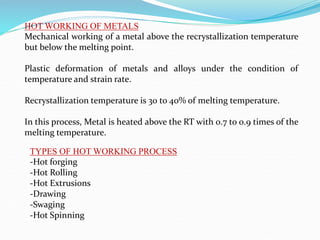
HOT WORKING OF METALS
Mechanical working of a metal above the recrystallization temperature
but below the melting point.
Plastic deformation of metals and alloys under the condition of
temperature and strain rate.
Recrystallization temperature is 30 to 40% of melting temperature.
In this process, Metal is heated above the RT with 0.7 to 0.9 times of the
melting temperature.
TYPES OF HOT WORKING PROCESS
-Hot forging
-Hot Rolling
-Hot Extrusions
-Drawing
-Swaging
-Hot Spinning
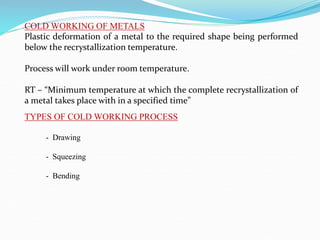
COLD WORKING OF METALS
Plastic deformation of a metal to the required shape being performed
below the recrystallization temperature.
Process will work under room temperature.
RT – “Minimum temperature at which the complete recrystallization of
a metal takes place with in a specified time”
TYPES OF COLD WORKING PROCESS
- Drawing
- Squeezing
- Bending
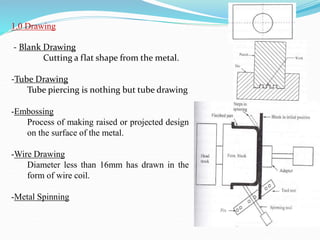
1.0 Drawing
- Blank Drawing
Cutting a flat shape from the metal.
-Tube Drawing
Tube piercing is nothing but tube drawing
-Embossing
Process of making raised or projected design
on the surface of the metal.
-Wire Drawing
Diameter less than 16mm has drawn in the
form of wire coil.
-Metal Spinning
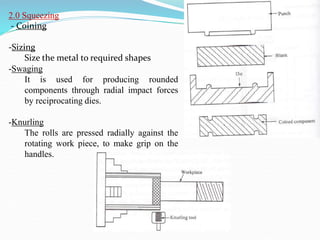
2.0 Squeezing
- Coining
-Sizing
Size the metal to required shapes
-Swaging
It is used for producing rounded
components through radial impact forces
by reciprocating dies.
-Knurling
The rolls are pressed radially against the
rotating work piece, to make grip on the
handles.
3.0 Bending
Bend into Desired shape like rods, wires, bars
- Plate Bending
Large Plates are bent to shapes
- Roll Forming
-It carries three rolls, Two are fixed and the third one is adjustable.
Diameter of all rolls are same.
- Angle Bending
Angles, Circles, Ovals
FORGING PROCESSES
The desired shape is obtained by the application of a compressive force.
Types
1.0 Smith or Open die Forging
The forging is done in a heated work at the proper temperature by
placing on flat surface anvil through hammering the metal piece.
a) Hand Forging
b) Power Forging
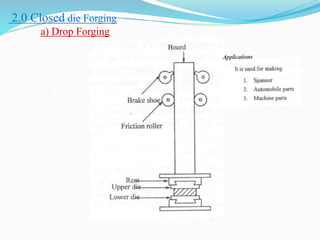
2.0 Closed die Forging
a) Drop Forging
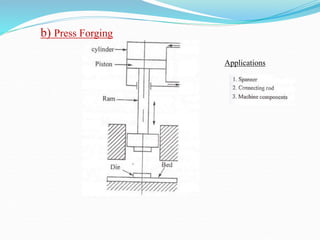
b) Press Forging
Applications
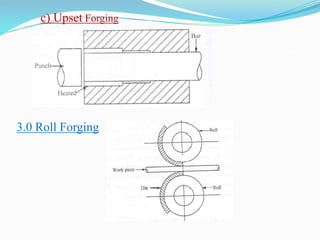
c) Upset Forging
3.0 Roll Forging
TYPES OF FORGING MACHINES
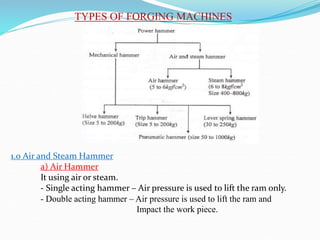
1.0 Air and Steam Hammer
a) Air Hammer
It using air or steam.
- Single acting hammer – Air pressure is used to lift the ram only.
- Double acting hammer – Air pressure is used to lift the ram and
Impact the work piece.
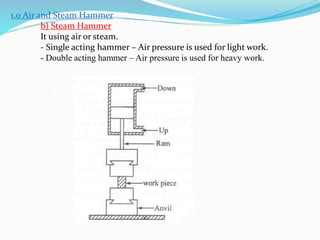
1.0 Air and Steam Hammer
b) Steam Hammer
It using air or steam.
- Single acting hammer – Air pressure is used for light work.
- Double acting hammer – Air pressure is used for heavy work.
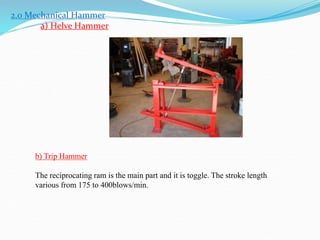
2.0 Mechanical Hammer
a) Helve Hammer
b) Trip Hammer
The reciprocating ram is the main part and it is toggle. The stroke length
various from 175 to 400blows/min.
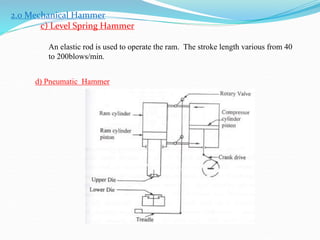
2.0 Mechanical Hammer
c) Level Spring Hammer
d) Pneumatic Hammer
An elastic rod is used to operate the ram. The stroke length various from 40
to 200blows/min.
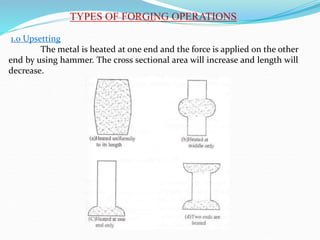
TYPES OF FORGING OPERATIONS
1.0 Upsetting
The metal is heated at one end and the force is applied on the other
end by using hammer. The cross sectional area will increase and length will
decrease.
TYPES OF FORGING OPERATIONS
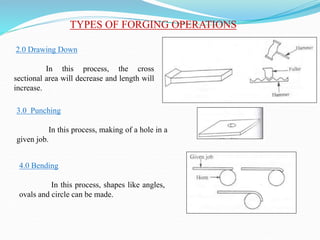
3.0 Punching
In this process, making of a hole in a
given job.
4.0 Bending
In this process, shapes like angles,
ovals and circle can be made.
2.0 Drawing Down
In this process, the cross
sectional area will decrease and length will
increase.
TYPES OF FORGING OPERATIONS
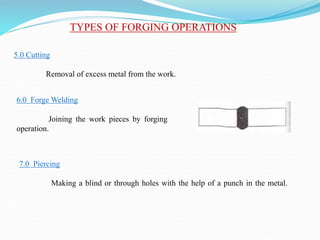
6.0 Forge Welding
Joining the work pieces by forging
operation.
7.0 Piercing
Making a blind or through holes with the help of a punch in the metal.
5.0 Cutting
Removal of excess metal from the work.
TYPES OF FORGING OPERATIONS
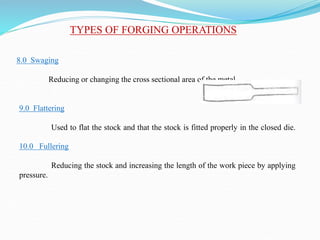
8.0 Swaging
Reducing or changing the cross sectional area of the metal.
9.0 Flattering
Used to flat the stock and that the stock is fitted properly in the closed die.
10.0 Fullering
Reducing the stock and increasing the length of the work piece by applying
pressure.
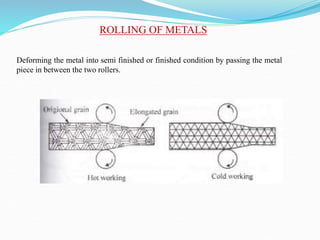
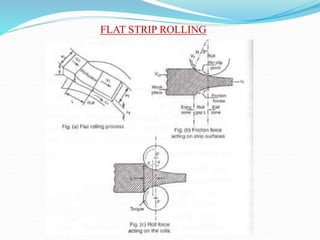
ROLLING OF METALS
Deforming the metal into semi finished or finished condition by passing the metal
piece in between the two rollers.
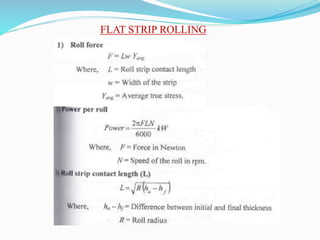
FLAT STRIP ROLLING
FLAT STRIP ROLLING
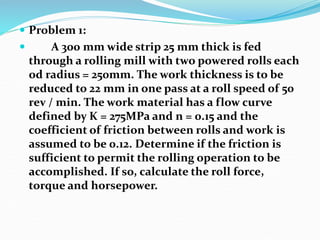
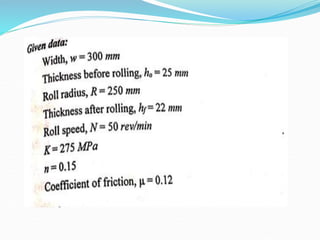
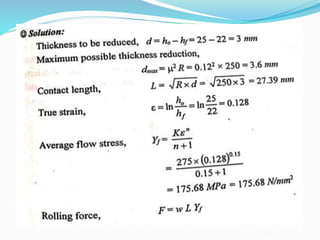
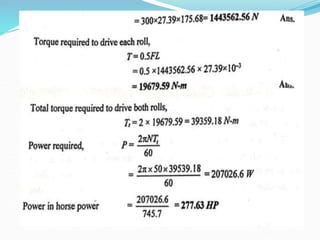
 Problem 1:
 A 300 mm wide strip 25 mm thick is fed
through a rolling mill with two powered rolls each
od radius = 250mm. The work thickness is to be
reduced to 22 mm in one pass at a roll speed of 50
rev / min. The work material has a flow curve
defined by K = 275MPa and n = 0.15 and the
coefficient of friction between rolls and work is
assumed to be 0.12. Determine if the friction is
sufficient to permit the rolling operation to be
accomplished. If so, calculate the roll force,
torque and horsepower.
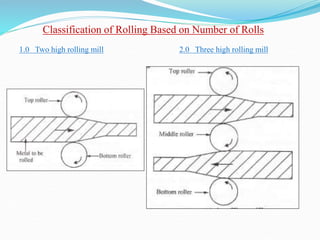
Classification of Rolling Based on Number of Rolls
1.0 Two high rolling mill 2.0 Three high rolling mill
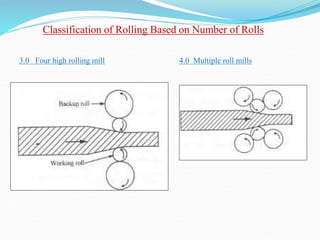
Classification of Rolling Based on Number of Rolls
3.0 Four high rolling mill 4.0 Multiple roll mills
Classification of Rolling Based on Number of Rolls
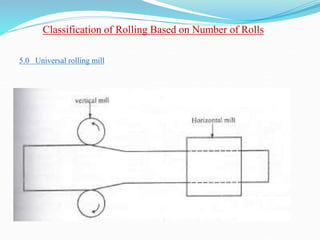
5.0 Universal rolling mill
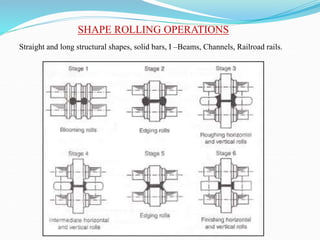
SHAPE ROLLING OPERATIONS
Straight and long structural shapes, solid bars, I –Beams, Channels, Railroad rails.
SHAPE ROLLING OPERATIONS
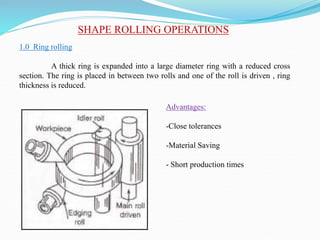
1.0 Ring rolling
A thick ring is expanded into a large diameter ring with a reduced cross
section. The ring is placed in between two rolls and one of the roll is driven , ring
thickness is reduced.
Advantages:
-Close tolerances
-Material Saving
- Short production times
SHAPE ROLLING OPERATIONS
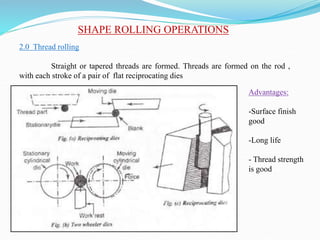
2.0 Thread rolling
Straight or tapered threads are formed. Threads are formed on the rod ,
with each stroke of a pair of flat reciprocating dies
Advantages:
-Surface finish
good
-Long life
- Thread strength
is good
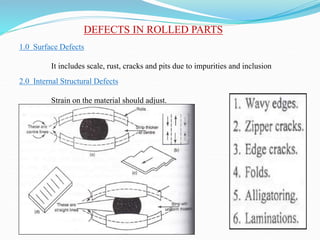
DEFECTS IN ROLLED PARTS
1.0 Surface Defects
It includes scale, rust, cracks and pits due to impurities and inclusion
2.0 Internal Structural Defects
Strain on the material should adjust.
DEFECTS IN ROLLED PARTS
3.0 Other Defects
a) Homogeneous deformation of element across the width
Due to decrease in thickness for the elements near the centre will be mainly converted
into increase in length and near the edge the decrease in thickness is converted into
lateral spread.
b) Homogeneous deformation in the thickness section
Due to reduction in height is converted into increase in length and the thickness of the
sheet does not undergo the same lateral deformation.
c) Folds
It is created during plate rolling if the reduction per pass is very small.
d) Lamination
Due to incomplete welding of pipe and blowholes during the rolling process the internal
defects such as fissures are created.
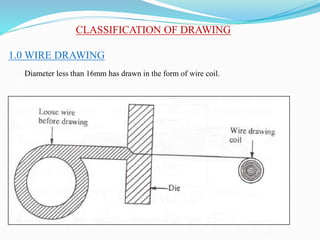
CLASSIFICATION OF DRAWING
1.0 WIRE DRAWING
Diameter less than 16mm has drawn in the form of wire coil.
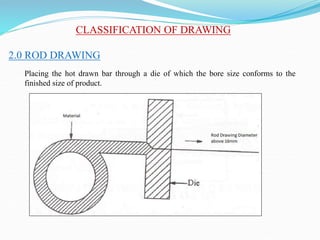
CLASSIFICATION OF DRAWING
2.0 ROD DRAWING
Placing the hot drawn bar through a die of which the bore size conforms to the
finished size of product.
CLASSIFICATION OF DRAWING
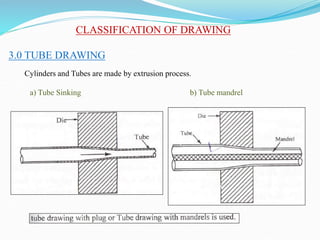
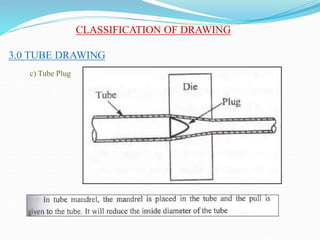
3.0 TUBE DRAWING
Cylinders and Tubes are made by extrusion process.
a) Tube Sinking b) Tube mandrel
CLASSIFICATION OF DRAWING
3.0 TUBE DRAWING
c) Tube Plug
CLASSIFICATION OF DRAWING
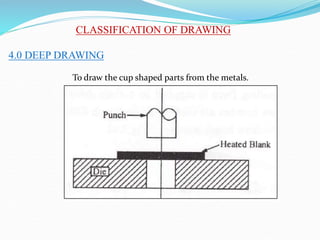
4.0 DEEP DRAWING
To draw the cup shaped parts from the metals.
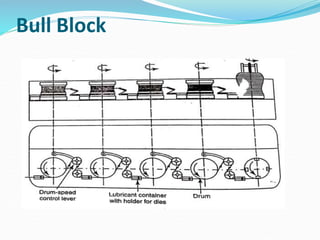
Bull Block
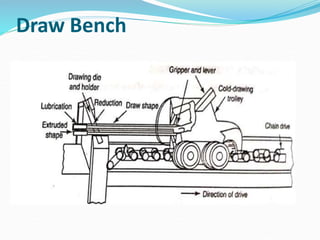
Draw Bench
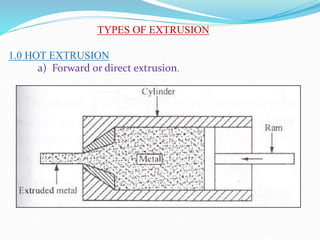
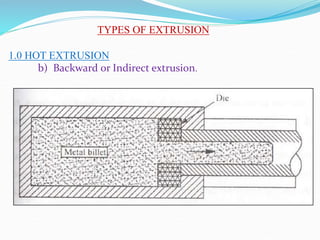
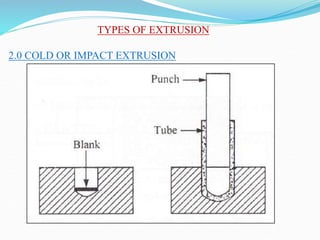
EXTRUSION
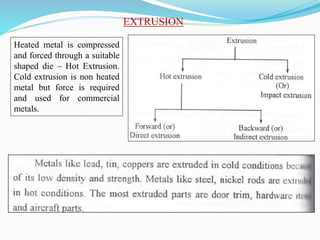
Heated metal is compressed
and forced through a suitable
shaped die – Hot Extrusion.
Cold extrusion is non heated
metal but force is required
and used for commercial
metals.
TYPES OF EXTRUSION
1.0 HOT EXTRUSION
a) Forward or direct extrusion.
TYPES OF EXTRUSION
1.0 HOT EXTRUSION
b) Backward or Indirect extrusion.
TYPES OF EXTRUSION
2.0 COLD OR IMPACT EXTRUSION

METAL FORMING PROCESSES

  • 1.
    METAL FORMING PROCESSES Hotworking and cold working of metals – Forging processes – Open, impression and closed die forging – Characteristics of the process – Types of Forging Machines – Typical forging operations – Rolling of metals – Types of Rolling mills - Flat strip rolling – Shape rolling operations – Defects in rolled parts - Principle of rod and wire drawing -Tube drawing –– Principles of Extrusion – Types of Extrusion – Hot and Cold extrusion – Equipments used.
  • 2.
    HOT WORKING OFMETALS Mechanical working of a metal above the recrystallization temperature but below the melting point. Plastic deformation of metals and alloys under the condition of temperature and strain rate. Recrystallization temperature is 30 to 40% of melting temperature. In this process, Metal is heated above the RT with 0.7 to 0.9 times of the melting temperature. TYPES OF HOT WORKING PROCESS -Hot forging -Hot Rolling -Hot Extrusions -Drawing -Swaging -Hot Spinning
  • 3.
    COLD WORKING OFMETALS Plastic deformation of a metal to the required shape being performed below the recrystallization temperature. Process will work under room temperature. RT – “Minimum temperature at which the complete recrystallization of a metal takes place with in a specified time” TYPES OF COLD WORKING PROCESS - Drawing - Squeezing - Bending
  • 4.
    1.0 Drawing - BlankDrawing Cutting a flat shape from the metal. -Tube Drawing Tube piercing is nothing but tube drawing -Embossing Process of making raised or projected design on the surface of the metal. -Wire Drawing Diameter less than 16mm has drawn in the form of wire coil. -Metal Spinning
  • 5.
    2.0 Squeezing - Coining -Sizing Sizethe metal to required shapes -Swaging It is used for producing rounded components through radial impact forces by reciprocating dies. -Knurling The rolls are pressed radially against the rotating work piece, to make grip on the handles.
  • 6.
    3.0 Bending Bend intoDesired shape like rods, wires, bars - Plate Bending Large Plates are bent to shapes - Roll Forming -It carries three rolls, Two are fixed and the third one is adjustable. Diameter of all rolls are same. - Angle Bending Angles, Circles, Ovals
  • 7.
    FORGING PROCESSES The desiredshape is obtained by the application of a compressive force. Types 1.0 Smith or Open die Forging The forging is done in a heated work at the proper temperature by placing on flat surface anvil through hammering the metal piece. a) Hand Forging b) Power Forging
  • 8.
    2.0 Closed dieForging a) Drop Forging
  • 9.
  • 10.
  • 11.
    TYPES OF FORGINGMACHINES 1.0 Air and Steam Hammer a) Air Hammer It using air or steam. - Single acting hammer – Air pressure is used to lift the ram only. - Double acting hammer – Air pressure is used to lift the ram and Impact the work piece.
  • 12.
    1.0 Air andSteam Hammer b) Steam Hammer It using air or steam. - Single acting hammer – Air pressure is used for light work. - Double acting hammer – Air pressure is used for heavy work.
  • 13.
    2.0 Mechanical Hammer a)Helve Hammer b) Trip Hammer The reciprocating ram is the main part and it is toggle. The stroke length various from 175 to 400blows/min.
  • 14.
    2.0 Mechanical Hammer c)Level Spring Hammer d) Pneumatic Hammer An elastic rod is used to operate the ram. The stroke length various from 40 to 200blows/min.
  • 15.
    TYPES OF FORGINGOPERATIONS 1.0 Upsetting The metal is heated at one end and the force is applied on the other end by using hammer. The cross sectional area will increase and length will decrease.
  • 16.
    TYPES OF FORGINGOPERATIONS 3.0 Punching In this process, making of a hole in a given job. 4.0 Bending In this process, shapes like angles, ovals and circle can be made. 2.0 Drawing Down In this process, the cross sectional area will decrease and length will increase.
  • 17.
    TYPES OF FORGINGOPERATIONS 6.0 Forge Welding Joining the work pieces by forging operation. 7.0 Piercing Making a blind or through holes with the help of a punch in the metal. 5.0 Cutting Removal of excess metal from the work.
  • 18.
    TYPES OF FORGINGOPERATIONS 8.0 Swaging Reducing or changing the cross sectional area of the metal. 9.0 Flattering Used to flat the stock and that the stock is fitted properly in the closed die. 10.0 Fullering Reducing the stock and increasing the length of the work piece by applying pressure.
  • 19.
    ROLLING OF METALS Deformingthe metal into semi finished or finished condition by passing the metal piece in between the two rollers.
  • 20.
  • 21.
  • 22.
     Problem 1: A 300 mm wide strip 25 mm thick is fed through a rolling mill with two powered rolls each od radius = 250mm. The work thickness is to be reduced to 22 mm in one pass at a roll speed of 50 rev / min. The work material has a flow curve defined by K = 275MPa and n = 0.15 and the coefficient of friction between rolls and work is assumed to be 0.12. Determine if the friction is sufficient to permit the rolling operation to be accomplished. If so, calculate the roll force, torque and horsepower.
  • 26.
    Classification of RollingBased on Number of Rolls 1.0 Two high rolling mill 2.0 Three high rolling mill
  • 27.
    Classification of RollingBased on Number of Rolls 3.0 Four high rolling mill 4.0 Multiple roll mills
  • 28.
    Classification of RollingBased on Number of Rolls 5.0 Universal rolling mill
  • 29.
    SHAPE ROLLING OPERATIONS Straightand long structural shapes, solid bars, I –Beams, Channels, Railroad rails.
  • 30.
    SHAPE ROLLING OPERATIONS 1.0Ring rolling A thick ring is expanded into a large diameter ring with a reduced cross section. The ring is placed in between two rolls and one of the roll is driven , ring thickness is reduced. Advantages: -Close tolerances -Material Saving - Short production times
  • 31.
    SHAPE ROLLING OPERATIONS 2.0Thread rolling Straight or tapered threads are formed. Threads are formed on the rod , with each stroke of a pair of flat reciprocating dies Advantages: -Surface finish good -Long life - Thread strength is good
  • 32.
    DEFECTS IN ROLLEDPARTS 1.0 Surface Defects It includes scale, rust, cracks and pits due to impurities and inclusion 2.0 Internal Structural Defects Strain on the material should adjust.
  • 33.
    DEFECTS IN ROLLEDPARTS 3.0 Other Defects a) Homogeneous deformation of element across the width Due to decrease in thickness for the elements near the centre will be mainly converted into increase in length and near the edge the decrease in thickness is converted into lateral spread. b) Homogeneous deformation in the thickness section Due to reduction in height is converted into increase in length and the thickness of the sheet does not undergo the same lateral deformation. c) Folds It is created during plate rolling if the reduction per pass is very small. d) Lamination Due to incomplete welding of pipe and blowholes during the rolling process the internal defects such as fissures are created.
  • 34.
    CLASSIFICATION OF DRAWING 1.0WIRE DRAWING Diameter less than 16mm has drawn in the form of wire coil.
  • 35.
    CLASSIFICATION OF DRAWING 2.0ROD DRAWING Placing the hot drawn bar through a die of which the bore size conforms to the finished size of product.
  • 36.
    CLASSIFICATION OF DRAWING 3.0TUBE DRAWING Cylinders and Tubes are made by extrusion process. a) Tube Sinking b) Tube mandrel
  • 37.
    CLASSIFICATION OF DRAWING 3.0TUBE DRAWING c) Tube Plug
  • 38.
    CLASSIFICATION OF DRAWING 4.0DEEP DRAWING To draw the cup shaped parts from the metals.
  • 39.
  • 40.
  • 41.
    EXTRUSION Heated metal iscompressed and forced through a suitable shaped die – Hot Extrusion. Cold extrusion is non heated metal but force is required and used for commercial metals.
  • 42.
    TYPES OF EXTRUSION 1.0HOT EXTRUSION a) Forward or direct extrusion.
  • 43.
    TYPES OF EXTRUSION 1.0HOT EXTRUSION b) Backward or Indirect extrusion.
  • 44.
    TYPES OF EXTRUSION 2.0COLD OR IMPACT EXTRUSION