.
 Product cost estimation of forging is basically the
process of determining the cost of a product.
 Forging is a commonly used production method,
here materials are deform plastically & shaped.
 Main industries like automotive & defence
industry use forgings or buy forgings from forging
companies.
 The items that form up forging costs like;
material cost, labour cost, tooling cost,
equipment cost,etc are calculated each time.
 Design of the forging part & the forging
process
 Material losses
 Forging equipment selection
 Forging die design
 Manufacturing of forging dies
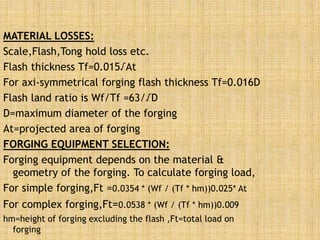
MATERIAL LOSSES:
Scale,Flash,Tong hold loss etc.
Flash thickness Tf=0.015√At
For axi-symmetrical forging flash thickness Tf=0.016D
Flash land ratio is Wf/Tf =63/√D
D=maximum diameter of the forging
At=projected area of forging
FORGING EQUIPMENT SELECTION:
Forging equipment depends on the material &
geometry of the forging. To calculate forging load,
For simple forging,Ft =0.0354 * (Wf / (Tf * hm))0.025* At
For complex forging,Ft=0.0538 * (Wf / (Tf * hm))0.009
hm=height of forging excluding the flash ,Ft=total load on
forging
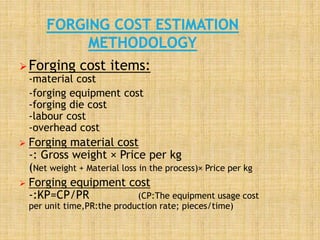
Forging cost items:
-material cost
-forging equipment cost
-forging die cost
-labour cost
-overhead cost
 Forging material cost
-: Gross weight × Price per kg
(Net weight + Material loss in the process)× Price per kg
 Forging equipment cost
-:KP=CP/PR (CP:The equipment usage cost
per unit time,PR:the production rate; pieces/time)
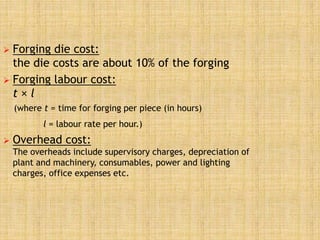
 Forging die cost:
the die costs are about 10% of the forging
 Forging labour cost:
t × l
(where t = time for forging per piece (in hours)
l = labour rate per hour.)
 Overhead cost:
The overheads include supervisory charges, depreciation of
plant and machinery, consumables, power and lighting
charges, office expenses etc.
10%
16%
10%
11%
53%
DIVISION OF TOTAL COSTS FOR STEEL FORGING
Die Cost
Equipment cost
over head cost
Quality cost
Material cost
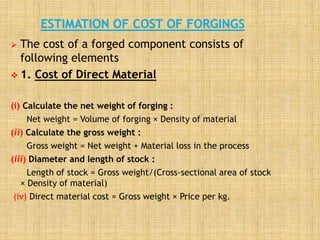
 The cost of a forged component consists of
following elements
 1. Cost of Direct Material
(i) Calculate the net weight of forging :
Net weight = Volume of forging × Density of material
(ii) Calculate the gross weight :
Gross weight = Net weight + Material loss in the process
(iii) Diameter and length of stock :
Length of stock = Gross weight/(Cross-sectional area of stock
× Density of material)
(iv) Direct material cost = Gross weight × Price per kg.
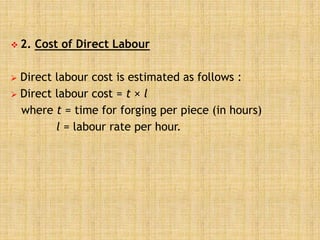
 2. Cost of Direct Labour
 Direct labour cost is estimated as follows :
 Direct labour cost = t × l
where t = time for forging per piece (in hours)
l = labour rate per hour.
 3. Direct Expenses
Cost of product using press per component
=Rs.A/1920 n N
cost of press = Rs. A
Life of press = n years
No. of components produced per hour = N
 4. Overheads
The overheads are generally expressed as
percentage of direct labour cost.
It includes supervisory charges, depreciation of
plant & machinery, consumable, power and
lighting charges, offices expenses.
(a)
(b)
(c) (d)
20 50
20 25
50 Φ 40Φ 30Φ 20Φ
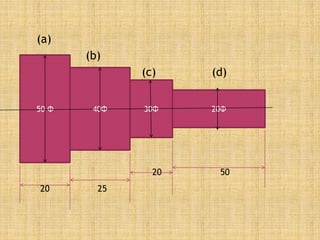
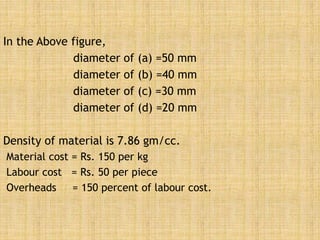
In the Above figure,
diameter of (a) =50 mm
diameter of (b) =40 mm
diameter of (c) =30 mm
diameter of (d) =20 mm
Density of material is 7.86 gm/cc.
Material cost = Rs. 150 per kg
Labour cost = Rs. 50 per piece
Overheads = 150 percent of labour cost.
 Solution :
 Net volume of forged component =
π/4[ (5)2 ×3 + (4)2 × 3.5 + (3)2 × 3 + (2)2 × 5]
=π/4(178)
= 139.73 cc
 Net weight = 139.73 × 7.86 = 1098 gms
= 1.098 kg
Losses:
• Scale loss = 6 percent of net weight
= 6/100× 1098
= 65.88 gms = 0.065 kg
 Taking flash width = 20 mm
Flash thickness = 3 mm
 Flash loss = (periphery of parting line) × 2
× 0.3 × 7.86
= [2 (3 + 3.5 + 3 + 5) + 2 + (3 – 2) + (4 – 3) +
(5 – 4) + 5] × 2 × 0.3 × 7.86
= 39.0 × 2 × 0.3 × 7.86 = 183 gms = 0.183 kg
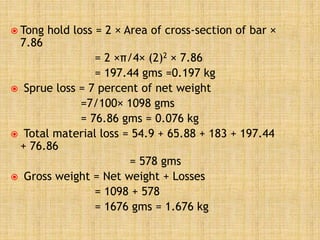
 Tong hold loss = 2 × Area of cross-section of bar ×
7.86
= 2 ×π/4× (2)2 × 7.86
= 197.44 gms =0.197 kg
 Sprue loss = 7 percent of net weight
=7/100× 1098 gms
= 76.86 gms = 0.076 kg
 Total material loss = 54.9 + 65.88 + 183 + 197.44
+ 76.86
= 578 gms
 Gross weight = Net weight + Losses
= 1098 + 578
= 1676 gms = 1.676 kg
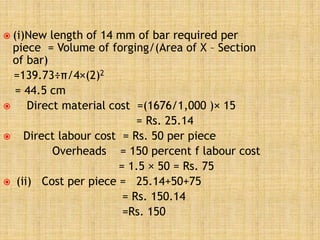
 (i)New length of 14 mm of bar required per
piece = Volume of forging/(Area of X – Section
of bar)
=139.73÷π/4×(2)2
= 44.5 cm
 Direct material cost =(1676/1,000 )× 15
= Rs. 25.14
 Direct labour cost = Rs. 50 per piece
Overheads = 150 percent f labour cost
= 1.5 × 50 = Rs. 75
 (ii) Cost per piece = 25.14+50+75
= Rs. 150.14
=Rs. 150
Product cost estimation is basically the
process of determining the cost of a product.
Cost estimation is very critical and important
in all types of manufacturing processes. In
forging cost estimation, determination of
the forge volume is very critical to find the
required press or hammer capacity, flash
allowance, scale loss, billet weight and the
forging material cost.
A computer aided cost estimation software
has been developed.
 cost calculation on forging

cost calculation on forging

  • 1.
  • 2.
     Product costestimation of forging is basically the process of determining the cost of a product.  Forging is a commonly used production method, here materials are deform plastically & shaped.  Main industries like automotive & defence industry use forgings or buy forgings from forging companies.  The items that form up forging costs like; material cost, labour cost, tooling cost, equipment cost,etc are calculated each time.
  • 3.
     Design ofthe forging part & the forging process  Material losses  Forging equipment selection  Forging die design  Manufacturing of forging dies
  • 4.
    MATERIAL LOSSES: Scale,Flash,Tong holdloss etc. Flash thickness Tf=0.015√At For axi-symmetrical forging flash thickness Tf=0.016D Flash land ratio is Wf/Tf =63/√D D=maximum diameter of the forging At=projected area of forging FORGING EQUIPMENT SELECTION: Forging equipment depends on the material & geometry of the forging. To calculate forging load, For simple forging,Ft =0.0354 * (Wf / (Tf * hm))0.025* At For complex forging,Ft=0.0538 * (Wf / (Tf * hm))0.009 hm=height of forging excluding the flash ,Ft=total load on forging
  • 5.
    Forging cost items: -materialcost -forging equipment cost -forging die cost -labour cost -overhead cost  Forging material cost -: Gross weight × Price per kg (Net weight + Material loss in the process)× Price per kg  Forging equipment cost -:KP=CP/PR (CP:The equipment usage cost per unit time,PR:the production rate; pieces/time)
  • 6.
     Forging diecost: the die costs are about 10% of the forging  Forging labour cost: t × l (where t = time for forging per piece (in hours) l = labour rate per hour.)  Overhead cost: The overheads include supervisory charges, depreciation of plant and machinery, consumables, power and lighting charges, office expenses etc.
  • 7.
    10% 16% 10% 11% 53% DIVISION OF TOTALCOSTS FOR STEEL FORGING Die Cost Equipment cost over head cost Quality cost Material cost
  • 8.
     The costof a forged component consists of following elements  1. Cost of Direct Material (i) Calculate the net weight of forging : Net weight = Volume of forging × Density of material (ii) Calculate the gross weight : Gross weight = Net weight + Material loss in the process (iii) Diameter and length of stock : Length of stock = Gross weight/(Cross-sectional area of stock × Density of material) (iv) Direct material cost = Gross weight × Price per kg.
  • 9.
     2. Costof Direct Labour  Direct labour cost is estimated as follows :  Direct labour cost = t × l where t = time for forging per piece (in hours) l = labour rate per hour.
  • 10.
     3. DirectExpenses Cost of product using press per component =Rs.A/1920 n N cost of press = Rs. A Life of press = n years No. of components produced per hour = N
  • 11.
     4. Overheads Theoverheads are generally expressed as percentage of direct labour cost. It includes supervisory charges, depreciation of plant & machinery, consumable, power and lighting charges, offices expenses.
  • 12.
    (a) (b) (c) (d) 20 50 2025 50 Φ 40Φ 30Φ 20Φ
  • 13.
    In the Abovefigure, diameter of (a) =50 mm diameter of (b) =40 mm diameter of (c) =30 mm diameter of (d) =20 mm Density of material is 7.86 gm/cc. Material cost = Rs. 150 per kg Labour cost = Rs. 50 per piece Overheads = 150 percent of labour cost.
  • 14.
     Solution : Net volume of forged component = π/4[ (5)2 ×3 + (4)2 × 3.5 + (3)2 × 3 + (2)2 × 5] =π/4(178) = 139.73 cc  Net weight = 139.73 × 7.86 = 1098 gms = 1.098 kg
  • 15.
    Losses: • Scale loss= 6 percent of net weight = 6/100× 1098 = 65.88 gms = 0.065 kg  Taking flash width = 20 mm Flash thickness = 3 mm  Flash loss = (periphery of parting line) × 2 × 0.3 × 7.86 = [2 (3 + 3.5 + 3 + 5) + 2 + (3 – 2) + (4 – 3) + (5 – 4) + 5] × 2 × 0.3 × 7.86 = 39.0 × 2 × 0.3 × 7.86 = 183 gms = 0.183 kg
  • 16.
     Tong holdloss = 2 × Area of cross-section of bar × 7.86 = 2 ×π/4× (2)2 × 7.86 = 197.44 gms =0.197 kg  Sprue loss = 7 percent of net weight =7/100× 1098 gms = 76.86 gms = 0.076 kg  Total material loss = 54.9 + 65.88 + 183 + 197.44 + 76.86 = 578 gms  Gross weight = Net weight + Losses = 1098 + 578 = 1676 gms = 1.676 kg
  • 17.
     (i)New lengthof 14 mm of bar required per piece = Volume of forging/(Area of X – Section of bar) =139.73÷π/4×(2)2 = 44.5 cm  Direct material cost =(1676/1,000 )× 15 = Rs. 25.14  Direct labour cost = Rs. 50 per piece Overheads = 150 percent f labour cost = 1.5 × 50 = Rs. 75  (ii) Cost per piece = 25.14+50+75 = Rs. 150.14 =Rs. 150
  • 18.
    Product cost estimationis basically the process of determining the cost of a product. Cost estimation is very critical and important in all types of manufacturing processes. In forging cost estimation, determination of the forge volume is very critical to find the required press or hammer capacity, flash allowance, scale loss, billet weight and the forging material cost. A computer aided cost estimation software has been developed.