Why-Why Analysis: RootCause
Discovery Masterclass
An In-Depth 3-Hour Training
Presented by [Your Name / Company]
2.
Training Agenda
• •Introduction to Root Cause Analysis
• • Origins and Principles of the Why-Why Technique
• • The 5 Whys in Practice: Detailed Methodology
• • Real-Life Case Studies and Critical Analysis
• • Hands-On Workshop Exercise with Scenario Challenges
• • Best Practices, Pitfalls, and Troubleshooting
• • Facilitator Guidance and Group Dynamics
• • Q&A, Key Takeaways, and Evaluation
3.
Understanding Root CauseAnalysis
(RCA)
• • RCA is a structured method for identifying the foundational causes of issues or incidents.
• • It seeks to prevent recurrence by eliminating the origin of the problem.
• • Widely used in healthcare, manufacturing, IT, logistics, and aviation.
• • Emphasizes data, objectivity, and a systems-thinking approach.
4.
Symptoms vs. RootCauses
• • Symptoms are immediate, visible indicators of a problem (e.g., a delayed order).
• • Root causes lie beneath the surface and drive the recurrence of the symptoms.
• • Effective RCA digs beyond the symptoms to address system weaknesses.
• • Analogy: Symptoms are like smoke; root cause is the fire.
5.
The Origins ofWhy-Why Analysis
• • Developed by Sakichi Toyoda, the founder of Toyota Industries.
• • Became a critical part of the Toyota Production System (TPS).
• • Advocates simplicity and thorough inquiry before implementing solutions.
• • Emphasizes teamwork, humility, and fact-based reasoning.
6.
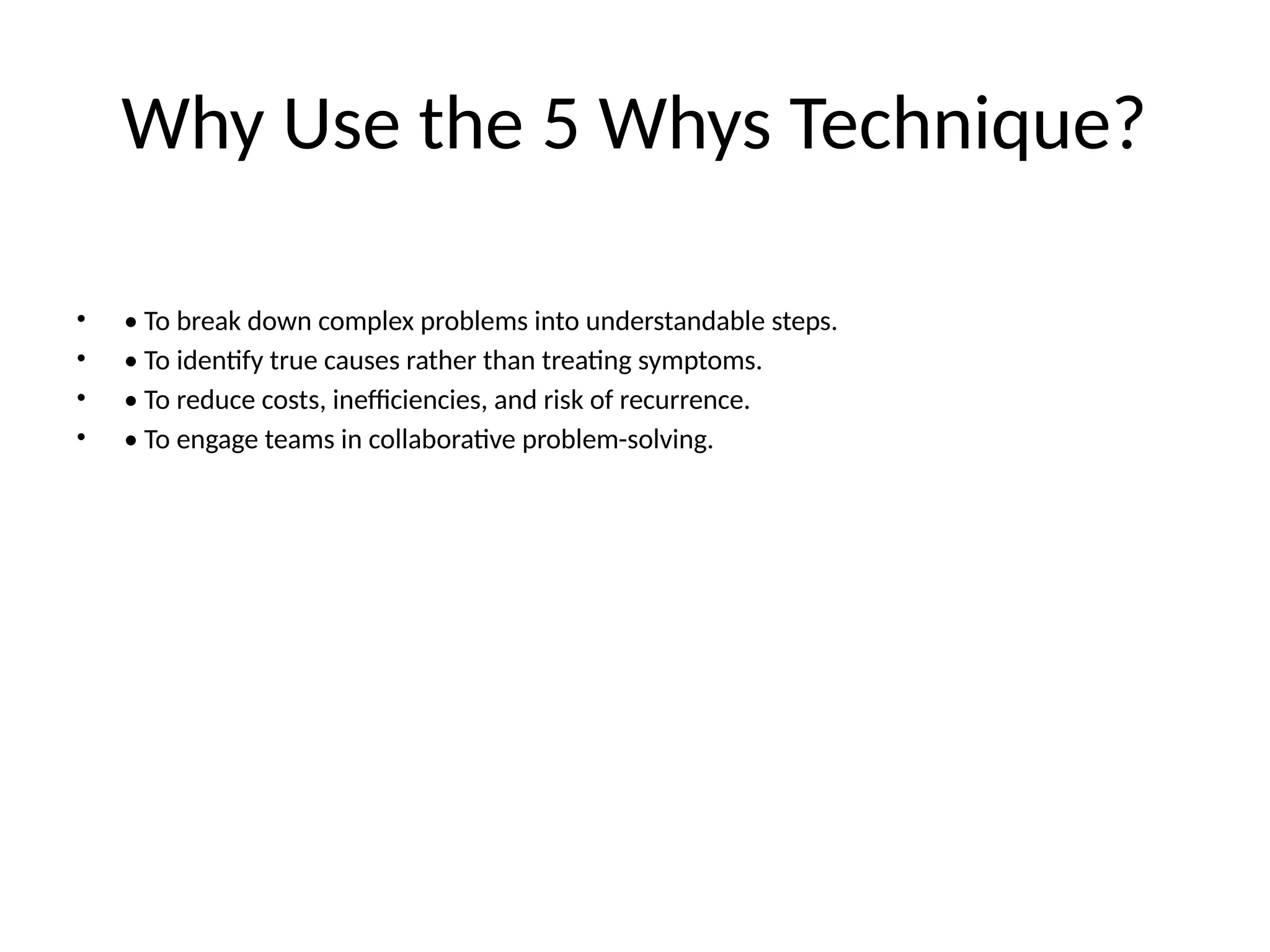
Why Use the5 Whys Technique?
• • To break down complex problems into understandable steps.
• • To identify true causes rather than treating symptoms.
• • To reduce costs, inefficiencies, and risk of recurrence.
• • To engage teams in collaborative problem-solving.
7.
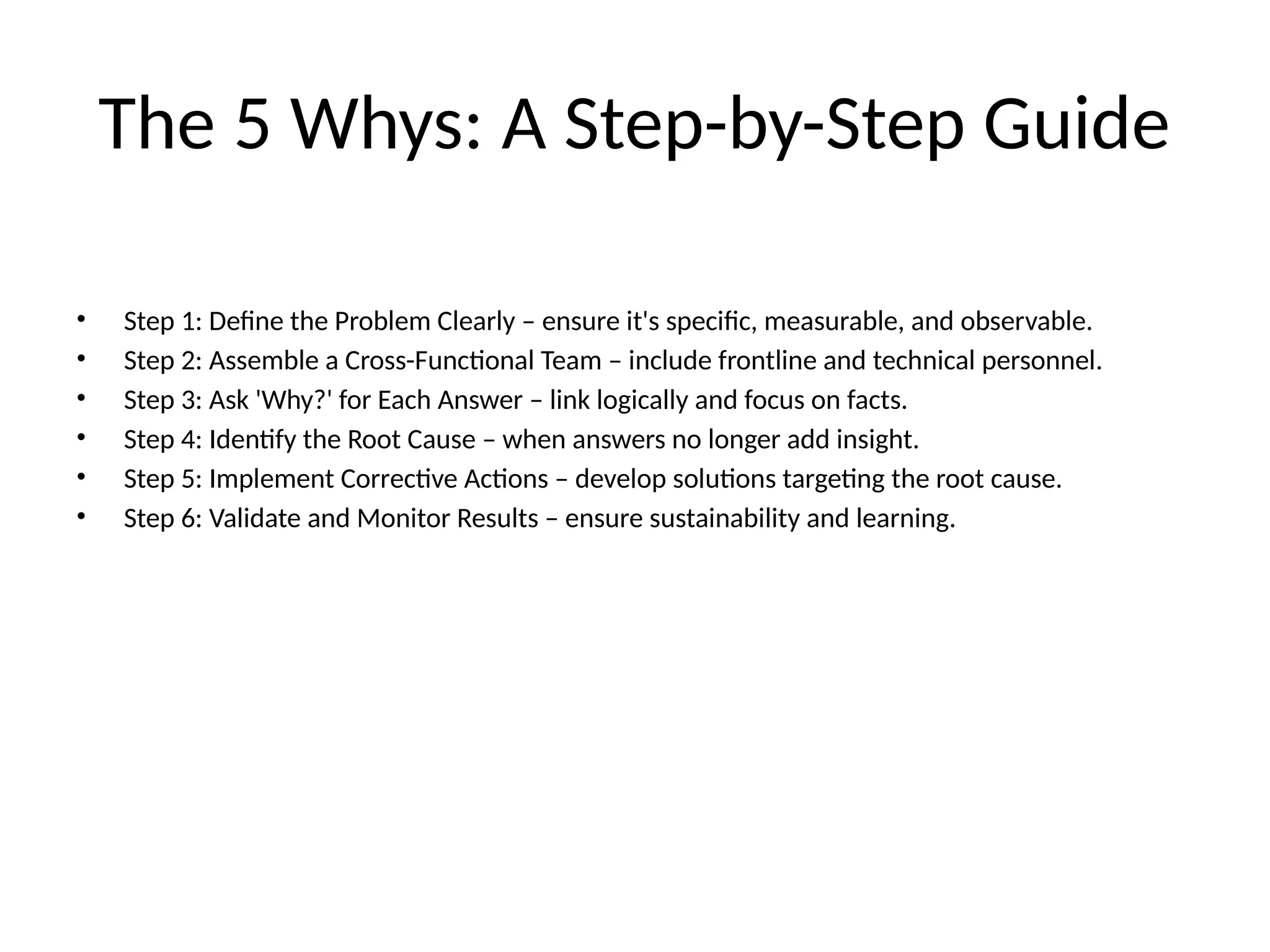
The 5 Whys:A Step-by-Step Guide
• Step 1: Define the Problem Clearly – ensure it's specific, measurable, and observable.
• Step 2: Assemble a Cross-Functional Team – include frontline and technical personnel.
• Step 3: Ask 'Why?' for Each Answer – link logically and focus on facts.
• Step 4: Identify the Root Cause – when answers no longer add insight.
• Step 5: Implement Corrective Actions – develop solutions targeting the root cause.
• Step 6: Validate and Monitor Results – ensure sustainability and learning.
8.
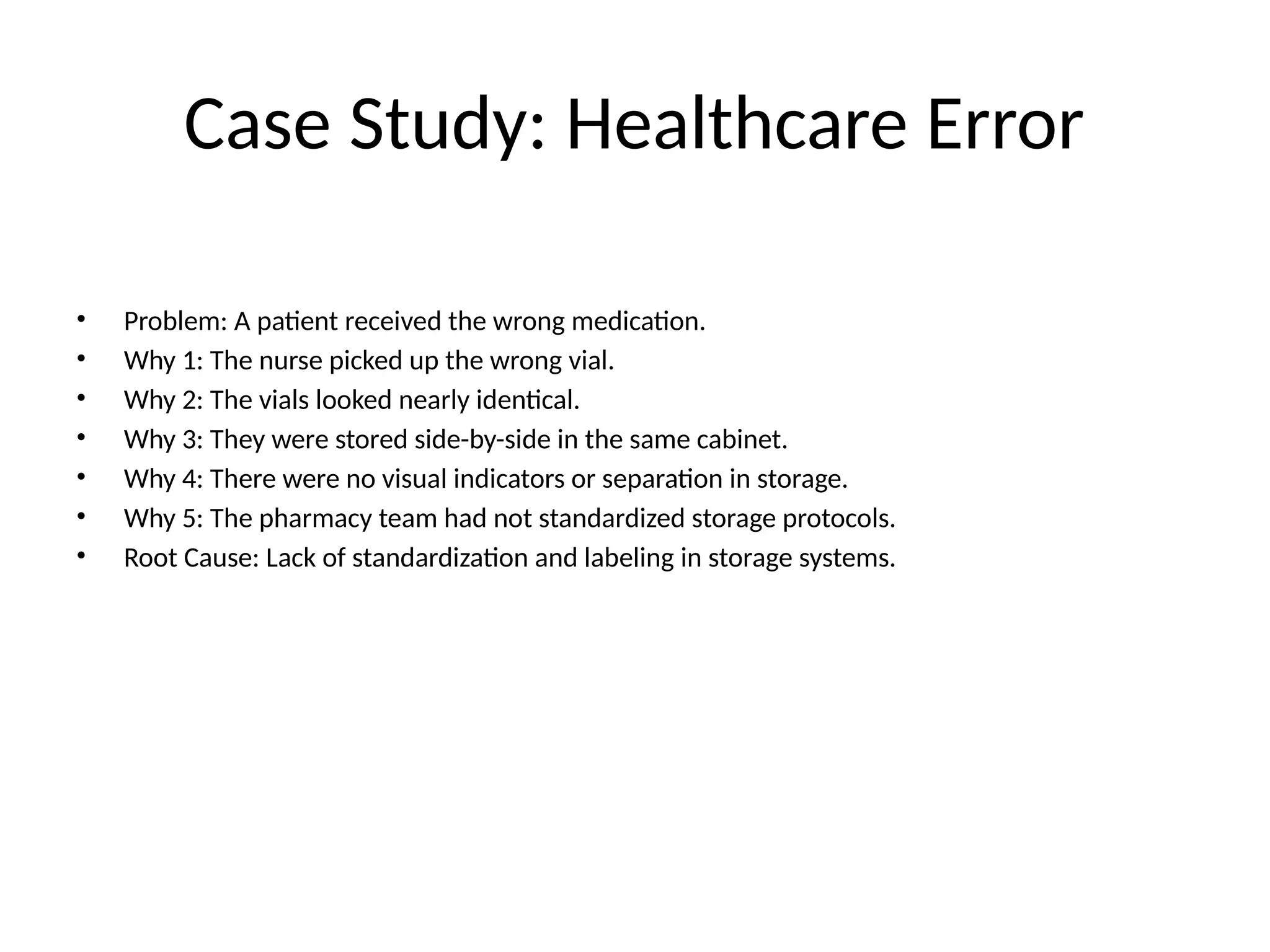
Case Study: HealthcareError
• Problem: A patient received the wrong medication.
• Why 1: The nurse picked up the wrong vial.
• Why 2: The vials looked nearly identical.
• Why 3: They were stored side-by-side in the same cabinet.
• Why 4: There were no visual indicators or separation in storage.
• Why 5: The pharmacy team had not standardized storage protocols.
• Root Cause: Lack of standardization and labeling in storage systems.
9.
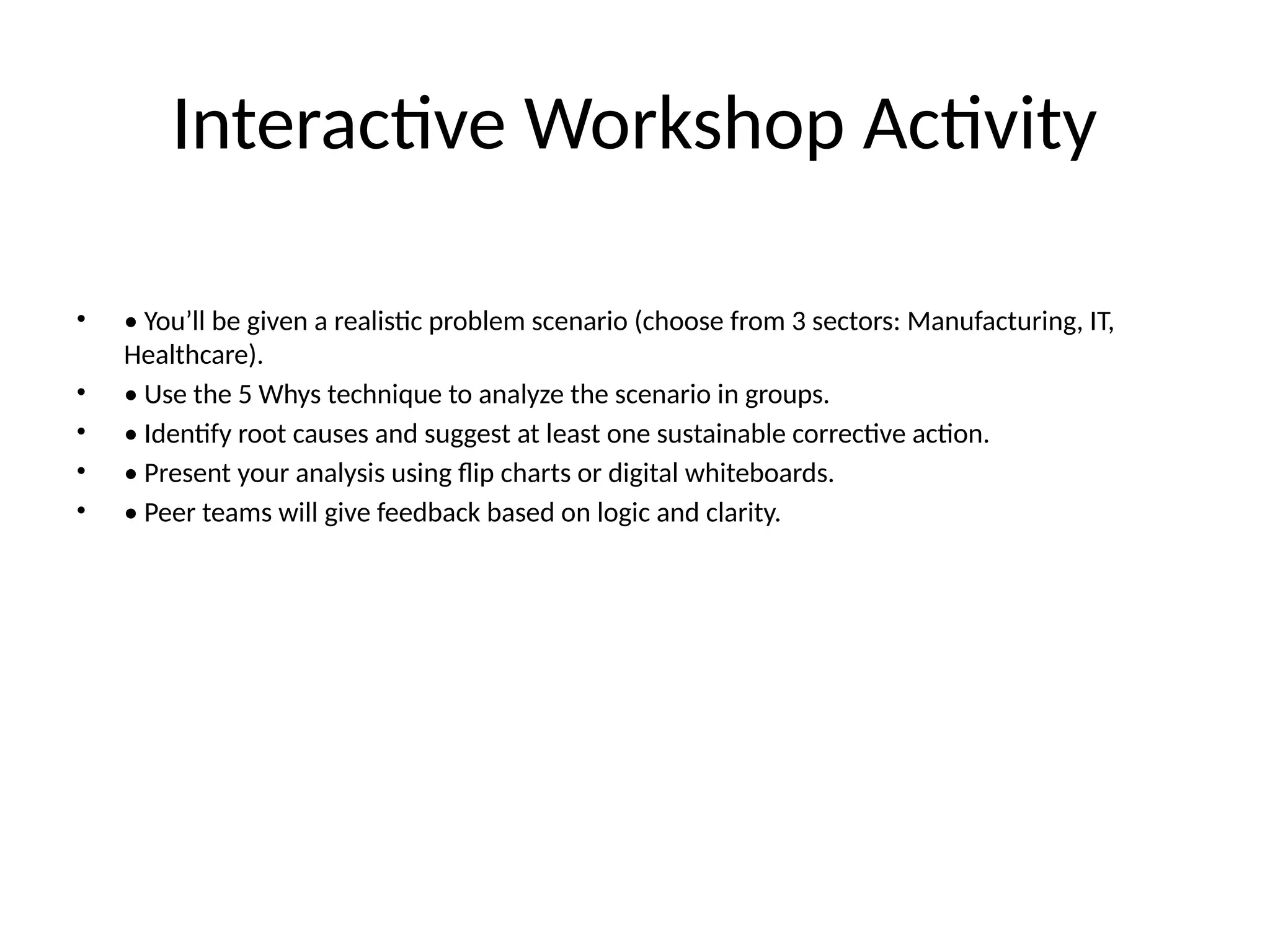
Interactive Workshop Activity
•• You’ll be given a realistic problem scenario (choose from 3 sectors: Manufacturing, IT,
Healthcare).
• • Use the 5 Whys technique to analyze the scenario in groups.
• • Identify root causes and suggest at least one sustainable corrective action.
• • Present your analysis using flip charts or digital whiteboards.
• • Peer teams will give feedback based on logic and clarity.
10.
Common Pitfalls toAvoid
• • Vague or overly broad problem definitions.
• • Asking 'Why?' in a circular or repetitive way.
• • Assigning blame rather than identifying system flaws.
• • Stopping analysis prematurely or accepting first answer.
• • Ignoring data, evidence, or frontline input.
11.
Best Practices inWhy-Why
Facilitation
• • Use real-time data or logs to support analysis.
• • Create a psychologically safe environment for open dialogue.
• • Use visuals (flowcharts, fishbone diagrams) to map reasoning.
• • Encourage diverse perspectives to avoid tunnel vision.
• • Document conclusions, test corrective actions, and follow up.
12.
Facilitator's Role andMindset
• • Guide the discussion, don't dominate it.
• • Listen actively and ask clarifying questions.
• • Keep the team focused on causes, not people.
• • Challenge assumptions with curiosity, not judgment.
• • Provide structure using templates or diagrams.
13.
Recap and KeyTakeaways
• • Root Cause Analysis is about finding sustainable solutions.
• • The 5 Whys tool is powerful in its simplicity when applied properly.
• • A clear, evidence-based process helps avoid recurring issues.
• • Team involvement and a structured approach drive real results.
• • Practice makes perfect – use it regularly in daily operations.
14.
Grazie Mille!
• Thankyou for joining this deep dive into Why-Why Analysis!
• We hope you're now empowered to dig deeper and solve smarter.
• “Simplicity is the ultimate sophistication.” – Leonardo da Vinci
• Until next time, keep asking 'Why?' with purpose!
![Why-Why Analysis: Root Cause
Discovery Masterclass
An In-Depth 3-Hour Training
Presented by [Your Name / Company]](https://image.slidesharecdn.com/whywhyanalysismasterclassdetailed-250618020715-be88c83e/75/Why_Why_Analysis_Masterclass_Detailed-pptx-1-2048.jpg)


![[DSC Europe 25] Ivan Peric - Intelligence Swarm Logic and Techno-Functional M...](https://cdn.slidesharecdn.com/ss_thumbnails/7my7c97fsduiccadgavw-2-251212103249-5a03f7c6-thumbnail.jpg?width=640&height=640&fit=bounds)

![[DSC Europe 25] Aleksandra Dragicevic - AI-Boosted Research in Healthcare: Fr...](https://cdn.slidesharecdn.com/ss_thumbnails/iqwngszurf2r7pi1lnnj-4-aleksandra-dragicevic-ad-dsc-europe-conference-20-251208151905-37c3238a-thumbnail.jpg?width=640&height=640&fit=bounds)


![[DSC Europe 25] Branko Urosevic -Rethinking Financial Talent: Integrating Cod...](https://cdn.slidesharecdn.com/ss_thumbnails/8jjrus8ttko6qj64f58f-3-251212103250-642c6374-thumbnail.jpg?width=640&height=640&fit=bounds)

![[DSC Europe 25] Bassam Maharmeh - Artificial Intelligence: Opportunities and ...](https://cdn.slidesharecdn.com/ss_thumbnails/thhfmr2fqpawzj7hsjpg-5-251211083048-2c23204f-thumbnail.jpg?width=640&height=640&fit=bounds)


![[DSC Europe 25] Jon Dajci - Bridging TradFi and DeFi: Building the Future of ...](https://cdn.slidesharecdn.com/ss_thumbnails/fqmhfvlbqhkihjvqvhmu-7-251211083849-6af7e325-thumbnail.jpg?width=640&height=640&fit=bounds)
![[DSC Europe 25] Behzad Hosseini - AI Agents in the Wild: Deploying Models tha...](https://cdn.slidesharecdn.com/ss_thumbnails/3qtejajvsjqrzwfept2c-10-251212103250-7f2b1068-thumbnail.jpg?width=640&height=640&fit=bounds)
![[DSC Europe 25] Milan Sekuloski - Data, Defence, and Development: Cybersecuri...](https://cdn.slidesharecdn.com/ss_thumbnails/dfrkwwx4qly6atqpbl4z-4-251209104645-c3d4b0ca-thumbnail.jpg?width=640&height=640&fit=bounds)
![[DSC Europe 25] Branko Dzakula - From Defense to Attack: How AI Redefines Cyb...](https://cdn.slidesharecdn.com/ss_thumbnails/80bdzdxpr3ky2g0qvyk9-8-251211083048-ce5fc1ee-thumbnail.jpg?width=640&height=640&fit=bounds)
![[DSC Europe 25] Sara Polak - The Ancient Operating System: What Archaeology T...](https://cdn.slidesharecdn.com/ss_thumbnails/3vch2p6tttdnwhsgazoz-3-sara-polak-smart-cities-251208152532-64404202-thumbnail.jpg?width=640&height=640&fit=bounds)
![[DSC Europe 25] Hans Kleinsman - The Compliance Gearbox: How Tax Tech Mediate...](https://cdn.slidesharecdn.com/ss_thumbnails/dxdytie1toel0hr90bjs-2-251212103250-174fdbe7-thumbnail.jpg?width=640&height=640&fit=bounds)

![[DSC Europe 25] Katherine Forrest - AI NOW: Understanding the Velocity of Cha...](https://cdn.slidesharecdn.com/ss_thumbnails/wvvbruqfrci0sfq9xwgb-4-251212104007-e5ad1987-thumbnail.jpg?width=640&height=640&fit=bounds)
![[DSC Europe 25] Marko Krstic - Understanding the AI Threat Landscape - Risks,...](https://cdn.slidesharecdn.com/ss_thumbnails/tiyim1ins5jvbrvzpzla-2-251209104645-c69d3553-thumbnail.jpg?width=640&height=640&fit=bounds)