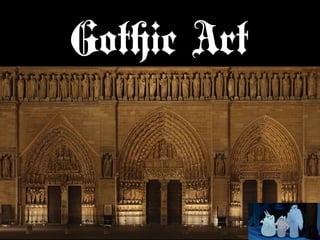
Gothic Art
In the 13th
and 14th
centuries, the Gothic style
replaced Romanesque. It
began in France and then
spread through Europe.
Urban architecture was more elaborate
than before. Market halls, squares and
city councils were built in the Gothic style,
like Sienna City Hall (13th
c)
Features of Gothic architecture
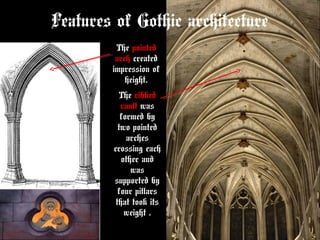
The pointed
arch created
impression of
height.
The ribbed
vault was
formed by
two pointed
arches
crossing each
other and
was
supported by
four pillars
that took its
weight .
Features of Gothic architecture
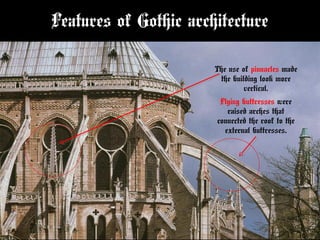
Flying buttresses were
raised arches that
connected the roof to the
external buttresses.
The use of pinnacles made
the building look more
vertical.
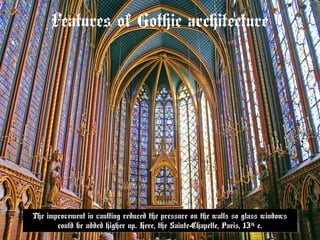
The improvement in vaulting reduced the pressure on the walls so glass windows
could be added higher up. Here, the Sainte-Chapelle, Paris, 13th
c.
The improvement in vaulting reduced the pressure on the walls so glass windows
could be added higher up. Here, the Sainte-Chapelle, Paris, 13th
c.
Features of Gothic architecture
The great circular openings on the façades of cathedrals were called rose windows.
Here, the rose window of Reims Cathedral (13th
c.) from the interior
The great circular openings on the façades of cathedrals were called rose windows.
Here, the rose window of Reims Cathedral (13th
c.) from the interior
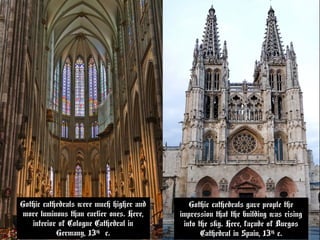
Gothic cathedrals were much higher and
more luminous than earlier ones. Here,
interior of Cologne Cathedral in
Germany, 13th
c.
Gothic cathedrals were much higher and
more luminous than earlier ones. Here,
interior of Cologne Cathedral in
Germany, 13th
c.
Gothic cathedrals gave people the
impression that the building was rising
into the sky. Here, façade of Burgos
Cathedral in Spain, 13th
c.
Gothic cathedrals gave people the
impression that the building was rising
into the sky. Here, façade of Burgos
Cathedral in Spain, 13th
c.
Gothic sculpture
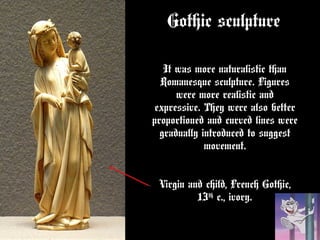
It was more naturalistic than
Romanesque sculpture. Figures
were more realistic and
expressive. They were also better
proportioned and curved lines were
gradually introduced to suggest
movement.
Virgin and child, French Gothic,
13th
c., ivory.
Gothic sculpture
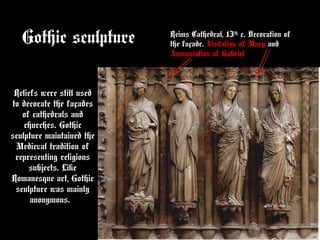
Reliefs were still used
to decorate the façades
of cathedrals and
churches. Gothic
sculpture maintained the
Medieval tradition of
representing religious
subjects. Like
Romanesque art, Gothic
sculpture was mainly
anonymous.
Reims Cathedral, 13th
c. Decoration of
the façade. Visitation of Mary and
Annunciation of Gabriel
Gothic painting
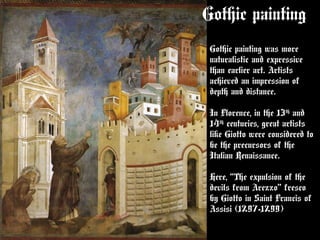
Gothic painting was more
naturalistic and expressive
than earlier art. Artists
achieved an impression of
depth and distance.
In Florence, in the 13th
and
14th
centuries, great artists
like Giotto were considered to
be the precursors of the
Italian Renaissance.
Here, “The expulsion of the
devils from Arezzo” fresco
by Giotto in Saint Francis of
Assisi (1297-1299)
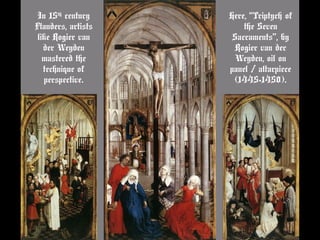
In 15th
century
Flanders, artists
like Rogier van
der Weyden
mastered the
technique of
perspective.
Here, “Triptych of
the Seven
Sacraments”, by
Rogier van der
Weyden, oil on
panel / altarpiece
(1445-1450).

Gothic art

  • 1.
  • 2.
    In the 13th and14th centuries, the Gothic style replaced Romanesque. It began in France and then spread through Europe. Urban architecture was more elaborate than before. Market halls, squares and city councils were built in the Gothic style, like Sienna City Hall (13th c)
  • 3.
    Features of Gothicarchitecture The pointed arch created impression of height. The ribbed vault was formed by two pointed arches crossing each other and was supported by four pillars that took its weight .
  • 4.
    Features of Gothicarchitecture Flying buttresses were raised arches that connected the roof to the external buttresses. The use of pinnacles made the building look more vertical.
  • 5.
    The improvement invaulting reduced the pressure on the walls so glass windows could be added higher up. Here, the Sainte-Chapelle, Paris, 13th c. The improvement in vaulting reduced the pressure on the walls so glass windows could be added higher up. Here, the Sainte-Chapelle, Paris, 13th c. Features of Gothic architecture
  • 6.
    Features of Gothicarchitecture The great circular openings on the façades of cathedrals were called rose windows. Here, the rose window of Reims Cathedral (13th c.) from the interior The great circular openings on the façades of cathedrals were called rose windows. Here, the rose window of Reims Cathedral (13th c.) from the interior
  • 7.
    Gothic cathedrals weremuch higher and more luminous than earlier ones. Here, interior of Cologne Cathedral in Germany, 13th c. Gothic cathedrals were much higher and more luminous than earlier ones. Here, interior of Cologne Cathedral in Germany, 13th c. Gothic cathedrals gave people the impression that the building was rising into the sky. Here, façade of Burgos Cathedral in Spain, 13th c. Gothic cathedrals gave people the impression that the building was rising into the sky. Here, façade of Burgos Cathedral in Spain, 13th c.
  • 8.
    Gothic sculpture It wasmore naturalistic than Romanesque sculpture. Figures were more realistic and expressive. They were also better proportioned and curved lines were gradually introduced to suggest movement. Virgin and child, French Gothic, 13th c., ivory.
  • 9.
    Gothic sculpture Reliefs werestill used to decorate the façades of cathedrals and churches. Gothic sculpture maintained the Medieval tradition of representing religious subjects. Like Romanesque art, Gothic sculpture was mainly anonymous. Reims Cathedral, 13th c. Decoration of the façade. Visitation of Mary and Annunciation of Gabriel
  • 10.
    Gothic painting Gothic paintingwas more naturalistic and expressive than earlier art. Artists achieved an impression of depth and distance. In Florence, in the 13th and 14th centuries, great artists like Giotto were considered to be the precursors of the Italian Renaissance. Here, “The expulsion of the devils from Arezzo” fresco by Giotto in Saint Francis of Assisi (1297-1299)
  • 11.
    In 15th century Flanders, artists likeRogier van der Weyden mastered the technique of perspective. Here, “Triptych of the Seven Sacraments”, by Rogier van der Weyden, oil on panel / altarpiece (1445-1450).