11/14/11
• What is an artist? Describe what he does,
what he thinks about, and what type of skills
he needs. How might the idea of an artist
have changed so far since prehistoric times?
13th – 15th C. Italy
The Early Renaissance
Highlights from Gardner’s
1. Nicola Pisano, pulpit of the baptistery, Pisa, Italy, 1259–1260. Marble, 15 high.
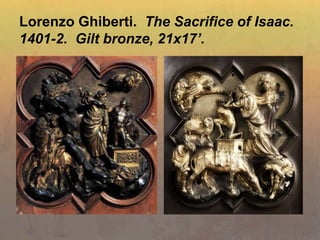
2. Lorenzo Ghiberti. The Sacrifice of Isaac. 1401-2. Gilt bronze, 21x17’.
3. Giotto di Bondone ,Madonna Enthroned, from the Church of Ognissanti, Florence,
Italy, ca. 1310. Tempera and gold leaf on wood, 10 8 6 8. Galleria degli Uffizi,
Florence.
4. Duccio di Buoninsegna, Virgin and Child Enthroned with Saints, principal panel of the
Maestà altarpiece, from Siena Cathedral, Siena, Italy, 1308–1311. Tempera and gold
leaf on wood, 7 13 (center panel).Museo dell’Opera del Duomo, Siena
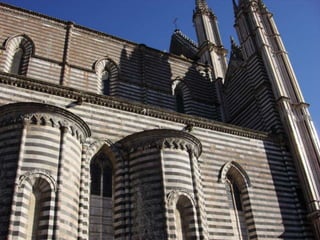
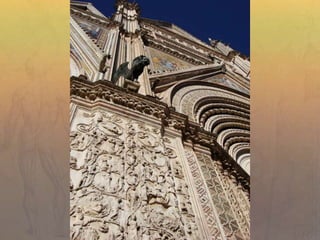
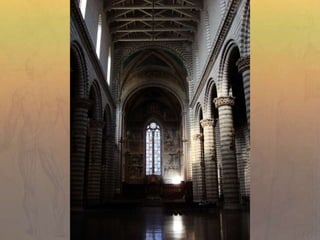
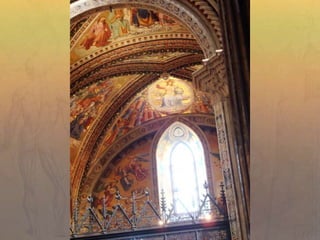
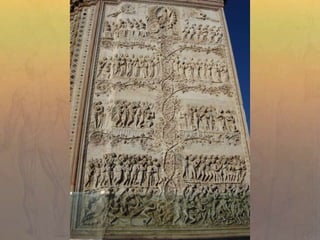
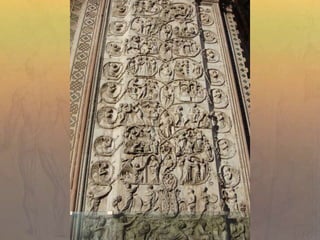
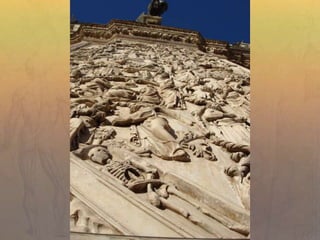
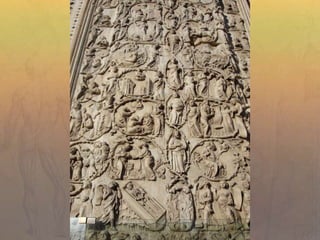
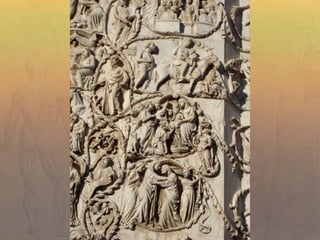
5. Lorenzo Maitani, west facade of Orvieto Cathedral, Orvieto, Italy, begun 1310.
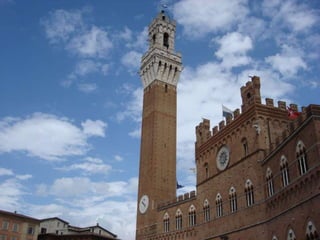
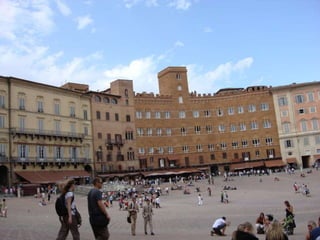
6. Campo with the Palazzo Pubblico, Siena, Italy, 1288–1309.
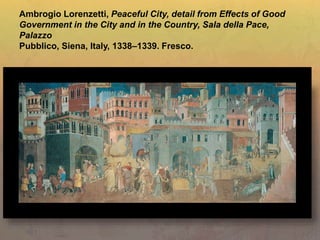
7. Ambrogio Lorenzetti, Peaceful City, detail from Effects of Good Government in the City
and in the Country, Sala della Pace, Palazzo Pubblico, Siena, Italy, 1338–1339. Fresco
8. Arnolfo di Cambio and others, Florence Cathedral Florence, Italy, begun 1296.
9. Doge’s Palace, Venice, Italy, begun ca. 1340–1345
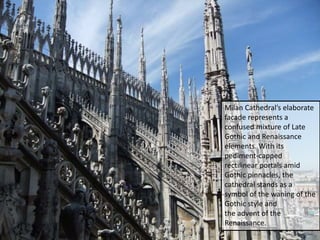
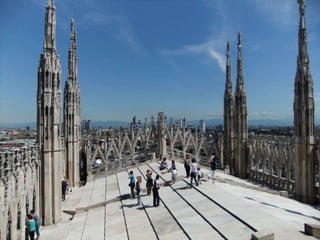
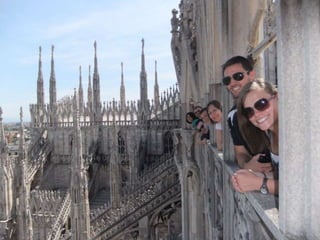
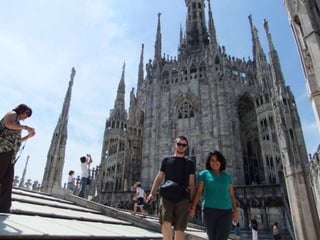
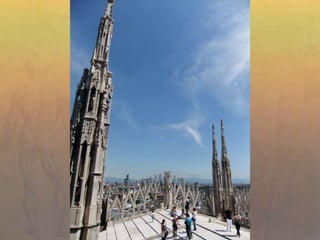
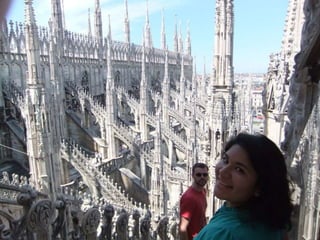
10. Milan Cathedral, Milan, Italy, begun 1386
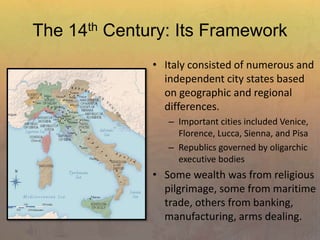
The 14th Century: Its Framework
• Italy consisted of numerous and
independent city states based
on geographic and regional
differences.
– Important cities included Venice,
Florence, Lucca, Sienna, and Pisa
– Republics governed by oligarchic
executive bodies
• Some wealth was from religious
pilgrimage, some from maritime
trade, others from banking,
manufacturing, arms dealing.
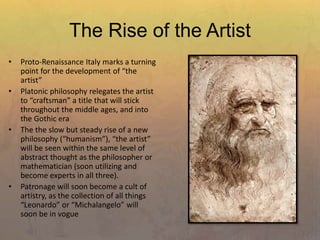
The Rise of the Artist
• Proto-Renaissance Italy marks a turning
point for the development of “the
artist”
• Platonic philosophy relegates the artist
to “craftsman” a title that will stick
throughout the middle ages, and into
the Gothic era
• The the slow but steady rise of a new
philosophy (“humanism”), “the artist”
will be seen within the same level of
abstract thought as the philosopher or
mathematician (soon utilizing and
become experts in all three).
• Patronage will soon become a cult of
artistry, as the collection of all things
“Leonardo” or “Michalangelo” will
soon be in vogue
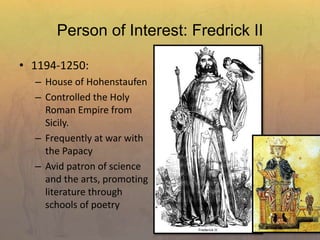
Person of Interest: Fredrick II
• 1194-1250:
– House of Hohenstaufen
– Controlled the Holy
Roman Empire from
Sicily.
– Frequently at war with
the Papacy
– Avid patron of science
and the arts, promoting
literature through
schools of poetry
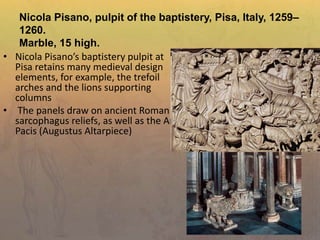
Nicola Pisano, pulpit of the baptistery, Pisa, Italy, 1259–
1260.
Marble, 15 high.
• Nicola Pisano’s baptistery pulpit at
Pisa retains many medieval design
elements, for example, the trefoil
arches and the lions supporting
columns
• The panels draw on ancient Roman
sarcophagus reliefs, as well as the Ara
Pacis (Augustus Altarpiece)
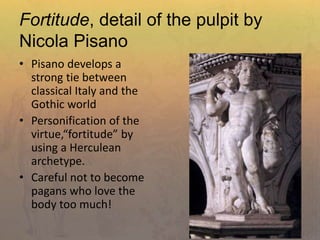
Fortitude, detail of the pulpit by
Nicola Pisano
• Pisano develops a
strong tie between
classical Italy and the
Gothic world
• Personification of the
virtue,“fortitude” by
using a Herculean
archetype.
• Careful not to become
pagans who love the
body too much!
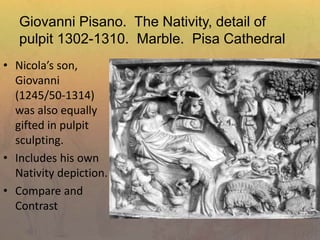
Giovanni Pisano. The Nativity, detail of
pulpit 1302-1310. Marble. Pisa Cathedral
• Nicola’s son,
Giovanni
(1245/50-1314)
was also equally
gifted in pulpit
sculpting.
• Includes his own
Nativity depiction.
• Compare and
Contrast
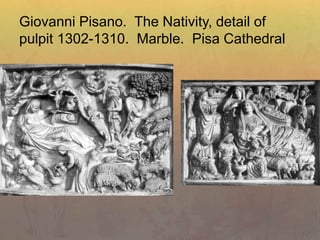
Giovanni Pisano. The Nativity, detail of
pulpit 1302-1310. Marble. Pisa Cathedral
Lorenzo Ghiberti. The Sacrifice of Isaac.
1401-2. Gilt bronze, 21x17’.
11/16 Warm-Up
• What would seem
revolutionary about the
elements and principles
of design found in
Giotto’s work? Describe
5 principles or
observations that are
unique to early Italian
Renaissance.
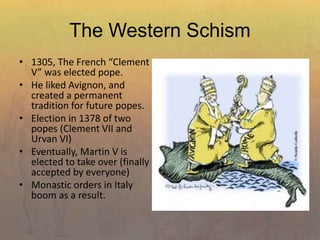
The Western Schism
• 1305, The French “Clement
V” was elected pope.
• He liked Avignon, and
created a permanent
tradition for future popes.
• Election in 1378 of two
popes (Clement VII and
Urvan VI)
• Eventually, Martin V is
elected to take over (finally
accepted by everyone)
• Monastic orders in Italy
boom as a result.
Warm-Up 11/17
• Create a MARCS paragraph
from one of your art
snapshots for the week.
• Use the following format:
– Topic/hook sentence:
– Culture:
– Description 1:
– Represents 1:
– Description 2:
– Represents 2:
– Overall Meaning:
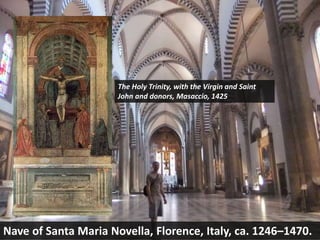
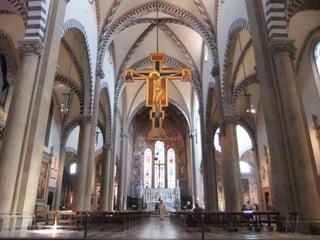
Nave of Santa Maria Novella, Florence, Italy, ca. 1246–1470.
The Holy Trinity, with the Virgin and Saint
John and donors, Masaccio, 1425
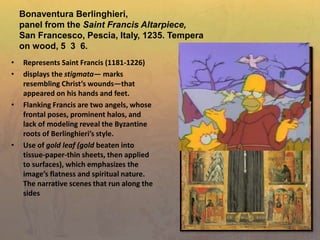
Bonaventura Berlinghieri,
panel from the Saint Francis Altarpiece,
San Francesco, Pescia, Italy, 1235. Tempera
on wood, 5 3 6.
• Represents Saint Francis (1181-1226)
• displays the stigmata— marks
resembling Christ’s wounds—that
appeared on his hands and feet.
• Flanking Francis are two angels, whose
frontal poses, prominent halos, and
lack of modeling reveal the Byzantine
roots of Berlinghieri’s style.
• Use of gold leaf (gold beaten into
tissue-paper-thin sheets, then applied
to surfaces), which emphasizes the
image’s flatness and spiritual nature.
The narrative scenes that run along the
sides
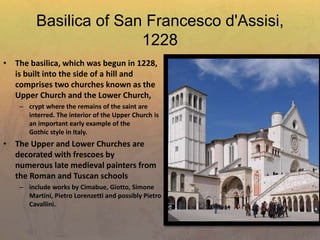
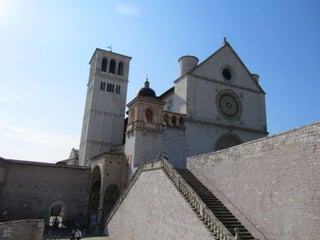
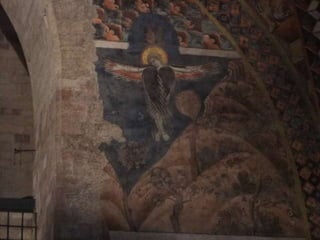
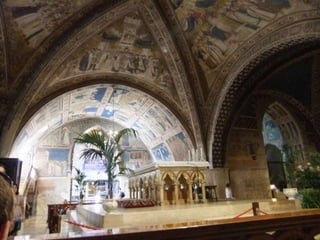
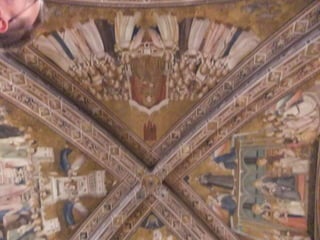
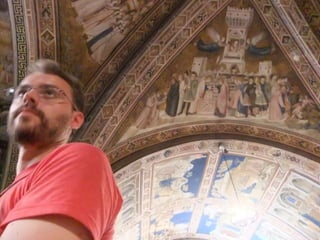
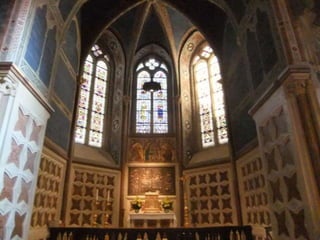
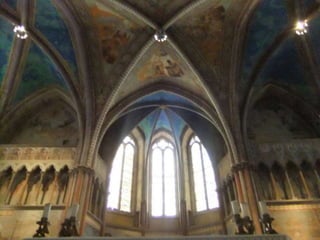
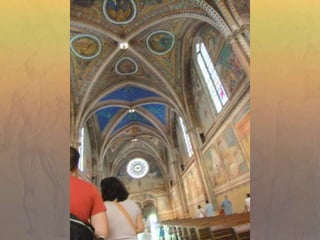
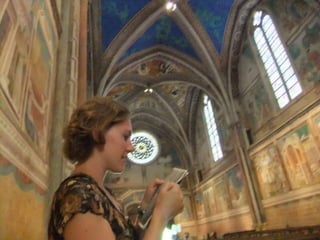
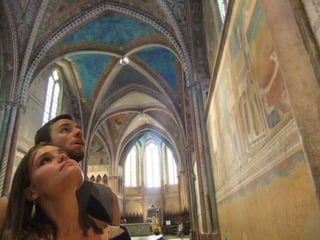
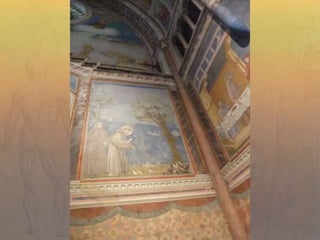
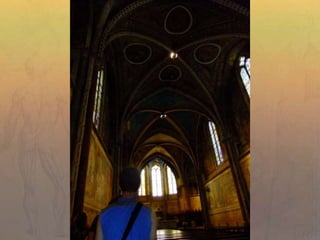
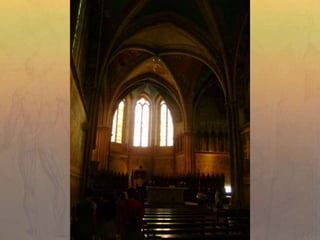
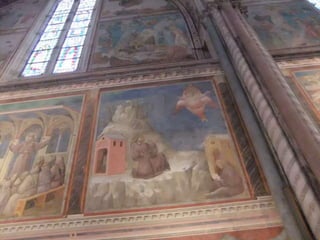
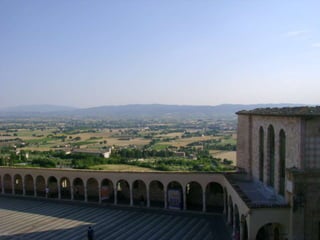
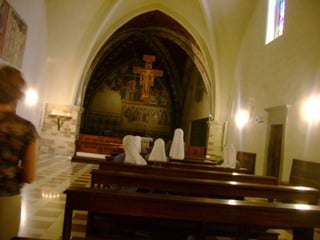
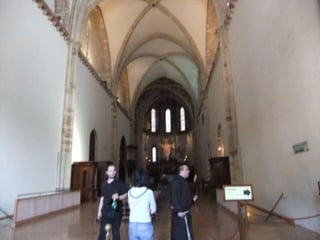
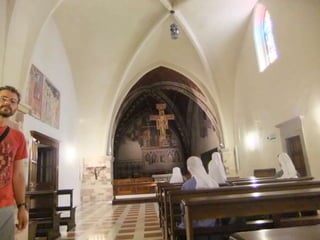
Basilica of San Francesco d'Assisi,
1228
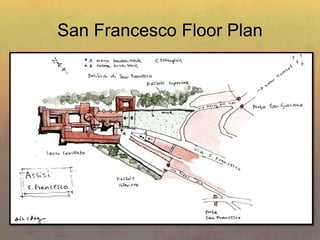
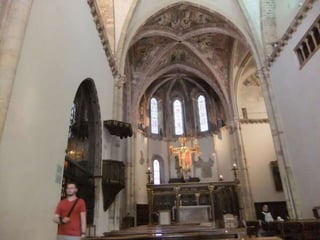
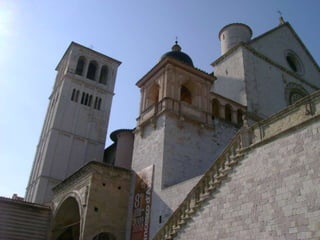
• The basilica, which was begun in 1228,
is built into the side of a hill and
comprises two churches known as the
Upper Church and the Lower Church,
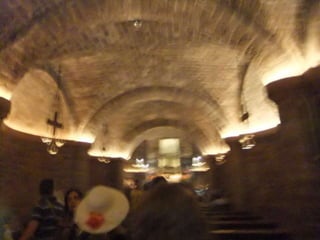
– crypt where the remains of the saint are
interred. The interior of the Upper Church is
an important early example of the
Gothic style in Italy.
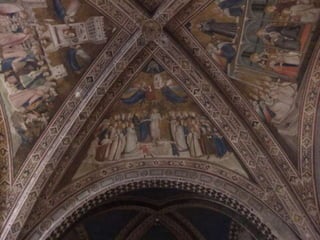
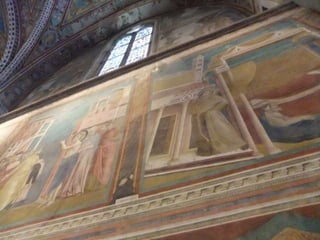
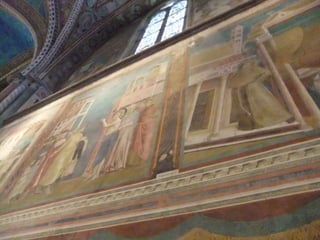
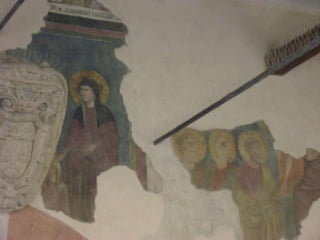
• The Upper and Lower Churches are
decorated with frescoes by
numerous late medieval painters from
the Roman and Tuscan schools
– include works by Cimabue, Giotto, Simone
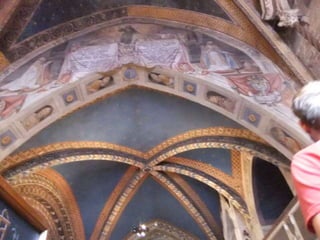
Martini, Pietro Lorenzetti and possibly Pietro
Cavallini.
San Francesco Floor Plan
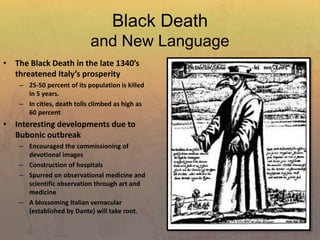
Black Death
and New Language
• The Black Death in the late 1340’s
threatened Italy’s prosperity
– 25-50 percent of its population is killed
in 5 years.
– In cities, death tolls climbed as high as
60 percent
• Interesting developments due to
Bubonic outbreak
– Encouraged the commissioning of
devotional images
– Construction of hospitals
– Spurred on observational medicine and
scientific observation through art and
medicine
– A blossoming Italian vernacular
(established by Dante) will take root.
Warm-up 11/18/11
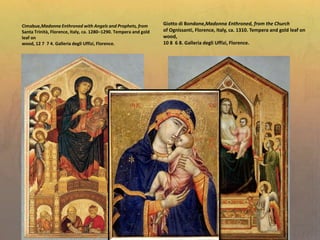
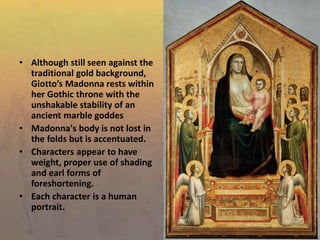
Giotto di Bondone,Madonna Enthroned, from the Church
of Ognissanti, Florence, Italy, ca. 1310. Tempera and gold leaf on
wood,
10 8 6 8. Galleria degli Uffizi, Florence.
Cimabue,Madonna Enthroned with Angels and Prophets, from
Santa Trinità, Florence, Italy, ca. 1280–1290. Tempera and gold
leaf on
wood, 12 7 7 4. Galleria degli Uffizi, Florence.
• Although still seen against the
traditional gold background,
Giotto’s Madonna rests within
her Gothic throne with the
unshakable stability of an
ancient marble goddes
• Madonna's body is not lost in
the folds but is accentuated.
• Characters appear to have
weight, proper use of shading
and earl forms of
foreshortening.
• Each character is a human
portrait.
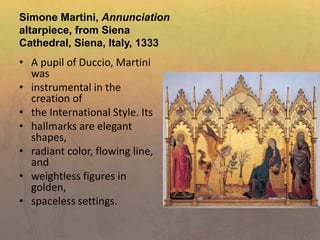
Simone Martini, Annunciation
altarpiece, from Siena
Cathedral, Siena, Italy, 1333
• A pupil of Duccio, Martini
was
• instrumental in the
creation of
• the International Style. Its
• hallmarks are elegant
shapes,
• radiant color, flowing line,
and
• weightless figures in
golden,
• spaceless settings.
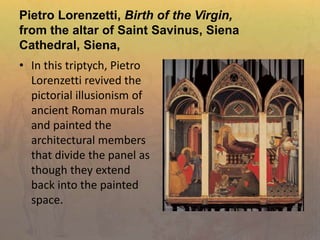
Pietro Lorenzetti, Birth of the Virgin,
from the altar of Saint Savinus, Siena
Cathedral, Siena,
• In this triptych, Pietro
Lorenzetti revived the
pictorial illusionism of
ancient Roman murals
and painted the
architectural members
that divide the panel as
though they extend
back into the painted
space.
Ambrogio Lorenzetti, Peaceful City, detail from Effects of Good
Government in the City and in the Country, Sala della Pace,
Palazzo
Pubblico, Siena, Italy, 1338–1339. Fresco.
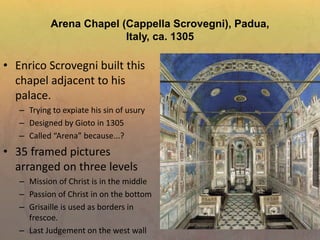
Arena Chapel (Cappella Scrovegni), Padua,
Italy, ca. 1305
• Enrico Scrovegni built this
chapel adjacent to his
palace.
– Trying to expiate his sin of usury
– Designed by Gioto in 1305
– Called “Arena” because...?
• 35 framed pictures
arranged on three levels
– Mission of Christ is in the middle
– Passion of Christ in on the bottom
– Grisaille is used as borders in
frescoe.
– Last Judgement on the west wall
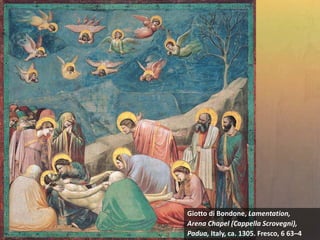
Giotto di Bondone, Lamentation,
Arena Chapel (Cappella Scrovegni),
Padua, Italy, ca. 1305. Fresco, 6 63–4
Warm-Up 12/05
• What are the benefits of a free society?Is
there such a thing? Define three elements to
a “free society” and argue for three
fundamental values of that society.
• Predict how having a free society will affect
Art in Italy during the 15th century.
15th Century Italy
Early Renaissance in Italy
Janson, Chapter 12
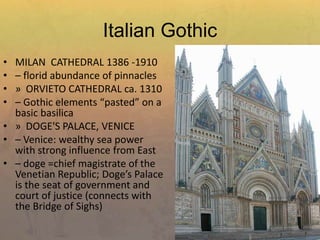
Italian Gothic
• MILAN CATHEDRAL 1386 -1910
• – florid abundance of pinnacles
• » ORVIETO CATHEDRAL ca. 1310
• – Gothic elements “pasted” on a
basic basilica
• » DOGE'S PALACE, VENICE
• – Venice: wealthy sea power
with strong influence from East
• – doge =chief magistrate of the
Venetian Republic; Doge’s Palace
is the seat of government and
court of justice (connects with
the Bridge of Sighs)
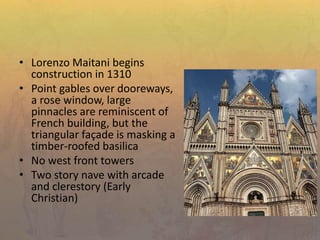
• Lorenzo Maitani begins
construction in 1310
• Point gables over dooreways,
a rose window, large
pinnacles are reminiscent of
French building, but the
triangular façade is masking a
timber-roofed basilica
• No west front towers
• Two story nave with arcade
and clerestory (Early
Christian)
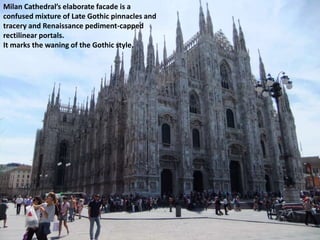
Milan Cathedral’s elaborate facade is a
confused mixture of Late Gothic pinnacles and
tracery and Renaissance pediment-capped
rectilinear portals.
It marks the waning of the Gothic style.
Milan Cathedral’s elaborate
facade represents a
confused mixture of Late
Gothic and Renaissance
elements. With its
pediment-capped
rectilinear portals amid
Gothic pinnacles, the
cathedral stands as a
symbol of the waning of the
Gothic style and
the advent of the
Renaissance.
12. 14th – 15th c. italy

12. 14th – 15th c. italy

  • 1.
    11/14/11 • What isan artist? Describe what he does, what he thinks about, and what type of skills he needs. How might the idea of an artist have changed so far since prehistoric times?
  • 2.
    13th – 15thC. Italy The Early Renaissance
  • 3.
    Highlights from Gardner’s 1.Nicola Pisano, pulpit of the baptistery, Pisa, Italy, 1259–1260. Marble, 15 high. 2. Lorenzo Ghiberti. The Sacrifice of Isaac. 1401-2. Gilt bronze, 21x17’. 3. Giotto di Bondone ,Madonna Enthroned, from the Church of Ognissanti, Florence, Italy, ca. 1310. Tempera and gold leaf on wood, 10 8 6 8. Galleria degli Uffizi, Florence. 4. Duccio di Buoninsegna, Virgin and Child Enthroned with Saints, principal panel of the Maestà altarpiece, from Siena Cathedral, Siena, Italy, 1308–1311. Tempera and gold leaf on wood, 7 13 (center panel).Museo dell’Opera del Duomo, Siena 5. Lorenzo Maitani, west facade of Orvieto Cathedral, Orvieto, Italy, begun 1310. 6. Campo with the Palazzo Pubblico, Siena, Italy, 1288–1309. 7. Ambrogio Lorenzetti, Peaceful City, detail from Effects of Good Government in the City and in the Country, Sala della Pace, Palazzo Pubblico, Siena, Italy, 1338–1339. Fresco 8. Arnolfo di Cambio and others, Florence Cathedral Florence, Italy, begun 1296. 9. Doge’s Palace, Venice, Italy, begun ca. 1340–1345 10. Milan Cathedral, Milan, Italy, begun 1386
  • 4.
    The 14th Century:Its Framework • Italy consisted of numerous and independent city states based on geographic and regional differences. – Important cities included Venice, Florence, Lucca, Sienna, and Pisa – Republics governed by oligarchic executive bodies • Some wealth was from religious pilgrimage, some from maritime trade, others from banking, manufacturing, arms dealing.
  • 5.
    The Rise ofthe Artist • Proto-Renaissance Italy marks a turning point for the development of “the artist” • Platonic philosophy relegates the artist to “craftsman” a title that will stick throughout the middle ages, and into the Gothic era • The the slow but steady rise of a new philosophy (“humanism”), “the artist” will be seen within the same level of abstract thought as the philosopher or mathematician (soon utilizing and become experts in all three). • Patronage will soon become a cult of artistry, as the collection of all things “Leonardo” or “Michalangelo” will soon be in vogue
  • 6.
    Person of Interest:Fredrick II • 1194-1250: – House of Hohenstaufen – Controlled the Holy Roman Empire from Sicily. – Frequently at war with the Papacy – Avid patron of science and the arts, promoting literature through schools of poetry
  • 7.
    Nicola Pisano, pulpitof the baptistery, Pisa, Italy, 1259– 1260. Marble, 15 high. • Nicola Pisano’s baptistery pulpit at Pisa retains many medieval design elements, for example, the trefoil arches and the lions supporting columns • The panels draw on ancient Roman sarcophagus reliefs, as well as the Ara Pacis (Augustus Altarpiece)
  • 8.
    Fortitude, detail ofthe pulpit by Nicola Pisano • Pisano develops a strong tie between classical Italy and the Gothic world • Personification of the virtue,“fortitude” by using a Herculean archetype. • Careful not to become pagans who love the body too much!
  • 9.
    Giovanni Pisano. TheNativity, detail of pulpit 1302-1310. Marble. Pisa Cathedral • Nicola’s son, Giovanni (1245/50-1314) was also equally gifted in pulpit sculpting. • Includes his own Nativity depiction. • Compare and Contrast
  • 10.
    Giovanni Pisano. TheNativity, detail of pulpit 1302-1310. Marble. Pisa Cathedral
  • 11.
    Lorenzo Ghiberti. TheSacrifice of Isaac. 1401-2. Gilt bronze, 21x17’.
  • 12.
    11/16 Warm-Up • Whatwould seem revolutionary about the elements and principles of design found in Giotto’s work? Describe 5 principles or observations that are unique to early Italian Renaissance.
  • 13.
    The Western Schism •1305, The French “Clement V” was elected pope. • He liked Avignon, and created a permanent tradition for future popes. • Election in 1378 of two popes (Clement VII and Urvan VI) • Eventually, Martin V is elected to take over (finally accepted by everyone) • Monastic orders in Italy boom as a result.
  • 25.
    Warm-Up 11/17 • Createa MARCS paragraph from one of your art snapshots for the week. • Use the following format: – Topic/hook sentence: – Culture: – Description 1: – Represents 1: – Description 2: – Represents 2: – Overall Meaning:
  • 26.
    Nave of SantaMaria Novella, Florence, Italy, ca. 1246–1470. The Holy Trinity, with the Virgin and Saint John and donors, Masaccio, 1425
  • 28.
    Bonaventura Berlinghieri, panel fromthe Saint Francis Altarpiece, San Francesco, Pescia, Italy, 1235. Tempera on wood, 5 3 6. • Represents Saint Francis (1181-1226) • displays the stigmata— marks resembling Christ’s wounds—that appeared on his hands and feet. • Flanking Francis are two angels, whose frontal poses, prominent halos, and lack of modeling reveal the Byzantine roots of Berlinghieri’s style. • Use of gold leaf (gold beaten into tissue-paper-thin sheets, then applied to surfaces), which emphasizes the image’s flatness and spiritual nature. The narrative scenes that run along the sides
  • 29.
    Basilica of SanFrancesco d'Assisi, 1228 • The basilica, which was begun in 1228, is built into the side of a hill and comprises two churches known as the Upper Church and the Lower Church, – crypt where the remains of the saint are interred. The interior of the Upper Church is an important early example of the Gothic style in Italy. • The Upper and Lower Churches are decorated with frescoes by numerous late medieval painters from the Roman and Tuscan schools – include works by Cimabue, Giotto, Simone Martini, Pietro Lorenzetti and possibly Pietro Cavallini.
  • 30.
  • 71.
    Black Death and NewLanguage • The Black Death in the late 1340’s threatened Italy’s prosperity – 25-50 percent of its population is killed in 5 years. – In cities, death tolls climbed as high as 60 percent • Interesting developments due to Bubonic outbreak – Encouraged the commissioning of devotional images – Construction of hospitals – Spurred on observational medicine and scientific observation through art and medicine – A blossoming Italian vernacular (established by Dante) will take root.
  • 73.
  • 74.
    Giotto di Bondone,MadonnaEnthroned, from the Church of Ognissanti, Florence, Italy, ca. 1310. Tempera and gold leaf on wood, 10 8 6 8. Galleria degli Uffizi, Florence. Cimabue,Madonna Enthroned with Angels and Prophets, from Santa Trinità, Florence, Italy, ca. 1280–1290. Tempera and gold leaf on wood, 12 7 7 4. Galleria degli Uffizi, Florence.
  • 75.
    • Although stillseen against the traditional gold background, Giotto’s Madonna rests within her Gothic throne with the unshakable stability of an ancient marble goddes • Madonna's body is not lost in the folds but is accentuated. • Characters appear to have weight, proper use of shading and earl forms of foreshortening. • Each character is a human portrait.
  • 76.
    Simone Martini, Annunciation altarpiece,from Siena Cathedral, Siena, Italy, 1333 • A pupil of Duccio, Martini was • instrumental in the creation of • the International Style. Its • hallmarks are elegant shapes, • radiant color, flowing line, and • weightless figures in golden, • spaceless settings.
  • 77.
    Pietro Lorenzetti, Birthof the Virgin, from the altar of Saint Savinus, Siena Cathedral, Siena, • In this triptych, Pietro Lorenzetti revived the pictorial illusionism of ancient Roman murals and painted the architectural members that divide the panel as though they extend back into the painted space.
  • 78.
    Ambrogio Lorenzetti, PeacefulCity, detail from Effects of Good Government in the City and in the Country, Sala della Pace, Palazzo Pubblico, Siena, Italy, 1338–1339. Fresco.
  • 85.
    Arena Chapel (CappellaScrovegni), Padua, Italy, ca. 1305 • Enrico Scrovegni built this chapel adjacent to his palace. – Trying to expiate his sin of usury – Designed by Gioto in 1305 – Called “Arena” because...? • 35 framed pictures arranged on three levels – Mission of Christ is in the middle – Passion of Christ in on the bottom – Grisaille is used as borders in frescoe. – Last Judgement on the west wall
  • 86.
    Giotto di Bondone,Lamentation, Arena Chapel (Cappella Scrovegni), Padua, Italy, ca. 1305. Fresco, 6 63–4
  • 87.
    Warm-Up 12/05 • Whatare the benefits of a free society?Is there such a thing? Define three elements to a “free society” and argue for three fundamental values of that society. • Predict how having a free society will affect Art in Italy during the 15th century.
  • 88.
    15th Century Italy EarlyRenaissance in Italy Janson, Chapter 12
  • 89.
    Italian Gothic • MILANCATHEDRAL 1386 -1910 • – florid abundance of pinnacles • » ORVIETO CATHEDRAL ca. 1310 • – Gothic elements “pasted” on a basic basilica • » DOGE'S PALACE, VENICE • – Venice: wealthy sea power with strong influence from East • – doge =chief magistrate of the Venetian Republic; Doge’s Palace is the seat of government and court of justice (connects with the Bridge of Sighs)
  • 90.
    • Lorenzo Maitanibegins construction in 1310 • Point gables over dooreways, a rose window, large pinnacles are reminiscent of French building, but the triangular façade is masking a timber-roofed basilica • No west front towers • Two story nave with arcade and clerestory (Early Christian)
  • 102.
    Milan Cathedral’s elaboratefacade is a confused mixture of Late Gothic pinnacles and tracery and Renaissance pediment-capped rectilinear portals. It marks the waning of the Gothic style.
  • 110.
    Milan Cathedral’s elaborate facaderepresents a confused mixture of Late Gothic and Renaissance elements. With its pediment-capped rectilinear portals amid Gothic pinnacles, the cathedral stands as a symbol of the waning of the Gothic style and the advent of the Renaissance.