EW Module 2 Lecture 1
Metal Forming
Introduction
• Practically all metals, which are not used in cast form are
reduced to some standard shapes for subsequent
processing
• Manufacturing companies producing metals supply metals
in the form of ingots (An ingot is a piece of metal, that is
cast into a shape suitable for further processing. ) which are
obtained by casting liquid metal into a square cross section.
• Slab (250-1800 mm wide and 40-300 mm thick)
• Billets (40 sq mm or more)
• Blooms (150 to 400 sq mm)
• Sometimes continuous casting methods are also used to
cast the liquid metal into slabs, billets or blooms.
• These shapes are further processed through hot rolling,
forging or extrusion, to produce materials in standard form
such as plates, sheets, rods, tubes and structural sections.
• Metal Forming Processes
1. Rolling
2. Forging
3. Extrusion
4. Tube and wire drawing
5. and Deep drawing
Rolling
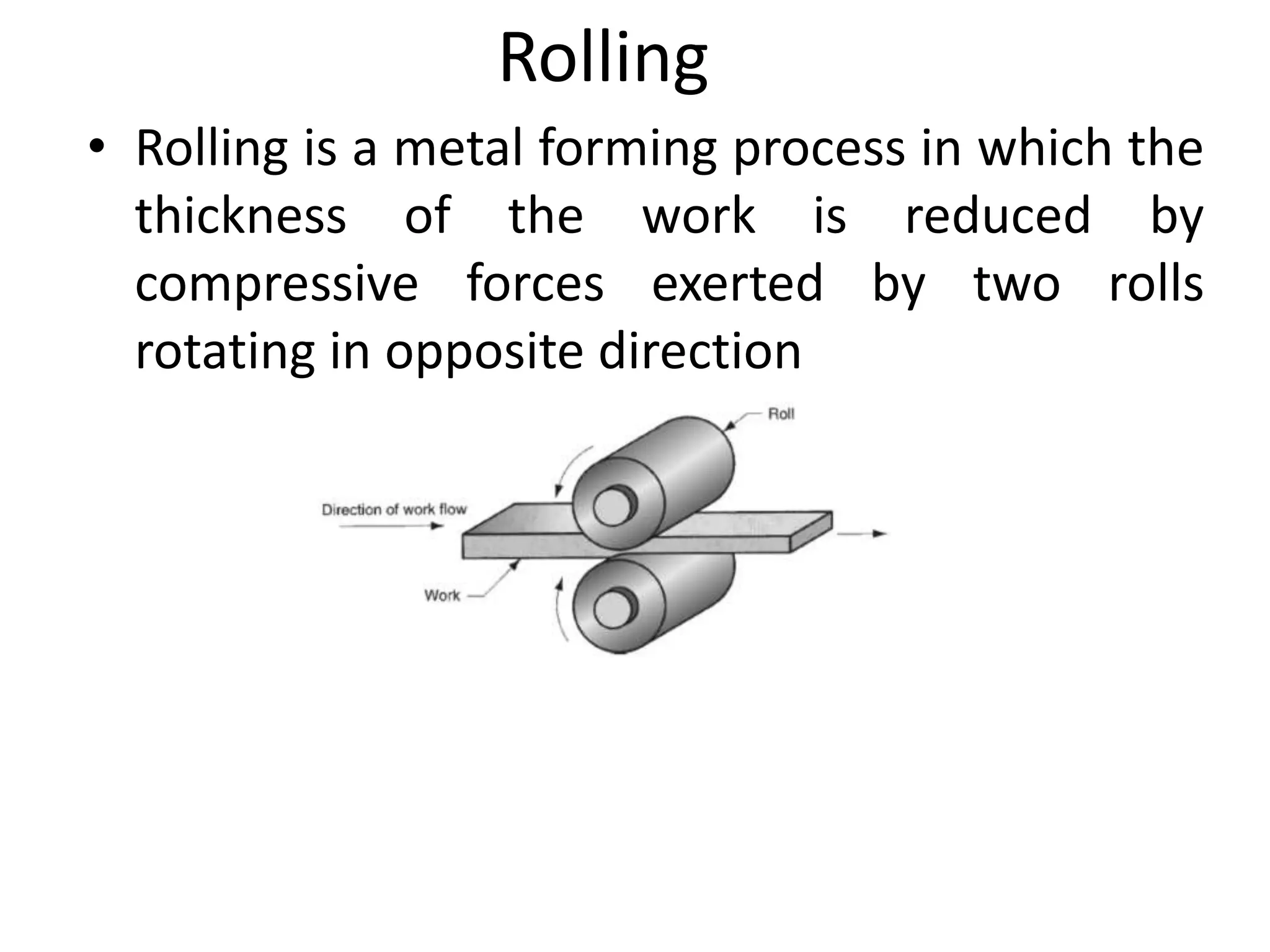
• Rolling is a metal forming process in which the
thickness of the work is reduced by
compressive forces exerted by two rolls
rotating in opposite direction
• Blooms are rolled into structural shapes like rails
for railroad tracks. Billets are rolled into bars,
rods. They become raw materials for machining,
wire drawing, forging, extrusion etc. Slabs are
rolled into plates, sheets, and strips. Hot rolled
plates are generally used in shipbuilding, bridges,
boilers, welded structures for various heavy
machines, and many other products.
Types of rolling mills
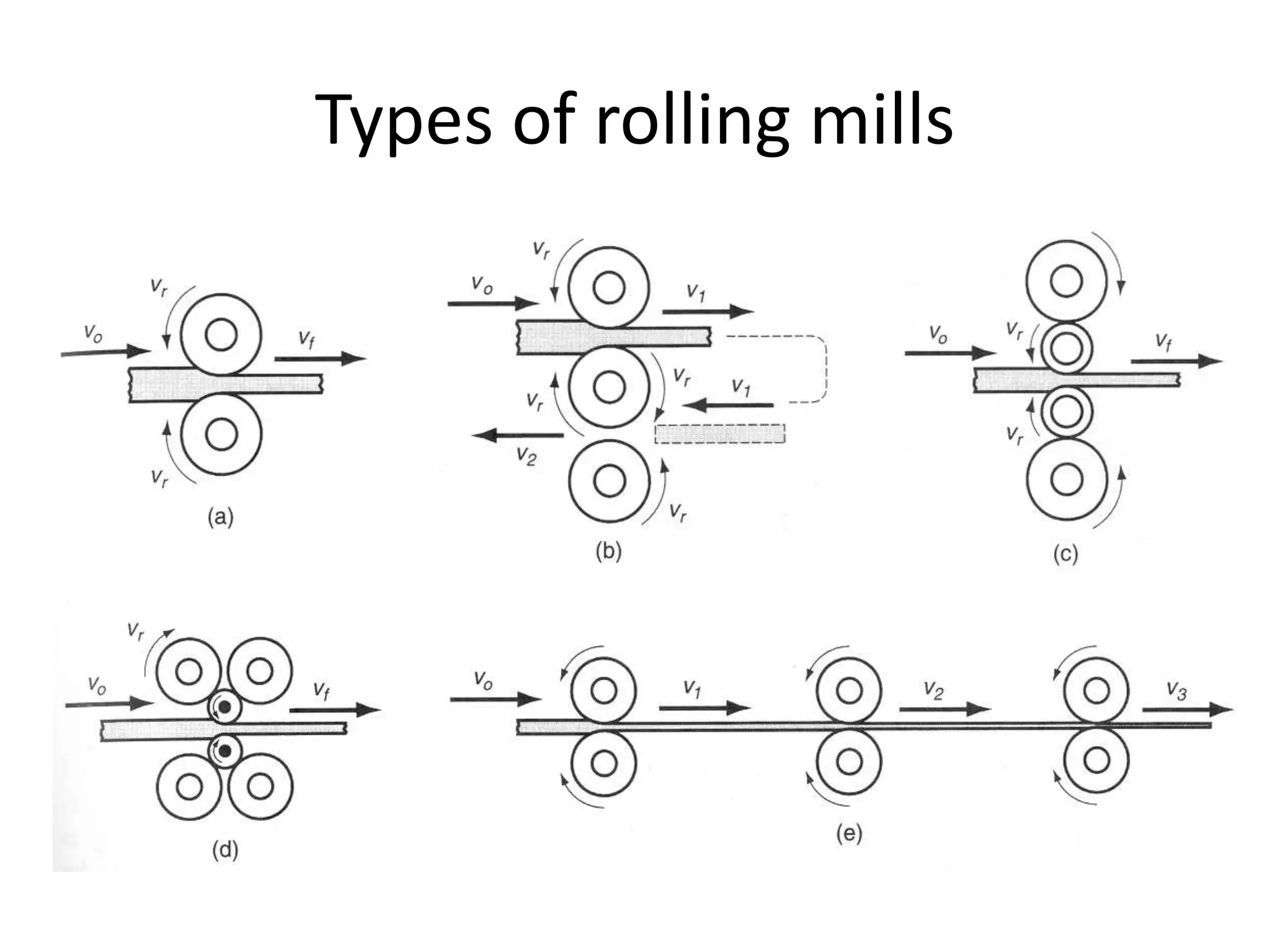
• Two high rolling mill: This type of
rolling mill consists of two rolls
rotating in opposite directions.
• Three high rolling mill: In this case,
there are three rolls one above the
other. At a time, for single pass, two
rolls will be used. The roll direction
will not be changed in this case.
• The top two rolls will be used for first
reduction and the sheet is shifted to
the bottom two rolls and further
reduction is done. This cycle is
continued till actual reduction is
attained. Disadvantage: automated
mechanism is required to shift the
slab
• Four high rolling mill: This consists
of two small rolls for thickness
reduction and two large backing rolls
to support the small rolls. The small
rolls will reduce the roll force
required as the roll-sheet contact
area will be reduced. The large
backing rolls are required to reduce
the elastic deflection of small rolls
when sheet passes between them.
• Cluster rolling mill: This uses smaller
rolls for rolling
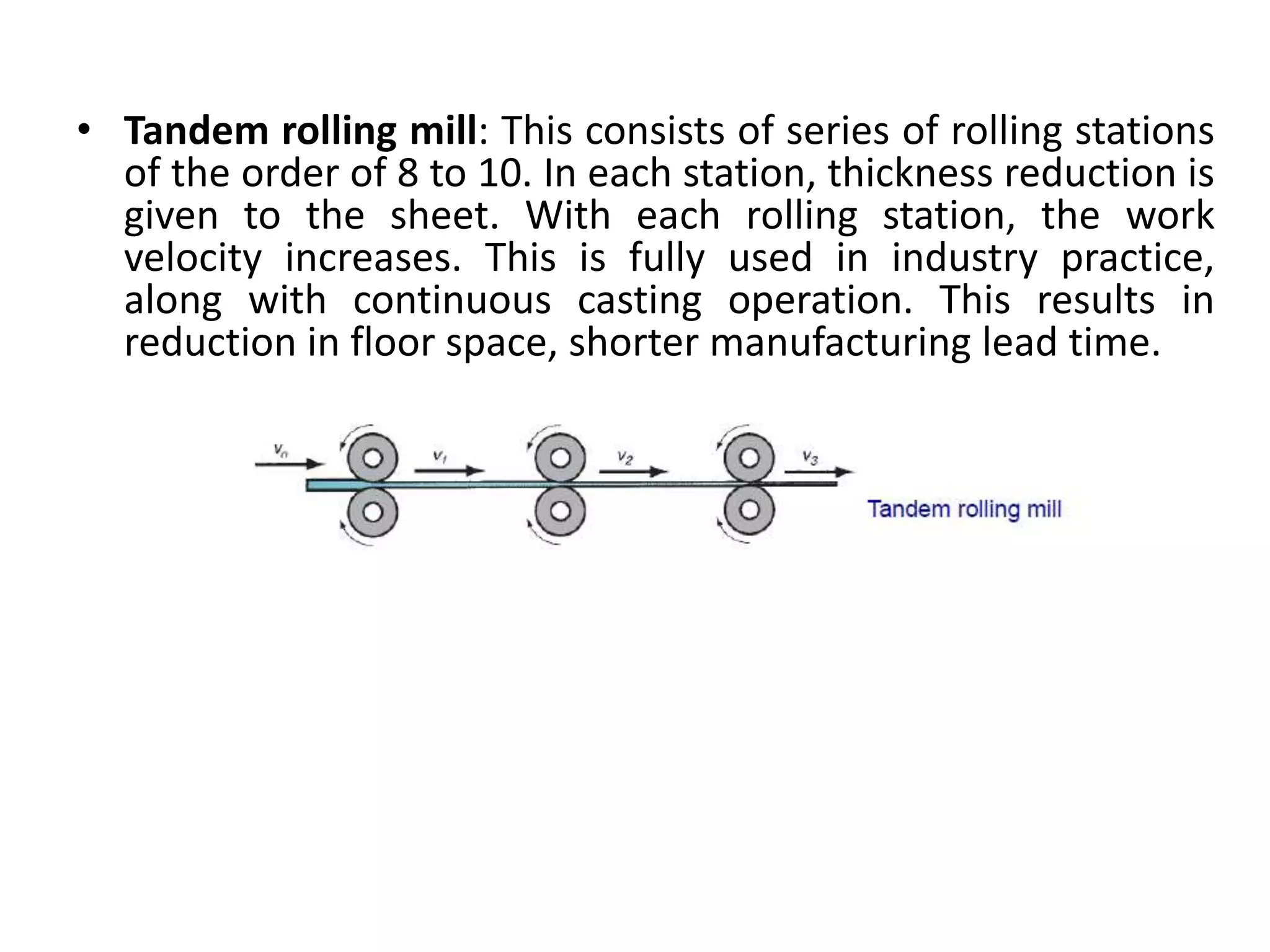
• Tandem rolling mill: This consists of series of rolling stations
of the order of 8 to 10. In each station, thickness reduction is
given to the sheet. With each rolling station, the work
velocity increases. This is fully used in industry practice,
along with continuous casting operation. This results in
reduction in floor space, shorter manufacturing lead time.
I- lagging zone
II- leading zone
Ho – initial thickness before
rolling
H1-final thickness of material
after rolling
Hn- thickness of material at
neutral plane
Vo- Initial velocity
V1-final velocity
•The surface velocity of both the rollers must be same to avoid
bending of the strip
(πDN/60)top = (πDN/60)bottom
DtNt = DbNb
Rolling operation in metal forming

Rolling operation in metal forming

  • 1.
    EW Module 2Lecture 1 Metal Forming
  • 2.
    Introduction • Practically allmetals, which are not used in cast form are reduced to some standard shapes for subsequent processing • Manufacturing companies producing metals supply metals in the form of ingots (An ingot is a piece of metal, that is cast into a shape suitable for further processing. ) which are obtained by casting liquid metal into a square cross section. • Slab (250-1800 mm wide and 40-300 mm thick) • Billets (40 sq mm or more) • Blooms (150 to 400 sq mm) • Sometimes continuous casting methods are also used to cast the liquid metal into slabs, billets or blooms. • These shapes are further processed through hot rolling, forging or extrusion, to produce materials in standard form such as plates, sheets, rods, tubes and structural sections.
  • 3.
    • Metal FormingProcesses 1. Rolling 2. Forging 3. Extrusion 4. Tube and wire drawing 5. and Deep drawing
  • 4.
    Rolling • Rolling isa metal forming process in which the thickness of the work is reduced by compressive forces exerted by two rolls rotating in opposite direction
  • 5.
    • Blooms arerolled into structural shapes like rails for railroad tracks. Billets are rolled into bars, rods. They become raw materials for machining, wire drawing, forging, extrusion etc. Slabs are rolled into plates, sheets, and strips. Hot rolled plates are generally used in shipbuilding, bridges, boilers, welded structures for various heavy machines, and many other products.
  • 7.
  • 8.
    • Two highrolling mill: This type of rolling mill consists of two rolls rotating in opposite directions. • Three high rolling mill: In this case, there are three rolls one above the other. At a time, for single pass, two rolls will be used. The roll direction will not be changed in this case. • The top two rolls will be used for first reduction and the sheet is shifted to the bottom two rolls and further reduction is done. This cycle is continued till actual reduction is attained. Disadvantage: automated mechanism is required to shift the slab
  • 9.
    • Four highrolling mill: This consists of two small rolls for thickness reduction and two large backing rolls to support the small rolls. The small rolls will reduce the roll force required as the roll-sheet contact area will be reduced. The large backing rolls are required to reduce the elastic deflection of small rolls when sheet passes between them. • Cluster rolling mill: This uses smaller rolls for rolling
  • 10.
    • Tandem rollingmill: This consists of series of rolling stations of the order of 8 to 10. In each station, thickness reduction is given to the sheet. With each rolling station, the work velocity increases. This is fully used in industry practice, along with continuous casting operation. This results in reduction in floor space, shorter manufacturing lead time.
  • 11.
    I- lagging zone II-leading zone Ho – initial thickness before rolling H1-final thickness of material after rolling Hn- thickness of material at neutral plane Vo- Initial velocity V1-final velocity •The surface velocity of both the rollers must be same to avoid bending of the strip (πDN/60)top = (πDN/60)bottom DtNt = DbNb