Food
Chemistry
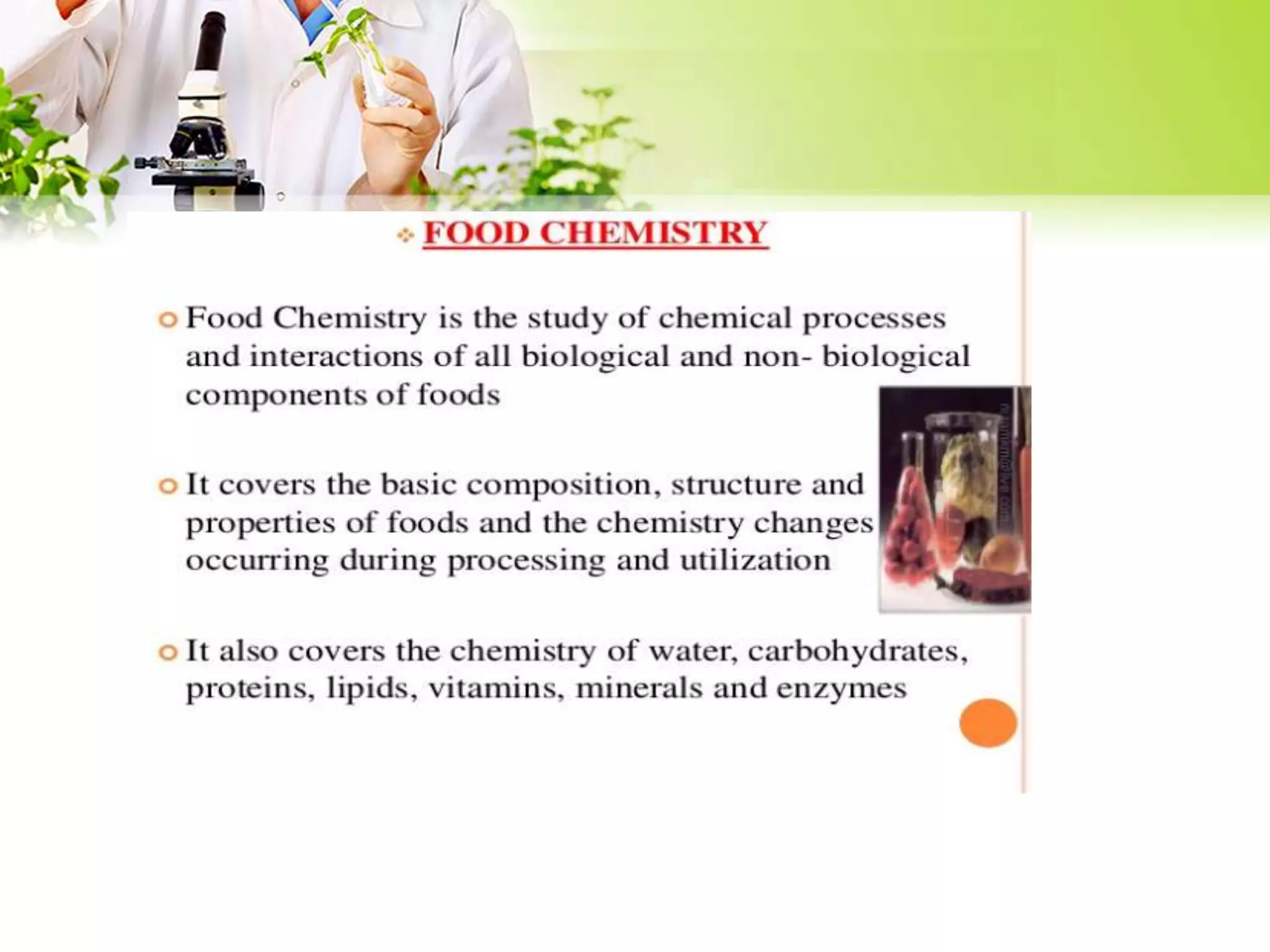
FOOD CHEMISTRY
Food chemistry is the study of chemical processes and
interactions of all biological and non-biological
components of foods. The biological substances include
such items as meat, poultry,, beer, and milk as examples.
What is the role of chemistry
in food?
• Substances are elements that make up chemical compounds.
• Chemistry informs us about changes in food during processing
and storage.
• Chemistry is important in the food industry because it explains
the changes in the cooking process, including how ingredients
interact to make food and how our body uses food.
Importance
• Chemical substances can play an important role in food production
and preservation.
• Food additives can, for example, prolong the shelf life of foods or
can make food more attractive, such as colors.
• Flavorings are used to make food tastier. Other chemicals can be
used to fight diseases in farm animals or crops.
What is the purpose for
chemical testing in food
• Laboratory testing is an important process, which relies on scientific
analysis to identify problems with food products.
• It provides analytical data on the quality of a product or
production process to support quality control in the HACCP system
Cell
• Cells are the fundamental units of life ' the bricks from which all
your tissues and organs are made ' and are the smallest
components considered to be living organisms in your body. Your
cells are constantly communicating with each other, responding to
your environment and to the signals they receive from what you
touch and how you move.
• Of the many important roles your cells play in your life everyday,
keeping your DNA safe from damage and providing energy for
everything you do are two of the most important
• Your DNA is stored within your cell in the nucleus, and your cell
has many ways to keep it safe; however, research has shown that
a poor diet -- one low in antioxidants and other important
phytonutrients -- and environmental exposure to toxins, like
pesticides, can cause your DNA to become damaged.
Why is food chemistry
important?
• Chemical substances can play an important role in food production and
preservation.
• Food additives can, for example, prolong the shelf life of foods or can
make food more attractive, such as colors.
• Flavorings are used to make food tastier
• Other chemicals can be used to fight diseases in farm animals or crops.
How does food relate to
chemistry ?
• Food scientists think of cooking in terms of the combination
of food chemicals and the reactions they undergo to form a
new food product.
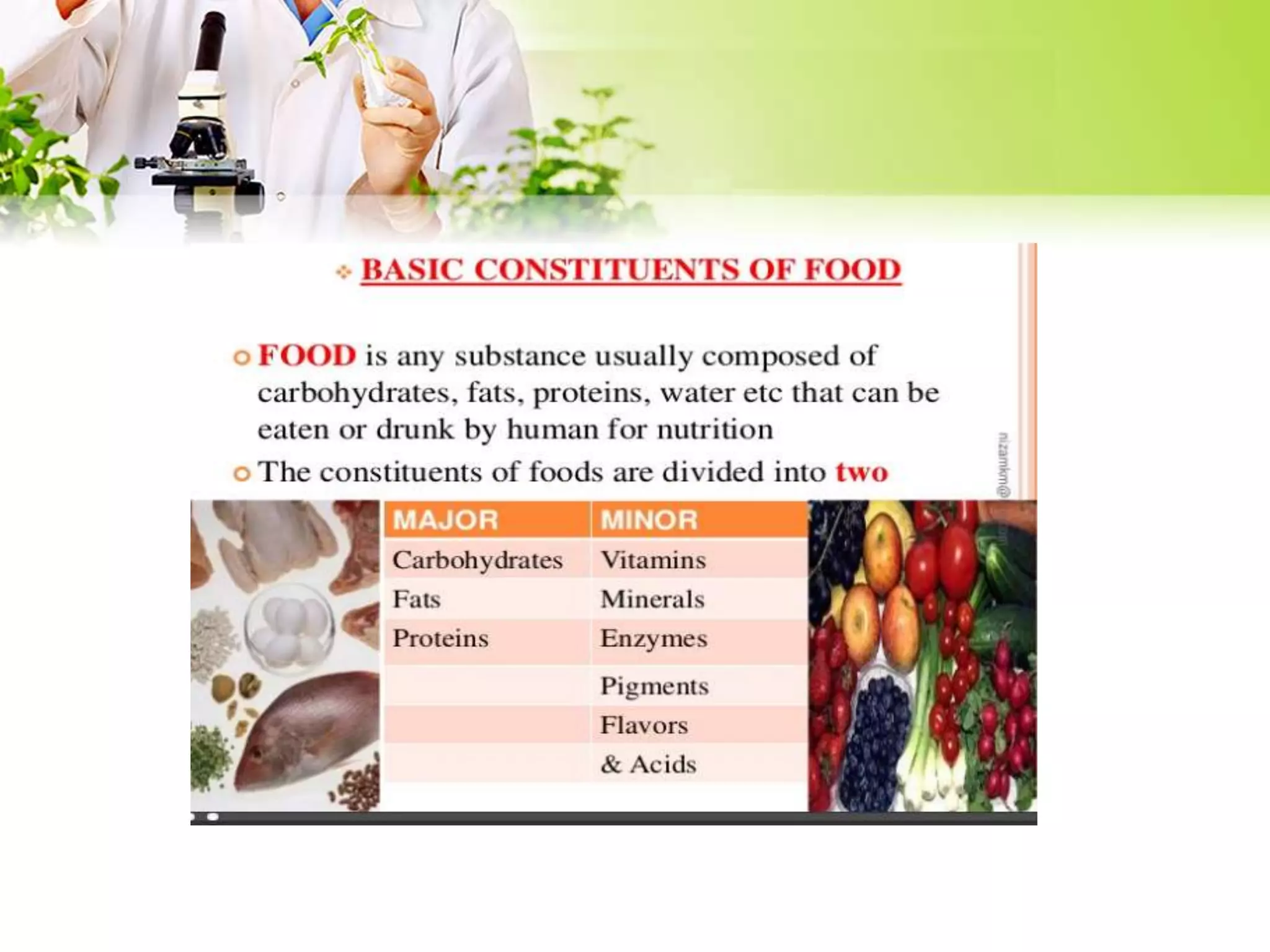
• Our food is made up of chemicals. Proteins, carbohydrates, and
fats are particular types of molecules and amino acids that
combine in predictable ways to make up a food.
Food Chemist
• They work in laboratories, offices and in the field on farms and
in food processing plants, coming up with new food sources, as
well as ways to preserve natural foods while keeping them
healthy, flavorful and safe to eat.Aug 19, 2018
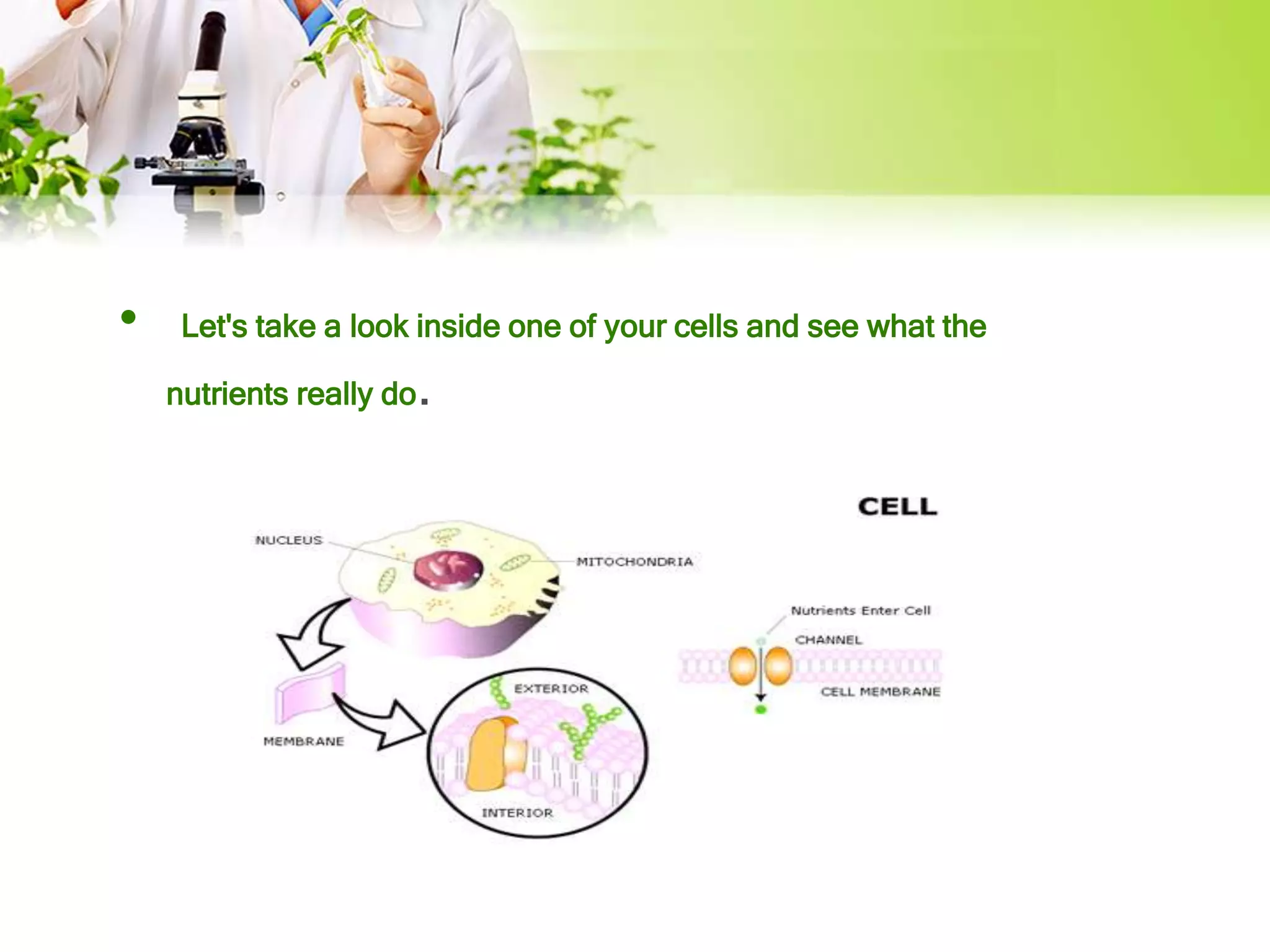
• Let's take a look inside one of your cells and see what the
nutrients really do.
What nutrients are important for the health of cells, and what do
they do?
• To more clearly illustrate how nutrition benefits health at a cellular level,
let's take a look at the function of three of your cell's components '
• (1) the cellular membrane,
• (2) the nucleus, and
• (3) the mitochondria ' and see how nutrition influences their structure,
functioning, and integrity.
• This will enable you to better appreciate how various nutrients in your
diet can help promote the health of your cells, and therefore the health of
your overall being.
What chemicals are in the
food we eat?
• Artificial Flavoring.
• High Fructose Corn Syrup.
• Monosodium Glutamate (MSG).
• Sodium Benzoate.
• Aspartame.
• Benzoic Acid.
• Potassium Bromate
• Sodium Casein ate.
Effects on shelf life of food
• Water activity is an important means of predicting and
controlling the shelf life of food products.
• Shelf life is the time during which a product will remain safe,
maintain desired sensory, chemical, physical, and
microbiological properties, and comply with nutritional
labeling.
• Prolong nutrients and vitamins in food.
How does water activity affect food spoilage
• The water activity increases with temperature.
• Most foods have a water activity above 0.95 and that
will provide sufficient moisture to support the growth of
bacteria, yeasts, and mold.
• The amount of available moisture can be reduced to a
point that will inhibit the growth of microorganisms.
Lipids and foods
• Lipids are a major component of food and important
structural and functional constituents of cells in
biological systems. As a class, lipids contribute many
desirable qualities to foods, including attributes of
texture, structure, mouthfeel, flavour, and colour.
• Oxidation is one of the most
important processes occurring in food
systems. It affects many interactions
among food constituents, leading to
both desirable and undesirable
products.
• Food lipids are foods components that are very
susceptible to oxidation processes, due to their
chemical instability;
• therefore, oxidation reactions are one of the major
sources of deterioration that occurs during
manufacturing, storage, distribution, and final
preparation of foods
• These oxidative processes in foods cause food quality
deterioration, leading to the characteristic oxidative
fragments, some of which are volatile and are
perceived as the off-flavours of rancidity and are the
cause of unpalatability.
• In addition to unpalatability, rancidity may give rise to
toxic levels of certain compounds like aldehydes,
hydroperoxides, epoxides, and cholesterol oxidation
products.
• As it is well known, lipid oxidation has detrimental
effects on both food quality and human health, and
then efforts must be made to minimize oxidation and
improve oxidative stability of lipid products.
• Antioxidant strategy has been successfully
employed in the food industry for quality
preservation of the food products and in the
medicinal industry for risk reduction of numerous
oxidative stress-mediated diseases.
• Use of antioxidants as important factors in reducing the
risk of chronic diseases and its economical aspects is
much discussed in the scientific world.
• Lipid peroxidation in dietary lipid oxidation products
have been proved to be the primary cause of many
diseases, that is, atherosclerosis cancer to name the
most important and aging process.
• Development, validation, and
application of novel analytical
methods for lipid analysis
• Influence of food processing on the
stability of lipids
• Lipid degradation: chemistry and
health aspects
• Natural antioxidants for lipid
preservation in foods
• Lipids and nutraceutical aspects
• Antioxidant food additives and health
benefits
• Chemical stability and bioavailability of
lipids
• Physicochemical change and heat
stability of fats
• Antimicrobial effect of lipids in food
lipid oxidation in food
• Degradation of unsaturated fatty acids by oxidation is
directly related to economic, nutritional, flavor, safety
and storage problems. There are two
major oxidation reactions which can occur
in food stuff containing lipids; auto-oxidation and
photo-oxidation, of which auto-oxidation is the most
common.
• As a class, lipids contribute many desirable
qualities to foods, including attributes
of texture, structure, mouth feel, flavor
and color.
• Certain key variables now known to influence
oxidative processes can be targeted to
increase food lipid stability during and after
processing.
Rancidity
• Rancidification is the decomposition of fats,
oils and other lipids by hydrolysis or oxidation,
or both conditions rancidity leads to the
destruction of vitamins in food. Oil Reversion:
The most important components present in oil
such as soyabean oil is unsaturated fatty acid.
Spoilage of food
• In simple terms, rancidity is the spoilage
of food such that it becomes unsuitable and
undesirable for
consumption. Food turns rancid when the fats
and oils within them get oxidized and the taste
and smell of the food changes.
• The condition produced by aerial oxidation of fats and
oils in food marked by unpleasant smell and taste is
called Rancidity.
• For Example, Potato Chips when kept in air for a long
time gives unpleasant smell and bad taste.
Rancidity can be prevented by packaging fat and oil
containing foods in Nitrogen gas
• One is that they lose their vitamins, but they also can
develop potentially toxic compounds" that have been
linked to advanced aging, neurological disorders, heart
disease and cancer.
Proteins in foods
Food chemistry
Food chemistry
Food chemistry
Food chemistry
Food chemistry
Food chemistry
Food chemistry
Food chemistry

Food chemistry

  • 1.
  • 2.
    FOOD CHEMISTRY Food chemistryis the study of chemical processes and interactions of all biological and non-biological components of foods. The biological substances include such items as meat, poultry,, beer, and milk as examples.
  • 3.
    What is therole of chemistry in food? • Substances are elements that make up chemical compounds. • Chemistry informs us about changes in food during processing and storage. • Chemistry is important in the food industry because it explains the changes in the cooking process, including how ingredients interact to make food and how our body uses food.
  • 4.
    Importance • Chemical substancescan play an important role in food production and preservation. • Food additives can, for example, prolong the shelf life of foods or can make food more attractive, such as colors. • Flavorings are used to make food tastier. Other chemicals can be used to fight diseases in farm animals or crops.
  • 5.
    What is thepurpose for chemical testing in food • Laboratory testing is an important process, which relies on scientific analysis to identify problems with food products. • It provides analytical data on the quality of a product or production process to support quality control in the HACCP system
  • 13.
    Cell • Cells arethe fundamental units of life ' the bricks from which all your tissues and organs are made ' and are the smallest components considered to be living organisms in your body. Your cells are constantly communicating with each other, responding to your environment and to the signals they receive from what you touch and how you move. • Of the many important roles your cells play in your life everyday, keeping your DNA safe from damage and providing energy for everything you do are two of the most important
  • 14.
    • Your DNAis stored within your cell in the nucleus, and your cell has many ways to keep it safe; however, research has shown that a poor diet -- one low in antioxidants and other important phytonutrients -- and environmental exposure to toxins, like pesticides, can cause your DNA to become damaged.
  • 15.
    Why is foodchemistry important? • Chemical substances can play an important role in food production and preservation. • Food additives can, for example, prolong the shelf life of foods or can make food more attractive, such as colors. • Flavorings are used to make food tastier • Other chemicals can be used to fight diseases in farm animals or crops.
  • 16.
    How does foodrelate to chemistry ? • Food scientists think of cooking in terms of the combination of food chemicals and the reactions they undergo to form a new food product. • Our food is made up of chemicals. Proteins, carbohydrates, and fats are particular types of molecules and amino acids that combine in predictable ways to make up a food.
  • 17.
    Food Chemist • Theywork in laboratories, offices and in the field on farms and in food processing plants, coming up with new food sources, as well as ways to preserve natural foods while keeping them healthy, flavorful and safe to eat.Aug 19, 2018
  • 18.
    • Let's takea look inside one of your cells and see what the nutrients really do.
  • 19.
    What nutrients areimportant for the health of cells, and what do they do? • To more clearly illustrate how nutrition benefits health at a cellular level, let's take a look at the function of three of your cell's components ' • (1) the cellular membrane, • (2) the nucleus, and • (3) the mitochondria ' and see how nutrition influences their structure, functioning, and integrity. • This will enable you to better appreciate how various nutrients in your diet can help promote the health of your cells, and therefore the health of your overall being.
  • 21.
    What chemicals arein the food we eat? • Artificial Flavoring. • High Fructose Corn Syrup. • Monosodium Glutamate (MSG). • Sodium Benzoate. • Aspartame. • Benzoic Acid. • Potassium Bromate • Sodium Casein ate.
  • 46.
    Effects on shelflife of food • Water activity is an important means of predicting and controlling the shelf life of food products. • Shelf life is the time during which a product will remain safe, maintain desired sensory, chemical, physical, and microbiological properties, and comply with nutritional labeling. • Prolong nutrients and vitamins in food.
  • 47.
    How does wateractivity affect food spoilage • The water activity increases with temperature. • Most foods have a water activity above 0.95 and that will provide sufficient moisture to support the growth of bacteria, yeasts, and mold. • The amount of available moisture can be reduced to a point that will inhibit the growth of microorganisms.
  • 73.
    Lipids and foods •Lipids are a major component of food and important structural and functional constituents of cells in biological systems. As a class, lipids contribute many desirable qualities to foods, including attributes of texture, structure, mouthfeel, flavour, and colour.
  • 74.
    • Oxidation isone of the most important processes occurring in food systems. It affects many interactions among food constituents, leading to both desirable and undesirable products.
  • 75.
    • Food lipidsare foods components that are very susceptible to oxidation processes, due to their chemical instability; • therefore, oxidation reactions are one of the major sources of deterioration that occurs during manufacturing, storage, distribution, and final preparation of foods
  • 76.
    • These oxidativeprocesses in foods cause food quality deterioration, leading to the characteristic oxidative fragments, some of which are volatile and are perceived as the off-flavours of rancidity and are the cause of unpalatability.
  • 77.
    • In additionto unpalatability, rancidity may give rise to toxic levels of certain compounds like aldehydes, hydroperoxides, epoxides, and cholesterol oxidation products.
  • 78.
    • As itis well known, lipid oxidation has detrimental effects on both food quality and human health, and then efforts must be made to minimize oxidation and improve oxidative stability of lipid products.
  • 79.
    • Antioxidant strategyhas been successfully employed in the food industry for quality preservation of the food products and in the medicinal industry for risk reduction of numerous oxidative stress-mediated diseases.
  • 80.
    • Use ofantioxidants as important factors in reducing the risk of chronic diseases and its economical aspects is much discussed in the scientific world.
  • 81.
    • Lipid peroxidationin dietary lipid oxidation products have been proved to be the primary cause of many diseases, that is, atherosclerosis cancer to name the most important and aging process.
  • 82.
    • Development, validation,and application of novel analytical methods for lipid analysis • Influence of food processing on the stability of lipids
  • 83.
    • Lipid degradation:chemistry and health aspects • Natural antioxidants for lipid preservation in foods • Lipids and nutraceutical aspects
  • 84.
    • Antioxidant foodadditives and health benefits • Chemical stability and bioavailability of lipids • Physicochemical change and heat stability of fats • Antimicrobial effect of lipids in food
  • 85.
    lipid oxidation infood • Degradation of unsaturated fatty acids by oxidation is directly related to economic, nutritional, flavor, safety and storage problems. There are two major oxidation reactions which can occur in food stuff containing lipids; auto-oxidation and photo-oxidation, of which auto-oxidation is the most common.
  • 86.
    • As aclass, lipids contribute many desirable qualities to foods, including attributes of texture, structure, mouth feel, flavor and color. • Certain key variables now known to influence oxidative processes can be targeted to increase food lipid stability during and after processing.
  • 87.
    Rancidity • Rancidification isthe decomposition of fats, oils and other lipids by hydrolysis or oxidation, or both conditions rancidity leads to the destruction of vitamins in food. Oil Reversion: The most important components present in oil such as soyabean oil is unsaturated fatty acid.
  • 88.
    Spoilage of food •In simple terms, rancidity is the spoilage of food such that it becomes unsuitable and undesirable for consumption. Food turns rancid when the fats and oils within them get oxidized and the taste and smell of the food changes.
  • 89.
    • The conditionproduced by aerial oxidation of fats and oils in food marked by unpleasant smell and taste is called Rancidity. • For Example, Potato Chips when kept in air for a long time gives unpleasant smell and bad taste. Rancidity can be prevented by packaging fat and oil containing foods in Nitrogen gas
  • 90.
    • One isthat they lose their vitamins, but they also can develop potentially toxic compounds" that have been linked to advanced aging, neurological disorders, heart disease and cancer.
  • 91.