Topic-
Sampling techniques
Submitted By-
Ankit Kumar
M. Tech (Dairy Technology )
DSFT IAS BHU.
Content
 What is food sampling.
 Objective of sampling.
 Sampling tools.
 Sample containers.
 Precautions during sampling.
 Sampling plan.
 Sampling collection techniques.
 Procedure during the sample collection.
 Quantity of food samples to be collected for analysis.
 Packing and sealing the samples.
 Dispatch of sample.
 Sampling report.
 Documentation.
 Conclusion.
What is food sampling ?
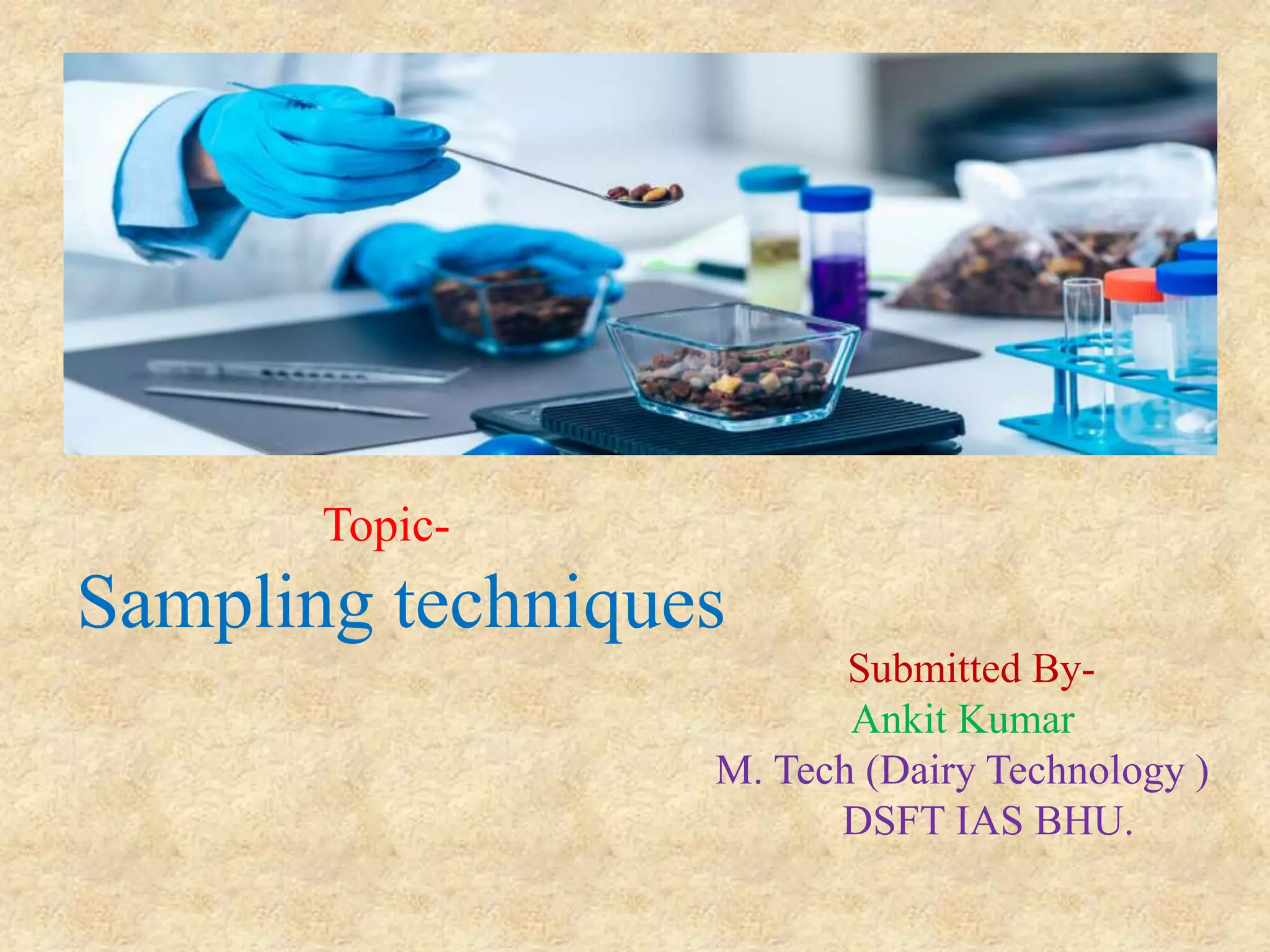
 Food sampling is a process of drawing a sample /a small
portion of food which is a representative of population/lot of a
food for testing ,analysing ,intended to show the nature and
quality of the whole specimen.
 A food sample is normally drawn to check the safety and
standards of the food product
.
 Types of samples – (Generally two types of samples)
1-Legal sample .
2-Surveillance Sample.
Objective of sampling
 Protecting the public health.
 Detecting fraudulent activities.
 Giving customers sufficient information to make informed
choices.
 Ensuring that food standards are maintained.
 Informing the enforcement approach.
 Providing product quality advice to the producer.
 Promoting fair trade and deterring bad practice .
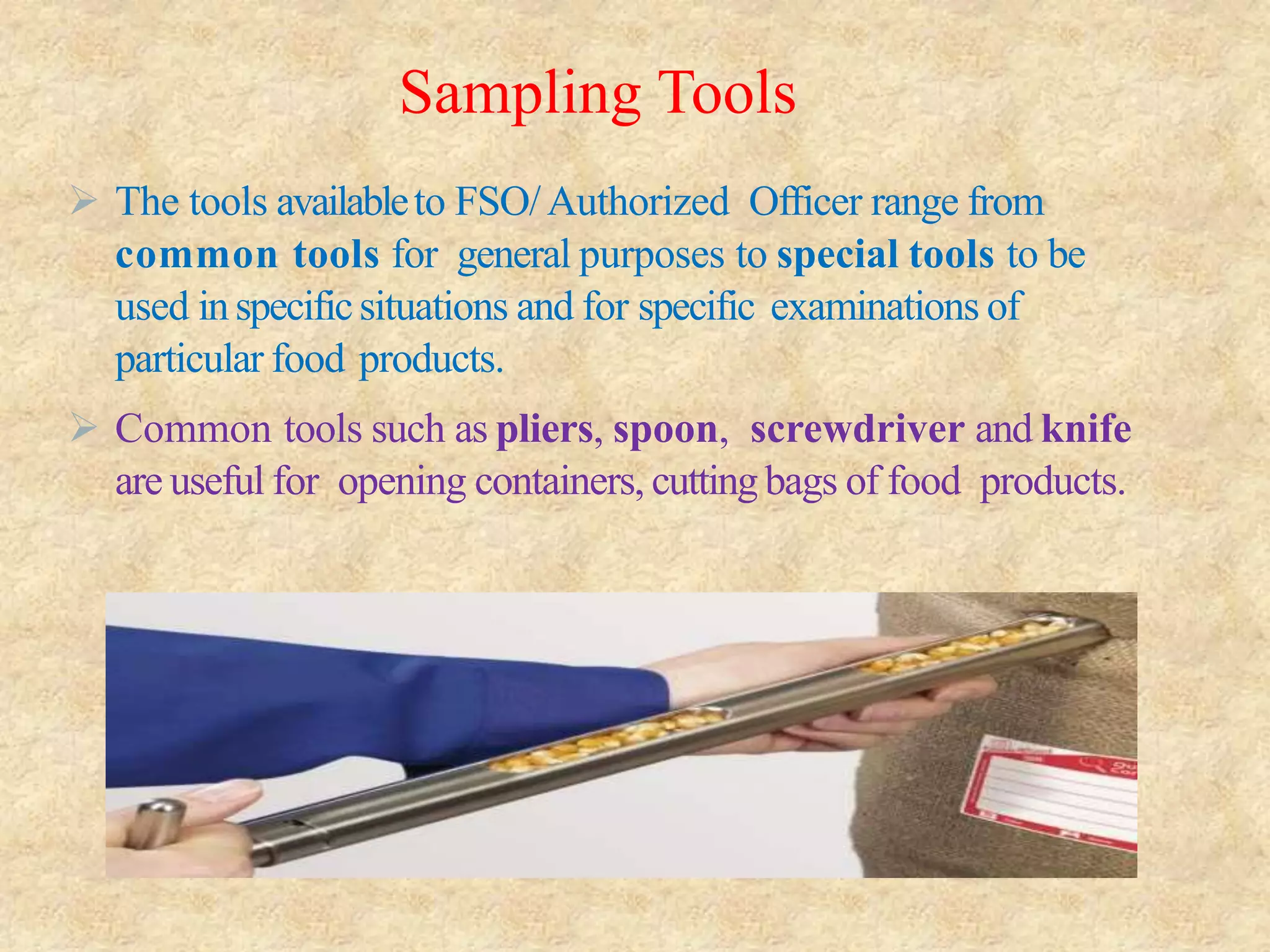
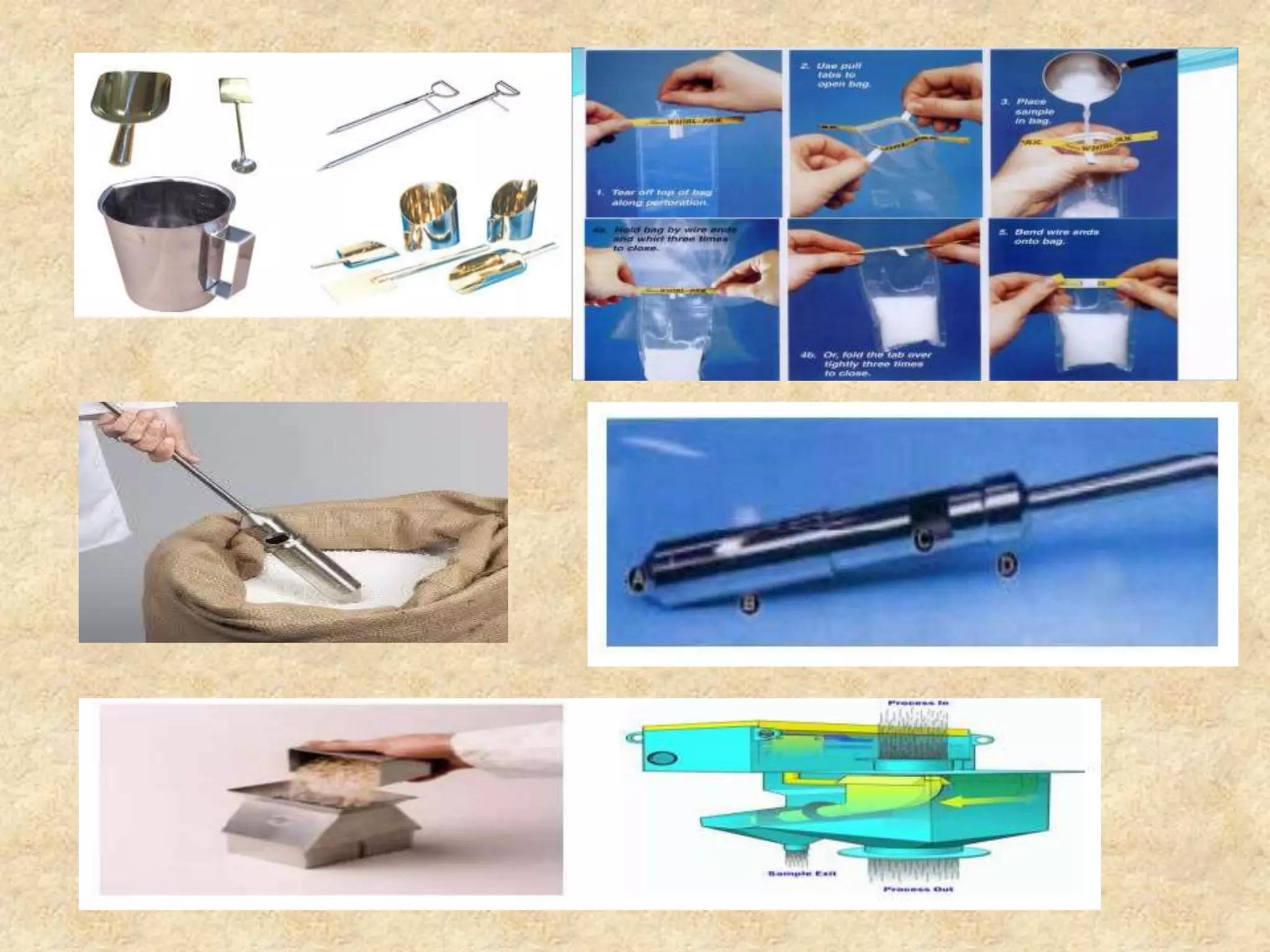
Sampling Tools
 The tools availableto FSO/Authorized Officer range from
common tools for general purposes to special tools to be
used inspecificsituations and for specific examinations of
particular food products.
 Common tools such as pliers, spoon, screwdriver and knife
are useful for opening containers, cutting bags of food products.
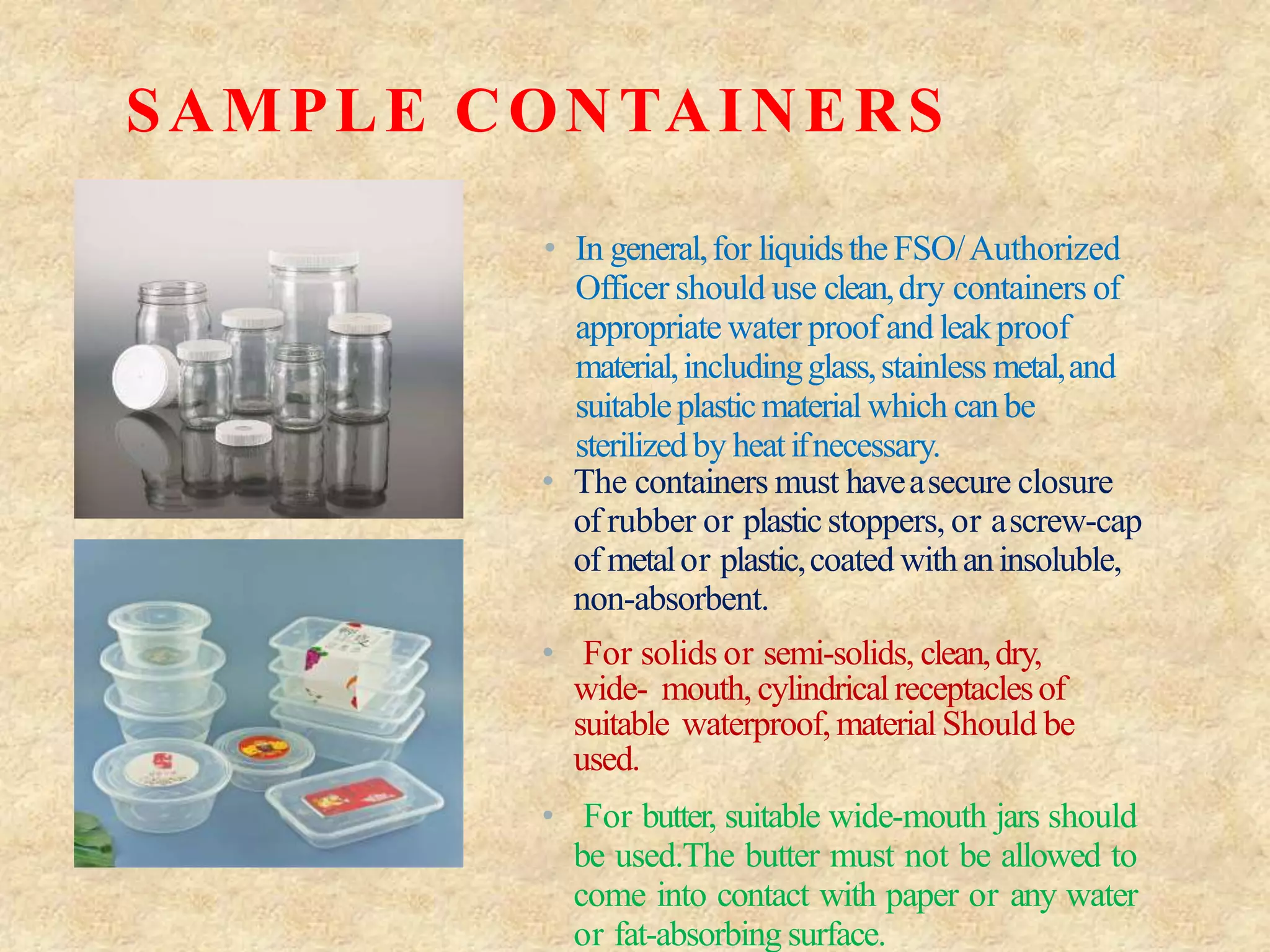
SAMPLE CONTAINERS
• In general,for liquidstheFSO/Authorized
Officer should use clean,dry containers of
appropriate water proof and leakproof
material,includingglass,stainless metal,and
suitableplasticmaterial which canbe
sterilizedby heatifnecessary.
• The containers must haveasecure closure
of rubber or plasticstoppers, or ascrew-cap
of metalor plastic,coated withaninsoluble,
non-absorbent.
• For solids or semi-solids, clean,dry,
wide- mouth, cylindricalreceptaclesof
suitable waterproof,material Should be
used.
• For butter, suitable wide-mouth jars should
be used.The butter must not be allowed to
come into contact with paper or any water
or fat-absorbing surface.
Precautions during sampling
• The condition of thesample receivedfor examination isof primary importance.
• Representativesample isessentialwhen pathogens or toxins aresparsely
distributedwithinthefood.
• The number of units thatcomprise a representativesamplefrom adesignatedlot of a
food product must be statistically significant.
• The proper statistical samplingprocedure, according to whether the food is solid,
semisolid,viscous, or liquid,must be determined by the FSO atthetimeof
sampling.
• Clean,dry,leak-proof,wide-mouthedandsterilecontainers ofasize
suitable for sampleoftheproduct must be used.
• Samplemust besubmittedinoriginal andinsealed condition.
• Dry or cannedfoods thatarenot perishableandarecollectedat ambient
temperatures need not berefrigerated.
• Collect frozensamplesinpre-chilled containers.
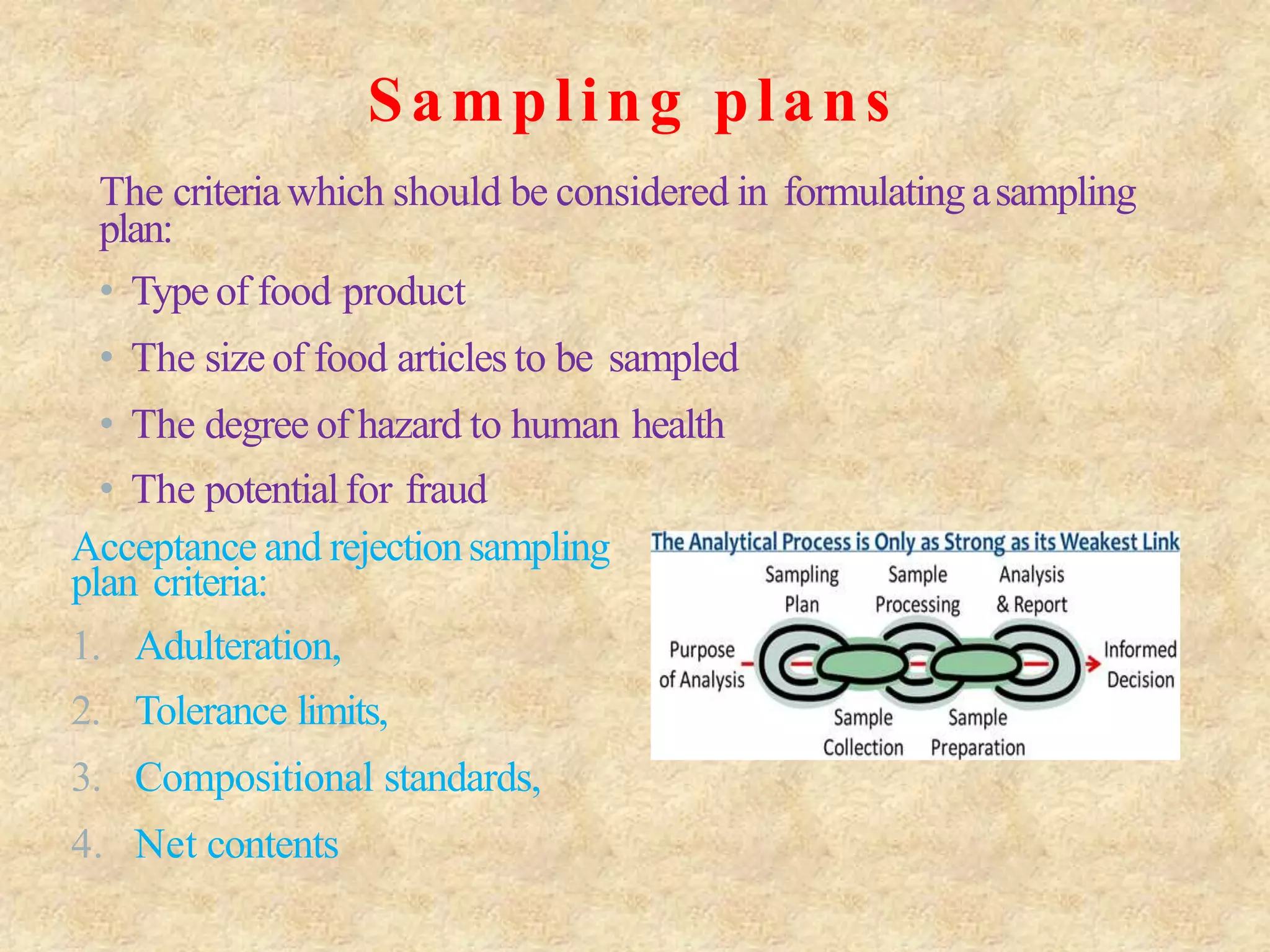
Sampling plans
The criteria which should be considered in formulatingasampling
plan:
• Type of food product
• The size of food articles to be sampled
• The degree of hazard to human health
• The potentialfor fraud
Acceptance and rejectionsampling
plan criteria:
1. Adulteration,
2. Tolerance limits,
3. Compositional standards,
4. Net contents
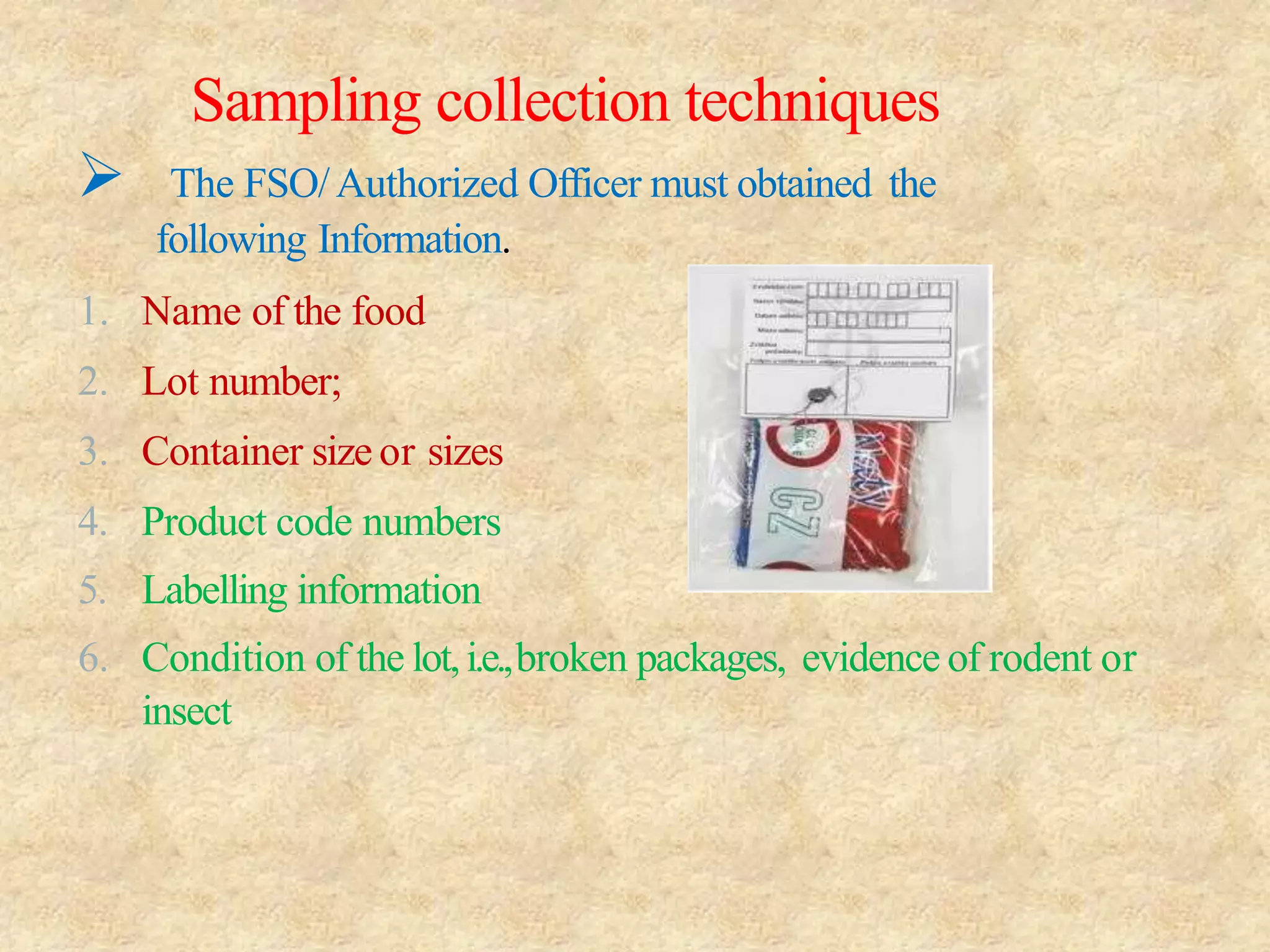
Sampling collection techniques
 The FSO/Authorized Officer must obtained the
following Information.
1. Name of the food
2. Lot number;
3. Container size or sizes
4. Product code numbers
5. Labelling information
6. Condition of the lot,i.e.,broken packages, evidence of rodent or
insect
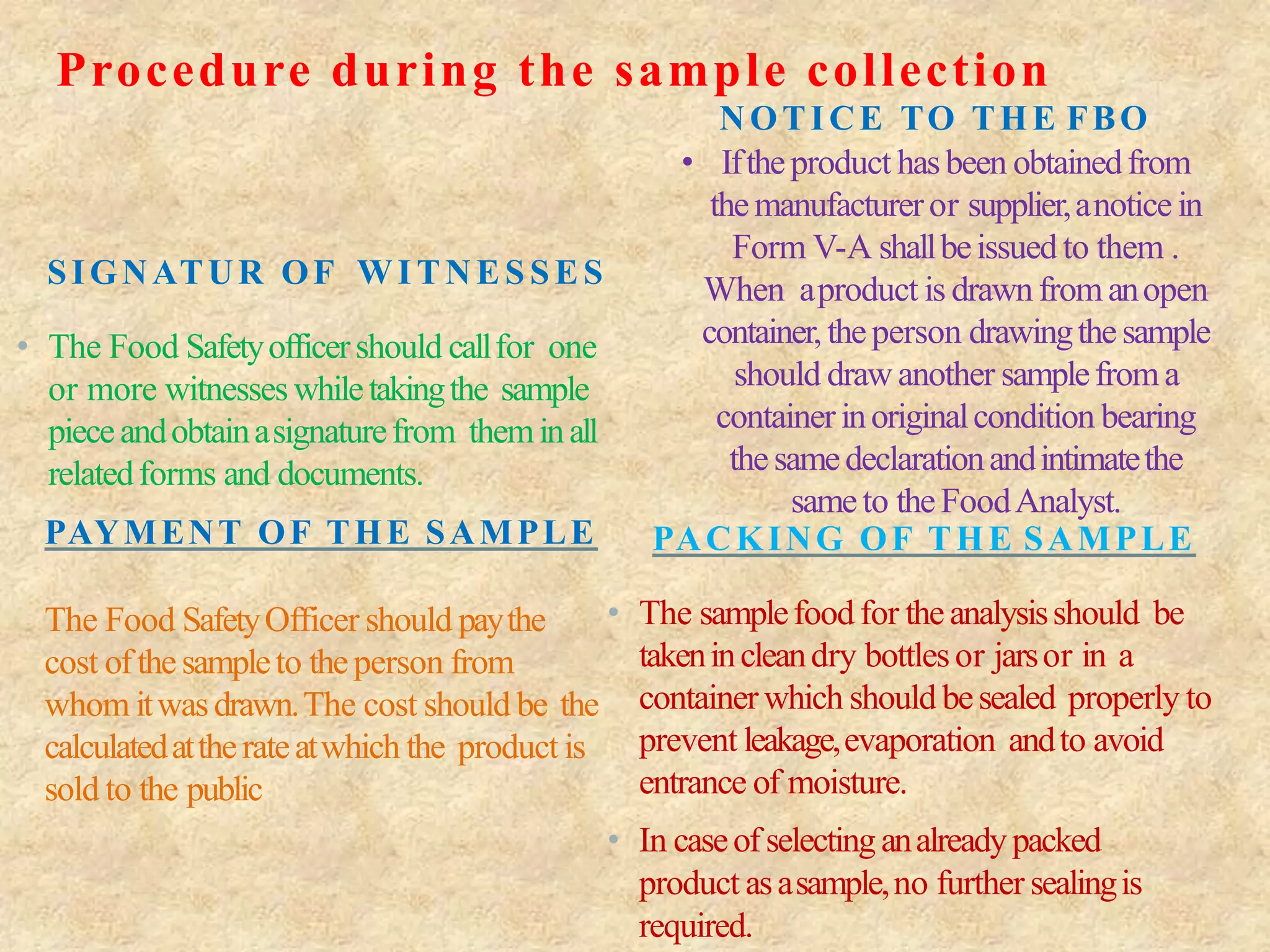
SIGNATUR OF WITNESSES
• The Food Safetyofficershould callfor one
or more witnesses whiletakingthe sample
pieceandobtainasignaturefrom theminall
relatedforms and documents.
NOTICE TO THE FBO
• Iftheproduct hasbeen obtainedfrom
themanufactureror supplier,anotice in
Form V-A shallbeissued to them .
When aproduct is drawnfromanopen
container,theperson drawingthesample
should drawanother samplefroma
containerinoriginalcondition bearing
thesamedeclarationandintimatethe
sameto theFoodAnalyst.
PAYMENT OF THE SAMPLE
The Food SafetyOfficer should paythe
cost ofthesampleto theperson from
whom itwasdrawn.The cost should be the
calculatedattherateatwhich the product is
sold to the public
PACKING OF THE SAMPLE
• The samplefood for theanalysisshould be
takenincleandry bottlesor jarsor in a
containerwhich should besealed properly to
prevent leakage,evaporation andto avoid
entrance of moisture.
• In caseofselectinganalreadypacked
product asasample,no further sealingis
required.
Procedure during the sample collection
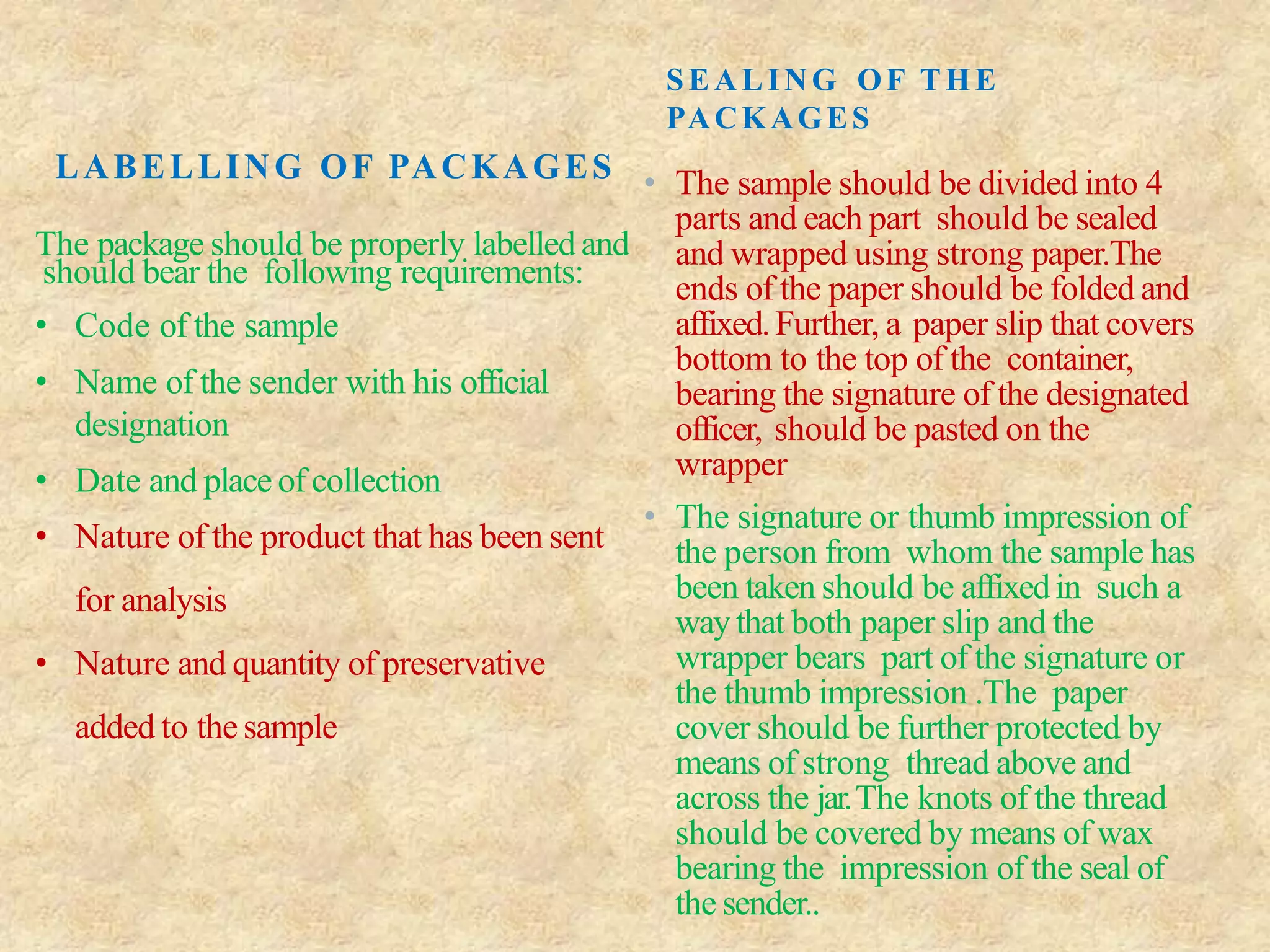
LABELLING OF PACKAGES
The package should be properly labelled and
should bear the following requirements:
• Code of the sample
• Name of the sender with his official
designation
• Date and place of collection
• Nature of the product that has been sent
for analysis
• Nature and quantity of preservative
added to thesample
SEALING OF THE
PACKAGES
• The sample should be divided into 4
parts and each part should be sealed
and wrapped using strong paper.The
ends of the paper should be folded and
affixed.Further, a paper slip that covers
bottom to the top of the container,
bearing the signature of the designated
officer, should be pasted on the
wrapper
• The signature or thumb impression of
the person from whom the sample has
been taken should be affixedin such a
waythat both paper slip and the
wrapper bears part of the signature or
the thumb impression .The paper
cover should be further protected by
means of strong thread above and
across the jar.The knots of the thread
should be covered by means of wax
bearing the impression of the seal of
the sender..
Packing and sealing the
samples
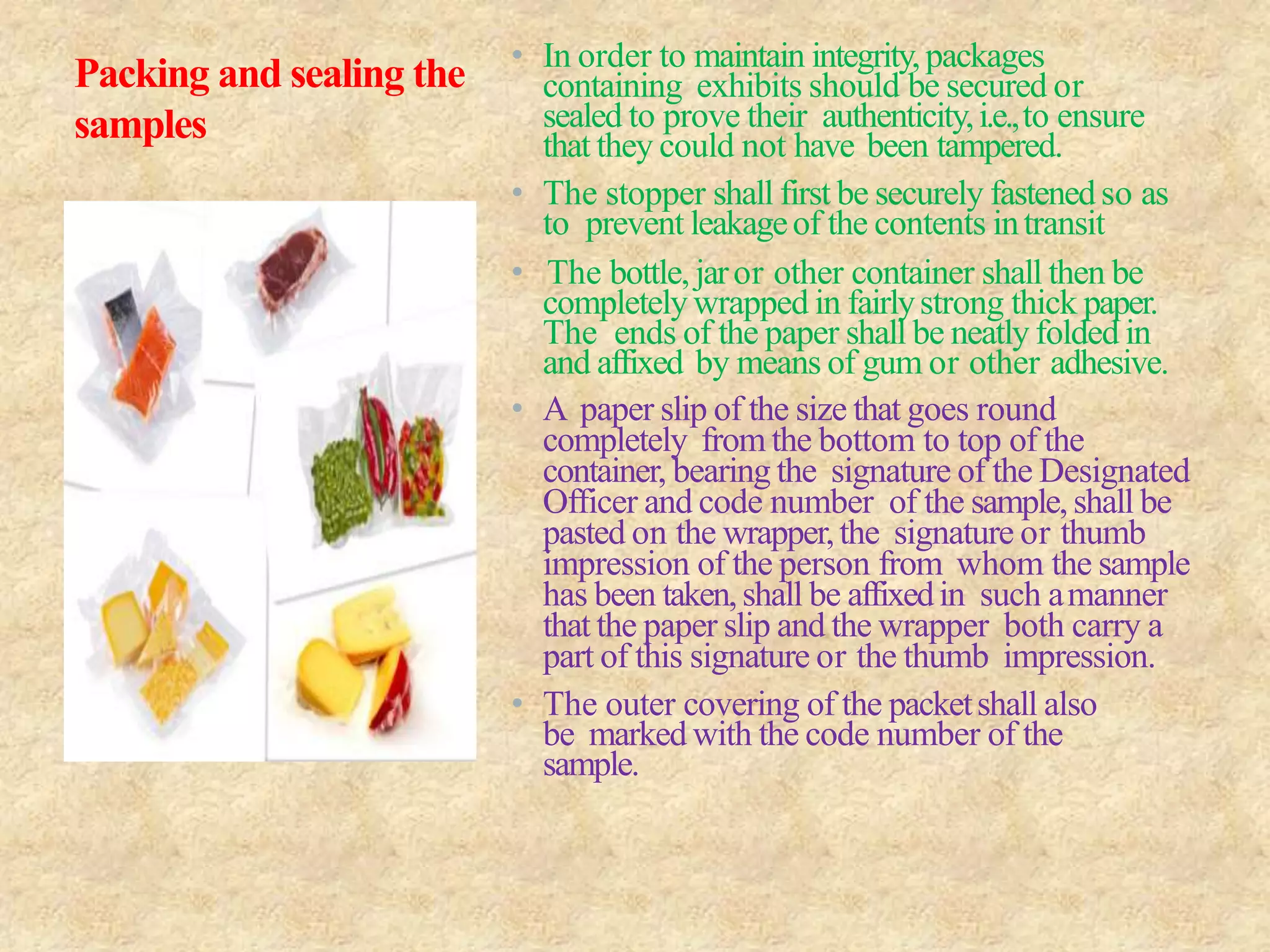
• In order to maintain integrity,packages
containing exhibits should be secured or
sealed to prove their authenticity,i.e.,to ensure
that they could not have been tampered.
• The stopper shall first be securely fastenedso as
to prevent leakageof the contents intransit
• The bottle, jaror other container shall then be
completely wrapped in fairlystrong thick paper.
The ends of the paper shall be neatly folded in
and affixed by means of gum or other adhesive.
• A paper slip of the size that goes round
completely from the bottom to top of the
container, bearing the signature of the Designated
Officer and code number of the sample, shall be
pasted on the wrapper,the signature or thumb
impression of the person from whom the sample
has been taken,shall be affixedin such amanner
that the paper slip and the wrapper both carry a
part of this signature or the thumb impression.
• The outer covering of the packetshall also
be marked with the code number of the
sample.
Dispatch of the sample
• All samples packaged for dispatch must be secured with
shock-absorbing materials to protect them from damage en-
route.
• Samples of frozen foods to be sent overnight maybe packedin
insulatedcartons containing dry icethatwilllastfor that length
of time.
• Ifspecial precautions inhandlingor storing samples are needed,
the FSO/Authorized Officer should ensure thatpersons who
will be handling the samples are informed.
The containers of the samples shallbe dispatched inthe
following manner:
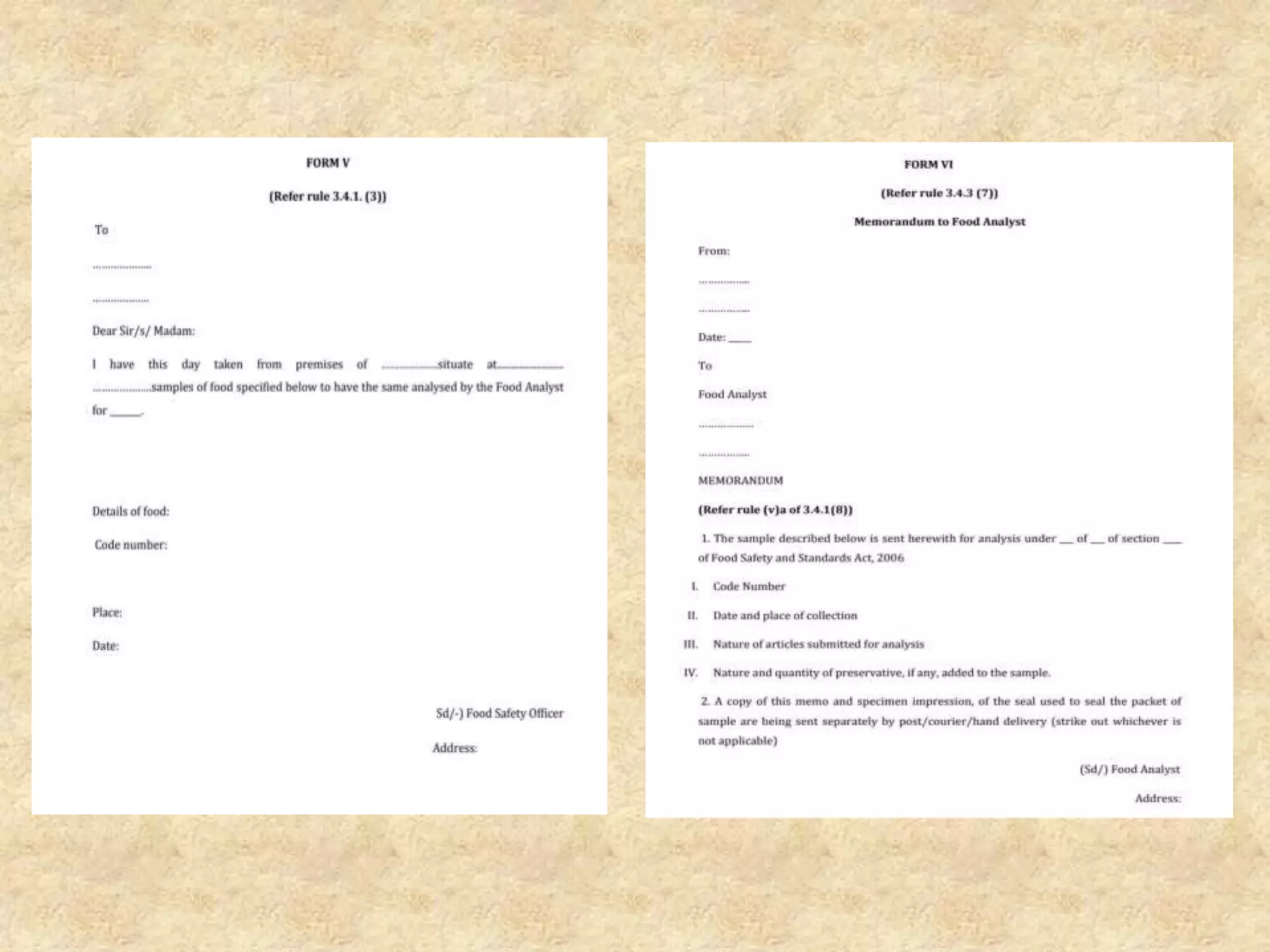
• The sealedcontainer of one part of the samplealongwith the
memorandum in Form VI should be sent to the Food Analyst.
• The second andthird parts of the sample alongwith two copies of
the memorandum inForm VI should be sent to the Designated
Officer.
• The fourth part of the samplealongwith acopy of the
memorandum inForm VI should be sent to anaccredited
laboratory alongwith prescribedfee.
• On receipt of the food sample, the authorized FSSAI lab would
analyze the quality and safety of the sample food product and
pass the final decision.
Sampling report
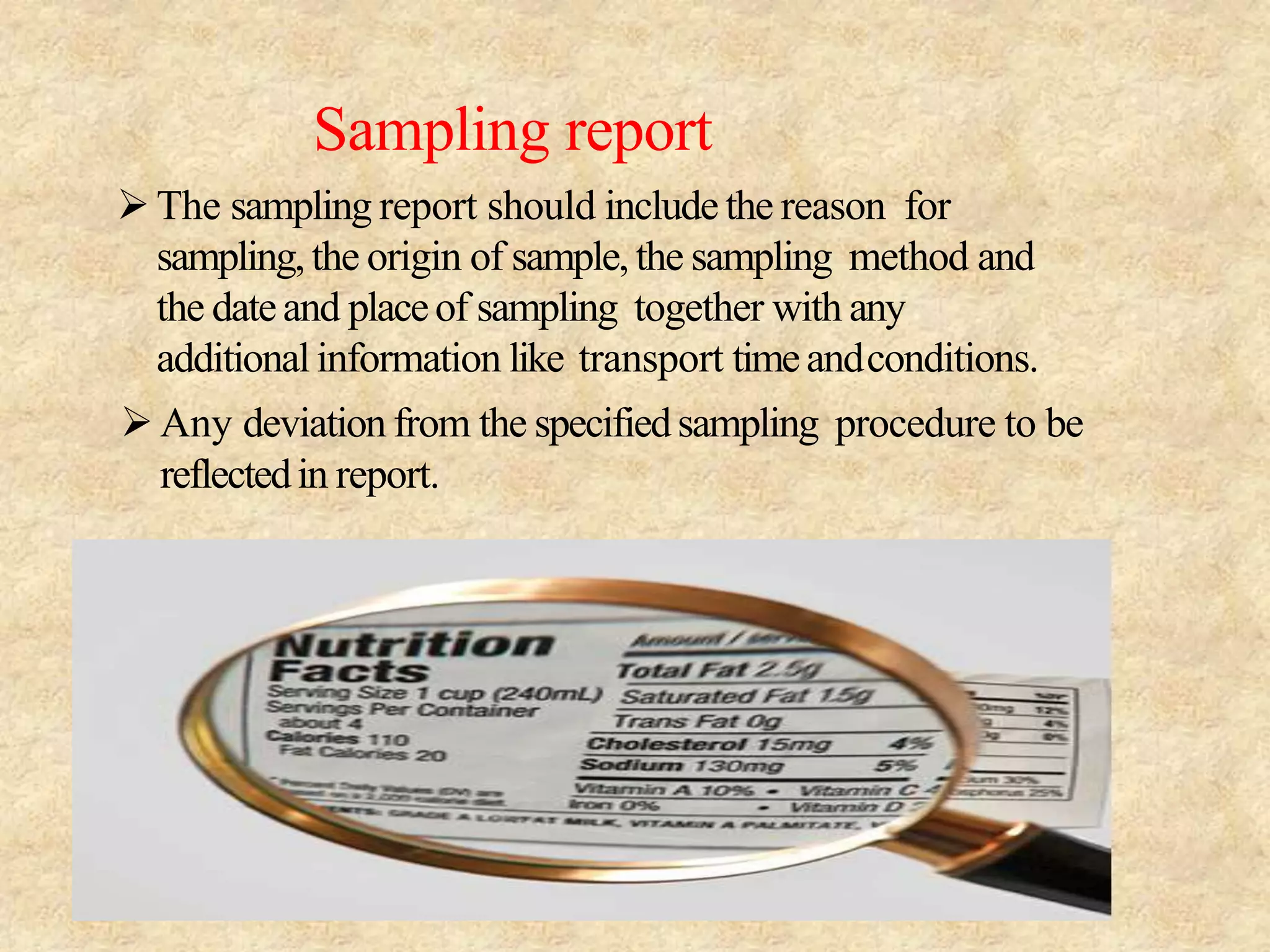
The sampling report should include the reason for
sampling,the origin of sample, the sampling method and
the dateand placeof sampling together with any
additionalinformation like transport timeandconditions.
Any deviation from the specifiedsampling procedure to be
reflectedin report.
Documentation
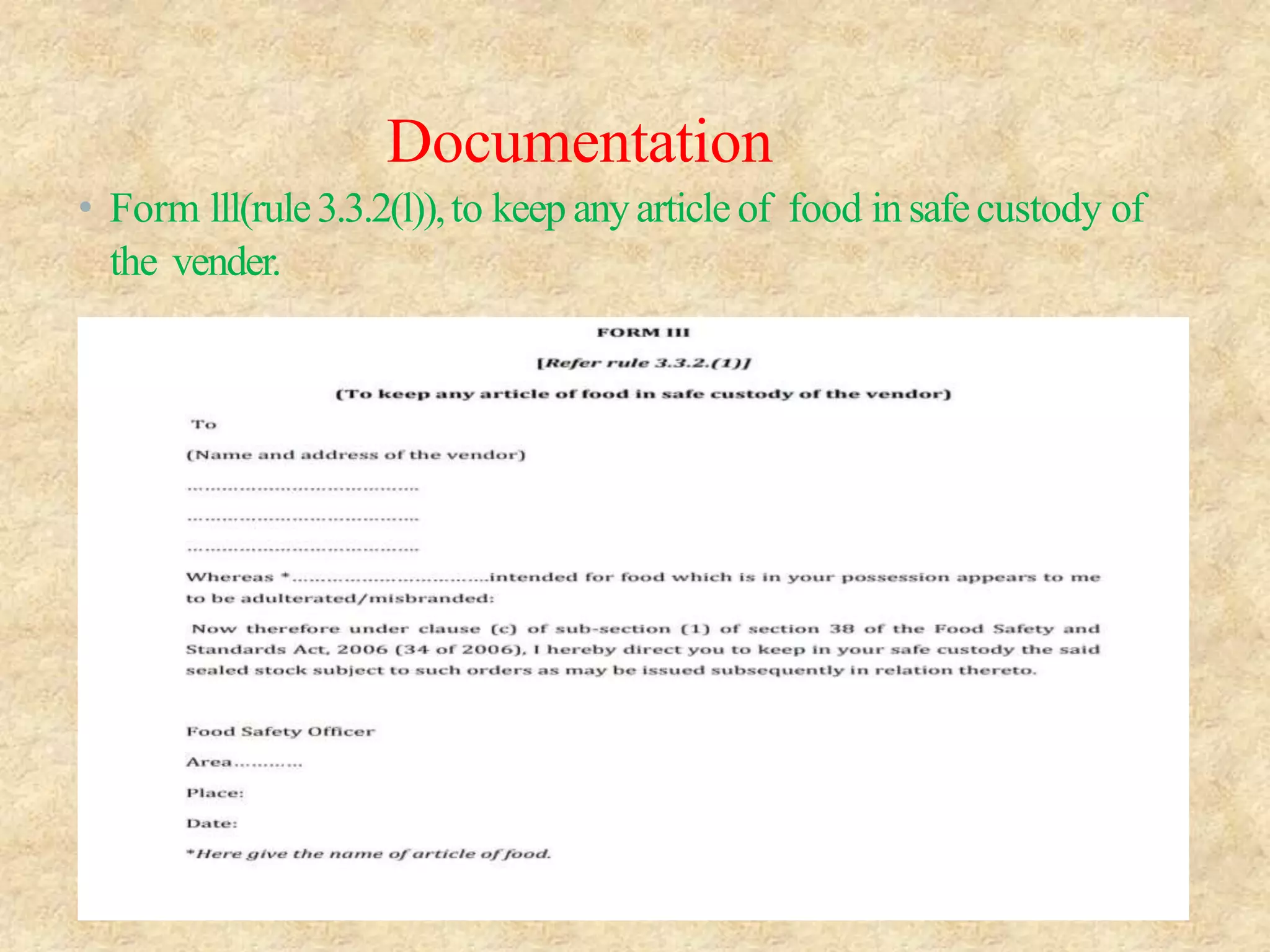
• Form lll(rule3.3.2(l)),to keep anyarticle of food insafecustody of
the vender.
Conclusion
 Sampling helps a lot in surveys and research, where we have to
take a sample from a large population. Different techniques of
Sampling are there to give different types of desired results.
 In this blog, we learned about different Sampling techniques
and how they are used. On the end note, we must keep in mind
that Sampling techniques should be used according to the case
taken, keeping in mind this case we must use the desired
sampling techniques.
References
Whitaker, T.B., 2001. Sampling techniques. Mycotoxin
protocols, pp.11-24.
International Commission on Microbiological Specifications for
Foods. 1986. Microorganisms in Foods. 2. Sampling for
Microbiological Analysis: Principles and Specific Applications,
2nd ed. University of Toronto Press, Toronto, Ontario, Canada.
Food and Drug Administration. 1978. EDRO Data Codes
Manual. Product Codes: Human Foods. FDA, Rockville, MD.
Food and Drug Administration. 1993. Investigations
Operations Manual. FDA, Rockville, MD.
THANKS

Sampling techniques of food

  • 1.
    Topic- Sampling techniques Submitted By- AnkitKumar M. Tech (Dairy Technology ) DSFT IAS BHU.
  • 2.
    Content  What isfood sampling.  Objective of sampling.  Sampling tools.  Sample containers.  Precautions during sampling.  Sampling plan.  Sampling collection techniques.  Procedure during the sample collection.  Quantity of food samples to be collected for analysis.  Packing and sealing the samples.  Dispatch of sample.  Sampling report.  Documentation.  Conclusion.
  • 3.
    What is foodsampling ?  Food sampling is a process of drawing a sample /a small portion of food which is a representative of population/lot of a food for testing ,analysing ,intended to show the nature and quality of the whole specimen.  A food sample is normally drawn to check the safety and standards of the food product .  Types of samples – (Generally two types of samples) 1-Legal sample . 2-Surveillance Sample.
  • 4.
    Objective of sampling Protecting the public health.  Detecting fraudulent activities.  Giving customers sufficient information to make informed choices.  Ensuring that food standards are maintained.  Informing the enforcement approach.  Providing product quality advice to the producer.  Promoting fair trade and deterring bad practice .
  • 5.
    Sampling Tools  Thetools availableto FSO/Authorized Officer range from common tools for general purposes to special tools to be used inspecificsituations and for specific examinations of particular food products.  Common tools such as pliers, spoon, screwdriver and knife are useful for opening containers, cutting bags of food products.
  • 7.
    SAMPLE CONTAINERS • Ingeneral,for liquidstheFSO/Authorized Officer should use clean,dry containers of appropriate water proof and leakproof material,includingglass,stainless metal,and suitableplasticmaterial which canbe sterilizedby heatifnecessary. • The containers must haveasecure closure of rubber or plasticstoppers, or ascrew-cap of metalor plastic,coated withaninsoluble, non-absorbent. • For solids or semi-solids, clean,dry, wide- mouth, cylindricalreceptaclesof suitable waterproof,material Should be used. • For butter, suitable wide-mouth jars should be used.The butter must not be allowed to come into contact with paper or any water or fat-absorbing surface.
  • 8.
    Precautions during sampling •The condition of thesample receivedfor examination isof primary importance. • Representativesample isessentialwhen pathogens or toxins aresparsely distributedwithinthefood. • The number of units thatcomprise a representativesamplefrom adesignatedlot of a food product must be statistically significant. • The proper statistical samplingprocedure, according to whether the food is solid, semisolid,viscous, or liquid,must be determined by the FSO atthetimeof sampling. • Clean,dry,leak-proof,wide-mouthedandsterilecontainers ofasize suitable for sampleoftheproduct must be used. • Samplemust besubmittedinoriginal andinsealed condition. • Dry or cannedfoods thatarenot perishableandarecollectedat ambient temperatures need not berefrigerated. • Collect frozensamplesinpre-chilled containers.
  • 9.
    Sampling plans The criteriawhich should be considered in formulatingasampling plan: • Type of food product • The size of food articles to be sampled • The degree of hazard to human health • The potentialfor fraud Acceptance and rejectionsampling plan criteria: 1. Adulteration, 2. Tolerance limits, 3. Compositional standards, 4. Net contents
  • 10.
    Sampling collection techniques The FSO/Authorized Officer must obtained the following Information. 1. Name of the food 2. Lot number; 3. Container size or sizes 4. Product code numbers 5. Labelling information 6. Condition of the lot,i.e.,broken packages, evidence of rodent or insect
  • 11.
    SIGNATUR OF WITNESSES •The Food Safetyofficershould callfor one or more witnesses whiletakingthe sample pieceandobtainasignaturefrom theminall relatedforms and documents. NOTICE TO THE FBO • Iftheproduct hasbeen obtainedfrom themanufactureror supplier,anotice in Form V-A shallbeissued to them . When aproduct is drawnfromanopen container,theperson drawingthesample should drawanother samplefroma containerinoriginalcondition bearing thesamedeclarationandintimatethe sameto theFoodAnalyst. PAYMENT OF THE SAMPLE The Food SafetyOfficer should paythe cost ofthesampleto theperson from whom itwasdrawn.The cost should be the calculatedattherateatwhich the product is sold to the public PACKING OF THE SAMPLE • The samplefood for theanalysisshould be takenincleandry bottlesor jarsor in a containerwhich should besealed properly to prevent leakage,evaporation andto avoid entrance of moisture. • In caseofselectinganalreadypacked product asasample,no further sealingis required. Procedure during the sample collection
  • 12.
    LABELLING OF PACKAGES Thepackage should be properly labelled and should bear the following requirements: • Code of the sample • Name of the sender with his official designation • Date and place of collection • Nature of the product that has been sent for analysis • Nature and quantity of preservative added to thesample SEALING OF THE PACKAGES • The sample should be divided into 4 parts and each part should be sealed and wrapped using strong paper.The ends of the paper should be folded and affixed.Further, a paper slip that covers bottom to the top of the container, bearing the signature of the designated officer, should be pasted on the wrapper • The signature or thumb impression of the person from whom the sample has been taken should be affixedin such a waythat both paper slip and the wrapper bears part of the signature or the thumb impression .The paper cover should be further protected by means of strong thread above and across the jar.The knots of the thread should be covered by means of wax bearing the impression of the seal of the sender..
  • 15.
    Packing and sealingthe samples • In order to maintain integrity,packages containing exhibits should be secured or sealed to prove their authenticity,i.e.,to ensure that they could not have been tampered. • The stopper shall first be securely fastenedso as to prevent leakageof the contents intransit • The bottle, jaror other container shall then be completely wrapped in fairlystrong thick paper. The ends of the paper shall be neatly folded in and affixed by means of gum or other adhesive. • A paper slip of the size that goes round completely from the bottom to top of the container, bearing the signature of the Designated Officer and code number of the sample, shall be pasted on the wrapper,the signature or thumb impression of the person from whom the sample has been taken,shall be affixedin such amanner that the paper slip and the wrapper both carry a part of this signature or the thumb impression. • The outer covering of the packetshall also be marked with the code number of the sample.
  • 16.
    Dispatch of thesample • All samples packaged for dispatch must be secured with shock-absorbing materials to protect them from damage en- route. • Samples of frozen foods to be sent overnight maybe packedin insulatedcartons containing dry icethatwilllastfor that length of time. • Ifspecial precautions inhandlingor storing samples are needed, the FSO/Authorized Officer should ensure thatpersons who will be handling the samples are informed.
  • 17.
    The containers ofthe samples shallbe dispatched inthe following manner: • The sealedcontainer of one part of the samplealongwith the memorandum in Form VI should be sent to the Food Analyst. • The second andthird parts of the sample alongwith two copies of the memorandum inForm VI should be sent to the Designated Officer. • The fourth part of the samplealongwith acopy of the memorandum inForm VI should be sent to anaccredited laboratory alongwith prescribedfee. • On receipt of the food sample, the authorized FSSAI lab would analyze the quality and safety of the sample food product and pass the final decision.
  • 18.
    Sampling report The samplingreport should include the reason for sampling,the origin of sample, the sampling method and the dateand placeof sampling together with any additionalinformation like transport timeandconditions. Any deviation from the specifiedsampling procedure to be reflectedin report.
  • 19.
    Documentation • Form lll(rule3.3.2(l)),tokeep anyarticle of food insafecustody of the vender.
  • 21.
    Conclusion  Sampling helpsa lot in surveys and research, where we have to take a sample from a large population. Different techniques of Sampling are there to give different types of desired results.  In this blog, we learned about different Sampling techniques and how they are used. On the end note, we must keep in mind that Sampling techniques should be used according to the case taken, keeping in mind this case we must use the desired sampling techniques.
  • 22.
    References Whitaker, T.B., 2001.Sampling techniques. Mycotoxin protocols, pp.11-24. International Commission on Microbiological Specifications for Foods. 1986. Microorganisms in Foods. 2. Sampling for Microbiological Analysis: Principles and Specific Applications, 2nd ed. University of Toronto Press, Toronto, Ontario, Canada. Food and Drug Administration. 1978. EDRO Data Codes Manual. Product Codes: Human Foods. FDA, Rockville, MD. Food and Drug Administration. 1993. Investigations Operations Manual. FDA, Rockville, MD.
  • 23.