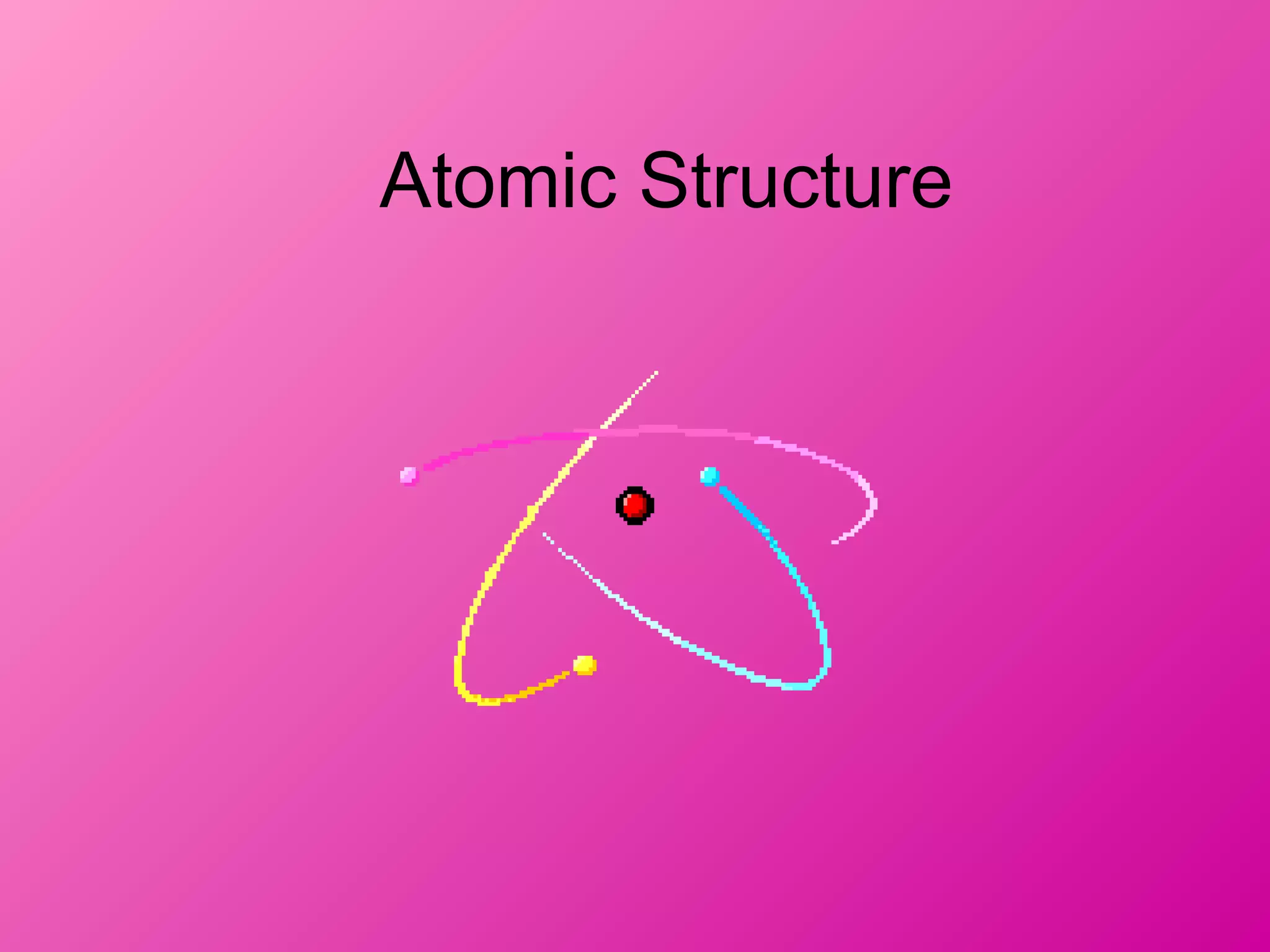
Atomic Structure
What are the 3 major parts of an
atom?
What are the 3 major parts of an
atom?
• Proton
• Neutron
• Electron
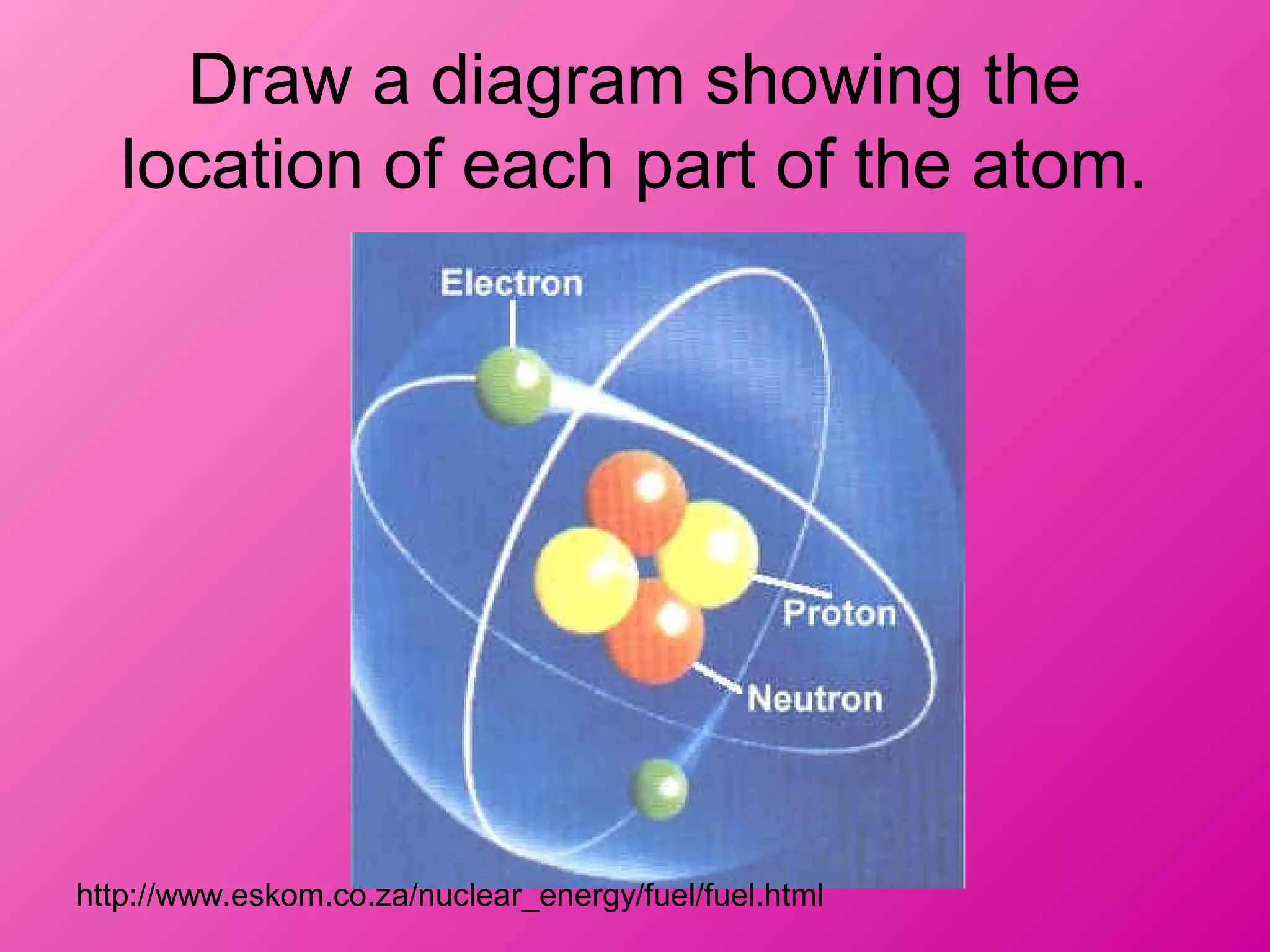
Draw a diagram showing the
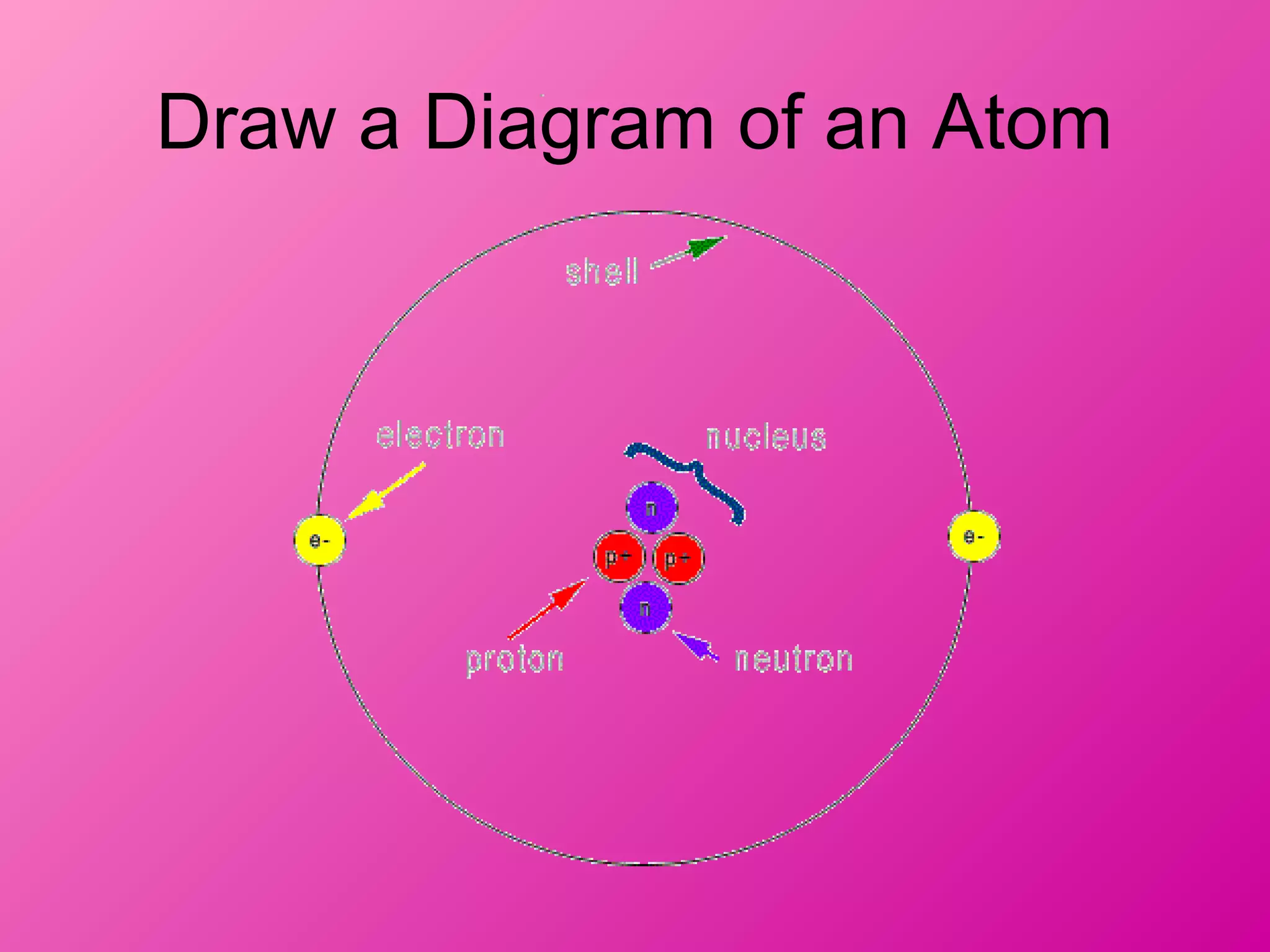
location of each part of the atom.
Draw a diagram showing the
location of each part of the atom.
http://www.eskom.co.za/nuclear_energy/fuel/fuel.html
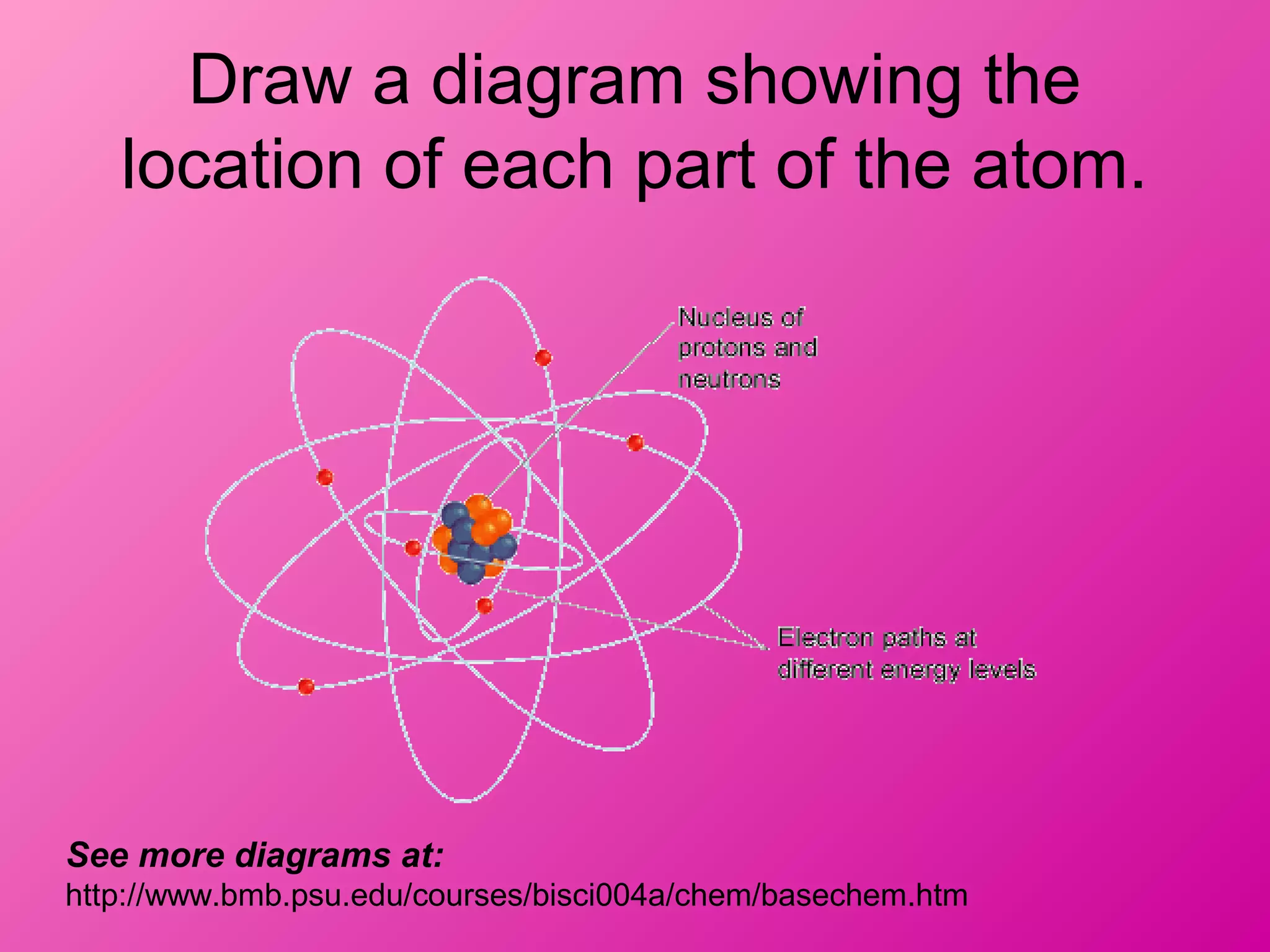
Draw a diagram showing the
location of each part of the atom.
See more diagrams at:
http://www.bmb.psu.edu/courses/bisci004a/chem/basechem.htm
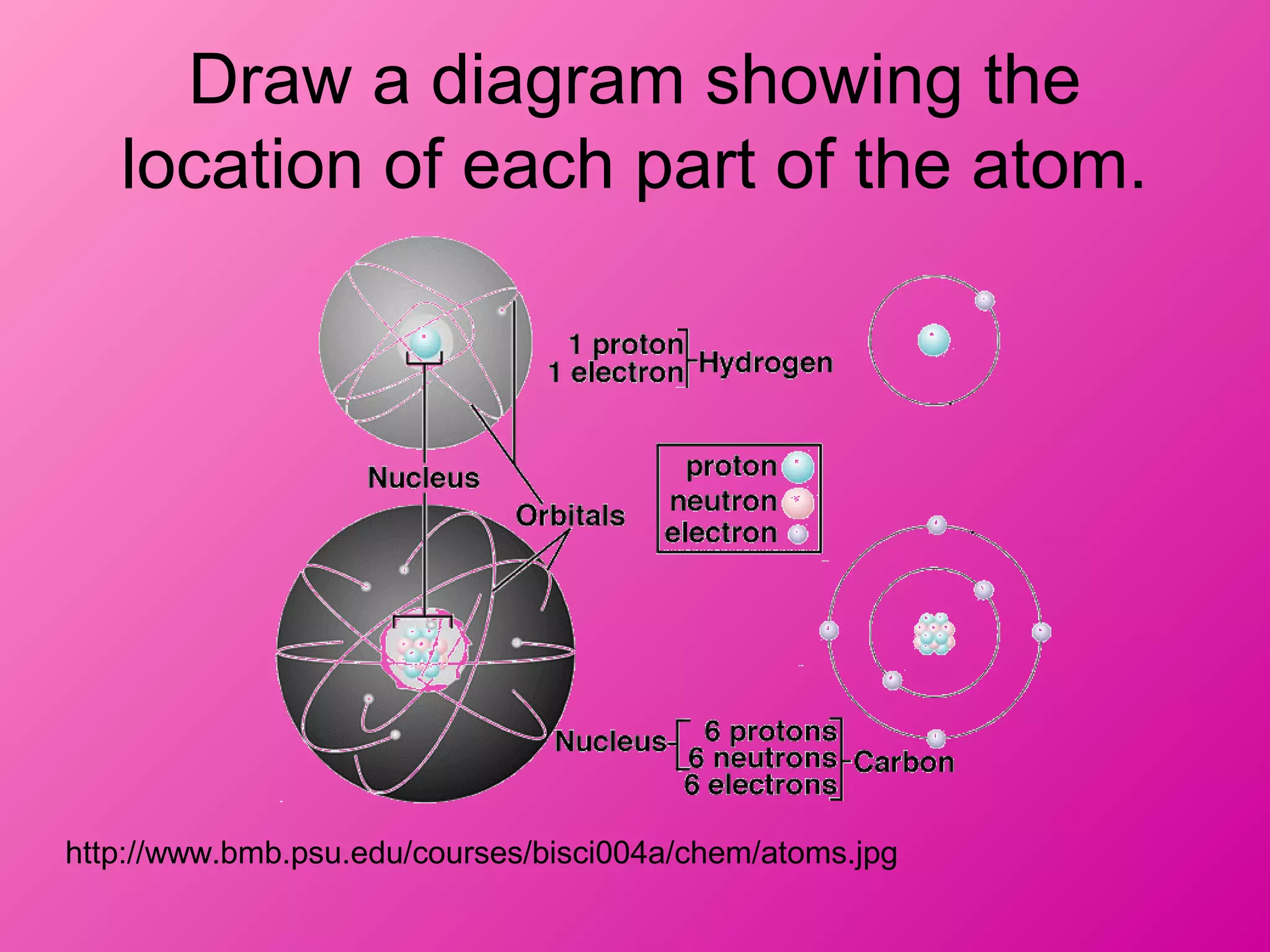
Draw a diagram showing the
location of each part of the atom.
http://www.bmb.psu.edu/courses/bisci004a/chem/atoms.jpg
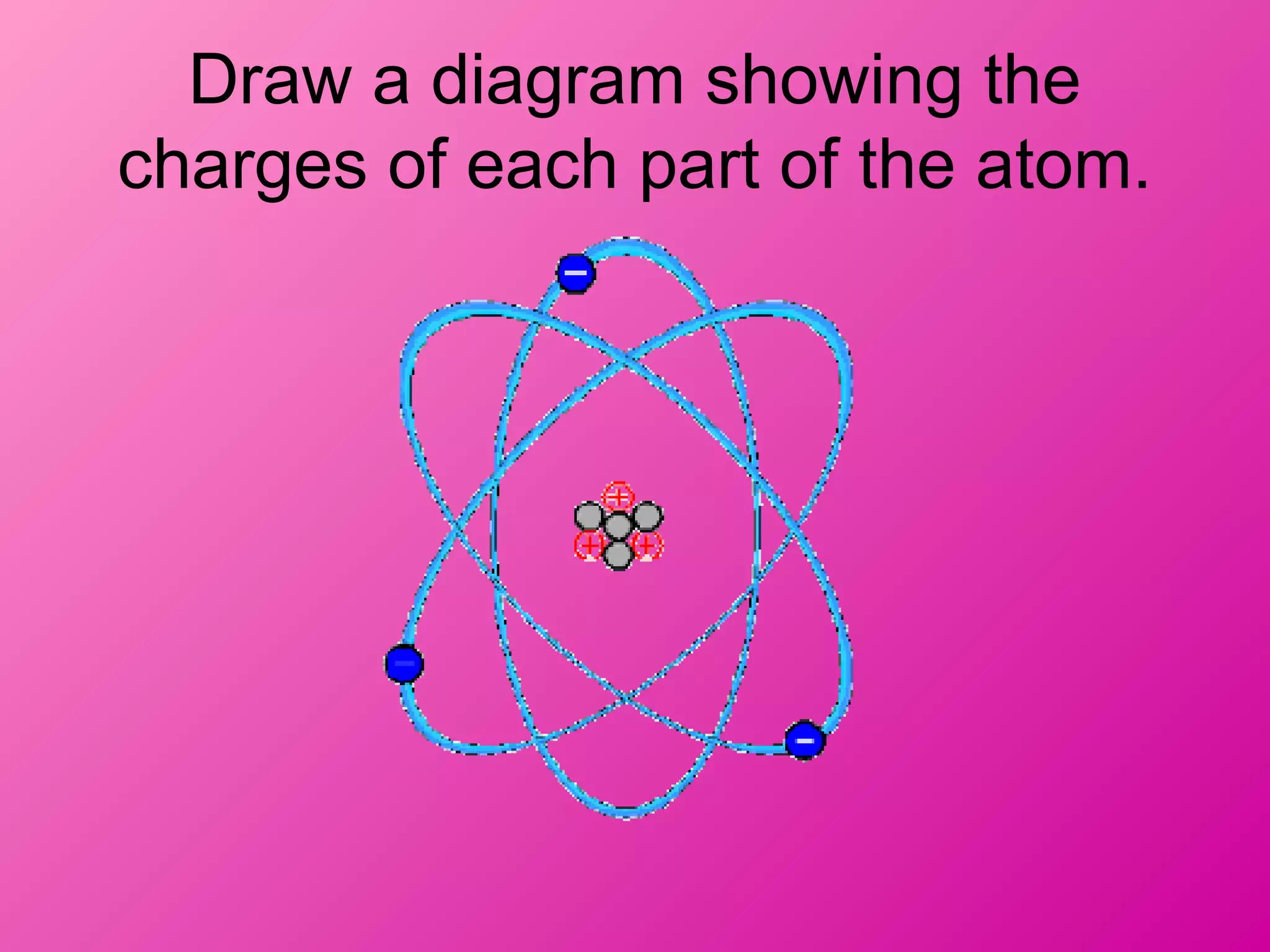
Draw a diagram showing the
charges of each part of the atom.
Draw a Diagram of an Atom
Draw a diagram showing the
charges of each part of the atom.
Describe Proton
• Protons are positively charged particles
found in the atomic nucleus. Protons were
discovered by Ernest Rutherford..
• Experiments done in the late 1960's and
early 1970's showed that protons are
made from other particles called quarks.
Protons are made from two 'up' quarks
and one 'down' quark.
Describe Neutron
• Neutrons are uncharged particles found in
the atomic nucleus. Neutrons were
discovered by James Chadwick in 1932.
• Experiments done in the late 1960's and
early 1970's showed that neutrons are
made from other particles called quarks.
Neutrons are made from one 'up' quark
and two 'down' quarks.
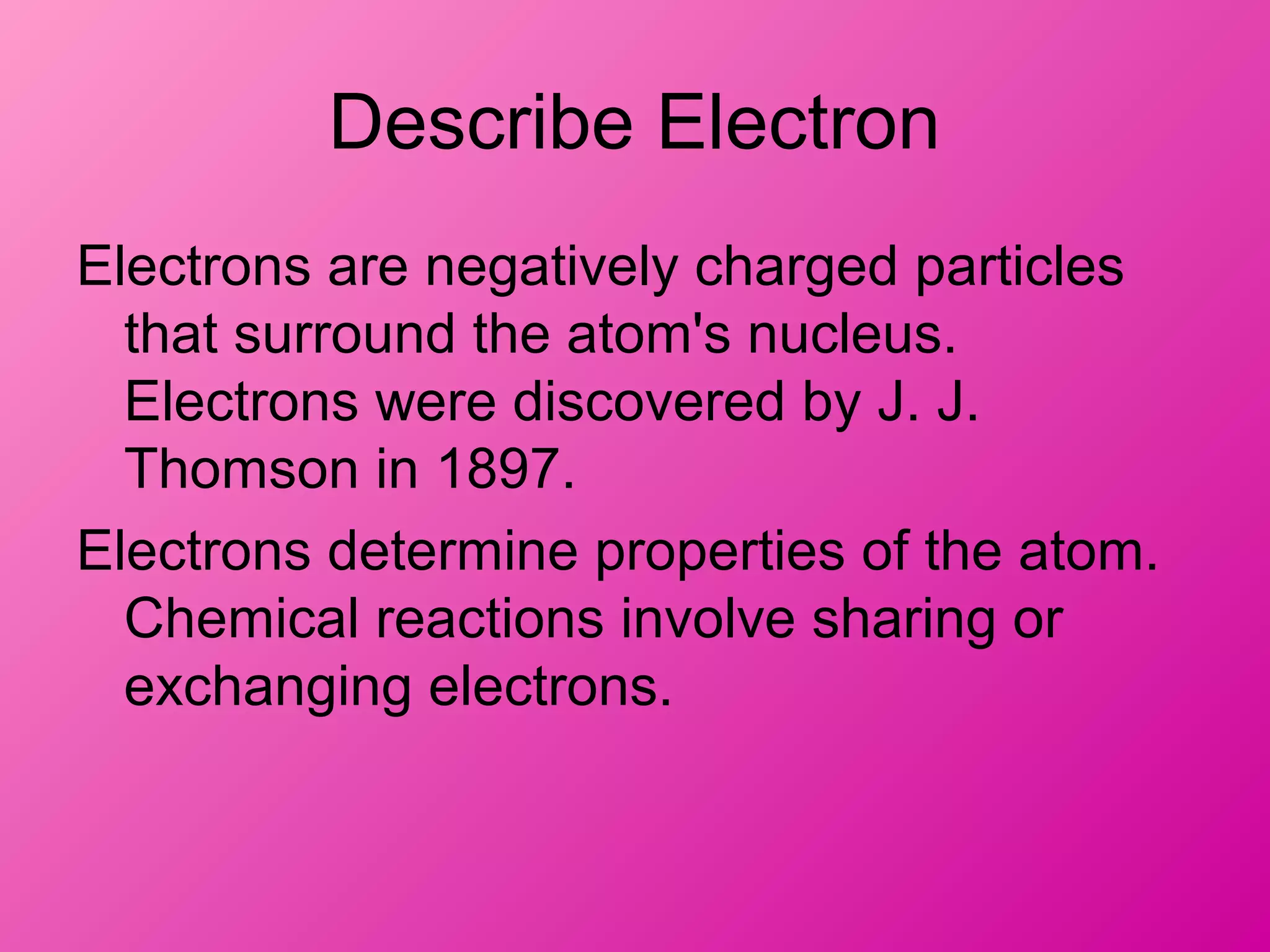
Describe Electron
Electrons are negatively charged particles
that surround the atom's nucleus.
Electrons were discovered by J. J.
Thomson in 1897.
Electrons determine properties of the atom.
Chemical reactions involve sharing or
exchanging electrons.
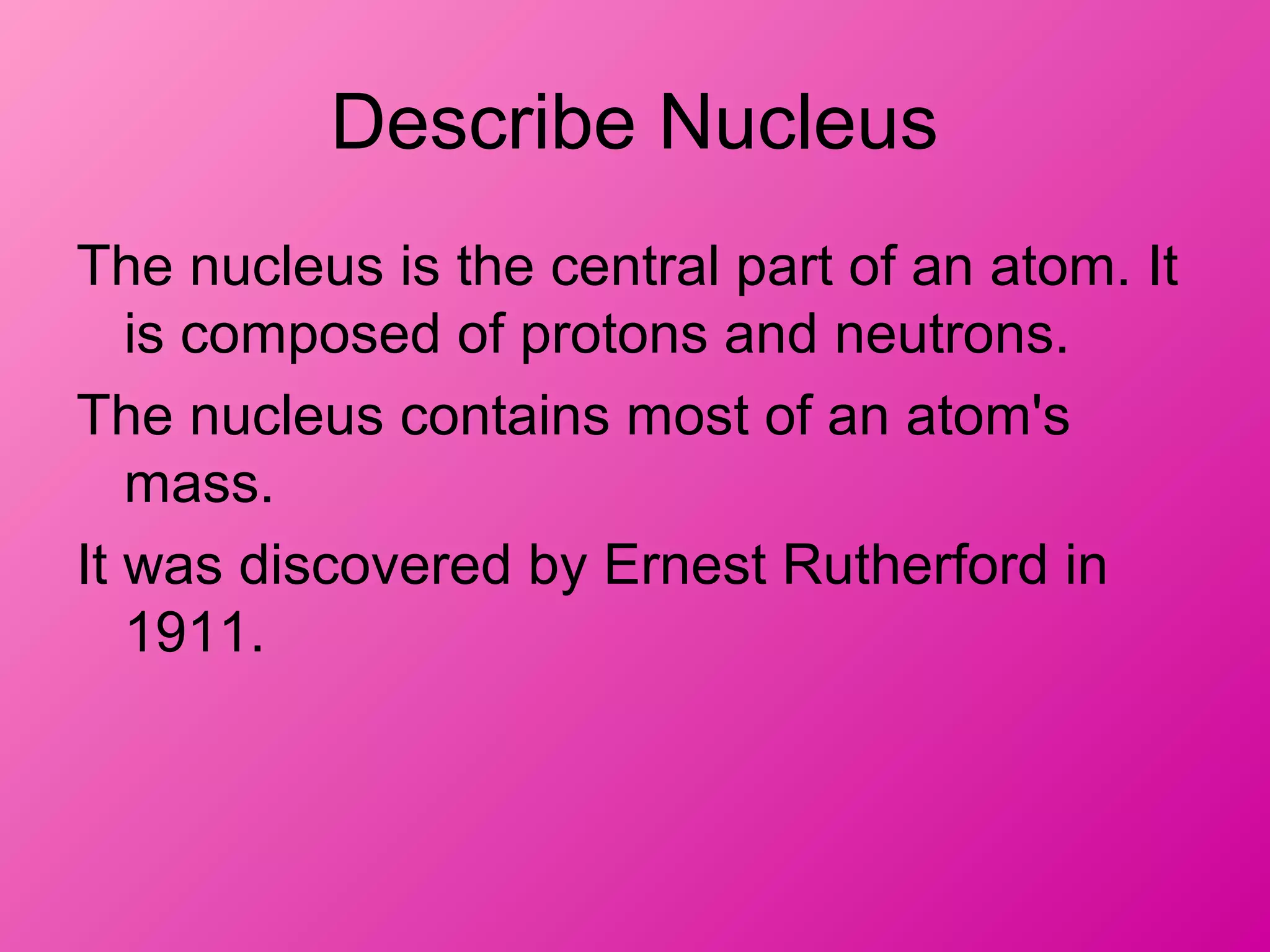
Describe Nucleus
The nucleus is the central part of an atom. It
is composed of protons and neutrons.
The nucleus contains most of an atom's
mass.
It was discovered by Ernest Rutherford in
1911.
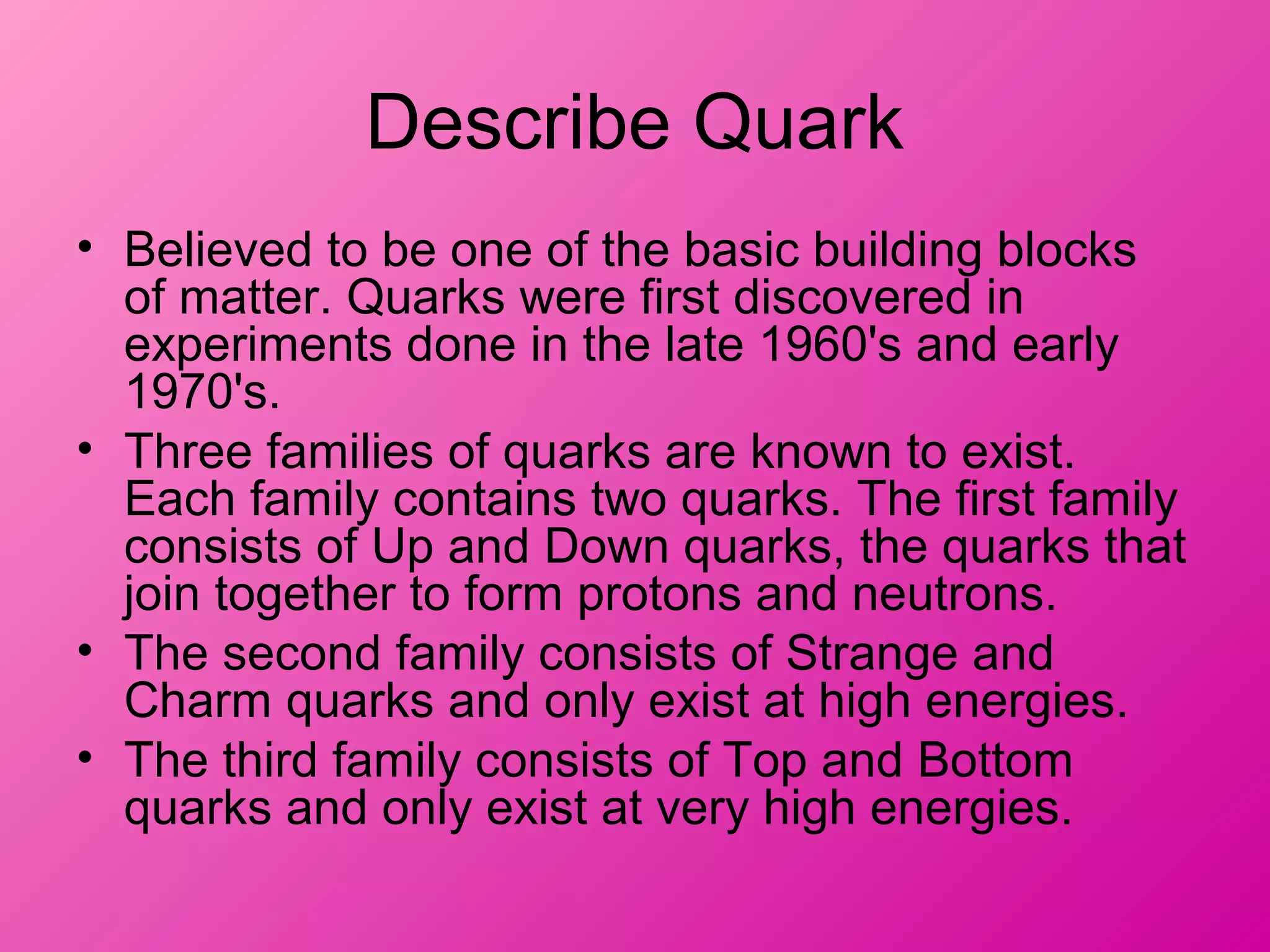
Describe Quark
• Believed to be one of the basic building blocks
of matter. Quarks were first discovered in
experiments done in the late 1960's and early
1970's.
• Three families of quarks are known to exist.
Each family contains two quarks. The first family
consists of Up and Down quarks, the quarks that
join together to form protons and neutrons.
• The second family consists of Strange and
Charm quarks and only exist at high energies.
• The third family consists of Top and Bottom
quarks and only exist at very high energies.
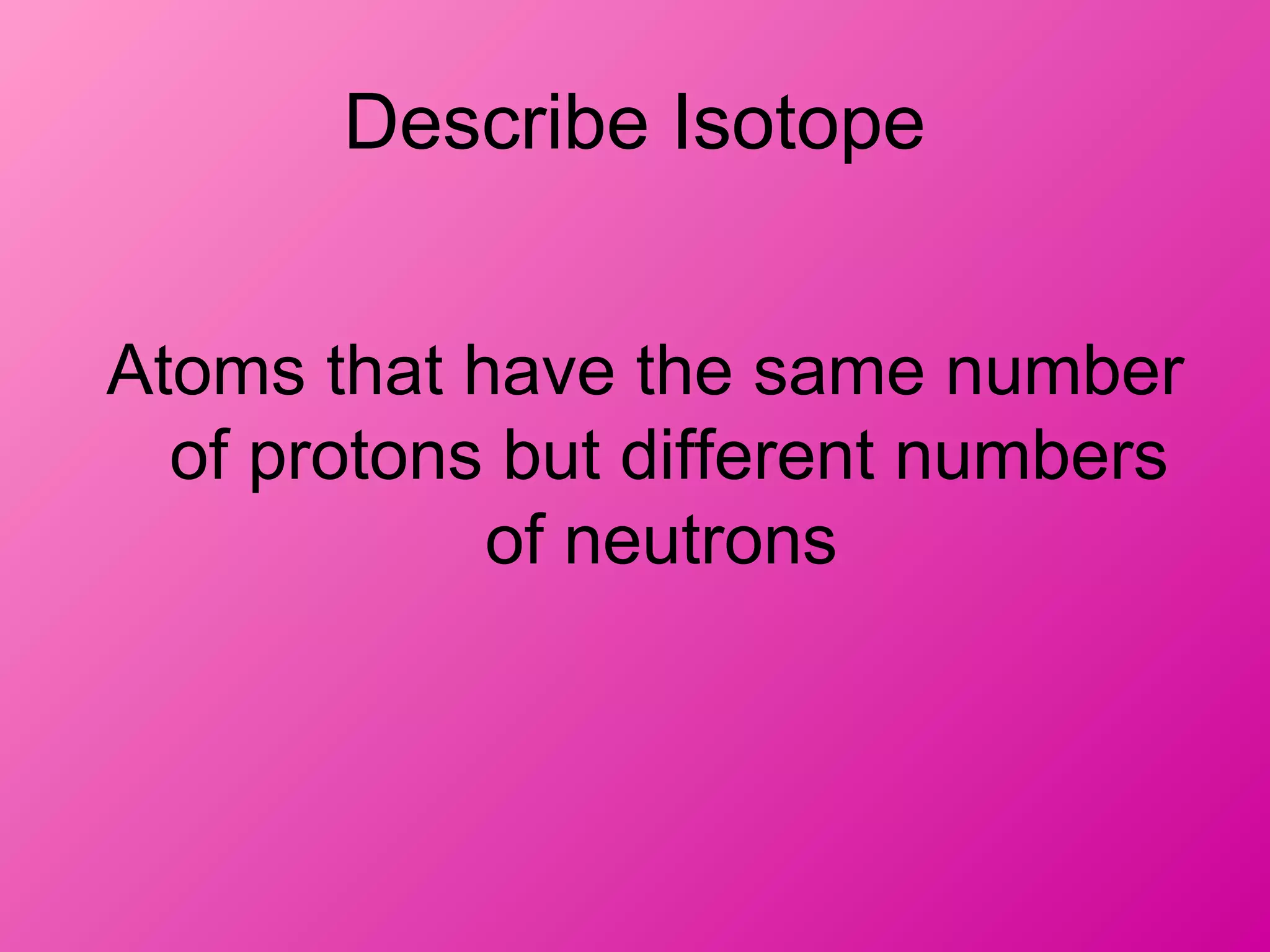
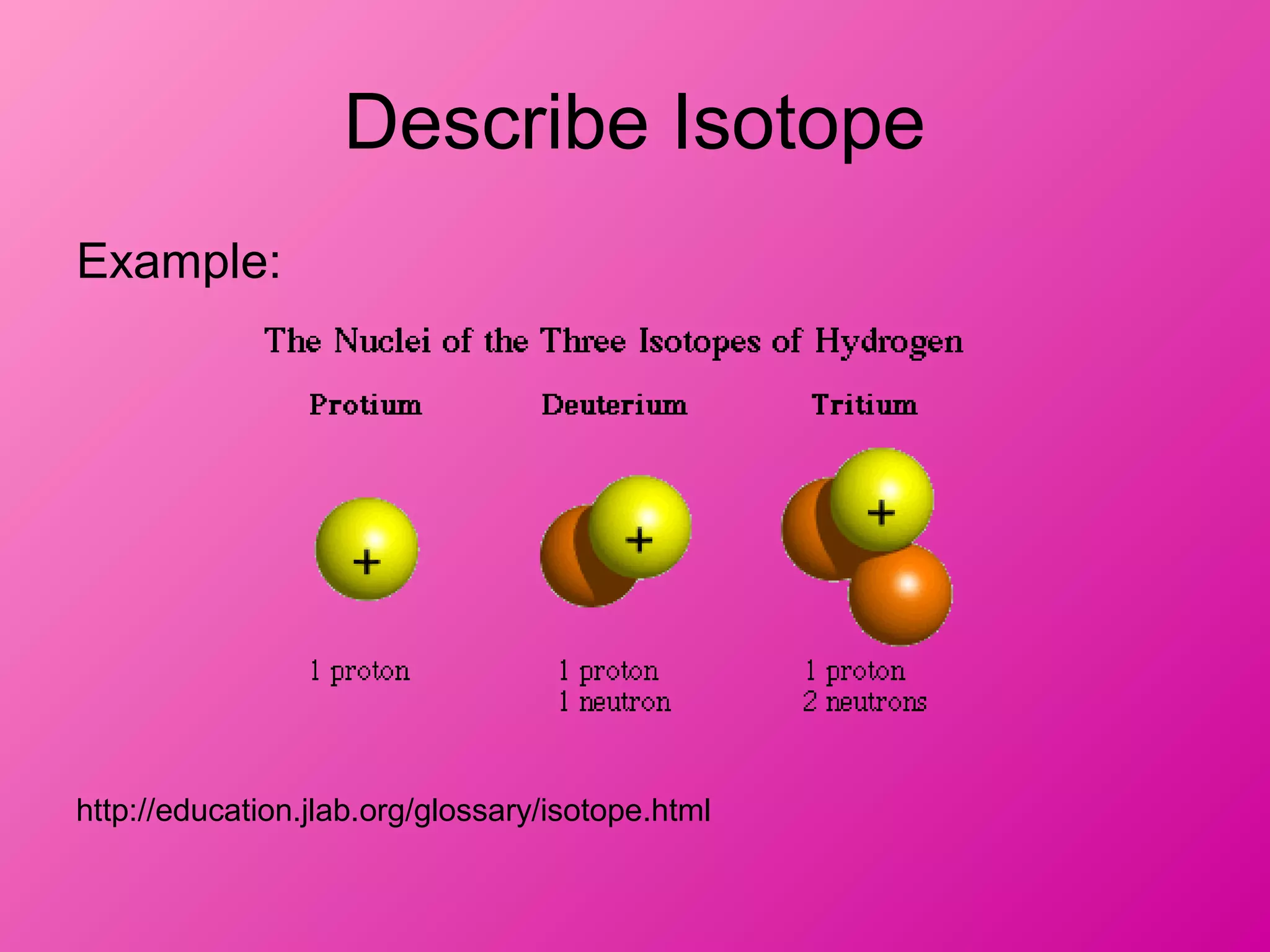
Describe Isotope
Atoms that have the same number
of protons but different numbers
of neutrons
Describe Isotope
Example:
http://education.jlab.org/glossary/isotope.html
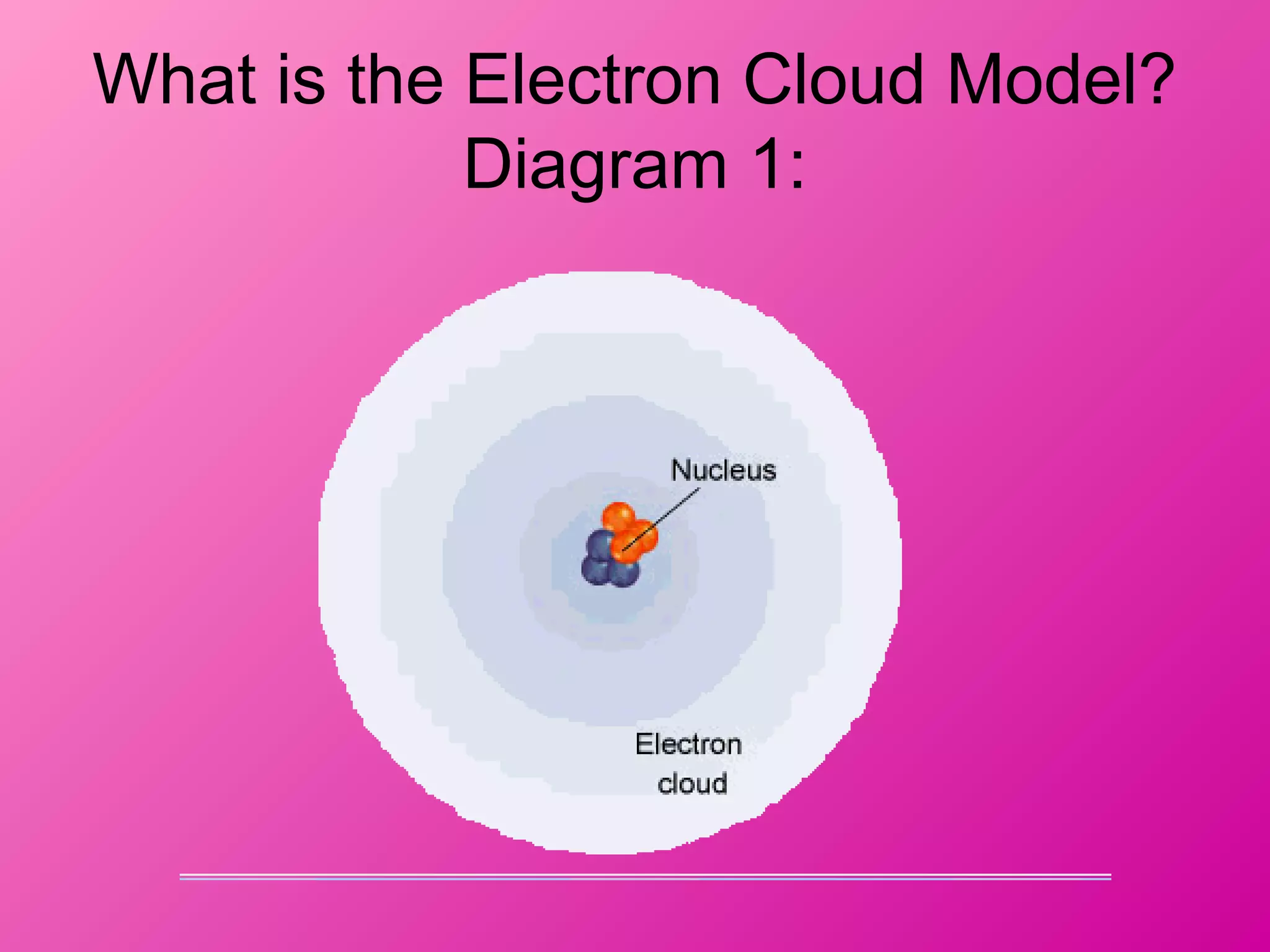
What is the Electron Cloud Model?
Model of the atom pictures the electrons moving
around the nucleus in a region called an electron
cloud.
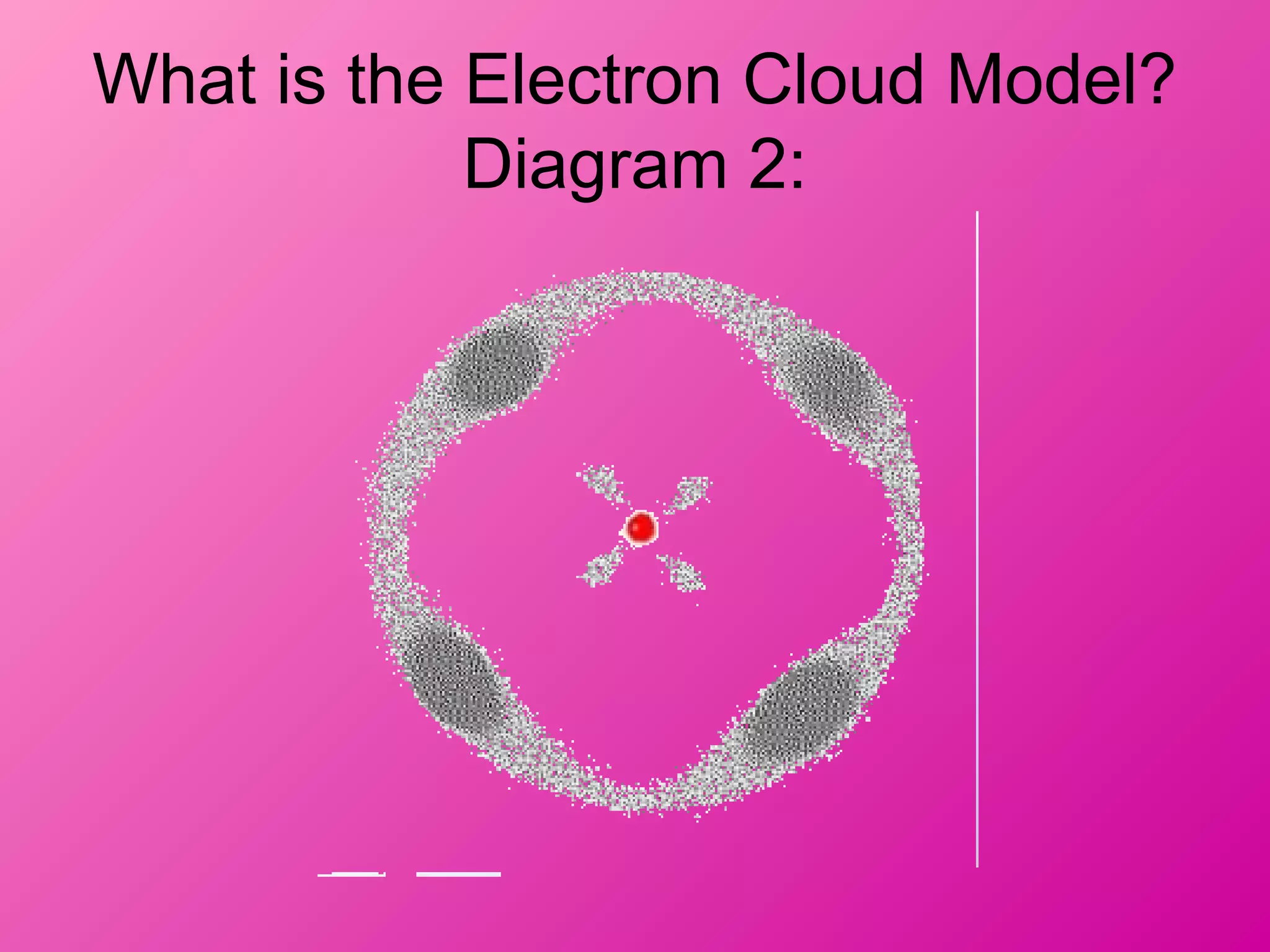
The electron cloud is a cloud of varying density
surrounding the nucleus. The varying density
shows where an electron is more or less likely to
be. Atoms with electrons in higher energy levels
have additional electron clouds of different
shapes that also show where those electrons
are likely to be.
For more information, click here:
http://regentsprep.org/Regents/physics/phys05/catomodel/cloud.htm
What is the Electron Cloud Model?
Diagram 1:
What is the Electron Cloud Model?
Diagram 2:

Module 1 1.2-4 - atomic theory

  • 1.
  • 2.
    What are the3 major parts of an atom?
  • 3.
    What are the3 major parts of an atom? • Proton • Neutron • Electron
  • 4.
    Draw a diagramshowing the location of each part of the atom.
  • 5.
    Draw a diagramshowing the location of each part of the atom. http://www.eskom.co.za/nuclear_energy/fuel/fuel.html
  • 6.
    Draw a diagramshowing the location of each part of the atom. See more diagrams at: http://www.bmb.psu.edu/courses/bisci004a/chem/basechem.htm
  • 7.
    Draw a diagramshowing the location of each part of the atom. http://www.bmb.psu.edu/courses/bisci004a/chem/atoms.jpg
  • 8.
    Draw a diagramshowing the charges of each part of the atom.
  • 9.
    Draw a Diagramof an Atom
  • 10.
    Draw a diagramshowing the charges of each part of the atom.
  • 11.
    Describe Proton • Protonsare positively charged particles found in the atomic nucleus. Protons were discovered by Ernest Rutherford.. • Experiments done in the late 1960's and early 1970's showed that protons are made from other particles called quarks. Protons are made from two 'up' quarks and one 'down' quark.
  • 12.
    Describe Neutron • Neutronsare uncharged particles found in the atomic nucleus. Neutrons were discovered by James Chadwick in 1932. • Experiments done in the late 1960's and early 1970's showed that neutrons are made from other particles called quarks. Neutrons are made from one 'up' quark and two 'down' quarks.
  • 13.
    Describe Electron Electrons arenegatively charged particles that surround the atom's nucleus. Electrons were discovered by J. J. Thomson in 1897. Electrons determine properties of the atom. Chemical reactions involve sharing or exchanging electrons.
  • 14.
    Describe Nucleus The nucleusis the central part of an atom. It is composed of protons and neutrons. The nucleus contains most of an atom's mass. It was discovered by Ernest Rutherford in 1911.
  • 15.
    Describe Quark • Believedto be one of the basic building blocks of matter. Quarks were first discovered in experiments done in the late 1960's and early 1970's. • Three families of quarks are known to exist. Each family contains two quarks. The first family consists of Up and Down quarks, the quarks that join together to form protons and neutrons. • The second family consists of Strange and Charm quarks and only exist at high energies. • The third family consists of Top and Bottom quarks and only exist at very high energies.
  • 16.
    Describe Isotope Atoms thathave the same number of protons but different numbers of neutrons
  • 17.
  • 18.
    What is theElectron Cloud Model? Model of the atom pictures the electrons moving around the nucleus in a region called an electron cloud. The electron cloud is a cloud of varying density surrounding the nucleus. The varying density shows where an electron is more or less likely to be. Atoms with electrons in higher energy levels have additional electron clouds of different shapes that also show where those electrons are likely to be. For more information, click here: http://regentsprep.org/Regents/physics/phys05/catomodel/cloud.htm
  • 19.
    What is theElectron Cloud Model? Diagram 1:
  • 20.
    What is theElectron Cloud Model? Diagram 2: