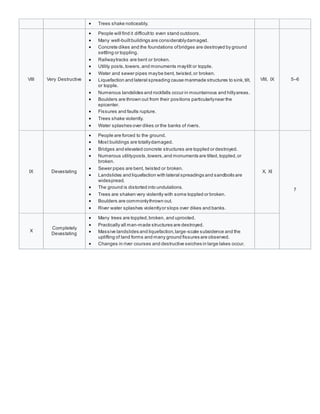
The document outlines the PHIVOLCS Earthquake Intensity Scale (PEIS), which categorizes earthquake effects from 'scarcely perceptible' to 'completely devastating'. Each intensity level describes the observable effects on people, structures, and the environment, ranging from minimal disturbances to total destruction. The scale provides a thorough understanding of how various intensities impact both people and infrastructure during seismic events.
![PHIVOLCS Earthquake Intensity Scale (PEIS)[2]
Intensity
Scale
Description
Equivalent to other
seismic scales[3]
Modified
Mercalli
Shindo
I
Scarcely
perceptible
Delicatelybalanced objects are disturbed slightly.
Still water in containers oscillates slowly.
I 0
II Slightly felt
Felt by few individuals atrest indoors.
Hanging objects swing slightly.
Still water in containers oscillates noticeably.
II 1
III Weak
Felt by many people indoors,especiallyin upper floors.
Hanging objects swing moderately.
Still water in containers oscillates moderately.
Feels like a lighttruck passing by.
III 2
IV
Moderately
strong
Felt generallyby people indoors and by some people outdoors.
Hanging objects swing considerably.
Motorcars may rock slightly.
Liquids in containers are slightlydisturbed.
Water in containers oscillates strongly.
A rumbling sound maysometimes be heard.
Feels like a heavy truck passing by.
IV 2–3
V Strong
Felt by mostpeople indoors and outdoors.
A strong shaking and rocking is felt throughoutbuilding.
Hanging objects swing violently.
Small,light,and unstable objects mayfall or overturn.
Liquids spill from filled open containers.
Vehicles rock noticeably.
Leaves and twigs of trees shake.
V 3
VI Very Strong
Furniture and other heavy objects are displaced.
Wall plaster maycrack.
People may lose balance.
Small church bells mayring.
If on the road,it may feel like driving with flat tires.
Very old or poorly built houses and man-made structures are slightly
damaged though well-builtstructures are notaffected.
Limited rockfalls and rolling boulders occur in hillyto mountainous areas
and escarpments.
Trees shake .
VI
4
VII Destructive
Heavy objects and furniture overturn or topple.
Difficulty standing on upper floors.
Old or poorly-builtstructures suffer considerable damage.
Some well-builtstructures are slightlydamaged.
Some cracks may appear on dikes,fishponds,road surface,or concrete
hollow block walls.
Limited liquefaction,lateral spreading and landslides are observed.
VII](https://image.slidesharecdn.com/phivolcsearthquakeintensityscale-191107101205/85/Phivolcs-earthquake-intensity-scale-1-320.jpg)
![PHIVOLCS Earthquake Intensity Scale (PEIS)[2]
Intensity
Scale
Description
Equivalent to other
seismic scales[3]
Modified
Mercalli
Shindo
I
Scarcely
perceptible
Delicatelybalanced objects are disturbed slightly.
Still water in containers oscillates slowly.
I 0
II Slightly felt
Felt by few individuals atrest indoors.
Hanging objects swing slightly.
Still water in containers oscillates noticeably.
II 1
III Weak
Felt by many people indoors,especiallyin upper floors.
Hanging objects swing moderately.
Still water in containers oscillates moderately.
Feels like a lighttruck passing by.
III 2
IV
Moderately
strong
Felt generallyby people indoors and by some people outdoors.
Hanging objects swing considerably.
Motorcars may rock slightly.
Liquids in containers are slightlydisturbed.
Water in containers oscillates strongly.
A rumbling sound maysometimes be heard.
Feels like a heavy truck passing by.
IV 2–3
V Strong
Felt by mostpeople indoors and outdoors.
A strong shaking and rocking is felt throughoutbuilding.
Hanging objects swing violently.
Small,light,and unstable objects mayfall or overturn.
Liquids spill from filled open containers.
Vehicles rock noticeably.
Leaves and twigs of trees shake.
V 3
VI Very Strong
Furniture and other heavy objects are displaced.
Wall plaster maycrack.
People may lose balance.
Small church bells mayring.
If on the road,it may feel like driving with flat tires.
Very old or poorly built houses and man-made structures are slightly
damaged though well-builtstructures are notaffected.
Limited rockfalls and rolling boulders occur in hillyto mountainous areas
and escarpments.
Trees shake .
VI
4
VII Destructive
Heavy objects and furniture overturn or topple.
Difficulty standing on upper floors.
Old or poorly-builtstructures suffer considerable damage.
Some well-builtstructures are slightlydamaged.
Some cracks may appear on dikes,fishponds,road surface,or concrete
hollow block walls.
Limited liquefaction,lateral spreading and landslides are observed.
VII](https://image.slidesharecdn.com/phivolcsearthquakeintensityscale-191107101205/75/Phivolcs-earthquake-intensity-scale-1-2048.jpg)