Earth & Life
Science
(Earth's
Subsystem)


G
R
A
D
E
1
1
by: JUVY M. BERDDUGO
QUARTER
1
MODULE
2
Origin and
Structure of the
Earth
(Subsystem)
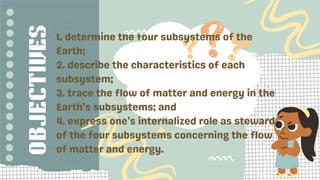
OBJECTIVES 1. determine the four subsystems of the
Earth;
2. describe the characteristics of each
subsystem;
3. trace the flow of matter and energy in the
Earth’s subsystems; and
4. express one’s internalized role as steward
of the four subsystems concerning the flow
of matter and energy.
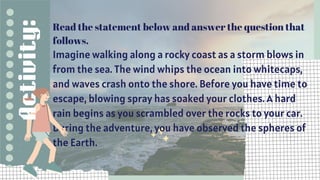
Read the statement below and answer the question that
follows.
Imagine walking along a rocky coast as a storm blows in
from the sea. The wind whips the ocean into whitecaps,
and waves crash onto the shore. Before you have time to
escape, blowing spray has soaked your clothes. A hard
rain begins as you scrambled over the rocks to your car.
During the adventure, you have observed the spheres of
the Earth.
Activity:
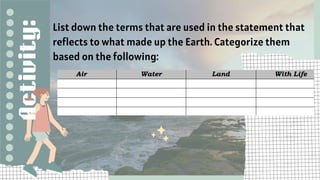
List down the terms that are used in the statement that
reflects to what made up the Earth. Categorize them
based on the following:
Activity:
It is the gaseous layer above the Earth’s surface
composed of 78% nitrogen and 21% oxygen.
Other gases like argon, carbon dioxide, carbon monoxide,
ozone, and other inert gases made the remaining 1%.
supports life because animals and oxygen, and plants
need both carbon dioxide and oxygen.
supports life indirectly by regulating climate. Air acts as
both a blanket and a filter, retaining heat at night and
shielding from direct solar radiation during the day.
1. ATMOSPHERE
2. BIOSPHERE
-the zone of Earth where all forms of life
exist: in the sea, on land, and in water. It is
sometimes called as the large ecosystem.
-This is the zone that life inhabits. Biosphere
is a very thin layer of the earth’s surface.
3. GEOSPHERE
– the solid Earth, consisting of
the entire planet from the
center of the core to the outer
crust. It includes the core,
mantle, and crust of the Earth.
4. HYDROSPHERE
-the water part of the Earth which
circulates among oceans,
continents, glaciers, and
atmosphere. Oceans cover 71% of
the Earth and contain 97.5% of its
water.
Are there any
questions?
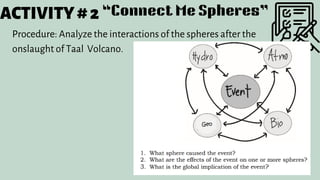
ACTIVITY#2 “Connect Me Spheres”


Procedure: Analyze the interactions of the spheres after the
onslaught of Taal Volcano.

EARTH'S SUBSYSTEM.pdf

  • 1.
  • 2.
  • 3.
    OBJECTIVES 1. determinethe four subsystems of the Earth; 2. describe the characteristics of each subsystem; 3. trace the flow of matter and energy in the Earth’s subsystems; and 4. express one’s internalized role as steward of the four subsystems concerning the flow of matter and energy.
  • 4.
    Read the statementbelow and answer the question that follows. Imagine walking along a rocky coast as a storm blows in from the sea. The wind whips the ocean into whitecaps, and waves crash onto the shore. Before you have time to escape, blowing spray has soaked your clothes. A hard rain begins as you scrambled over the rocks to your car. During the adventure, you have observed the spheres of the Earth. Activity:
  • 5.
    List down theterms that are used in the statement that reflects to what made up the Earth. Categorize them based on the following: Activity:
  • 6.
    It is thegaseous layer above the Earth’s surface composed of 78% nitrogen and 21% oxygen. Other gases like argon, carbon dioxide, carbon monoxide, ozone, and other inert gases made the remaining 1%. supports life because animals and oxygen, and plants need both carbon dioxide and oxygen. supports life indirectly by regulating climate. Air acts as both a blanket and a filter, retaining heat at night and shielding from direct solar radiation during the day. 1. ATMOSPHERE
  • 7.
    2. BIOSPHERE -the zoneof Earth where all forms of life exist: in the sea, on land, and in water. It is sometimes called as the large ecosystem. -This is the zone that life inhabits. Biosphere is a very thin layer of the earth’s surface.
  • 8.
    3. GEOSPHERE – thesolid Earth, consisting of the entire planet from the center of the core to the outer crust. It includes the core, mantle, and crust of the Earth.
  • 9.
    4. HYDROSPHERE -the waterpart of the Earth which circulates among oceans, continents, glaciers, and atmosphere. Oceans cover 71% of the Earth and contain 97.5% of its water.
  • 10.
  • 11.
    ACTIVITY#2 “Connect MeSpheres” Procedure: Analyze the interactions of the spheres after the onslaught of Taal Volcano.