ROBOTICS
 robot
WHAT IS ROBOT?
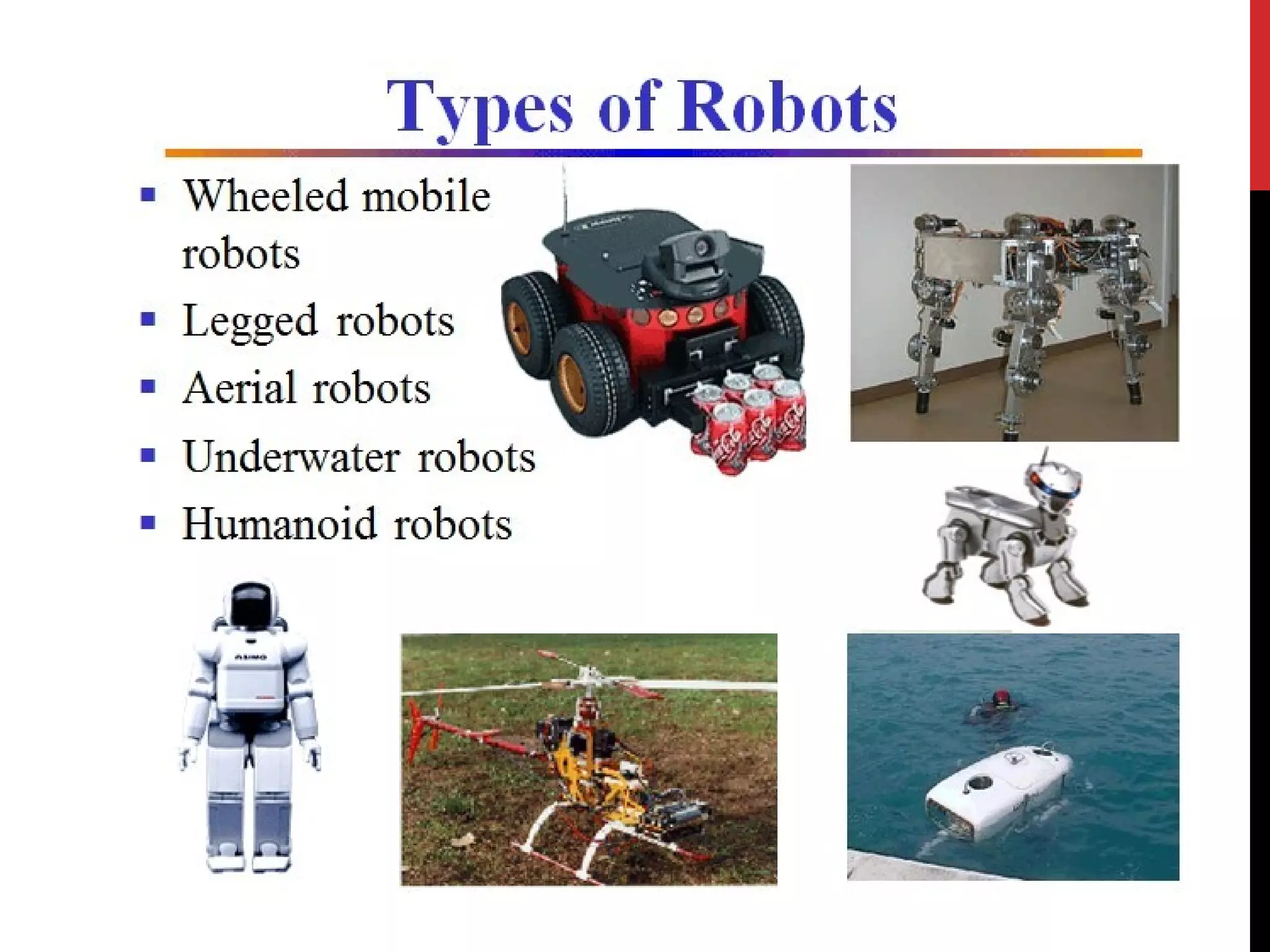
A robot is an automatic mechanical device often
resembling a human oranimal. Modern robots are
usually an electro-mechanical machine guided by a
computerprogramorelectronic circuitry.
Robota (Czech) = A workerof forced labor
FromCzech playwright Karel Capek's 1921 play
“R.U.R” (“Rossum's Universal Robots”)
A BRIEF HISTORY OF
ROBOTICS
The first digital and programmable robot
was invented by George Devol in 1954
and was named the Unimate. It was sold
to General Motors in 1961 where it was
used to lift pieces of hot metal fromdie
casting machines at the Inland Fisher
Guide Plant in the West Trenton section
of Ewing Township, New Jersey.
Leonardo's robot or Leonardo's mechanical
knight refers to a humanoid automaton designed by
Leonardo da Vinci around the year 1495.
1822
Charles Babbage demonstrates a prototype of his "Difference
Engine" to the Royal Astronomical Society. He continues his work by designing
an even more ambitious project the “Analytical Engine" that reportedly was to
use punch cards inspired by Joseph Jacquard's invention.
1942
Issac Asimov is generally credited with the popularization of the
term "Robotics" which was first mentioned in his story "Runaround" in 1942. His
most important contribution to the history of the robot is the creation of his “Laws
of Robotics”.
 BASIC PARTS OF ROBOT
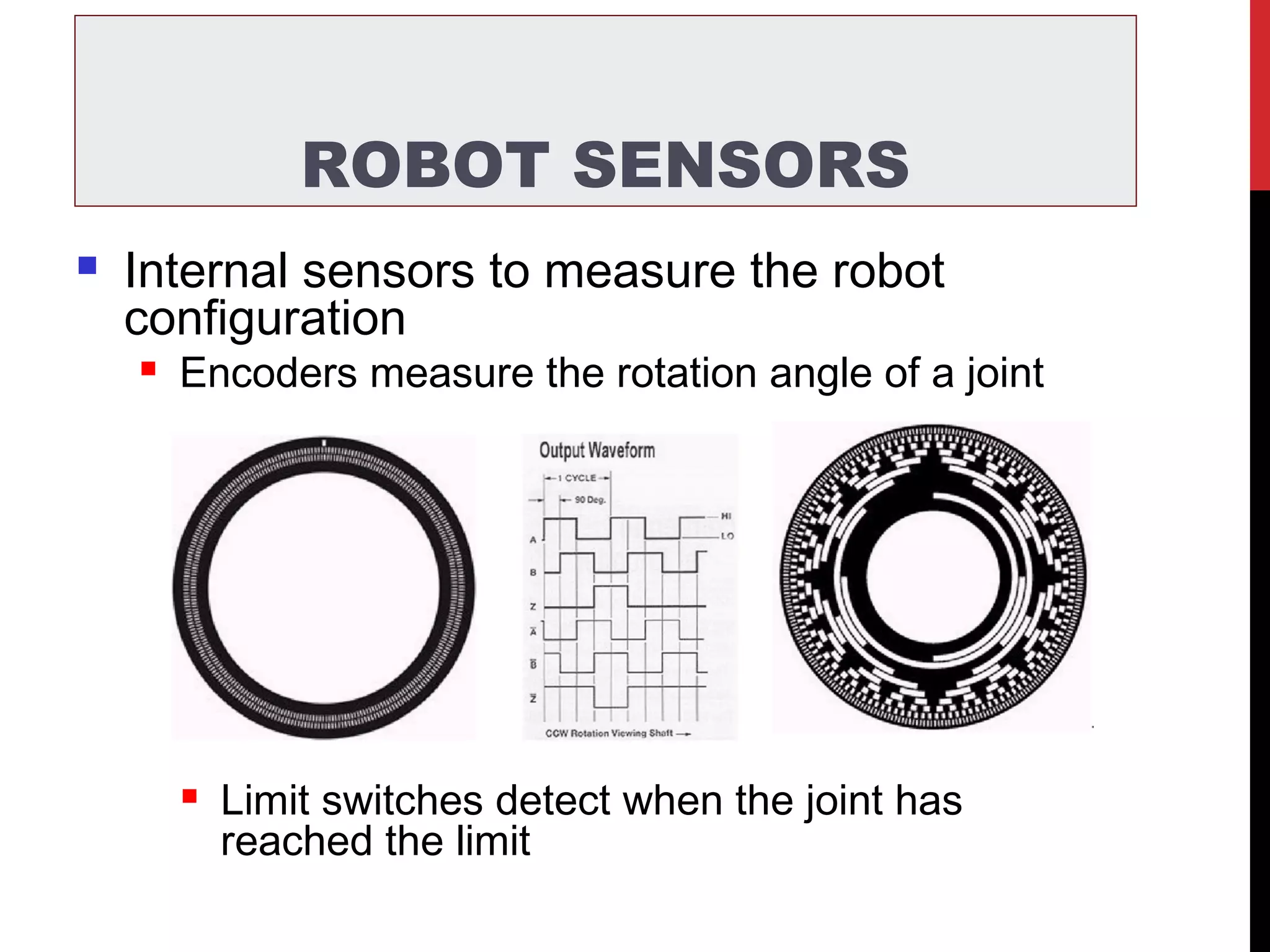
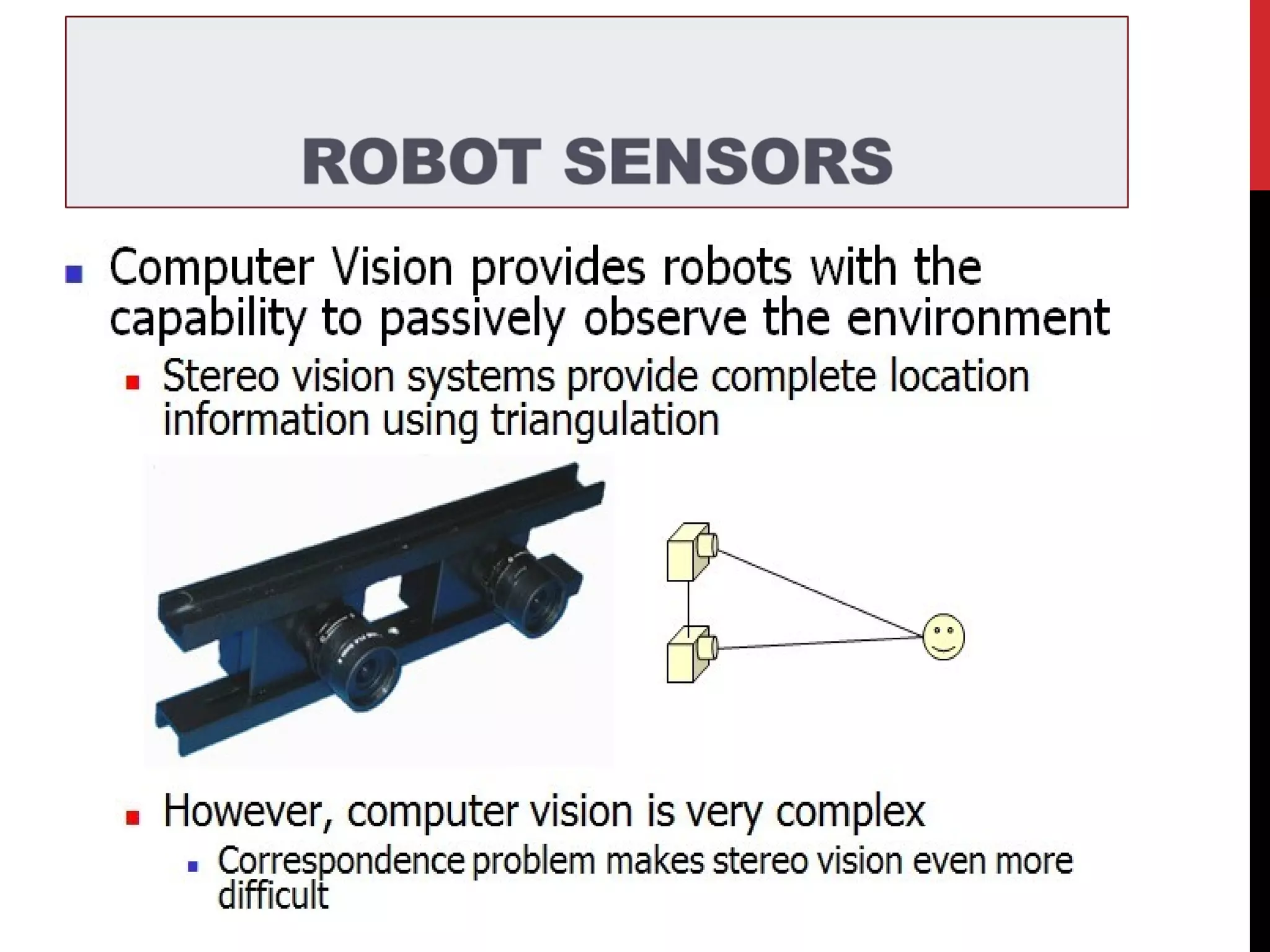
ROBOT SENSORS
 Internal sensors to measure the robot
configuration
 Encoders measure the rotation angle of a joint
 Limit switches detect when the joint has
reached the limit
 Proximity sensors are used to measure the distance or
location of objects in the environment. This can then be used
to determine the location of the robot.
 Infrared sensors determine the distance to an object by measuring
the amount of infrared light the object reflects back to the robot
 Ultrasonic sensors (sonars) measure the time that an ultrasonic
signal takes until it returns to the robot
 Laser range finders determine distance by
measuring either the time it takes for a laser
beam to be reflected back to the robot or by
measuring where the laser hits the object
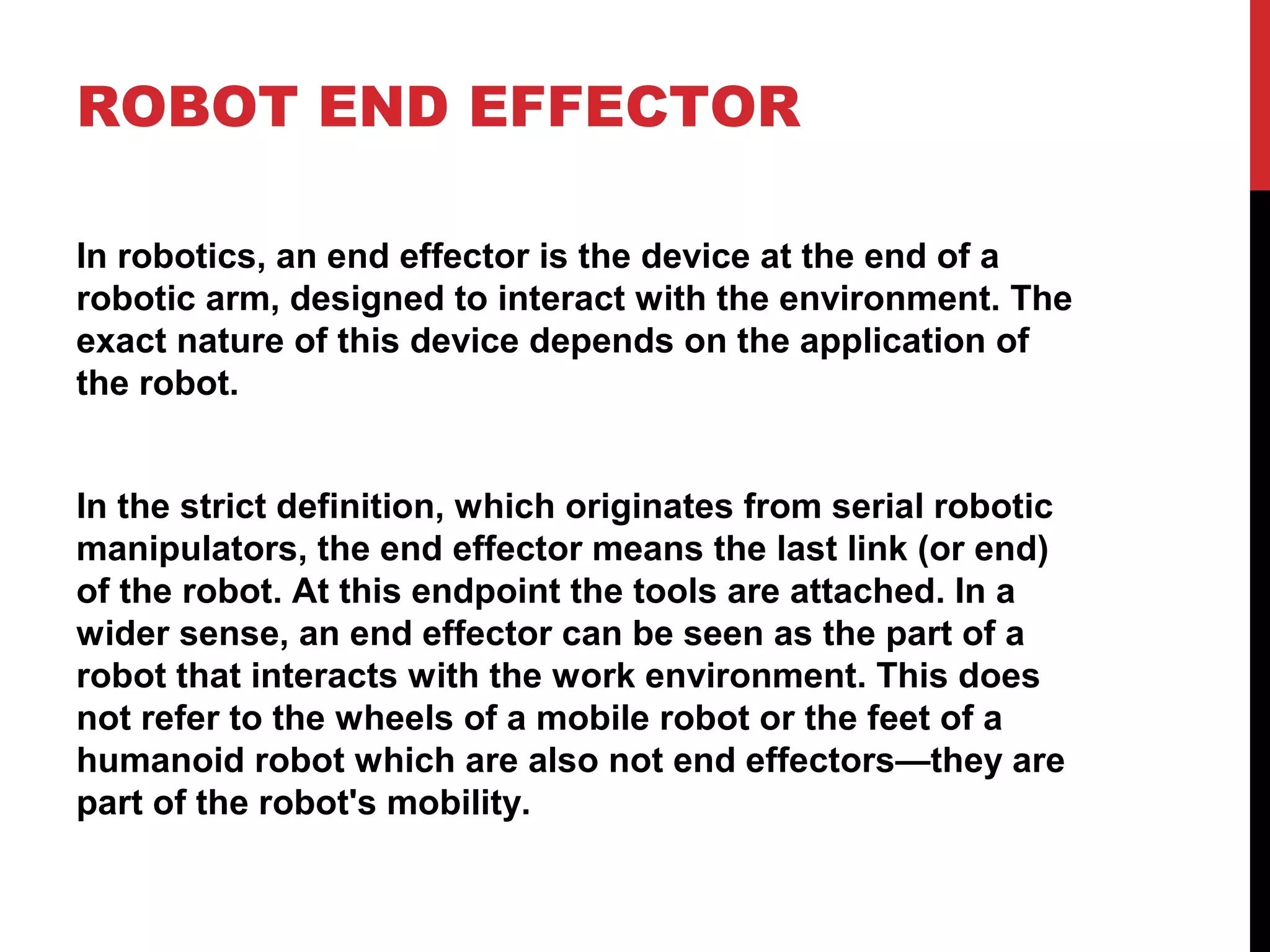
ROBOT END EFFECTOR
In robotics, an end effector is the device at the end of a
robotic arm, designed to interact with the environment. The
exact nature of this device depends on the application of
the robot.
In the strict definition, which originates from serial robotic
manipulators, the end effector means the last link (or end)
of the robot. At this endpoint the tools are attached. In a
wider sense, an end effector can be seen as the part of a
robot that interacts with the work environment. This does
not refer to the wheels of a mobile robot or the feet of a
humanoid robot which are also not end effectors—they are
part of the robot's mobility.
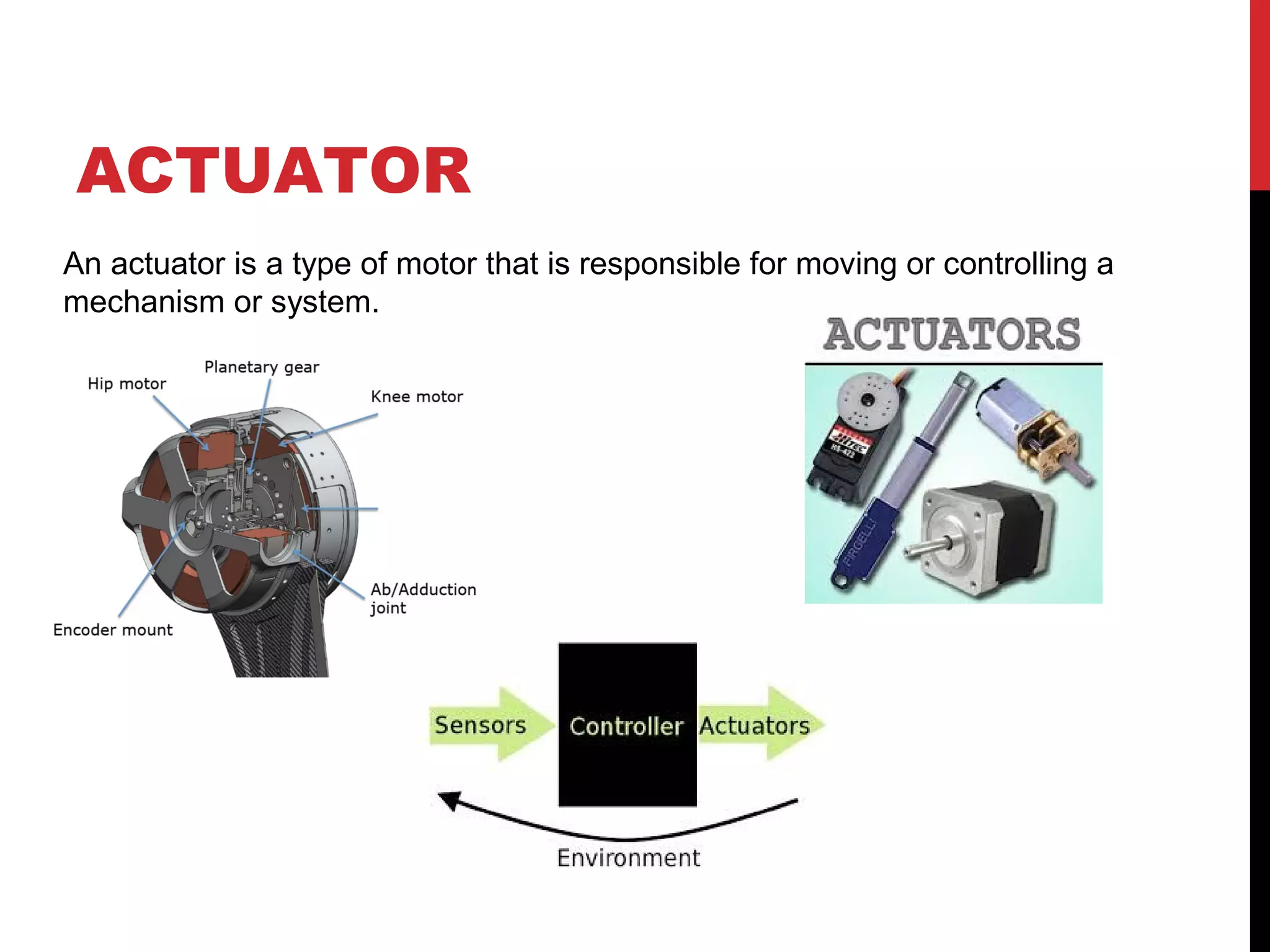
ACTUATOR
An actuator is a type of motor that is responsible for moving or controlling a
mechanism or system.
ROBOT CONTROLLER
In a broad sense, robot controller is a combination of
hardware and software to program and control a single or
multiple robots.
LOCOMOTION OF
ROBOT(A.V)
where robots are used?
Why use a robot?
There are many different reasons for using a robot but the central reason for most
applications is to eliminate a human operator. The most obvious reason is:
To save labor and reduce cost.
To save labor and reduce cost.
Human is bad for the product for example semiconductor
handling.
Within this class are other reasons for using robots for example food handling,
pharmaceuticals, etc.
Product is bad for the human for example radioactive product.
Within the above are other reasons for using robots for example robots can be used to 
replace human operators where the dangers are Repetitive strain syndrome.
1.Working with machinery that is dangerous for example presses, winders.
2.Working with materials which might be harmful in the short or long term.
3.Working with materials which might be harmful in the short or long term.
robots in military robots in medicine
robots in industry robots in space
Robots can take the place of humans in
handling dangerous substances
Dangerous diseases like ebola and toxic environment
As more people die from the virus, robotics experts are
looking for ways to enlist robots in the fight to contain Ebola
in the coming months and years.
Some Robots That Will Shape Our
Future
1. Valkyrie
NASA’s ‘superhero’ robot is 6 feet 2 inches
tall and was originally designed for use on
the International Space Station. Valkyrie is
able to walk by itself, pick up objects and
use tools. NASA hopes that one day, it can
be used to help humans in danger zones
and disaster-stricken areas. The robot is
basically a she-bot since it was built with
female characteristics. The droid has
several built-in cameras, recording and
sonar equipment.
2. Schaft
This robot, made by a Japanese company
(which was later bought by Google), won the
recent DARPA robotics competition. The 4
feet 11 inches tall robot uses a high-voltage
liquid-cooled motor technology and a
capacitor to power itself instead of a battery.
This gives it greater movement and mobility
since batteries limit how fast the robot can
actually perform tasks. Schaft blew the
competition away and will be competing in
the final round of the 2014 Robo-Olympics.
Alpha Dog
This robot can stand upright, walk
continuously for 20 miles and is
able to carry 400 pounds. The
robot is also able to pick itself up if
it falls over. The robot is designed
to follow soldiers and carry their
weapons through rough terrain
and automatically go wherever
they go, without having to stop.
The Alpha Dog is currently being
tested by the Marines.
Curiosity (rover)
Curiosity is a car-sized robotic rover exploring Gale
Crater on Mars as part of NASA's Mars Science
Laboratory mission (MSL)
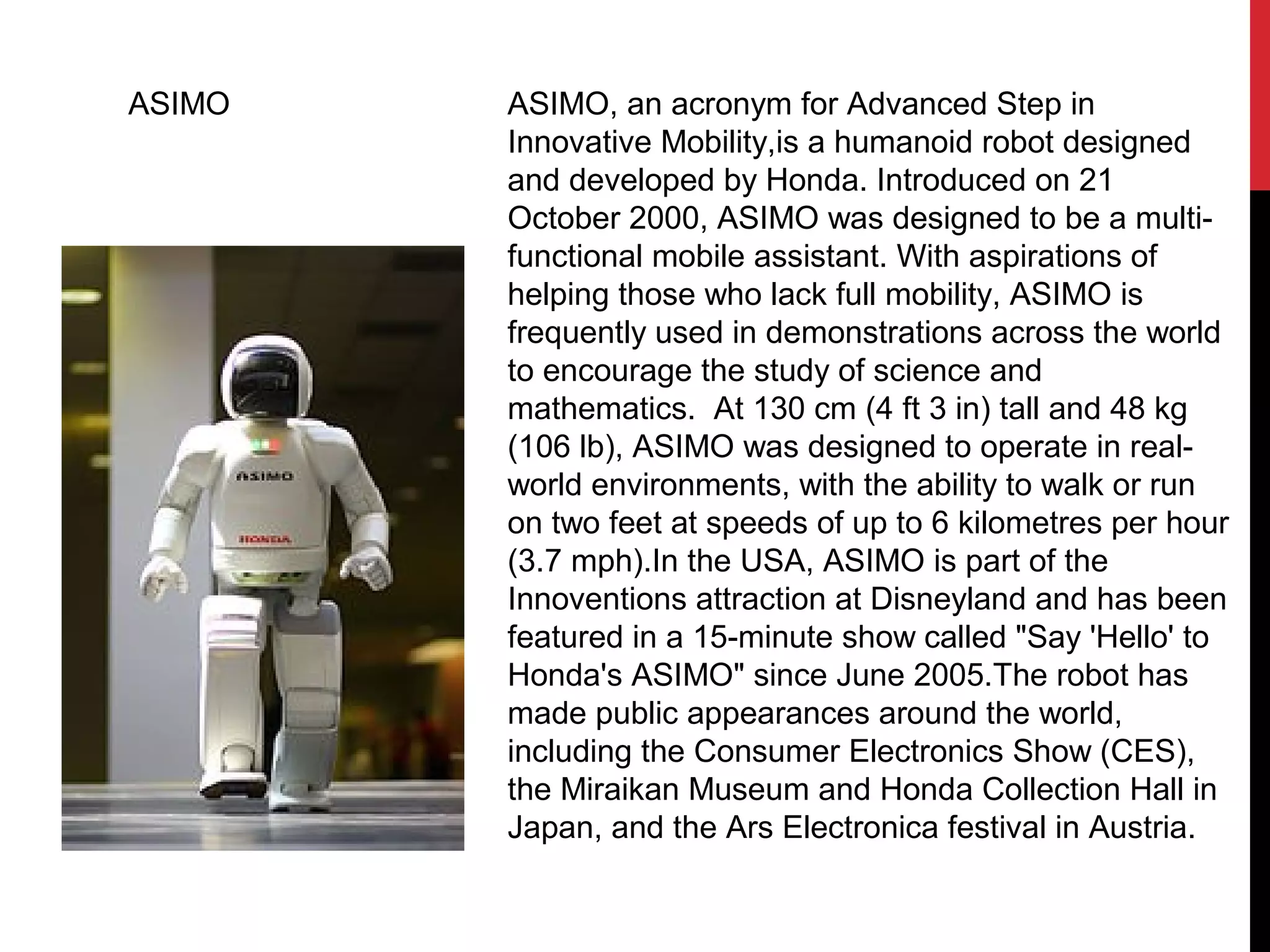
ASIMO ASIMO, an acronym for Advanced Step in
Innovative Mobility,is a humanoid robot designed
and developed by Honda. Introduced on 21
October 2000, ASIMO was designed to be a multi-
functional mobile assistant. With aspirations of
helping those who lack full mobility, ASIMO is
frequently used in demonstrations across the world
to encourage the study of science and
mathematics. At 130 cm (4 ft 3 in) tall and 48 kg
(106 lb), ASIMO was designed to operate in real-
world environments, with the ability to walk or run
on two feet at speeds of up to 6 kilometres per hour
(3.7 mph).In the USA, ASIMO is part of the
Innoventions attraction at Disneyland and has been
featured in a 15-minute show called "Say 'Hello' to
Honda's ASIMO" since June 2005.The robot has
made public appearances around the world,
including the Consumer Electronics Show (CES),
the Miraikan Museum and Honda Collection Hall in
Japan, and the Ars Electronica festival in Austria.
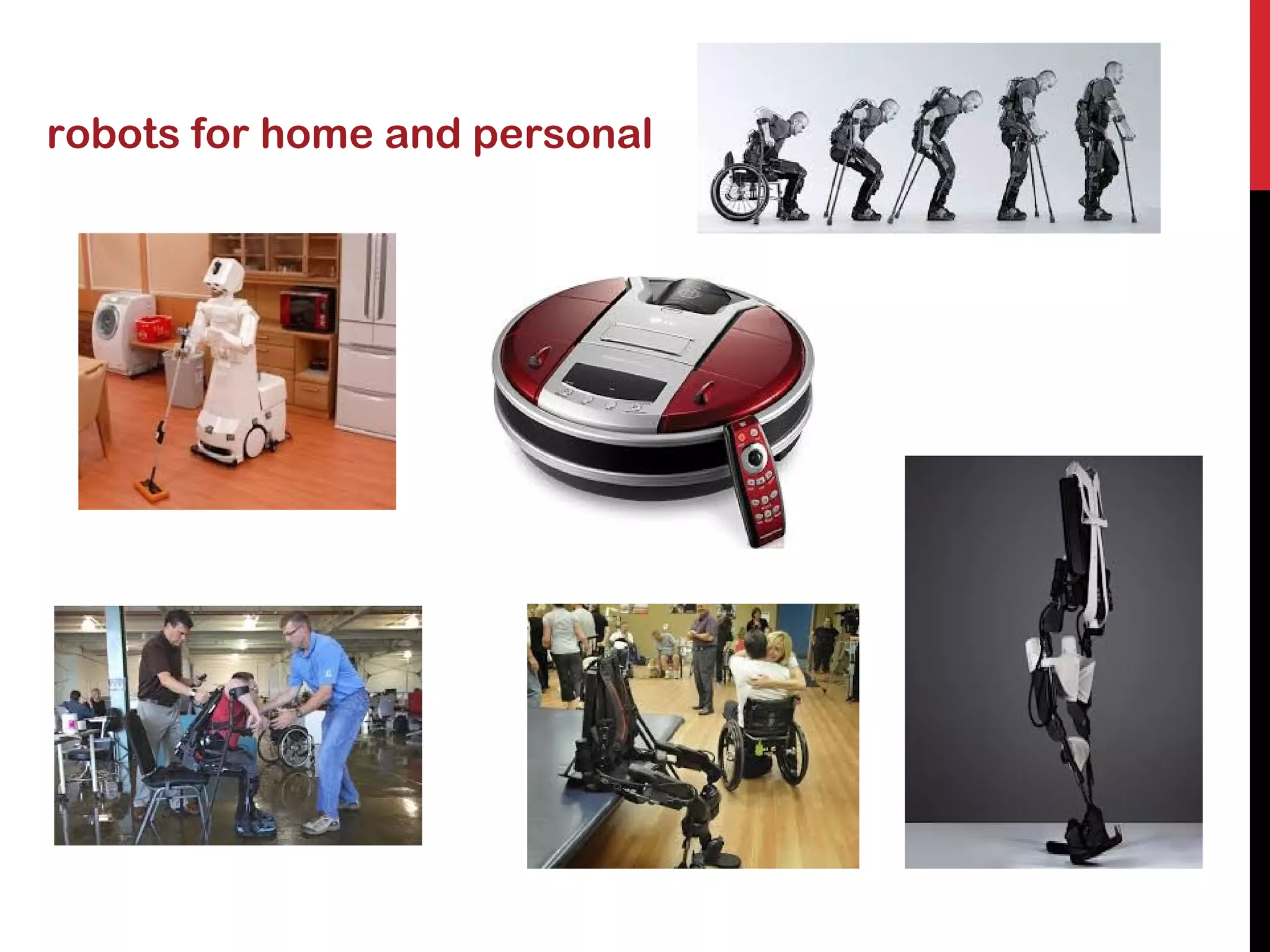
robots for home and personal
 Robots are an important component in Intelligent
Environments
 Automate devices
 Provide physical services
 Robot Systems in these environments need particular
capabilities
 Autonomous control systems
 Simple and natural human-robot interface
 Adaptive and learning capabilities
 Robots have to maintain safety during operation
 While a number of techniques to address these
requirements exist, no functional, satisfactory solutions
have yet been developed
 Only very simple robots for single tasks in intelligent environments
exist
ROBOTICS

ROBOTICS

  • 1.
  • 2.
    WHAT IS ROBOT? Arobot is an automatic mechanical device often resembling a human oranimal. Modern robots are usually an electro-mechanical machine guided by a computerprogramorelectronic circuitry. Robota (Czech) = A workerof forced labor FromCzech playwright Karel Capek's 1921 play “R.U.R” (“Rossum's Universal Robots”)
  • 3.
    A BRIEF HISTORYOF ROBOTICS The first digital and programmable robot was invented by George Devol in 1954 and was named the Unimate. It was sold to General Motors in 1961 where it was used to lift pieces of hot metal fromdie casting machines at the Inland Fisher Guide Plant in the West Trenton section of Ewing Township, New Jersey.
  • 4.
    Leonardo's robot orLeonardo's mechanical knight refers to a humanoid automaton designed by Leonardo da Vinci around the year 1495.
  • 5.
    1822 Charles Babbage demonstratesa prototype of his "Difference Engine" to the Royal Astronomical Society. He continues his work by designing an even more ambitious project the “Analytical Engine" that reportedly was to use punch cards inspired by Joseph Jacquard's invention.
  • 6.
    1942 Issac Asimov isgenerally credited with the popularization of the term "Robotics" which was first mentioned in his story "Runaround" in 1942. His most important contribution to the history of the robot is the creation of his “Laws of Robotics”.
  • 7.
  • 8.
    ROBOT SENSORS  Internalsensors to measure the robot configuration  Encoders measure the rotation angle of a joint  Limit switches detect when the joint has reached the limit
  • 9.
     Proximity sensorsare used to measure the distance or location of objects in the environment. This can then be used to determine the location of the robot.  Infrared sensors determine the distance to an object by measuring the amount of infrared light the object reflects back to the robot  Ultrasonic sensors (sonars) measure the time that an ultrasonic signal takes until it returns to the robot  Laser range finders determine distance by measuring either the time it takes for a laser beam to be reflected back to the robot or by measuring where the laser hits the object
  • 11.
    ROBOT END EFFECTOR Inrobotics, an end effector is the device at the end of a robotic arm, designed to interact with the environment. The exact nature of this device depends on the application of the robot. In the strict definition, which originates from serial robotic manipulators, the end effector means the last link (or end) of the robot. At this endpoint the tools are attached. In a wider sense, an end effector can be seen as the part of a robot that interacts with the work environment. This does not refer to the wheels of a mobile robot or the feet of a humanoid robot which are also not end effectors—they are part of the robot's mobility.
  • 13.
    ACTUATOR An actuator isa type of motor that is responsible for moving or controlling a mechanism or system.
  • 14.
    ROBOT CONTROLLER In abroad sense, robot controller is a combination of hardware and software to program and control a single or multiple robots.
  • 17.
  • 18.
    where robots areused? Why use a robot? There are many different reasons for using a robot but the central reason for most applications is to eliminate a human operator. The most obvious reason is: To save labor and reduce cost. To save labor and reduce cost. Human is bad for the product for example semiconductor handling. Within this class are other reasons for using robots for example food handling, pharmaceuticals, etc. Product is bad for the human for example radioactive product. Within the above are other reasons for using robots for example robots can be used to  replace human operators where the dangers are Repetitive strain syndrome. 1.Working with machinery that is dangerous for example presses, winders. 2.Working with materials which might be harmful in the short or long term. 3.Working with materials which might be harmful in the short or long term.
  • 19.
    robots in militaryrobots in medicine robots in industry robots in space
  • 20.
    Robots can takethe place of humans in handling dangerous substances Dangerous diseases like ebola and toxic environment As more people die from the virus, robotics experts are looking for ways to enlist robots in the fight to contain Ebola in the coming months and years.
  • 21.
    Some Robots ThatWill Shape Our Future 1. Valkyrie NASA’s ‘superhero’ robot is 6 feet 2 inches tall and was originally designed for use on the International Space Station. Valkyrie is able to walk by itself, pick up objects and use tools. NASA hopes that one day, it can be used to help humans in danger zones and disaster-stricken areas. The robot is basically a she-bot since it was built with female characteristics. The droid has several built-in cameras, recording and sonar equipment.
  • 22.
    2. Schaft This robot,made by a Japanese company (which was later bought by Google), won the recent DARPA robotics competition. The 4 feet 11 inches tall robot uses a high-voltage liquid-cooled motor technology and a capacitor to power itself instead of a battery. This gives it greater movement and mobility since batteries limit how fast the robot can actually perform tasks. Schaft blew the competition away and will be competing in the final round of the 2014 Robo-Olympics.
  • 23.
    Alpha Dog This robotcan stand upright, walk continuously for 20 miles and is able to carry 400 pounds. The robot is also able to pick itself up if it falls over. The robot is designed to follow soldiers and carry their weapons through rough terrain and automatically go wherever they go, without having to stop. The Alpha Dog is currently being tested by the Marines.
  • 24.
    Curiosity (rover) Curiosity isa car-sized robotic rover exploring Gale Crater on Mars as part of NASA's Mars Science Laboratory mission (MSL)
  • 25.
    ASIMO ASIMO, anacronym for Advanced Step in Innovative Mobility,is a humanoid robot designed and developed by Honda. Introduced on 21 October 2000, ASIMO was designed to be a multi- functional mobile assistant. With aspirations of helping those who lack full mobility, ASIMO is frequently used in demonstrations across the world to encourage the study of science and mathematics. At 130 cm (4 ft 3 in) tall and 48 kg (106 lb), ASIMO was designed to operate in real- world environments, with the ability to walk or run on two feet at speeds of up to 6 kilometres per hour (3.7 mph).In the USA, ASIMO is part of the Innoventions attraction at Disneyland and has been featured in a 15-minute show called "Say 'Hello' to Honda's ASIMO" since June 2005.The robot has made public appearances around the world, including the Consumer Electronics Show (CES), the Miraikan Museum and Honda Collection Hall in Japan, and the Ars Electronica festival in Austria.
  • 26.
    robots for homeand personal
  • 29.
     Robots arean important component in Intelligent Environments  Automate devices  Provide physical services  Robot Systems in these environments need particular capabilities  Autonomous control systems  Simple and natural human-robot interface  Adaptive and learning capabilities  Robots have to maintain safety during operation  While a number of techniques to address these requirements exist, no functional, satisfactory solutions have yet been developed  Only very simple robots for single tasks in intelligent environments exist