ROBOTICS AND MOTION CONTROL
Presented By:
Abu Sufyan Malik
(16E31A0342)
OUTLINE
1. Introduction.
2. Robot’s Anatomy.
3. Robot’s Components.
4. Laws of Robots.
5. Robotics Motion and Movements
6. Robots Joints.
7. Robots Configuration.
8. Robots Kinematics.
9. Types of Robots.
10. Robots Specification
11. Need of Robots.
12. Industrial Use of Robots.
INTRODUCTION
 The term ‘Robot’ was first used in a play called
“Rossum’s Universal Robots” by the writer Karel
Capek.
 Robotics is the science that generally deals with
Robots.
 Robotics is a form of Industrial Automation,
generally Programmable automation referred as
Robots.
 A robot is a machine in the form of a human being
that performs all functions of human being but lacks
sensitivity.
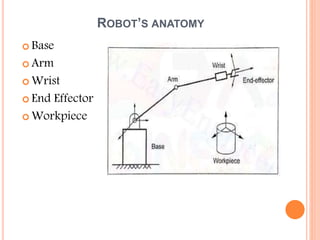
ROBOT’S ANATOMY
 Base
 Arm
 Wrist
 End Effector
 Workpiece
ROBOTS COMPONENTS
 Manipulator or Rover:- Main body of the robots (Links,
Joints, other structural elements of robot).
 End Effector:- The part is connected to the last hand
of the manipulator.
 Actuators:- Muscles of the manipulators (Servomotor,
Stepper motor, Pneumatic or Hydraulic Cylinders).
 Sensors:- To collect information about the internal
state of the robot or to communicate with the outside
environments.
 Controller:-Similar to Cerebellum. It controls all the
motion of the actuators.
 Processor:- Brain of Robot.
LAWS OF ROBOTS
 Zero Law:-A robot may not injure humanity or
though inaction , allow humanity to come to harm.
 First Law:- A robot may not injure humanity or
though inaction , allow humanity to come to harm,
unless it would violates higher order laws.
 Second Law:-A robot must obey orders given it by
human beings, except where it would conflict higher
order laws.
 Third Law:-A robot must protect its own existence
as much as such protection does not conflict with
higher order laws.
ROBOTIC MOTION AND MOVEMENTS
 Motion:-Motion of Robots can be defined by LERT.
1. Linear Motion.
2. Extension Motion.
3. Rotational Motion.
4. Twisting Motion.
 Movements:- Robots generally have three movements.
1. Rotational Movements.
2. Radial Movements.
3. Vertical Movements.
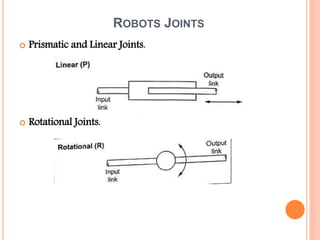
ROBOTS JOINTS
 Prismatic and Linear Joints.
 Rotational Joints.
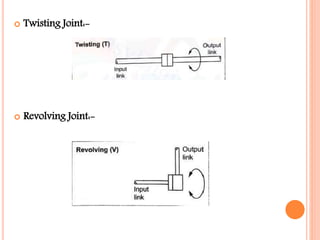
 Twisting Joint:-
 Revolving Joint:-
ROBOTS CONFIGURATION
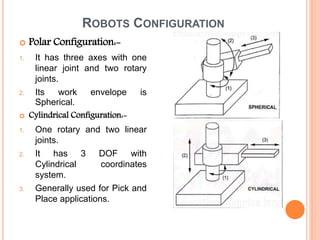
 Polar Configuration:-
1. It has three axes with one
linear joint and two rotary
joints.
2. Its work envelope is
Spherical.
 Cylindrical Configuration:-
1. One rotary and two linear
joints.
2. It has 3 DOF with
Cylindrical coordinates
system.
3. Generally used for Pick and
Place applications.
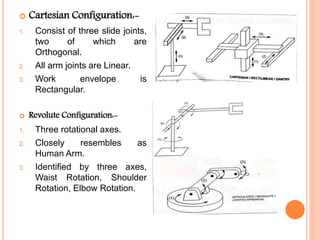
 Cartesian Configuration:-
1. Consist of three slide joints,
two of which are
Orthogonal.
2. All arm joints are Linear.
3. Work envelope is
Rectangular.
 Revolute Configuration:-
1. Three rotational axes.
2. Closely resembles as
Human Arm.
3. Identified by three axes,
Waist Rotation, Shoulder
Rotation, Elbow Rotation.
ROBOTS KINEMATICS
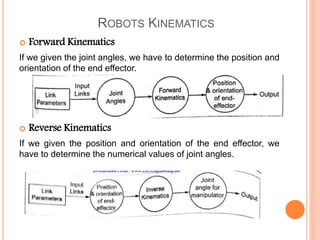
 Forward Kinematics
If we given the joint angles, we have to determine the position and
orientation of the end effector.
 Reverse Kinematics
If we given the position and orientation of the end effector, we
have to determine the numerical values of joint angles.
TYPES OF ROBOTS
1. Industrial Robots.
2. Laboratory Robots.
3. Explorer Robots.
4. Hobbyist Robots.
5. Class Room Robots.
6. Educational Robots.
7. Tele-Robots.
ROBOTS SPECIFICATION
1. Accuracy.
2. Repeatability.
3. Reliability.
4. Resolution.
5. Spatial Resolution.
6. Precision of Robot.
7. Quality of Robot.
8. Reach.
9. Maximum Speed.
10. Payload.
11. Pitch.
12. Yaw.
NEED OF ROBOTS
1. Speed.
2. Hazardous Environment
3. Repetitive Task.
4. Efficiency.
5. Accuracy.
6. Adaptability.
INDUSTRIAL USE OF ROBOTS
1. Loading and Unloading
2. Palletizing and Depalletizing.
3. Spot and Electric Arc Welding.
4. Pick and Place Option.
5. Assembly.
6. Spray Finishing Operation.
7. Spot Welding Robots.
8. Aerospace Industries.
REFERENCES
 www.wikipedia.com/robotics
 Industrial Robotics by P.Jaganathan.

Robotics and motion control

  • 1.
    ROBOTICS AND MOTIONCONTROL Presented By: Abu Sufyan Malik (16E31A0342)
  • 2.
    OUTLINE 1. Introduction. 2. Robot’sAnatomy. 3. Robot’s Components. 4. Laws of Robots. 5. Robotics Motion and Movements 6. Robots Joints. 7. Robots Configuration. 8. Robots Kinematics. 9. Types of Robots. 10. Robots Specification 11. Need of Robots. 12. Industrial Use of Robots.
  • 3.
    INTRODUCTION  The term‘Robot’ was first used in a play called “Rossum’s Universal Robots” by the writer Karel Capek.  Robotics is the science that generally deals with Robots.  Robotics is a form of Industrial Automation, generally Programmable automation referred as Robots.  A robot is a machine in the form of a human being that performs all functions of human being but lacks sensitivity.
  • 4.
    ROBOT’S ANATOMY  Base Arm  Wrist  End Effector  Workpiece
  • 5.
    ROBOTS COMPONENTS  Manipulatoror Rover:- Main body of the robots (Links, Joints, other structural elements of robot).  End Effector:- The part is connected to the last hand of the manipulator.  Actuators:- Muscles of the manipulators (Servomotor, Stepper motor, Pneumatic or Hydraulic Cylinders).  Sensors:- To collect information about the internal state of the robot or to communicate with the outside environments.  Controller:-Similar to Cerebellum. It controls all the motion of the actuators.  Processor:- Brain of Robot.
  • 6.
    LAWS OF ROBOTS Zero Law:-A robot may not injure humanity or though inaction , allow humanity to come to harm.  First Law:- A robot may not injure humanity or though inaction , allow humanity to come to harm, unless it would violates higher order laws.  Second Law:-A robot must obey orders given it by human beings, except where it would conflict higher order laws.  Third Law:-A robot must protect its own existence as much as such protection does not conflict with higher order laws.
  • 7.
    ROBOTIC MOTION ANDMOVEMENTS  Motion:-Motion of Robots can be defined by LERT. 1. Linear Motion. 2. Extension Motion. 3. Rotational Motion. 4. Twisting Motion.  Movements:- Robots generally have three movements. 1. Rotational Movements. 2. Radial Movements. 3. Vertical Movements.
  • 8.
    ROBOTS JOINTS  Prismaticand Linear Joints.  Rotational Joints.
  • 9.
     Twisting Joint:- Revolving Joint:-
  • 10.
    ROBOTS CONFIGURATION  PolarConfiguration:- 1. It has three axes with one linear joint and two rotary joints. 2. Its work envelope is Spherical.  Cylindrical Configuration:- 1. One rotary and two linear joints. 2. It has 3 DOF with Cylindrical coordinates system. 3. Generally used for Pick and Place applications.
  • 11.
     Cartesian Configuration:- 1.Consist of three slide joints, two of which are Orthogonal. 2. All arm joints are Linear. 3. Work envelope is Rectangular.  Revolute Configuration:- 1. Three rotational axes. 2. Closely resembles as Human Arm. 3. Identified by three axes, Waist Rotation, Shoulder Rotation, Elbow Rotation.
  • 12.
    ROBOTS KINEMATICS  ForwardKinematics If we given the joint angles, we have to determine the position and orientation of the end effector.  Reverse Kinematics If we given the position and orientation of the end effector, we have to determine the numerical values of joint angles.
  • 13.
    TYPES OF ROBOTS 1.Industrial Robots. 2. Laboratory Robots. 3. Explorer Robots. 4. Hobbyist Robots. 5. Class Room Robots. 6. Educational Robots. 7. Tele-Robots.
  • 14.
    ROBOTS SPECIFICATION 1. Accuracy. 2.Repeatability. 3. Reliability. 4. Resolution. 5. Spatial Resolution. 6. Precision of Robot. 7. Quality of Robot. 8. Reach. 9. Maximum Speed. 10. Payload. 11. Pitch. 12. Yaw.
  • 15.
    NEED OF ROBOTS 1.Speed. 2. Hazardous Environment 3. Repetitive Task. 4. Efficiency. 5. Accuracy. 6. Adaptability.
  • 16.
    INDUSTRIAL USE OFROBOTS 1. Loading and Unloading 2. Palletizing and Depalletizing. 3. Spot and Electric Arc Welding. 4. Pick and Place Option. 5. Assembly. 6. Spray Finishing Operation. 7. Spot Welding Robots. 8. Aerospace Industries.
  • 17.