A TOUR TO
We're fascinated with robots because
they are reflections of ourselves.
-Ken Goldberg
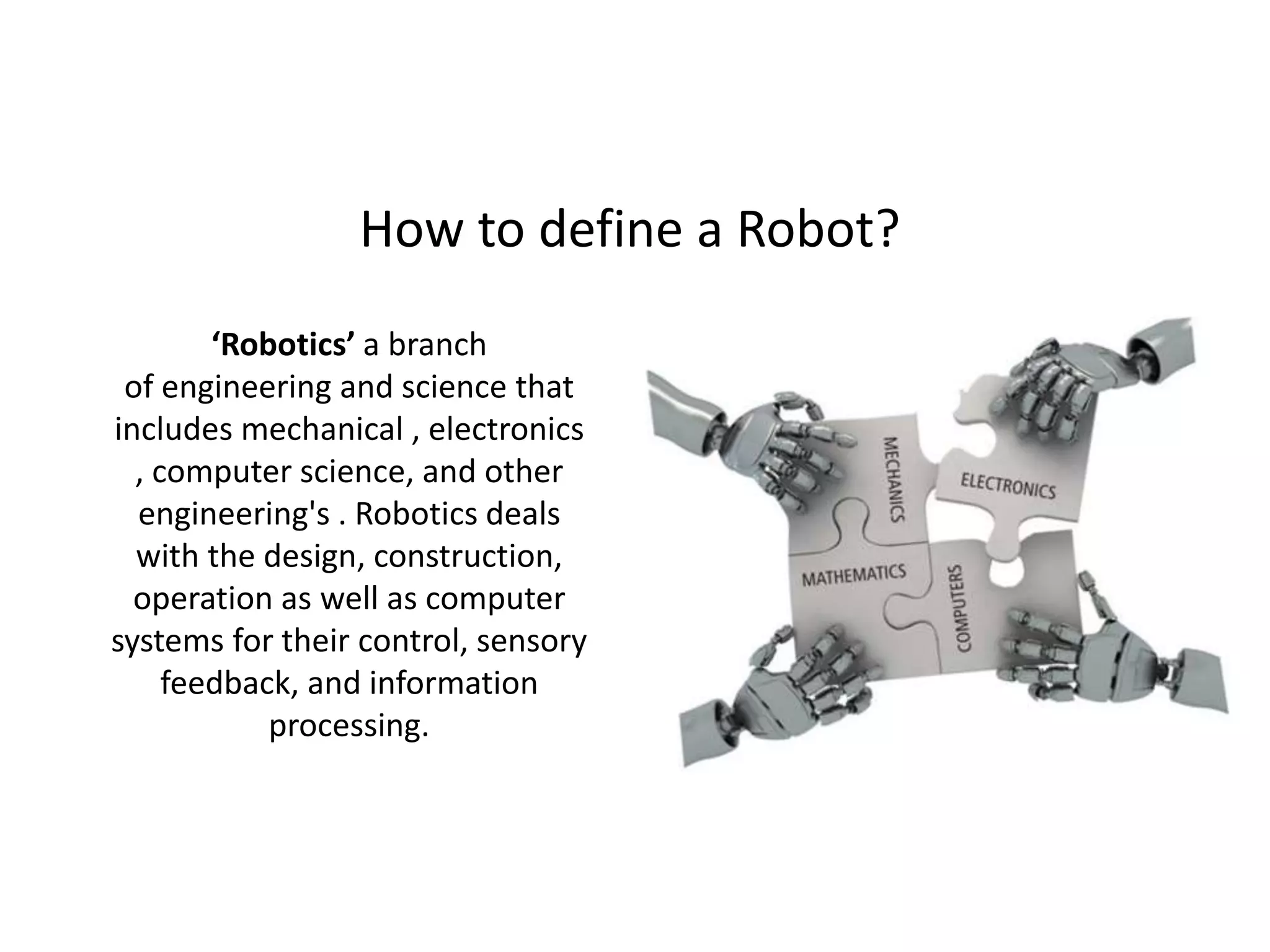
‘Robotics’ a branch
of engineering and science that
includes mechanical , electronics
, computer science, and other
engineering's . Robotics deals
with the design, construction,
operation as well as computer
systems for their control, sensory
feedback, and information
processing.
How to define a Robot?
Laws related to Robotics
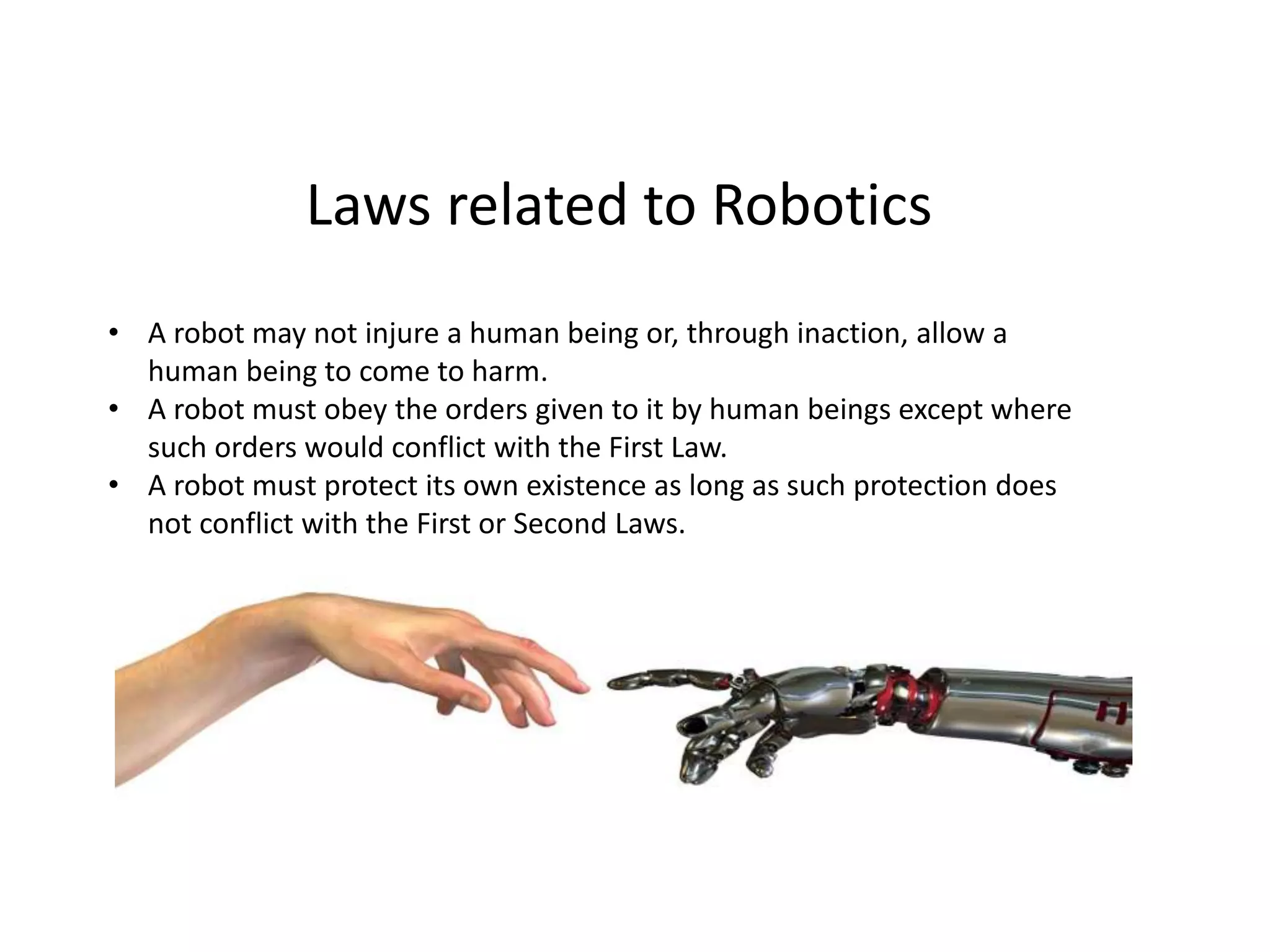
• A robot may not injure a human being or, through inaction, allow a
human being to come to harm.
• A robot must obey the orders given to it by human beings except where
such orders would conflict with the First Law.
• A robot must protect its own existence as long as such protection does
not conflict with the First or Second Laws.
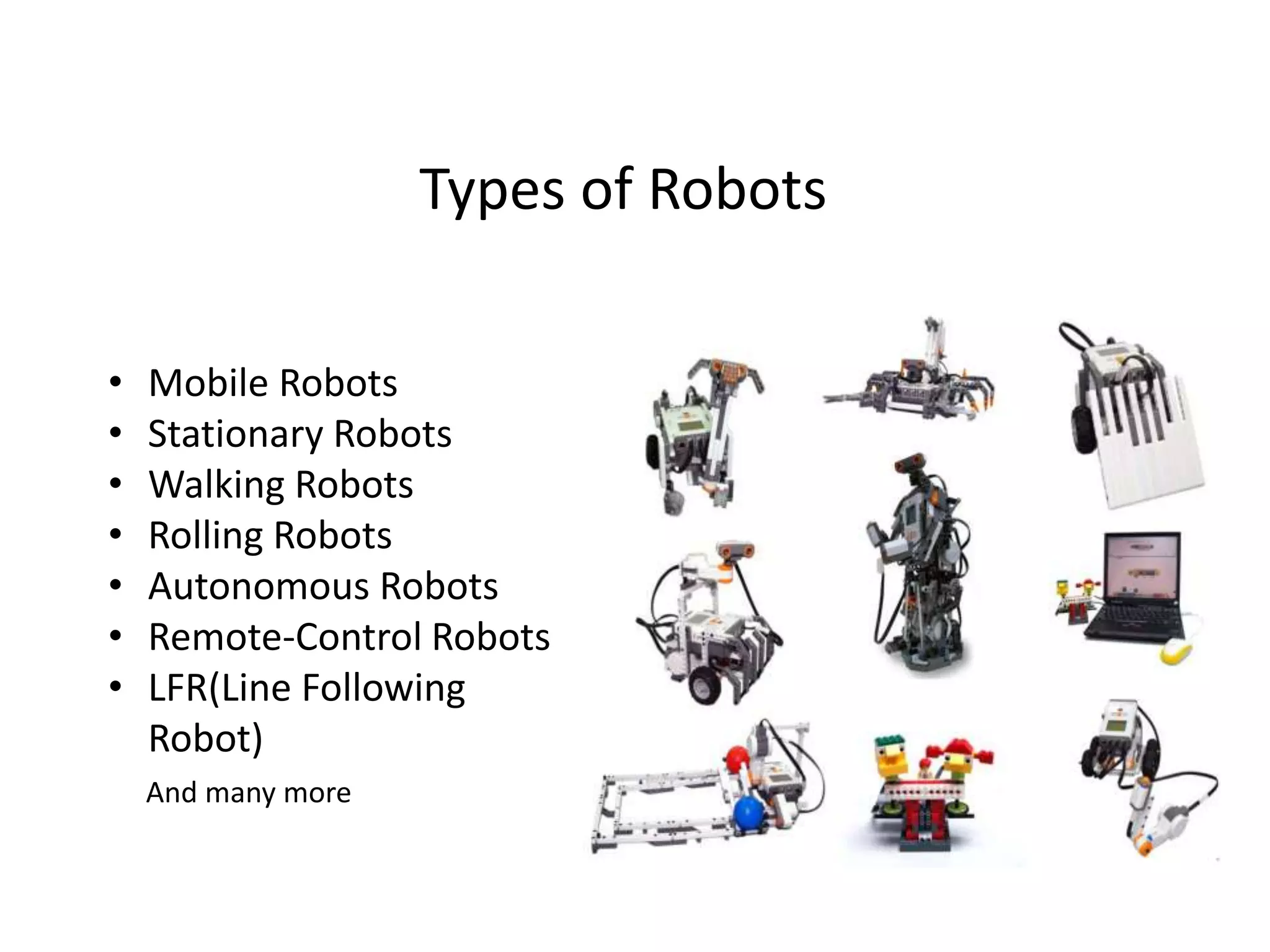
Types of Robots
• Mobile Robots
• Stationary Robots
• Walking Robots
• Rolling Robots
• Autonomous Robots
• Remote-Control Robots
• LFR(Line Following
Robot)
And many more
Mobile Robots
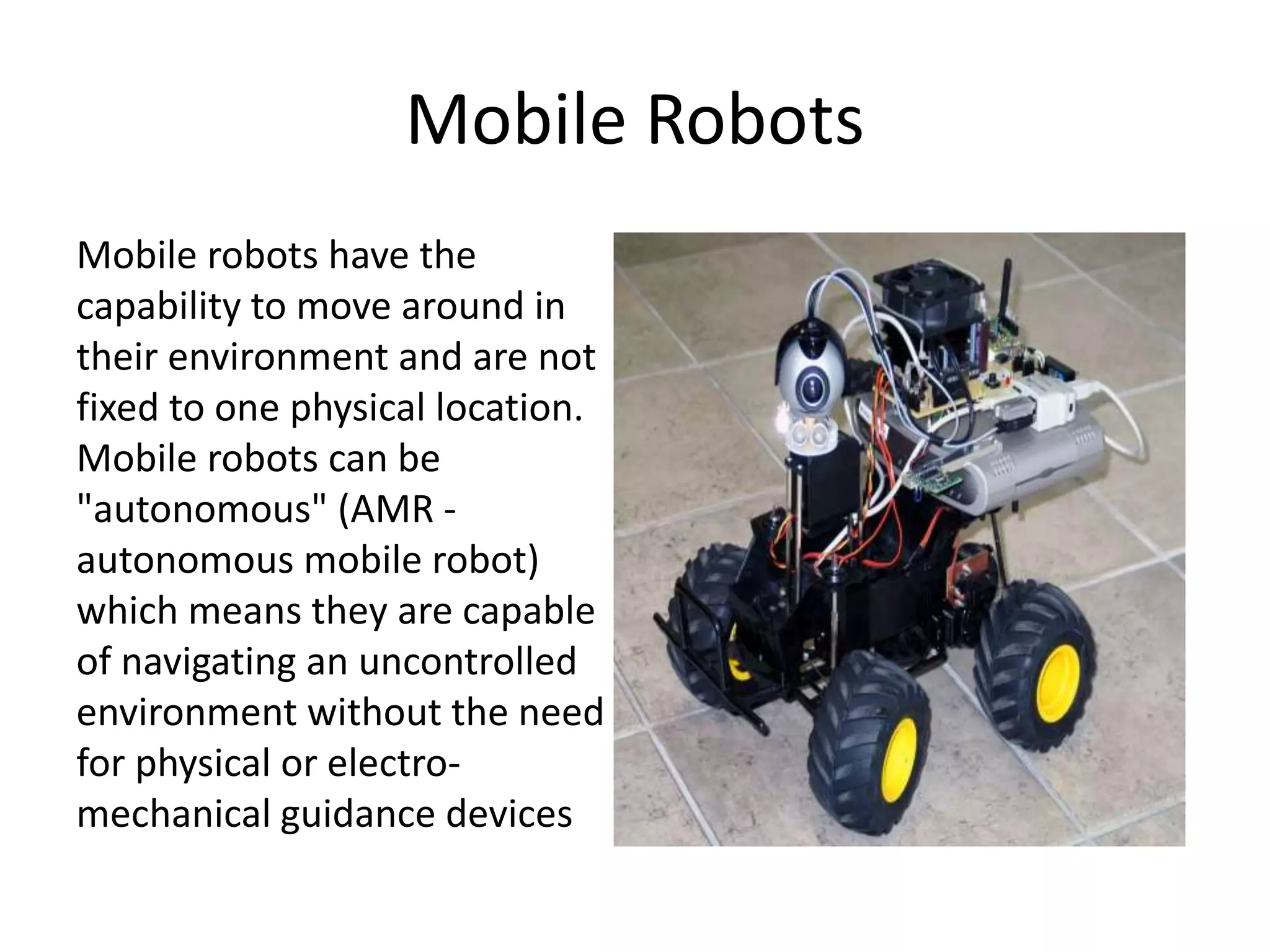
Mobile robots have the
capability to move around in
their environment and are not
fixed to one physical location.
Mobile robots can be
"autonomous" (AMR -
autonomous mobile robot)
which means they are capable
of navigating an uncontrolled
environment without the need
for physical or electro-
mechanical guidance devices
Rolling Robots
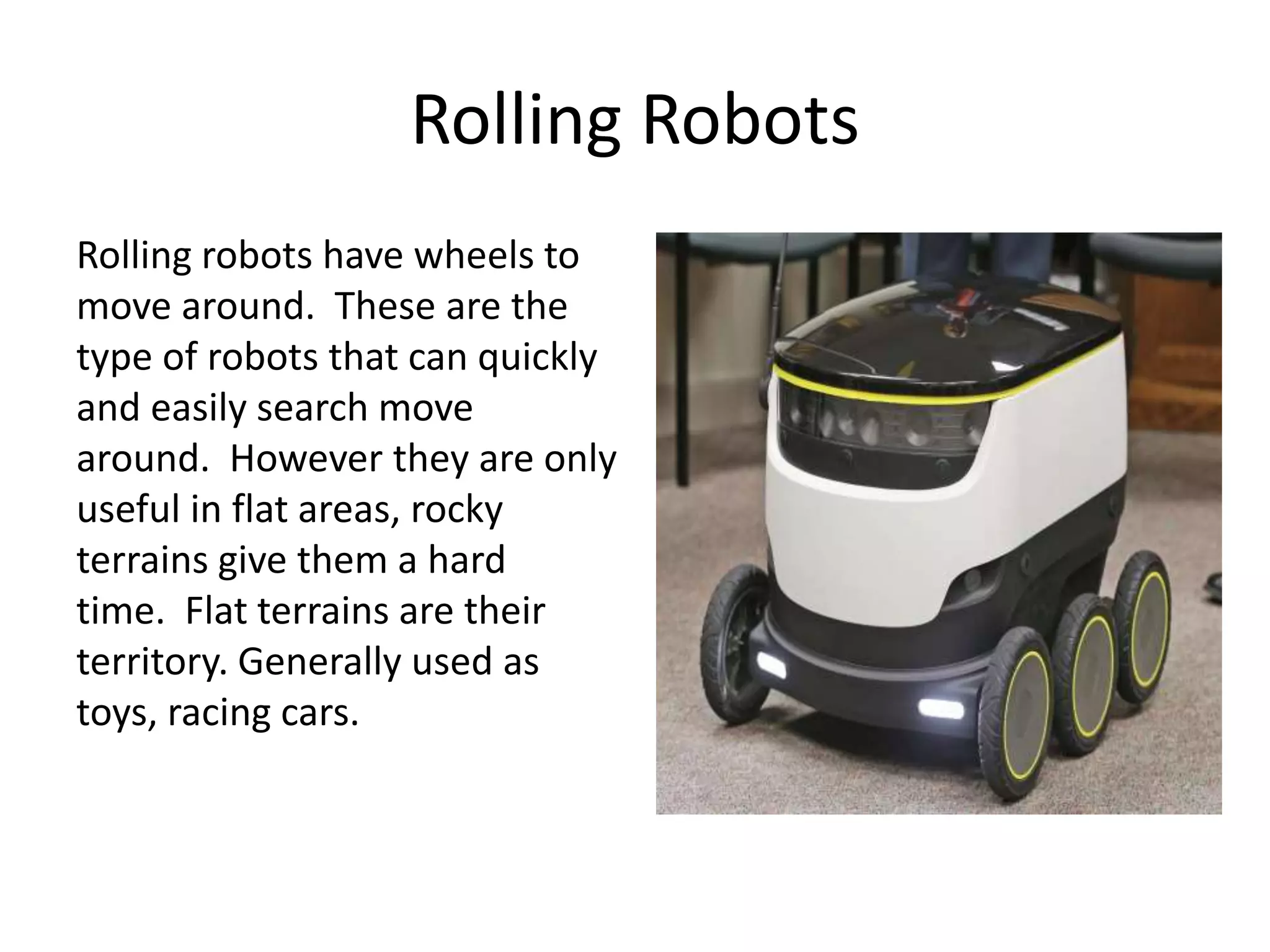
Rolling robots have wheels to
move around. These are the
type of robots that can quickly
and easily search move
around. However they are only
useful in flat areas, rocky
terrains give them a hard
time. Flat terrains are their
territory. Generally used as
toys, racing cars.
Walking Robots
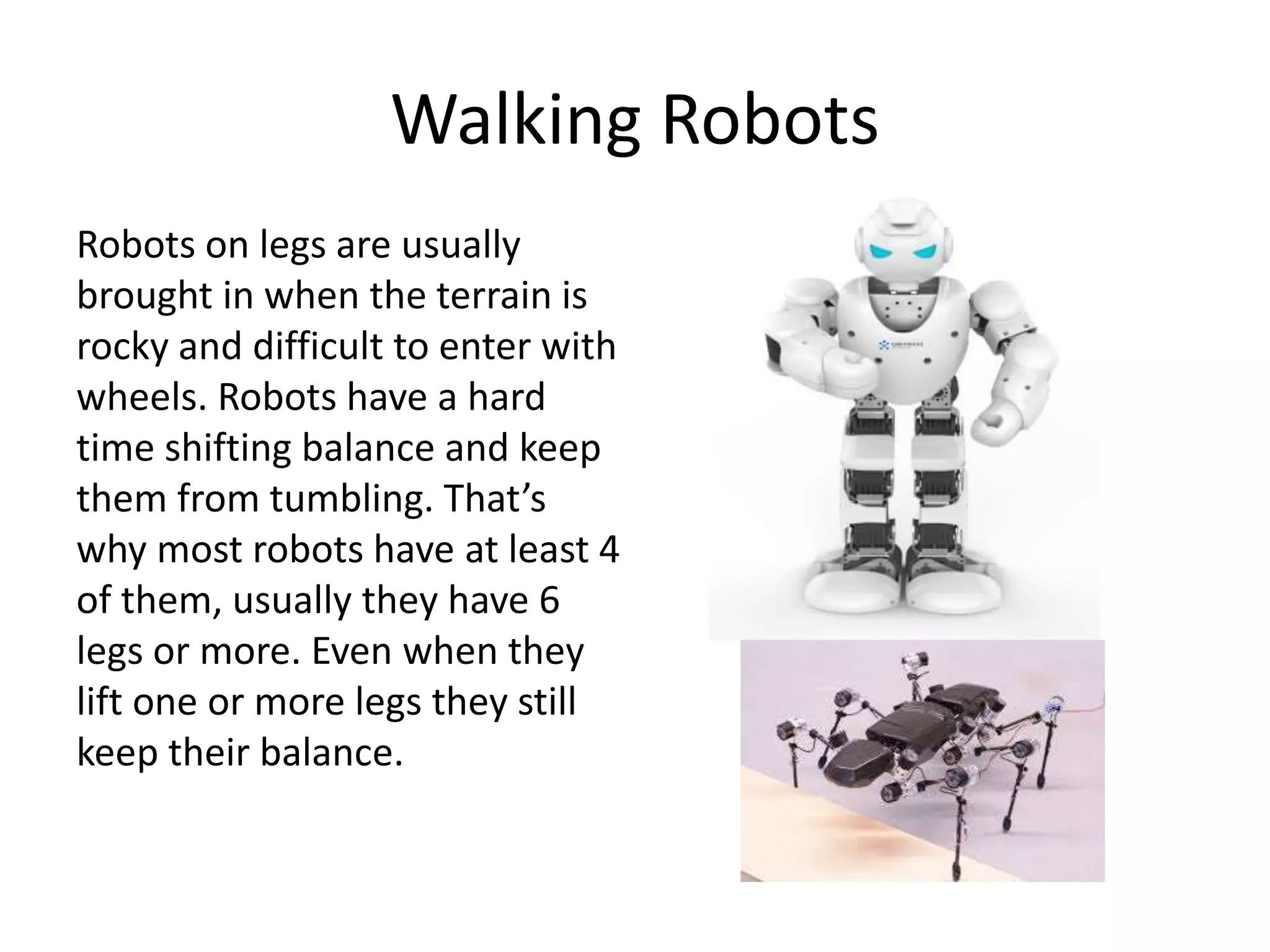
Robots on legs are usually
brought in when the terrain is
rocky and difficult to enter with
wheels. Robots have a hard
time shifting balance and keep
them from tumbling. That’s
why most robots have at least 4
of them, usually they have 6
legs or more. Even when they
lift one or more legs they still
keep their balance.
Stationary Robots
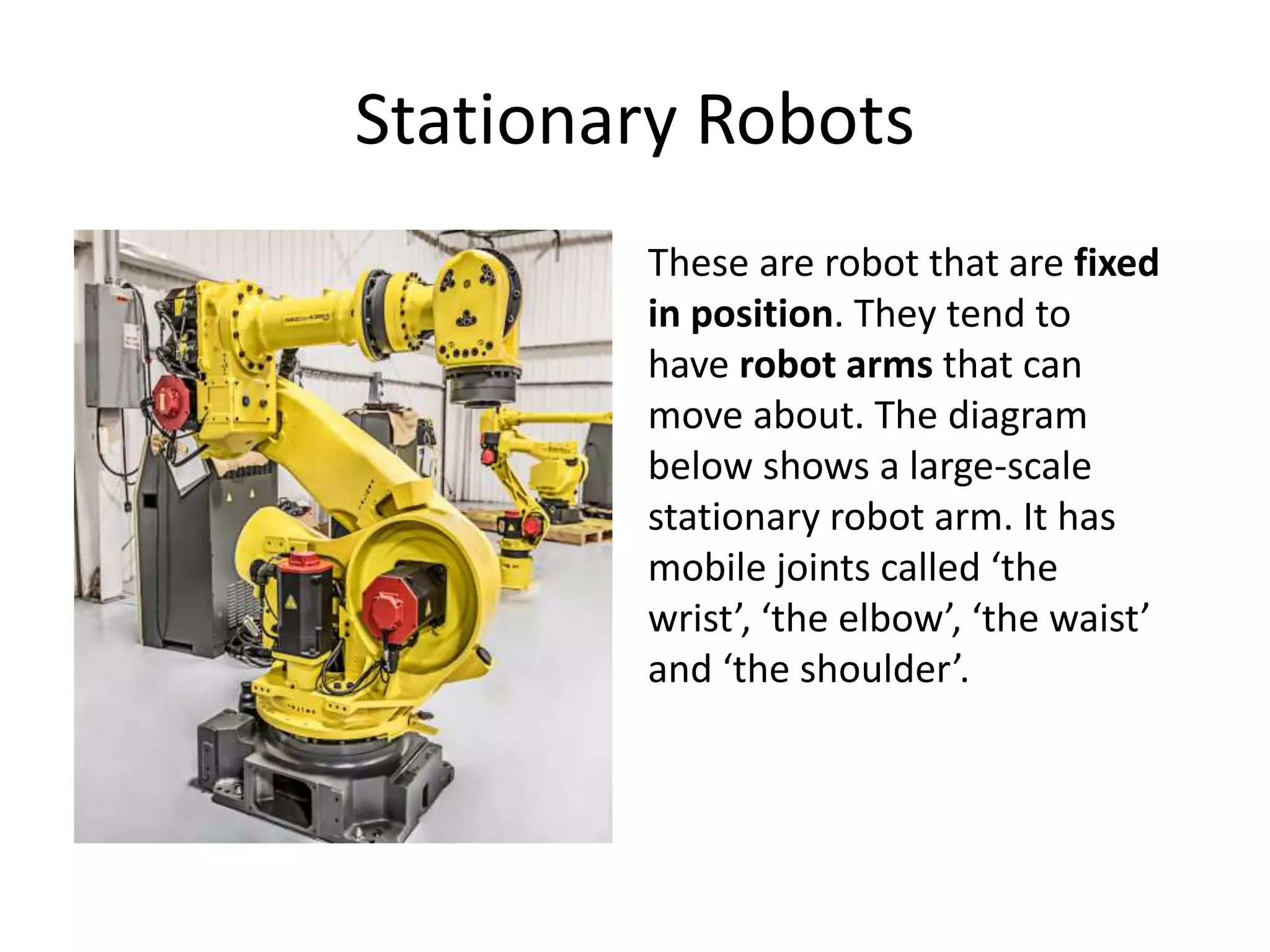
These are robot that are fixed
in position. They tend to
have robot arms that can
move about. The diagram
below shows a large-scale
stationary robot arm. It has
mobile joints called ‘the
wrist’, ‘the elbow’, ‘the waist’
and ‘the shoulder’.
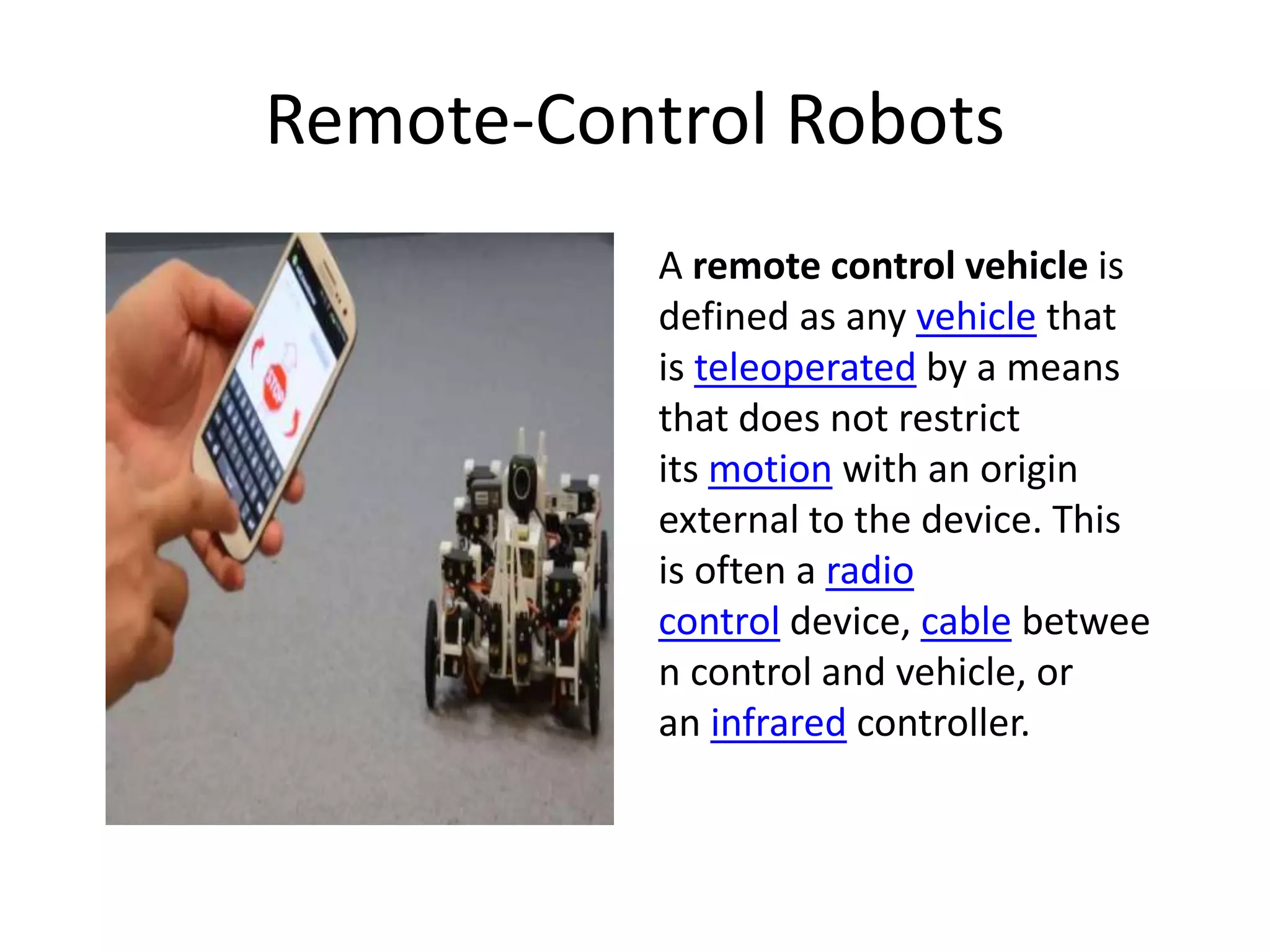
Remote-Control Robots
A remote control vehicle is
defined as any vehicle that
is teleoperated by a means
that does not restrict
its motion with an origin
external to the device. This
is often a radio
control device, cable betwee
n control and vehicle, or
an infrared controller.
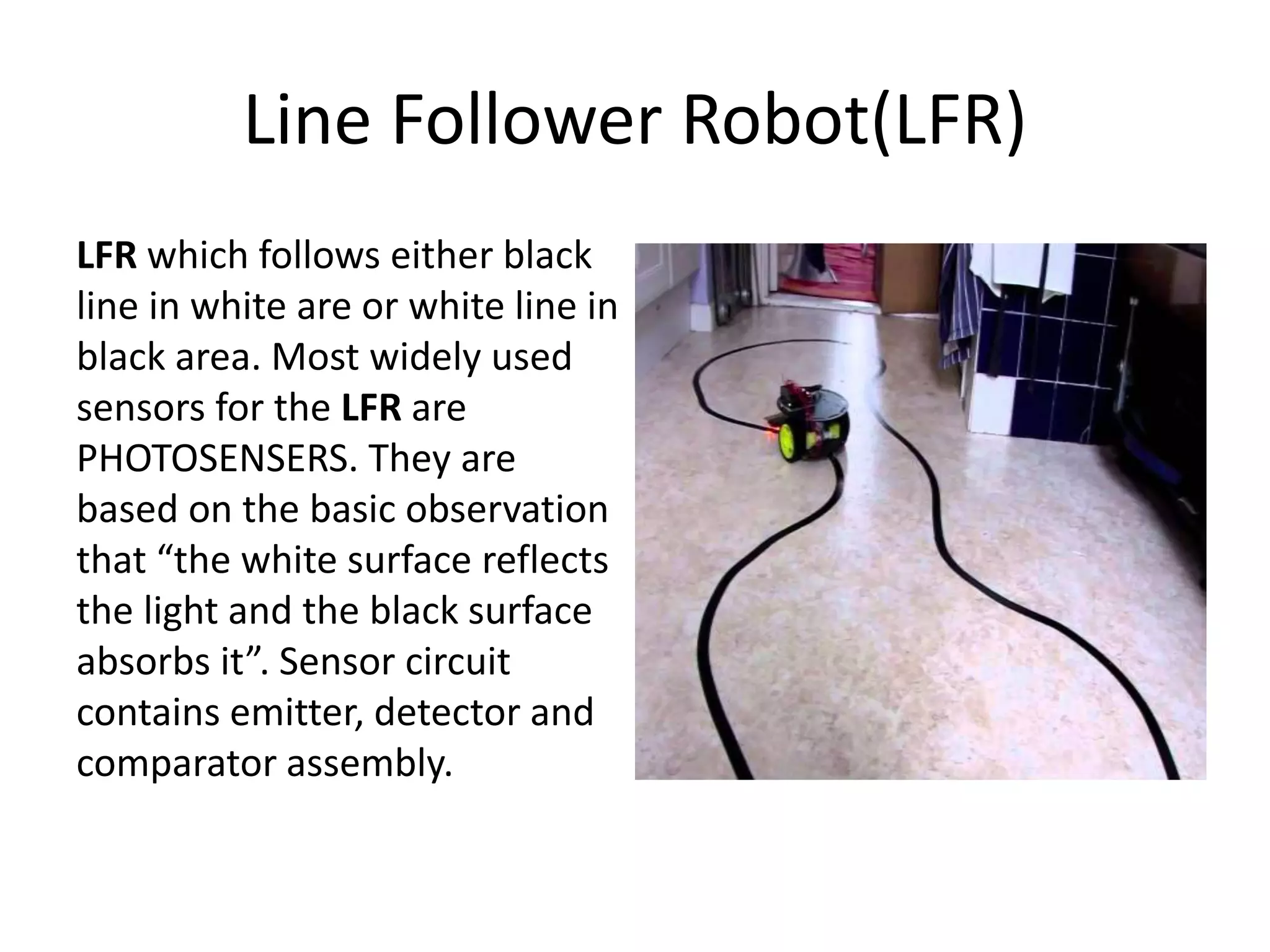
Line Follower Robot(LFR)
LFR which follows either black
line in white are or white line in
black area. Most widely used
sensors for the LFR are
PHOTOSENSERS. They are
based on the basic observation
that “the white surface reflects
the light and the black surface
absorbs it”. Sensor circuit
contains emitter, detector and
comparator assembly.
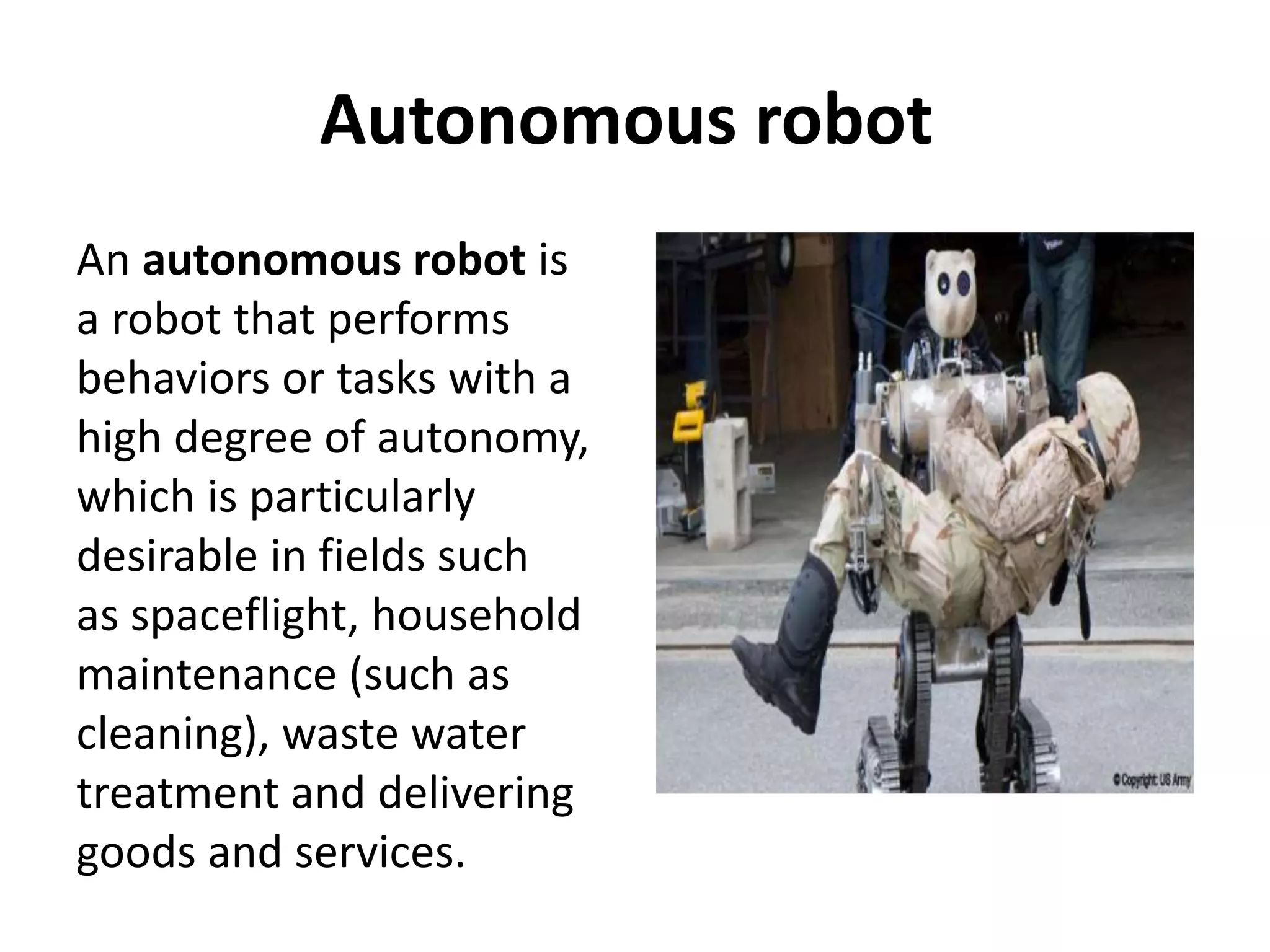
Autonomous robot
An autonomous robot is
a robot that performs
behaviors or tasks with a
high degree of autonomy,
which is particularly
desirable in fields such
as spaceflight, household
maintenance (such as
cleaning), waste water
treatment and delivering
goods and services.
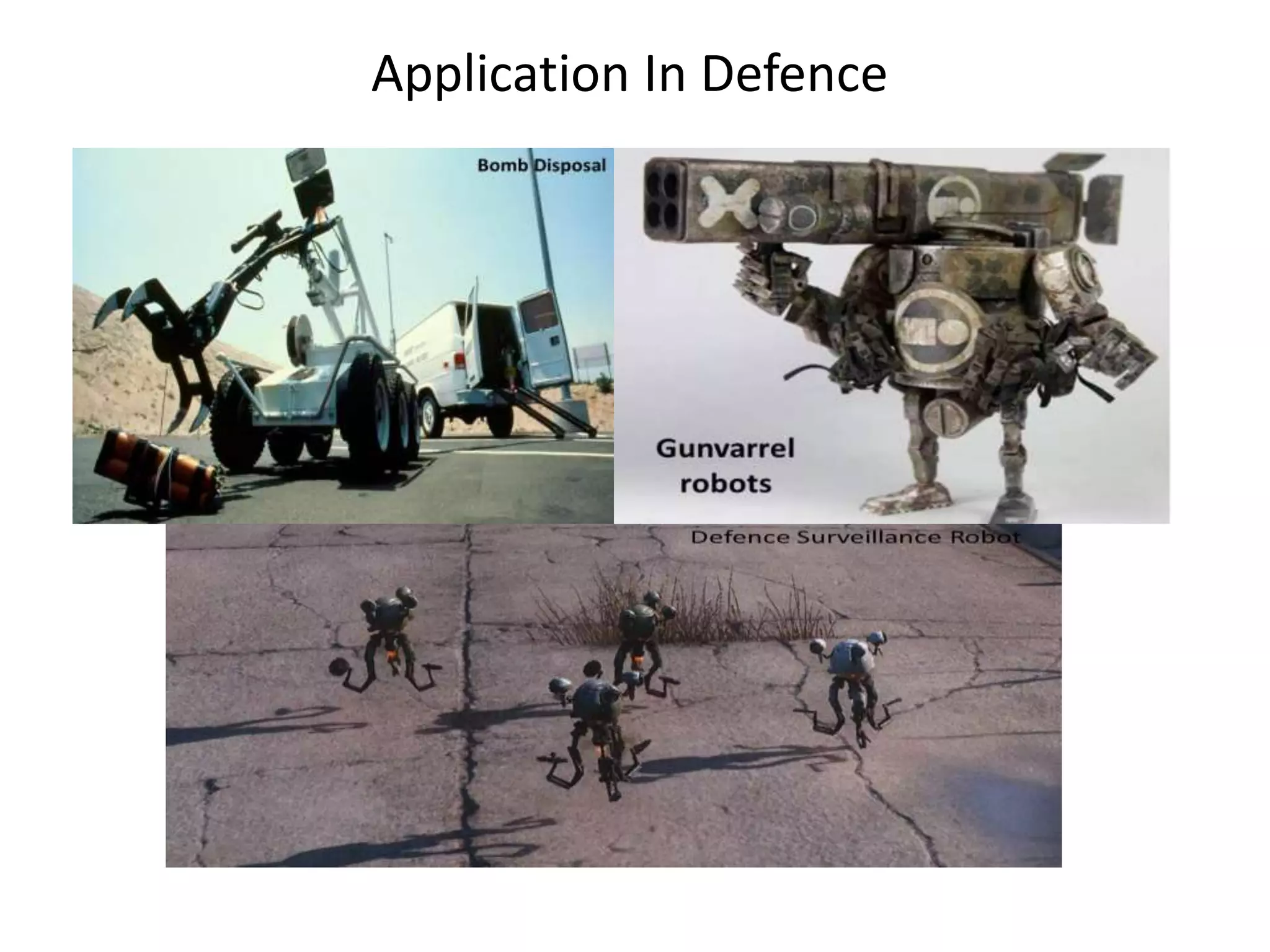
Application In Defence
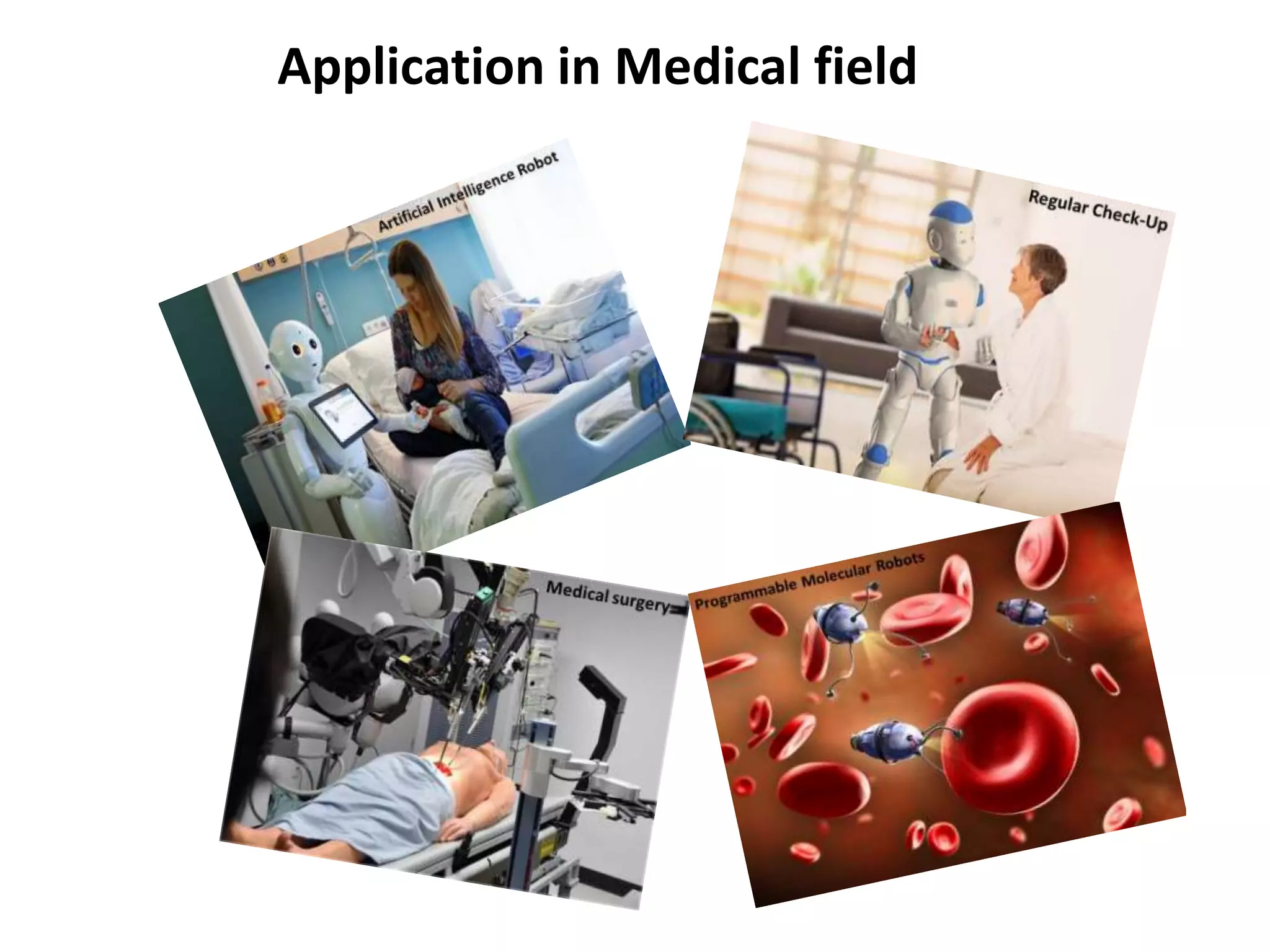
Application in Medical field
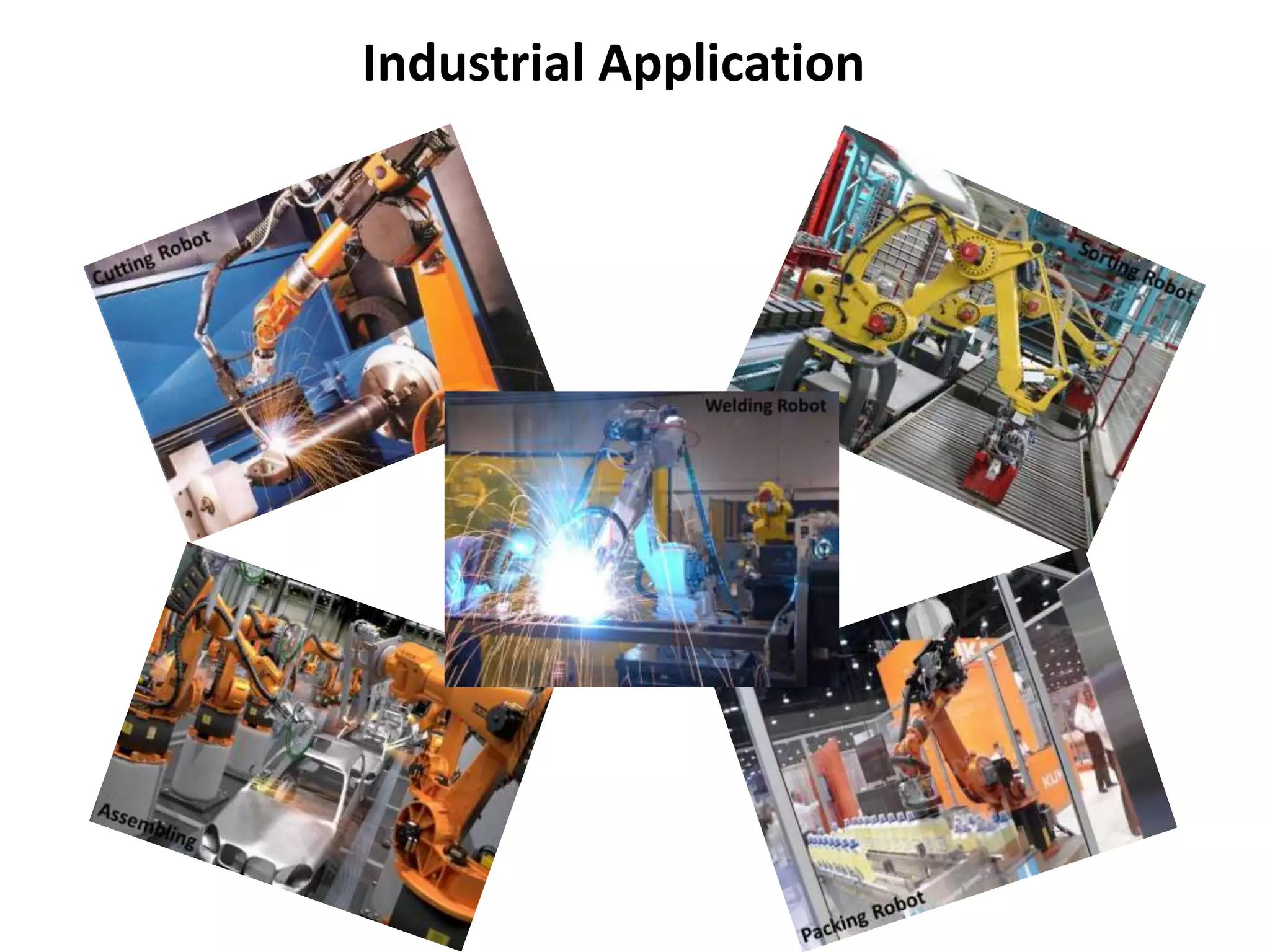
Industrial Application
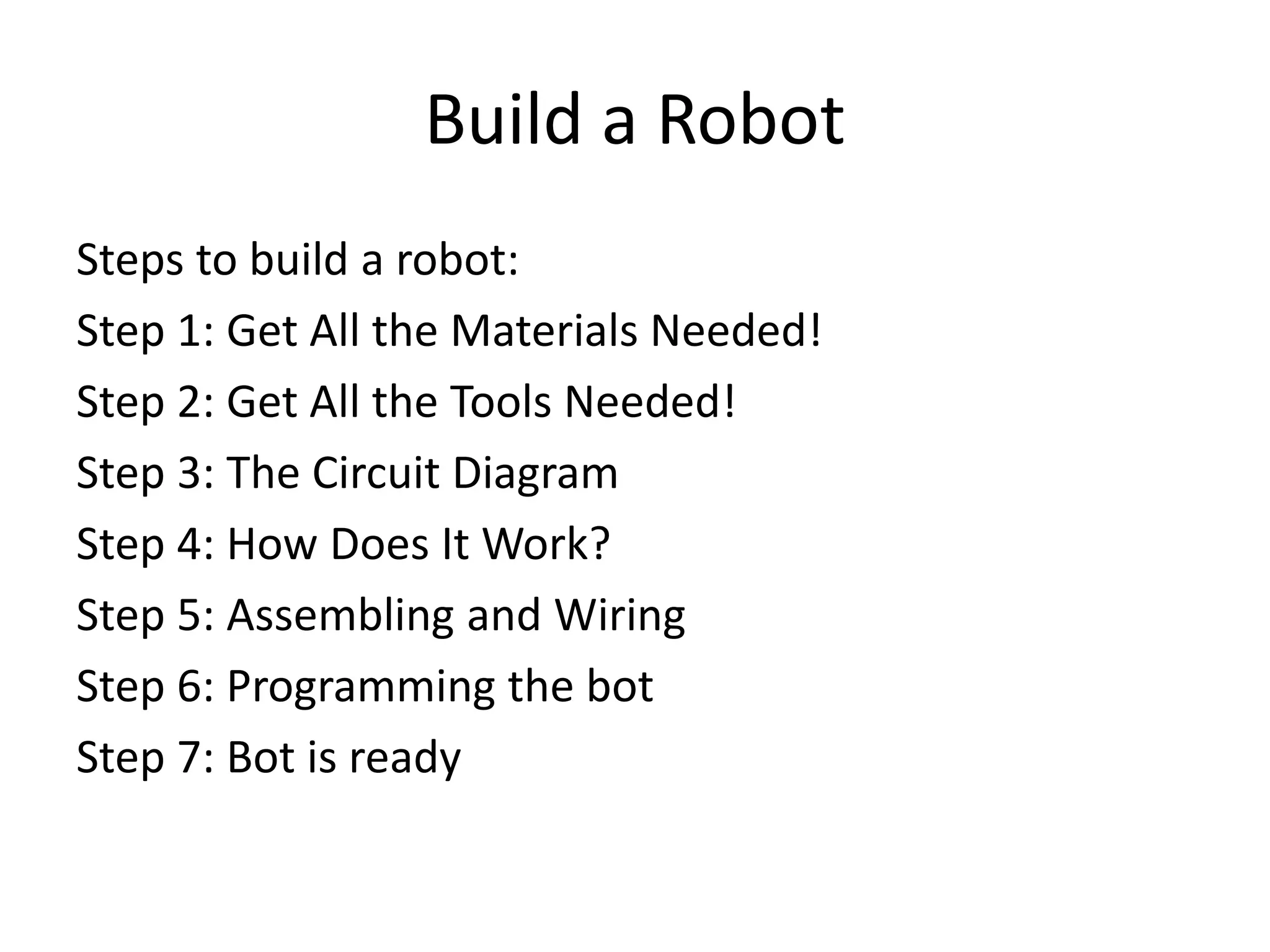
Build a Robot
Steps to build a robot:
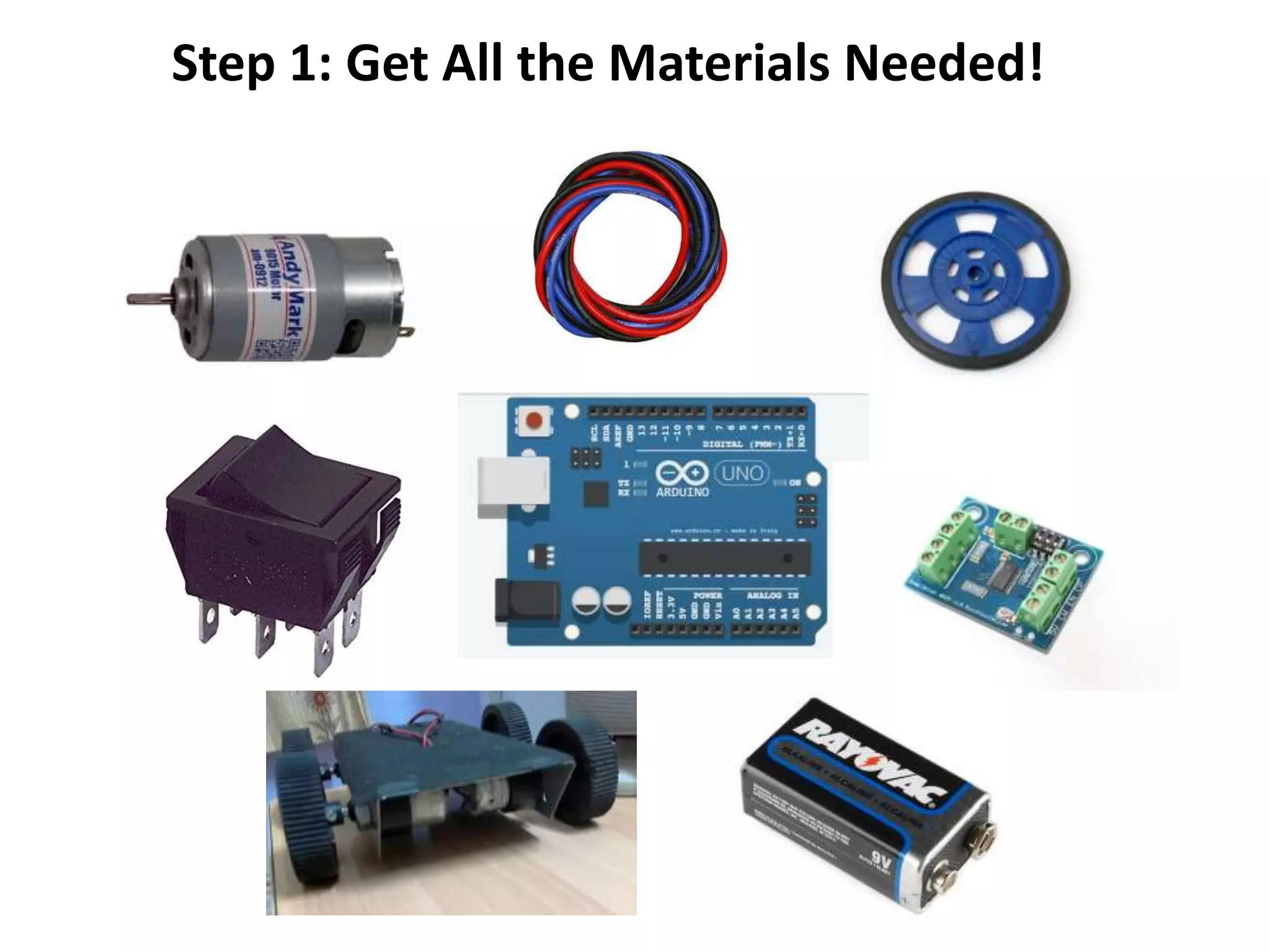
Step 1: Get All the Materials Needed!
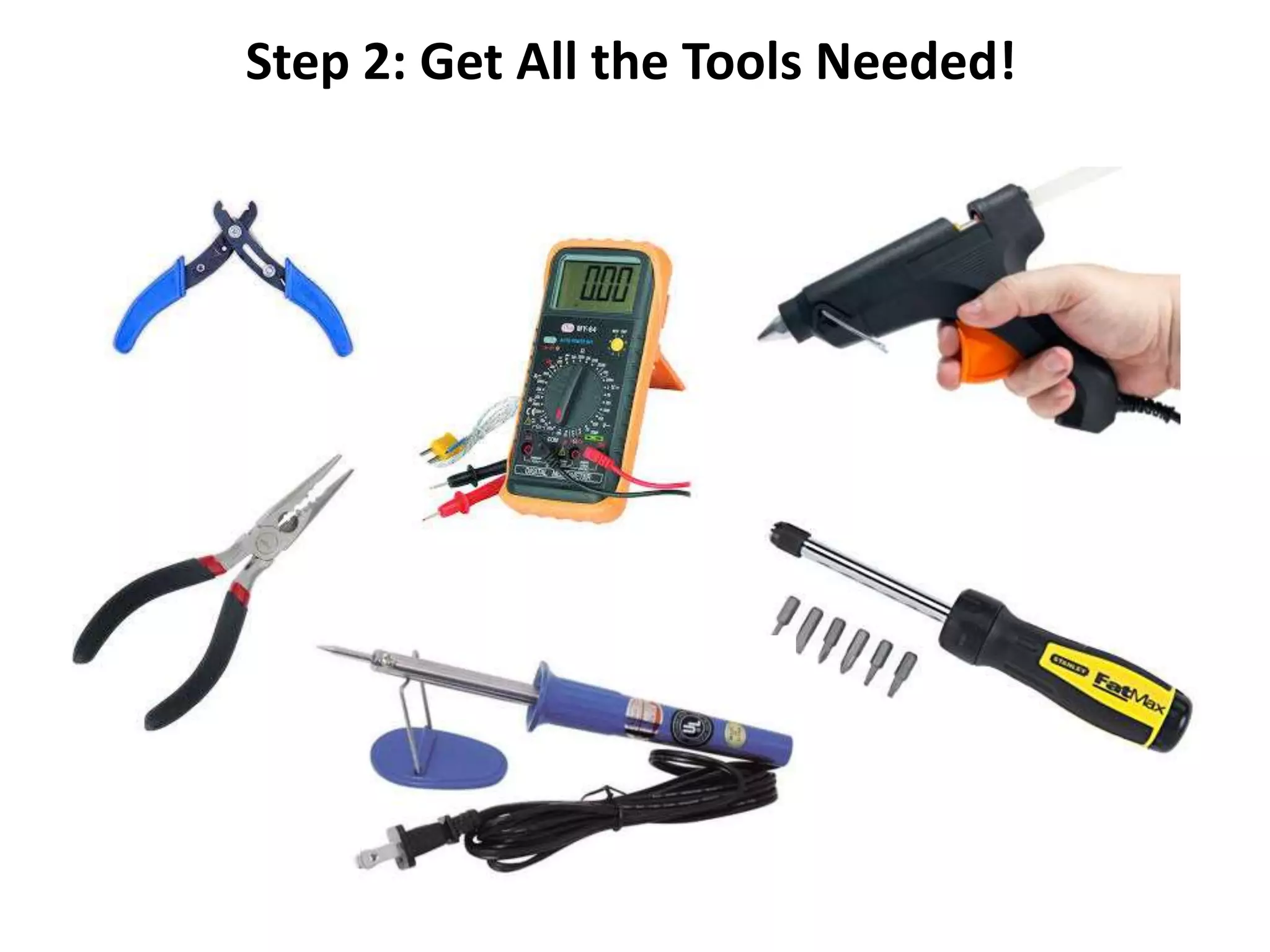
Step 2: Get All the Tools Needed!
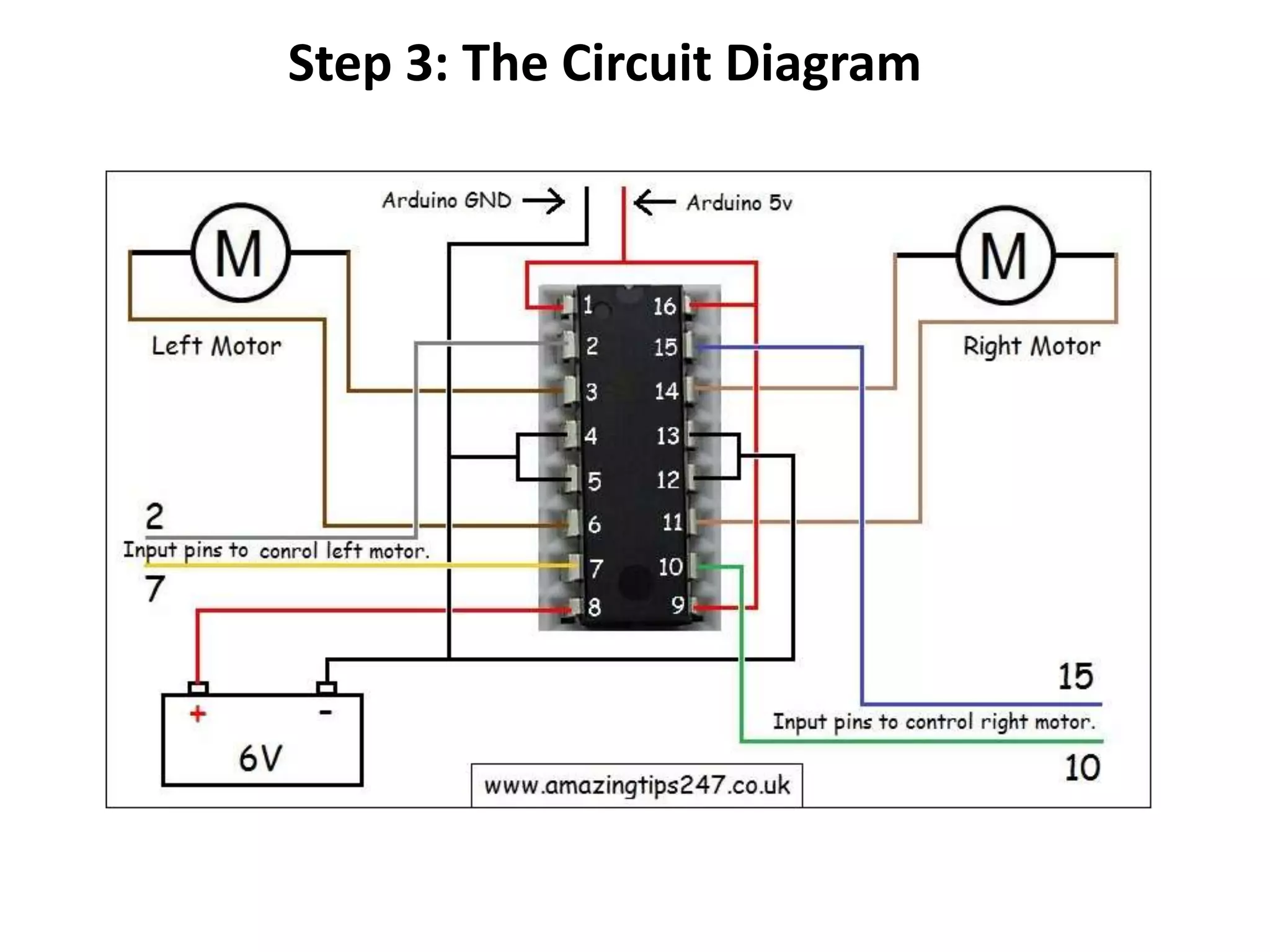
Step 3: The Circuit Diagram
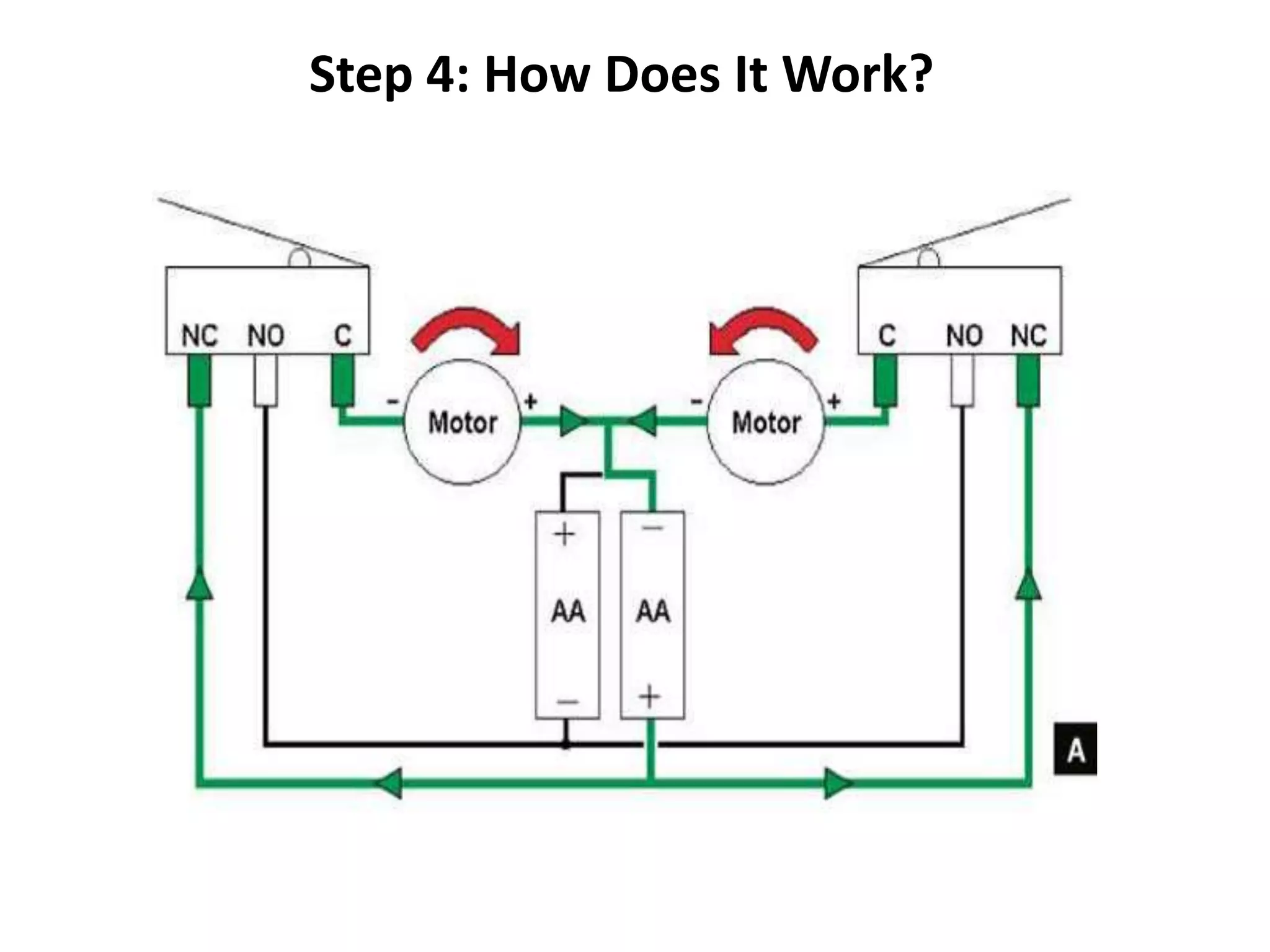
Step 4: How Does It Work?
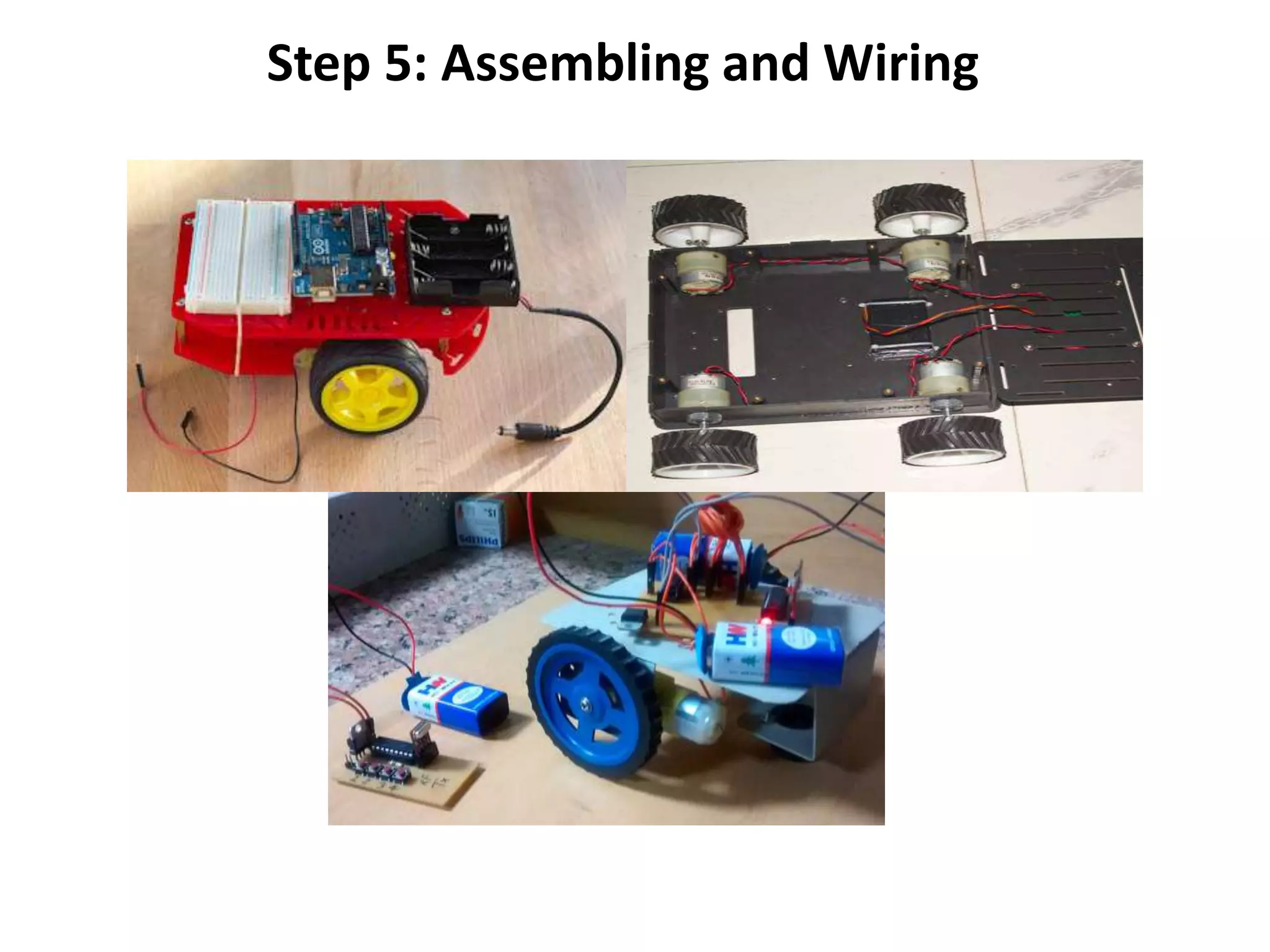
Step 5: Assembling and Wiring
Step 6: Programming the bot
Step 7: Bot is ready
Step 1: Get All the Materials Needed!
Step 2: Get All the Tools Needed!
Step 3: The Circuit Diagram
Step 4: How Does It Work?
Step 5: Assembling and Wiring
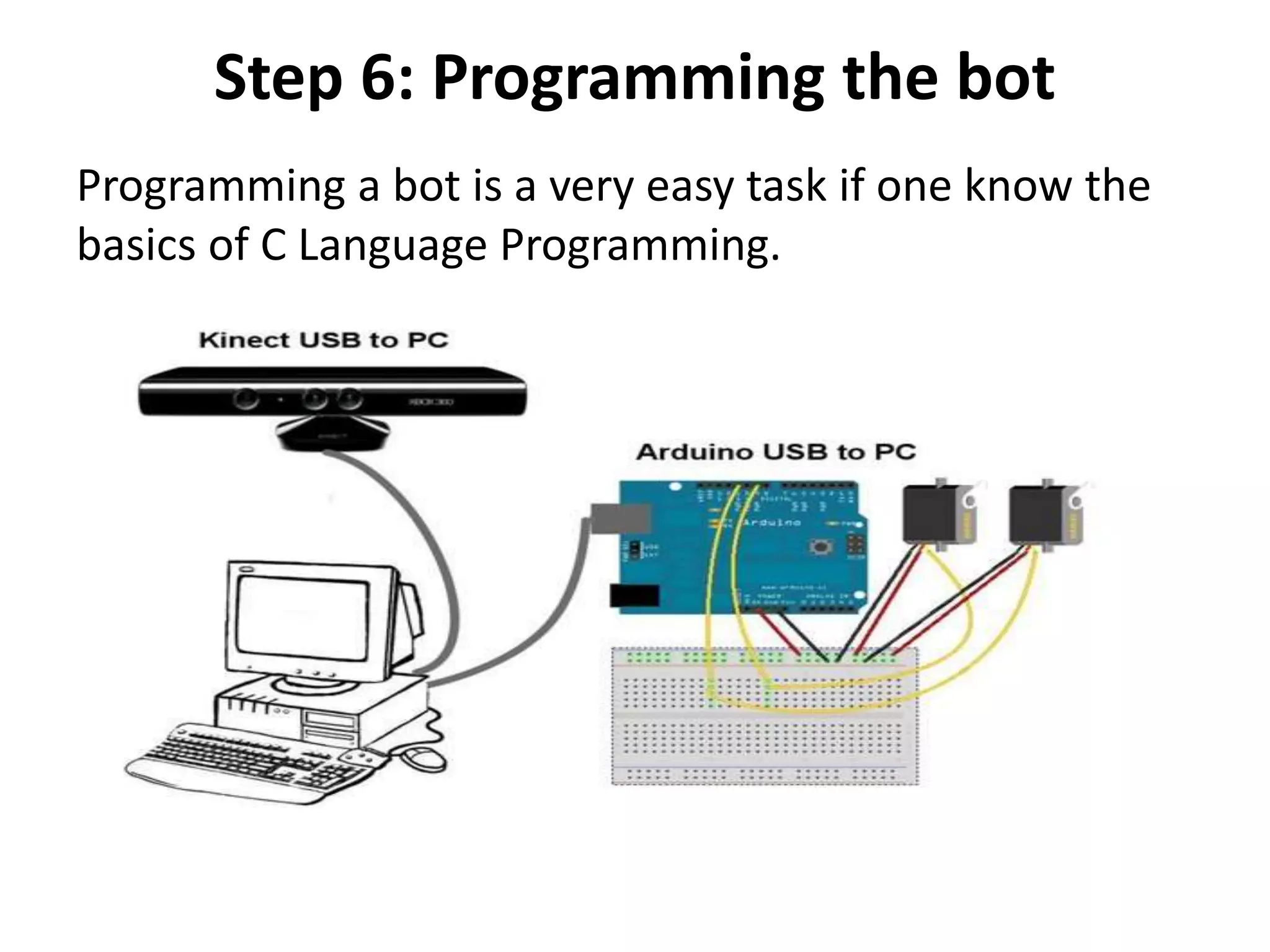
Step 6: Programming the bot
Programming a bot is a very easy task if one know the
basics of C Language Programming.
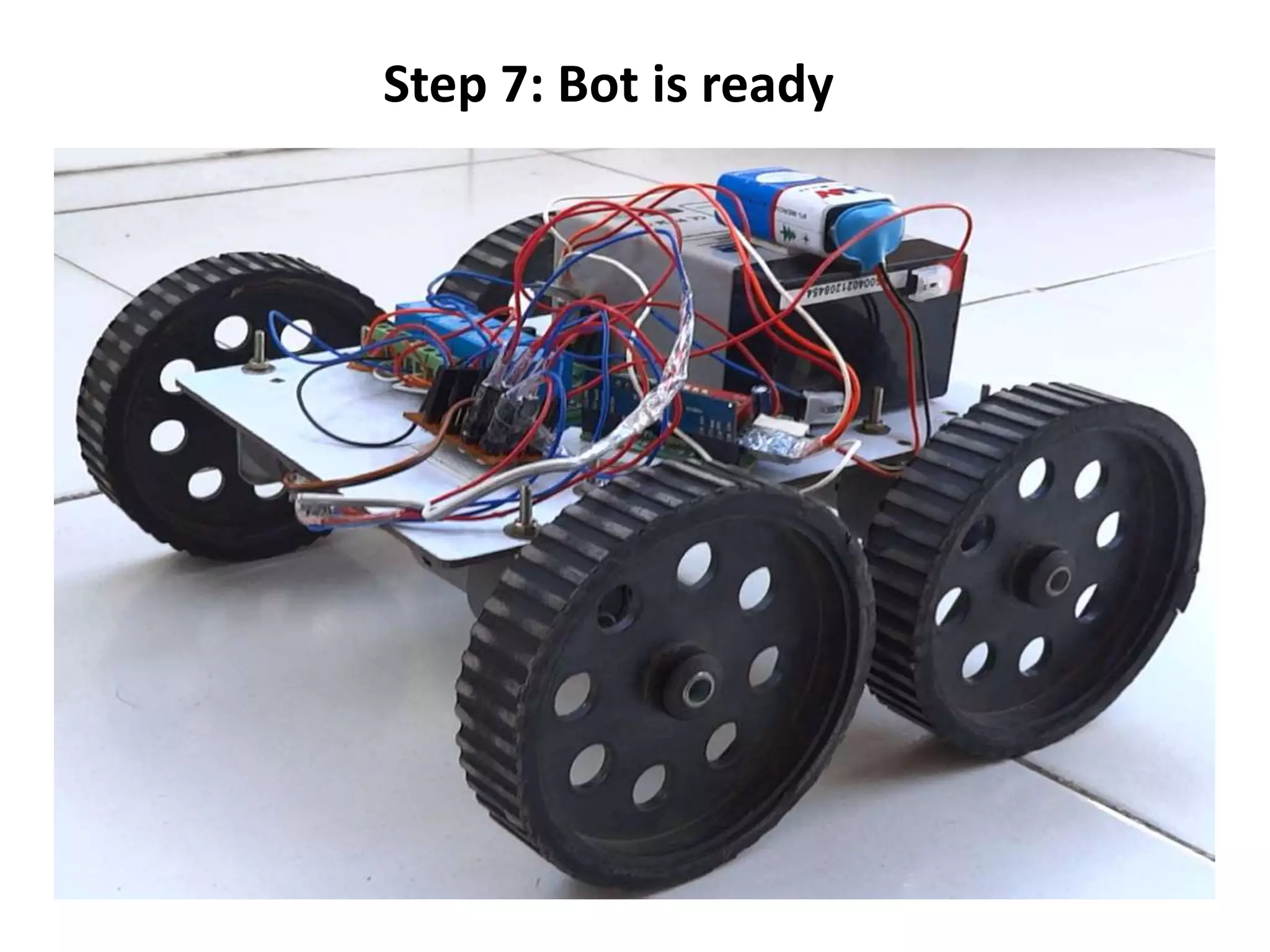
Step 7: Bot is ready
Future Aspect
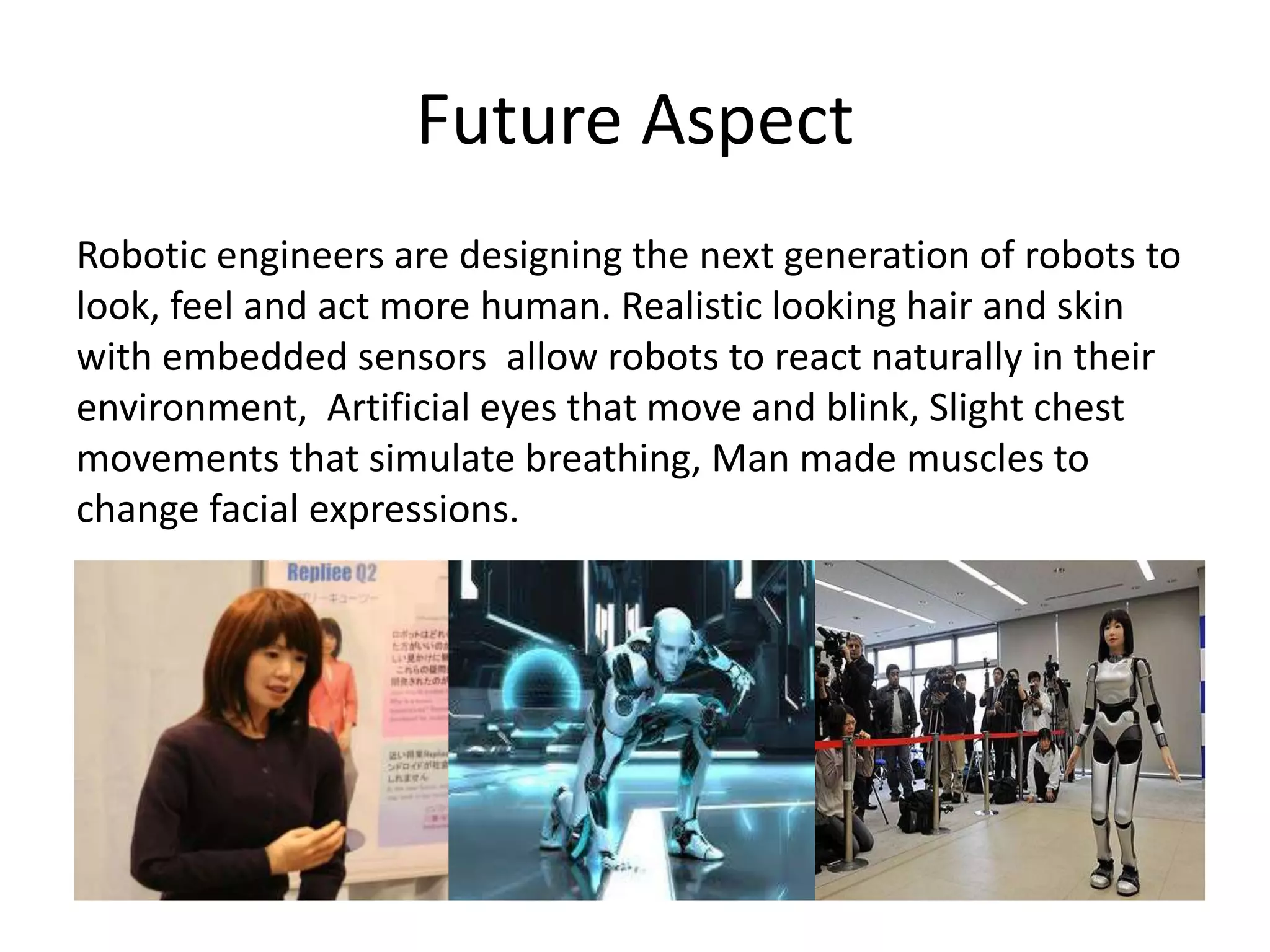
Robotic engineers are designing the next generation of robots to
look, feel and act more human. Realistic looking hair and skin
with embedded sensors allow robots to react naturally in their
environment, Artificial eyes that move and blink, Slight chest
movements that simulate breathing, Man made muscles to
change facial expressions.
Conclusion.
Today we find most robots working for people in
industries, factories, warehouses, and laboratories.
For instance, it boosts economy because businesses
need to be efficient to keep up with the industry
competition. Robots can do jobs better and faster
than humans can, e.g. robot can built, assemble a
car. Yet robots cannot perform every job; today
robots roles include assisting research and industry.
Finally, as the technology improves, there will be
new ways to use robots which will bring new hopes
and new potentials.

Robotics

  • 1.
    A TOUR TO We'refascinated with robots because they are reflections of ourselves. -Ken Goldberg
  • 2.
    ‘Robotics’ a branch ofengineering and science that includes mechanical , electronics , computer science, and other engineering's . Robotics deals with the design, construction, operation as well as computer systems for their control, sensory feedback, and information processing. How to define a Robot?
  • 3.
    Laws related toRobotics • A robot may not injure a human being or, through inaction, allow a human being to come to harm. • A robot must obey the orders given to it by human beings except where such orders would conflict with the First Law. • A robot must protect its own existence as long as such protection does not conflict with the First or Second Laws.
  • 4.
    Types of Robots •Mobile Robots • Stationary Robots • Walking Robots • Rolling Robots • Autonomous Robots • Remote-Control Robots • LFR(Line Following Robot) And many more
  • 5.
    Mobile Robots Mobile robotshave the capability to move around in their environment and are not fixed to one physical location. Mobile robots can be "autonomous" (AMR - autonomous mobile robot) which means they are capable of navigating an uncontrolled environment without the need for physical or electro- mechanical guidance devices
  • 6.
    Rolling Robots Rolling robotshave wheels to move around. These are the type of robots that can quickly and easily search move around. However they are only useful in flat areas, rocky terrains give them a hard time. Flat terrains are their territory. Generally used as toys, racing cars.
  • 7.
    Walking Robots Robots onlegs are usually brought in when the terrain is rocky and difficult to enter with wheels. Robots have a hard time shifting balance and keep them from tumbling. That’s why most robots have at least 4 of them, usually they have 6 legs or more. Even when they lift one or more legs they still keep their balance.
  • 8.
    Stationary Robots These arerobot that are fixed in position. They tend to have robot arms that can move about. The diagram below shows a large-scale stationary robot arm. It has mobile joints called ‘the wrist’, ‘the elbow’, ‘the waist’ and ‘the shoulder’.
  • 9.
    Remote-Control Robots A remotecontrol vehicle is defined as any vehicle that is teleoperated by a means that does not restrict its motion with an origin external to the device. This is often a radio control device, cable betwee n control and vehicle, or an infrared controller.
  • 10.
    Line Follower Robot(LFR) LFRwhich follows either black line in white are or white line in black area. Most widely used sensors for the LFR are PHOTOSENSERS. They are based on the basic observation that “the white surface reflects the light and the black surface absorbs it”. Sensor circuit contains emitter, detector and comparator assembly.
  • 11.
    Autonomous robot An autonomousrobot is a robot that performs behaviors or tasks with a high degree of autonomy, which is particularly desirable in fields such as spaceflight, household maintenance (such as cleaning), waste water treatment and delivering goods and services.
  • 12.
  • 13.
  • 14.
  • 15.
    Build a Robot Stepsto build a robot: Step 1: Get All the Materials Needed! Step 2: Get All the Tools Needed! Step 3: The Circuit Diagram Step 4: How Does It Work? Step 5: Assembling and Wiring Step 6: Programming the bot Step 7: Bot is ready
  • 16.
    Step 1: GetAll the Materials Needed!
  • 17.
    Step 2: GetAll the Tools Needed!
  • 18.
    Step 3: TheCircuit Diagram
  • 19.
    Step 4: HowDoes It Work?
  • 20.
  • 21.
    Step 6: Programmingthe bot Programming a bot is a very easy task if one know the basics of C Language Programming.
  • 22.
    Step 7: Botis ready
  • 23.
    Future Aspect Robotic engineersare designing the next generation of robots to look, feel and act more human. Realistic looking hair and skin with embedded sensors allow robots to react naturally in their environment, Artificial eyes that move and blink, Slight chest movements that simulate breathing, Man made muscles to change facial expressions.
  • 24.
    Conclusion. Today we findmost robots working for people in industries, factories, warehouses, and laboratories. For instance, it boosts economy because businesses need to be efficient to keep up with the industry competition. Robots can do jobs better and faster than humans can, e.g. robot can built, assemble a car. Yet robots cannot perform every job; today robots roles include assisting research and industry. Finally, as the technology improves, there will be new ways to use robots which will bring new hopes and new potentials.