What is a robot?
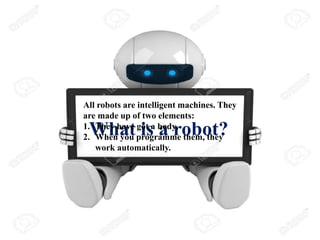
All robots are intelligent machines. They
are made up of two elements:
1. They have got a body.
2. When you programme them, they
work automatically.
The most common types of robots are…
1. Mobile Robots.
2. Stationary Robots.
3. Autonomous Robots.
4. Remote- controlled Robots
5. Virtual Robots.
Mobile Robots
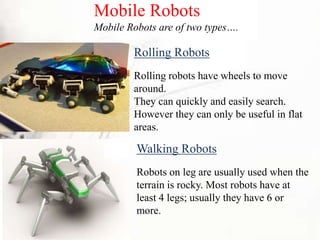
Mobile Robots are of two types….
Rolling Robots
Rolling robots have wheels to move
around.
They can quickly and easily search.
However they can only be useful in flat
areas.
Walking Robots
Robots on leg are usually used when the
terrain is rocky. Most robots have at
least 4 legs; usually they have 6 or
more.
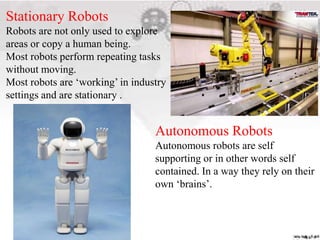
Stationary Robots
Robots are not only used to explore
areas or copy a human being.
Most robots perform repeating tasks
without moving.
Most robots are ‘working’ in industry
settings and are stationary .
Autonomous Robots
Autonomous robots are self
supporting or in other words self
contained. In a way they rely on their
own ‘brains’.
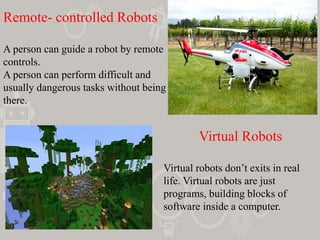
Remote- controlled Robots
A person can guide a robot by remote
controls.
A person can perform difficult and
usually dangerous tasks without being
there.
Virtual Robots
Virtual robots don’t exits in real
life. Virtual robots are just
programs, building blocks of
software inside a computer.
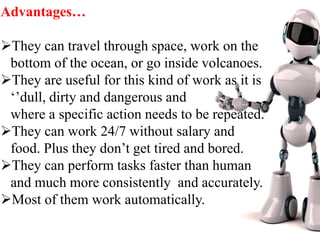
Advantages…
They can travel through space, work on the
bottom of the ocean, or go inside volcanoes.
They are useful for this kind of work as it is
‘’dull, dirty and dangerous and
where a specific action needs to be repeated.
They can work 24/7 without salary and
food. Plus they don’t get tired and bored.
They can perform tasks faster than human
and much more consistently and accurately.
Most of them work automatically.
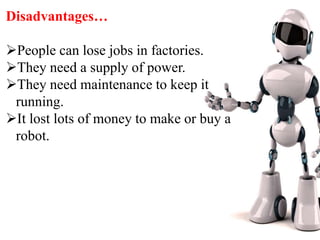
Disadvantages…
People can lose jobs in factories.
They need a supply of power.
They need maintenance to keep it
running.
It lost lots of money to make or buy a
robot.
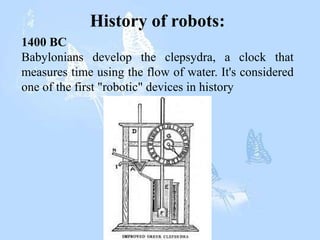
History of robots:
1400 BC
Babylonians develop the clepsydra, a clock that
measures time using the flow of water. It's considered
one of the first "robotic" devices in history
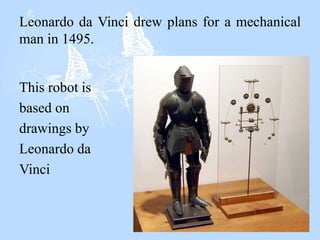
Leonardo da Vinci drew plans for a mechanical
man in 1495.
This robot is
based on
drawings by
Leonardo da
Vinci
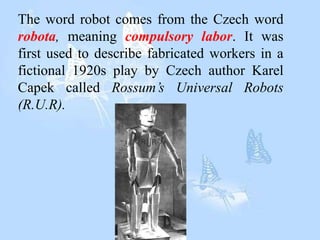
The word robot comes from the Czech word
robota, meaning compulsory labor. It was
first used to describe fabricated workers in a
fictional 1920s play by Czech author Karel
Capek called Rossum’s Universal Robots
(R.U.R).
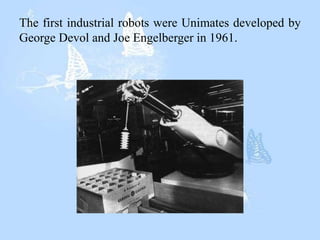
The first industrial robots were Unimates developed by
George Devol and Joe Engelberger in 1961.
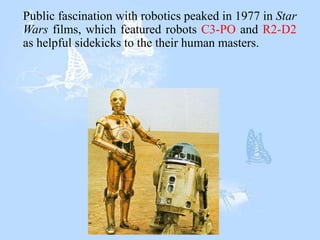
Public fascination with robotics peaked in 1977 in Star
Wars films, which featured robots C3-PO and R2-D2
as helpful sidekicks to the their human masters.
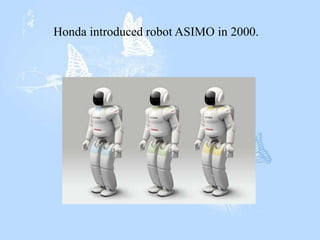
Honda introduced robot ASIMO in 2000.
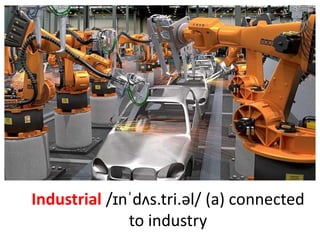
Most robots today industrial robots.
Humans use them to make work easier
and quicker. You often see them in car
factories where they put the cars
together. They are useful for this kind of
work as it is ‘dull, dirty and dangerous’-
DDD. Robots are often used for DDD
jobs and where a specific action needs
to be repeated. It is very difficult for
humans to do this.
There are many different types of
robots. Some robots travel through
space, work on the bottom of the
ocean, or go inside volcanoes. They
do the work of people, but for a different
reason this time: these are places that
are very dangerous for people, or
impossible for people to go to.
Robots are everywhere. Most people
don’t know that robots help us every day
and in many different ways. In most
houses there are robots. For example,
in some houses today there is a
washing machine in the kitchen.
Washing machines are robots. People
can programme them and then they
wash clothes automatically.
Some scientists make robots for fun. For
example, the dogs in this photo.
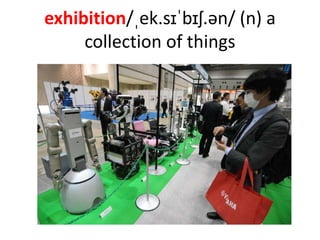
Japan produces the most robots. Every
year in the capital, Tokyo, there is a robot
exhibition called Robodex. It is the
largest robot exhibition in the world.
Use the words below to make a sentence.
1. easier/ Robots/ make/ quicker
2. do/ difficult/ people/ ‘dull, dirty and dangerous jobs’.
3. robots/ types/ different
4. People/ programme/ robots / do/ work/ autimatically.
5. Robodex/ exhibition/ largest/ the world.
Robots make work/life easier and quicker.
It is difficult for people to do ‘dull, dirty and
dangerous jobs’.
There are many different types of robots.
People can programme robots to do work
automatically.
Robodex is the largest robot exhibition in the
world.
Industrial /ɪnˈdʌs.tri.əl/ (a) connected
to industry
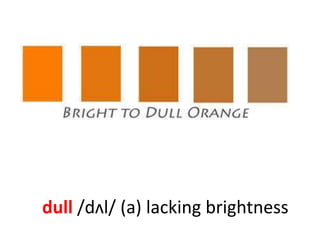
dull /dʌl/ (a) lacking brightness
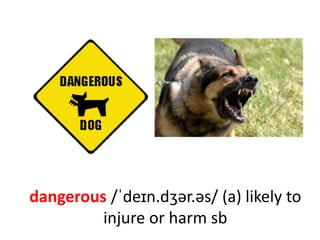
dangerous /ˈdeɪn.dʒər.əs/ (a) likely to
injure or harm sb
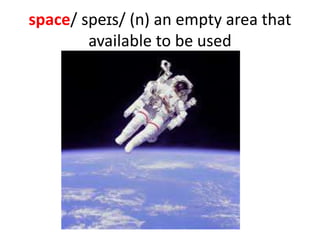
space/ speɪs/ (n) an empty area that
available to be used
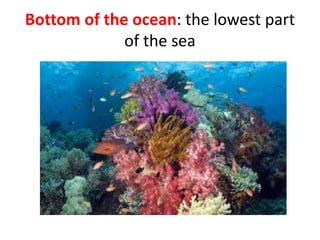
Bottom of the ocean: the lowest part
of the sea
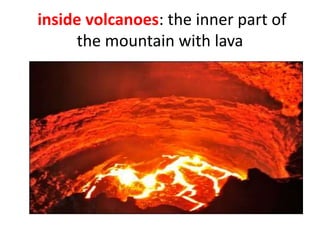
inside volcanoes: the inner part of
the mountain with lava
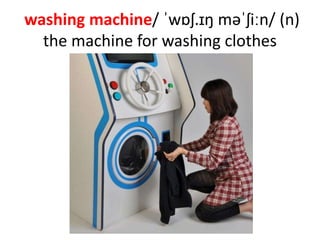
washing machine/ ˈwɒʃ.ɪŋ məˈʃiːn/ (n)
the machine for washing clothes
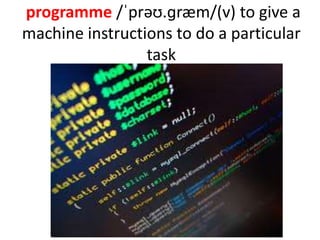
programme /ˈprəʊ.ɡræm/(v) to give a
machine instructions to do a particular
task
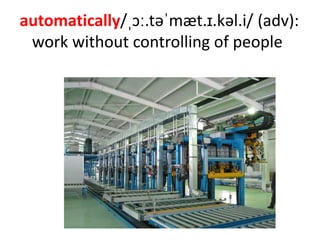
automatically/ˌɔː.təˈmæt.ɪ.kəl.i/ (adv):
work without controlling of people
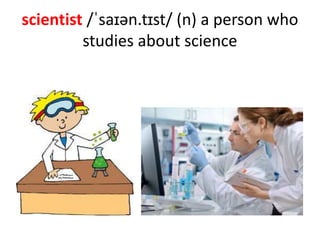
scientist /ˈsaɪən.tɪst/ (n) a person who
studies about science
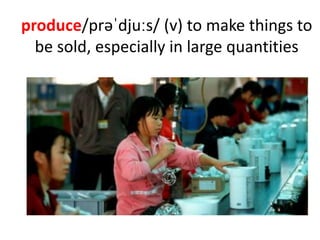
produce/prəˈdjuːs/ (v) to make things to
be sold, especially in large quantities
exhibition/ˌek.sɪˈbɪʃ.ən/ (n) a
collection of things
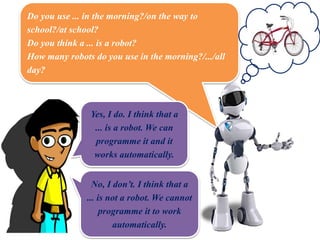
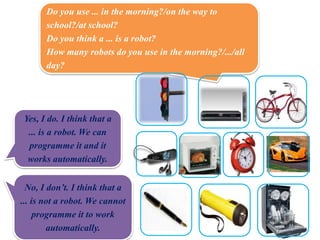
Do you use ... in the morning?/on the way to
school?/at school?
Do you think a ... is a robot?
How many robots do you use in the morning?/.../all
day?
Yes, I do. I think that a
... is a robot. We can
programme it and it
works automatically.
No, I don’t. I think that a
... is not a robot. We cannot
programme it to work
automatically.
Do you use ... in the morning?/on the way to
school?/at school?
Do you think a ... is a robot?
How many robots do you use in the morning?/.../all
day?
Yes, I do. I think that a
... is a robot. We can
programme it and it
works automatically.
No, I don’t. I think that a
... is not a robot. We cannot
programme it to work
automatically.
Most incredible robots!
Robots

Robots

  • 2.
    What is arobot? All robots are intelligent machines. They are made up of two elements: 1. They have got a body. 2. When you programme them, they work automatically.
  • 3.
    The most commontypes of robots are… 1. Mobile Robots. 2. Stationary Robots. 3. Autonomous Robots. 4. Remote- controlled Robots 5. Virtual Robots.
  • 4.
    Mobile Robots Mobile Robotsare of two types…. Rolling Robots Rolling robots have wheels to move around. They can quickly and easily search. However they can only be useful in flat areas. Walking Robots Robots on leg are usually used when the terrain is rocky. Most robots have at least 4 legs; usually they have 6 or more.
  • 5.
    Stationary Robots Robots arenot only used to explore areas or copy a human being. Most robots perform repeating tasks without moving. Most robots are ‘working’ in industry settings and are stationary . Autonomous Robots Autonomous robots are self supporting or in other words self contained. In a way they rely on their own ‘brains’.
  • 6.
    Remote- controlled Robots Aperson can guide a robot by remote controls. A person can perform difficult and usually dangerous tasks without being there. Virtual Robots Virtual robots don’t exits in real life. Virtual robots are just programs, building blocks of software inside a computer.
  • 7.
    Advantages… They can travelthrough space, work on the bottom of the ocean, or go inside volcanoes. They are useful for this kind of work as it is ‘’dull, dirty and dangerous and where a specific action needs to be repeated. They can work 24/7 without salary and food. Plus they don’t get tired and bored. They can perform tasks faster than human and much more consistently and accurately. Most of them work automatically.
  • 8.
    Disadvantages… People can losejobs in factories. They need a supply of power. They need maintenance to keep it running. It lost lots of money to make or buy a robot.
  • 9.
    History of robots: 1400BC Babylonians develop the clepsydra, a clock that measures time using the flow of water. It's considered one of the first "robotic" devices in history
  • 10.
    Leonardo da Vincidrew plans for a mechanical man in 1495. This robot is based on drawings by Leonardo da Vinci
  • 11.
    The word robotcomes from the Czech word robota, meaning compulsory labor. It was first used to describe fabricated workers in a fictional 1920s play by Czech author Karel Capek called Rossum’s Universal Robots (R.U.R).
  • 12.
    The first industrialrobots were Unimates developed by George Devol and Joe Engelberger in 1961.
  • 13.
    Public fascination withrobotics peaked in 1977 in Star Wars films, which featured robots C3-PO and R2-D2 as helpful sidekicks to the their human masters.
  • 14.
    Honda introduced robotASIMO in 2000.
  • 15.
    Most robots todayindustrial robots. Humans use them to make work easier and quicker. You often see them in car factories where they put the cars together. They are useful for this kind of work as it is ‘dull, dirty and dangerous’- DDD. Robots are often used for DDD jobs and where a specific action needs to be repeated. It is very difficult for humans to do this.
  • 16.
    There are manydifferent types of robots. Some robots travel through space, work on the bottom of the ocean, or go inside volcanoes. They do the work of people, but for a different reason this time: these are places that are very dangerous for people, or impossible for people to go to.
  • 17.
    Robots are everywhere.Most people don’t know that robots help us every day and in many different ways. In most houses there are robots. For example, in some houses today there is a washing machine in the kitchen. Washing machines are robots. People can programme them and then they wash clothes automatically.
  • 18.
    Some scientists makerobots for fun. For example, the dogs in this photo. Japan produces the most robots. Every year in the capital, Tokyo, there is a robot exhibition called Robodex. It is the largest robot exhibition in the world.
  • 19.
    Use the wordsbelow to make a sentence. 1. easier/ Robots/ make/ quicker 2. do/ difficult/ people/ ‘dull, dirty and dangerous jobs’. 3. robots/ types/ different 4. People/ programme/ robots / do/ work/ autimatically. 5. Robodex/ exhibition/ largest/ the world. Robots make work/life easier and quicker. It is difficult for people to do ‘dull, dirty and dangerous jobs’. There are many different types of robots. People can programme robots to do work automatically. Robodex is the largest robot exhibition in the world.
  • 20.
  • 21.
    dull /dʌl/ (a)lacking brightness
  • 22.
    dangerous /ˈdeɪn.dʒər.əs/ (a)likely to injure or harm sb
  • 23.
    space/ speɪs/ (n)an empty area that available to be used
  • 24.
    Bottom of theocean: the lowest part of the sea
  • 25.
    inside volcanoes: theinner part of the mountain with lava
  • 26.
    washing machine/ ˈwɒʃ.ɪŋməˈʃiːn/ (n) the machine for washing clothes
  • 27.
    programme /ˈprəʊ.ɡræm/(v) togive a machine instructions to do a particular task
  • 28.
  • 29.
    scientist /ˈsaɪən.tɪst/ (n)a person who studies about science
  • 30.
    produce/prəˈdjuːs/ (v) tomake things to be sold, especially in large quantities
  • 31.
  • 32.
    Do you use... in the morning?/on the way to school?/at school? Do you think a ... is a robot? How many robots do you use in the morning?/.../all day? Yes, I do. I think that a ... is a robot. We can programme it and it works automatically. No, I don’t. I think that a ... is not a robot. We cannot programme it to work automatically.
  • 33.
    Do you use... in the morning?/on the way to school?/at school? Do you think a ... is a robot? How many robots do you use in the morning?/.../all day? Yes, I do. I think that a ... is a robot. We can programme it and it works automatically. No, I don’t. I think that a ... is not a robot. We cannot programme it to work automatically.
  • 34.