CONTENT
• Introduction of robot
• Evolution of robot
• Future of robot
• Laws of robot
• Utility of robot
• Robot v/s Humans
• Scope of robotics in india
• Conclusion
INTRODUCTION
WHAT IS ROBOT ?
A robot is a machine especially one programmable
by a computer capable of carrying out a complex
series of actions automatically.Robots can be guided
by an external control device or the control may be
embedded within. Robots may be constructed to
take on human form but most robots are machines
designed to perform a task with no regard to how
they look.
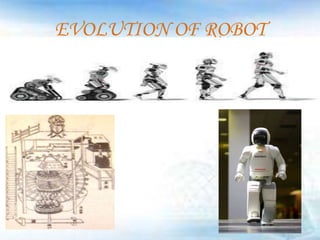
EVOLUTION OF ROBOT
HISTORY OF ROBOT
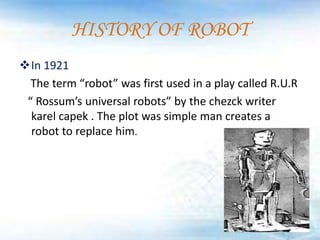
In 1921
The term “robot” was first used in a play called R.U.R
“ Rossum’s universal robots” by the chezck writer
karel capek . The plot was simple man creates a
robot to replace him.
HISTORY OF ROBOT (contd.)
1954
George Devol designed the first truly programmable
robot and called it UNIMATE for "Universal
Automation." (US patent 2 998 237) Later, in 1956,
George Devol and Joseph Engelberger formed the
world's first robot company “Unimation” which
stands for “universal automatio. Unimation is still in
production today, with robots for sale.
HISTORY OF ROBOT ( contd. )
1960’s
One of the first operational, industrial robots in North
America appeared in the early 1960’s in a candy
factory in Kitchener, Ontario
1964
Artificial intelligence research laboratories
are opened at M.I.T., Stanford Research Institute
(SRI), Stanford University, and the University of
Edinburgh. [20]
HISTORY OF ROBOT (CONTD.)
1973
Cincinnati Milacron released the T3, the first
commercially available minicomputer-controlled
industrial robot (designed by Richard hohn)
 1996
Honda created the P2, which was the first major step
in creating their ASIMO. The P2 was the first self-
regulating, bipedal humanoid robot
HISTORY OF ROBOT (CONTD.)
2017
• Saudi Arabia become the first country in the world to grant
citizenship to a robot.
• The female robot’s name is Sophia. She was recently
introduced at a large investment conference in the Saudi
capital, Riyadh.
• Sophia was presented as an example of how robot technology
and artificial intelligence will make machines more human-
like in the future.
LAWS OF ROBOTICS
• A robot may not harm humanity, or by inaction, allow
humanity to come to harm.
• A robot may not injure a human being or, through
inaction, allow a human being to come to harm, except
when required to do so in order to prevent greater
harm to humanity itself.
• A robot must obey any orders given to it by human
beings, except where such orders would conflict with
the First Law or cause greater harm to humanity itself.
• A robot must protect its own existence as long as such
protection does not conflict with the First or Second
Law or cause greater harm to humanity itself.
FUTURE OF ROBOT
ARTIFICIAL INTELLIGENCE
• Artificial intelligence (AI) is an area of computer
science that emphasizes the creation of intelligent
machines that work and react like humans. Some of
the activities computers with artificial intelligence
are designed for include:
• Speech recognition
• Learning
• Planning
• Problem solving
APPLICATION OF ROBOT
Industrial utility
Used for machine handling
Processing operations like
Welding
spray panting
Casting
Heat treatment
Finishing operation
Assembly
Inspection
APPLICATION OF ROBOT
APPLICATIONS OF ROBOT
Non industrial application
 space application
Agricultural application
Defense
Ocean exploration
Household jobs etc.
APPLICATION OF ROBOT
ROBOT V/S HUMANS
• Now, let’s compare the five basic characteristics of
humans and robots and try to gauge where we really
stand.
1. Adaptation
One of the greatest gifts of living beings is their
ability to adapt to their surroundings. Be it animals
or humans, we can easily blend into whatever
circumstances we find ourselves in. Although it’s
definitely not as easy as it sounds, it is still
something that we are essentially capable of
achieving… Unlike robots.
Victor: Humans
ROBOT V/S HUMANS
2. Logical ability
• This might surprise you, but robots are much more
logical when it comes to their thinking and execution
of plans. The truly interesting thing is that we have
bestowed them with this amazing gift ourselves.
What’s even more fascinating is that robots
completely lack emotion (unlike humans, whose
decisions and thinking may be influenced by certain
emotional factors), which makes them faster, logical
and also… potentially more evil.
Victor: Robots
ROBOT V/S HUMANS
3. Speech Recognition
Although we have had some robots in recent times
that have very nearly achieved this quality to a great
extent, humans are still better when it comes to the
recognition of voices and making sense out of them.
We can hear what a person is saying, and by using
visual and aural cues, we can fathom some meaning
out of a sentence, something that robots can’t do
perfectly
Victor: Humans
ROBOT V/S HUMANS
4. Speed
Robots are way faster than humans, mainly because
robots are free from all other emotional, physical
and mental noise that humans experience. Thus,
robots are equipped with better speed and
endurance than humans. Their brains consist of the
core functioning at its peak potential with nothing to
hold it back
Victor: Robots
ROBOT V/S HUMANS
5. Thinking, Planning and Decision-making:
Thus far, and for a good number of coming years,
this will remain a forte of humans. We can map out a
series of steps that can lead us to a certain goal. This
is what robots cannot perform, as they lack the
ability to plan ahead of time. Some people do this for
a really, really long time in advance (like selecting the
boarding school of their second son when those
future parents are still in high school).
Victor: Humans
SCOPE OF ROBOTICS IN INDIA
With the advancement of computer science and related
research technologies, Robotics jobs in India are gaining more
popularity.
Computer intelligence forms the basics of Robotics. These
robots carry out jobs that are considered dangerous and
sometimes impossible for a human being.
These days not only the students, professors, professionals
but the normal person also thinks and knows about the future
aspect of the robotics. The scope of robots is found in every
industry n in India. Recently a movie on Robot from the South
Film Industry has created huge records in the Indian Film
History.
SCOPE OF ROBOTICS IN INDIA
 India can become the second largest
market for robotic surgery
With the aim of installing 200 more robots and
reaching over 20,000 robotic-assisted surgeries per
year by 2020,
At present, India has over 50 surgical robots and a
pool of over 300 trained robotic surgeons. An
estimated 700 robotic-assisted surgeries a month are
conducted in the country.
CONCLUSION
• Robots will offer great benefits to humanity in
near future . Robotics enables great
advantages for people to do works in a short
period of time.
• Defending the country, creating new
machines, operating with robots. Therefore,
the technology is developing rapidly and
people should benefit from technology’s
opportunities.
THANK YOU

Robotics ppt

  • 2.
    CONTENT • Introduction ofrobot • Evolution of robot • Future of robot • Laws of robot • Utility of robot • Robot v/s Humans • Scope of robotics in india • Conclusion
  • 3.
    INTRODUCTION WHAT IS ROBOT? A robot is a machine especially one programmable by a computer capable of carrying out a complex series of actions automatically.Robots can be guided by an external control device or the control may be embedded within. Robots may be constructed to take on human form but most robots are machines designed to perform a task with no regard to how they look.
  • 4.
  • 5.
    HISTORY OF ROBOT In1921 The term “robot” was first used in a play called R.U.R “ Rossum’s universal robots” by the chezck writer karel capek . The plot was simple man creates a robot to replace him.
  • 6.
    HISTORY OF ROBOT(contd.) 1954 George Devol designed the first truly programmable robot and called it UNIMATE for "Universal Automation." (US patent 2 998 237) Later, in 1956, George Devol and Joseph Engelberger formed the world's first robot company “Unimation” which stands for “universal automatio. Unimation is still in production today, with robots for sale.
  • 7.
    HISTORY OF ROBOT( contd. ) 1960’s One of the first operational, industrial robots in North America appeared in the early 1960’s in a candy factory in Kitchener, Ontario 1964 Artificial intelligence research laboratories are opened at M.I.T., Stanford Research Institute (SRI), Stanford University, and the University of Edinburgh. [20]
  • 8.
    HISTORY OF ROBOT(CONTD.) 1973 Cincinnati Milacron released the T3, the first commercially available minicomputer-controlled industrial robot (designed by Richard hohn)  1996 Honda created the P2, which was the first major step in creating their ASIMO. The P2 was the first self- regulating, bipedal humanoid robot
  • 9.
    HISTORY OF ROBOT(CONTD.) 2017 • Saudi Arabia become the first country in the world to grant citizenship to a robot. • The female robot’s name is Sophia. She was recently introduced at a large investment conference in the Saudi capital, Riyadh. • Sophia was presented as an example of how robot technology and artificial intelligence will make machines more human- like in the future.
  • 10.
    LAWS OF ROBOTICS •A robot may not harm humanity, or by inaction, allow humanity to come to harm. • A robot may not injure a human being or, through inaction, allow a human being to come to harm, except when required to do so in order to prevent greater harm to humanity itself. • A robot must obey any orders given to it by human beings, except where such orders would conflict with the First Law or cause greater harm to humanity itself. • A robot must protect its own existence as long as such protection does not conflict with the First or Second Law or cause greater harm to humanity itself.
  • 11.
    FUTURE OF ROBOT ARTIFICIALINTELLIGENCE • Artificial intelligence (AI) is an area of computer science that emphasizes the creation of intelligent machines that work and react like humans. Some of the activities computers with artificial intelligence are designed for include: • Speech recognition • Learning • Planning • Problem solving
  • 13.
    APPLICATION OF ROBOT Industrialutility Used for machine handling Processing operations like Welding spray panting Casting Heat treatment Finishing operation Assembly Inspection
  • 14.
  • 15.
    APPLICATIONS OF ROBOT Nonindustrial application  space application Agricultural application Defense Ocean exploration Household jobs etc.
  • 16.
  • 17.
    ROBOT V/S HUMANS •Now, let’s compare the five basic characteristics of humans and robots and try to gauge where we really stand. 1. Adaptation One of the greatest gifts of living beings is their ability to adapt to their surroundings. Be it animals or humans, we can easily blend into whatever circumstances we find ourselves in. Although it’s definitely not as easy as it sounds, it is still something that we are essentially capable of achieving… Unlike robots. Victor: Humans
  • 18.
    ROBOT V/S HUMANS 2.Logical ability • This might surprise you, but robots are much more logical when it comes to their thinking and execution of plans. The truly interesting thing is that we have bestowed them with this amazing gift ourselves. What’s even more fascinating is that robots completely lack emotion (unlike humans, whose decisions and thinking may be influenced by certain emotional factors), which makes them faster, logical and also… potentially more evil. Victor: Robots
  • 19.
    ROBOT V/S HUMANS 3.Speech Recognition Although we have had some robots in recent times that have very nearly achieved this quality to a great extent, humans are still better when it comes to the recognition of voices and making sense out of them. We can hear what a person is saying, and by using visual and aural cues, we can fathom some meaning out of a sentence, something that robots can’t do perfectly Victor: Humans
  • 20.
    ROBOT V/S HUMANS 4.Speed Robots are way faster than humans, mainly because robots are free from all other emotional, physical and mental noise that humans experience. Thus, robots are equipped with better speed and endurance than humans. Their brains consist of the core functioning at its peak potential with nothing to hold it back Victor: Robots
  • 21.
    ROBOT V/S HUMANS 5.Thinking, Planning and Decision-making: Thus far, and for a good number of coming years, this will remain a forte of humans. We can map out a series of steps that can lead us to a certain goal. This is what robots cannot perform, as they lack the ability to plan ahead of time. Some people do this for a really, really long time in advance (like selecting the boarding school of their second son when those future parents are still in high school). Victor: Humans
  • 22.
    SCOPE OF ROBOTICSIN INDIA With the advancement of computer science and related research technologies, Robotics jobs in India are gaining more popularity. Computer intelligence forms the basics of Robotics. These robots carry out jobs that are considered dangerous and sometimes impossible for a human being. These days not only the students, professors, professionals but the normal person also thinks and knows about the future aspect of the robotics. The scope of robots is found in every industry n in India. Recently a movie on Robot from the South Film Industry has created huge records in the Indian Film History.
  • 23.
    SCOPE OF ROBOTICSIN INDIA  India can become the second largest market for robotic surgery With the aim of installing 200 more robots and reaching over 20,000 robotic-assisted surgeries per year by 2020, At present, India has over 50 surgical robots and a pool of over 300 trained robotic surgeons. An estimated 700 robotic-assisted surgeries a month are conducted in the country.
  • 24.
    CONCLUSION • Robots willoffer great benefits to humanity in near future . Robotics enables great advantages for people to do works in a short period of time. • Defending the country, creating new machines, operating with robots. Therefore, the technology is developing rapidly and people should benefit from technology’s opportunities.
  • 25.