ROBOTICS
ROBOT CONTROL
TEMPUS IV Project: 158644 – JPCR
Development of Regional Interdisciplinary Mechatronic Studies - DRIMS
ROBOTICS
2
ROBOT CONTROL
Classification Based on Control Systems:
– 1. Point-to-point (PTP) control robot
– 2. Continuous-path (CP) control robot
– 3. Controlled-path robot
TEMPUS IV Project: 158644 – JPCR
Development of Regional Interdisciplinary Mechatronic Studies - DRIMS
ROBOTICS
Point to Point Control Robot (PTP):
• The PTP robot is capable of moving from one
point to another point.
• The locations are recorded in the control
memory. PTP robots do not control the path to
get from one point to the next point.
• Common applications include:
– component insertion
– spot welding
– hole drilling
– machine loading and unloading
– assembly operations
3
TEMPUS IV Project: 158644 – JPCR
Development of Regional Interdisciplinary Mechatronic Studies - DRIMS
ROBOTICS
Continuous-Path Control Robot (CP):
• The CP robot is capable of performing movements along
the controlled path. With CP from one control, the robot
can stop at any specified point along the controlled path.
• All the points along the path must be stored explicitly in
the robot's control memory. Applications Straight-line
motion is the simplest example for this type of robot.
Some continuous-path controlled robots also have the
capability to follow a smooth curve path that has been
defined by the programmer. In such cases the
programmer manually moves the robot arm through the
desired path and the controller unit stores a large
number of individual point locations along the path in
memory (teach-in).
4
TEMPUS IV Project: 158644 – JPCR
Development of Regional Interdisciplinary Mechatronic Studies - DRIMS
ROBOTICS
Continuous-Path Control Robot (CP):
Typical applications include:
– spray painting
– finishing
– gluing
– arc welding operations
5
TEMPUS IV Project: 158644 – JPCR
Development of Regional Interdisciplinary Mechatronic Studies - DRIMS
ROBOTICS
Controlled-Path Robot:
• In controlled-path robots, the control equipment can
generate paths of different geometry such as straight
lines, circles, and interpolated curves with a high degree
of accuracy. Good accuracy can be obtained at any point
along the specified path.
• Only the start and finish points and the path definition
function must be stored in the robot's control memory. It
is important to mention that all controlled-path robots
have a servo capability to correct their path.
6
TEMPUS IV Project: 158644 – JPCR
Development of Regional Interdisciplinary Mechatronic Studies - DRIMS
ROBOTICS
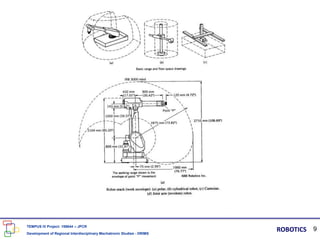
Robot Reach:
Robot reach, also known as the work
envelope or work volume, is the space of
all points in the surrounding space that
can be reached by the robot arm.
Reach is one of the most important
characteristics to be considered in
selecting a suitable robot because the
application space should not fall out of the
selected robot's reach.
7
TEMPUS IV Project: 158644 – JPCR
Development of Regional Interdisciplinary Mechatronic Studies - DRIMS
ROBOTICS
Robot Reach:
• For a Cartesian configuration the reach is
a rectangular-type space.
• For a cylindrical configuration the reach is
a hollow cylindrical space.
• For a polar configuration the reach is part
of a hollow spherical shape.
• Robot reach for a jointed-arm
configuration does not have a specific
shape.
8
TEMPUS IV Project: 158644 – JPCR
Development of Regional Interdisciplinary Mechatronic Studies - DRIMS
ROBOTICS
9
TEMPUS IV Project: 158644 – JPCR
Development of Regional Interdisciplinary Mechatronic Studies - DRIMS
ROBOTICS
ROBOT MOTION ANALYSIS
In robot motion analysis we study the
geometry of the robot arm with respect to
a reference coordinate system, while the
end-effector moves along the prescribed
path .
10
TEMPUS IV Project: 158644 – JPCR
Development of Regional Interdisciplinary Mechatronic Studies - DRIMS
ROBOTICS
The kinematic analysis involves two
different kinds of problems:
– 1. Determining the coordinates of the end-
effector or end of arm for a given set of joints
coordinates.
– 2. Determining the joints coordinates for a
given location of the end-effector or end of
arm.
ROBOT MOTION ANALYSIS
11
TEMPUS IV Project: 158644 – JPCR
Development of Regional Interdisciplinary Mechatronic Studies - DRIMS
ROBOTICS
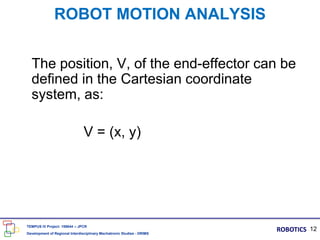
The position, V, of the end-effector can be
defined in the Cartesian coordinate
system, as:
V = (x, y)
ROBOT MOTION ANALYSIS
12
TEMPUS IV Project: 158644 – JPCR
Development of Regional Interdisciplinary Mechatronic Studies - DRIMS
ROBOTICS
Generally, for robots the location of the
end-effector can be defined in two
systems:
a. joint space and
b. world space (also known as global
space)
ROBOT MOTION ANALYSIS
13
TEMPUS IV Project: 158644 – JPCR
Development of Regional Interdisciplinary Mechatronic Studies - DRIMS
ROBOTICS
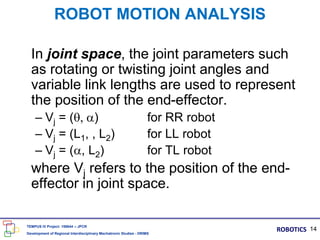
In joint space, the joint parameters such
as rotating or twisting joint angles and
variable link lengths are used to represent
the position of the end-effector.
– Vj = (q, a) for RR robot
– Vj = (L1, , L2) for LL robot
– Vj = (a, L2) for TL robot
where Vj refers to the position of the end-
effector in joint space.
ROBOT MOTION ANALYSIS
14
TEMPUS IV Project: 158644 – JPCR
Development of Regional Interdisciplinary Mechatronic Studies - DRIMS
ROBOTICS
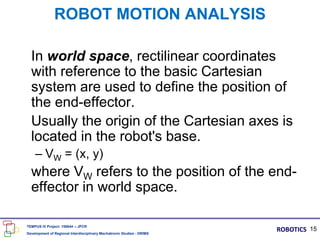
In world space, rectilinear coordinates
with reference to the basic Cartesian
system are used to define the position of
the end-effector.
Usually the origin of the Cartesian axes is
located in the robot's base.
– VW = (x, y)
where VW refers to the position of the end-
effector in world space.
ROBOT MOTION ANALYSIS
15
TEMPUS IV Project: 158644 – JPCR
Development of Regional Interdisciplinary Mechatronic Studies - DRIMS
ROBOTICS
• The transformation of coordinates of the
end-effector point from the joint space to
the world space is known as forward
kinematic transformation.
• Similarly, the transformation of coordinates
from world space to joint space is known
as backward or reverse kinematic
transformation.
ROBOT MOTION ANALYSIS
16
TEMPUS IV Project: 158644 – JPCR
Development of Regional Interdisciplinary Mechatronic Studies - DRIMS
ROBOTICS

Robot Control types and applications 2024

  • 1.
    ROBOTICS ROBOT CONTROL TEMPUS IVProject: 158644 – JPCR Development of Regional Interdisciplinary Mechatronic Studies - DRIMS ROBOTICS
  • 2.
    2 ROBOT CONTROL Classification Basedon Control Systems: – 1. Point-to-point (PTP) control robot – 2. Continuous-path (CP) control robot – 3. Controlled-path robot TEMPUS IV Project: 158644 – JPCR Development of Regional Interdisciplinary Mechatronic Studies - DRIMS ROBOTICS
  • 3.
    Point to PointControl Robot (PTP): • The PTP robot is capable of moving from one point to another point. • The locations are recorded in the control memory. PTP robots do not control the path to get from one point to the next point. • Common applications include: – component insertion – spot welding – hole drilling – machine loading and unloading – assembly operations 3 TEMPUS IV Project: 158644 – JPCR Development of Regional Interdisciplinary Mechatronic Studies - DRIMS ROBOTICS
  • 4.
    Continuous-Path Control Robot(CP): • The CP robot is capable of performing movements along the controlled path. With CP from one control, the robot can stop at any specified point along the controlled path. • All the points along the path must be stored explicitly in the robot's control memory. Applications Straight-line motion is the simplest example for this type of robot. Some continuous-path controlled robots also have the capability to follow a smooth curve path that has been defined by the programmer. In such cases the programmer manually moves the robot arm through the desired path and the controller unit stores a large number of individual point locations along the path in memory (teach-in). 4 TEMPUS IV Project: 158644 – JPCR Development of Regional Interdisciplinary Mechatronic Studies - DRIMS ROBOTICS
  • 5.
    Continuous-Path Control Robot(CP): Typical applications include: – spray painting – finishing – gluing – arc welding operations 5 TEMPUS IV Project: 158644 – JPCR Development of Regional Interdisciplinary Mechatronic Studies - DRIMS ROBOTICS
  • 6.
    Controlled-Path Robot: • Incontrolled-path robots, the control equipment can generate paths of different geometry such as straight lines, circles, and interpolated curves with a high degree of accuracy. Good accuracy can be obtained at any point along the specified path. • Only the start and finish points and the path definition function must be stored in the robot's control memory. It is important to mention that all controlled-path robots have a servo capability to correct their path. 6 TEMPUS IV Project: 158644 – JPCR Development of Regional Interdisciplinary Mechatronic Studies - DRIMS ROBOTICS
  • 7.
    Robot Reach: Robot reach,also known as the work envelope or work volume, is the space of all points in the surrounding space that can be reached by the robot arm. Reach is one of the most important characteristics to be considered in selecting a suitable robot because the application space should not fall out of the selected robot's reach. 7 TEMPUS IV Project: 158644 – JPCR Development of Regional Interdisciplinary Mechatronic Studies - DRIMS ROBOTICS
  • 8.
    Robot Reach: • Fora Cartesian configuration the reach is a rectangular-type space. • For a cylindrical configuration the reach is a hollow cylindrical space. • For a polar configuration the reach is part of a hollow spherical shape. • Robot reach for a jointed-arm configuration does not have a specific shape. 8 TEMPUS IV Project: 158644 – JPCR Development of Regional Interdisciplinary Mechatronic Studies - DRIMS ROBOTICS
  • 9.
    9 TEMPUS IV Project:158644 – JPCR Development of Regional Interdisciplinary Mechatronic Studies - DRIMS ROBOTICS
  • 10.
    ROBOT MOTION ANALYSIS Inrobot motion analysis we study the geometry of the robot arm with respect to a reference coordinate system, while the end-effector moves along the prescribed path . 10 TEMPUS IV Project: 158644 – JPCR Development of Regional Interdisciplinary Mechatronic Studies - DRIMS ROBOTICS
  • 11.
    The kinematic analysisinvolves two different kinds of problems: – 1. Determining the coordinates of the end- effector or end of arm for a given set of joints coordinates. – 2. Determining the joints coordinates for a given location of the end-effector or end of arm. ROBOT MOTION ANALYSIS 11 TEMPUS IV Project: 158644 – JPCR Development of Regional Interdisciplinary Mechatronic Studies - DRIMS ROBOTICS
  • 12.
    The position, V,of the end-effector can be defined in the Cartesian coordinate system, as: V = (x, y) ROBOT MOTION ANALYSIS 12 TEMPUS IV Project: 158644 – JPCR Development of Regional Interdisciplinary Mechatronic Studies - DRIMS ROBOTICS
  • 13.
    Generally, for robotsthe location of the end-effector can be defined in two systems: a. joint space and b. world space (also known as global space) ROBOT MOTION ANALYSIS 13 TEMPUS IV Project: 158644 – JPCR Development of Regional Interdisciplinary Mechatronic Studies - DRIMS ROBOTICS
  • 14.
    In joint space,the joint parameters such as rotating or twisting joint angles and variable link lengths are used to represent the position of the end-effector. – Vj = (q, a) for RR robot – Vj = (L1, , L2) for LL robot – Vj = (a, L2) for TL robot where Vj refers to the position of the end- effector in joint space. ROBOT MOTION ANALYSIS 14 TEMPUS IV Project: 158644 – JPCR Development of Regional Interdisciplinary Mechatronic Studies - DRIMS ROBOTICS
  • 15.
    In world space,rectilinear coordinates with reference to the basic Cartesian system are used to define the position of the end-effector. Usually the origin of the Cartesian axes is located in the robot's base. – VW = (x, y) where VW refers to the position of the end- effector in world space. ROBOT MOTION ANALYSIS 15 TEMPUS IV Project: 158644 – JPCR Development of Regional Interdisciplinary Mechatronic Studies - DRIMS ROBOTICS
  • 16.
    • The transformationof coordinates of the end-effector point from the joint space to the world space is known as forward kinematic transformation. • Similarly, the transformation of coordinates from world space to joint space is known as backward or reverse kinematic transformation. ROBOT MOTION ANALYSIS 16 TEMPUS IV Project: 158644 – JPCR Development of Regional Interdisciplinary Mechatronic Studies - DRIMS ROBOTICS