218.224
CONSTRUCTION TECHNOLOGY &
Services III
Roads (Transport Infrastructure)
1
Roads are piece of land prepared to connect two or more points, used for ease of travelling.
According to Land Transport Act 1998, a road is
• a street; and
• a motorway; and
• a beach; and
• a place to which the public have access, whether as of right or not; and
• all bridges, culverts, ferries, and fords forming part of a road or street or motorway.
ROADS
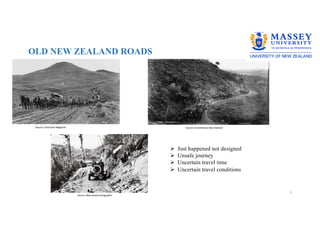
OLD NEW ZEALAND ROADS
3
Source: Contractor Magazine
Source: New Zealand Geographic
Source: Envirohistory New Zealand
Ø Just happened not designed
Ø Unsafe journey
Ø Uncertain travel time
Ø Uncertain travel conditions
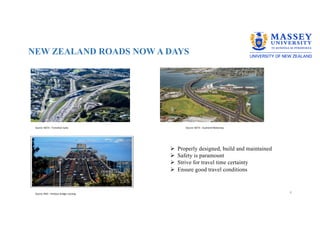
NEW ZEALAND ROADS NOW A DAYS
4
Source: NZTA – Transition Gully
Source: RNZ – Harbour bridge crossing
Source: NZTA – Auckland Motorway
Ø Properly designed, build and maintained
Ø Safety is paramount
Ø Strive for travel time certainty
Ø Ensure good travel conditions
• Roads are provided in a variety of surface finishes
• Establish the quality of the soil
• General principle:
ØClay & sand must be removed and replaced with stable material
ØStable soils compacted to a high density
ØA stable and dense base will prevent cracking
• ports, electricity, telecommunications, water supply and sanitation. ...
Throughout this paper where the term 'infrastructure' is used, it refers
to economic infrastructure
ABOUT ROADS
ROAD DESIGN CONSIDERATIONS
Traffic Volume: Number of vehicles passing through a road over a period of time (usually per hour).
More traffic volume = More lanes.
Vehicles Types: Vehicles differ in size (height, width, length, and weight), ability to brake, accelerate and turn.
Design Speed: Maximum safe and allowable speed on road in perfect conditions – critical for safety.
Sight Distance: Length of road in front of the vehicle that is visible to the driver, to make a safe stop.
Passing Sight Distance: Length of road visible to drivers to safely pass other vehicles.
Topography: Geometry and design speed depends on the topography of the terrain.
Land Use Characteristics: Type of land use (commercial, residential, industrial) determines the traffic
volume.
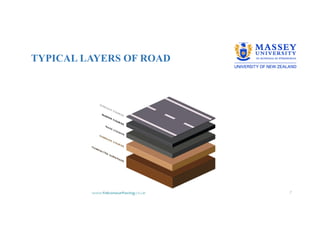
TYPICAL LAYERS OF ROAD
7
TYPES OF ROADS
8
1. Flexible Roads (Bitumen)
2. Rigid Roads (Concrete)
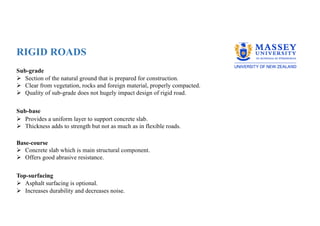
RIGID ROADS
Sub-grade
Ø Section of the natural ground that is prepared for construction.
Ø Clear from vegetation, rocks and foreign material, properly compacted.
Ø Quality of sub-grade does not hugely impact design of rigid road.
Sub-base
Ø Provides a uniform layer to support concrete slab.
Ø Thickness adds to strength but not as much as in flexible roads.
Base-course
Ø Concrete slab which is main structural component.
Ø Offers good abrasive resistance.
Top-surfacing
Ø Asphalt surfacing is optional.
Ø Increases durability and decreases noise.
RIGID ROADS
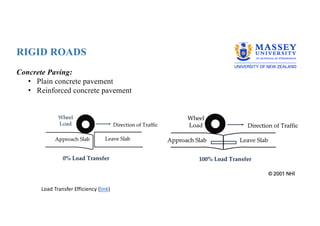
Concrete Paving:
• Plain concrete pavement
• Reinforced concrete pavement
Load Transfer Efficiency (link)
RIGID ROADS
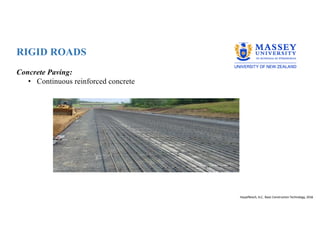
Concrete Paving:
• Continuous reinforced concrete
Hauptfleisch, A.C; Basic Construction Technology, 2016
RIGID ROADS
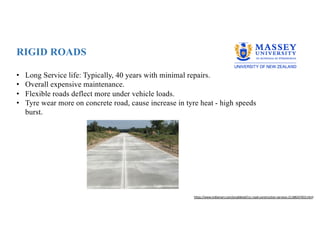
• Long Service life: Typically, 40 years with minimal repairs.
• Overall expensive maintenance.
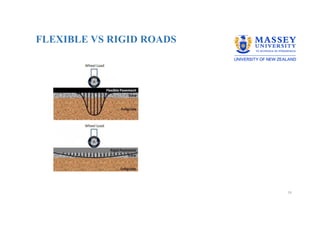
• Flexible roads deflect more under vehicle loads.
• Tyre wear more on concrete road, cause increase in tyre heat - high speeds
burst.
https://www.indiamart.com/proddetail/rcc-road-construction-services-21188247655.html
RIGID ROADS
• A polythene membrane is placed on the sub-base underneath the concrete. To prevent the
water/cement from the concrete ‘leaking’ through to the sub-base.
• The steel reinforcing must be designed to satisfy soil conditions and meet the expected
traffic loads.
• To avoid expansion, contraction and wrapping, joints should be provided.
• Curing of the concrete is very important.
• Storm water drainage design is of utmost importance to prevent damage to the road
resulting from floods or the erosion of the road shoulders and edges.
Hauptfleisch, A.C; Basic Construction Technology, 2016
FLEXIBLE ROADS
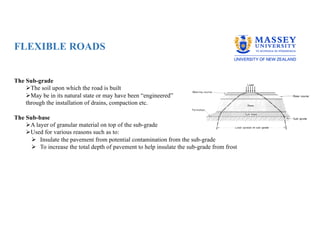
The Sub-grade
ØThe soil upon which the road is built
ØMay be in its natural state or may have been “engineered”
through the installation of drains, compaction etc.
The Sub-base
ØA layer of granular material on top of the sub-grade
ØUsed for various reasons such as to:
Ø Insulate the pavement from potential contamination from the sub-grade
Ø To increase the total depth of pavement to help insulate the sub-grade from frost
FLEXIBLE ROADS
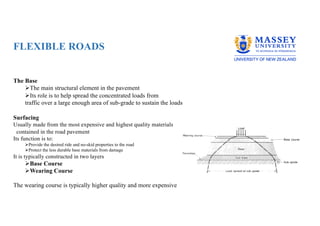
The Base
ØThe main structural element in the pavement
ØIts role is to help spread the concentrated loads from
traffic over a large enough area of sub-grade to sustain the loads
Surfacing
Usually made from the most expensive and highest quality materials
contained in the road pavement
Its function is to:
ØProvide the desired ride and no-skid properties to the road
ØProtect the less durable base materials from damage
It is typically constructed in two layers
ØBase Course
ØWearing Course
The wearing course is typically higher quality and more expensive
16
FLEXIBLE VS RIGID ROADS
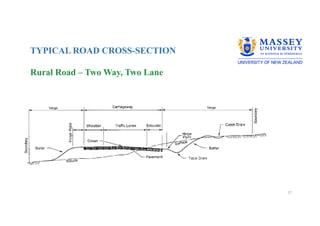
TYPICAL ROAD CROSS-SECTION
Rural Road – Two Way, Two Lane
17
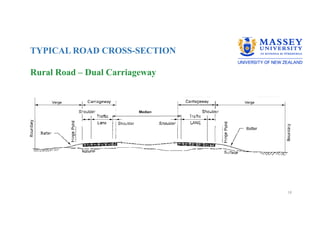
TYPICAL ROAD CROSS-SECTION
Rural Road – Dual Carriageway
18
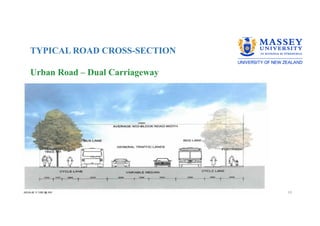
TYPICAL ROAD CROSS-SECTION
Urban Road – Dual Carriageway
19
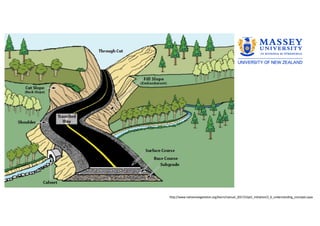
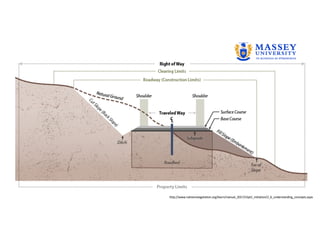
http://www.nativerevegetation.org/learn/manual_2017/chpt2_initiation/2_6_understanding_concepts.aspx
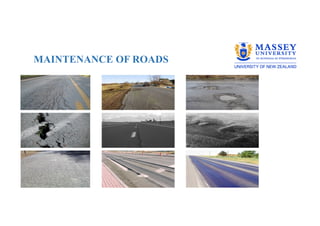
MAINTENANCE OF ROADS
• Roads are a valuable asset, developed to last long.
• Finances for road development and maintenance are limited (Transport
sector competes with housing, healthcare, education etc.).
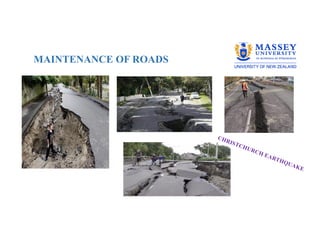
MAINTENANCE OF ROADS
CHRISTCHURCH EARTHQUAKE
QUESTIONS?

Lecture_Roads_Week2.pdf

  • 1.
    218.224 CONSTRUCTION TECHNOLOGY & ServicesIII Roads (Transport Infrastructure) 1
  • 2.
    Roads are pieceof land prepared to connect two or more points, used for ease of travelling. According to Land Transport Act 1998, a road is • a street; and • a motorway; and • a beach; and • a place to which the public have access, whether as of right or not; and • all bridges, culverts, ferries, and fords forming part of a road or street or motorway. ROADS
  • 3.
    OLD NEW ZEALANDROADS 3 Source: Contractor Magazine Source: New Zealand Geographic Source: Envirohistory New Zealand Ø Just happened not designed Ø Unsafe journey Ø Uncertain travel time Ø Uncertain travel conditions
  • 4.
    NEW ZEALAND ROADSNOW A DAYS 4 Source: NZTA – Transition Gully Source: RNZ – Harbour bridge crossing Source: NZTA – Auckland Motorway Ø Properly designed, build and maintained Ø Safety is paramount Ø Strive for travel time certainty Ø Ensure good travel conditions
  • 5.
    • Roads areprovided in a variety of surface finishes • Establish the quality of the soil • General principle: ØClay & sand must be removed and replaced with stable material ØStable soils compacted to a high density ØA stable and dense base will prevent cracking • ports, electricity, telecommunications, water supply and sanitation. ... Throughout this paper where the term 'infrastructure' is used, it refers to economic infrastructure ABOUT ROADS
  • 6.
    ROAD DESIGN CONSIDERATIONS TrafficVolume: Number of vehicles passing through a road over a period of time (usually per hour). More traffic volume = More lanes. Vehicles Types: Vehicles differ in size (height, width, length, and weight), ability to brake, accelerate and turn. Design Speed: Maximum safe and allowable speed on road in perfect conditions – critical for safety. Sight Distance: Length of road in front of the vehicle that is visible to the driver, to make a safe stop. Passing Sight Distance: Length of road visible to drivers to safely pass other vehicles. Topography: Geometry and design speed depends on the topography of the terrain. Land Use Characteristics: Type of land use (commercial, residential, industrial) determines the traffic volume.
  • 7.
  • 8.
    TYPES OF ROADS 8 1.Flexible Roads (Bitumen) 2. Rigid Roads (Concrete)
  • 9.
    RIGID ROADS Sub-grade Ø Sectionof the natural ground that is prepared for construction. Ø Clear from vegetation, rocks and foreign material, properly compacted. Ø Quality of sub-grade does not hugely impact design of rigid road. Sub-base Ø Provides a uniform layer to support concrete slab. Ø Thickness adds to strength but not as much as in flexible roads. Base-course Ø Concrete slab which is main structural component. Ø Offers good abrasive resistance. Top-surfacing Ø Asphalt surfacing is optional. Ø Increases durability and decreases noise.
  • 10.
    RIGID ROADS Concrete Paving: •Plain concrete pavement • Reinforced concrete pavement Load Transfer Efficiency (link)
  • 11.
    RIGID ROADS Concrete Paving: •Continuous reinforced concrete Hauptfleisch, A.C; Basic Construction Technology, 2016
  • 12.
    RIGID ROADS • LongService life: Typically, 40 years with minimal repairs. • Overall expensive maintenance. • Flexible roads deflect more under vehicle loads. • Tyre wear more on concrete road, cause increase in tyre heat - high speeds burst. https://www.indiamart.com/proddetail/rcc-road-construction-services-21188247655.html
  • 13.
    RIGID ROADS • Apolythene membrane is placed on the sub-base underneath the concrete. To prevent the water/cement from the concrete ‘leaking’ through to the sub-base. • The steel reinforcing must be designed to satisfy soil conditions and meet the expected traffic loads. • To avoid expansion, contraction and wrapping, joints should be provided. • Curing of the concrete is very important. • Storm water drainage design is of utmost importance to prevent damage to the road resulting from floods or the erosion of the road shoulders and edges. Hauptfleisch, A.C; Basic Construction Technology, 2016
  • 14.
    FLEXIBLE ROADS The Sub-grade ØThesoil upon which the road is built ØMay be in its natural state or may have been “engineered” through the installation of drains, compaction etc. The Sub-base ØA layer of granular material on top of the sub-grade ØUsed for various reasons such as to: Ø Insulate the pavement from potential contamination from the sub-grade Ø To increase the total depth of pavement to help insulate the sub-grade from frost
  • 15.
    FLEXIBLE ROADS The Base ØThemain structural element in the pavement ØIts role is to help spread the concentrated loads from traffic over a large enough area of sub-grade to sustain the loads Surfacing Usually made from the most expensive and highest quality materials contained in the road pavement Its function is to: ØProvide the desired ride and no-skid properties to the road ØProtect the less durable base materials from damage It is typically constructed in two layers ØBase Course ØWearing Course The wearing course is typically higher quality and more expensive
  • 16.
  • 17.
    TYPICAL ROAD CROSS-SECTION RuralRoad – Two Way, Two Lane 17
  • 18.
    TYPICAL ROAD CROSS-SECTION RuralRoad – Dual Carriageway 18
  • 19.
    TYPICAL ROAD CROSS-SECTION UrbanRoad – Dual Carriageway 19
  • 20.
  • 21.
  • 22.
    MAINTENANCE OF ROADS •Roads are a valuable asset, developed to last long. • Finances for road development and maintenance are limited (Transport sector competes with housing, healthcare, education etc.).
  • 23.
  • 24.
  • 25.