WHITE TOPPING AND
ULTRA THIN WHITE
TOPPING
1
White Topping
White Topping is defined as a Portland
Cement Concrete (PCC) overlay constructed
on the top of the existing distressed
bituminous pavement
2
TYPES OF WHITETOPPING
3
1)Conventional White Topping (200mm or more)
2)Thin White Topping (TWT) (100-200mm)
3)Ultra-Thin White Topping (UTWT)(≤ 100 mm)
1.Conventional White Topping (CWT)
A PCC overlay of thickness 200mm or more designed and
constructed without consideration of any bond between
the concrete overlay and underlying bituminous layer.
It is constructed as a new rigid pavement without
assuming any composite action.
CWT treats the existing bituminous surface as a sub base
like DLC.
Joints at spacing 4 to 4.5m
4
2. Thin White Topping (TWT)
 PCC overlay thickness greater than 100 and less than 200 is
known as Thin White Topping(TWT).
 The bond between the overlaid PCC and underlying bituminous
layer is often a consideration but not mandatory.
 High strength concrete with fibres are commonly used.
 Joint spacing – 0.6 to 1.25m.
5
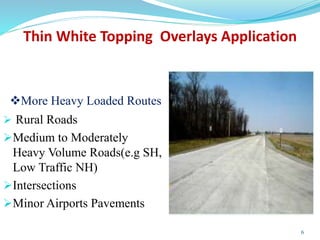
Thin White Topping Overlays Application
 Rural Roads
Medium to Moderately
Heavy Volume Roads(e.g SH,
Low Traffic NH)
Intersections
Minor Airports Pavements
6
More Heavy Loaded Routes
3.Ultra Thin White topping
 PCC overlay Thickness equal to less than 100 mm is known as
Ultra Thin White Topping.
 Bonding is mandatory in between the underlying bituminous
layer and overlaid PCC layer.
 Bonding is achieved by milling the existing bituminous surface
upto 25mm depth.
 Joint Spacing – 0.6 to 1.25 m
7
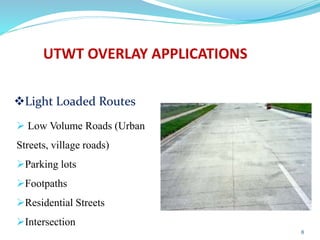
UTWT OVERLAY APPLICATIONS
8
 Low Volume Roads (Urban
Streets, village roads)
Parking lots
Footpaths
Residential Streets
Intersection
Light Loaded Routes
9
Advantages of White Topping
Long life, low maintenance, low life cycle cost, improved safety
and environmental benefits.
 Bituminous overlay exhibits a more rapid loss of serviceability as
compared to concrete white topping.
 Deformation like rutting and cracking predominant in case of
bituminous pavement which is normally absent with concrete
surfaces of white topping.
White Topping is reduction in street light requirements.
White Topping is quite cost effective to tackle annual budget
constraints and high traffic levels
CONSTRUCTION STEPS FOR
UTWT/TWT
10
CONSTRUCTION STEPS
Mill and clean surface.
Place concrete, finish and cure
Early sawing is required
Opening to traffic.
11
MILLING
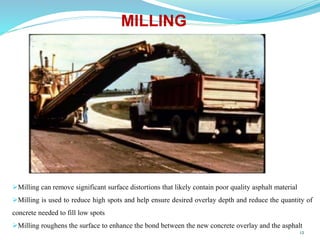
Milling can remove significant surface distortions that likely contain poor quality asphalt material
Milling is used to reduce high spots and help ensure desired overlay depth and reduce the quantity of
concrete needed to fill low spots
Milling roughens the surface to enhance the bond between the new concrete overlay and the asphalt
12
CLEANING OF SURFACE
 Air Blasting/vacuum cleaner
Power Brooming
Water Blasting
Sand Blasting
13
14
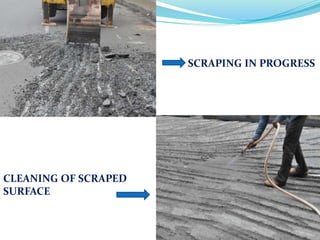
SCRAPING IN PROGRESS
CLEANING OF SCRAPED
SURFACE
PAVING WITH
SLIPFORM PAVER
PAVING WITH
VIBRATING SCREED
15
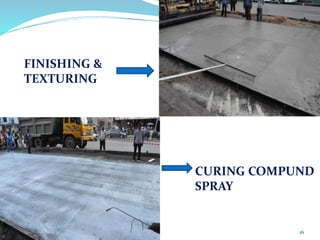
FINISHING &
TEXTURING
CURING COMPUND
SPRAY
16
JOINT SAWING
17
SAWING DEPTH
H/3 TO H/4
18

White topping

  • 1.
    WHITE TOPPING AND ULTRATHIN WHITE TOPPING 1
  • 2.
    White Topping White Toppingis defined as a Portland Cement Concrete (PCC) overlay constructed on the top of the existing distressed bituminous pavement 2
  • 3.
    TYPES OF WHITETOPPING 3 1)ConventionalWhite Topping (200mm or more) 2)Thin White Topping (TWT) (100-200mm) 3)Ultra-Thin White Topping (UTWT)(≤ 100 mm)
  • 4.
    1.Conventional White Topping(CWT) A PCC overlay of thickness 200mm or more designed and constructed without consideration of any bond between the concrete overlay and underlying bituminous layer. It is constructed as a new rigid pavement without assuming any composite action. CWT treats the existing bituminous surface as a sub base like DLC. Joints at spacing 4 to 4.5m 4
  • 5.
    2. Thin WhiteTopping (TWT)  PCC overlay thickness greater than 100 and less than 200 is known as Thin White Topping(TWT).  The bond between the overlaid PCC and underlying bituminous layer is often a consideration but not mandatory.  High strength concrete with fibres are commonly used.  Joint spacing – 0.6 to 1.25m. 5
  • 6.
    Thin White ToppingOverlays Application  Rural Roads Medium to Moderately Heavy Volume Roads(e.g SH, Low Traffic NH) Intersections Minor Airports Pavements 6 More Heavy Loaded Routes
  • 7.
    3.Ultra Thin Whitetopping  PCC overlay Thickness equal to less than 100 mm is known as Ultra Thin White Topping.  Bonding is mandatory in between the underlying bituminous layer and overlaid PCC layer.  Bonding is achieved by milling the existing bituminous surface upto 25mm depth.  Joint Spacing – 0.6 to 1.25 m 7
  • 8.
    UTWT OVERLAY APPLICATIONS 8 Low Volume Roads (Urban Streets, village roads) Parking lots Footpaths Residential Streets Intersection Light Loaded Routes
  • 9.
    9 Advantages of WhiteTopping Long life, low maintenance, low life cycle cost, improved safety and environmental benefits.  Bituminous overlay exhibits a more rapid loss of serviceability as compared to concrete white topping.  Deformation like rutting and cracking predominant in case of bituminous pavement which is normally absent with concrete surfaces of white topping. White Topping is reduction in street light requirements. White Topping is quite cost effective to tackle annual budget constraints and high traffic levels
  • 10.
  • 11.
    CONSTRUCTION STEPS Mill andclean surface. Place concrete, finish and cure Early sawing is required Opening to traffic. 11
  • 12.
    MILLING Milling can removesignificant surface distortions that likely contain poor quality asphalt material Milling is used to reduce high spots and help ensure desired overlay depth and reduce the quantity of concrete needed to fill low spots Milling roughens the surface to enhance the bond between the new concrete overlay and the asphalt 12
  • 13.
    CLEANING OF SURFACE Air Blasting/vacuum cleaner Power Brooming Water Blasting Sand Blasting 13
  • 14.
  • 15.
    PAVING WITH SLIPFORM PAVER PAVINGWITH VIBRATING SCREED 15
  • 16.
  • 17.
  • 18.