GENE SILENCING
BY
RNA INTERFERANCE
&
ANTISENCE THERAPY
JAYA PRAKASH.S
CONTENTS
INTRODUCTION
RNA INTERFERENCE
ANTI-SENCE THERAPY
INTRODUCTION
 Gene silencing is the regulation of gene expression
in a cell to prevent the expression of a certain gene.
 Gene silencing can occur during either transcription
or translation and is often used in research.
 Gene silencing methods used to silence genes are
being increasingly used to produce therapeutics to
combat cancer and diseases, such as infectious
diseases and neurodegenerative disorders.
 There are mainly two types of Gene silencing
 Transcriptional Gene Silencing
 Post Transcriptional Gene Silencing
 Transcriptional gene silencing is the process of silence
the gene by modify the Gene.
 Post transcriptional gene silencing means double-
stranded RNA (dsRNA) suppress the expression of
the gene.
 It have two type of mechanisms
 RNA Interference (RNAi)
 Antisense Therapy
RNA INTERFERENCE (RNAi)
 Andrew Fire and C. Mello shared the 2006 Nobel Prize in
Physiology or Medicine for their work on RNA
interference in the nematode worm Caenorhabditis
elegans, which they published in 1998.
 RNA interference (RNAi) is a biological process in
which RNA molecules inhibit gene expression or
translation, by neutralizing targeted mRNA molecules.
 RNAi was known by other names, including Co-
suppression, Post-transcriptional gene silencing (PTGS),
and Quelling.
MECHANISM
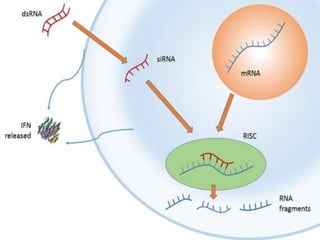
 During RNAi, long dsRNA is cut or "diced" into small
fragments ~21 nucleotides long by an enzyme called
"Dicer".
 These small fragments, referred to as small interfering
RNAs (siRNA), then it bind to the mRNA sequence which
derived from the Trancription process.
 It bind to messenger RNA with the help of the multi
protein complex named RISC(ribo nucleo protein).
 RISC protein helps that siRNA to crop the mRNA into
small DNA fragments.
 These small DNA fragments can’t undergoes to the
Translation process. So the Gene Express was inhibited.
ANTISENSE THERAPY
 Antisense therapy was first demonstrated in 1970s
Zamecnik and Stephenson in Rous sarcoma virus.
 It is slightly differed from the RNAi process.
Instead of gene cutting mechanism, the
Oligonucleotide was introduced to silence the
gene.
 Antisense therapy helps in the study of Gene
function.
 It uses to prevent the synthesis of specific protein.
MECHANISM
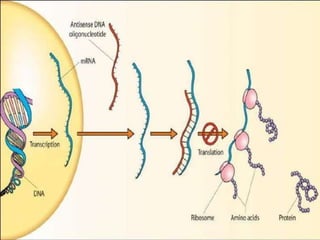
 This process was done with the help of Antisence DNA
Oligonucleoside(AS-ON). These all are the short segments
of single strand DNA.
 The AS-Ons usually consists of 15-20 nucleotides, which
are complementary to their mRNA.
 It will bind to the target RNA. When it bind to the mRNA,
a DNA-RNA hybrid will be formed.
 After the hybrid formation it will be degraded by the
enzyme RNaseH. It cleave the mRNA by the hydrolytic
mechanism.
 Because of that cleavage the translation process should
be blocked.
Gene silencing by RNA interference & Antisense therapy

Gene silencing by RNA interference & Antisense therapy

  • 1.
  • 2.
  • 3.
    INTRODUCTION  Gene silencingis the regulation of gene expression in a cell to prevent the expression of a certain gene.  Gene silencing can occur during either transcription or translation and is often used in research.  Gene silencing methods used to silence genes are being increasingly used to produce therapeutics to combat cancer and diseases, such as infectious diseases and neurodegenerative disorders.
  • 4.
     There aremainly two types of Gene silencing  Transcriptional Gene Silencing  Post Transcriptional Gene Silencing  Transcriptional gene silencing is the process of silence the gene by modify the Gene.  Post transcriptional gene silencing means double- stranded RNA (dsRNA) suppress the expression of the gene.  It have two type of mechanisms  RNA Interference (RNAi)  Antisense Therapy
  • 5.
    RNA INTERFERENCE (RNAi) Andrew Fire and C. Mello shared the 2006 Nobel Prize in Physiology or Medicine for their work on RNA interference in the nematode worm Caenorhabditis elegans, which they published in 1998.  RNA interference (RNAi) is a biological process in which RNA molecules inhibit gene expression or translation, by neutralizing targeted mRNA molecules.  RNAi was known by other names, including Co- suppression, Post-transcriptional gene silencing (PTGS), and Quelling.
  • 6.
    MECHANISM  During RNAi,long dsRNA is cut or "diced" into small fragments ~21 nucleotides long by an enzyme called "Dicer".  These small fragments, referred to as small interfering RNAs (siRNA), then it bind to the mRNA sequence which derived from the Trancription process.  It bind to messenger RNA with the help of the multi protein complex named RISC(ribo nucleo protein).  RISC protein helps that siRNA to crop the mRNA into small DNA fragments.  These small DNA fragments can’t undergoes to the Translation process. So the Gene Express was inhibited.
  • 8.
    ANTISENSE THERAPY  Antisensetherapy was first demonstrated in 1970s Zamecnik and Stephenson in Rous sarcoma virus.  It is slightly differed from the RNAi process. Instead of gene cutting mechanism, the Oligonucleotide was introduced to silence the gene.  Antisense therapy helps in the study of Gene function.  It uses to prevent the synthesis of specific protein.
  • 9.
    MECHANISM  This processwas done with the help of Antisence DNA Oligonucleoside(AS-ON). These all are the short segments of single strand DNA.  The AS-Ons usually consists of 15-20 nucleotides, which are complementary to their mRNA.  It will bind to the target RNA. When it bind to the mRNA, a DNA-RNA hybrid will be formed.  After the hybrid formation it will be degraded by the enzyme RNaseH. It cleave the mRNA by the hydrolytic mechanism.  Because of that cleavage the translation process should be blocked.