英語教育リサーチメソッド
July 3rd, 2013
WATARI Yoichi
eywatar@ipc.shizuoka.ac.jp
第11回 量的研究(2)
•Presentation & Discussion
•Study Box
•Correlations
•Further Reading
Presentation & Discussion
•初回アンケート集計データ
•t検定、ANOVA, カイ二乗検定いずれか
•RQsに対して適切な手法が選択され
ているか
•RQsの観点や群構成は自由: 実際の研究
ではRQsと必要な群を立ててから調査
Presentation & Discussion
•Research Questions
•検定: 手順1∼3
•分析結果: 手順4∼5(6)
•その他: 気になったこと、気づいたこと
Correlations 相関関係の分析
•相関分析 correlation analysis
•回帰分析 regression analysis
•a) 単回帰分析
•b) 重回帰分析
•因子分析 factor analysis
Correlations 相関関係の分析
• 相関分析 correlation analysis
• 用途:
• 2つのテストなどの点数の散らばり具合が
どの程度にているのかを検証する
• 例: TOEICスコアと語彙サイズテストの得点
の相関係数を算出して、スコアが高い生徒
が語彙サイズテストでも点数が高いか
Correlations 相関関係の分析
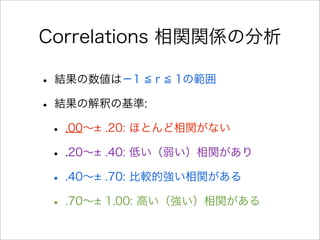
• 結果の数値は−1 r 1の範囲
• 結果の解釈の基準:
• .00∼ .20: ほとんど相関がない
• .20∼ .40: 低い(弱い)相関があり
• .40∼ .70: 比較的強い相関がある
• .70∼ 1.00: 高い(強い)相関がある
Correlations 相関関係の分析
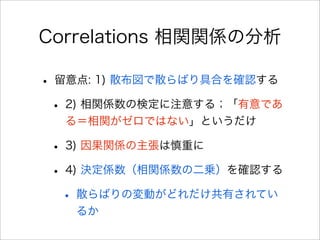
• 留意点: 1) 散布図で散らばり具合を確認する
Correlations 相関関係の分析
図(略)
Correlations 相関関係の分析
• 留意点: 1) 散布図で散らばり具合を確認する
• 2) 相関係数の検定に注意する;「有意であ
る=相関がゼロではない」というだけ
• 3) 因果関係の主張は慎重に
• 4) 決定係数(相関係数の二乗)を確認する
• 散らばりの変動がどれだけ共有されてい
るか
Correlations 相関関係の分析
• 相関分析 correlation analysis
• a) 間隔尺度・比率尺度: ピアソン(積率)
相関
• 外れ値の影響を受けやすい
• b) 順序尺度、点数分布の正規性が保証され
ていない場合: スピアマン(順位)相関
• 外れ値の影響を受けない
Correlations 相関関係の分析
図(略)
Correlations 相関関係の分析
• 手順: a) Excel「データ」→「データ分析」→
• 「相関」or「数式」→「関数の挿入」
→「PEARSON」→「配列1」「配列2」
を指定(ラベルの行は含めない)
• b)「RANK.EQ」を用いて数値を順位に変換
→「数値」(数値セル)、「参照」(範囲)、
「順序」(降順or昇順)→「関数の挿入」
→「CORREL」→「配列1」「配列2」
Correlations 相関関係の分析
•報告: r = r値, p = p値(nまたはdf)
•rが分かればR2=決定係数は載せなく
ても良い
•自由度(自由に値をとることができる
数)はn­2で求める。
Correlations 相関関係の分析
•報告: r = r値, p = p値(nまたはdf)
• A Pearson correlation coefficient of r =.
06, p = .66 (n = 50) was found between
scores on the memory test and a timed
vocabulary recall test that students took.
This means that scores on the memory
test explained R2 = 4% of the variance in
the vocabulary test, a very small effect
size.
Correlations 相関関係の分析
•報告: r = r値, p = p値(nまたはdf)
• 「TOEICのスコアと語彙サイズテストの得点
の相関を求めたところ、r =.64(p < .05, df
= 18)で比較的強い相関があることがわかっ
た」。
研究事例検討
• Jalilifar (2009). System 38(1): 96-108.
•Research question
•Participants
•Method
•Results
•Conclusion
研究事例検討
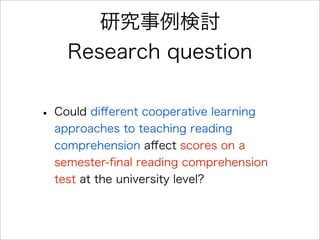
Research question
• Could different cooperative learning
approaches to teaching reading
comprehension affect scores on a
semester-final reading comprehension
test at the university level?
研究事例検討
Participants
• 90 female Iranian leaners of English who
attended 16 sessions of 45 minutes each
during a college semester.
研究事例検討
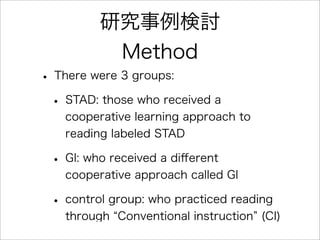
Method
• There were 3 groups:
• STAD: those who received a
cooperative learning approach to
reading labeled STAD
• GI: who received a different
cooperative approach called GI
• control group: who practiced reading
through Conventional instruction (CI)
研究事例検討
Results
• Mean scores and standard deviations on a
semester-final comprehension test ... the STAD
group (M=12.3, SD=3.3) ... the control group
(M=10.23, SD=2.76). A one-way ANOVA was
performed, F (2, 87) = 3.46, p = .036,
indicating that not all of the groups performed
the same way .... Post-hoc tests found a
statistical difference between the STAD and
control groups only. (... Cohen s d effect
sizes ... STAD vs. control, d = .68, effect size is
medium)
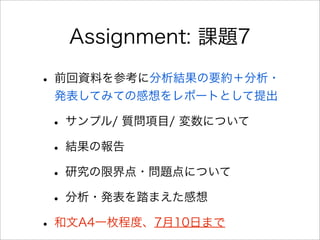
Assignment: 課題7
• 前回資料を参考に分析結果の要約+分析・
発表してみての感想をレポートとして提出
• サンプル/ 質問項目/ 変数について
• 結果の報告
• 研究の限界点・問題点について
• 分析・発表を踏まえた感想
• 和文A4一枚程度、7月10日まで

Rm20130703 11key